
Chihuahua Dog Years to Human Years Calculator 2026 Updated Chart
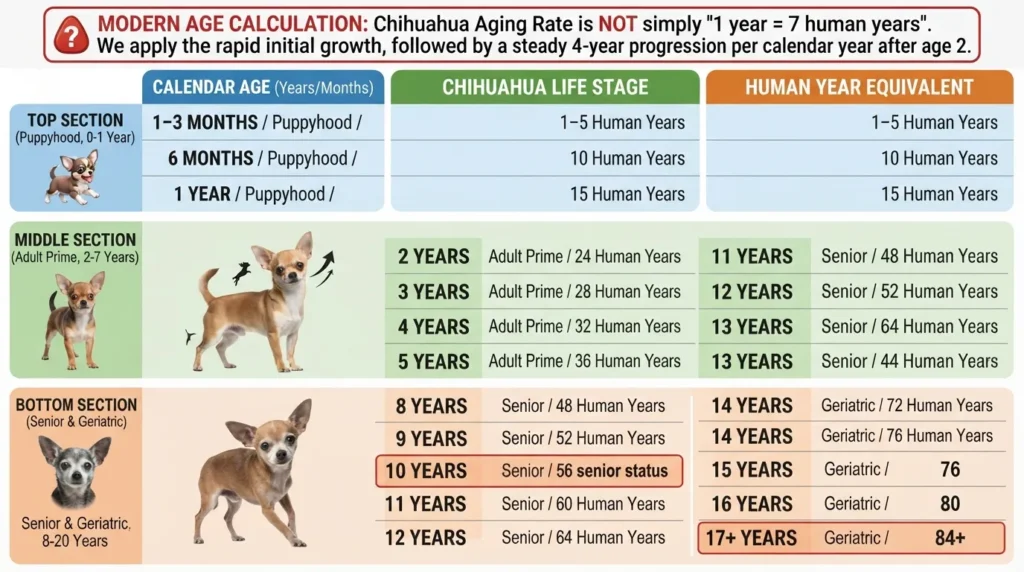
If you’ve ever tried multiplying your Chihuahua’s age by seven, you’ve been using a rule of thumb that veterinary science retired years ago.
The old “1 year equals 7 human years” myth treats a 100-pound Mastiff the exact same as a 5-pound Chihuahua. In reality, canine size dictates biological aging. While Chihuahuas mature rapidly during their first two years of life, their biological clock slows down significantly in adulthood compared to larger breeds.
According to guidelines established by the American Veterinary Medical Association (AVMA) and the American Animal Hospital Association (AAHA), small dogs under 20 pounds experience a unique aging curve.
Our chihuahua dog years to human years calculator uses these updated 2026 veterinary benchmarks to convert your dog’s calendar age into true human equivalent years instantly—reflecting the exact science behind your toy breed’s life stage.dog age calculator tool
Chihuahua Age Calculator
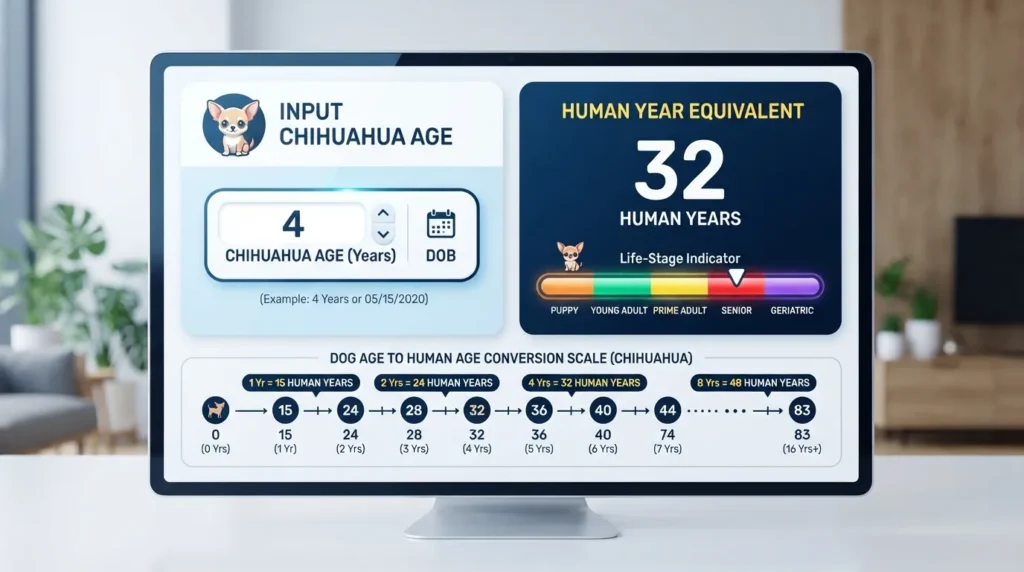
Calculate your Chihuahua’s exact age in human years using our quick tool below. Whether you want to convert your dog’s calendar age or figure out how old a human equivalent age is in dog years, this tool handles both instantly using updated veterinary aging guidelines.
Interactive tool embed (input: birth date OR current age)
Note: This calculator works both ways—convert dog age to human years, or enter a human age to see what that looks like in Chihuahua years.
For informational purposes only—consult your vet for medical concerns.
Chihuahua Dog Years to Human Years
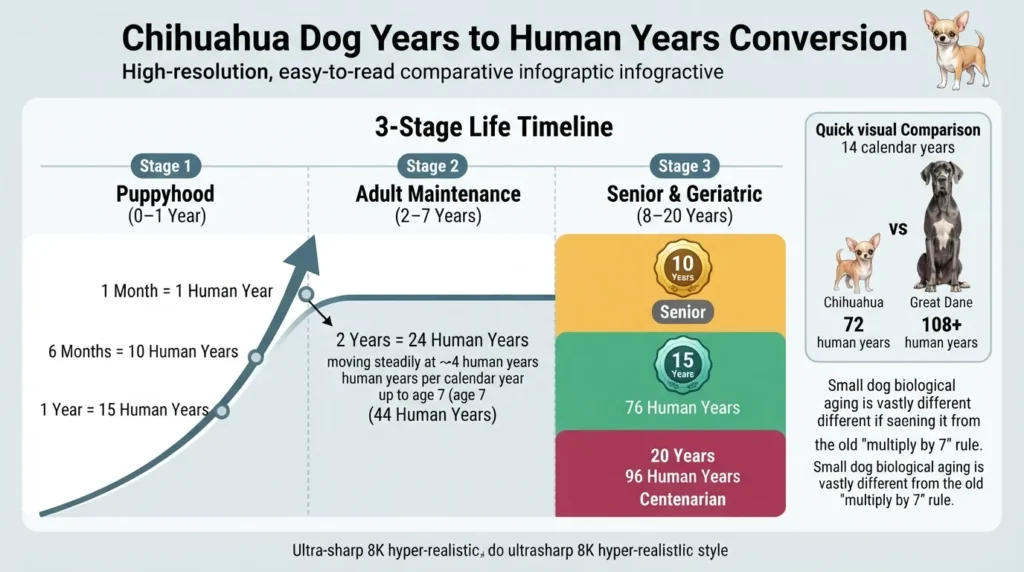
Puppy Age Breakdown (0–1 Year)
1 to 3 Months: Rapid early growth, equivalent to a 1 to 5-year-old human child.
6 Months: Enters pre-adolescence, roughly equal to a 10-year-old human.
1 Year: Reaches young adult status, biological equivalent of a 15-year-old teenager.
Adult Age Breakdown (1–7 Years)
2 Years: Fully grown young adult, equivalent to 24 human years.
3 to 5 Years: Stable prime adulthood, spanning 28 to 36 human years.
6 to 7 Years: Enters mature adulthood, reaching approximately 40 to 44 human years.
Senior Age Breakdown (7–20 Years)
8 to 10 Years: Transitions into early senior status (48 to 56 human years).
11 to 13 Years: Late senior stage, equivalent to 60 to 68 human years.
14 to 17 Years: Geriatric stage—reaching 17 dog years in human years makes your Chihuahua roughly 84 human years old.
18 to 20 Years: Exceptional longevity stage, equivalent to an 88 to 96-year-old human centenarian.
Note: You can download or print our full quick-reference guide to keep track of your Chihuahua’s milestones and share updates with your veterinarian.
Why the "1 Dog Year = 7 Human Years" Rule Is Wrong for Chihuahuas
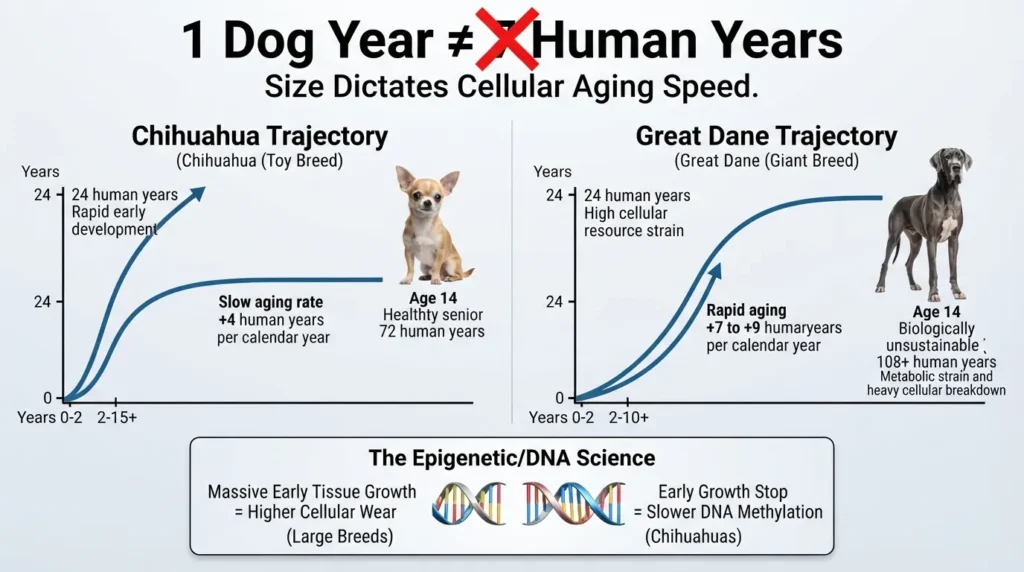
The popular belief that one calendar year equals seven human years originated decades ago as a rough statistical average. It was never intended as an accurate biological formula.
Applying a single multiplier to every canine ignores the dramatic impact that physical size has on aging rates. If you rely on the 7-year rule, a 17-year-old dog would be calculated as 119 human years old. For a giant breed like a Great Dane, that estimate is vastly off the mark, but for a Chihuahua, it vastly overstates their biological maturity.
The Real Science — Small Size = Slower Aging
In most of the animal kingdom, larger species outlive smaller ones—whales outlive mice by decades. Canines are one of the few exceptions where within a single species, smaller individuals significantly outlive larger ones.
According to research supported by the American Animal Hospital Association (AAHA), large dogs age at an accelerated rate because their bodies experience extreme cellular growth during early development. A 90-pound dog burns through cellular resources rapidly just to build massive bone and muscle tissue.
Chihuahuas, by contrast, finish their main physical growth within their first year. Because their bodies do not endure the metabolic strain of supporting rapid, large-scale tissue expansion, their cellular breakdown slows down dramatically once they reach adulthood.
Epigenetic/Methylation Research Explained Simply
Modern veterinary science relies on epigenetics—the study of chemical tags attached to DNA—to determine real biological age. A landmark study on canine aging led by researchers at UC San Diego (Wang et al., published in Cell Systems) analyzed these DNA methylation patterns to track cellular aging across different life stages.
The findings completely debunked simple multiplication rules:
Rapid Early Development: All dogs age rapidly during puppyhood while their DNA tags shift quickly to build adult bodies.
The Slower Plateau: Once a Chihuahua hits roughly two calendar years (equivalent to 24 human years), their epigenetic aging curve flattens significantly.
Sustained Longevity: While large breeds continue aging at a rate of 7 to 9 human years per calendar year, a adult Chihuahua ages at a steady rate of approximately 4 human years per calendar year.
Chihuahua vs Labrador vs Great Dane Aging Speed Comparison
To see how size alters biological age over time, consider how these three popular breeds compare at key milestones:
At 2 Calendar Years:
Chihuahua: 24 human years (fully mature young adult)
Labrador Retriever: 24 human years (rapid initial growth complete)
Great Dane: 24 human years (adult size reached, but heavy cellular toll begins)
At 7 Calendar Years:
Chihuahua: 44 human years (entering middle age; vibrant and active)
Labrador Retriever: 50 human years (approaching senior status)
Great Dane: 56 human years (firmly senior; high risk for age-related conditions)
At 14 Calendar Years:
Chihuahua: 72 human years (early geriatric stage; often still mobile)
Labrador Retriever: 88 human years (extreme old age; well past average life expectancy)
Great Dane: 108+ human years (virtually impossible biologically; giant breeds rarely exceed 10–12 years)
Understanding this biological curve explains why calculating 17 dog years in human years for your Chihuahua results in roughly 84 human years—a venerable, geriatric age, but a milestone that toy breeds achieve far more often than larger dogs.
Chihuahua Life Stages
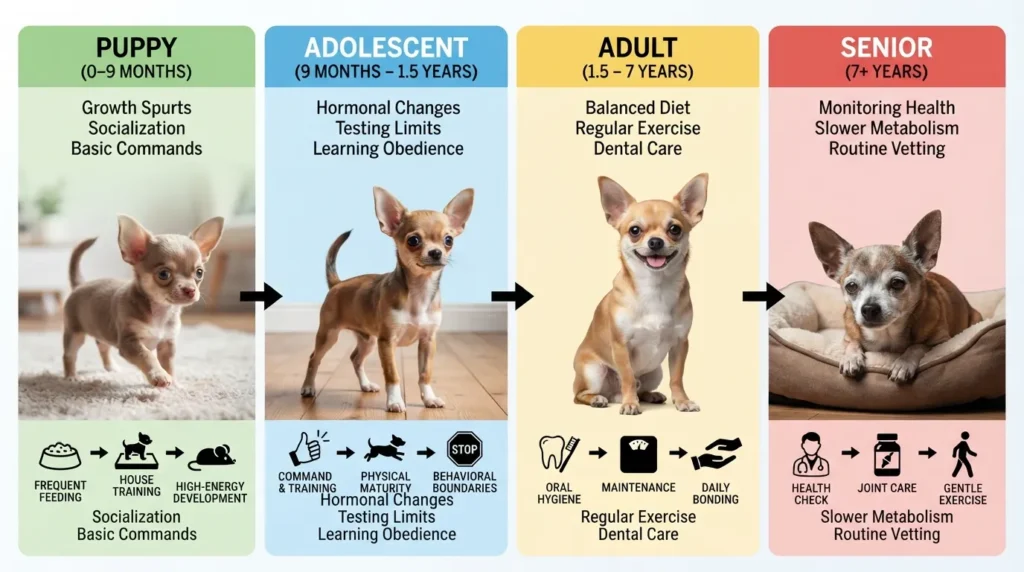
Understanding where your Chihuahua falls on the age scale helps you anticipate their physical needs, behavioral shifts, and daily energy levels. Toy breeds move through these developmental phases at a unique pace, transitioning from high-energy puppies to resilient, long-lived seniors.
Puppy (0–9 months)
During these early months, your Chihuahua experiences rapid developmental bursts. Their brain is a sponge, making this the critical window for house training, leash practice, and building confidence around new sounds and people.
You’ll notice sharp puppy teeth coming in, intense curiosity, and sudden bursts of zoomies followed by hard crashes into long naps. Because toy puppies have tiny stomachs and high metabolic rates, keeping their blood sugar stable with small, frequent meals is essential during this stage.
Adolescent (9 months–1.5 years)
Adolescence is the testing phase. Your Chihuahua has reached most of their adult height, their permanent teeth are in, and they might suddenly pretend they’ve forgotten basic commands you taught them weeks ago.
Hormonal changes occur during this window, often bringing a surge of independence, territorial vocalizations, or slight fear periods. Consistent routines, positive reinforcement, and daily mental stimulation help smooth out these teenage testing behaviors.
Adult (1.5–7 years)
This is your Chihuahua’s prime maintenance era—a long, stable period where their personality is fully formed and their energy levels settle into a predictable routine. They remain active, playful, and deeply attached to their favorite humans.
Behaviorally, adult Chihuahuas thrive on daily bonding, clear boundaries, and moderate exercise. The main focus during these middle years centers on weight management and oral hygiene, as routine dental care prevents early-stage periodontal issues down the road.
Senior (7+ years)
As your Chihuahua moves past their seventh year, subtle changes begin to emerge. You might spot a few white hairs around their muzzle, notice they prefer sleeping in sunny spots over long walks, or catch them taking a little extra time to jump onto the couch.
Behaviorally, seniors often become more affectionate, quiet, and sensitive to temperature changes. They require a gentler pace, softer resting surfaces, routine wellness monitoring, and extra patience as their vision, hearing, or joint mobility naturally begin to shift.
Signs Your Chihuahua Is Aging Senior Symptoms
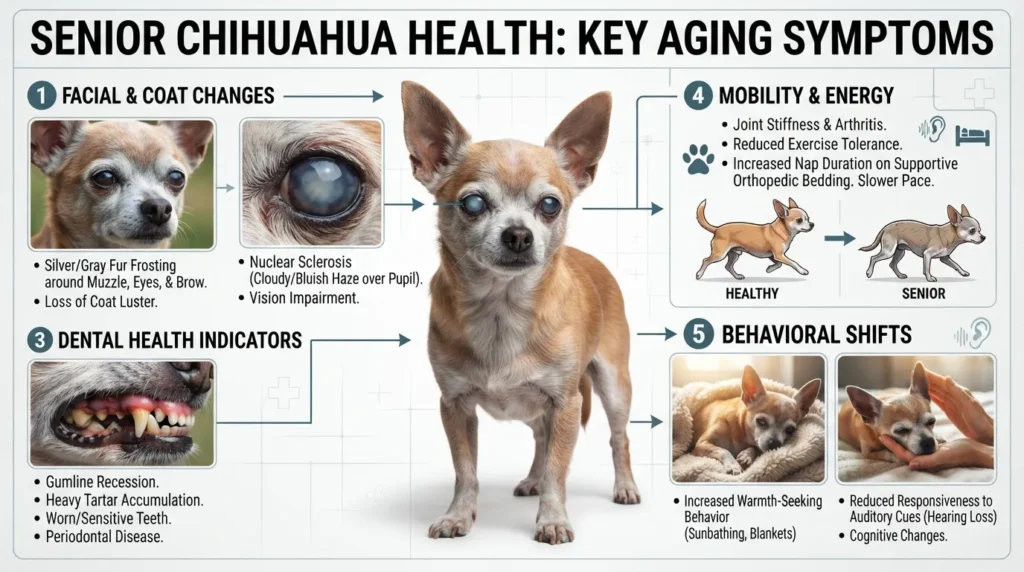
As your Chihuahua approaches their late teens, subtle physical and behavioral shifts start showing up in their daily routine. Recognizing these age-related changes early helps you make easy adjustments to keep your senior companion comfortable and thriving.
Graying Muzzle/Coat
One of the first visible signs of aging in a Chihuahua is the frosting of gray or white fur around their muzzle, eyebrows, and face. According to veterinary dermatologists, this pigment loss in hair follicles usually begins around age 7 or 8 and becomes much more pronounced as they reach their geriatric years.
Reduced Activity Level
Senior Chihuahuas spend significantly more time sleeping and may hesitate before jumping onto the couch or tackling steep stairs. This natural slowing down often stems from mild joint stiffness or loss of muscle mass, which is typical for small dogs in their golden years.
Dental Changes
Due to their tiny jaws and crowded teeth, Chihuahuas are uniquely prone to periodontal disease as they age. You might notice persistent bad breath, visible tartar buildup, reddened gums, or a preference for softer food over hard kibble as dental sensitivity increases.
Vision/Hearing Changes
It’s common to spot a bluish, cloudy haze in a senior Chihuahua’s eyes—a harmless condition called nuclear sclerosis, or sometimes early-stage cataracts. You may also notice your dog startling more easily when approached from behind or sleeping through household noises they used to react to immediately.
How Long Do Chihuahuas Live?
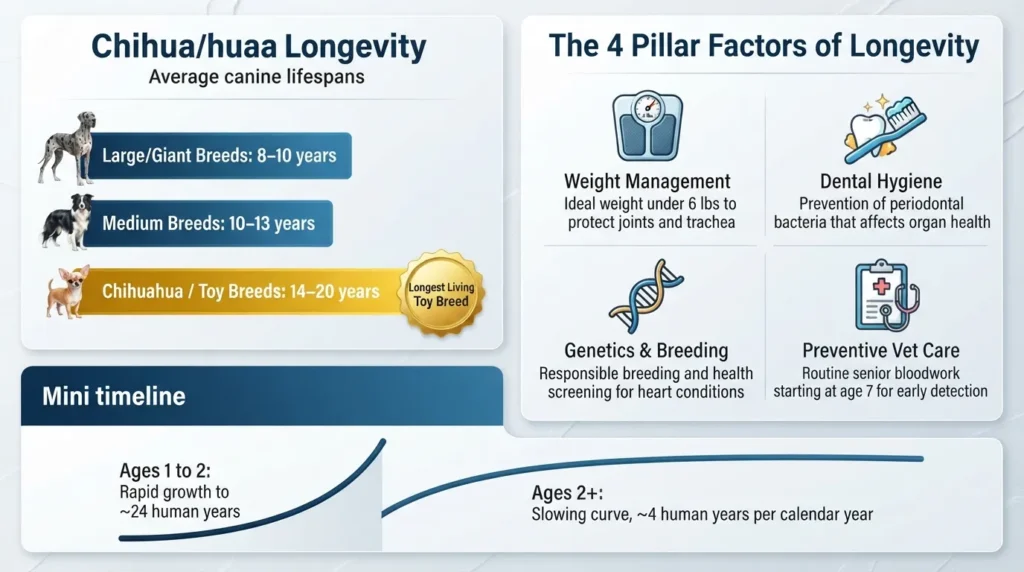
Chihuahuas routinely outlive almost every other dog breed on the planet. While the average canine life expectancy sits around 10 to 12 years, a healthy Chihuahua regularly lives between 14 and 16 years, with many stretching well into their late teens—and occasionally even reaching 20.
Their compact size plays the biggest role in this extraordinary longevity. According to research on canine cell metabolism, small breeds undergo far less physiological stress during their initial growth phase than giant breeds. Because a Chihuahua doesn’t have to scale up from a few ounces to a hundred pounds, their organ systems experience less biological wear and tear over time, allowing them to maintain youthfulness much longer.
In fact, toy breeds like Chihuahuas hold records as some of the longest-living domestic dogs in veterinary history. While they mature quickly during their first two calendar years, their physical aging trajectory slows down dramatically once they hit adulthood, ticking along at roughly 4 human years per calendar year.
However, reaching those upper teenage years isn’t purely down to good luck. Several key factors directly dictate whether a Chihuahua reaches their maximum lifespan potential:
Weight Management: Obese Chihuahuas face severe health compromises. Carrying even two extra pounds puts tremendous pressure on their tiny joints, heart, and delicate tracheal rings, which can prematurely age a small dog.
Dental Care Routine: Periodontal disease is one of the biggest hidden life-shortening threats for toy breeds. Bacteria from infected gums easily enter the bloodstream, causing chronic damage to the heart valves and kidneys over time.
Genetics and Breeding: Dogs bred from lines screened for congenital heart issues (like mitral valve disease) and patellar luxation consistently outlive those with unvetted genetic backgrounds.
Preventive Veterinary Care: Regular bloodwork starting around age seven catches early renal or cardiac changes long before outward symptoms appear, allowing for early therapeutic diet shifts that extend life expectancy.
Teacup Chihuahua vs Standard Chihuahua — Aging Difference
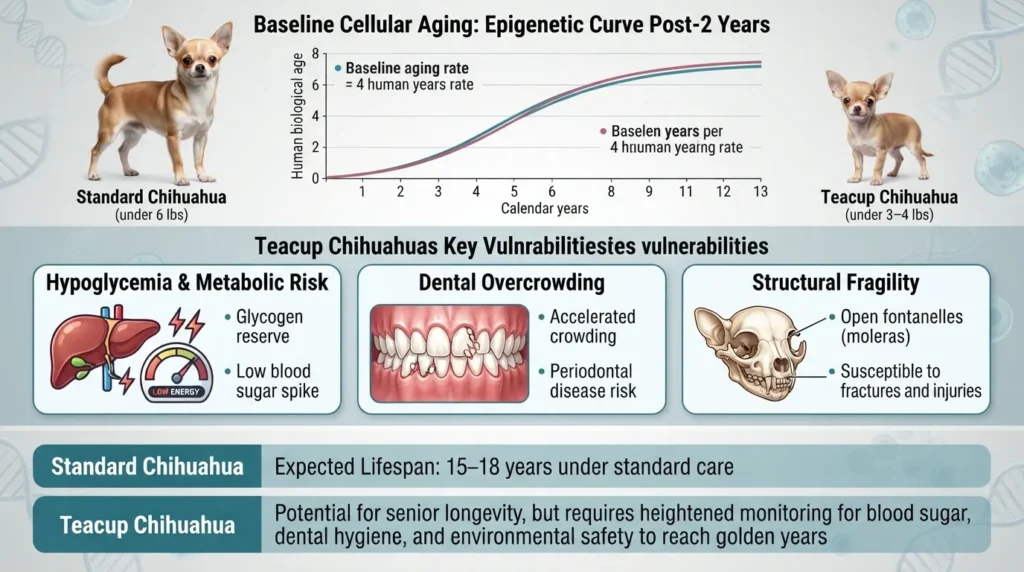
Size plays a direct role in how rapidly a dog ages, but when it comes to standard versus “teacup” Chihuahuas, the biological aging rate stays remarkably similar. Standard Chihuahuas (typically weighing under 6 pounds) and teacups (usually under 3–4 pounds) both fall into the toy breed classification, meaning their cellular aging curve follows the same slow baseline after age two.
However, teacup Chihuahuas often face unique structural and metabolic challenges that can impact their overall life expectancy. While a standard Chihuahua frequently reaches 15 to 18 years, extra-small Chihuahuas require far more vigilant management to reach those same golden years.
Teacup Chihuahua Considerations
Because teacup Chihuahuas are bred to be exceptionally tiny, their fragile frames and minimal bodily reserves affect how they experience aging:
Hypoglycemia & Metabolic Spikes: Their tiny livers store very little glycogen, making them prone to dangerous blood sugar drops—especially during stress or illness.
Dental Crowding: Micro-sized jaws cause severe dental overcrowding, accelerating periodontal disease which can put extra strain on the heart and kidneys as they age.
Structural Vulnerability: Open fontanelles (moleras) and delicate bones mean minor accidents or jumps off furniture pose higher risks for senior teacups.
Mixed-Breed Chihuahua
If your dog is a Chihuahua mix, rely on their total adult weight rather than breed percentage to calculate their true age in human years. Dogs under 20 pounds age at the standard Chihuahua rate, while mixes over 20 pounds age slightly faster after year two.
Frequently Asked Questions
How old is a 5-year-old Chihuahua in human years?
A 5-year-old Chihuahua is approximately 36 human years old. At this stage, your Chihuahua is in the middle of their prime adult years—fully developed physically and mentally, with a stable energy level and mature behavior.
How old is a 10-year-old Chihuahua in human years?
A 10-year-old Chihuahua is equivalent to roughly 56 human years old. According to American Animal Hospital Association (AAHA) guidelines, this officially marks their entry into the senior stage, where subtle lifestyle and dietary adjustments become beneficial.
Do Chihuahuas age slower than other dogs?
Yes, Chihuahuas age significantly slower than medium, large, and giant breeds once they pass adulthood. While all dogs mature rapidly during their first two years, toy breeds like Chihuahuas only age about 4 human years per calendar year after age two, compared to 6–9 human years per calendar year for larger breeds.
At what age is a Chihuahua considered a senior?
A Chihuahua is officially considered a senior at 10 calendar years old (56 human years). Because small breeds have longer life expectancies, their senior transition happens later than large dogs, who are often classed as seniors at age 7.
What is the oldest recorded Chihuahua age?
The oldest verified Chihuahua on record was a rescue named TobyKeith, who reached an astounding 21 years and 66 days old (equivalent to over 100 human years). Many well-cared-for Chihuahuas routinely reach 16 to 20 years of age.
Is a 15-year-old Chihuahua old?
Yes, a 15-year-old Chihuahua is considered geriatric, which is biologically equivalent to a 76-year-old human. While advanced in age, many 15-year-old Chihuahuas remain happy, active, and affectionate with the right senior care, comfortable bedding, and regular dental checkups.
🐾 Other Age Guides

I built Dogagescalculator.com to give dog owners honest, science-backed answers instead of the outdated "×7" myth. Every figure here is checked against AKC, AVMA, and published veterinary research.
More about the author & this site →
Comments