
How Old Are the Puppies? Complete Puppy Age Guide Stages, Human Years & How to Tell
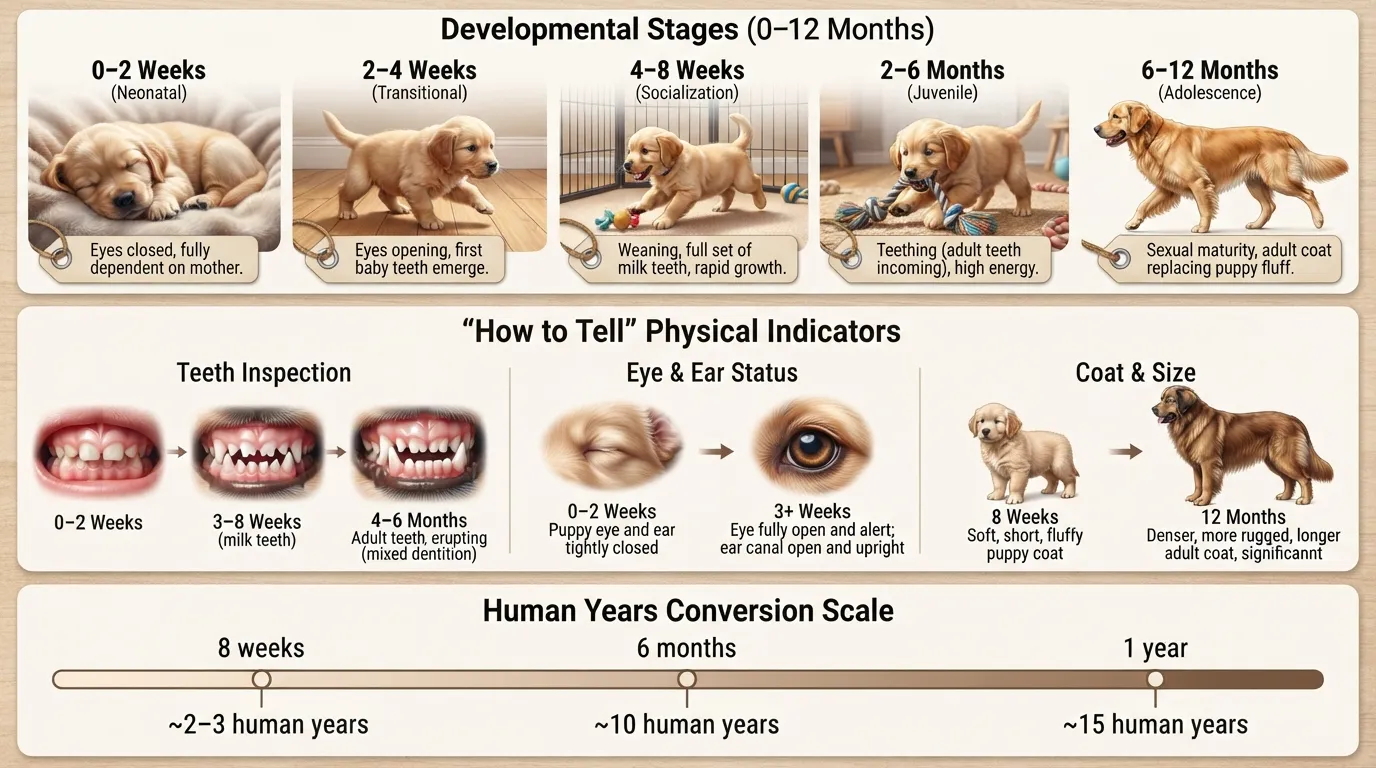
Determining a puppy’s age depends heavily on their size and rate of growth. Dogs are considered puppies from birth until they reach full physical maturity, which typically occurs between 12 and 24 months. Small breeds transition to adulthood around 10 to 12 months, whereas large and giant breeds continue developing until 18 to 24 months.
Quick Puppy Age Cheat Sheet
| Stage | Age Range | Key Sign |
|---|---|---|
| Neonatal | 0–2 weeks | Eyes and ears closed; relies entirely on nursing and maternal warmth |
| Transitional | 2–4 weeks | Eyes open, milk teeth start emerging, first wobbly steps |
| Socialization | 4–12 weeks | Fully weaned, highly curious, prime window for learning social cues |
| Juvenile & Teething | 3–6 months | Baby teeth drop out, rapid physical growth, high energy levels |
| Adolescence | 6–18+ months | Permanent teeth in place, sexual maturity, testing boundaries |
| Age Range | 0–2 weeks |
|---|---|
| Key Sign | Eyes and ears closed; relies entirely on nursing and maternal warmth |
| Age Range | 2–4 weeks |
|---|---|
| Key Sign | Eyes open, milk teeth start emerging, first wobbly steps |
| Age Range | 4–12 weeks |
|---|---|
| Key Sign | Fully weaned, highly curious, prime window for learning social cues |
| Age Range | 3–6 months |
|---|---|
| Key Sign | Baby teeth drop out, rapid physical growth, high energy levels |
| Age Range | 6–18+ months |
|---|---|
| Key Sign | Permanent teeth in place, sexual maturity, testing boundaries |
What Age Is Considered a "Puppy"?
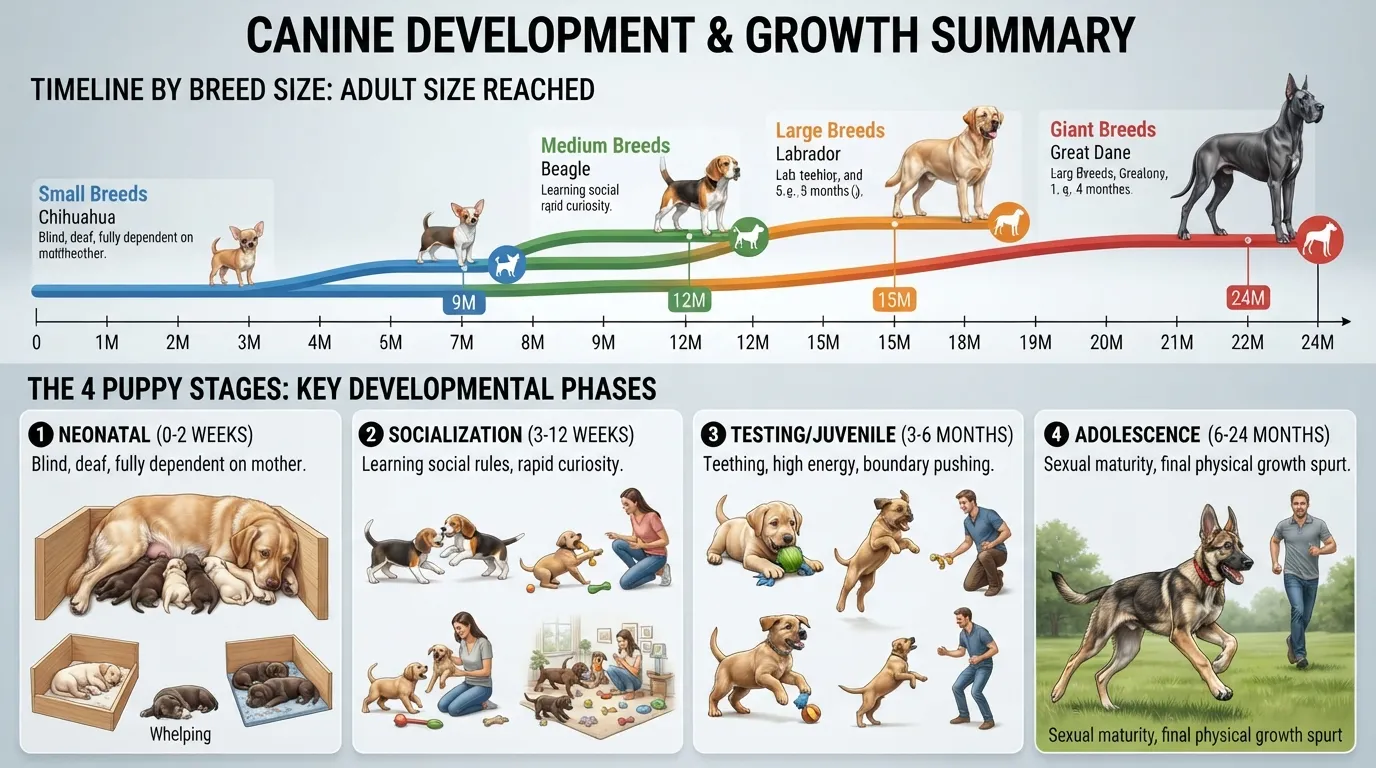
Determining when a dog stops being a puppy isn’t as simple as checking a single date on the calendar. While most owners picture a floppy-eared, high-energy dog under a year old, veterinary medicine defines puppyhood by physical, hormonal, and skeletal maturity rather than birthdate alone.
General Puppy Age Range (0–12 Months)
As a baseline standard, almost every dog is biologically a puppy during their first 12 months of life. During this initial year, a young dog progresses through rapid physical milestones—from helpless newborn to energetic teenager—and relies heavily on specialized nutrition to support bone, muscle, and brain development.
According to the American Veterinary Medical Association (AVMA), feeding a growth-formulated diet during this initial 12-month period ensures young dogs get the elevated protein and precise calcium-to-phosphorus ratios needed for proper structural growth. For most average-sized dogs, reaching their first birthday marks the transition into adult care routines.
Why Large Breeds Stay “Puppies” Longer Than Small Breeds
Although 12 months is the standard benchmark, the exact timeline for when puppyhood ends depends heavily on a dog’s expected adult frame. Smaller dogs have far less skeleton to build, meaning their growth plates—the soft areas of cartilage at the ends of long bones—close much earlier than those of larger dogs. A toy breed completes its entire structural expansion in under a year, whereas a giant breed’s bones continue laying down tissue well past its second birthday.
Small breeds (e.g., Chihuahua, Yorkshire Terrier): Reach full adult size and skeletal maturity by 9 to 12 months. Their fast metabolic rates mean they finish growing quickly and can transition to adult food sooner.
Medium breeds (e.g., Beagle, Cocker Spaniel): Mature right on schedule at approximately 12 months, filling out their adult weight shortly after reaching their full height.
Large breeds (e.g., Labrador Retriever, German Shepherd): Reach their full height around a year but take 15 to 18 months for their skeletal frame and muscular build to solidify completely.
Giant breeds (e.g., Great Dane, Mastiff): Remain structural puppies for 18 to 24 months. Because they can gain upwards of 100 to 140 pounds from birth, their growth plates remain open longer to support slow, safe skeletal development.
Puppy Development Stages by Age Full Timeline
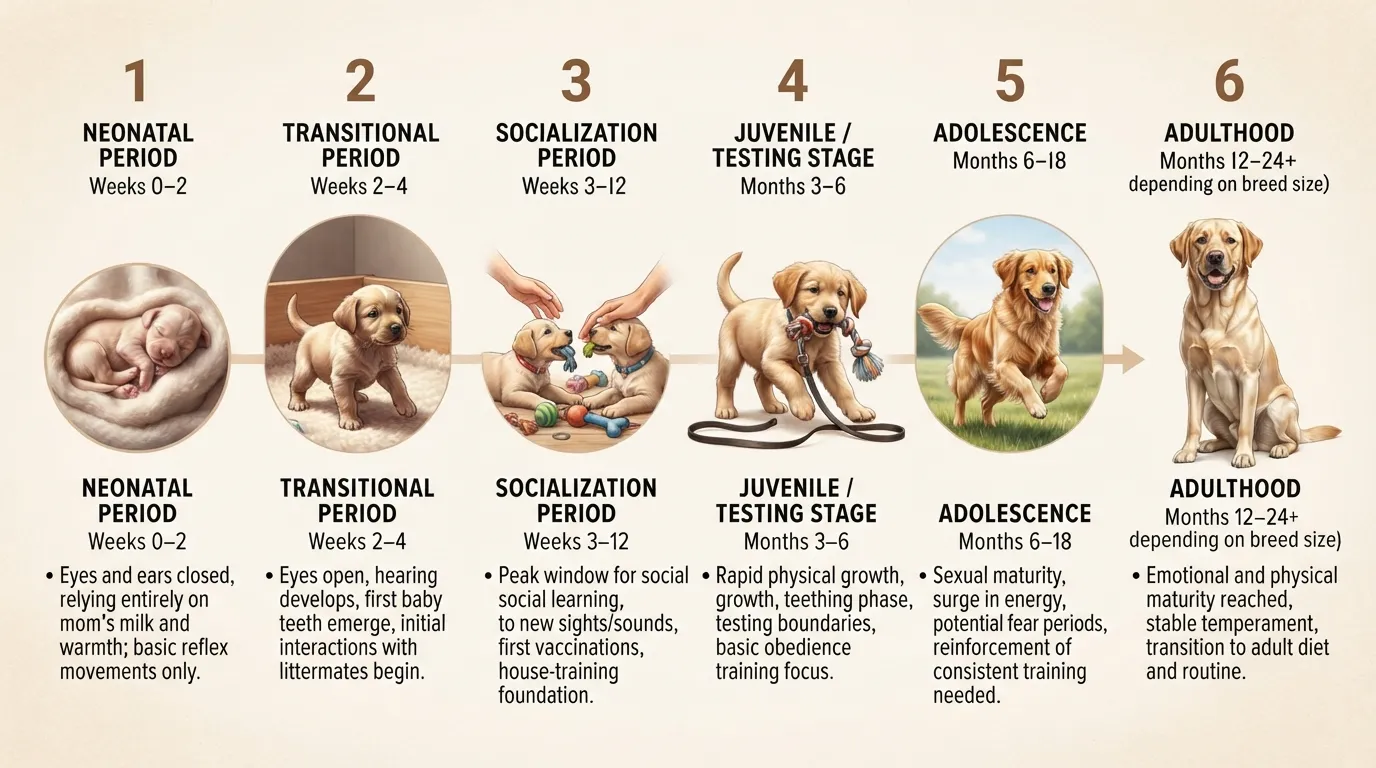
A puppy’s journey from a helpless newborn to a confident companion happens in distinct developmental phases. Each stage brings unique physical milestones, behavioral shifts, and specific care requirements that every owner should know.
Neonatal Stage (0–2 Weeks)
During their first two weeks of life, newborn puppies are almost entirely helpless and rely on their mother for survival. Their eyes and ears remain tightly sealed, meaning they navigate their world purely through scent and touch.
Fully dependent on mom: Puppies cannot regulate their own body temperature or eliminate waste independently, requiring maternal warmth and grooming.
Eyes and ears closed: Visual and auditory canals are closed to allow delicate neural structures to develop safely without environmental stimulation.
Only crawling: Unable to stand or walk, they use a side-to-side crawling motion driven by a strong rooting reflex to find their mother’s milk.
Transitional Stage (2–4 Weeks)
This short phase acts as a bridge between complete sensory darkness and active exploration. The puppy’s brain matures rapidly as physical senses come online almost all at once.
Eyes open: Visual sight begins to function around day 10 to 14, followed shortly by the opening of ear canals around day 18 to 20.
First teeth: Sharp deciduous (baby) incisors begin poking through the gums, signaling that the pup will soon be capable of chewing soft food.
Starts walking and barking: Muscles strengthen enough for wobbly, four-legged steps, and puppies begin experimenting with soft yips, growls, and tail wags.
Socialization Stage (3–12/16 Weeks)
Often called the most critical window in a dog’s life, this stage shapes how a puppy views the world forever. The brain is uniquely flexible, making positive exposure to new environments, people, and other animals vital.
Weaning begins: Mother dogs naturally start pushing puppies away from nursing around 4 to 5 weeks as sharp baby teeth come in, transitioning them to solid food sluries.
First vaccinations: Core vaccine series typically begin between 6 and 8 weeks to protect against dangerous viruses like parvovirus and distemper as maternal antibody protection fades.
Learns bite inhibition: Through play-fighting with littermates, puppies learn how much jaw pressure hurts; a littermate’s sharp yelp teaches them to soften their bite before heading to new homes around 8 weeks.
Juvenile Stage (3–6 Months)
This is the “elementary school” phase of puppyhood. Physical growth skyrockets, and your puppy’s mouth becomes their primary tool for exploring every household object within reach.
Rapid growth: Long bones elongate rapidly, often leading to a lanky, uncoordinated look where paws seem far too big for the body.
Adult teeth emerging: Baby teeth fall out to make way for 42 permanent adult teeth, triggering intense teething urges that require durable rubber chew toys.
First fear phase: Around 8 to 11 weeks (and sometimes again around 4 to 5 months), puppies may suddenly show fear toward familiar objects like vacuum cleaners or trash cans; gentle, low-pressure reassurance helps them pass through safely.
Adolescent Stage (6–12 Months)
Welcome to the teenage phase. Adolescence is marked by a surge in independence, physical stamina, and a tendency to test house rules that seemed well-established just weeks earlier.
Testing boundaries: Brain remodeling can cause temporary “selective deafness” where previously mastered commands like sit or recall are ignored.
Hormonal changes: Sexual maturity arrives; unneutered males may begin lifting their legs or marking territory, while unspayed females may experience their first heat cycle depending on size.
Peak energy: Exercise needs rise dramatically alongside physical strength, requiring structured mental enrichment and consistent daily training to keep high energy redirected productively.
Young Adult / Social Maturity (1–2 Years)
While your dog may look completely grown on the outside, full development involves both skeletal expansion and mental settling.
Physically full-grown: Growth plates close completely—earlier for toy breeds around 12 months, later for giant breeds stretching toward 24 months.
Still mentally maturing: Brain development catches up to the physical body; impulse control improves, play behavior becomes more selective, and temperamental traits fully solidify into adulthood.
How Old Should a Puppy Be Before Leaving Its Mother?
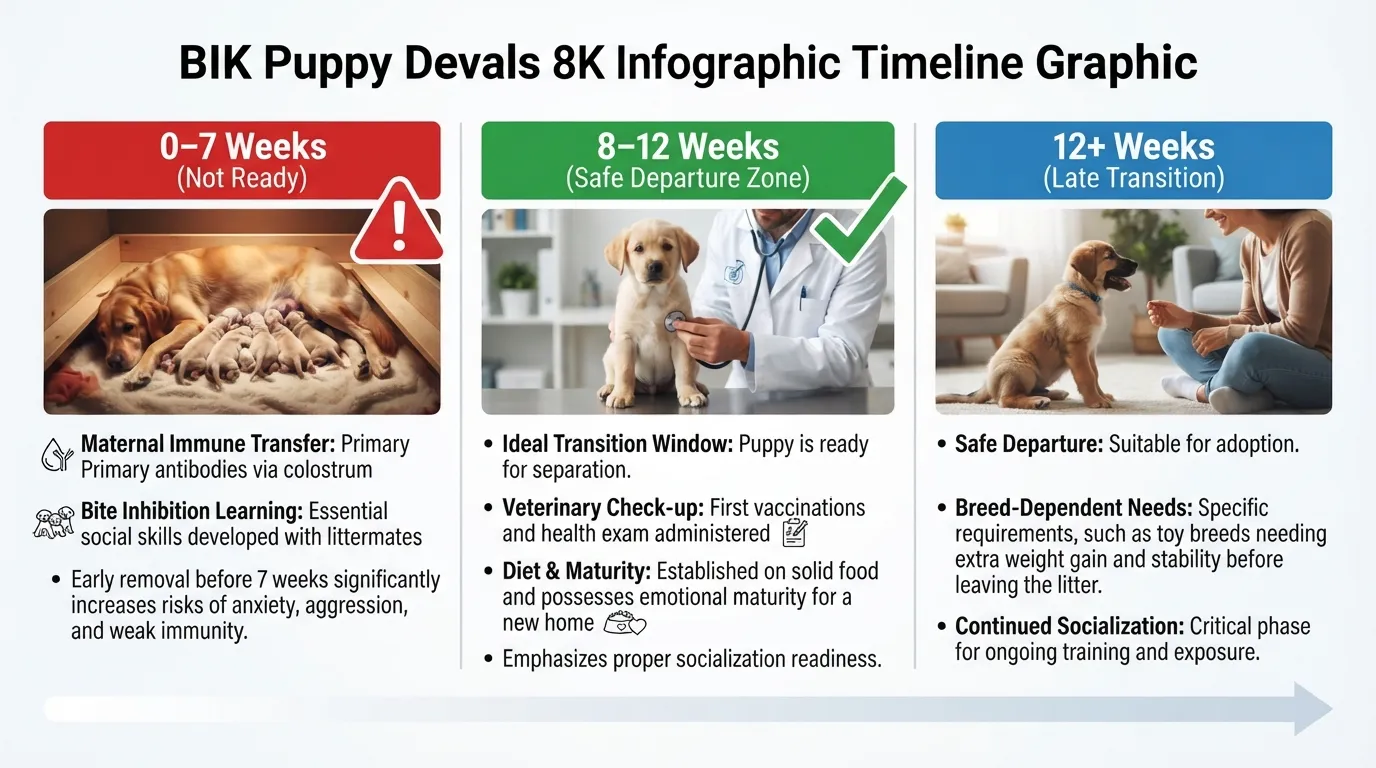
Bringing a new puppy home is an exciting milestone, but timing is everything. Removing a puppy from their mother and littermates too soon can disrupt critical physical and psychological growth phases, leading to long-term health and behavioral challenges.
Why 8 Weeks Is the Minimum (developmental + legal reasons)
Veterinary experts, including the American Veterinary Medical Association (AVMA), strongly recommend that puppies stay with their mother and littermates until they are at least 8 weeks old. The 6-to-8-week window is essential for weaning off maternal milk, developing immune resiliency, and learning foundational “canine etiquette”.
During weeks 6 through 8, mother dogs teach their litters impulse control and boundaries. Littermates also play-fight constantly, learning bite inhibition—the understanding of how much jaw pressure hurts. When a puppy bites a sibling too hard, a sharp yelp and a pause in play teach them to soften their mouth, a lesson far harder for human owners to teach later on.
There are legal standards backing this timeline as well. In the United States, USDA regulations under the Animal Welfare Act prohibit commercial breeders from selling or shipping puppies under 8 weeks of age. Additionally, more than half of U.S. states have explicit laws making it illegal to sell, adopt out, or transfer a puppy before they hit the 8-week mark.
Risks of Taking a Puppy Home Too Early
When a puppy is removed from their litter at 5 or 6 weeks, they miss out on crucial developmental milestones. Research published in veterinary behavior studies shows that early separation significantly increases the risk of behavioral issues in adult dogs.
Common risks associated with premature separation include:
Severe Bite Inhibition Issues: Puppies separated early often mouth or bite human hands forcefully because they never learned jaw control from their siblings.
Heightened Anxiety and Fearfulness: Early separation impairs emotional coping mechanisms, leading to a higher incidence of separation anxiety, noise phobias, and general reactivity.
Cornell University College of Veterinary MedicineDifficulty Communicating with Other Dogs: Dogs raised without that final month of litter dynamics frequently misread canine body language, making them more prone to dog-on-dog aggression or extreme timidity in social settings.
Weakened Immune System: Early weaning causes nutritional stress right as maternal antibodies naturally wane, making young pups more susceptible to gastrointestinal upsets and infectious diseases.
Cornell University
How to Confirm a Puppy's Real Age From a Breeder or Shelter
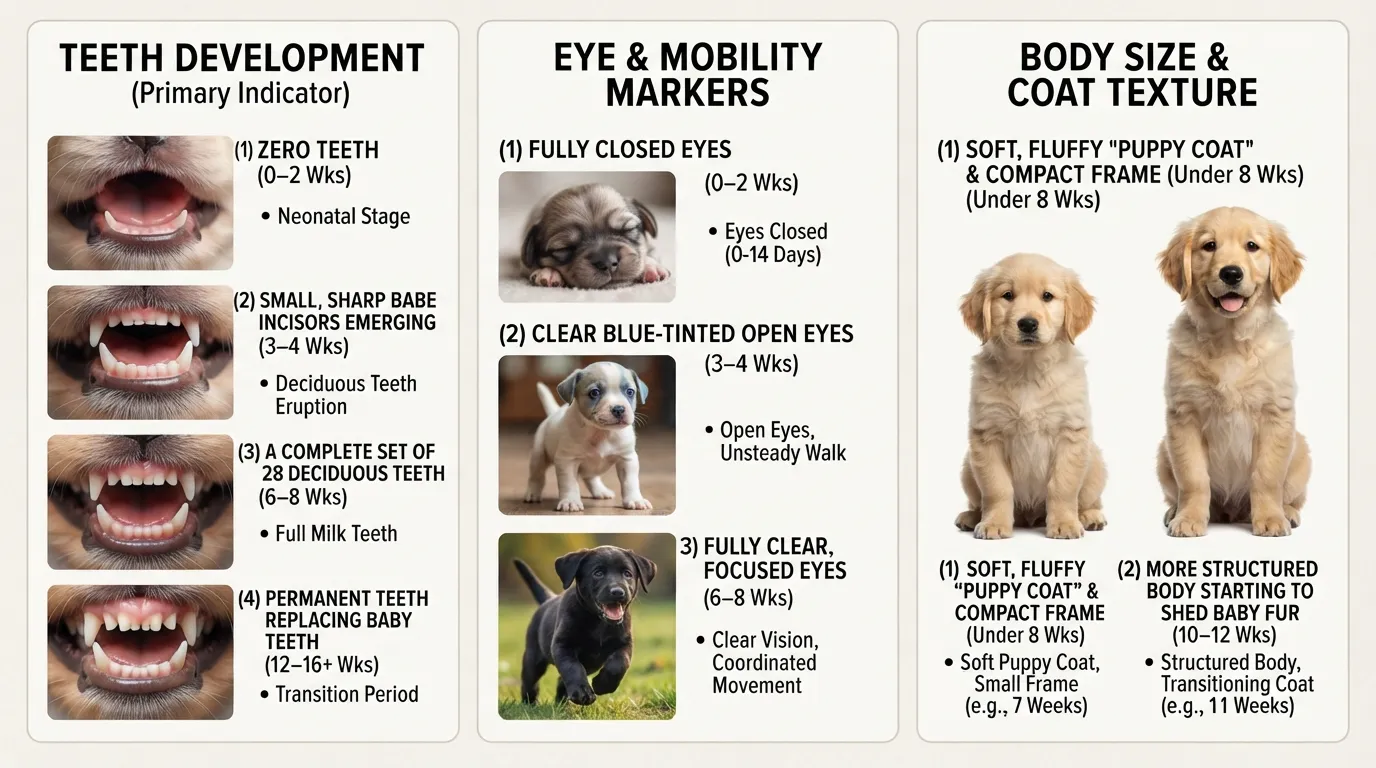
Whether you are adopting from a rescue or purchasing from a breeder, verifying a young dog’s exact birthdate is essential. Knowing how old your puppy is ensures you start vaccinations at the correct biological milestone, feed age-appropriate nutrition, and avoid bringing home an underaged pup.
Questions to Ask the Breeder/Seller
Clear, specific questions help you evaluate whether a seller is being transparent about a litter’s age. Reputable breeders and shelters will welcome these questions and readily share details.
“Can I see the mother nursing or interacting with the litter?” Observing the mother with her pups confirms they are still actively weaning and haven’t been separated prematurely.
“What exact date was the litter whelped?” A responsible source keeps precise records and will immediately give you an exact date, not a vague guess like “about two months ago.”
“Has a veterinarian examined this puppy yet, and at what age?” First vet visits typically occur around 6 to 8 weeks for initial health checks and first vaccinations.
“What food are the puppies currently eating, and when did weaning start?” Weaning usually begins around 3 to 4 weeks of age; if a seller claims 4-week-old puppies are fully weaned onto dry kibble, the age or the care provided may be questionable.
Documents That Prove a Puppy’s Birth Date (vet records, litter registration)
When verbal confirmation isn’t enough—or when adopting a stray with an unknown background—written documentation provides reliable proof of age.
Official Veterinary Health Records: A signed health certificate or vaccination passport from a licensed veterinarian lists the estimated or confirmed birthdate alongside documented weight check-ins and core vaccine dates.
AKC or Kennel Club Litter Registration: For purebred dogs, official registration papers from organizations like the American Kennel Club (AKC) record the official whelping date registered by the breeder.
Shelter Intake & Microchip Documentation: Rescue groups and animal shelters log physical exams conducted by staff veterinarians upon intake, detailing weight, dental development, and estimated age.
Need a fast way to estimate your pup’s milestones? You can easily check where your dog stands in human years using our Puppy & Dog Age Calculator—it factors in exact birthdates and breed size for precise results.
How to Tell How Old a Puppy Is When You Don't Know
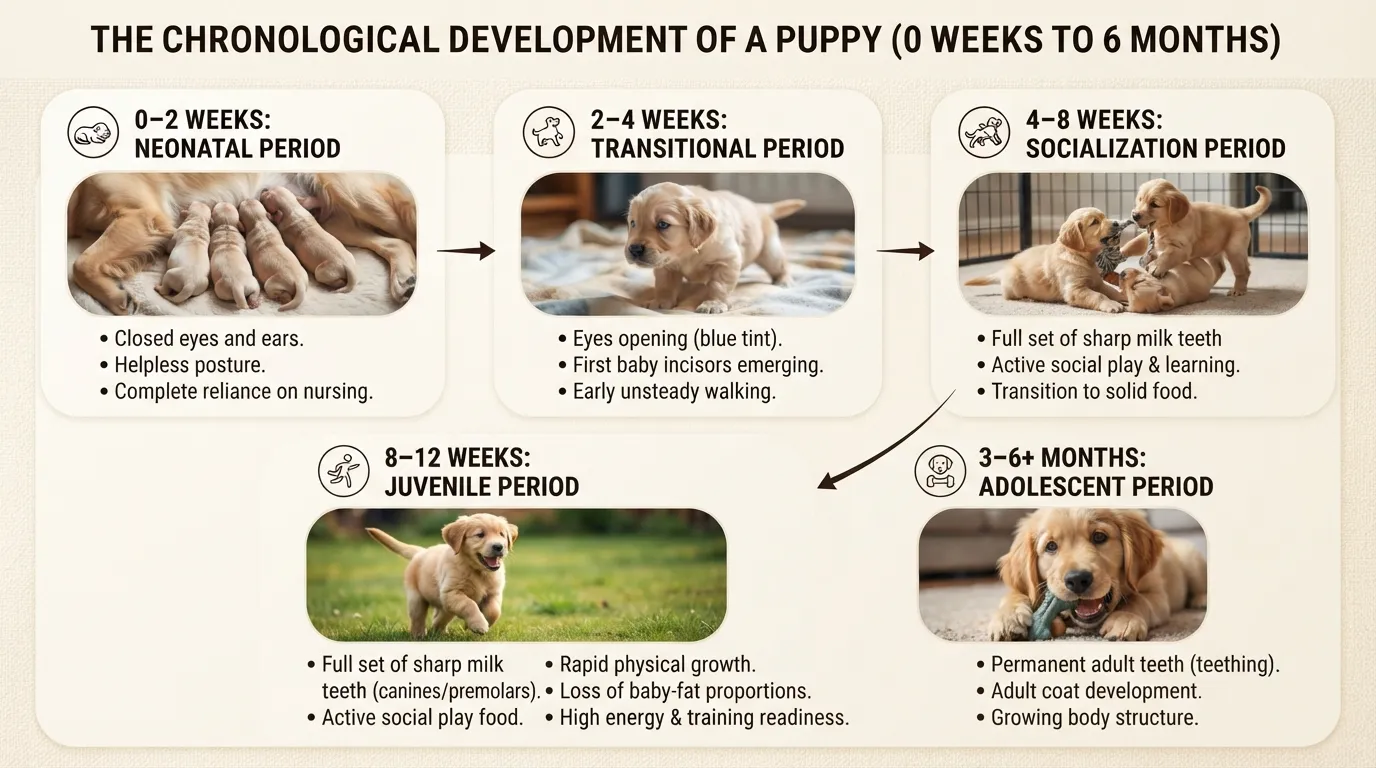
If you have rescued a stray or adopted a puppy with an unknown past, pinpointing their exact age can feel like a guessing game. Fortunately, puppies develop along a predictable physical timeline. By looking at specific biological markers, you can narrow down how old your puppy is with remarkable accuracy.
Check the Teeth (Age-by-Teeth Chart)
Checking a puppy’s mouth is the single most reliable way to estimate their age during the first six months. Canine teeth erupt and shed in a strict sequence.
2–3 Weeks: Baby teeth (deciduous teeth) start piercing through the gums, beginning with the front incisors.
6–8 Weeks: All 28 temporary baby teeth have erupted. They are razor-sharp, bright white, and small.
3–4 Months: Baby incisors begin falling out as permanent adult teeth start pushing through.
6–7 Months: All 42 permanent adult teeth have completely erupted, including adult molars at the back of the mouth.
Puppy Growth & Weight Chart by Week/Month
While weight varies significantly by breed, trackable milestones relative to projected adult size provide a clear window into age. On average, medium-to-large breed puppies double their birth weight in their first week and gain roughly 5% to 10% of their ultimate adult body weight each week during peak growth.
| Age | Estimated Weight Range (Small Breeds) | Estimated Weight Range (Medium Breeds) | Estimated Weight Range (Large Breeds) |
|---|---|---|---|
| 4 Weeks | 0.5 – 1.5 lbs | 2 – 4 lbs | 5 – 8 lbs |
| 8 Weeks | 1.5 – 3.5 lbs | 4 – 8 lbs | 10 – 18 lbs |
| 12 Weeks (3 Mos) | 3 – 6 lbs | 8 – 15 lbs | 20 – 30 lbs |
| 6 Months | 5 – 12 lbs | 15 – 30 lbs | 40 – 60 lbs |
| 12 Months | 8 – 18 lbs (Full size) | 25 – 50 lbs (Full size) | 55 – 80 lbs |
| Small Breeds | 0.5 – 1.5 lbs |
|---|---|
| Medium Breeds | 2 – 4 lbs |
| Large Breeds | 5 – 8 lbs |
| Small Breeds | 1.5 – 3.5 lbs |
|---|---|
| Medium Breeds | 4 – 8 lbs |
| Large Breeds | 10 – 18 lbs |
| Small Breeds | 3 – 6 lbs |
|---|---|
| Medium Breeds | 8 – 15 lbs |
| Large Breeds | 20 – 30 lbs |
| Small Breeds | 5 – 12 lbs |
|---|---|
| Medium Breeds | 15 – 30 lbs |
| Large Breeds | 40 – 60 lbs |
| Small Breeds | 8 – 18 lbs (Full size) |
|---|---|
| Medium Breeds | 25 – 50 lbs (Full size) |
| Large Breeds | 55 – 80 lbs |
Observe Behavior & Coordination Level
Physical movement and motor skills reveal a lot about a young puppy’s internal neurological development:
Under 3 Weeks: Limited to crawling, shivering to generate warmth, and sleeping up to 90% of the day.
3 to 4 Weeks: Wobbling on four legs, exploring within a few feet of their bed, and making soft playful attempts at littermates.
6 to 8 Weeks: Running, pouncing, biting during play, and displaying high environmental curiosity without fear.
3 to 6 Months: High energy, awkward lankiness (“paws too big for the body”), intense chew drive due to teething discomfort, and testing house rules.
When to Ask a Veterinarian for a Confirmed Estimate
While at-home physical checks offer a solid starting point, you should always schedule an intake exam with a veterinarian to confirm your puppy’s age. A vet will evaluate bone structure, eye clarity, dental health, and weight progress.
Getting a professional estimate is vital for setting up a safe medical schedule. Distemper and parvovirus vaccines must follow a strict 3-to-4-week booster cadence starting around 6 to 8 weeks of age, while core deworming treatments depend entirely on exact body weight and developmental stage.
Puppy Age in Human Years — How Old Is Your Puppy Really?
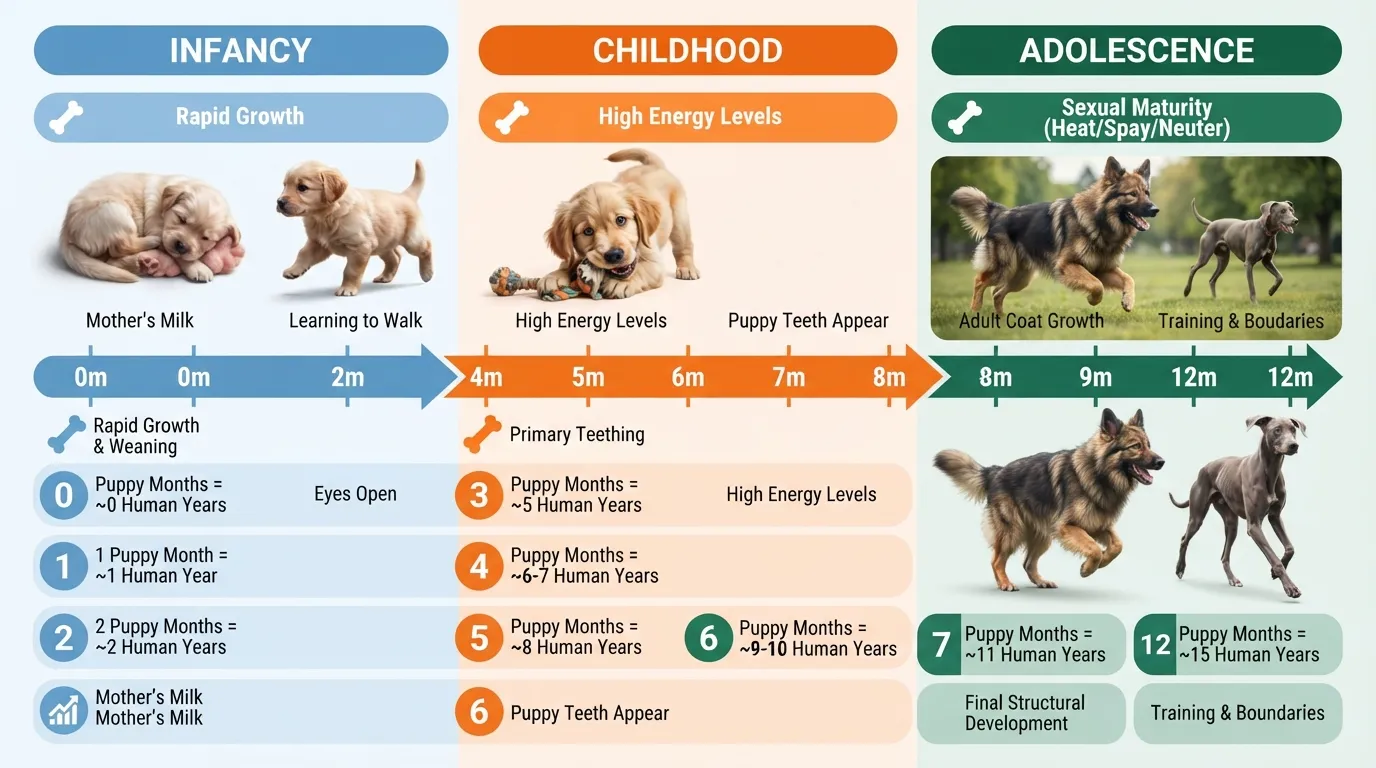
Comparing a young dog’s age to human milestones helps put their rapid physical and behavioral changes into perspective. However, translating puppy months to human years requires looking past simple multiplication. A six-month-old puppy isn’t acting like a toddler—they are navigating the equivalent of human adolescence.
“Puppy Years” vs “Dog Years” vs “Human Years” — Clearing the Confusion
To calculate a dog’s age accurately, it helps to break down the terms commonly used by pet parents and veterinarians:
Puppy Years: The rapid developmental phase covering the first 12 to 24 months of life. Physical growth, brain remodeling, and sexual maturity happen at a concentrated rate during this period.
Dog Years: The actual chronological age of the dog based on their birthdate (e.g., a dog born six months ago is biologically 0.5 dog years old).
Human Years: The equivalent stage of human physiological and behavioral maturity. A 6-month-old pup is equivalent to a 10-to-12-year-old child, while a 1-year-old dog has reached the maturity of a young human adult.
Puppy-to-Human Year Conversion Chart (Month-by-Month)
During their first year, dogs develop roughly 10 to 15 times faster than humans. According to developmental guidelines cited by the American Animal Hospital Association (AAHA), a dog reaches human young-adulthood by their first birthday, with slight variations based on expected adult frame size.
| Puppy Age (Months) | Human Age Equivalent (Small/Medium Breeds) | Human Age Equivalent (Large/Giant Breeds) | Key Life Stage Comparable |
|---|---|---|---|
| 1 Month | 1 Year | 1 Year | Infant / Toddler |
| 2 Months (8 Wks) | 3 Years | 2 Years | Early Childhood (Pre-K) |
| 4 Months | 6–7 Years | 5–6 Years | Grade Schooler |
| 6 Months | 10–12 Years | 8–10 Years | Pre-Teen / Early Puberty |
| 9 Months | 13–14 Years | 11–12 Years | Young Teenager |
| 12 Months (1 Yr) | 15–16 Years | 13–14 Years | Teenager / High School |
| 18 Months | 20–21 Years | 16–17 Years | Young Adult |
| 24 Months (2 Yrs) | 24 Years | 20–22 Years | Full Adult Maturity |
| Small/Medium Breeds | 1 Year |
|---|---|
| Large/Giant Breeds | 1 Year |
| Life Stage | Infant / Toddler |
| Small/Medium Breeds | 3 Years |
|---|---|
| Large/Giant Breeds | 2 Years |
| Life Stage | Early Childhood (Pre-K) |
| Small/Medium Breeds | 6–7 Years |
|---|---|
| Large/Giant Breeds | 5–6 Years |
| Life Stage | Grade Schooler |
| Small/Medium Breeds | 10–12 Years |
|---|---|
| Large/Giant Breeds | 8–10 Years |
| Life Stage | Pre-Teen / Early Puberty |
| Small/Medium Breeds | 13–14 Years |
|---|---|
| Large/Giant Breeds | 11–12 Years |
| Life Stage | Young Teenager |
| Small/Medium Breeds | 15–16 Years |
|---|---|
| Large/Giant Breeds | 13–14 Years |
| Life Stage | Teenager / High School |
| Small/Medium Breeds | 20–21 Years |
|---|---|
| Large/Giant Breeds | 16–17 Years |
| Life Stage | Young Adult |
| Small/Medium Breeds | 24 Years |
|---|---|
| Large/Giant Breeds | 20–22 Years |
| Life Stage | Full Adult Maturity |
Why the Old “1 Year = 7 Human Years” Rule Doesn’t Work for Puppies
The traditional “multiply by seven” rule falls apart completely when applied to puppies. If the 7-to-1 ratio were accurate, a 1-year-old dog would only be 7 years old in human terms. In reality, a 12-month-old dog has already gone through teething, reached sexual maturity, and completed the vast majority of their skeletal growth—milestones no human 7-year-old has experienced.
The rate of aging in dogs is highly non-linear. Growth is extremely front-loaded: dogs accomplish nearly 15 years’ worth of human physical development during their first 12 months. Once a dog reaches adulthood, their aging curve flattens out to roughly 4 to 5 human years per calendar year, depending heavily on breed size.
🐾 Calculate Your Pup’s Exact Age
Not sure exactly how old your puppy is in human years? Factor in your dog’s specific birthdate and breed size for an accurate breakdown with our free Puppy & Dog Age Calculator.
🎥 Watch: Puppy Growth Stages in Action
For a visual breakdown of these physical stages—specifically focusing on dental development and physical markers from birth through 12 months—watch this helpful guide:
- [00:00:08] Newborn to 3 weeks: Identifying toothless neonatals and closed-eye markers
- [00:00:30] 3 to 6 weeks: Canine eruption and the appearance of early incisors/premolars
- [00:01:37] 8 weeks: Evaluating a full set of 28 sharp baby teeth before adoption
- [00:02:07] 16 weeks to 12 months: Transitioning from baby teeth to permanent adult teeth
🎥 Quick Way to Estimate a Puppy's Age
Watch how a veterinary team quickly checks a puppy's teeth to compare a 3-month-old with baby teeth against a 6-month-old with full adult teeth:
- [00:00:03] 3-Month Old Exam: Checking baby incisors and canines on a 3-month pup
- [00:00:24] 6-Month Old Exam: Identifying clean adult teeth on a 6-month dog
People Also Ask
Is a 2-Year-Old Dog Still a Puppy?
For most small and medium breeds, a 2-year-old dog is physically and behaviorally an adult. However, giant breeds like Great Danes, Mastiffs, and Saint Bernards continue growing until 18 to 24 months. While their physical growth slows down, many 2-year-old dogs still exhibit playful, high-energy adolescent behaviors.
Is a 3-Month-Old a Puppy?
Yes, a 3-month-old (12-week-old) dog is definitely a puppy. At three months, puppies are in the middle of their critical socialization and juvenile growth stages. They are typically fully weaned, working through initial vaccine boosters, and beginning the active teething phase as baby teeth start to loosen.
Is a 2-Month-Old Dog a Puppy?
Yes, a 2-month-old (8-week-old) dog is in the prime of puppyhood. This is the exact minimum age at which puppies are legally and developmentally ready to leave their mother and littermates for adoption. At 8 weeks, they are curious, starting basic training, and fully transitioned to solid puppy food.
Is a 3-Year-Old a Puppy?
No, a 3-year-old dog is considered a fully grown adult across all dog breeds. By age three, skeletal growth plates have closed, muscle mass is fully established, and behavioral maturity has set in. Any high energy or playfulness at three years old reflects your dog’s adult personality, not puppyhood.
What Is “I Love You” in Dog Language?
Dogs express affection through soft eye contact, gentle tail wags, leaning their body against you, and resting their head in your lap. When a dog holds a relaxed, unblinking gaze with you, their brain releases oxytocin—the same bonding hormone shared between humans and their babies—showing deep trust and love.
What Age Is the Hardest Puppy Stage?
Most dog owners and trainers consider 6 to 12 months the hardest puppy stage. Known as canine adolescence, this period brings a surge of hormones, adult energy, and testing boundaries. Puppies often experience temporary “selective deafness” toward commands, adult teeth finishing eruption, and increased physical strength requiring consistent daily training.
When Does a Puppy Officially Become an Adult Dog?
Transitioning from puppyhood to adulthood isn’t an overnight event marked by a single birthday. Biologically, a dog officially becomes an adult when three growth milestones converge: skeletal growth plates fuse completely, reproductive capacity reaches full maturity, and adolescent brain remodeling settles into stable adult behavior.
Because skeletal frame size dictates how long growth plates remain open, a dog’s breed and expected adult weight are the primary factors in determining their official transition to adult status.
Full Growth & Adulthood Timeline by Breed Size
While a toy breed finishes expanding their frame before their first birthday, giant breeds can take twice as long to build their dense skeletal structures and muscle mass. Transitioning your dog to adult food formulas should always coincide with the age their skeletal growth plate activity ceases.
| Breed Category | Example Breeds | Adult Weight Range | Height Maturation Age | Full Adult Maturity (Skeletal & Mental) |
|---|---|---|---|---|
| Toy Breeds | Chihuahua, Pomeranian, Yorkshire Terrier | 2 – 10 lbs | 6 to 8 months | 9 to 12 months |
| Small Breeds | French Bulldog, Cavalier King Charles, Dachshund | 10 – 22 lbs | 8 to 10 months | 10 to 12 months |
| Medium Breeds | Beagle, Australian Shepherd, Border Collie | 23 – 50 lbs | 10 to 12 months | 12 to 14 months |
| Large Breeds | Labrador Retriever, Golden Retriever, German Shepherd | 50 – 90 lbs | 12 to 14 months | 15 to 18 months |
| Giant Breeds | Great Dane, Mastiff, Saint Bernard, Irish Wolfhound | 90 to 140+ lbs | 18 to 24 months | 18 to 24 months |
| Example Breeds | Chihuahua, Pomeranian, Yorkshire Terrier |
|---|---|
| Adult Weight | 2 – 10 lbs |
| Height Maturation | 6 to 8 months |
| Full Maturity | 9 to 12 months |
| Example Breeds | French Bulldog, Cavalier King Charles, Dachshund |
|---|---|
| Adult Weight | 10 – 22 lbs |
| Height Maturation | 8 to 10 months |
| Full Maturity | 10 to 12 months |
| Example Breeds | Beagle, Australian Shepherd, Border Collie |
|---|---|
| Adult Weight | 23 – 50 lbs |
| Height Maturation | 10 to 12 months |
| Full Maturity | 12 to 14 months |
| Example Breeds | Labrador Retriever, Golden Retriever, German Shepherd |
|---|---|
| Adult Weight | 50 – 90 lbs |
| Height Maturation | 12 to 14 months |
| Full Maturity | 15 to 18 months |
| Example Breeds | Great Dane, Mastiff, Saint Bernard, Irish Wolfhound |
|---|---|
| Adult Weight | 90 to 140+ lbs |
| Height Maturation | 18 to 24 months |
| Full Maturity | 18 to 24 months |
Final Thoughts — Know Your Puppy's Exact Age
Understanding how old your puppy is does far more than just satisfy your curiosity—it dictates their medical care, vaccination schedules, training expectations, and nutritional needs.
While every dog develops on their own unique schedule, keeping a few key takeaways in mind will help you navigate puppyhood smoothly:
Teeth are your best timeline: Baby teeth erupt between 3 and 8 weeks, while adult teeth replace them between 3 and 7 months.
Breed size sets the adult finish line: Small breeds mature physically around 10 to 12 months, whereas giant breeds remain growing puppies until 18 to 24 months.
Litter time is non-negotiable: Puppies need at least 8 full weeks with their mother and littermates to build biting control, canine communication skills, and emotional stability.
🐾 Other Age Guides

I built Dogagescalculator.com to give dog owners honest, science-backed answers instead of the outdated "×7" myth. Every figure here is checked against AKC, AVMA, and published veterinary research.
More about the author & this site →
Comments