
How Many Types of Mastiff Dogs Are There
How many types of Mastiff dogs are there? While dog registries like the American Kennel Club (AKC) and Fédération Cynologique Internationale (FCI) officially recognize around 14 to 15 distinct Mastiff breeds, there are over 20 unique types of Mastiff-type dogs worldwide when including regional and non-recognized working breeds.
Known for their colossal size, ancient history as war and guard dogs, and gentle loyalty, these gentle giants have captured hearts for thousands of years. Below is a quick breakdown to help you navigate this incredible family of giants.
How Many Mastiff Breeds Are There?

Globally, there are 14 to 18 officially recognized Mastiff breeds registered with major kennel clubs like the American Kennel Club (AKC) and the Fédération Cynologique Internationale (FCI). However, if you include rare, regional, and working Molosser variants, the total number expands to over 20 distinct Mastiff-type breeds worldwide.
This number varies depending on whether a registry classifies a specific breed under the official “Mastiff” or “Molosser” umbrella—for instance, some clubs recognize breeds like the Cane Corso or Great Dane as distinct working dogs, while others group them strictly under Mastiff ancestry.
Mastiff Classifications: True Mastiffs vs Molosser Group vs AKC/FCI
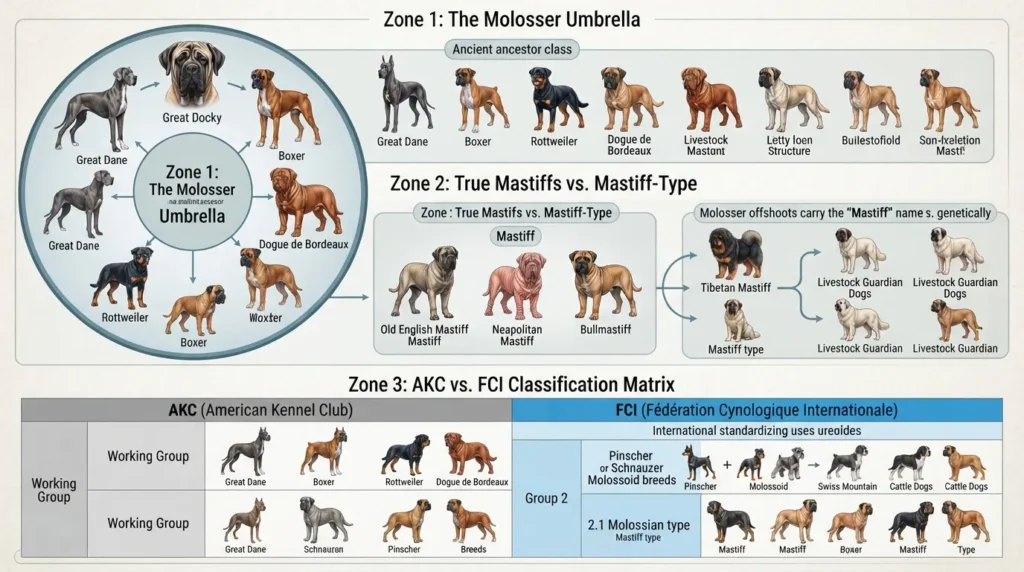
To understand how many Mastiff types exist, it helps to look at how global dog registries classify these massive dogs. While the word “Mastiff” is often used as a catch-all term for any huge, heavy-boned dog, official breed classifications break them down into specific genetic lineages and function-based groups.
What Makes a Dog a “True” Mastiff?
A “True Mastiff” refers to breeds that carry direct lineage from ancient European and Asian heavy-guarding dogs, possessing specific physical and physical trait combinations:
Physical Structure: Massive, broad-skulled heads, heavy bone density, a short-to-medium muzzle with pendulous jowls, and a deep chest.
Function & Drive: Historically bred specifically for personal defense, estate guarding, big-game hunting, or war.
Genetics: Direct descendants of historic Molossian bloodlines that maintained thick, muscular builds without heavy hybridization into lighter working classes.
Classic examples include the English Mastiff, Bullmastiff, Neapolitan Mastiff, and Dogue de Bordeaux.
The Wider Molosser Family
The Molosser group (or Molossoids) is the broader ancestral umbrella named after the ancient Molossi tribe of ancient Greece. All True Mastiffs are Molossers, but not all Molossers are called Mastiffs.
Over centuries, breeders crossed ancient Mastiff-type dogs with lighter, more agile working breeds. This established distinct breeds that share heavy bone structure and broad heads but serve very different purposes:
Boxers & Bulldogs: Developed by crossing Mastiff-type predecessors (Bullenbeissers) with smaller local breeds for holding game or bull-baiting.
Rottweilers: Descended from Roman drover Mastiffs crossed with local herding dogs to drive livestock while guarding cattlemen.
Great Danes: Created by blending heavy Mastiff bloodlines with fast Greyhounds to hunt wild boar, combining massive height with athletic speed.
Livestock Guardians (Great Pyrenees, St. Bernard): Heavy-coated mountain Molossers bred to live alongside sheep and ward off wolves.
AKC vs. FCI Recognition Differences
The primary reason behind different breed counts globally comes down to how major kennel clubs classify dogs.
1. Fédération Cynologique Internationale (FCI)
Method: Uses a morphological (physical building block) system.
Structure: Groups breeds by body type into 10 groups. It places Mastiffs into Group 2, Section 2: Molossoid Breeds.
Impact: FCI formally separates “Mastiff-type” (Dogo types) from “Mountain-type” Molossers, granting international recognition to many regional European and South American guard breeds.
2. American Kennel Club (AKC)
Method: Uses a functional (job-based) system.
Structure: Places Mastiffs into the Working Group alongside non-Mastiff working dogs like Alaskan Malamutes, Siberian Huskies, and Doberman Pinschers.
Impact: The AKC is traditionally stricter and slower to grant full breed recognition, often keeping newer or foreign Mastiff variants in its Foundation Stock Service (FSS) registry before full admission.
Complete List of Mastiff Dog Breeds
Mastiff vs. Great Dane vs. St. Bernard: Key Differences
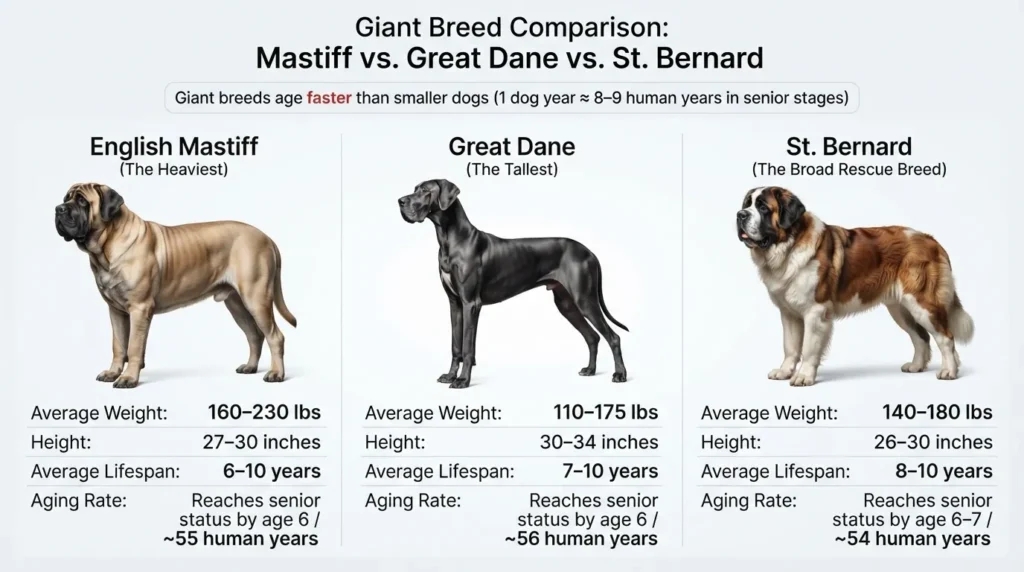
While all three of these giant breeds belong to the broader Molosser family tree, they were selectively bred for entirely different tasks, leading to distinct physical builds and daily temperaments.
1. English Mastiff
Build: Extremely heavy-boned, broad, and compact with a thick, massive skull and deep chest. They are built for sheer weight and physical mass rather than speed or endurance.
Temperament: Calm, low-energy, and quietly watchful. They act as “couch potatoes” indoors and rely on their intimidating size and deep bark to deter threats rather than direct aggression.
Original Purpose: Estate guarding, war, and personal protection—designed to catch and hold intruders using brute weight.
2. Great Dane
Build: Tall, athletic, and lean with long legs, a streamlined body, and a longer, narrower head. They trade raw bulk for agility and galloping speed.
Temperament: Energetic, playful, and affectionately known as “gentle giants.” They tend to have a friendlier, more social disposition toward strangers compared to traditional guard-heavy Mastiffs.
Original Purpose: Big-game hunting (specifically wild boar)—engineered by crossing heavy Mastiff bloodlines with fast Greyhounds for combined power and speed.
3. St. Bernard
Build: Massive, deep-chested, and heavily furred (available in both smooth and rough coats). They possess a broader, blockier head with heavy brow ridges designed to withstand extreme cold.
Temperament: Exceptionally patient, gentle, and steady. Known for their high tolerance and affection toward children, though their thick coats require significantly more grooming than Mastiffs or Danes.
Original Purpose: Mountain search-and-rescue and livestock guarding—bred by Swiss monks to navigate deep alpine snow, track lost travelers, and pull heavy loads.
History & Origin of Mastiff Dogs

The history of the Mastiff spans thousands of years, evolving from ancient frontline war beasts into the gentle, couch-lounging companions we know today.
1. Ancient Antiquity & Lineage (3000 BCE – 500 BCE)
Mesopotamia & Egypt: Early carvings and stone reliefs from Babylon, Assyria, and ancient Egypt depict massive, broad-headed dogs guarding estates and tracking big game.
The Molossus Archetype: The foundational ancestor of all modern Mastiffs—the Molossus—was bred by the ancient Molossi tribe of Epirus (in modern-day Greece). Recognized for their immense bone density and protective instinct, these dogs were prized across the Mediterranean basin.
2. War Dogs & Roman Arenas (500 BCE – 500 CE)
Battlefield Vanguard: Greek, Persian, and Roman armies deployed Molossian dogs in combat. Romans equipped these formidable hounds with armored spiked collars and used them to disrupt enemy cavalry charges.
Colosseum Combatants: When Julius Caesar invaded Britain in 55 BCE, he encountered the Pugnaces Britanniae (the ancient precursor to the English Mastiff). Impressed by their fierce combat skill, the Romans exported them back to Italy to fight gladiators, lions, and bears in public arenas.
3. Medieval Estate Guardians & Working Dogs (Middle Ages – 1800s)
Castles & Livestock: As large-scale warfare shifted away from war dogs, European nobility bred local Mastiff varieties to guard rural estates, castles, and livestock herds against wolves, bears, and human intruders.
Specialized Breeding: Regional needs gave rise to distinct working variants—from the Gamekeeper’s Night Dog (Bullmastiff) in England to livestock protection giants like the Spanish and Pyrenean Mastiffs.
4. Modern Era & Transition to Family Pets (1900s – Present)
Near Extinction: Food rationing during World War I and World War II hit giant breeds particularly hard in Europe, nearly causing the English Mastiff to go extinct. Dedicated breeders eventually rebuilt the population using imported lines from North America.
The Gentle Giant Today: Modern breeding focuses on stabilizing temperament, curbing excessive aggression, and enhancing their natural patience. Today, veterinary guidelines and kennel clubs emphasize early socialization to harness their calm, protective nature safely within family homes.
Temperament & Family Suitability

While their massive scale can be intimidating, Mastiffs are famous for having heart-melting personalities when raised in the right environment.
Core Traits (The Ultimate “Gentle Giant”): Despite their history as estate guardians and war dogs, modern Mastiffs are quiet, low-energy, and deeply affectionate companions. They are renowned for their calm dignity, unflappable patience, and profound loyalty to their human “pack.” Rather than acting aggressively, a Mastiff’s primary method of protection is simply standing between their family and a perceived threat—relying on their sheer size and deep, echoing bark to deter unwanted visitors.
Good with Kids and Other Pets: Yes, Mastiffs can make exceptional family pets, but strict supervision is mandatory. They are notoriously gentle and tolerant around children (often acting as patient nannies), but their massive body weight means an enthusiastic tail wag or accidental bump can easily knock over a toddler. When socialized together from puppyhood, they generally coexist peacefully with cats and other dogs, though male-to-male dominance can sometimes arise in certain guardian breeds like the Cane Corso or Boerboel.
Training & Socialization Requirements: Early, structured training is non-negotiable for a dog that will eventually outweigh many adults. Veterinary behaviorists and professional trainers strongly emphasize starting positive-reinforcement training and broad socialization before 16 weeks of age—exposing them safely to diverse sights, sounds, people, and other animals. Because Mastiffs are surprisingly sensitive and headstrong, heavy-handed or harsh training methods will cause them to shut down; firm, consistent, and reward-based leadership works best.
Caring for a Mastiff Giant-Breed-Specific

Caring for a Mastiff requires a tailored approach. Due to their rapid growth spurts and colossal frame, standard dog care routines won’t cut it—their health depends heavily on giant-breed-specific husbandry.
Diet & Growth Control
Controlled Puppy Growth: Mastiff puppies grow at an astounding rate. To prevent severe skeletal conditions like hip dysplasia or osteochondrosis, they must be fed specialized giant-breed puppy food formulated with a lower calcium-to-phosphorus ratio and controlled calories to prevent them from gaining weight faster than their bones can mature.
Mitigating Bloat Risk: Gastric Dilatation-Volvulus (GDV), or bloat, is a life-threatening emergency for deep-chested giants. Veterinary experts strongly recommend feeding 2–3 smaller meals daily instead of one large portion, using slow-feeder bowls, and strictly restricting vigorous exercise for at least one hour before and after meals.
Exercise Needs
Low-Impact Movement: Despite their massive build, Mastiffs are low-to-moderate energy dogs. Daily 30-to-45-minute casual walks alongside controlled backyard playtime are usually sufficient to maintain healthy muscle tone and prevent obesity.
Severe Heat Sensitivity: Because of their thick muscular mass—and in short-muzzled breeds like the Bullmastiff or Dogue de Bordeaux, reduced respiratory efficiency—Mastiffs overheat rapidly. Keep outdoor activity limited to early mornings or cool evenings during summer, ensuring constant access to shade, air conditioning, and fresh water.
Health Issues & Lifespan
Shorter Life Expectancy: On average, giant Mastiff breeds live between 6 to 11 years, depending on the specific breed and overall genetic health.
Common Health Concerns: Key risks include orthopedic issues (hip and elbow dysplasia, cruciate ligament tears), heart conditions (Dilated Cardiomyopathy or DCM), bloat, and certain cancers like osteosarcoma. Routine health screenings and maintaining a lean body weight are vital to extending their quality of life.
Grooming & Hygiene
Coat & Shedding Care: Most Mastiffs possess short, dense coats that require low-maintenance weekly brushing with a rubber curry comb to remove loose fur and reduce seasonal shedding.
Facial Wrinkle & Drool Management: Breeds with heavy facial folds (such as Neapolitan Mastiffs, English Mastiffs, and Dogues de Bordeaux) require daily wrinkle care. Moisture and debris trapped in skin folds must be gently wiped clean and thoroughly dried to prevent bacterial and yeast skin infections. Keep a towel handy—drooling after eating, drinking, or heat exposure comes with the territory!
Cost of Owning a Mastiff Dog
Buying and raising a giant breed comes with a significant financial commitment. Across most recognized breeds, a purebred Mastiff puppy from a reputable breeder typically costs between $1,200 and $3,500, depending on bloodlines, health clearances, and regional availability. However, the initial purchase price is only a fraction of the total investment—ongoing costs like giant-breed food, high-dose medications, and extra-large gear add up quickly over their lifetime.
| Category | Breed | Estimated Puppy Price | Key Price Factors |
|---|---|---|---|
| Most Budget-Friendly | Bullmastiff | $1,000 – $2,000 | High availability, established domestic breeding programs, and widespread recognition reduce import fees. |
| Mid-Range / Standard | English Mastiff / Cane Corso | $1,500 – $3,500 | Steady demand and rigorous health testing (hip/heart clearances) set standard purebred pricing. |
| Most Expensive | Tibetan Mastiff | $2,500 – $10,000+ | Extreme rarity, ancient Himalayan bloodlines, and status-symbol demand (rare prize show lines have sold for millions overseas). |
| Breed | Bullmastiff |
| Est. Price | $1,000 – $2,000 |
| Price Factors | High availability, established domestic breeding programs, and widespread recognition reduce import fees. |
| Breed | English Mastiff / Cane Corso |
| Est. Price | $1,500 – $3,500 |
| Price Factors | Steady demand and rigorous health testing (hip/heart clearances) set standard purebred pricing. |
| Breed | Tibetan Mastiff |
| Est. Price | $2,500 – $10,000+ |
| Price Factors | Extreme rarity, ancient Himalayan bloodlines, and status-symbol demand (rare prize show lines have sold for millions overseas). |
Frequently Asked Questions
How many types of Mastiff dogs are there?
There are roughly 14 to 18 officially recognized Mastiff breeds across major kennel clubs like the AKC and FCI. However, when including regional, working, and rare Molosser variations worldwide, the total count expands to over 20 distinct Mastiff-type breeds.
What are the 7 types of dogs?
The “7 types of dogs” refers to the 7 functional breed groups defined by the American Kennel Club (AKC), which categorizes dogs based on their historical jobs rather than physical traits. These 7 groups are:
Working Group (where Mastiffs belong)
Herding Group
Hound Group
Sporting Group
Non-Sporting Group
Toy Group
Terrier Group
This classification system organizes all recognized domestic dogs and is separate from specific breed families like Mastiffs.
What dog costs $1 million?
A Tibetan Mastiff holds the title for the most expensive dog ever sold. In China, a rare red Tibetan Mastiff puppy named “Big Splash” (Hong Dong) was purchased for $1.5 million in 2011, and another red Mastiff reportedly sold for nearly $1.9 million in 2014. In Chinese high society, these ancient Himalayan guardians became ultimate status symbols representing wealth and power.
Which is the best Mastiff dog?
The “best” Mastiff depends entirely on your lifestyle, living space, and dog-handling experience:
Best for Families & First-Time Giant Owners: English Mastiff or Bullmastiff (calm, highly affectionate, and low energy).
Best for Active/Experienced Owners: Cane Corso (athletic, highly trainable, and intense drive).
Best for Large Acreage/Livestock Protection: Spanish Mastiff or Pyrenean Mastiff (independent, calm mountain guardians).
What is the No. 1 strongest dog?
In terms of bite force, the Kangal Shepherd Dog (a Turkish Mastiff-type livestock guardian) holds the record with an incredible bite strength of 743 PSI (pounds per square inch)—stronger than a lion’s average bite (~650 PSI). In terms of sheer physical pulling power and mass, the English Mastiff ranks number one, holding historical records for moving weights over 5,000 lbs.
What is the most expensive Mastiff breed?
The Tibetan Mastiff is consistently the most expensive Mastiff breed in the world. While standard purebred puppies from reputable Western breeders cost between $2,500 and $6,000, rare bloodlines exported directly from China or Tibet can reach tens or hundreds of thousands of dollars.
Are any Mastiff breeds banned or restricted?
Yes. Due to their immense size, protective instincts, and historical use as catch/guard dogs, certain Mastiff-derived breeds face Breed-Specific Legislation (BSL) or restrictions in several countries and cities:
Tosa Inu (Japanese Mastiff): Strictly banned or heavily restricted in over 18 countries, including the UK, Australia, Denmark, and Singapore.
Presa Canario & Fila Brasileiro: Banned from import or ownership in countries like the UK, New Zealand, and Australia.
Cane Corso & Boerboel: Restricted by certain municipalities, housing authorities, and airline transport policies globally.
Comments