
What Age Does a Dog Have a Period? Complete Heat Cycle & Breeding Age Guide
What Age Does a Dog Have Their First “Period”?
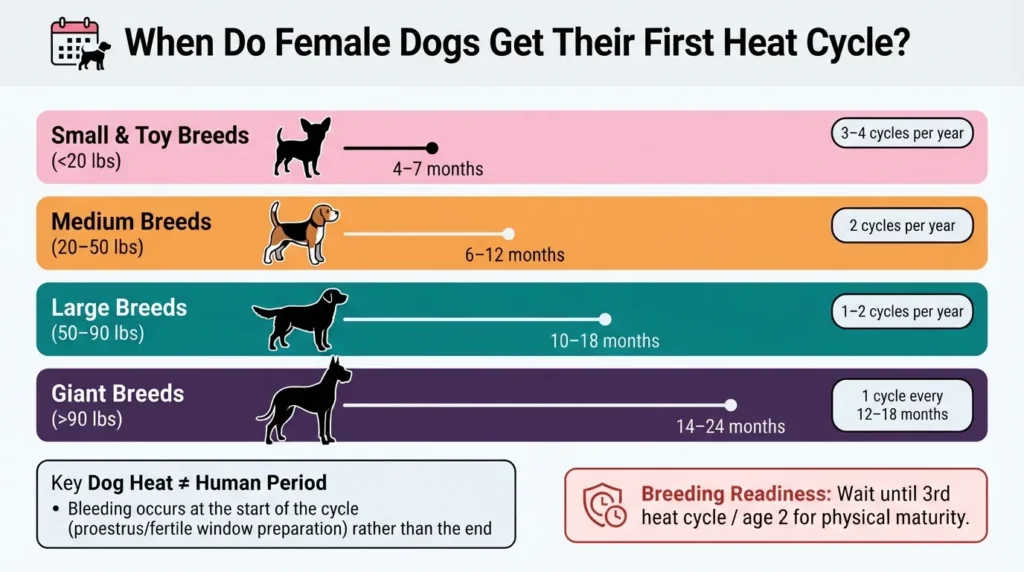
A dog typically gets her first heat cycle—often called a “period”—around 6 months of age. However, this isn’t a fixed rule for every dog. The exact timing depends almost entirely on your dog’s size, breed, and individual rate of physical development.
Small and toy breeds tend to reach sexual maturity much earlier than large ones. A tiny Chihuahua or French Bulldog might experience her first heat cycle as early as 4 to 6 months old. On the flip side, giant breeds like Great Danes, Mastiffs, or Saint Bernards develop much more slowly and may not have their first cycle until they are 18 to 24 months old.
According to American Kennel Club (AKC) guidelines, here is the general timeline you can expect based on your dog’s size:
Small & Toy Breeds (under 20 lbs): 4 to 7 months
Medium Breeds (20 to 50 lbs): 6 to 12 months
Large Breeds (50 to 90 lbs): 10 to 18 months
Giant Breeds (over 90 lbs): 14 to 24 months
Do Dogs Actually Have “Periods” Like Humans?
While dog owners frequently refer to bleeding as a “period,” dogs do not actually menstruate in the human sense. The biological process is completely different.
In humans, menstruation happens at the end of a reproductive cycle when an unfertilized egg is shed along with the uterine lining. In female dogs (bitches), the discharge happens at the beginning of their estrus cycle. This bloody discharge signals that the body is preparing for potential pregnancy, driven by a surge in estrogen levels, rather than shedding unused tissue.
Understanding this difference is important because a dog’s bleeding phase means she is entering her fertile window—not wrapping it up.
| Feature | Human Menstruation | Dog Heat Cycle (Proestrus) |
|---|---|---|
| Timing in Cycle | End of reproductive cycle | Beginning of reproductive cycle |
| Biological Purpose | Shedding unfertilized uterine wall | Pre-mating preparation & estrogen |
| Fertile Window | Mid-cycle (long after bleeding) | During/immediately after bleeding |
| Average Duration | 3 to 7 days | 7 to 10 days (Proestrus phase) |
Signs Your Dog Is Going Into Her First Heat
Recognizing the early signs of a heat cycle allows you to prepare your home and prevent an unplanned pregnancy. You’ll usually notice physical changes first, followed by subtle changes in her mood and behavior.
Physical & Behavioral Symptoms to Watch For
Swollen vulva: This is often the very first sign, appearing a few days before any visible discharge. The swelling can be quite pronounced.
Bloody or pinkish discharge: You may notice small spots of blood on her bedding, carpet, or when she sits on light surfaces.
Excessive licking: She will likely groom her genital area far more frequently than usual to keep herself clean.
Changes in urination habits: She may urinate more frequently or start “marking” outside to leave scent signals for male dogs.
Tail tucking or flagging: Early on, she may tuck her tail to guard herself. Later in the cycle, she may “flag” (hold her tail to the side) to invite attention from male dogs.
Clinginess or restlessness: Hormonal shifts can make some dogs extra affectionate and needy, while others become anxious or easily agitated.
If you suspect your dog is starting her first cycle, keep her strictly on a leash during walks. Intact male dogs can catch the scent of a female in heat from up to several miles away.
The 4 Stages of the Canine Heat Cycle
A complete canine estrus cycle consists of four distinct phases. Understanding where your dog is in this timeline helps you track her health and manage her care effectively.
Proestrus (Days 1 – 9 / The Beginning Phase) This is the stage most owners identify as the “period.” The vulva swells significantly and a bright red, bloody discharge begins. During proestrus, her body attracts male dogs due to strong pheromones, but she will actively reject their advances—often growling or sitting down if a male gets too close.
Estrus (Days 9 – 20 / The Fertile Window) This is the actual “mating phase.” The bloody discharge typically lightens to a pinkish, watery, or straw-colored liquid. The vulva remains soft and swollen. During estrus, she becomes receptive to males, frequently moving her tail to the side (“flagging”). Ovulation occurs during this phase, making this the window where pregnancy can happen.
Diestrus (Days 21 – 60+ / The Post-Heat Phase) Her body transitions out of the fertile state. The discharge stops completely, and vulvar swelling subsides. Regardless of whether she became pregnant or not, her progesterone levels remain elevated for roughly two months. Some unbred females may experience “false pregnancy” (pseudopregnancy) symptoms during this stage, such as nesting or nesting toys.
Anestrus (4 to 5 Months / The Resting Phase) This is the dormant stage of the reproductive cycle where the uterus rests and repairs itself. Hormonal activity is low, and there are no outward physical or behavioral signs. Anestrus lasts until the next proestrus phase begins.
How Often Do Dogs Have Heat Cycles?
On average, a healthy adult dog goes into heat twice a year (roughly every 6 months). However, it is completely normal for a young dog’s schedule to be irregular for the first 12 to 18 months after her first cycle.
Smaller breeds tend to cycle more frequently—sometimes 3 times a year—while giant breeds may only go into heat once every 12 to 18 months.
Unlike humans, dogs do not go through menopause. A female dog will continue to have heat cycles for her entire life unless she is spayed. As dogs age, the time between cycles may lengthen, but they remain capable of becoming pregnant well into their senior years.
Managing Your Dog During Her Heat Cycle
Managing a dog in heat requires a mix of good hygiene practices and strict supervision to keep her safe and comfortable.
Practical Care Tips for Owners
Use Dog Diapers: To keep your furniture and floors clean, invest in washable or disposable dog diapers. Be sure to change them every few hours to avoid skin irritation or urinary tract infections.
Never Leave Her Unattended Outdoors: A fenced yard is not enough to secure a dog in heat. Intact males have been known to jump fences, dig under barriers, or mate through chain-link fences.
Leash Walks Only: Avoid dog parks, off-leash trails, or busy dog-walking areas entirely until her full 3-week cycle is finished.
Keep Her Indoors and Rested: Exercise her with light indoor play if she seems anxious, but avoid strenuous workouts if she feels lethargic.
Create a Quiet Space: Extra hormones can make her irritable or fatigued. Give her a quiet, cozy bed away from household noise.
When Should You Spay Your Female Dog?
Spaying (ovariohysterectomy or ovariectomy) eliminates heat cycles entirely, removes the risk of unplanned litters, and protects against life-threatening uterine infections like pyometra.
The optimal timing for spaying has evolved in modern veterinary medicine. While the historical standard was 6 months of age, current guidelines from organizations like the American Animal Hospital Association (AAHA) suggest a more tailored approach:
Small & Medium Dogs: Often spayed around 6 to 9 months of age, frequently before their first heat cycle.
Large & Giant Dogs: Many vets now recommend waiting until growth plates close—typically between 12 to 18 months—to support healthy joint development and lower the risk of certain cancers.
Always discuss the best timeline for your specific dog with your veterinarian, as factors like breed, weight, lifestyle, and home environment play a major role in the decision.
Do Dogs Actually Have a "Period"?
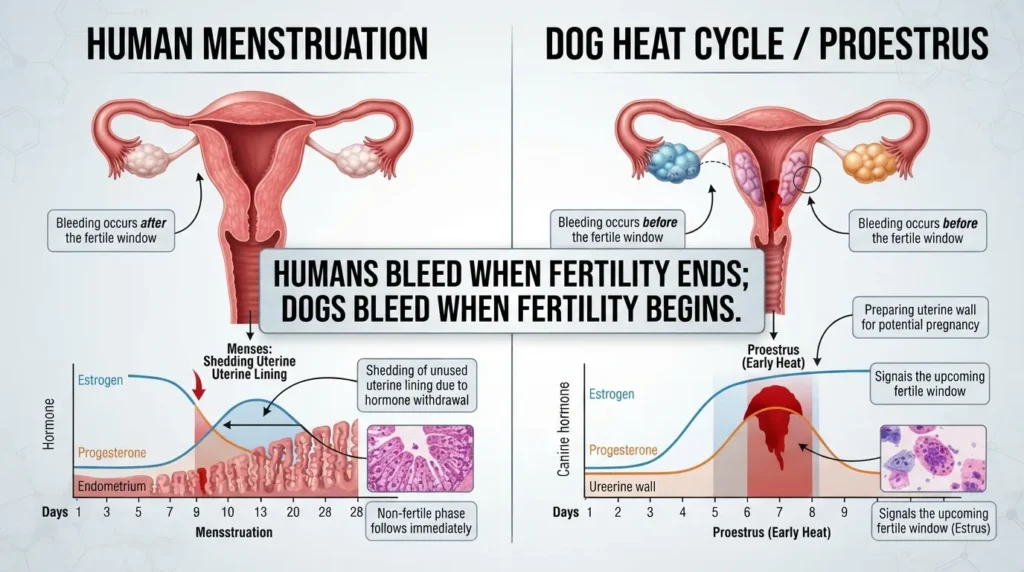
While dog owners frequently refer to bloody vaginal discharge as a “period,” female dogs do not menstruate in the way humans do.
The confusion comes from the most obvious shared sign: physical bleeding. However, the biological trigger behind a dog’s discharge is almost the exact opposite of human menstruation. Recognizing this difference helps you understand where your dog actually stands in her reproductive timeline and when she is at risk for an unplanned pregnancy.
Period vs Estrus Cycle — The Real Difference
In human biology, menstruation happens at the end of anovulatory or unfertilized reproductive cycles. When an egg isn’t fertilized, estrogen and progesterone levels drop sharply, causing the body to shed its thickened uterine lining. This shedding process is the bloody discharge known as a period.
In female dogs (bitches), bleeding occurs at the beginning of the estrus cycle, specifically during a phase called proestrus.
Instead of shedding tissue because a cycle failed, a dog’s blood vessels in the uterine lining dilate and leak fluid under a rapid rise in estrogen. This discharge signals that her body is preparing to ovulate. In short: a human bleeds when her fertile window has closed for the month, while a dog bleeds to signal that her fertile window is about to open.
| Feature | Human Period (Menstruation) | Dog "Period" (Proestrus Phase) |
|---|---|---|
| Biological Purpose | Sheds unused uterine lining after no pregnancy occurs | Prepares the uterine lining and signals readiness for mating |
| Hormonal Driver | Drop in estrogen and progesterone | Surge in estrogen levels |
| Timing in Cycle | End of the reproductive cycle | Beginning of the estrus (heat) cycle |
| Typical Duration | 3 to 7 days | 7 to 10 days on average (can last 3 to 21 days) |
| Cycle Frequency | Roughly every 28 days (~12 times per year) | Every 6 months on average (1 to 3 times per year depending on size) |
| Fertility Window | Non-fertile (fertility occurs mid-cycle, long before/after bleeding) | Highly fertile soon after (fertility peaks as bleeding lightens in estrus) |
What Age Does a Dog Have Her First Heat Cycle?
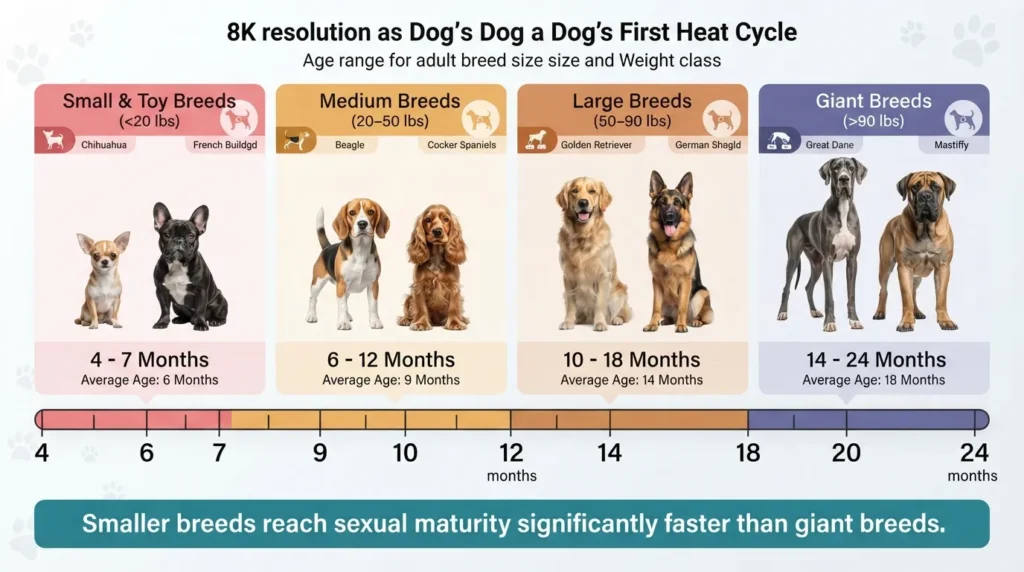
A female dog typically experiences her first heat cycle around 6 months of age, but this timeline is far from uniform across all dogs. Physical maturation varies significantly based on genetics, weight, and overall developmental speed, meaning your dog could enter her first cycle noticeably earlier or much later than the standard 6-month average.
Average First Heat Age by Breed Size
Size is the single biggest factor determining when a dog reaches sexual maturity. As a general rule in veterinary physiology, smaller dogs mature rapidly and go into heat early, while larger breeds grow at a slower rate and reach maturity much later.
According to life stage guidelines from the American Animal Hospital Association (AAHA), here is how the timing breaks down across weight classes:
Small breeds (under 20 lbs): Typically experience their first heat around 6 months, with some tiny toy breeds starting as early as 4 or 5 months.
Medium breeds (20 to 50 lbs): Usually enter their first cycle between 6 and 9 months, aligning closely with the overall species average.
Large and giant breeds (50+ lbs): Commonly experience their first heat between 12 and 24 months. Giant dogs like Great Danes or Mastiffs take up to two full years to reach complete physical and hormonal maturity.
Earliest & Latest Recorded Age Range
The broader scientific spectrum for a dog’s first estrus cycle spans from 4 months on the early end to 24 months on the late end.
Seeing a toy breed go into heat at 4 months is biologically normal and usually no cause for concern. On the flip side, if a large or giant breed hasn’t had her first cycle by 18 to 20 months, she is simply following her body’s natural, slow-growth curve.
However, if a small or medium dog reaches 12 to 14 months without ever showing signs of heat—or a giant breed reaches 24 months with no cycle—it’s worth discussing with your veterinarian. Delayed maturity can occasionally point to underlying conditions like silent heats, thyroid imbalances, or anatomical abnormalities.
Breeding Age — When Can Dogs Get Pregnant & How Old Is Too Old?
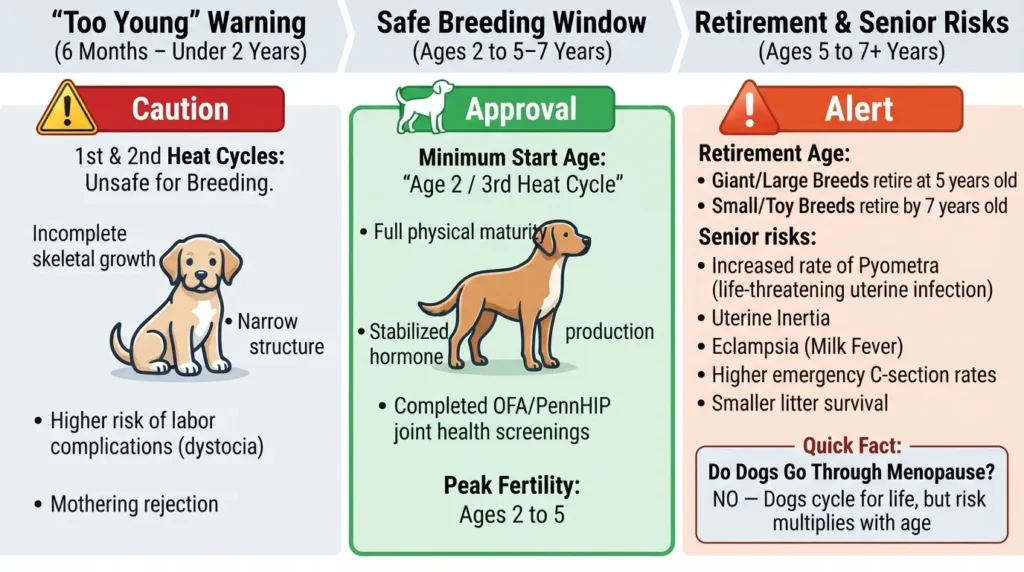
A female dog reaches sexual maturity during her first heat cycle, meaning she becomes physically capable of getting pregnant as early as 6 months of age. However, physical capability doesn’t equal biological readiness. Breeding a dog during her very first heat cycle is dangerous because her body and reproductive organs are still growing, even if she looks full-sized on the outside.
Knowing when to safely start—and permanently stop—breeding is critical for protecting the mother’s health, ensuring litter survival, and preventing life-threatening complications like uterine infections or dystocia (obstructed labor).
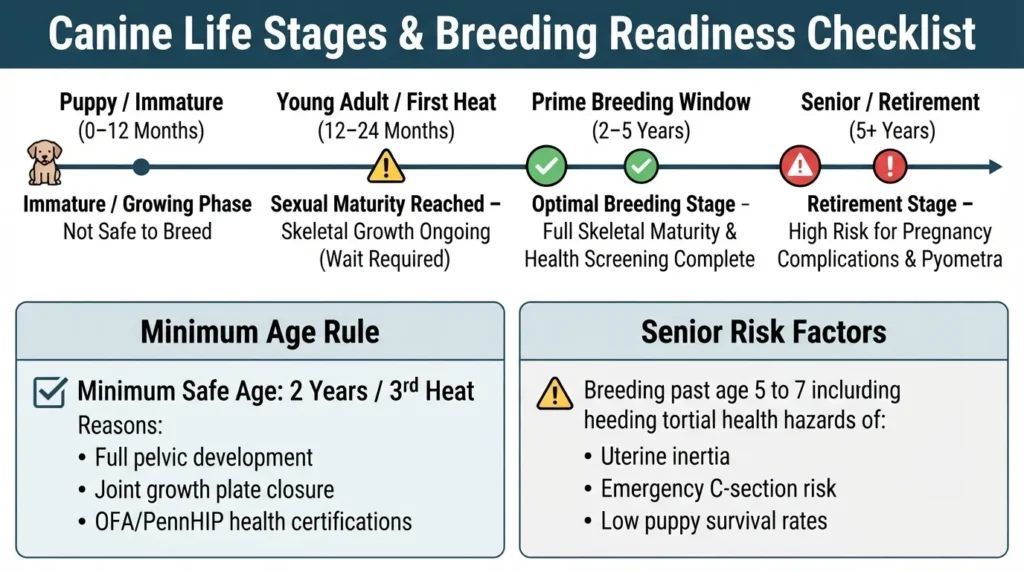
Minimum Safe Breeding Age (vets recommend 3rd heat cycle)
Veterinarians and responsible breed organizations strongly advise waiting until a female dog is at least 2 years old—or until her third heat cycle—before breeding her for the first time.
By her third heat, her body has reached full skeletal maturity, her hormonal production has stabilized, and her pelvic canal is wide enough to safely pass puppies. Waiting until age two also allows breeders to complete essential orthopedic, cardiac, and genetic health screenings (such as OFA or PennHIP hip evaluations) that cannot be officially certified in younger dogs.
Maximum Safe Breeding Age (senior risk factors)
Most female dogs should be retired from breeding between 5 and 7 years of age, depending on their breed and individual health history. Large and giant breeds age faster and should generally retire closer to age 5, while smaller breeds may safely carry a litter until age 7 if they are in peak condition.
Breeding a senior dog carries severe physiological risks. As a dog ages, uterine tissue loses elasticity, blood flow to the placenta decreases, and abdominal muscle tone weakens. Senior mothers face significantly higher rates of stillbirths, small litter sizes, uterine inertia (where contractions stop during labor), and emergency C-sections.
Do Dogs Go Through Menopause? (quick fact)
No, dogs do not experience menopause. Unlike human females, a dog’s ovaries never stop releasing eggs, and she will continue to have heat cycles for her entire natural life unless she is spayed.
However, just because a senior dog can get pregnant doesn’t mean she should. Fertility drops sharply after age 6, and pregnancy in an elderly dog places immense strain on her kidneys, heart, and immune system.
Risks of Breeding Too Young or Too Old
Behavioral rejection: Immature mothers under two years old often lack maternal instincts, leading them to abandon, neglect, or accidentally step on their newborn pups.
Physical growth stinting: Pregnant puppies must split their nutritional intake between their own growing bones and their developing litter, causing permanent structural deficits in the mother.
Increased rate of Pyometra: Older intact females face a dramatically higher risk of pyometra, a severe, life-threatening uterine infection triggered by repeated hormonal cycles without pregnancy or spaying.
Eclampsia (Milk Fever): Older or excessively young mothers are more vulnerable to sudden drops in blood calcium during nursing, which leads to tremors, seizures, and rapid death if untreated.
Surgical complications: Senior dogs facing emergency C-sections carry far higher anesthesia and recovery risks than young adult dogs.
How Often Do Dogs Have Their Period?
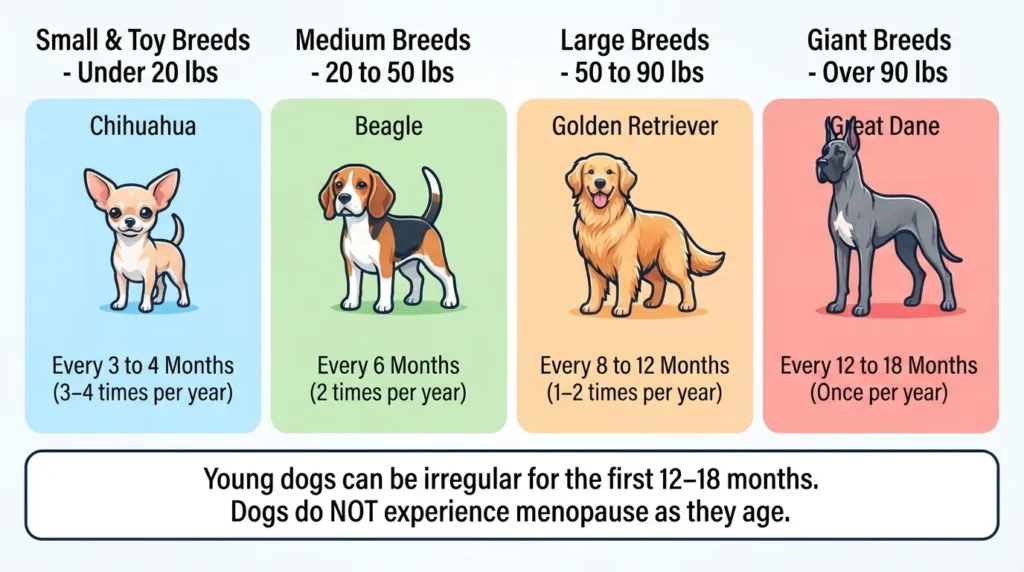
On average, a healthy adult dog goes into heat roughly twice a year (every 6 months). However, “twice a year” is just an average—your dog’s actual cycle frequency depends heavily on her breed size, genetics, and age.
Smaller dogs mature faster and have higher metabolic rates, which translates to a more frequent cycle. Giant breeds, on the other hand, take much longer to go through reproductive cycles.
Small & Toy Breeds (under 20 lbs): Every 3 to 4 months (3–4 times per year). Breeds like Chihuahuas, Yorkshire Terriers, and Pomeranians often cycle much more frequently than larger dogs.
Medium Breeds (20 to 50 lbs): Every 6 months (2 times per year). Standard Poodles, Beagles, and Cocker Spaniels usually stick closely to the 6-month average.
Large Breeds (50 to 90 lbs): Every 8 to 12 months (1–2 times per year). Labradors, Golden Retrievers, and German Shepherds tend to have longer gaps between heat cycles.
Giant Breeds (over 90 lbs): Once a year (every 12 to 18 months). Breeds like Great Danes, Mastiffs, and Irish Wolfhounds typically have the longest intervals between cycles.
How Frequency Changes as Dogs Age
When a female dog first starts having heat cycles, her schedule will likely be unpredictable. It is completely normal for a young dog to have irregular gaps between her first few cycles during the first 12 to 18 months as her hormones stabilize.
Unlike humans, dogs do not go through menopause. A female dog will continue having heat cycles for her entire life unless she is spayed. However, as your dog enters her senior years, you will notice subtle changes in her reproductive pattern.
According to veterinary guidelines from the American Animal Hospital Association (AAHA), senior dogs experience a natural drop in fertility. This means the time between her cycles will gradually stretch out—a dog that used to cycle every 6 months might shift to every 9 or 12 months. The bleeding during her heat phase may also become lighter, though she can still become pregnant if she mates.
How Long Does a Dog's Heat Cycle Last?
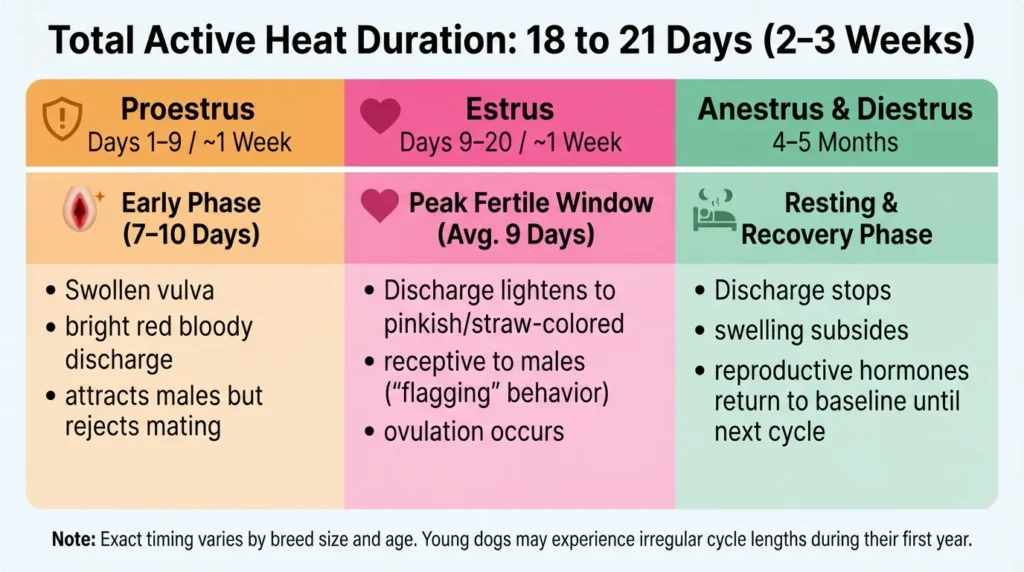
On average, a dog’s active heat cycle lasts between 2 to 3 weeks (roughly 18 to 21 days) from start to finish. However, the complete biological cycle—including the resting phase between heats—runs continuously in a multi-month loop.
While the visible symptoms like swelling and bleeding usually last about three weeks, exact timing varies based on your dog’s size, age, and individual hormone levels. Young dogs in particular often have irregular cycle lengths during their first year or two before settling into a predictable routine.
The 3 Phases of the Cycle
To understand how long heat lasts, it helps to break down what happens biologically during each main stage of the cycle:
Proestrus (7–10 days): This is the early phase where physical signs first appear. You will notice vulvar swelling and a bright red, bloody discharge. Your dog attracts male dogs with her scent during this time, but she is not fertile yet and will actively reject any mating attempts.
Estrus (avg. 9 days): Known as the “true heat” or fertile window, estrus averages around 9 days (though it can range anywhere from 4 to 12 days). The discharge usually lightens to a straw-colored or watery fluid, and your dog becomes receptive to males. Ovulation occurs during this phase, making strict supervision crucial if you want to prevent pregnancy.
Anestrus (4–5 months): This is the extended resting phase where reproductive hormones return to baseline levels and the uterus repairs itself. There are no outward signs, bleeding, or behavioral changes during anestrus, which lasts until the body triggers the next proestrus phase.
(Note: In complete reproductive anatomy, a post-heat phase called diestrus occurs for about 60 to 90 days right after estrus before the body fully enters anestrus).
Signs Your Dog Is in Heat
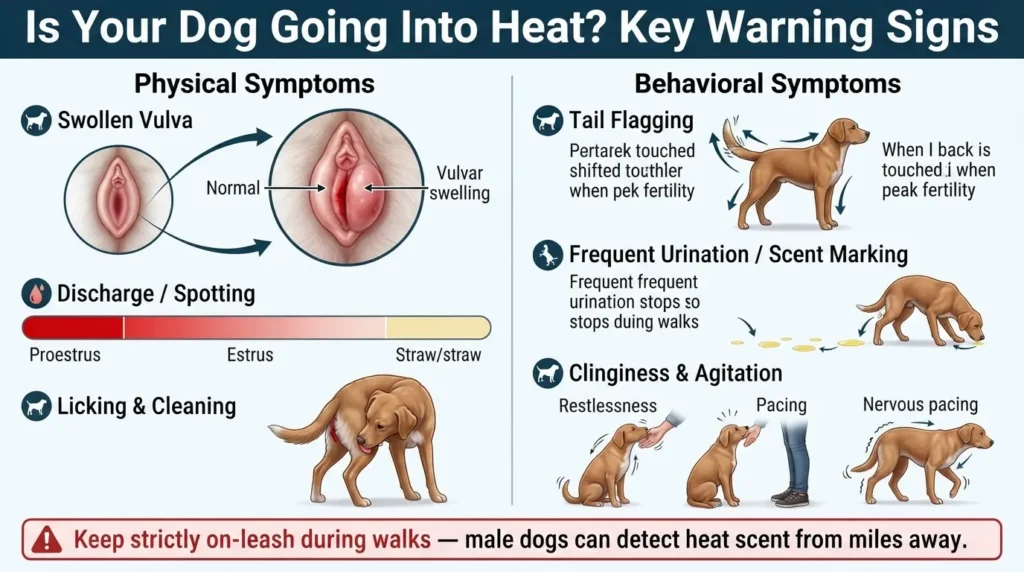
Spotting the signs of a heat cycle early gives you time to protect your dog, keep your home clean, and prevent unwanted male attention. Hormonal shifts trigger distinct physical and behavioral changes, though every dog displays them slightly differently.
Physical and Behavioral Symptoms
Swollen vulva: This is usually the first visible physical indicator, appearing a few days before any bleeding starts. The swelling can be minor in some dogs or up to three times its normal size in others.
Blood-tinged discharge: The discharge typically begins as a dark red or pink fluid during the initial proestrus stage. As she enters her fertile window, this fluid lightens to a watery, straw-colored liquid.
Increased urination: Rising hormone levels prompt her to urinate more frequently to leave scent markers for male dogs. You might notice her lifting her leg or marking spot-by-spot during routine walks.
Behavior changes (clingy or restless): Shifting estrogen levels directly affect her temperament. She might become unusually affectionate and demanding of your attention, or act restless, anxious, and unable to settle down comfortably.
“Flagging” behavior: When she is in her peak fertile stage (estrus) and receptive to breeding, she will shift her tail to one side and hold her hindquarters still when touched on her lower back.
Subtle early warning signs: Before overt physical symptoms appear, you may notice mild swelling around her nipples, a sudden change in appetite, or her spending an unusual amount of time licking her genital area to keep clean.
When Is a Dog's Period Not Normal? Vet Warning Signs
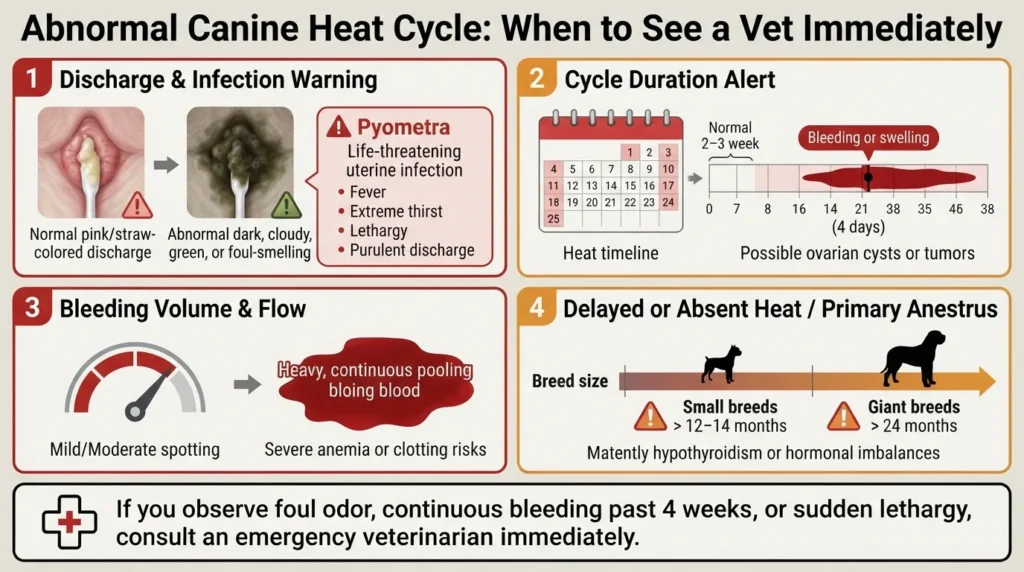
While heat cycles bring plenty of predictable physical and behavioral changes, certain red flags mean something isn’t right. Uterine infections, hormonal imbalances, and reproductive disorders can mimic regular heat symptoms at first, so staying observant is essential.
If you spot any of the following symptoms during or after your dog’s cycle, schedule a vet visit right away:
Heavy or prolonged bleeding: It’s normal to see light spotting or moderate dripping, but active, heavy bleeding that pools on the floor or requires changing diapers every hour isn’t typical. Severe blood loss can quickly lead to anemia or signal a clotting disorder.
Foul-smelling or milky discharge: Normal discharge ranges from bright red to pale pink or straw-colored, with little to no noticeable odor. Dark, cloudy, yellowish-green, or foul-smelling discharge is a classic indicator of pyometra—a severe, life-threatening infection of the uterus that requires immediate emergency care.
No heat cycle at all (silent heat or primary anestrus): If a small breed hasn’t had her first cycle by 12 months, or a large breed by 24 months, she may be experiencing a “silent heat” (where ovulation occurs without external signs) or underlying endocrine issues like hypothyroidism or ovarian dysfunction.
A cycle lasting longer than 4 weeks: A standard heat cycle lasts roughly 2 to 3 weeks from start to finish. If your dog continues to bleed, swell, or show behavioral heat signs past the 4-week mark, persistent ovarian cysts or estrogen-producing tumors could be driving prolonged hormone production.
Does Spaying Stop a Dog's Period?
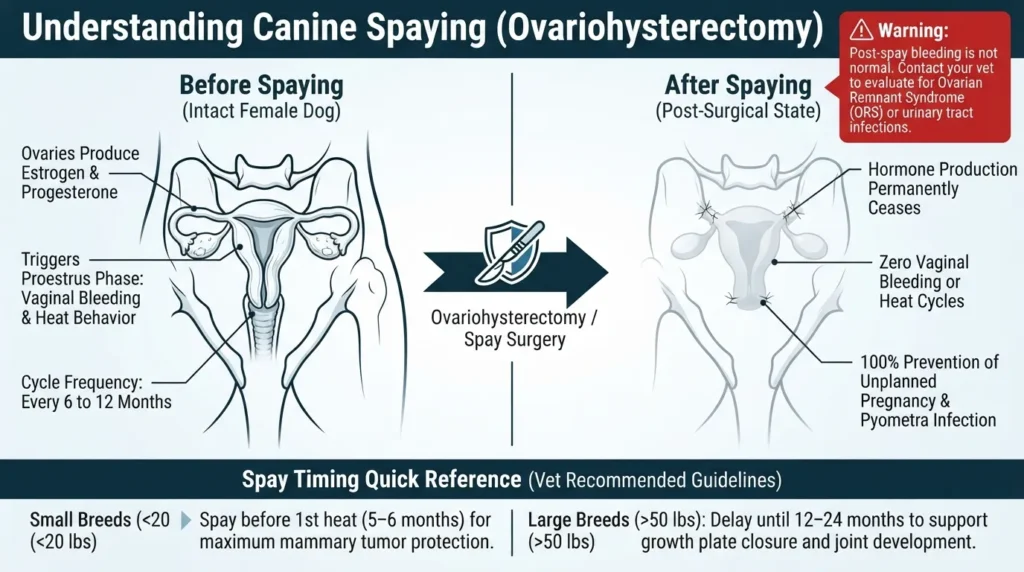
Yes, spaying permanently stops a dog’s period and eliminates her heat cycle entirely. During a standard spay procedure (ovariohysterectomy), a veterinarian surgically removes both the ovaries and the uterus. Because the ovaries produce the estrogen and progesterone that trigger the reproduction cycle, removing them stops the hormonal signaling that causes vulvar swelling, bleeding, and heat behaviors.
If a dog continues to show signs of heat or experiences vaginal bleeding after being spayed, this is not normal. It typically points to Ovarian Remnant Syndrome (ORS)—a rare condition where a small piece of functional ovarian tissue remains inside the abdomen—or an underlying urinary tract infection or vaginal inflammation. Any bleeding after a spay warrants a visit to your veterinarian to pinpoint the exact cause.
Best Age to Spay (before vs after first heat — pros/cons)
Veterinary medicine has moved away from a single “one-size-fits-all” recommendation for spay timing. Guidelines from the American Animal Hospital Association (AAHA) emphasize customizing the age of spaying based on your dog’s adult size, breed, and individual health risks.
Deciding whether to spay before or after her first heat cycle involves weighing cancer prevention against joint and bone development.
Spaying Before the First Heat (Around 5 to 6 Months)
Pro (Maximum Cancer Protection): Spaying prior to the first cycle reduces the lifetime risk of developing mammary gland tumors (breast cancer) to less than 0.5%, according to veterinary oncology research.
Pro (Zero Unplanned Pregnancies): Completely avoids the risk of accidental mating and eliminates the need to manage bleeding and behavioral shifts during her first cycle.
Pro (Eliminates Pyometra Risk): Removes the uterus early, permanently protecting her from pyometra—a severe, life-threatening uterine infection common in unspayed older females.
Con (Joint Development Risks in Large Dogs): Estrogen tells growth plates in long bones when to stop growing. Removing these hormones early in large or giant breeds can cause bones to grow longer than normal, increasing the risk of hip dysplasia and cruciate ligament (ACL) injuries.
Con (Slightly Higher Urinary Incontinence Risk): Early spaying is linked to a higher incidence of hormone-responsive urinary incontinence later in life.
Spaying After the First Heat (12 to 24 Months)
Pro (Full Physical & Musculoskeletal Maturity): Allowing sex hormones to remain active while her body grows ensures proper bone density, muscle alignment, and joint stability—critical for working, athletic, or large breeds.
Pro (Lower Joint Disorder Risk in Specific Breeds): Breed-specific studies from UC Davis highlight that delaying spaying in breeds like Golden Retrievers, German Shepherds, and Labradors significantly reduces their risk of joint disorders and certain vascular cancers.
Con (Higher Mammary Tumor Risk): After just one heat cycle, her risk of developing mammary tumors rises from 0.5% to roughly 8%. After two cycles, that risk jumps to nearly 26%.
Con (Inconvenience & Management): You must strictly isolate her from male dogs for 3 to 4 weeks, deal with vaginal discharge, and monitor her constantly outdoors.
| Spay Timing | Recommended For | Key Benefit | Key Trade-off |
|---|---|---|---|
| Before First Heat (5–6 months) | Small & Toy Breeds (<20 lbs) | Max protection against mammary cancer (<0.5% risk) | Slightly elevated risk of urinary incontinence |
| After First Heat (12–24 months) | Large & Giant Breeds (>45 lbs) | Full joint/bone maturity; lower CCL & dysplasia risk | Higher mammary tumor risk (~8%+); must manage 1+ heat cycles |
For small and toy dogs, the physical risks to joints are minimal, making early spaying before the first heat the standard choice for cancer prevention. For large and giant breeds, waiting until growth plates close—usually between 12 and 18 months—is increasingly recommended to safeguard long-term mobility.
What to Do If Your Dog Accidentally Mates While in Heat
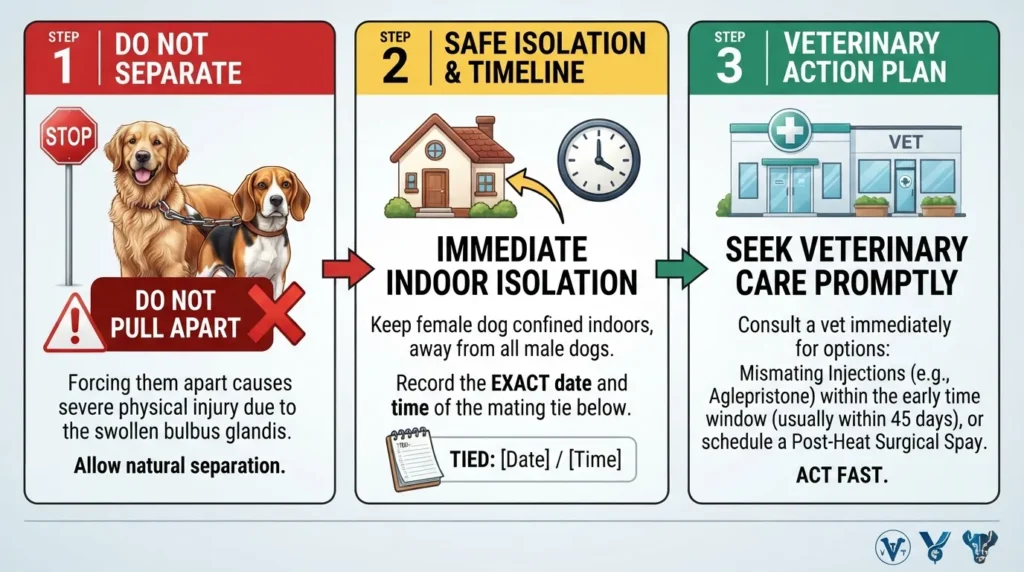
Accidents happen fast. A gate left unlatched for ten seconds or a neighbor’s intact male jumping a fence is all it takes for an unplanned tie to occur.
If you catch your dog in the middle of mating, do not attempt to pull the dogs apart. During mating, the male’s bulbus glandis swells, locking the pair together in a natural process called a “tie” that can last anywhere from 10 to 30 minutes. Trying to separate them by pulling, spraying water, or making loud noises can cause severe physical injury, including vaginal tearing in the female or penile trauma in the male.
Instead, stay calm, keep both dogs as quiet and still as possible until they naturally separate, and take these immediate steps:
Note the exact date and time: Write down when the tie occurred. Your vet will need this precise timeline to evaluate emergency contraception options.
Isolate your dog immediately: Keep her indoors in a secure, quiet room. She will remain fertile and continue attracting other males for the rest of her heat cycle.
Contact your veterinarian right away: Call your clinic the same day to inform them of the accidental mating so you can map out a medical plan before early pregnancy sets in.
Mismating Injection Option & Vet Timeline
If you do not intend for your dog to have puppies, veterinary medicine offers safe, effective options to prevent or safely terminate an unwanted pregnancy. The key is acting within specific time windows.
The Mismating Injection (Alizin / Aglepristone)
The most common and effective medical treatment used by veterinarians outside the US (and via special import or alternative protocol in North America) is Aglepristone (commonly known by the brand name Alizin).
How it works: Aglepristone is an antiprogestagen. It blocks progesterone receptors in the uterus, preventing a fertilized egg from implanting or causing a safe, early resorption/abortion if pregnancy has already begun.
Success rate: Greater than 99% when administered early in the cycle.
Side effects: Typically mild, including temporary pain or swelling at the injection site, or slight restlessness.
Crucial Medical Timeline After Unplanned Mating
Timing determines which medical options are available to your dog. Here is the veterinary protocol to follow:
| Timeline After Mating | Recommended Action / Medical Option | What to Expect |
|---|---|---|
| Days 1 to 21 | Initial Veterinary Consultation & Early Mismating Injection | Your vet can administer the first protocol of mismating injections (typically two injections given 24 hours apart). Treating early prevents uterine implantation entirely. |
| Days 25 to 30 | Diagnostic Ultrasound Confirmation | An abdominal ultrasound can reliably confirm whether pregnancy occurred. If confirmed late, medical termination protocols (using prostaglandins or antiprogestagens) can still be performed safely under vet supervision. |
| Anytime Post-Heat | Surgical Spay (Ovariohysterectomy) | If you do not plan to breed your dog in the future, performing a surgical spay shortly after her heat cycle finishes is the definitive solution. It permanently prevents pregnancy and eliminates future heat cycles. |
Do not attempt any “home remedies” or human emergency contraceptives—these are extremely toxic to dogs and can cause fatal uterine hemorrhage or severe bone marrow suppression. Work directly with your vet to choose the safest path forward for your dog’s long-term health.
Can Dogs Have a False Pregnancy After Their Period?
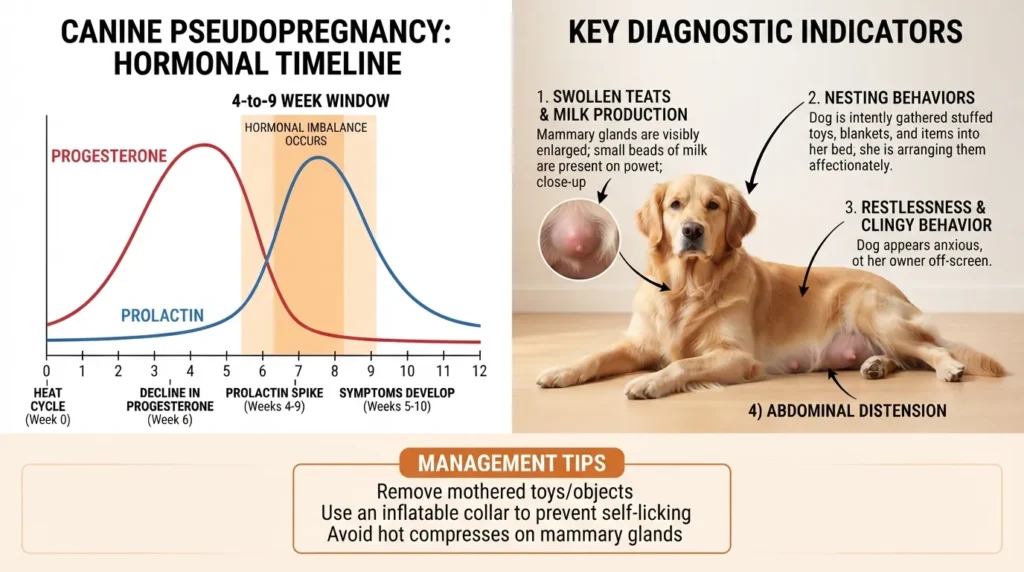
Yes, a female dog can experience a false pregnancy (medically known as pseudopregnancy or pseudocyesis) roughly 4 to 9 weeks after her heat cycle finishes. In fact, veterinary studies show that up to 50% or more of unspayed female dogs will show symptoms of a false pregnancy at least once in their lifetime.
This happens because of a unique quirk in canine hormones. Once a heat cycle ends, a female dog’s body produces high levels of progesterone for about two months, whether she was successfully bred or not. As those progesterone levels eventually decline, prolactin—the hormone responsible for milk production and mothering instincts—spikes. Her brain literally tricks her body into believing she is carrying puppies.
Symptoms of False Pregnancy in Dogs
Signs range from subtle mood shifts to full physical preparation for a litter. You might notice your dog engaging in distinct behavioral and bodily changes:
Nesting and mothering behaviors: She may gather toys, socks, or blankets into her bed, guarding them gently and treating them like newborn puppies.
Restlessness and anxiety: She might pace, whine, or become unusually clingy and protective of her sleeping area.
Mammary gland enlargement: Her teats may swell, feel firm, and even produce clear fluid or actual milk.
Abdominal swelling: Her belly might appear slightly distended, occasionally mimicking real pregnancy.
Lethargy and loss of appetite: She may seem tired, lose interest in food, or occasionally suffer from mild vomiting.
How to Manage a False Pregnancy at Home
In most cases, a false pregnancy is self-limiting and resolves on its own within 1 to 3 weeks without medical intervention. However, a few practical adjustments can help her settle down faster:
Remove “puppies”: Quietly remove any stuffed toys or items she is mothering. Leaving them in her nest prolongs the hormonal surge.
Prevent licking: Don’t let her lick or groom her own swollen teats, as self-stimulation triggers her body to produce more milk. Use an inflatable collar or a light t-shirt if necessary.
Avoid warm compresses: Do not massage or put hot compresses on her mammary glands, which encourages milk production.
Increase activity: Gentle exercise and engaging games help distract her and burn off nervous energy.
If her mammary glands become hard, red, or hot to the touch, or if the discharge turns foul-smelling, contact your veterinarian. This can signal mastitis (a painful bacterial infection).
Spaying your dog once her false pregnancy has completely passed is the only permanent solution, preventing future hormonal rollercoasters and eliminating the risk altogether.
How to Manage Your Dog's Heat Cycle
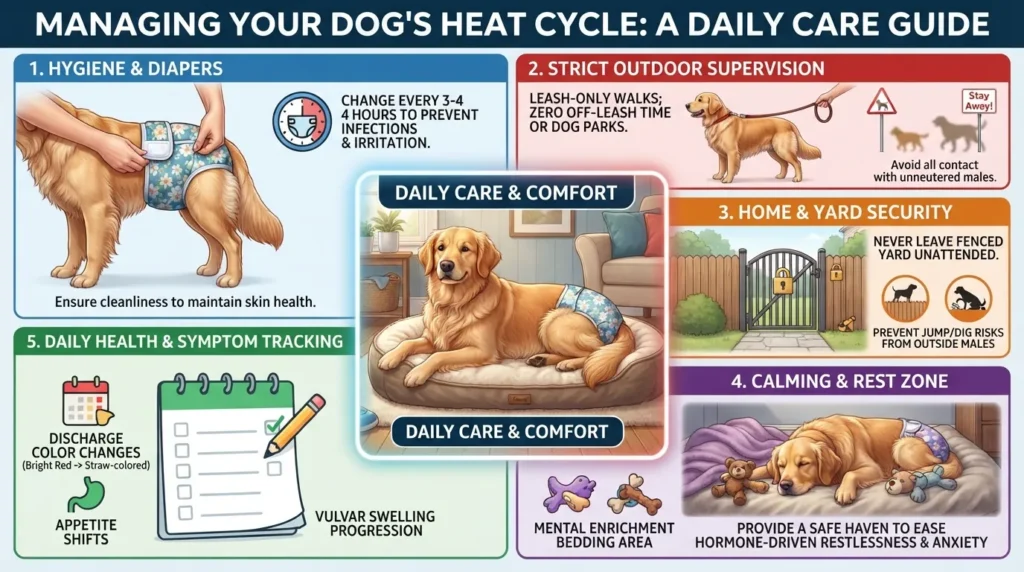
Managing a dog in heat comes down to two main priorities: keeping your home clean during the bleeding phase and preventing unwanted contact with intact male dogs. With a clear routine, the two- to three-week cycle passes smoothly without mess or accidental litters.
Diapers (reusable vs disposable): Dog diapers are essential for protecting furniture and rugs from discharge during proestrus. Disposable diapers are convenient for quick cleanups and travel, but reusable cloth diapers with washable inserts offer better absorption, a softer fit around the tail hole, and significant savings over time.
Hygiene tips: Change your dog’s diaper every 3 to 4 hours to prevent moisture buildup, bacterial growth, and urinary tract infections. Use fragrance-free, pet-safe wipes to clean her vulva gently during diaper changes, and ensure her skin is completely dry before slipping on a fresh diaper.
Keeping male dogs away: Never leave your female unattended in a back yard—intact males can smell a female in heat from over two miles away and are notoriously persistent. Skip dog parks entirely, walk her on a short non-retractable leash at off-peak hours, and keep windows closed if local neighborhood dogs start roaming nearby.
First Heat Checklist for New Dog Owners
Navigating your dog’s first heat cycle can feel overwhelming, but having the right supplies ready beforehand takes the stress out of the process.
Stock up on diapers and liner pads: Buy at least 3 to 4 reusable diaper covers or a bulk pack of disposables, plus extra absorbent pads to extend diaper life between washes.
Gather cleaning supplies: Have an enzymatic stain-and-odor cleaner on hand for occasional leaks on carpet, along with gentle, pet-safe baby wipes for routine cleaning.
Secure your home and yard perimeter: Double-check latching gates, fence lines, and door handles. Intact male dogs will dig or jump barriers, and your female may attempt to escape to find a mate during her fertile window.
Prepare an indoor safe space: Set up a comfortable, easy-to-clean area with washable blankets or towels where she can rest comfortably without access to high-traffic upholstered furniture.
Adjust your walking routine: Switch to short, leash-only bathroom breaks close to home, avoiding communal dog areas until her cycle is completely finished.
Check Your Dog's Age & Breeding Stage
Determining how old your dog is in human years isn’t as simple as multiplying by seven. Factors like weight class, breed size, and reproductive history significantly alter how quickly a dog’s cellular aging progresses.
Whether you are managing a senior dog who has reached 17 dog years in human years—translating to roughly 84 to 120 human years depending on weight—or tracking a young female’s reproductive development, precision matters. Understanding where your companion falls on the life-stage curve allows you to tailor diet, mobility support, and veterinary care to their exact biological needs.
Internal CTA: Dog Age Calculator Tool
Want an instant, scientifically accurate breakdown customized to your dog’s specific weight category and breed profile?
Use our interactive Dog Age Calculator Tool to pinpoint your dog’s exact age in human equivalent years, assess their current life stage, and review personalized care recommendations based on updated American Animal Hospital Association (AAHA) guidelines.
Calculate Your Dog’s Exact Human Age in Seconds: Dog Age Calculator Tool
Frequently Asked Questions
What age does a dog have her first period?
Most dogs have their first period (heat cycle) around 6 months of age. However, the exact age can range anywhere from 4 to 24 months depending on your dog's physical size and breed.
Do small and large dogs start their periods at the same age?
No. Small breeds (like Chihuahuas or Yorkies) mature faster and can have their first period as early as 4 to 7 months. Large and giant breeds (like Great Danes or Mastiffs) mature slower and may not start until 18 to 24 months.
Is it normal for a dog's first period to be late?
Yes, especially in larger breeds. If a small or medium dog hasn't had her first period by 12 to 14 months, or a large breed by 24 months, schedule a checkup with your vet to ensure her reproductive system is developing normally.
At what age do dogs stop having periods?
Dogs do not go through menopause. An unspayed female dog will continue having heat cycles her entire life, though the time between cycles may lengthen as she reaches senior age.
How often do dogs get their period after the first one?
On average, dogs have a period twice a year (every 6 months). However, it is completely normal for a young dog's schedule to be irregular for the first 12 to 18 months after her very first heat cycle.
🐾 Other Age Guides

I built Dogagescalculator.com to give dog owners honest, science-backed answers instead of the outdated "×7" myth. Every figure here is checked against AKC, AVMA, and published veterinary research.
More about the author & this site →
Comments