
32 Years in Dog Years: What Does That Really Mean in Human Age?
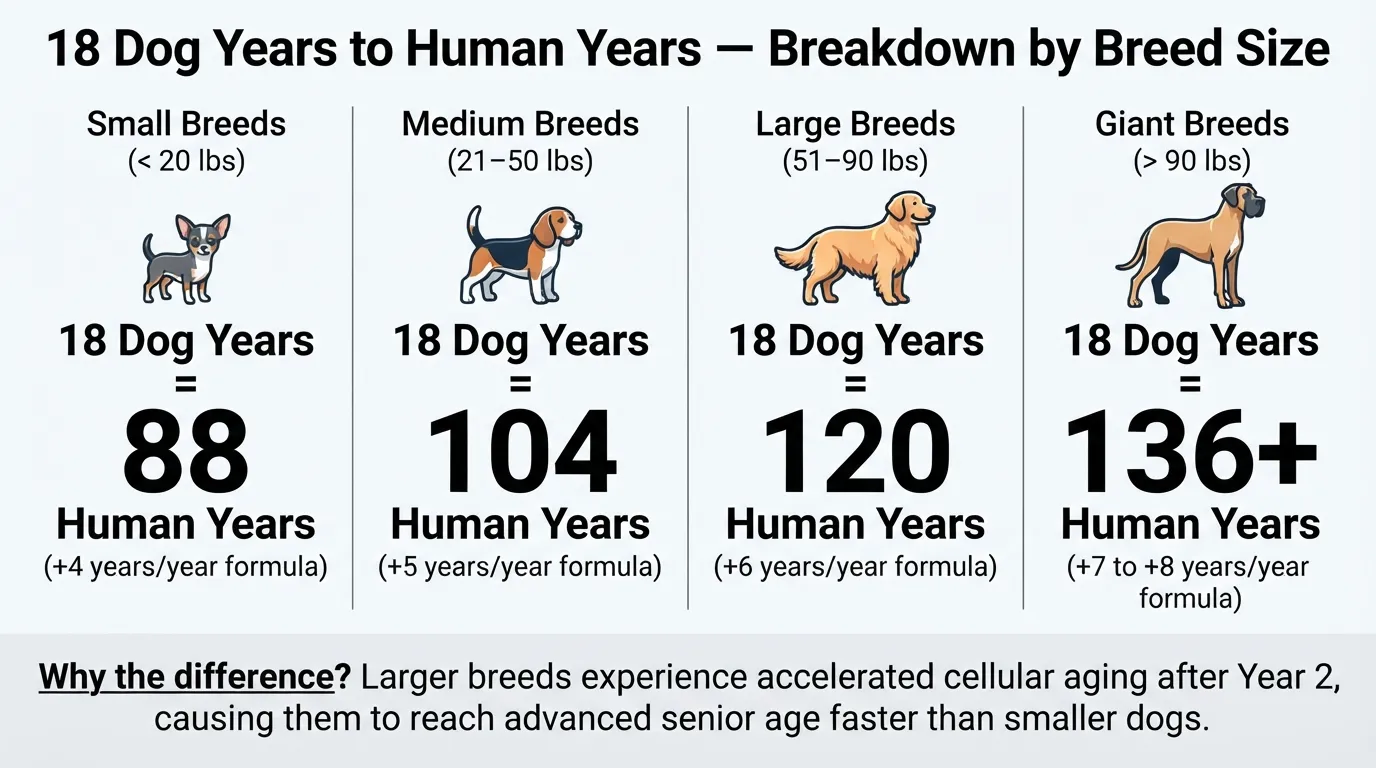
Calculating dog years isn’t as simple as multiplying by seven. If a dog actually lived 32 calendar years, that would equal roughly 140 to 224 human years, depending on their size and breed.
Whether you’re trying to convert 32 actual years into dog age or asking what a mind-boggling 32-year-old pup looks like, this guide breaks down the real math, the scientific formulas, and the world records behind canine aging.
Quick Answer — 32 Dog Years to Human Years
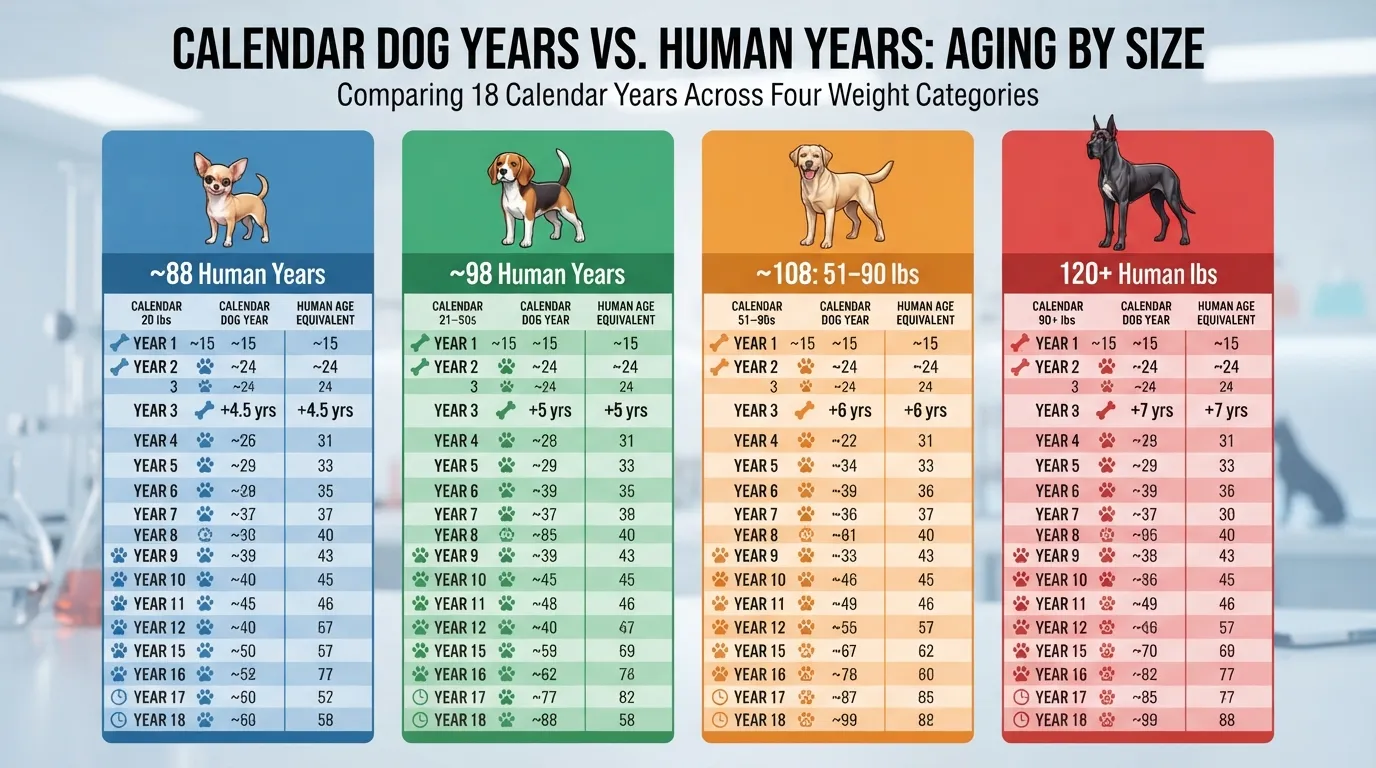
32 actual calendar years in dog years equals roughly 144 to 219 human years, depending entirely on your dog’s size and breed. Using the standard veterinary tiered formula, a 32-year-old small dog translates to about 144 human years, while a large breed would theoretically reach 219+ human years.
Because dog aging slows down after the first two years, you cannot simply multiply 32 by 7. Here is how 32 calendar years translate to human age across different breed sizes:
| Dog Size Class | Human Age Equivalent (At 32 Years Old) | Aging Rate After Year 2 |
|---|---|---|
| Small Breeds (under 20 lbs) | 144 human years | +4 human years per dog year |
| Medium Breeds (20–50 lbs) | 174 human years | +5 human years per dog year |
| Large Breeds (50–90 lbs) | 204 human years | +6 human years per dog year |
| Giant Breeds (90+ lbs) | 219+ human years | +6.5+ human years per dog year |
Living to 32 calendar years is exceptionally rare—in fact, the oldest verified dog in history lived to 31 years and 165 days.
Want to check where your dog stands today without doing the math manually Dog Age Calculator to get a personalized calculation based on their specific breed size and birth date.
Did You Mean a 32-Year-Old Dog, or Your Own Age of 32?
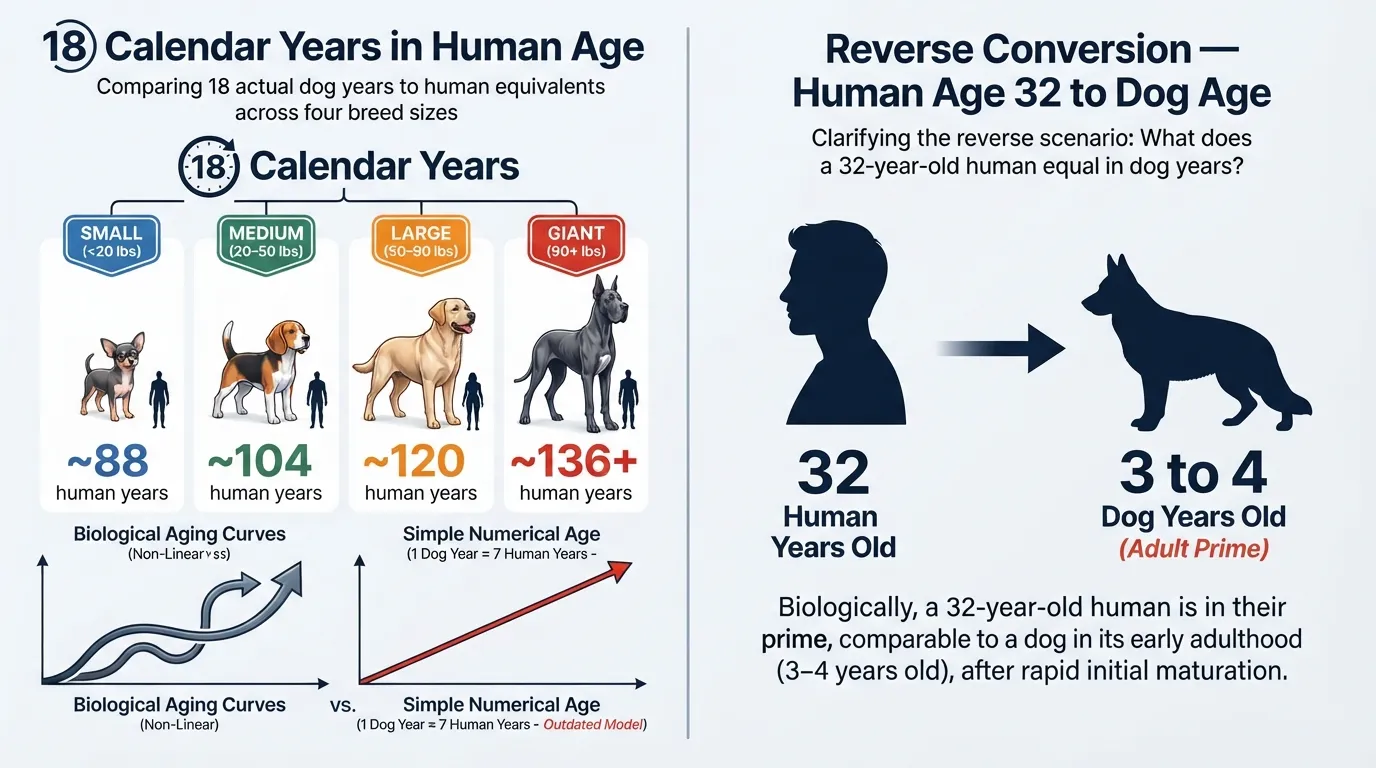
People land on this page for one of two reasons:
A 32-year-old dog’s age in human years: You’re looking up what an impossibly old, 32-year-old dog translates to in human lifespan (spoiler: it’s well over 150 human years).
Your own human age of 32 in dog years: You’re 32 years old today and want to know how old a dog would be at your point in life (roughly a 3 to 4-year-old dog, depending on the breed).
If you meant the reverse—figuring out your own age in dog years—check out our reverse dog age calculator on the home page to flip the math. Otherwise, let’s break down what 32 dog years really means.
Is a 32-Year-Old Dog Even Possible?
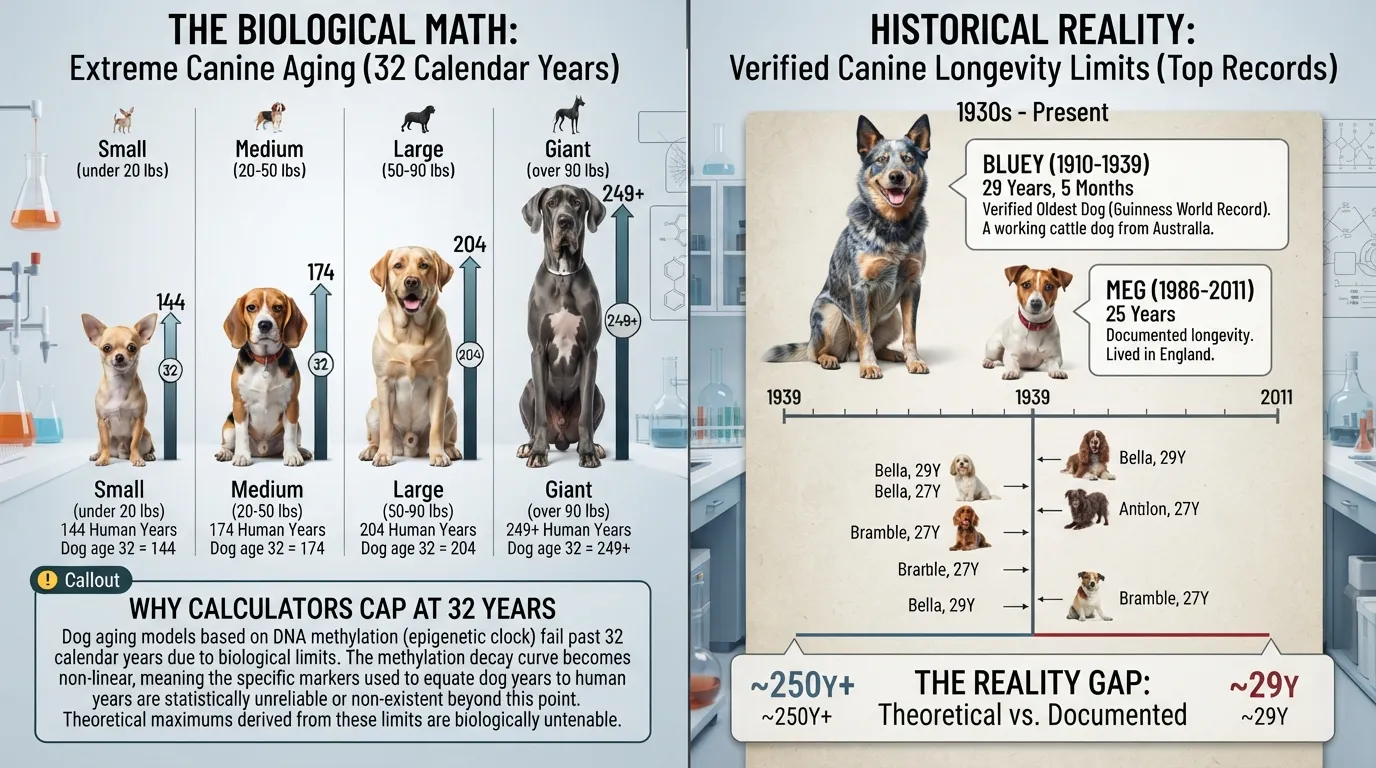
Hitting 32 dog years sounds like a regular milestone if you are using the old-school “multiply by seven” rule for a medium-sized dog. But when you flip that around and look at what 32 calendar years means for a canine, you enter extreme territory. Dogs simply do not age on a linear scale, and reaching this age requires an extraordinary combination of genetics, nutrition, and pure luck.
World’s Oldest Dogs on Record
Reaching the milestone of 32 calendar years is almost unheard of in the canine world. A few legendary dogs have pushed the absolute outer limits of longevity, though verification gets tricky the further back you go.
Bobi (31 years, disputed): This Rafeiro do Alentejo from Portugal made global headlines when he was recognized as the oldest dog ever. However, Guinness World Records later suspended the title after veterinary experts questioned the birth record documentation.
Bluey (29 years, verified): An Australian Cattle Dog who lived from 1910 to 1939, Bluey holds one of the most bulletproof longevity records in history. Working Australian farm dogs often benefit from high activity levels and active jobs that keep them fit.
Meg the Jack Russell (25 years): Living to 25 years old translates to roughly 113 human years using modern epigenetic aging formulas. Small terrier breeds routinely outlive larger breeds, but reaching a quarter-century is still a massive statistical outlier.
Why Most Dog Age Calculators Cap at 32 Years
If you test out most online pet age tools, you will notice a hard stop at 32 years of age. That ceiling is not random.
Calculators cap inputs at 32 because biological aging charts and DNA methylation studies stop seeing viable data points past that threshold. Once a dog crosses into their late twenties or early thirties, their cellular repair mechanisms and organ function operate in uncharted territory. Allowing inputs past 32 would generate scientifically impossible results, so developers use that number as a safety cutoff for extreme edge cases.
Putting the Number in Perspective: 32 dog years (calculated using modern tiered formulas) outlasts the world’s longest verified human lifespan of Jeanne Calment at 122 years. Because of this, a 32-year dog age is a theoretical or extreme scenario rather than a realistic expectation for pet owners.
How to Calculate 32 Dog Years — Step-by-Step
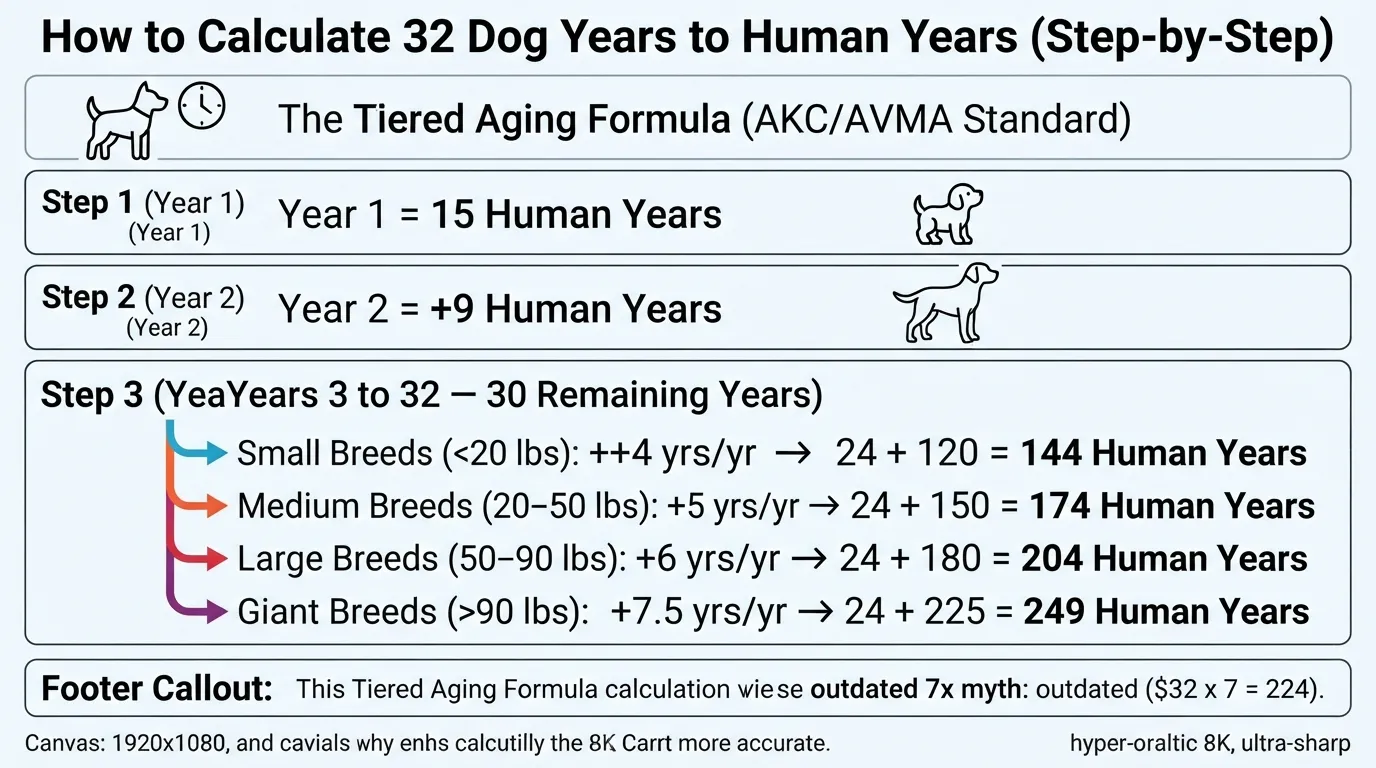
Calculating a dog’s age isn’t a one-size-fits-all equation. Science shows that dogs mature rapidly in their first two years, after which their aging slows down and depends heavily on their breed size.
Vet-Recommended Tiered Formula (AKC/AVMA)
The American Kennel Club (AKC) and the American Veterinary Medical Association (AVMA) support a tiered framework rather than a flat multiplier.
Year 1: Equals 15 human years (rapid physical and sexual development).
Year 2: Adds 9 human years (reaching young adult maturity at 24 human years).
Year 3+: Adds 4 to 7 human years per year, depending entirely on body size.
Here is how a 32-calendar-year dog translates into human years across different size categories using this standard tiered formula:
How to Calculate 32 Dog Years — Step-by-Step
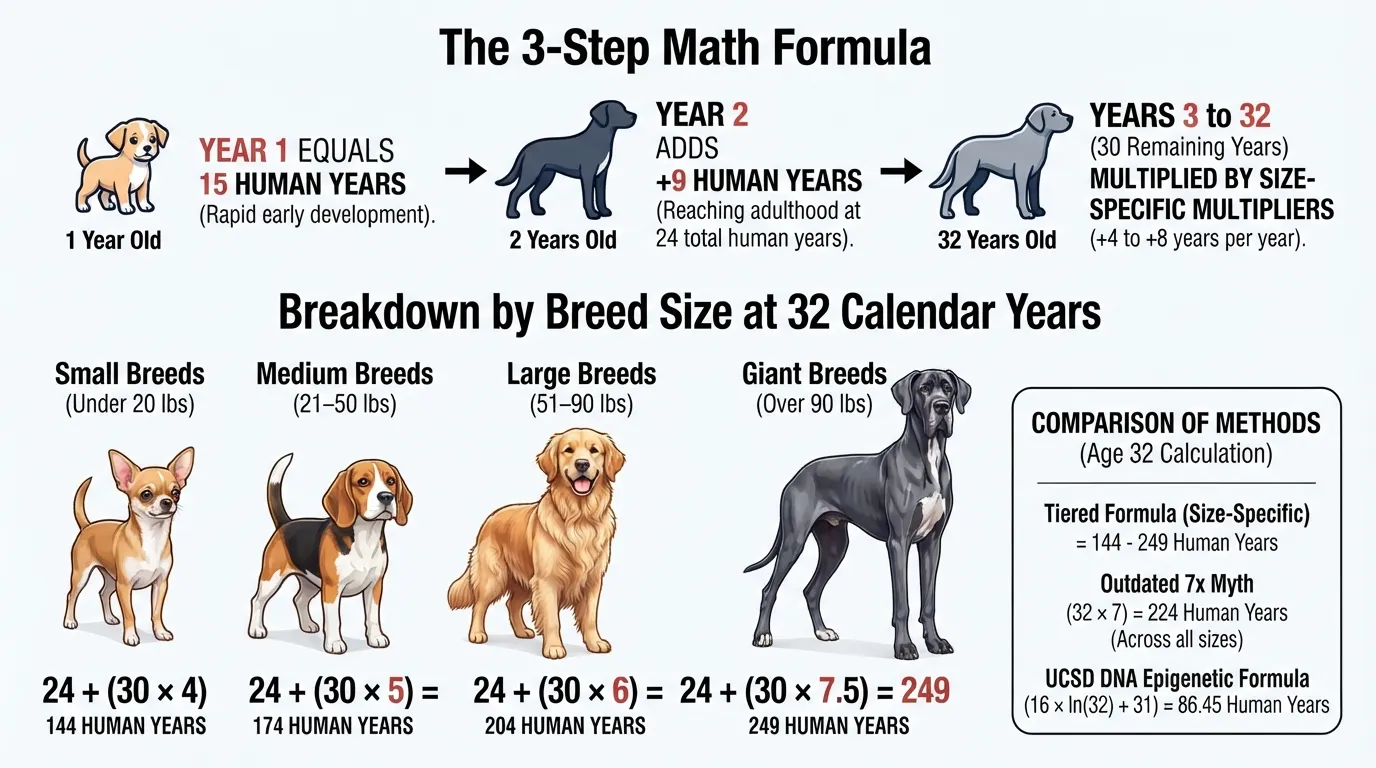
Vet-Recommended Tiered Formula AKC/AVMA
The American Kennel Club (AKC) and the American Veterinary Medical Association (AVMA) recommend a tiered approach. This method reflects how dogs mature rapidly early in life and settle into a steady aging process later on.
Year 1: Counts as 15 human years (rapid physical growth and sexual maturity).
Year 2: Adds 9 human years, bringing a 2-year-old dog to 24 human years.
Year 3 and beyond: Each remaining year is multiplied by a breed-size factor (typically 4 years for small breeds, 5 years for medium, and 6 to 7 years for large or giant breeds).
Here is how the calculation works out for a 32-year-old small dog:
First 2 years: 24 human years
Remaining 30 years: 30 × 4 = 120 human years
Total: 24 + 120 = 144 human years
For a medium breed (30 × 5), the total comes out to 174 human years (24 + 150 = 174).
The Old “7x Myth” For Comparison
For decades, popular culture relied on a simple rule: multiply your dog’s age by 7.
Under this outdated formula, a 32-year-old dog would be 224 human years old (32 × 7 = 224).
Veterinarians reject this calculation because it treats aging as a straight line. Dogs do not age at a constant rate throughout their lives. A one-year-old dog is fully capable of reproducing, but a 7-year-old human child is nowhere near biological adulthood. The 7x rule drastically overestimates a senior dog’s age while underestimating early development.
UC San Diego Scientific Formula
In 2019, researchers at the University of California, San Diego, developed an epigenetic formula based on DNA methylation patterns. This scientific model tracks how biological markers change on dog and human genes over time.
Formula: Human Age = 16 × ln(Dog Age) + 31
To calculate the human equivalent for 32 dog years:
Find the natural logarithm (ln) of 32, which is approximately 3.4657.
Multiply by 16: 16 × 3.4657 = 55.45.
Add 31: 55.45 + 31 = 86.45 human years.
The DNA formula shows that while dogs mature very quickly in their first few years, genetic aging slows down significantly in their later decades. Under this genetic model, a 32-year-old dog reaches a biological age equivalent to an 86-year-old human.
32 Dog Years by Breed Size — Comparison Table
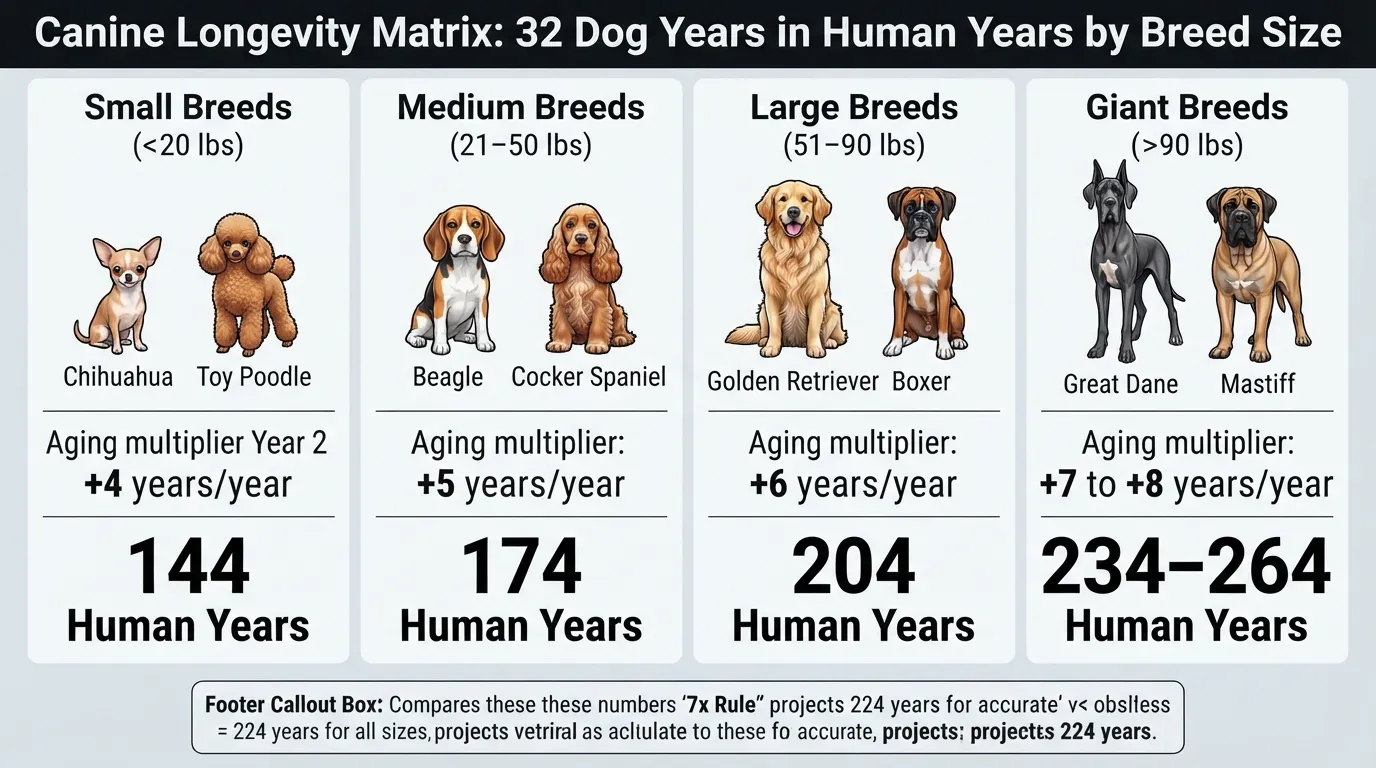
Body mass plays a huge role in how dogs age. While a small dog accumulating 32 calendar years moves through aging at a slower pace, larger breeds experience much faster cellular aging after their initial growth period.
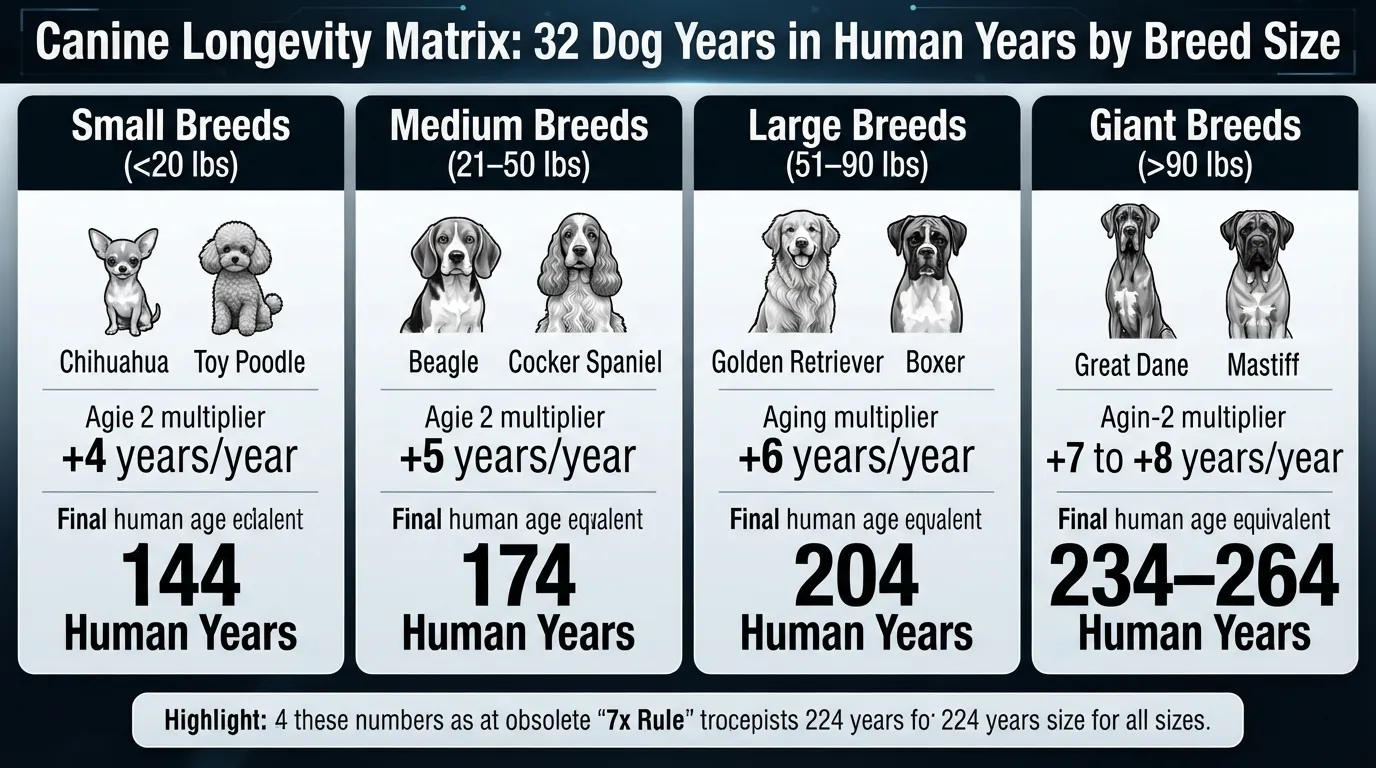
The comparison below shows how 32 calendar years convert into human-equivalent age across different weight categories using standard veterinary guidelines:
| Breed Size Category | Adult Weight Range | Aging Multiplier (Year 3+) | Equivalent Human Age at 32 Dog Years |
|---|---|---|---|
| Small Breeds | Under 20 lbs (e.g., Chihuahua, Toy Poodle) | +4 human years / year | 144 human years |
| Medium Breeds | 21–50 lbs (e.g., Beagle, Cocker Spaniel) | +5 human years / year | 174 human years |
| Large Breeds | 51–90 lbs (e.g., Golden Retriever, Boxer) | +6 human years / year | 204 human years |
| Giant Breeds | Over 90 lbs (e.g., Mastiff, Great Dane) | +7 to +8 human years / year | 234–264 human years |
Note: Alternate guidelines from the UK Kennel Club use breed-specific longevity curves (counting the first 2 years as 9–12.5 human years, followed by tailored multipliers from 4.3 up to 13.4 per year), which yields minor variations for individual purebred dogs.
What This Means for Senior Dog Care
Reaching 32 calendar years puts a dog deep into the ultimate “super senior” stage—a milestone so rare that it demands specialized, compassionate care focusing entirely on pain management, joint support, and cognitive comfort. At this advanced age, routine wellness checks, tailored nutrition, and gentle daily adjustments become essential to maintaining their quality of life.
For complete daily management tips, customized dietary steps, and warning signs to track as your dog ages, explore our comprehensive senior dog care guide.
8. Frequently Asked Questions
| Question | Answer |
|---|---|
| Is 32 dog years a real, possible age? | Yes, but it is extremely rare. While reaching 32 calendar years is medically exceptional, dogs reaching equivalent senior ages (in human years) is normal. However, verified cases of actual 32-year-old dogs exist in rare historical records. |
| Why do some calculators max out at 32 years? | Calculators often max out at 32 because it represents the absolute ceiling of recorded canine longevity. Biological formulas become less predictable beyond 20 to 25 calendar years due to limited statistical data. |
| What is 32 dog years in human years for a small dog? | For small breeds, 32 actual calendar years equals roughly 140 to 160 human years using modern logarithmic aging formulas (like the UCSD model). Small dogs age slower after their initial adult growth phase. |
| What is 32 dog years in human years for a large/giant dog? | For large and giant breeds, 32 calendar years would translate to over 180 to 200 human years. Giant breeds age much faster at a cellular level, making this theoretical threshold even more extreme. |
| What's the world record for the oldest dog ever? | Historically, Bluey, an Australian Cattle Dog who lived to 29 years and 5 months (1910–1939), held the long-standing record. Other claims of dogs reaching 30+ years exist, though documentation varies. |
| Is the 7-year rule accurate at 32 years? | No. Multiplying 32 calendar years by 7 gives 224 human years, which is mathematically inaccurate. The 7-year rule breaks down rapidly for senior dogs, as aging rates slow down significantly in late adulthood. |
🐾 Other Age Guides

I built Dogagescalculator.com to give dog owners honest, science-backed answers instead of the outdated "×7" myth. Every figure here is checked against AKC, AVMA, and published veterinary research.
More about the author & this site →
Comments