
How Long Does It Take a Chihuahua to Give Birth?
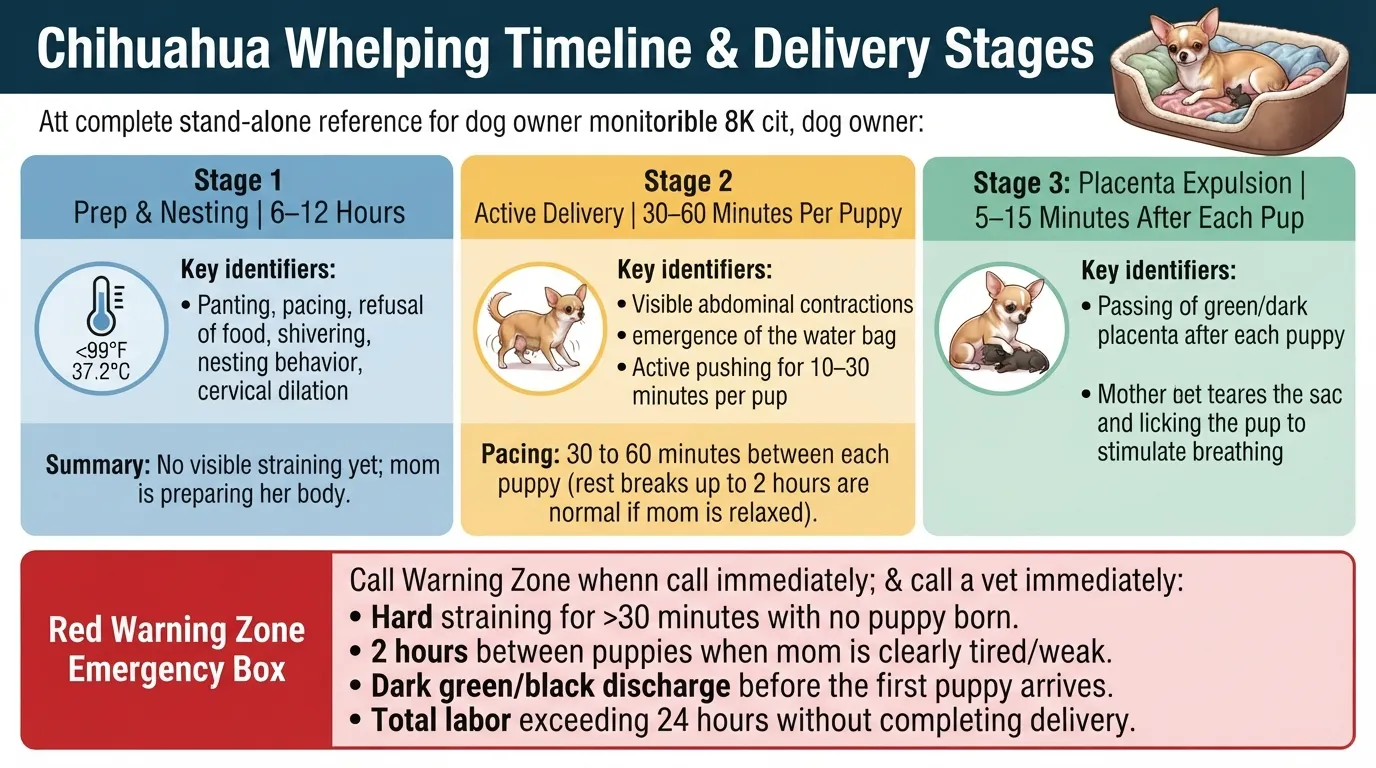
A Chihuahua’s labor typically lasts between 6 to 18 hours from start to finish. Once active straining begins, delivery takes 10 to 30 minutes per puppy, with a normal resting gap of 30 minutes to 2 hours between births. A typical Chihuahua litter ranges from 1 to 3 puppies.dog ages calculator
How Long Are Chihuahuas Pregnant Before Labor Begins?
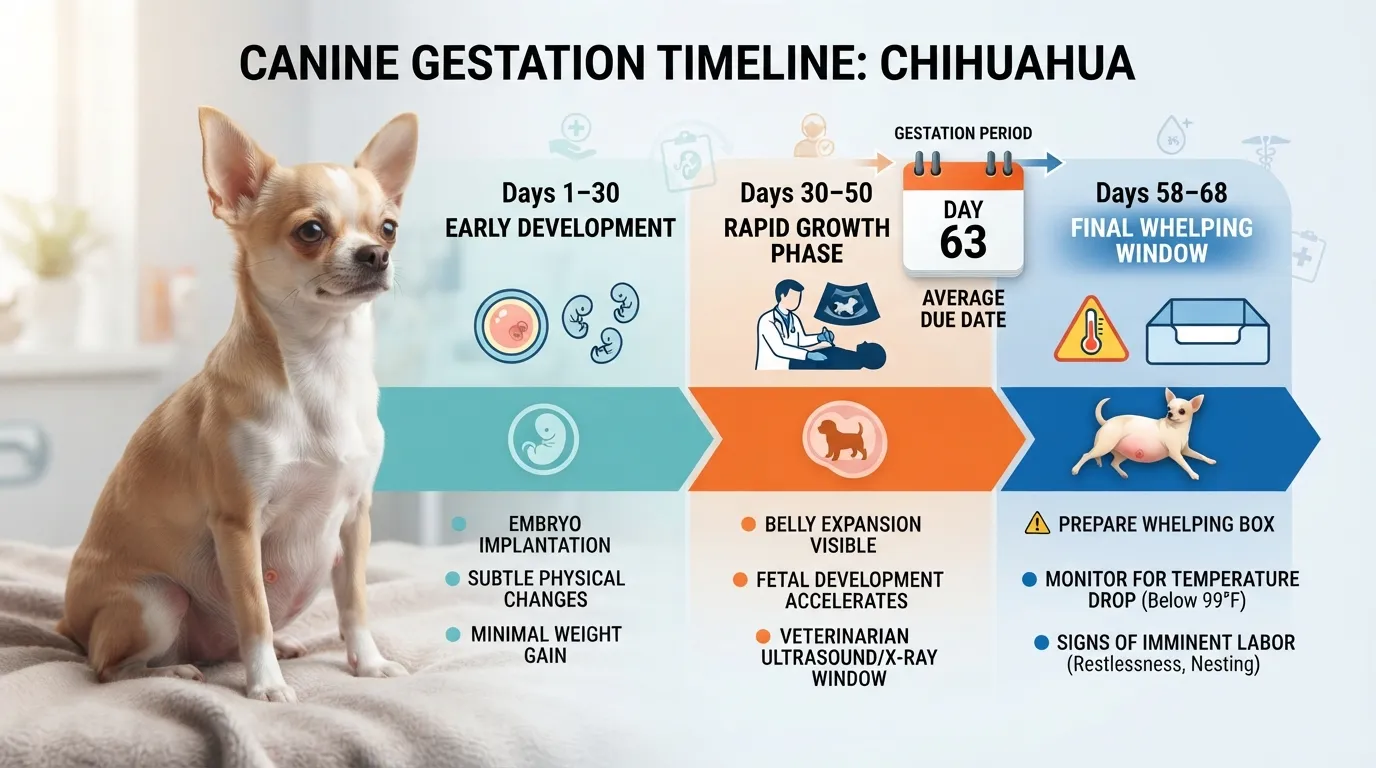
A Chihuahua’s pregnancy typically lasts between 58 and 68 days, with 63 days from ovulation being the most common average. Because Chihuahuas are a toy breed, pinpointing an accurate timeline helps you prepare your whelping area well before active labor starts.
Why Due Dates Can Vary
It is completely normal for a Chihuahua’s delivery date to shift by a few days depending on several biological factors:
Inaccurate Breeding Dates: Sperm can survive inside the female for up to a week. If you calculated the due date based on the mating date rather than ovulation testing (progesterone levels), the actual fertilization may have happened several days later.
Litter Size: Larger litters often trigger labor a day or two early because the uterus reaches maximum capacity faster. Conversely, a Chihuahua carrying just one or two puppies might stay pregnant a bit longer.
First-Time Mothers: Maiden dam Chihuahuas sometimes take slightly longer to go into Stage 1 labor compared to experienced mothers.
What If She Goes Past 68 Days?
If your Chihuahua reaches day 68 after breeding without showing any signs of labor (like a drop in body temperature, nesting, or loss of appetite), contact your veterinarian immediately.
Because of their tiny body structure and prone nature to single-pup litters, overdue Chihuahuas run a higher risk of dystocia (difficult birth) or puppies outgrowing the pelvic canal. A quick ultrasound or X-ray by your vet will confirm the puppies’ heart rates and determine if a planned C-section is necessary to keep both mom and her litter safe.
How Long Does Chihuahua Labor Actually Take? Full Timeline
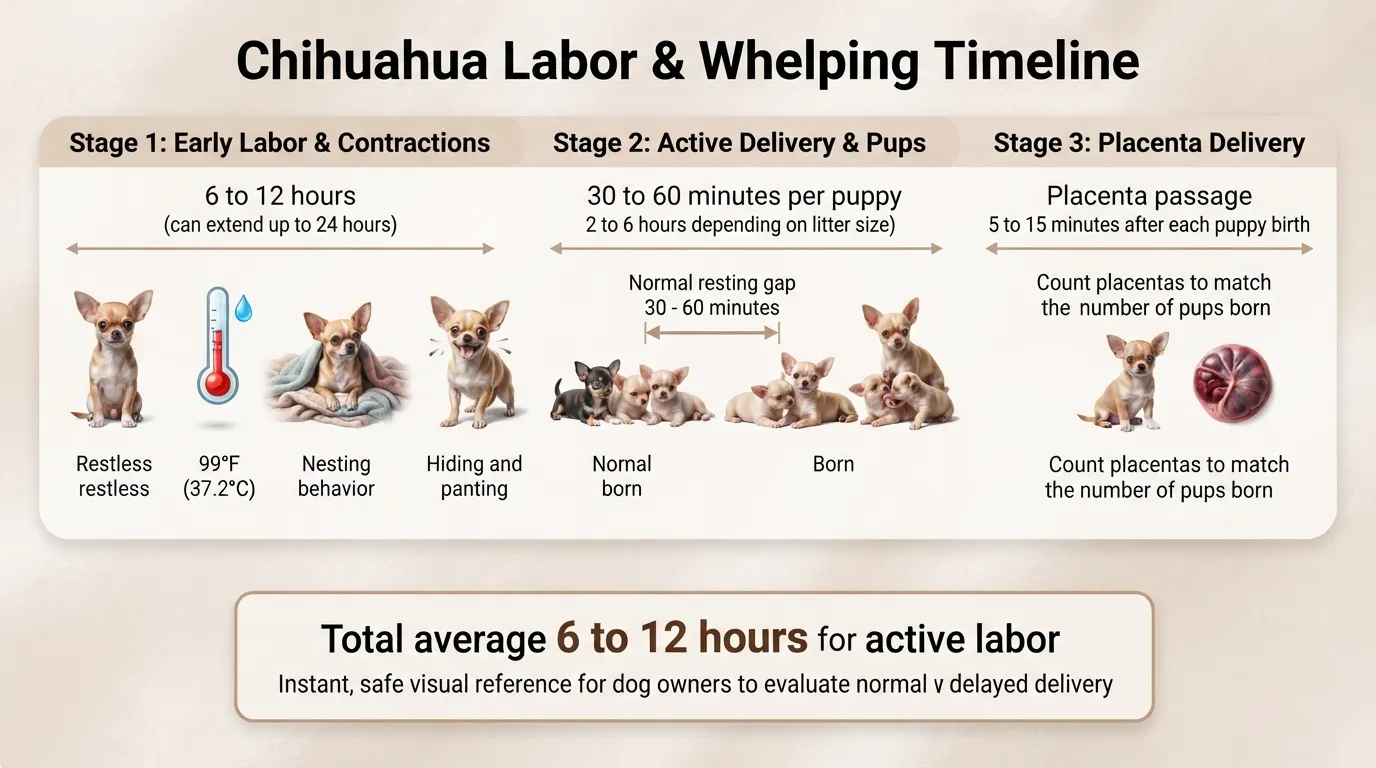
On average, total labor for a Chihuahua lasts between 3 to 12 hours from the first hard push to the delivery of the final placenta. If it’s your Chihuahua’s very first litter, or if she’s carrying a larger-than-normal litter, the whole process can stretch up to 24 hours.
To help you keep track of what’s normal during active delivery, here is a quick breakdown of the three stages of Chihuahua whelping:
| Stage | Average Duration | What You Will See Happening |
|---|---|---|
| Stage 1 (Early Labor) | 6 to 12 hours (up to 24 hrs for first-timers) | Nesting, panting, shivering, pacing, and refusing food. Her body temperature usually drops below 99°F (37.2°C). No visible pushing yet. |
| Stage 2 (Active Delivery) | 2 to 6 hours total (10–60 mins per puppy) | Hard, visible abdominal contractions. The water sac breaks, and puppies are born one by one. |
| Stage 3 (Placenta Delivery) | 5 to 15 minutes (after each puppy) | Passing of a green-black placenta after each pup. Your female may eat them—this is completely natural. |
How Long Between Each Puppy?
In a smooth Chihuahua delivery, you will usually see a puppy arrive every 10 to 60 minutes.
It’s completely normal for a mother dog to take a short breather between pups. She might rest quietly, nurse the newborns already beside her, and regain her strength. However, you need to keep a close eye on the clock during these breaks:
10 to 30 minutes: Ideal gap between puppies during active delivery.
30 to 60 minutes: Normal resting period, provided she isn’t actively straining.
Over 60 minutes of hard straining: Red flag. If she is pushing hard for more than 30 to 45 minutes without producing a puppy, something is wrong.
2 hours between puppies without pushing: Emergency. If over 2 hours have passed since the last puppy and you know there are more inside, call your vet immediately.
Pro Tip: Keep a notebook and pen right next to the whelping box. Write down the exact time each puppy arrives, whether the placenta came out with it, and its birth weight. When you’re running on zero sleep at 3 AM, you will not remember these details.
Does Litter Size Affect How Long Labor Takes?
Yes, litter size directly impacts the total time your Chihuahua will spend in labor.
Chihuahuas typically have small litters—usually between 1 and 4 puppies, with 3 being the sweet spot.
Single-Puppy Litters 1 Puppy: Labor is usually much shorter overall, often wrapped up within 2 to 4 hours of active stage 2 labor. However, single-puppy pregnancies carry a higher risk of “Single Pup Syndrome,” where the puppy grows too large for the birth canal because it had all the room and nutrients to itself. Watch these deliveries very carefully.
Larger Litters 4 to 6 Puppies: The actual labor phase will naturally take longer simply because there are more puppies to deliver. A mom delivering 5 puppies will take significantly more time than one delivering 2.
Keep in mind that uterine fatigue is common in small breeds with larger litters. By puppy number 4 or 5, your Chihuahua’s uterine muscles may tire out, slowing down contractions or stopping labor entirely before the last pup is born.
The 3 Stages of Chihuahua Labor
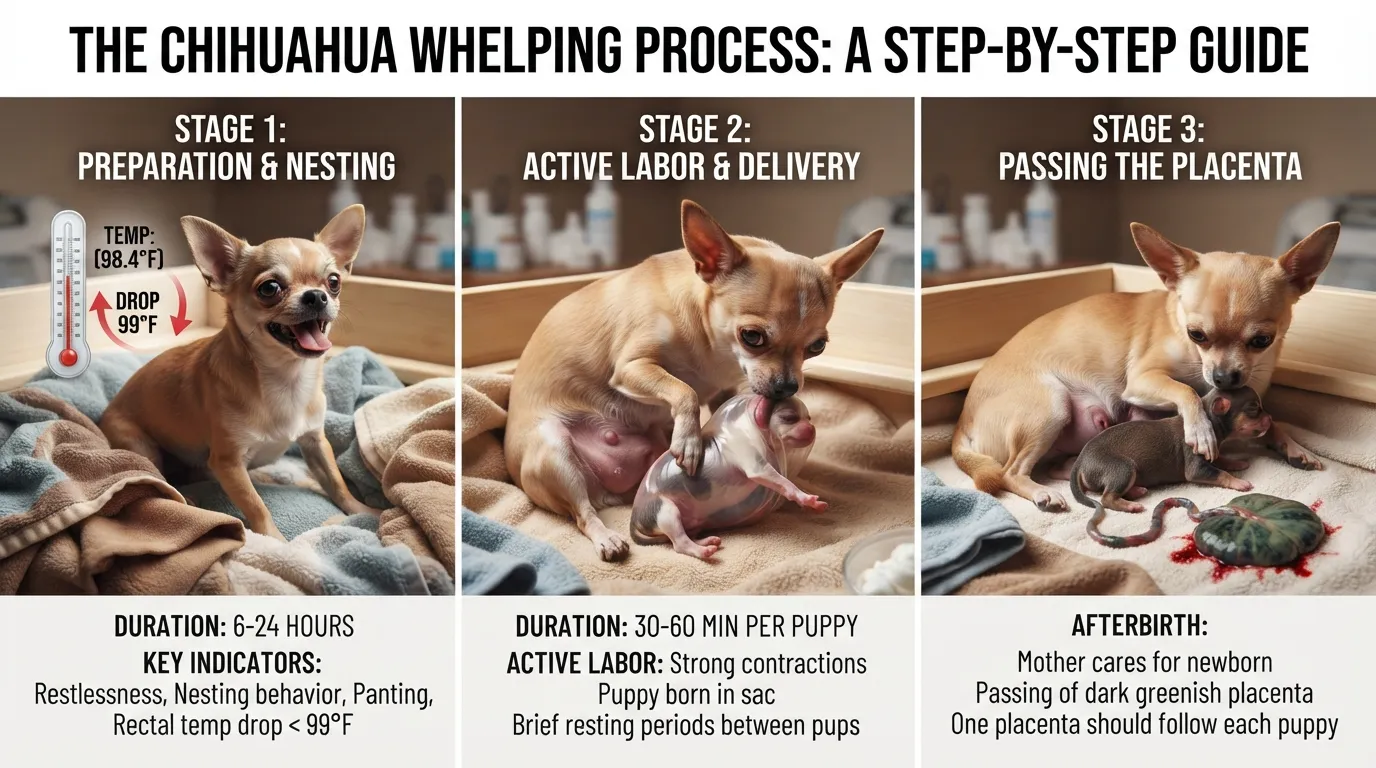
Understanding the labor process helps you stay calm and know exactly what your pregnant Chihuahua is going through. Labor unfolds in three distinct stages, starting hours before the first puppy actually arrives.
Stage 1 – Early Labor & Signs
Stage 1 typically lasts between 6 to 12 hours, though it can stretch up to 24 hours for a first-time mother. During this phase, your Chihuahua’s cervix begins to dilate and uterine contractions start internally, though you won’t see visible straining yet.
Your dog will show subtle behavioral and physical cues during early labor:
Temperature Drop: A healthy dog’s body temperature sits between 101°F and 102.5°F. About 8 to 24 hours before active labor begins, her temperature drops below 100°F (usually around 98°F or 99°F).
Nesting Behavior: She will actively shred blankets, dig in her whelping box, or try to create a hidden, secure space.
Restlessness & Pacing: You’ll notice her changing positions constantly, panting, shivering, or following you around more than usual.
Loss of Appetite: Most Chihuahuas refuse food entirely 12 to 24 hours before labor starts, though some might still drink small amounts of water.
Vomiting or Shivering: Light vomiting or clear, odorless vaginal discharge can occur as her body prepares.
Real Labor vs. False Labor
It’s common for owners to confuse false labor (Braxton Hicks contractions or pre-labor anxiety) with active Stage 1 labor. Here is how to tell the difference:
Temperature Readout: Real labor is almost always preceded by a sustained rectal temperature drop below 100°F. False labor rarely shows a true, sustained temperature drop.
Progression of Symptoms: False labor symptoms come and go in short bursts, and the dog usually calms down within an hour or two. Real labor symptoms steadily intensify and do not stop once started.
Eating & Drinking: A dog in false labor will often still take high-value treats or food if offered. A Chihuahua entering true Stage 1 labor almost always refuses food.
Contraction Rhythm: False labor involves irregular, mild restlessness with no clear pattern. True labor shifts consistently into active nesting, shivering, and visible discomfort.
How Many Puppies Do Chihuahuas Have?
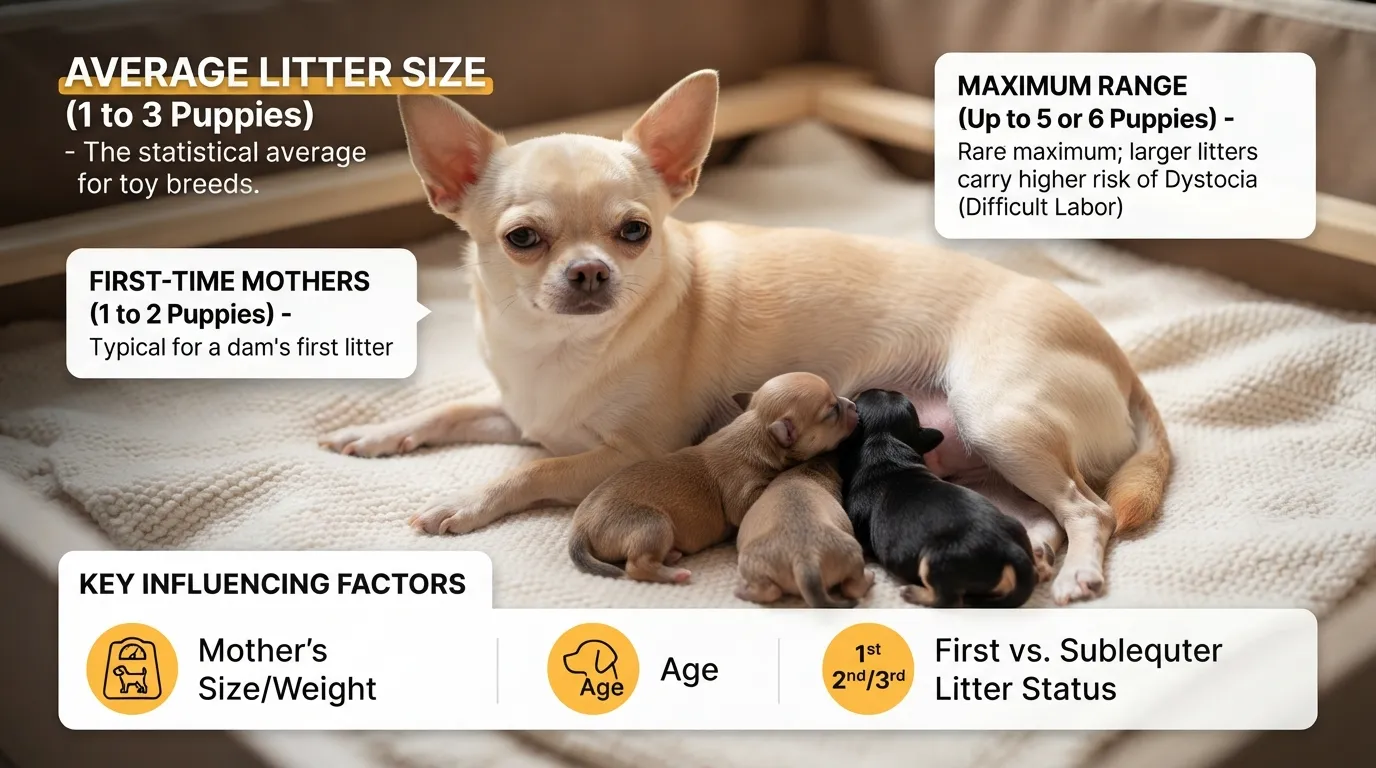
A typical Chihuahua litter sizes up to 1 to 3 puppies, though litters of up to 5 or 6 can happen in larger or experienced moms. Because Chihuahuas are tiny, even one extra puppy makes a huge difference in how long labor lasts and how physically demanding it is for her body.
If you haven’t already, try to get a count from your vet via an X-ray or ultrasound before labor begins. Knowing the exact puppy count lets you track labor progress accurately and prevents the dangerous assumption that she’s finished when a puppy might still be trapped inside.
Does Labor Take Longer for First-Time Moms?
Yes, first-time Chihuahua moms (primiparous females) generally take longer to go through active labor. Their uterine muscles haven’t stretched before, and they are often more anxious, which can temporarily stall contractions.
Here is what you can expect when a first-time mom delivers compared to an experienced breeder dog:
Slower Stage 1 Labor: Early labor restlessness and temperature drops often drag out closer to the full 24-hour mark in first-timers as her body prepares for delivery.
Longer Delivery Intervals: First-time moms frequently rest longer between puppies—sometimes up to 1 to 2 hours between births—as their bodies adjust to the intense exertion.
Needing Extra Support: A panicked young mom might not immediately instinctually break the amniotic sac or chew the umbilical cord. You should keep clean towels, blunt-tipped scissors, and a bulb syringe nearby to jump in within 60 seconds if she hesitates.
If a first-time mom is pushing hard with active contractions for more than 30 minutes without producing a puppy, contact your vet or emergency clinic right away. Chihuahuas are especially prone to dystocia (difficult birth), and immediate medical guidance is essential.
Why Chihuahuas Have a Higher Risk of Difficult Birth Dystocia
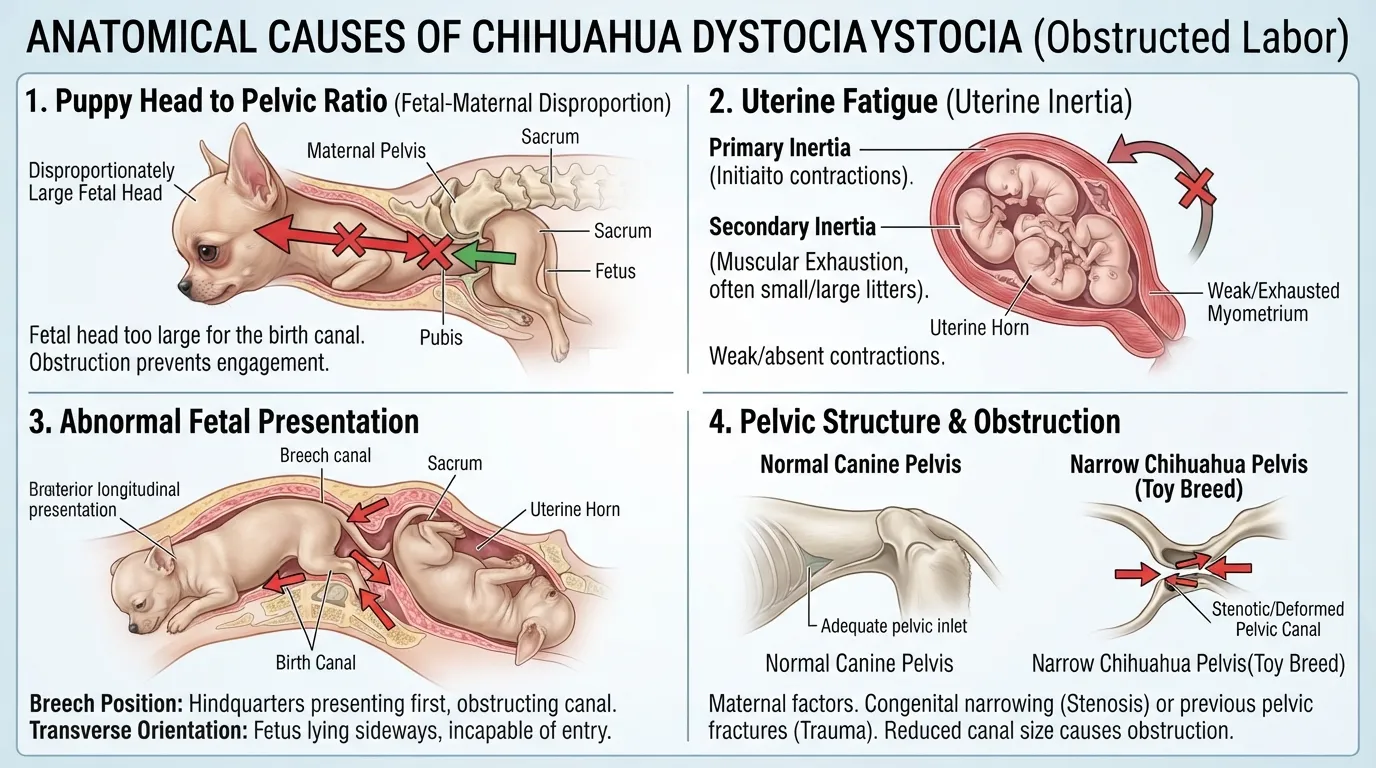
Chihuahuas face a significantly higher rate of dystocia (difficult labor) compared to larger breeds. The main biological culprit is disproportion: Chihuahuas have a remarkably narrow pelvic canal, yet their puppies often feature relatively large, dome-shaped heads (apple-head traits). This creates a high risk of fetal-maternal disproportion, where a puppy physically cannot pass through the birth canal, leading to blocked delivery.
Teacup Chihuahuas — Extra Risk
If your Chihuahua weighs under 4 pounds (often referred to as a “teacup” or micro-Chihuahua), the risks increase dramatically. Their pelvic structure is extremely tiny, and their body reserves are minimal.
Uterine Inertia: Tiny Chihuahuas exhaust their muscle energy quickly. Their uterus may simply stop contracting before all puppies are delivered.
Severe Hypoglycemia: The stress and exertion of labor can cause their blood sugar to crash dangerously fast.
Higher C-Section Rate: Most experienced veterinarians recommend planning a C-section for Chihuahuas under 4 pounds rather than risking natural labor.
Signs of Dystocia Emergency Warning Signs
Labor complications can become life-threatening for both the mom and puppies within an hour. Contact an emergency vet immediately if you notice any of these red flags:
Hard contractions for more than 30–45 minutes without a puppy being produced.
More than 2 hours passing between puppies when you know more are still inside.
Green or dark discharge before the first puppy is born (this signals placental separation and fetal distress).
Extreme lethargy, collapse, or shaking/tremors (which can indicate hypocalcemia or hypoglycemia).
A puppy stuck in the birth canal visible for more than 10 minutes without progress.
Active labor lasting over 12 hours total with incomplete delivery.
When Is a C-Section Needed?
A C-section becomes necessary when natural delivery poses an immediate threat to the mother or her litter. Vets typically advise an emergency C-section if dystocia is diagnosed, if ultrasound shows puppy distress (heart rates below 160–180 bpm), or if a puppy is abnormally positioned and blocking the passage.
| Factor | What to Expect |
| Cost Range | $1,500 to $4,000+ (Emergency/after-hours clinics generally charge higher rates than planned procedures). |
| Anesthesia Risk | Chihuahuas are sensitive to anesthesia, but modern vet protocols specifically use safe, short-acting agents for pregnant dogs. |
| Recovery Time | The mother usually recovers within 10–14 days. Incision sutures are typically removed after 2 weeks. |
| Post-Op Nursing | Mom can start nursing as soon as she wakes up from anesthesia, but you must supervise closely until the medication fully wears off. |
Keep your vet’s phone number and the address of the nearest 24/7 emergency animal hospital pinned near your whelping box before labor starts.
When to Call the Vet Immediately Emergency Checklist
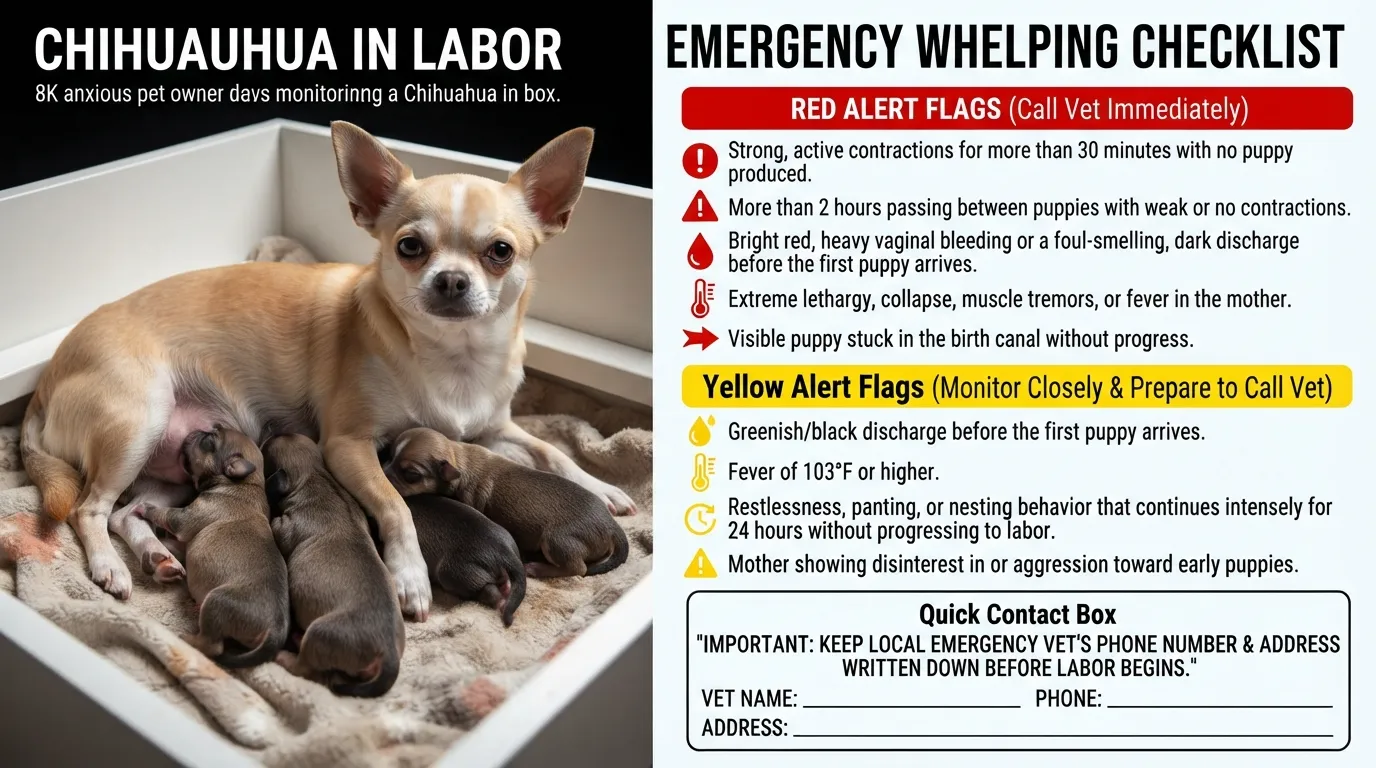
Chihuahuas are prone to dystocia (difficult birth) because of their tiny pelvic structures and relatively large puppy heads. While a calm environment helps, you must act fast if labor stalls. Keep your vet or nearest emergency clinic’s number saved on your phone and call right away if you notice any of these red flags:
Strong, active contractions for 30 to 60 minutes with no puppy produced: If your Chihuahua is hard at work pushing constantly and nothing appears within an hour, a puppy might be stuck in the birth canal.
A gap of 2 or more hours between puppies: While a mother dog can take brief rest breaks between deliveries, waiting longer than two hours—especially if you know there are more puppies inside—signals severe labor fatigue or a blockage.
Extreme pain, vocalization, or utter exhaustion: Continuous crying, biting at her rear, or trembling uncontrollably from pain is not typical labor discomfort. Similarly, if she gives up pushing completely and lies limp, her body has exhausted its energy reserves.
Greenish-black discharge before the first puppy arrives: A dark green discharge (uteroverdin) indicates that a placenta has detached from the uterine wall. If this happens before a puppy is delivered, that puppy’s oxygen supply is compromised and immediate medical intervention is required. (Note: Green discharge after a puppy is born is completely normal).
How to Prepare for Your Chihuahua's Labor
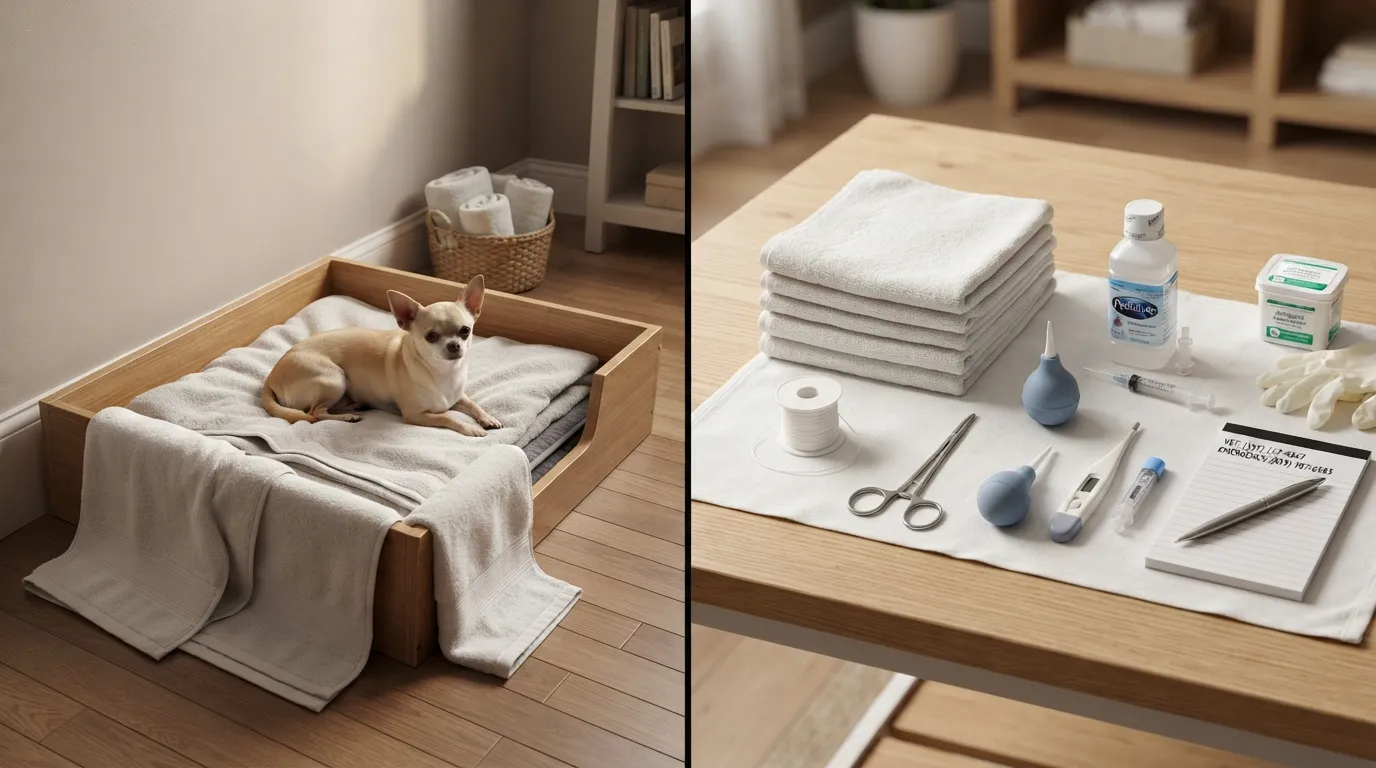
Preparing for your Chihuahua’s labor early takes a huge weight off your shoulders when delivery day finally arrives. Because Chihuahuas are a toy breed prone to whelping complications due to their small pelves and relatively large puppy heads, having everything organized beforehand isn’t just helpful—it can save lives.
Here is how to get your home and vet strategy ready well before the first contraction hits.
Whelping Box Setup
Set up the whelping box at least 1 to 2 weeks before her expected due date. This gives your Chihuahua time to get comfortable with the space so she doesn’t try to hide in a closet or under your bed to give birth.
Location: Choose a quiet, warm, and draft-free room with minimal foot traffic. Chihuahuas need to feel completely safe to let labor progress smoothly.
Size & Structure: A low-sided wooden box, a sturdy plastic whelping box, or even a heavy-duty plastic storage container with one side cut down works great. It should be big enough for her to stretch out fully, but cozy enough to retain heat.
Pig Rails: Ensure the box has internal safety rails (pig rails) raised 2 to 3 inches off the floor. These prevent mom from accidentally trapping or suffocating a tiny puppy against the wall.
Bedding: Line the bottom with non-skid rubber matting, followed by clean, dry towels or fleece blankets. Avoid loose, shredded paper or deep plush bedding that newborn Chihuahuas can easily get lost or smothered under.
Temperature Control: Newborn puppies cannot regulate their own body temperature. Keep a heating pad (set on low, wrapped in a thick towel and covering only half the box) or an overhead heat lamp ready to maintain a ambient temperature of around 85°F to 90°F (29°C to 32°C) for the first week.
Supplies Checklist
Keep a dedicated basket or tray right next to the whelping box containing these essential supplies:
Clean Bath Towels & Washcloths: Lots of them, pre-washed without strong scented detergents, to warm and dry newborns immediately.
Unflavored Dental Floss or Sterilized Thread: To tie off umbilical cords if the mother doesn’t chew them herself.
Blunt-End Scissors: Sterilized with rubbing alcohol, for cutting umbilical cords.
Bulb Syringe Pediatric Suction Bulb: Crucial for clearing fluid from a newborn puppy’s mouth and nostrils right after birth.
Digital Thermometer & Water-Based Lubricant: To monitor her rectal temperature daily starting around day 57 (a sharp drop below 99°F or 37.2°C usually signals labor within 24 hours).
Antiseptic Betadine or Iodine: To dab on the cut ends of the umbilical cords to prevent infection.
Unweighed Food Scale Grams/Ounces: To weigh each puppy at birth and track daily growth.
Color-Coded Ribbons or Soft Collars: To identify identical-looking puppies in the litter.
Whelping Chart & Pen: To record birth times, birth weights, placenta deliveries, and any notes.
Veterinary Emergency Contact Info: Written clearly on paper—including your primary vet’s number and the nearest 24/7 emergency clinic address.
Vet Check at 55–58 Days X-Ray for Puppy Count
Scheduling a veterinary visit around days 55 to 58 of pregnancy is one of the most critical steps in Chihuahua breeding.
At this stage, the puppies’ skeletons have calcified enough to show up clearly on a radiograph (X-ray). Knowing the exact puppy count before labor starts is a major safety advantage. If your Chihuahua gives birth to three puppies, but the X-ray showed four, you will know immediately that she has a retained puppy or placenta and requires urgent emergency vet care.
This late-stage visit also allows your vet to evaluate the mother’s overall health, assess puppy size relative to her pelvic opening, and determine whether a scheduled or emergency C-section might be necessary.
What to Do After Each Puppy Is Born
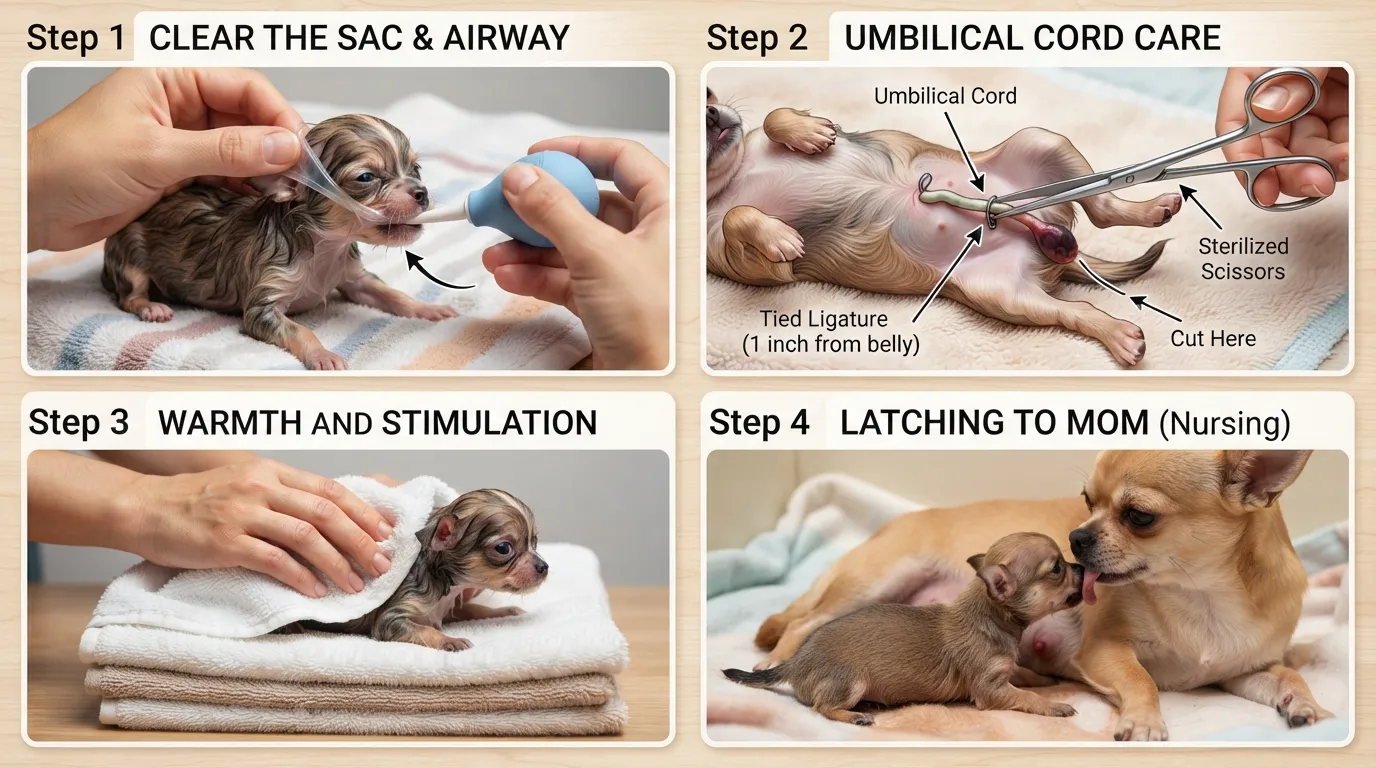
The moment a puppy drops, your Chihuahua’s natural instincts usually kick in within seconds. However, because Chihuahuas are a toy breed and often deliver small litters with high exertion, they can tire out fast. Here is the immediate care routine for every newborn puppy:
Clear the amniotic sac: If the mother doesn’t tear the sac open within 30 to 60 seconds, gently rip the membrane around the puppy’s face with your fingers and clear the nose and mouth using a clean bulb syringe or soft towel.
Handle the umbilical cord: The mom will usually chew through the cord herself. If she ignores it, tie off the cord with clean dental floss about 1 to 2 inches from the puppy’s belly, snip it with sterilized scissors, and dab the tip with a drop of Iodine to prevent infection.
Stimulate breathing and warmth: Rub the puppy briskly with a clean, dry towel. This friction dries their coat and encourages their lungs to expand. Keep the whelping box warm—around 85°F to 90°F (29°C to 32°C)—since tiny Chihuahua puppies cannot regulate their body temperature for the first few weeks.
Encourage early nursing: As soon as the puppy is dry and breathing comfortably, place them near the mother’s nipple. Early nursing supplies vital colostrum and triggers natural oxytocin release, helping the dam with her next contractions.
Should You Help or Let Her Do It Alone?
Step back first, but stay within arm’s reach.
Most Chihuahuas prefer to handle the process on their own, and interfering unnecessarily can stress the mother or disrupt her bond with the pups. Let her lick the baby, break the sac, and clean her puppy if she is actively doing so.
However, you must intervene immediately if:
She looks exhausted and ignores a puppy still wrapped in its sac.
A puppy is born and she isn’t cleaning or stimulation-rubbing them.
She chews too close to the puppy’s abdomen while severing the umbilical cord.
Keep a clean towel, bulb syringe, dental floss, and blunt-ended scissors right beside the whelping box so you can step in seamlessly without creating panic.
Chihuahua Postpartum Care
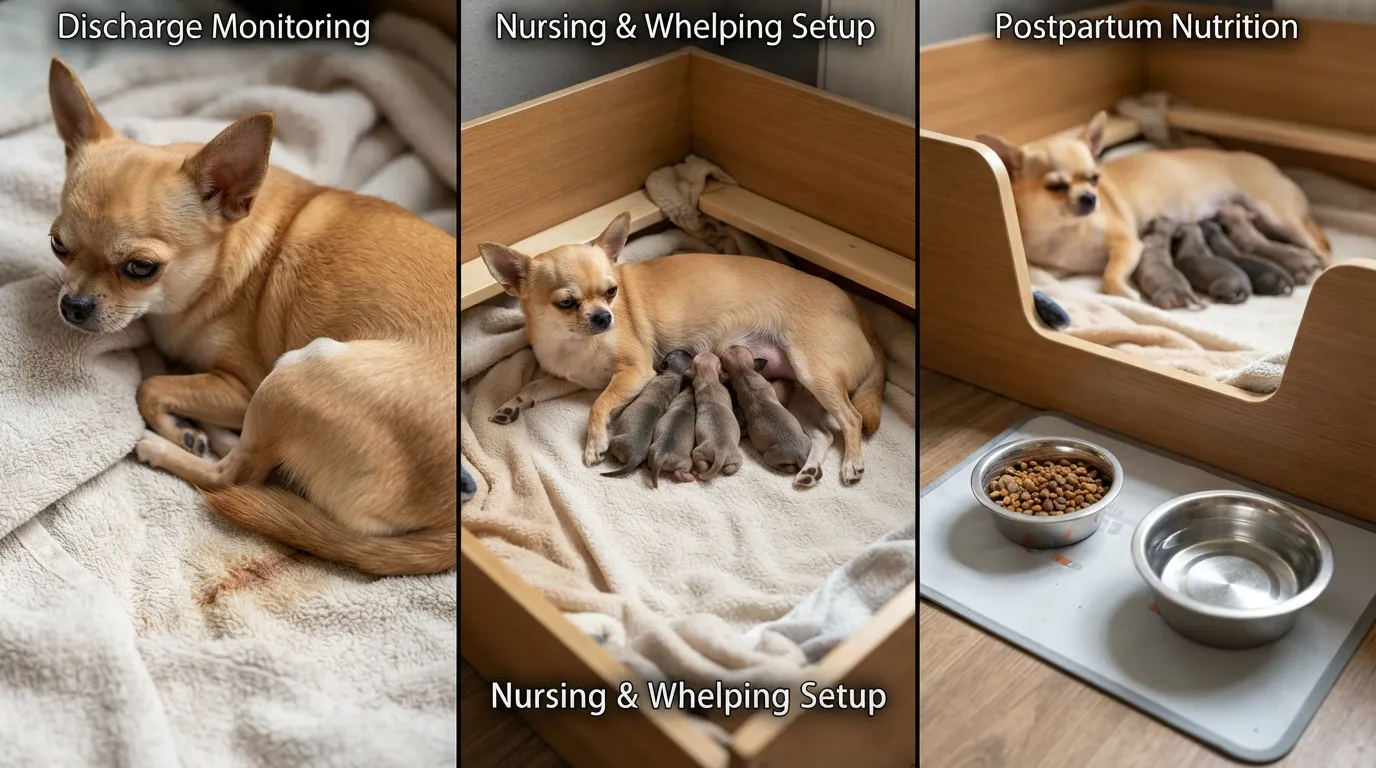
Taking care of your Chihuahua after she gives birth is just as important as managing her labor. Her body has gone through immense physical strain, and the next few weeks require close monitoring to ensure both the new mom and her pups stay healthy.
Managing Normal Discharge (Lochia): You’ll notice a reddish-brown or dark green vaginal discharge called lochia for about 3 to 7 days after whelping. This is completely normal as her uterus cleanses itself. However, if the discharge smells foul, turns bright red with active heavy bleeding, or continues beyond 3 weeks, contact your vet immediately as these can be signs of a uterine infection (metritis).
Supporting the 8-Week Nursing Period: Chihuahua puppies rely entirely on their mother’s milk for the first 3 to 4 weeks before weaning slowly begins, with full weaning usually completed by 8 weeks. Keep the whelping area warm, quiet, and clean so mom feels safe enough to stay with her pups without feeling stressed or agitated.
Mother’s Recovery Diet: Producing milk burns a tremendous amount of energy, especially for a toy breed. Transition your Chihuahua to high-calorie, nutrient-dense puppy food (or a vet-recommended lactation diet) right after birth, and keep fresh water available right next to her bed at all times. Feeding her smaller, frequent meals throughout the day helps her maintain weight and supports a strong milk supply without overwhelming her delicate stomach.
FAQs
| Question | Answer |
|---|---|
What is the best age for a Chihuahua to give birth? | The ideal age for a Chihuahua to give birth is between 2 and 5 years old. Breeding under 2 years carries health risks as her body isn't fully mature, while breeding past 5 years increases complication risks. |
Can Chihuahuas give birth naturally or do they always need a C-section? | While natural births are possible, Chihuahuas frequently require C-sections due to their narrow pelvises and relatively large puppy heads. If labor stalls, see our Dystocia section for emergency warning signs. |
How do I know labor is completely finished? | Labor is complete when contractions cease, all placentas have been delivered, the mother calms down to nurse, and her abdominal area relaxes. If she continues straining for over 30 minutes, consult a veterinarian immediately. |
Is it normal for a Chihuahua to pause/rest during labor? | Yes, resting for 30 minutes up to 2 hours between puppies is completely normal as long as the mother is resting quietly and not actively straining without producing a puppy. |
What is the best age for a Chihuahua to give birth?
Can Chihuahuas give birth naturally or do they always need a C-section?
How do I know labor is completely finished?
Is it normal for a Chihuahua to pause/rest during labor?
🐾 Other Age Guides

I built Dogagescalculator.com to give dog owners honest, science-backed answers instead of the outdated "×7" myth. Every figure here is checked against AKC, AVMA, and published veterinary research.
More about the author & this site →
Comments