How Long Do Pugs Live in Human Years? Pug Age Chart + Lifespan Guide
If you’re wondering how long Pugs live, the typical Pug lifespan is about 12 to 15 years. Some Pugs may live beyond this range, while others may have a shorter life depending on genetics, body weight, nutrition, exercise, breathing health, and regular veterinary care.
Pugs are a small companion breed known for their affectionate personalities and distinctive flat-faced appearance. However, their brachycephalic (short-muzzled) structure can make breathing and heat regulation important lifelong health considerations. Keeping a Pug at a healthy weight and addressing breathing or other health problems early can play an important role in supporting a longer life.
Pug Lifespan at a Glance
| Lifespan Factor | What to Know |
|---|---|
| Average Pug Lifespan | About 12–15 years |
| Breed | Pug |
| Size | Small |
| Senior Years | Usually around 8–10+ years |
| Main Lifespan Factors | Genetics, weight, nutrition, exercise, breathing health, and veterinary care |
| Exceptional Longevity | Some Pugs may live beyond 15 years |
So, how long can Pugs live? A healthy, well-cared-for Pug can often enjoy more than a decade of life, but individual longevity varies. Because Pugs can be prone to weight gain, breathing difficulties, eye problems, and other breed-related conditions, preventive care is especially important.
If you’re also asking how long Pugs live in human years, their age does not convert using the outdated “one dog year equals seven human years” rule. Dogs mature very quickly during their first two years, and their equivalent human age changes more gradually afterward. A 12-year-old Pug, for example, is a senior dog and is roughly comparable to a human in their late 60s or older, depending on the aging method used.
In this guide, we’ll cover the Pug lifespan, Pug life expectancy, Pug age span, human-year equivalents, common health factors, and practical ways to help your Pug live a longer and healthier life.
How Long Do Pugs Live? Average Lifespan
Average Lifespan Range 12–15 Years
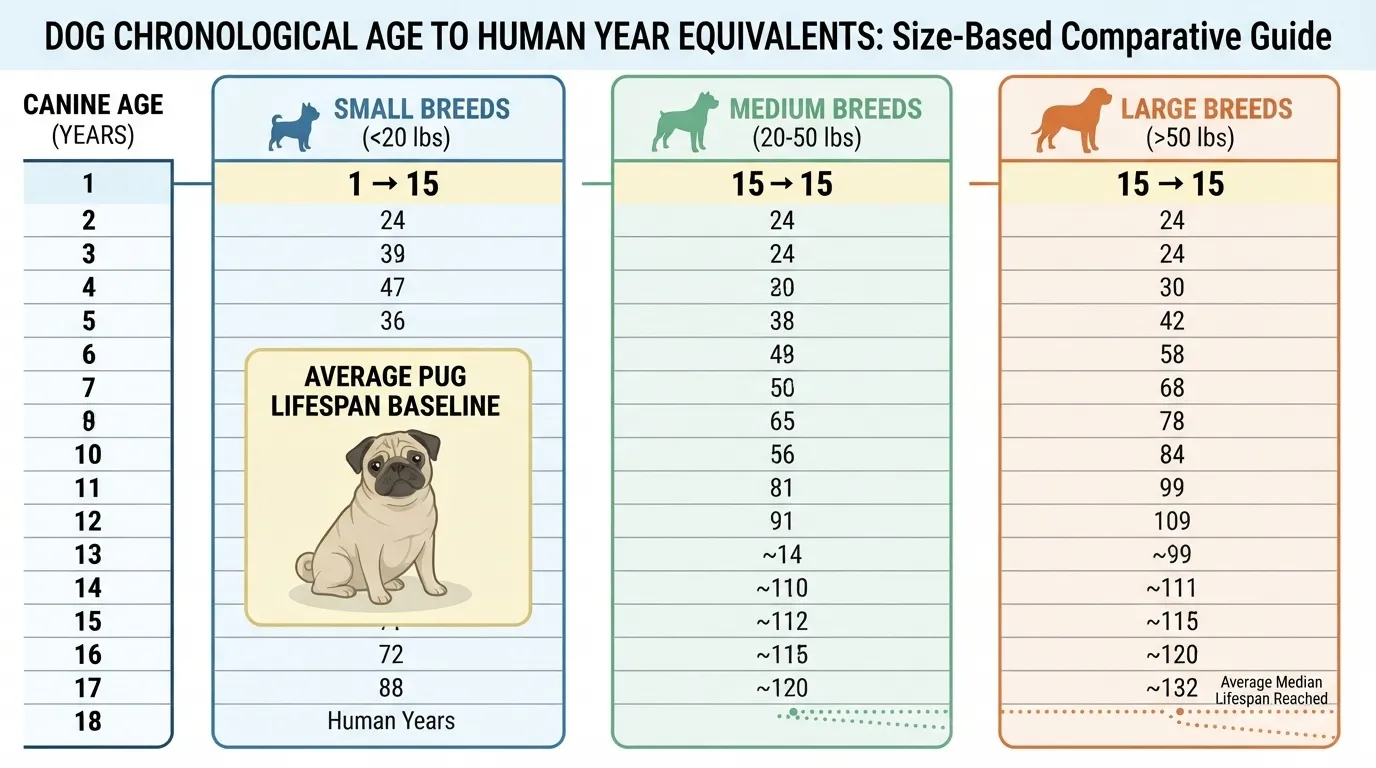
A healthy Pug typically lives between 12 and 15 years. Because they are a small breed, they generally enjoy a longer lifespan than large-breed dogs, whose bodies age at a much faster metabolic rate. However, reaching the upper end of this 15-year range depends heavily on managing the specific genetic health risks built into the breed’s signature anatomy.
Male vs Female Pug Lifespan
Data from veterinary cohort studies, including extensive lifespan data from the Royal Veterinary College, indicates that female Pugs tend to live slightly longer than males. On average, female Pugs outlive their male counterparts by a window of about one to two years. While behavioral traits and neuter status play a role in overall longevity, male Pugs are statistically slightly more prone to early onset mobility issues and weight-related complications that can impact their later years.
Pugs vs Average Dog Lifespan
When looking at the broader canine world, Pugs hold a unique position. The average lifespan across all domestic dogs sits around 11 to 12 years, meaning Pugs frequently outlive the baseline average.
| Dog Group / Breed Size | Average Lifespan | Comparison to Pug |
|---|---|---|
| All Dogs (Baseline Average) | 11 – 12 Years | Pugs live 1 to 3 years longer |
| Large Breeds (e.g., German Shepherds) | 9 – 11 Years | Pugs live 3 to 4 years longer |
| Standard Pugs | 12 – 15 Years | Target Breed Baseline |
| Longest-Lived Small Breeds (e.g., Chihuahuas) | 15 – 18 Years | Pugs live 2 to 3 years less |
| All Dogs (Baseline Average) | |
|---|---|
| Lifespan: | 11 – 12 Years |
| vs. Pug: | Pugs live 1 to 3 years longer |
| Large Breeds (e.g., German Shepherds) | |
|---|---|
| Lifespan: | 9 – 11 Years |
| vs. Pug: | Pugs live 3 to 4 years longer |
| Standard Pugs | |
|---|---|
| Lifespan: | 12 – 15 Years |
| vs. Pug: | Target Breed Baseline |
| Longest-Lived Small Breeds (e.g., Chihuahuas) | |
|---|---|
| Lifespan: | 15 – 18 Years |
| vs. Pug: | Pugs live 2 to 3 years less |
While small size works in a Pug’s favor, their status as a brachycephalic (flat-faced) breed keeps them from reaching the extreme 17 or 18-year lifespans seen in sharp-snouted toy breeds like Chihuahuas or Yorkshire Terriers. Respiratory inefficiencies put a natural ceiling on their average longevity.
Oldest Pug Ever Recorded
The extraordinary exception to the standard lifespan rule belongs to a Pug named Snookie, who lived in South Africa. Snookie reached an astonishing 27 years of age before passing away in 2018. While this extreme longevity is incredibly rare, it highlights the resilience of the breed’s underlying small-dog genetics when paired with optimal lifelong care, strict weight management, and favorable DNA.
Why the "7-Year Rule" Is a Myth — The Real Science Behind Dog Aging
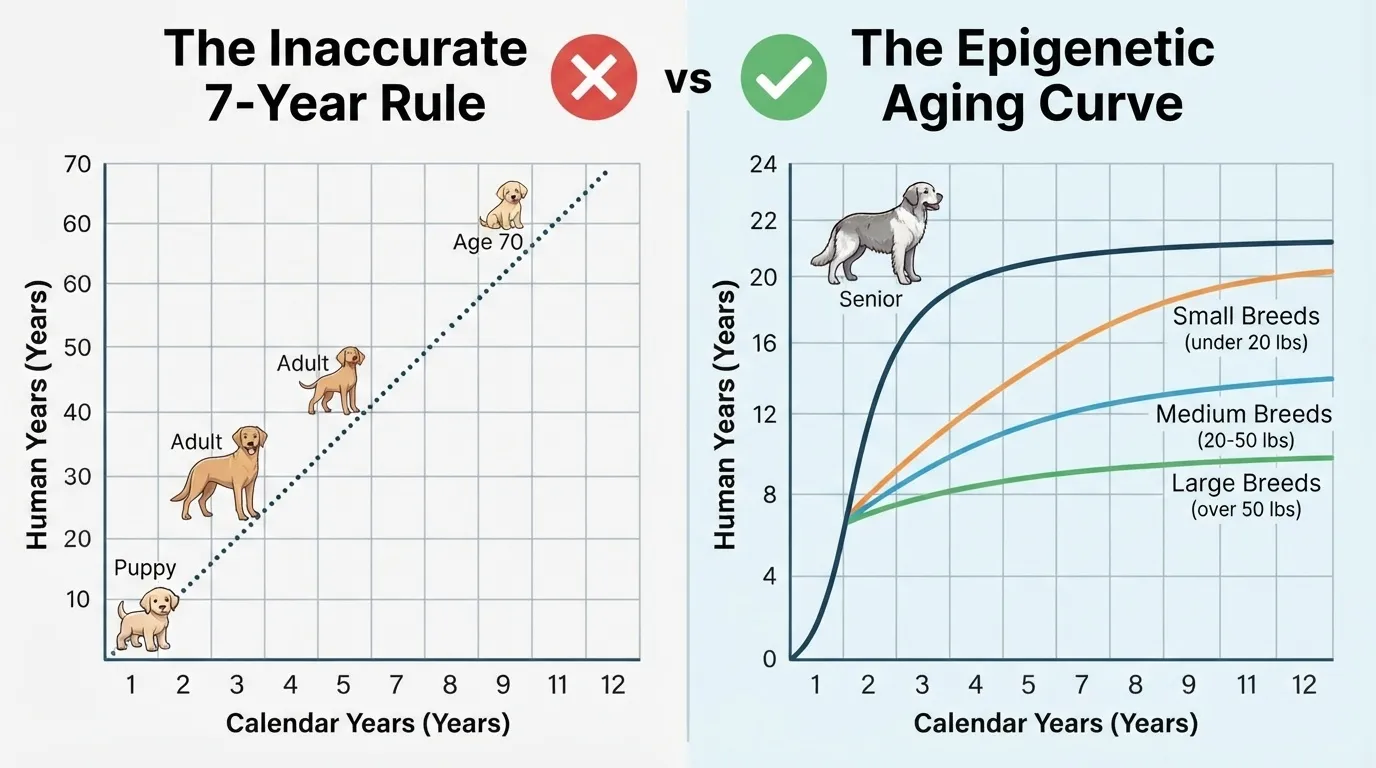
For a long time, people believed a simple rule: multiply your dog’s age by seven to find their age in “human years.” While this math is easy, it is not scientifically true.
The main problem with the seven-year rule is that it assumes dogs and humans age at the exact same steady pace. In reality, dogs do not age in a straight line. For example, a one-year-old dog can already have puppies. A seven-year-old human child is far too young to have children.
To fix this mistake, scientists studied a field called epigenetics. As animals get older, tiny chemical tags attach to their DNA. These tags act like small switches that turn certain genes off or on.
By tracking these changes over time, researchers at the University of California, San Diego discovered that dogs age incredibly fast during their first two years of life. After that, their aging slows down a lot.
The Modern Formula: Sixteen times the natural logarithm of the dog’s age plus thirty-one
By matching the DNA changes between humans and dogs, the scientists created a much better formula.
Instead of multiplying by seven, the real human equivalent age is found by taking the natural logarithm of the dog’s age, multiplying it by sixteen, and then adding thirty-one.
Because this formula accounts for the rapid growth of young dogs, the numbers change quickly at first and slow down later:
At One Dog Year: The natural logarithm of one is zero. Sixteen multiplied by zero is zero, and adding thirty-one equals thirty-one. This means a one-year-old dog already has the biological maturity of a thirty-one-year-old human. They skip childhood completely!
At Two Dog Years: The pace changes. A two-year-old dog is equal to roughly forty-nine human years.
At Seven Dog Years: The aging process slows down heavily, making a seven-year-old dog equal to roughly sixty-two human years.
Why Breed Size Matters in the Formula
While this new formula is a huge step forward, it has one major limit: scientists only used DNA data from Labrador Retrievers to create it.
Labradors are medium-to-large dogs that usually live for about twelve years. However, anyone who owns a Chihuahua or a Great Dane knows that different sizes of dogs live for very different amounts of time.
Small Breeds (like Chihuahuas and Pugs): These dogs grow up fast when they are puppies but age very slowly as adults. They often live for fifteen to eighteen years. Because the new formula is based on a Labrador’s shorter lifespan, it makes small dogs seem older on paper than they actually are.
Giant Breeds (like Great Danes and Mastiffs): Giant dogs have very short lives. They often show signs of old age by the time they are six or seven years old. For these huge dogs, the formula makes them seem younger than they actually are.
In the end, science proves that a dog’s first year requires special junior care, while their older years pass by much slower than the old seven-year myth ever predicted.
Scientific Study Source: Quantitative Translation of Dog-to-Human Aging by Conserved Remodeling of the DNA Methylome (Cell Systems, 2020)
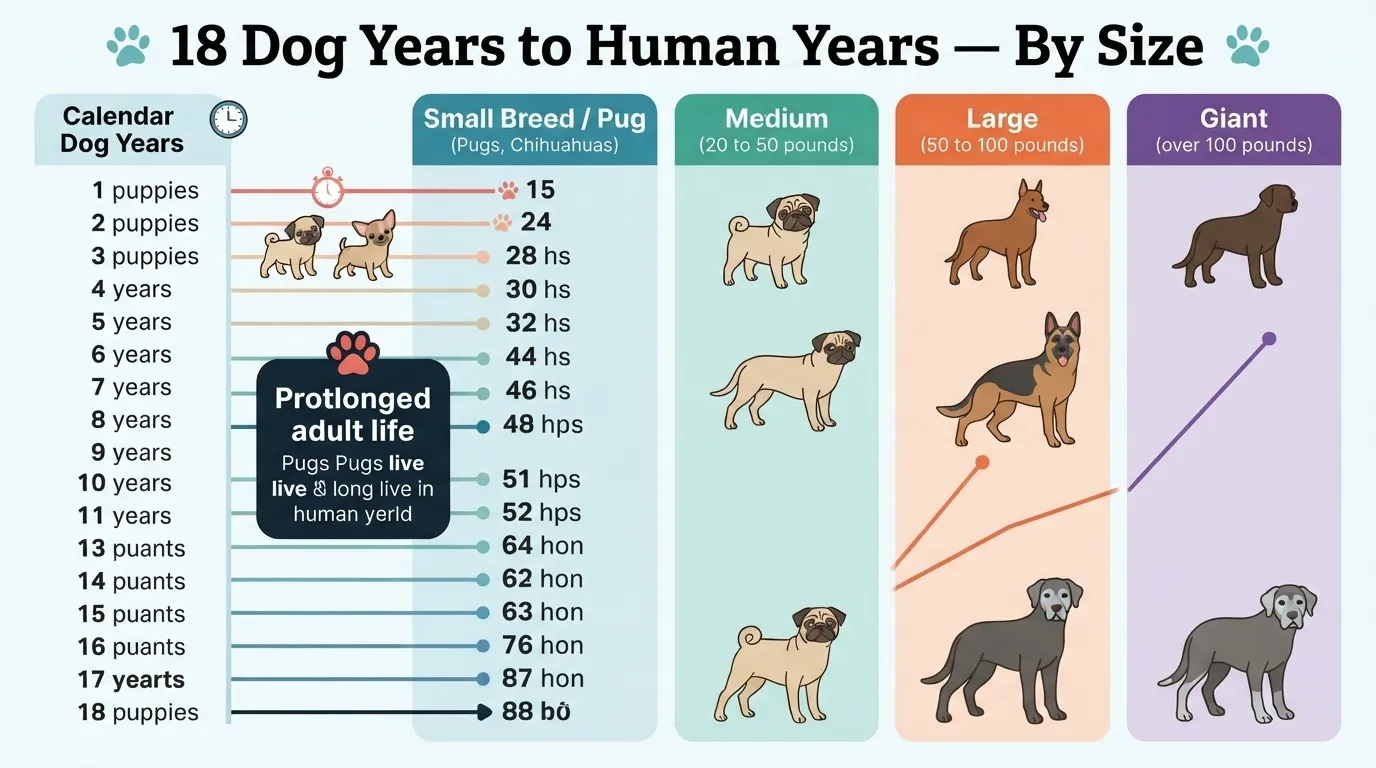
Pug Age in Human Years Chart
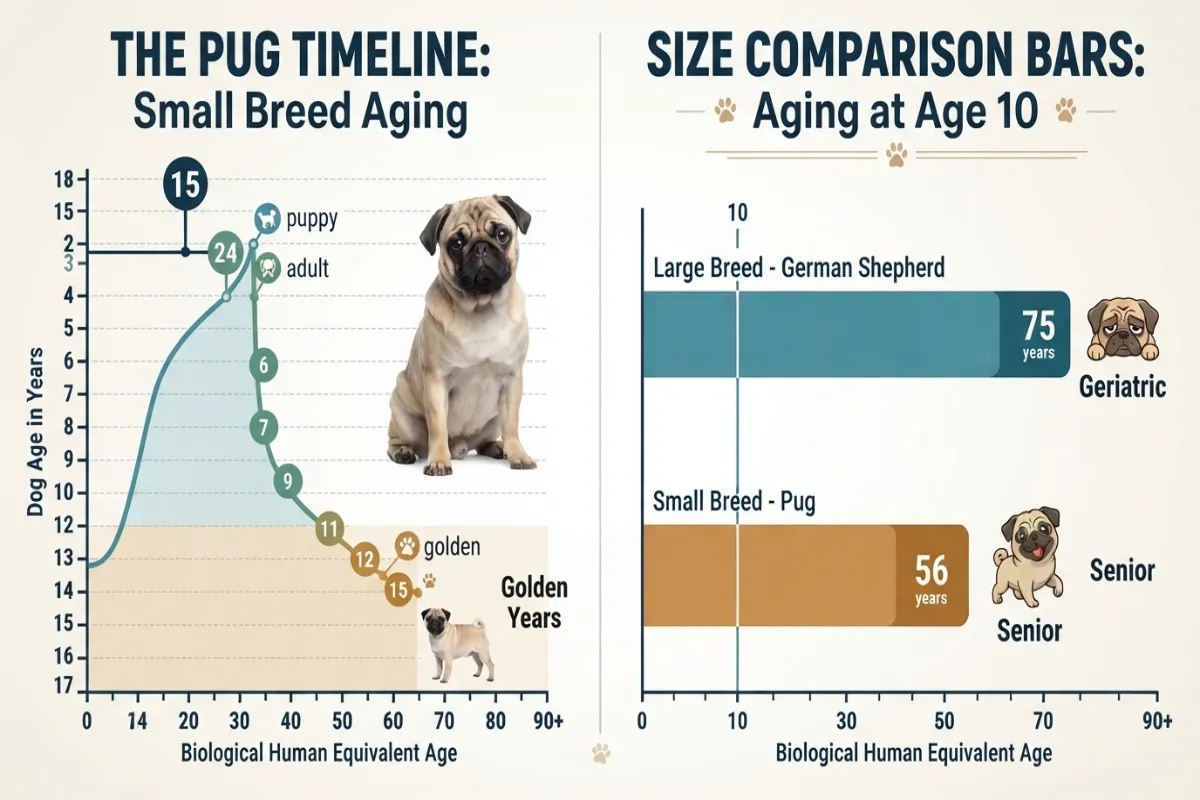
Because Pugs belong to the small breed category, their aging timeline looks very different from a big dog like a German Shepherd. Pugs experience a massive burst of growth in their infancy, but once they reach adulthood, their biological clock ticks much slower. This unique pacing allows them to enjoy a long lifespan, often reaching fifteen years or more.
Full Conversion Table Years 1 to 18
This table tracks exactly how a Pug matures from a bouncy puppy into a senior companion. It uses the real biological aging standards for small dogs rather than the inaccurate seven-year rule.
| Pug Age (Calendar Years) | Equivalent Human Age | Life Stage |
|---|---|---|
| 1 Year | 15 Years | Teenage / Adolescent |
| 2 Years | 24 Years | Young Adult |
| 3 Years | 28 Years | Adult |
| 4 Years | 32 Years | Adult |
| 5 Years | 36 Years | Adult |
| 6 Years | 40 Years | Mature Adult |
| 7 Years | 44 Years | Mature Adult |
| 8 Years | 48 Years | Mature Adult |
| 9 Years | 52 Years | Senior |
| 10 Years | 56 Years | Senior |
| 11 Years | 60 Years | Senior |
| 12 Years | 64 Years | Golden Senior |
| 13 Years | 68 Years | Golden Senior |
| 14 Years | 72 Years | Golden Senior |
| 15 Years | 76 Years | Geriatric |
| 16 Years | 80 Years | Geriatric |
| 17 Years | 84 Years | Geriatric |
| 18 Years | 88 Years | Geriatric |
| Pug Age | Human Age | Life Stage |
|---|---|---|
| 1 Year | 15 Yrs | Teenage |
| 2 Years | 24 Yrs | Young Adult |
| 3 Years | 28 Yrs | Adult |
| 4 Years | 32 Yrs | Adult |
| 5 Years | 36 Yrs | Adult |
| 6 Years | 40 Yrs | Mature Adult |
| 7 Years | 44 Yrs | Mature Adult |
| 8 Years | 48 Yrs | Mature Adult |
| 9 Years | 52 Yrs | Senior |
| Pug Age | Human Age | Life Stage |
|---|---|---|
| 10 Years | 56 Yrs | Senior |
| 11 Years | 60 Yrs | Senior |
| 12 Years | 64 Yrs | Golden Senior |
| 13 Years | 68 Yrs | Golden Senior |
| 14 Years | 72 Yrs | Golden Senior |
| 15 Years | 76 Yrs | Geriatric |
| 16 Years | 80 Yrs | Geriatric |
| 17 Years | 84 Yrs | Geriatric |
| 18 Years | 88 Yrs | Geriatric |
Why the First Two Years Count Extra
Looking at the table, you will notice a massive leap between year zero and year two. By the time a Pug celebrates their first birthday, they are already biologically equal to a fifteen-year-old human teenager. When they reach two years old, they jump to twenty-four human years.
This dramatic front-loading happens because small dogs rapidly develop their skeletal systems, internal organs, and immune defenses early on. A one-year-old Pug is fully grown and physically capable of reproducing, skipping human childhood entirely.
Once your Pug hits that twenty-four-year baseline at age two, their aging curve flattens out beautifully. For the rest of their adult life, they only age by roughly four human years for every single calendar year. This slow and steady adult pace is exactly why small breeds live so much longer than large dogs.
Wondering about your dog’s exact age? Try our interactive [Dog Age Calculator] to instantly find your dog’s true human equivalent age based on their specific breed size and birthdate.
Pug Life Stages Explained
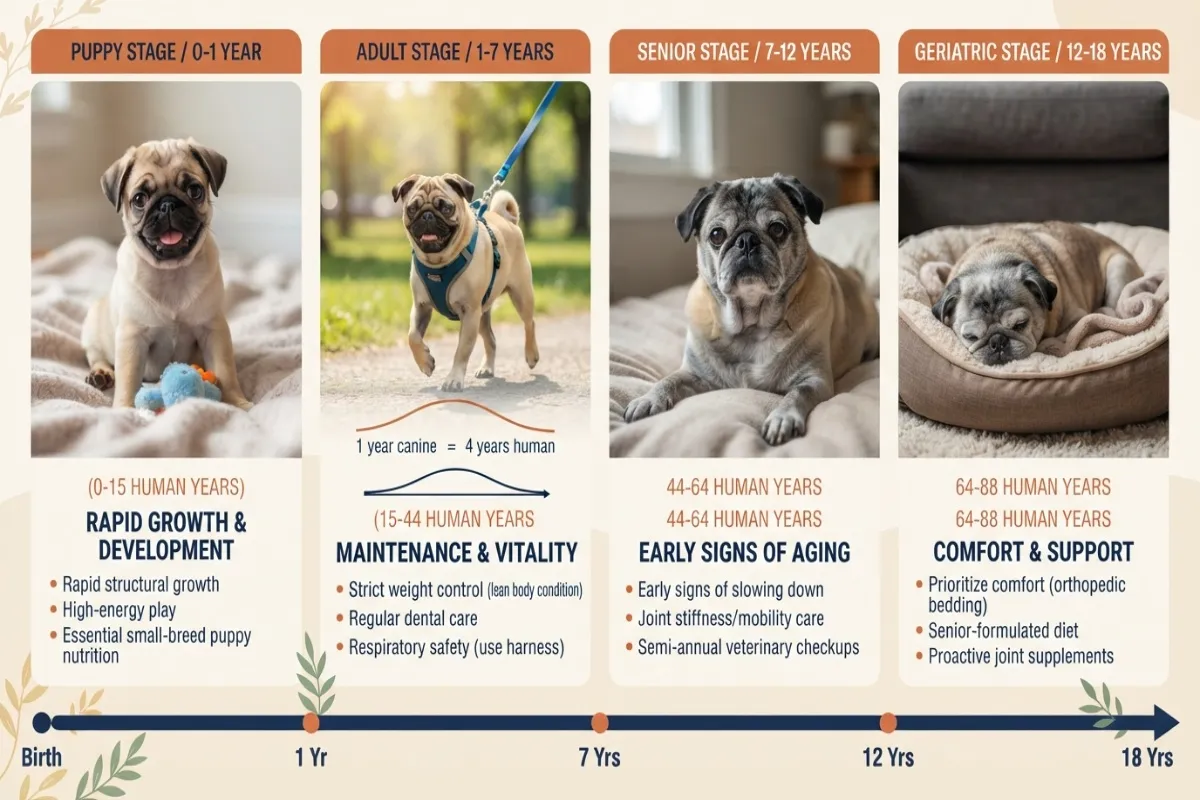
Tracking dog aging shows that growth rates shift significantly once your pet matures past the puppy life stage. While small breeds stay younger longer, giant breeds age faster by the time they reach five years old. Seeing the full dog human age progression helps you provide the right care for every stage of your companion’s life.
Click here to view the full chart and use our main calculator page
What Should You Do When Your Dog Turns 1?
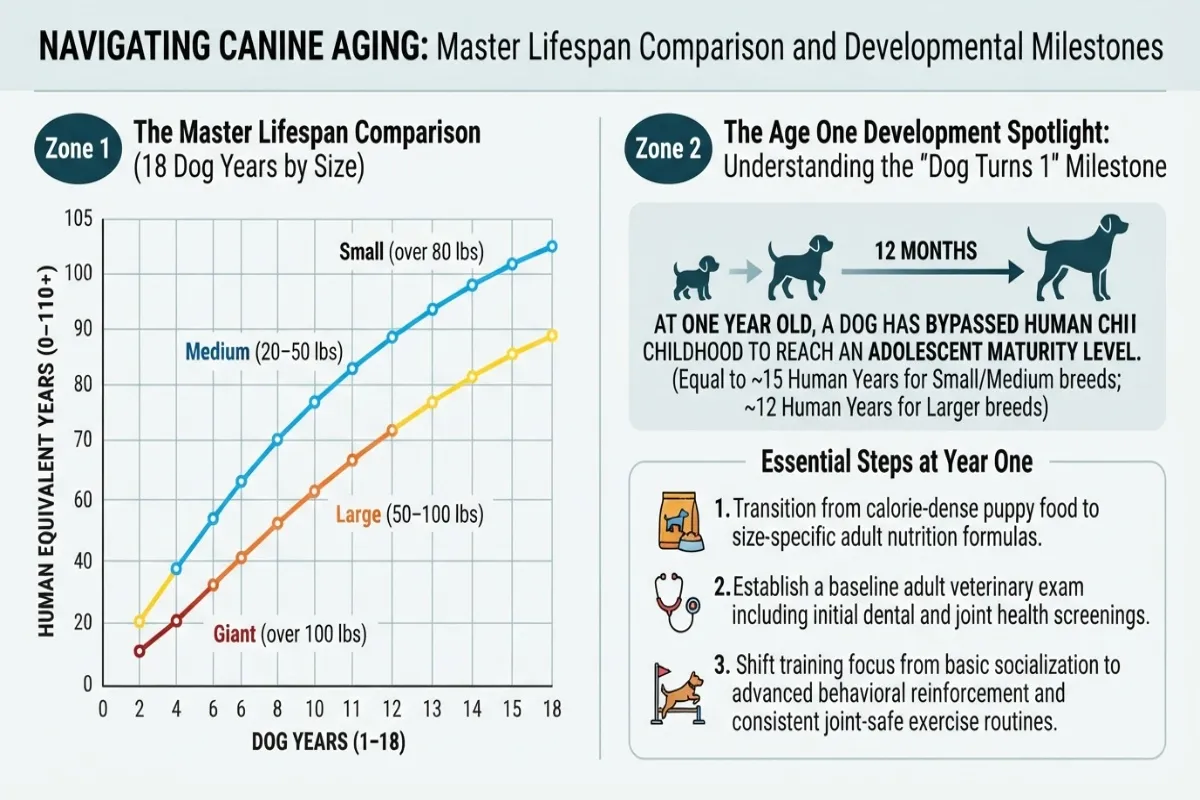
Understanding how a Pug ages helps you provide the right care at the right time. Because small breeds pack most of their physical development into their early life, their needs shift dramatically as they transition from high-energy puppies to relaxed seniors.
Puppy Stage Zero to One Year
The puppy stage is a whirlwind of rapid growth. As noted in our aging charts, a Pug goes from a newborn to a fifteen-year-old human teenager in just twelve months.
During this timeframe, their bodies are working overtime to develop strong bones, muscles, and immune systems. Because their growth is so front-loaded, puppies require highly nutritious, calorie-dense food formulated specifically for small breeds.
This is also the most critical window for socialization and basic training. Pugs are naturally eager to please, but their stubborn streak can emerge early if they do not learn consistent boundaries during this foundational year.
Adult Stage One to Seven Years
Once a Pug crosses their first birthday, they enter the longest, most stable phase of their life. From age two to seven, their biological clock settles down into a steady rhythm, aging roughly four human years for every calendar year.
During these prime years, a Pug’s main health priorities shift from growth to maintenance:
Weight Management: Pugs love food, and their low-slung bodies gain weight easily. Maintaining a strict diet and routine exercise is vital during adulthood to protect their joints.
Breathing Care: As a brachycephalic (flat-faced) breed, adult Pugs require careful monitoring during hot weather or strenuous exercise to prevent overheating.
Dental Health: Small mouths crowd teeth together, making regular dental cleanings crucial during their adult years to prevent early tooth loss.
Senior Stage Seven to Eight Plus Years
When a Pug reaches seven or eight calendar years old, they officially cross into the senior threshold, which is biologically equivalent to a human in their mid-forties to early fifties.
Because small dogs enjoy a slower adult aging curve, a senior Pug still has plenty of wonderful, active years ahead. However, you will start to notice subtle changes. Their signature black masks may begin to frost over with gray fur, and they will naturally choose longer naps over high-energy play.
Senior care focuses heavily on comfort and proactive health management. Swapping to senior-formulated food protects their slowing metabolism, while adding joint supplements like glucosamine helps manage arthritis. Regular veterinary checkups twice a year become essential to monitor their vision, hearing, and organ health, ensuring your companion stays happy and comfortable throughout their golden years.
Factors That Affect a Pug's Lifespan and Health
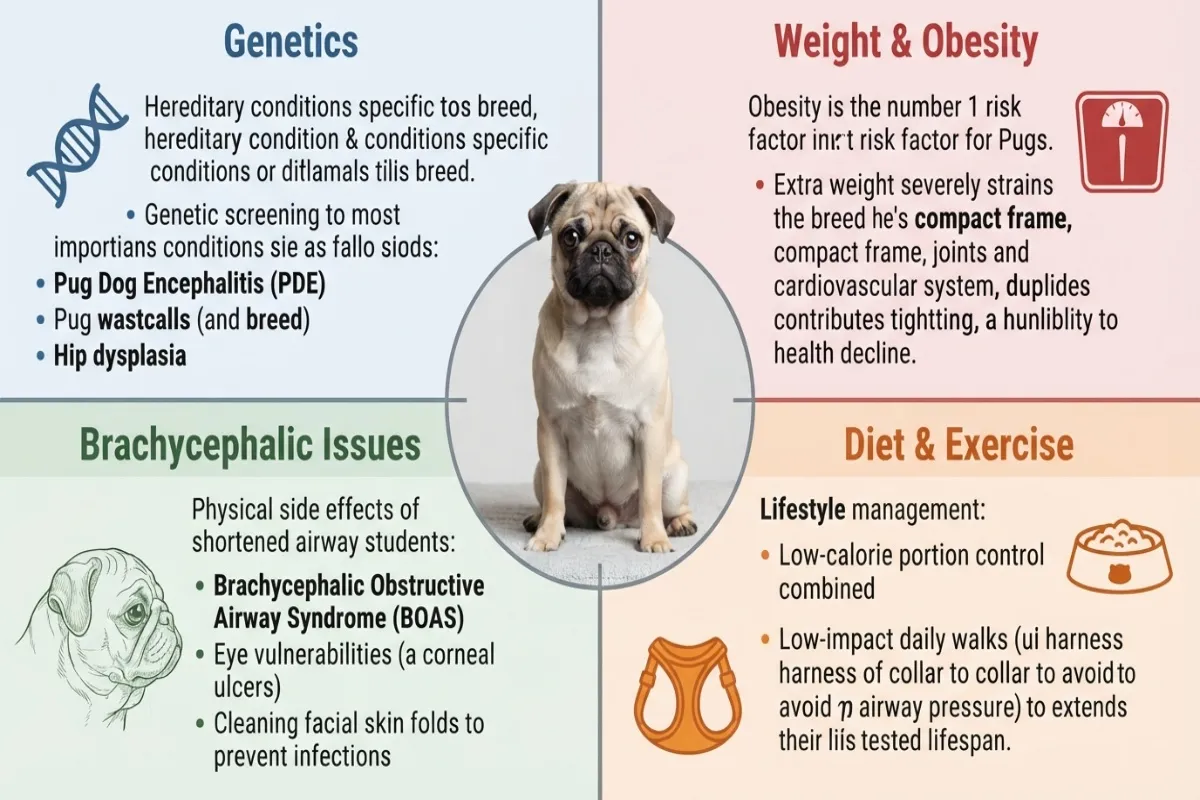
While small dogs naturally enjoy a long lifespan, a Pug’s daily health is heavily influenced by a combination of genetics and daily lifestyle choices. By understanding these key factors, you can actively protect your companion from common breed risks.
Genetics
A Pug’s health foundation starts long before they arrive at your home. Because Pugs are a purebred line, they are biologically susceptible to specific hereditary conditions.
Responsible breeders perform extensive genetic screening to test parent dogs for conditions like Pug Dog Encephalitis—a serious, breed-specific brain inflammation—and hip dysplasia. Choosing a puppy from screened, health-tested lines dramatically reduces the risk of early-onset genetic illnesses.
Weight and Obesity Biggest Risk Factor
Obesity is the single greatest threat to a Pug’s overall lifespan. Because Pugs have a natural passion for food and a relatively low metabolism, they can cross from a healthy weight to clinically overweight very easily.
Carrying even two extra pounds puts immense stress on a Pug’s compact frame. Obesity directly accelerates the decline of their joints, strains their cardiovascular system, and significantly worsens the breathing difficulties already common to the breed. Keeping your Pug at a lean, healthy weight—where you can easily feel their ribs and see a defined waistline—is the most effective way to extend their years.
Brachycephalic-Related Health Issues
Pugs are classified as a brachycephalic breed, meaning they possess a shortened, flat-faced skull structure. While this gives them their iconic, expressive look, it introduces specific anatomical challenges that require attentive daily management:
BOAS Breathing Issues: Brachycephalic Obstructive Airway Syndrome occurs because the soft tissues in a Pug’s throat are crowded into a very small space. Narrow nostrils and an elongated soft palate restrict airflow, making it difficult for them to pant effectively. This makes Pugs highly vulnerable to heatstroke and respiratory distress.
Eye Problems Corneal Ulcers, Dry Eye: Because a Pug’s skull features shallow eye sockets, their eyes protrude slightly. This exposure makes them prone to scratching the clear surface of the eye, causing corneal ulcers. They also frequently suffer from dry eye, requiring daily lubricating drops to prevent painful inflammation.
Skin Fold Infections: The signature wrinkles over a Pug’s nose trap moisture, friction, and debris. Without regular care, these warm folds become breeding grounds for bacteria and yeast, leading to painful skin fold dermatitis.
Joint and Spinal Issues: Due to their screw-tail genetics, Pugs are prone to spinal malformations like hemivertebrae (deformed vertebrae) and luxating patellas (slipping kneecaps), both of which can impact their mobility as they age.
Role of Diet and Exercise
Because Pugs gain weight easily and struggle with breathing, their diet and exercise routines require a careful, balanced approach.
Your Pug’s diet should consist of high-quality, precisely measured portions. Free-feeding or overdoing the table scraps can quickly lead to weight problems. Using low-calorie treats like green beans or small pieces of carrot during training helps satisfy their love for food without adding extra pounds.
When it comes to exercise, consistency is much better than intensity. A couple of short, twenty-minute walks daily will keep their muscles strong and joints mobile without overworking their airways. Always walk your Pug using a harness rather than a traditional neck collar to keep pressure completely off their windpipe. Finally, adjust your exercise plans based on the weather; on hot or humid days, swap outdoor activities for indoor playtime to keep them safe from overheating.
How to Help Your Pug Live Longer
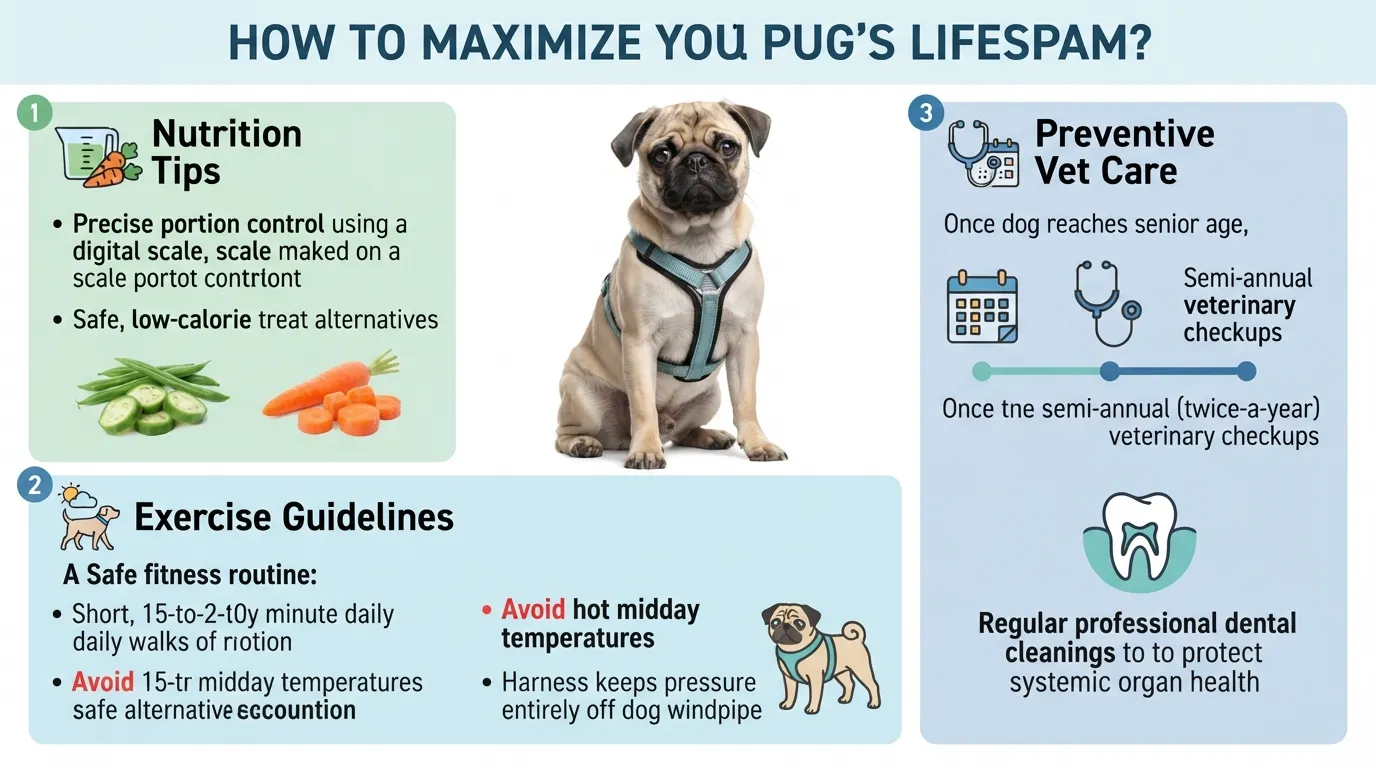
While biology gives small dogs a natural advantage, your daily care habits play the biggest role in helping your Pug reach their golden years comfortably. By implementing simple, breed-specific routines, you can actively prevent chronic health issues and maximize their quality of life.
Nutrition Tips
Because a Pug’s metabolism slows down quickly after their second year, their diet requires strict oversight. Managing their portions is the most effective way to protect their joints and airways.
Measure Every Meal: Avoid estimating your dog’s portions. Use a digital kitchen scale or a precise measuring cup to ensure you are feeding the exact amount recommended by your veterinarian.
Choose High-Fiber, Low-Calorie Options: Pugs love to eat and will often beg even when full. Look for high-quality kibble that contains healthy fiber to help them feel satisfied without adding unnecessary calories.
Swap Commercial Treats for Fresh Veggies: Instead of high-fat store-bought treats, use small pieces of raw green beans, cucumbers, or carrots as training rewards. These provide a satisfying crunch with virtually zero fat.
Exercise Guidelines
Pugs do not need hours of high-intensity running, but they do require daily physical activity to maintain their muscle tone and keep their digestion moving smoothly.
Stick to Short, Frequent Walks: Two or three short walks lasting fifteen to twenty minutes are far safer and more beneficial than one long, exhausting hike.
Ditch the Collar for a Harness: Never attach a leash directly to a Pug’s neck collar. Pulling puts direct pressure on their already compressed windpipe, which can cause their airway to collapse. Always use a supportive Y-shaped body harness instead.
Exercise Early or Late: Because of their flat faces, Pugs cannot cool themselves down efficiently in the heat. During the summer months, schedule your walks for the early morning or late evening when temperatures are coolest, and keep them indoors in an air-conditioned space during the peak heat of the day.
Preventive Vet Care
Because Pugs are prone to specific structural and genetic health issues, proactive veterinary care is essential for catching potential problems before they become painful or dangerous.
Schedule Semi-Annual Exams for Seniors: Once your Pug crosses their seventh birthday, switch from annual checkups to twice-a-year veterinary visits. This allows your vet to track subtle changes in their organ function, vision, and joint health.
Prioritize Professional Dental Cleanings: A Pug’s compact jaw forces their teeth closely together, trapping plaque and bacteria. Regular professional cleanings prevent periodontal disease, which can otherwise spread harmful bacteria to their heart and kidneys.
Keep Up with Routine Screening: Ask your veterinarian for baseline blood work and joint evaluations during their mature adult years. Catching early signs of arthritis or kidney issues early allows you to start supportive supplements and dietary adjustments immediately.
Signs Your Pug Is Aging Senior Care Guide
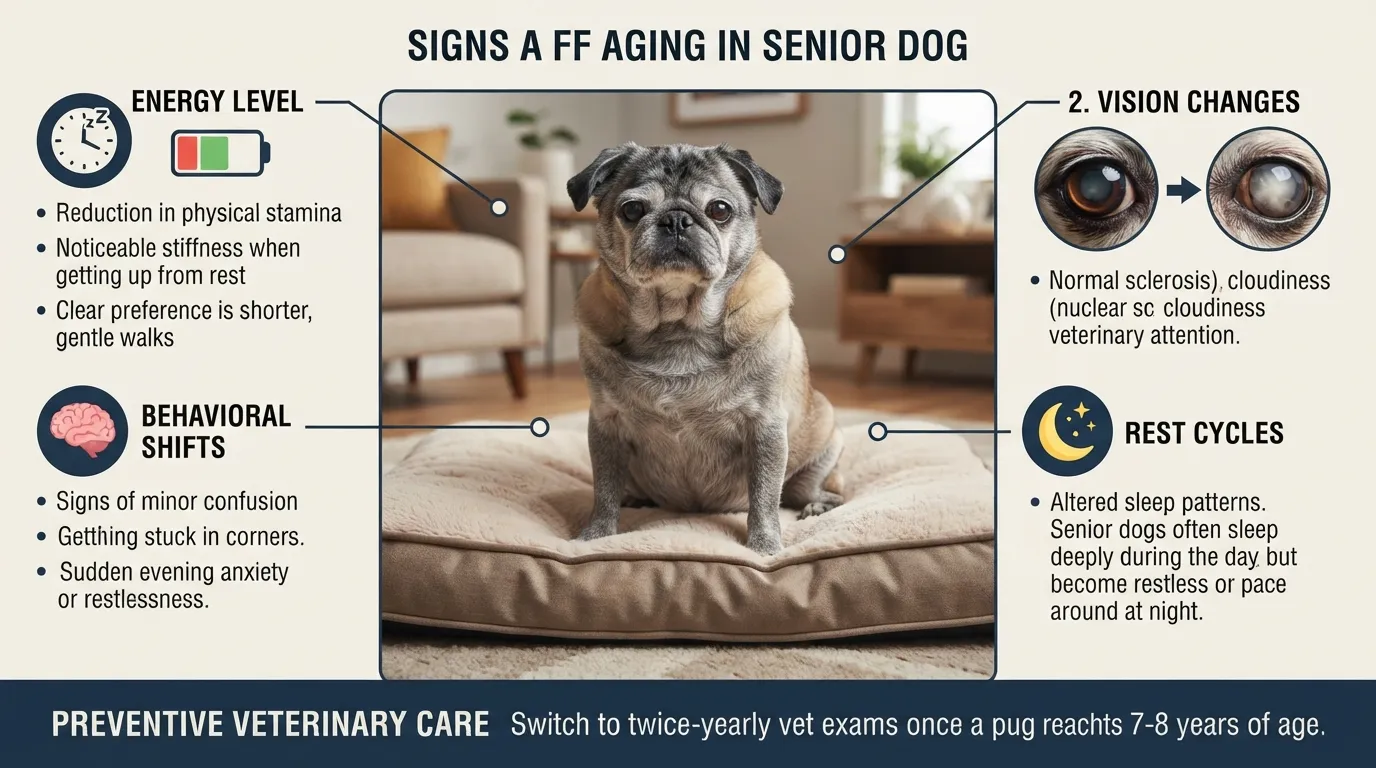
As your Pug approaches their seventh or eighth year, their needs will naturally shift. Because they transition into senior status gracefully, it can be easy to miss the early indicators of aging. Recognizing these subtle signs allows you to adjust their environment and routines, ensuring their golden years are completely comfortable.
Slowing Down and Low Energy: You may notice your Pug takes a little longer to get out of bed in the morning or hesitates before jumping onto the couch. This natural dip in energy is often a combination of a slowing metabolism and early joint stiffness or arthritis. Swapping out high-impact activities for gentle walks helps keep them mobile without causing discomfort.
Cloudy Eyes and Vision Changes: A bluish-gray haze inside your Pug’s pupils is a common sign of lenticular sclerosis, a normal aging change that slightly dims their vision. However, distinct white cloudiness can indicate cataracts. If you notice your Pug bumping into furniture in dim light or tearing up frequently, a veterinary eye check is essential to protect their sight.
Confusion and Anxiety: Senior dogs can experience cognitive changes similar to dementia, known as Canine Cognitive Dysfunction. If your companion stares blankly at walls, gets stuck behind doors, or shows sudden separation anxiety, their changing brain chemistry is likely the cause. Keeping a strict daily routine and providing simple puzzle toys can help them feel safe and mentally grounded.
Sleep Pattern Changes: An aging nervous system often disrupts a senior Pug’s internal clock. You might find your dog sleeping heavily throughout the day, only to become restless, pace, or whine during the night. Adjusting their evening routine with a calm, short bathroom walk and providing an orthopedic memory foam bed can help them settle into a deep, restful sleep.
Frequently Asked Questions
For a Pug, their very first calendar year is equivalent to fifteen human years. Because small dogs develop incredibly fast in infancy, they completely skip human childhood and achieve teenage biological maturity by their first birthday.
No, the old seven-year rule is highly inaccurate for Pugs. It assumes dogs age at a steady, straight-line pace, whereas Pugs actually age rapidly during their first two years and then slow down significantly. Multiplying by seven makes a young Pug look younger than they are biologically, and makes an older Pug seem much older than they actually are.
Pugs enjoy a long average lifespan of twelve to fifteen years, which is significantly longer than large breeds like German Shepherds. However, they do not quite outlive the longest-lived small breeds. Super-small dogs with longer muzzles, like Chihuahuas or Yorkshire Terriers, frequently reach fifteen to eighteen years because they do not face the breathing and respiratory challenges associated with a Pug's flat face.
A Pug is officially considered a senior when they reach seven to eight calendar years old. At this stage, their biological maturity is roughly equivalent to a human in their mid-forties to early fifties. This is the ideal time to switch to senior-specific nutrition and increase veterinary checkups to twice a year.
The most accurate way to calculate your Pug's age is to follow the small-breed growth curve: count their first year as fifteen human years, their second year as nine human years (bringing them to twenty-four), and then add roughly four human years for every calendar year after that.
🐾 Other Age Guides

Gulfam Haider Mehdi
Founder & Developer
I built Dogagescalculator.com to give dog owners honest, science-backed answers instead of the outdated "×7" myth. Every figure here is checked against AKC, AVMA, and published veterinary research.
More about the author & this site →📌 Featured Guides
how long do red bone coon hounds live
→
Home
→
How Big Will My Puppy Get? Growth Chart & Calculator
→
how old should a puppy be to take home
→
How to Tell the Age of a Dog
→
what age is a golden retriever full grown
→
How much to feed a Great Pyrenees
→
golden retriever puppy feeding guide
→
Life Expectancy Of a West Highland White Terrier
→
How much food should I feed my German Shepherd
→
Comments