
What Is 3 Human Years in Dog Years?
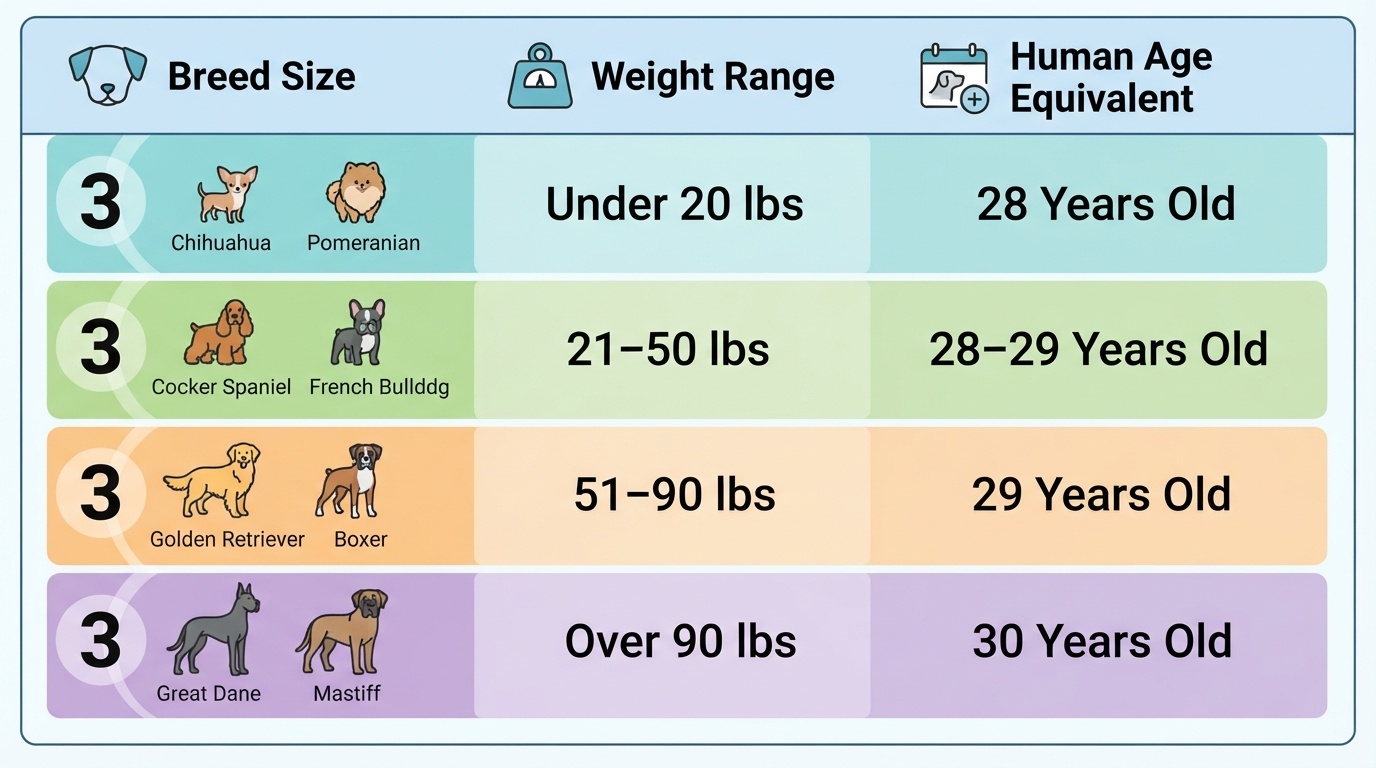
🐾 At a Glance
Small Breeds: ~28 years old
Medium Breeds: ~28–29 years old
Large Breeds: ~29 years old
Giant Breeds: ~30 years old
✅ Reviewed & Approved by Veterinary Advisory Board | 🗓️ Last Updated: July 2026
A 3-year-old dog has officially outgrown the erratic, high-energy puppy phase and entered the peak of their biological adulthood. While the old “multiply by 7” rule suggests they are 21, modern veterinary medicine from institutions like the American Veterinary Medical Association (AVMA) proves they are actually much closer to a human in their late twenties or early thirties.
The exact development depends heavily on your dog’s adult weight, as smaller dogs mature faster initially but age slower over time, whereas giant breeds face a steeper biological curve by this third year.
Why "3 Human Years" Isn't 21 in Dog Years
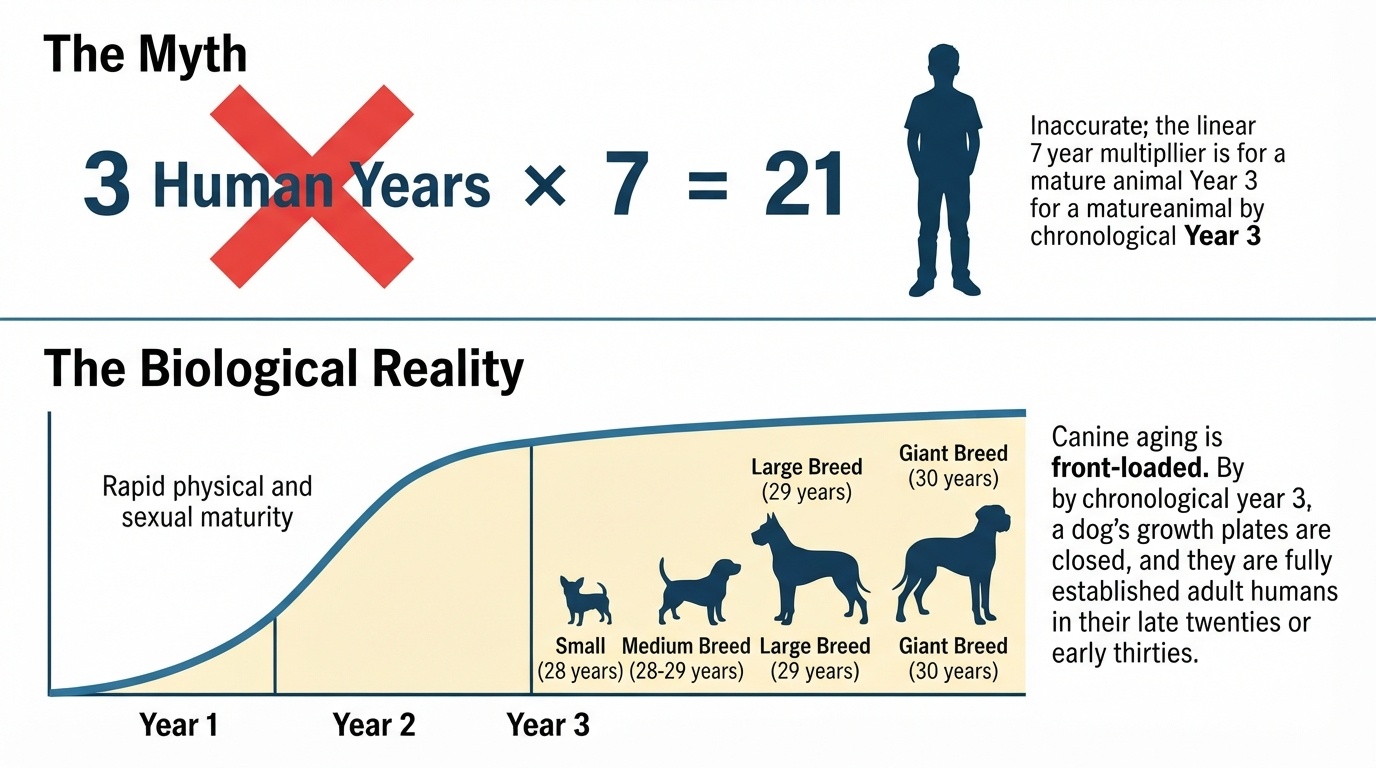
Applying a blanket rule to a 3-year-old dog leaves a massive gap in understanding their true biological state. If your dog is celebrating their third birthday, treating them like a 21-year-old human overlooks the rapid physiological milestones they have already crossed.
Where the x7 Myth Came From
The “multiply by 7” rule was a mid-20th-century oversimplification based on a basic mathematical average: the assumption that a healthy human lived to around 70, and an average dog lived to about 10. While this served as a quick marketing tool to encourage pet owners to bring their dogs to the clinic once a year, it failed to account for the actual rate of canine development. It assumed dogs age at a completely linear pace from birth to senior status, which modern research shows is entirely inaccurate.
Why It Doesn’t Apply at Year 3
By the time a dog reaches 3 human years, their growth curve looks nothing like a straight line. Canine development is incredibly front-loaded; dogs experience a massive spike in physical and sexual maturity during their first two years, which then tapers off into a more stable, gradual aging process during year three.
The Reality of the Third Year: A 21-year-old human is just stepping into full legal and physical adulthood. In contrast, a 3-year-old dog has already completed their skeletal growth, stabilized their behavioral patterns, and settled into peak physical maturity.
The Danger of the Myth: Relying on the 7-year rule at this specific age causes owners to treat a fully matured adult dog as a younger, still-developing adolescent. This can lead to incorrect nutritional portions, missed signs of early joint stress in larger breeds, and a misunderstanding of their changing behavioral needs.
The Vet-Approved Formula, Applied to a 3-Year-Old Dog
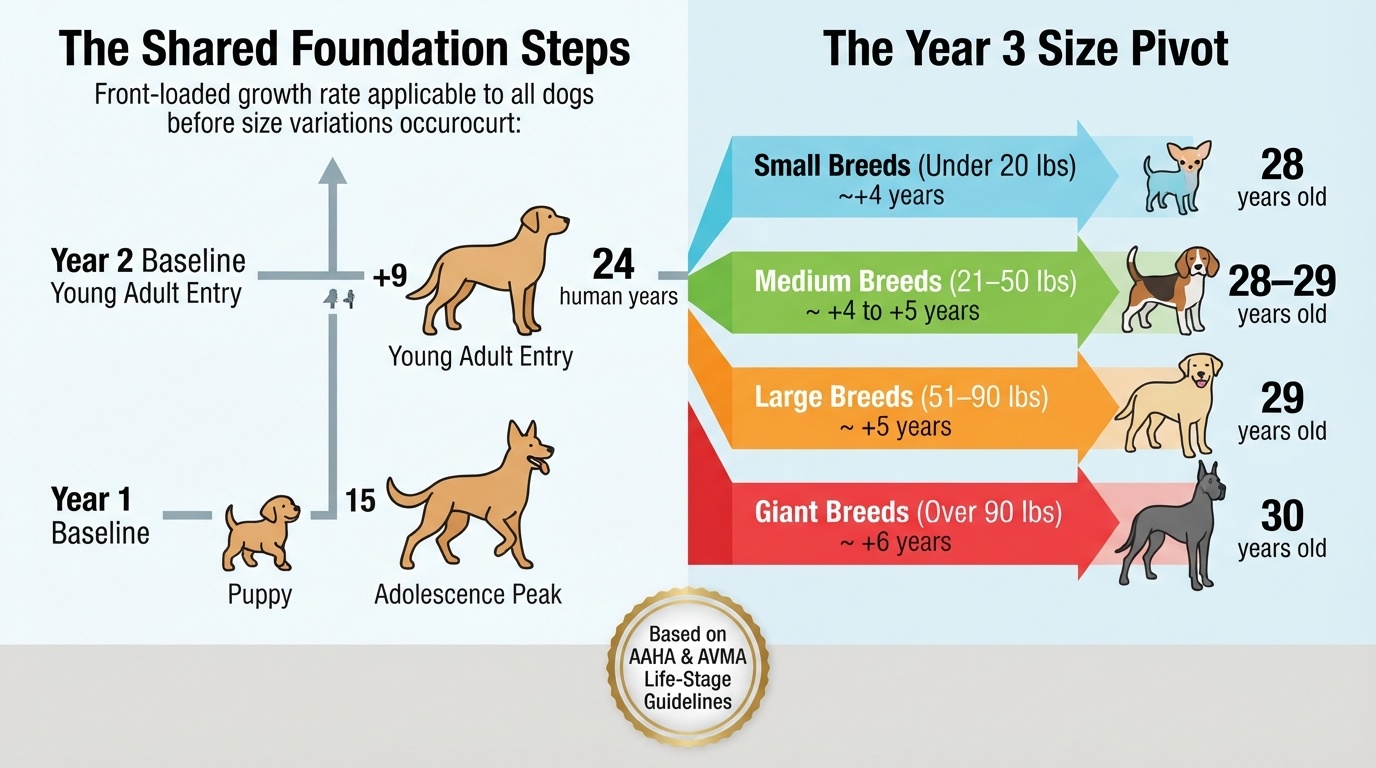
To accurately calculate where a 3-year-old dog stands, veterinary guidelines from the American Animal Hospital Association (AAHA) break down aging into distinct life stages rather than a single multiplier. This method accounts for the rapid initial development and the subsequent shift into stable adulthood.
Step-by-Step: Year 1 → Year 2 → Year 3 Calculation
Calculating the biological age at this milestone requires analyzing the shifting momentum of canine growth over these three specific blocks of time.
Step 1: The Initial Leap (Year 1)
The first 12 months represent the most intense growth period. Regardless of breed size, a dog spends this year developing from a helpless newborn into a fully grown teenager. Biologically, completing this first year equates to roughly 15 years of human development, marking the end of infancy and early puberty.
Step 2: Consolidating Adulthood (Year 2)
During the second year, the physical growth pace begins to settle, though structural filling out continues. This year adds a fixed equivalent of 9 human years across almost all breed sizes. By the second birthday, the biological foundation is firmly set at approximately 24 human years.
Step 3: The Size-Dependent Pivot (Year 3)
This is where breed size completely alters the calculation. Upon hitting the third year, the rapid developmental spikes stop, and the dog enters a predictable, annual aging rhythm. For small and medium dogs, this third year adds roughly 4 to 5 human years to their baseline. For giant breeds, the intense metabolic demands of maintaining a massive frame mean this single year adds closer to 6 human years.
By adding the front-loaded foundation of the first two years (15 + 9) to the specific, size-based rate of the third year, vets can determine the precise adult status of your companion.
The Scientific DNA-Based Formula for Age 3
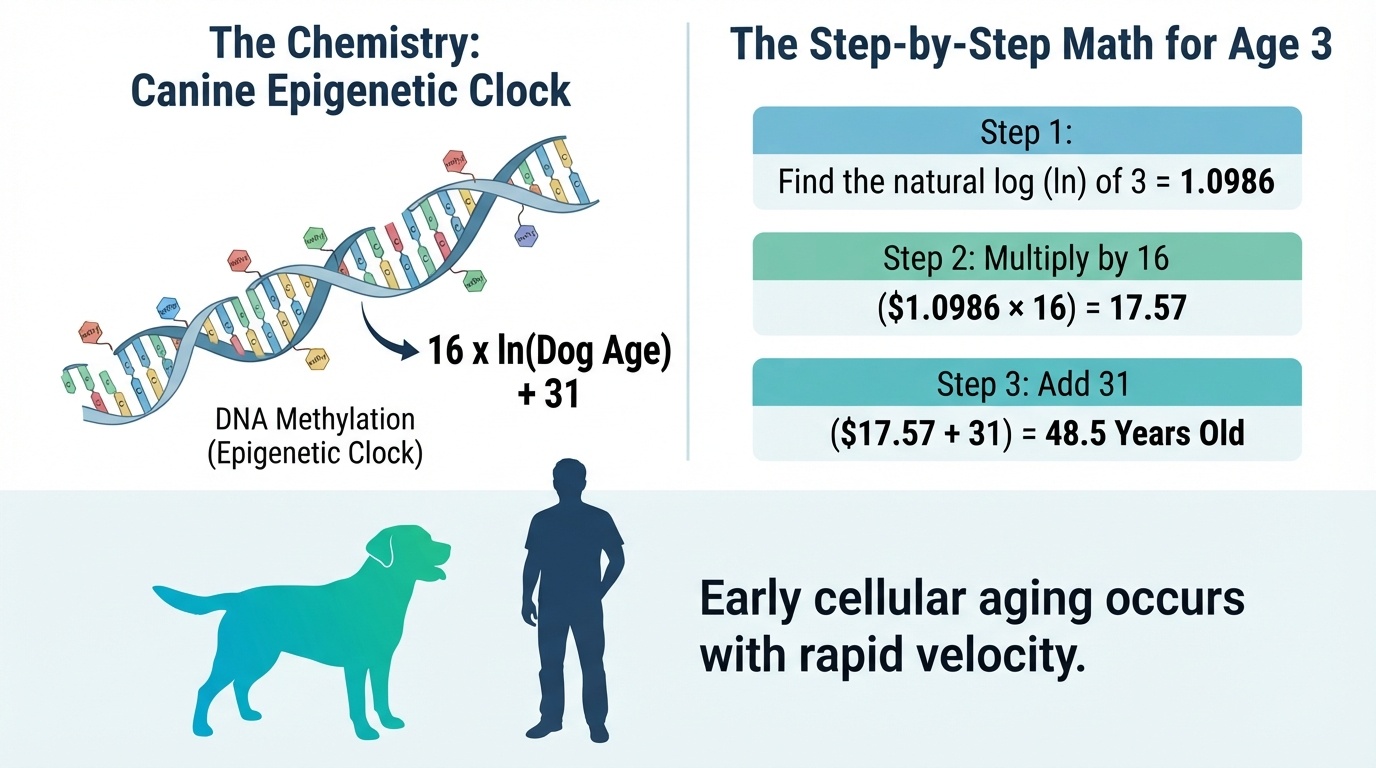
In recent years, researchers at the University of California, San Diego (UCSD) introduced a groundbreaking method to determine canine age. Instead of looking at size or behavior, this approach measures chemical changes (DNA methylation) inside a dog’s cells.
What the DNA Math Says for a 3-Year-Old Dog
According to this scientific formula, calculating the genetic age of a 3-year-old dog looks like this:
16 x ln(3) + 31
To prevent any math confusion, here is the step-by-step breakdown simplified:
| Step | What It Means | The Result |
| Step 1 | Finding the natural logarithm ($\ln$) of 3 | 1.0986 |
| Step 2 | Multiplying that number by 16 | 17.57 |
| Step 3 | Adding 31 to get the final human equivalent | 48.5 |
🔬 The Molecular Reality: This genetic data proves that a dog’s cells mature with extreme speed in their earliest years. On a microscopic level, a 3-year-old dog has already reached the biological wear-and-tear of a 48.5-year-old middle-aged human.
Which Formula Should You Trust for Your 3-Year-Old Dog?
With two different calculation methods available, here is how to choose the right one for your pet:
The DNA Formula’s Limitation:
This UCSD study was conducted only on Labrador Retrievers. Because it treats all dogs the same, it does not account for the vastly different lifespans between a 4-pound Chihuahua and a 150-pound Mastiff.
The Breed-Specific Standard (The Vet’s Choice):
For daily pet care, traditional guidelines from the AAHA and AVMA remain the most reliable. Because they factor in your dog’s specific adult weight group, they provide accurate milestones for real-world health tracking.
The Bottom Line: Use the weight-based standard for lifestyle choices, food portions, and medical care. Keep the DNA formula in mind as a fascinating scientific reminder of just how fast our companions mature on the inside.
3 Years by Breed Size — Small vs. Medium vs. Large vs. Giant
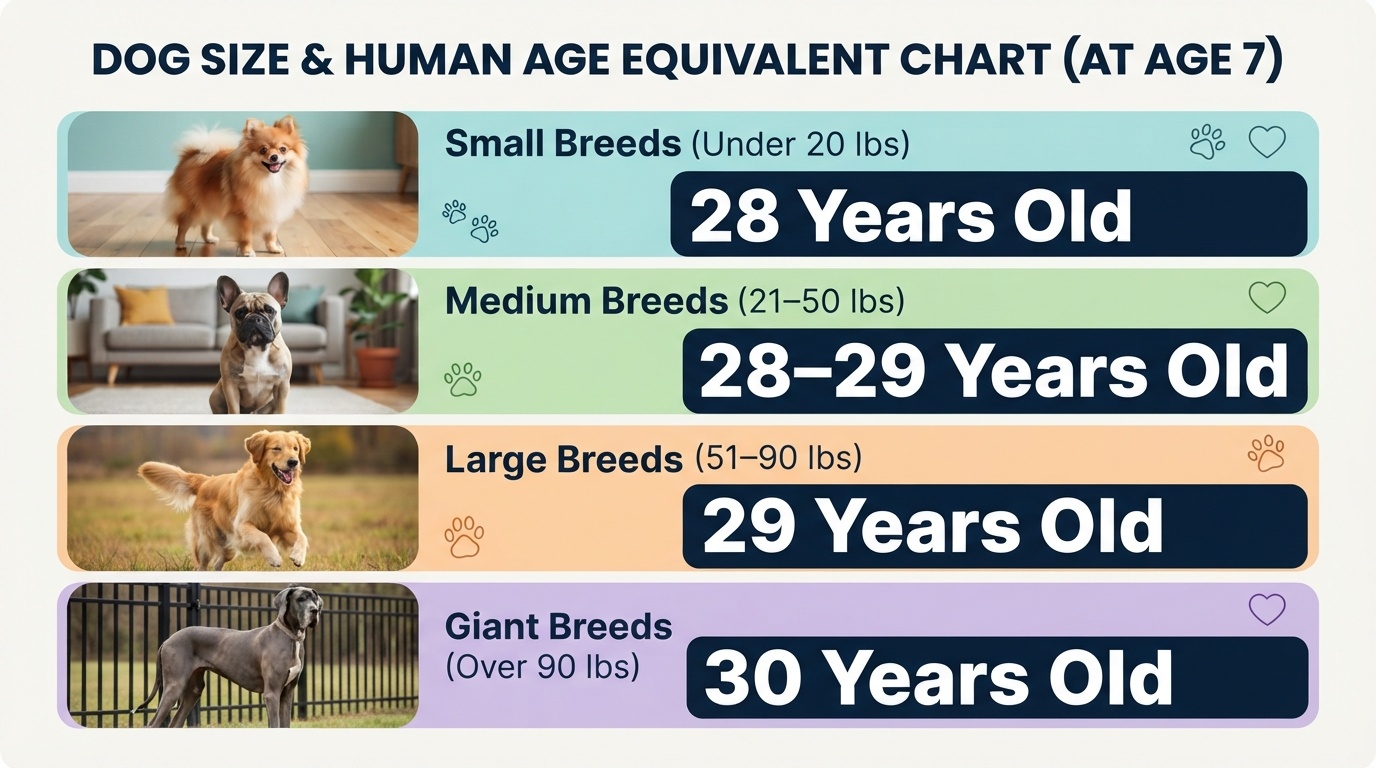
Because dogs develop at drastically different speeds depending on their physical mass, a uniform calculation does not work at this life stage. By the time a dog reaches 3 human years, their weight category determines how much strain their metabolism has endured and dictates their true biological age.
The chart below highlights how the third year affects each breed size category differently.
| Breed Size | Adult Weight Range | Human Age Equivalent at Year 3 |
| Small Breeds | Under 20 lbs (e.g., Chihuahua, Pomeranian) | 28 Years Old |
| Medium Breeds | 21 – 50 lbs (e.g., French Bulldog, Cocker Spaniel) | 28 – 29 Years Old |
| Large Breeds | 51 – 90 lbs (e.g., Golden Retriever, Boxer) | 29 Years Old |
| Giant Breeds | Over 90 lbs (e.g., Great Dane, Mastiff) | 30 Years Old |
🖨️ [ Print / Download This Chart ]
What This Means for Care at Year 3: While small and medium dogs are settled into a stable aging rhythm that only adds about 4 years annually, giant breeds are already hitting a biological age of 30 due to the immense physical stress of maintaining large skeletal frames. This is the exact year where health monitoring must shift toward size-specific needs.
When Your Dog Isn't Exactly 3
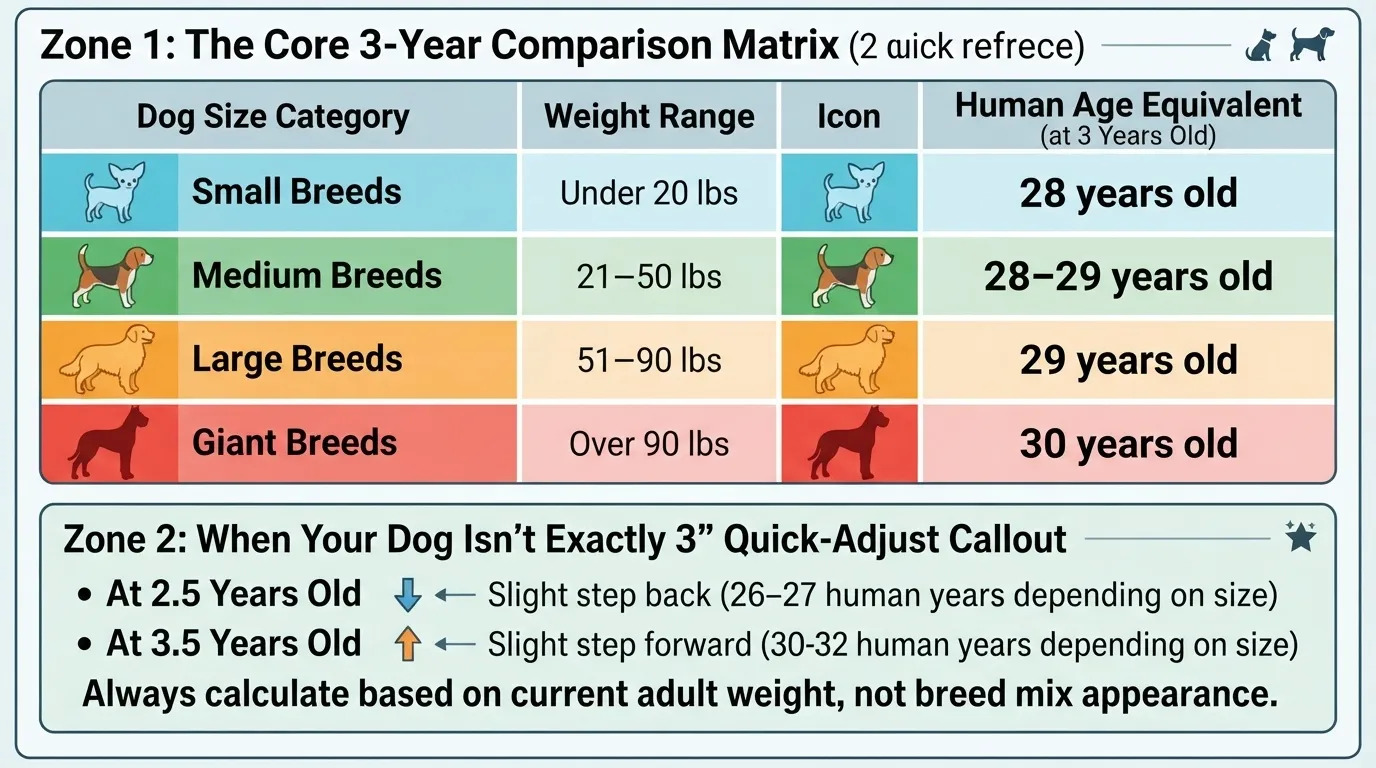
Canine development does not stop for precise calendar birthdays. If your dog is hovering around the three-year mark, or if their exact history is a bit of a mystery, you can still pinpoint their precise biological stage with a few expert adjustments.
My Dog Is 2.5 or 3.5 Years Old
When a dog is at the half-year mark around age 3, you cannot just add a full year’s worth of aging. Instead, you need to split the difference based on their weight category.
At 2.5 Years Old: Your dog is right on the cusp of full maturity. For small and medium dogs, this puts them at roughly 26 human years. For large and giant breeds, they are sitting at about 27 human years, just finishing the physical widening of their frame.
At 3.5 Years Old: Your dog has been a settled adult for several months. Small and medium breeds scale up to roughly 30 human years. Large and giant breeds push closer to 31 to 32 human years, where their annual aging rate begins to slightly accelerate compared to smaller dogs.
My Dog Is a Mixed Breed
If your dog is a beautiful mix of different breeds, ignore the specific breed traits and focus entirely on their current, stable adult weight.
Genetics dictate size, and metabolic aging is directly tied to physical mass. If your mixed-breed dog weighs 15 pounds, track them strictly under the “Small Breed” guidelines (28 human years). If they weigh 75 pounds, utilize the “Large Breed” track (29 human years), regardless of whether they look like a Terrier or a Labrador.
I Don’t Know My Dog’s Exact Age
If you rescued your dog and do not have a birth certificate, you can check specific physical markers to confirm if they are currently living in their third year. At age 3, a dog’s body leaves very specific clues:
The Teeth Test: By year 3, all permanent adult teeth are fully present, but they will show mild to moderate tartar buildup and slight wear on the back molars. If the teeth are pristine white, the dog is likely younger; if there is heavy, dark brown crusting and gum recession, they are likely past age 5.
The Muscle & Coat Test: A 3-year-old dog has excellent, firm muscle tone and a vibrant, glossy coat with no graying around the muzzle or eyes.
The Clear Eyes Test: Their eyes will be completely clear, bright, and free from the cloudy haze (lenticular sclerosis) that naturally develops later in life.
What Life Stage Is a 3-Year-Old Dog In?
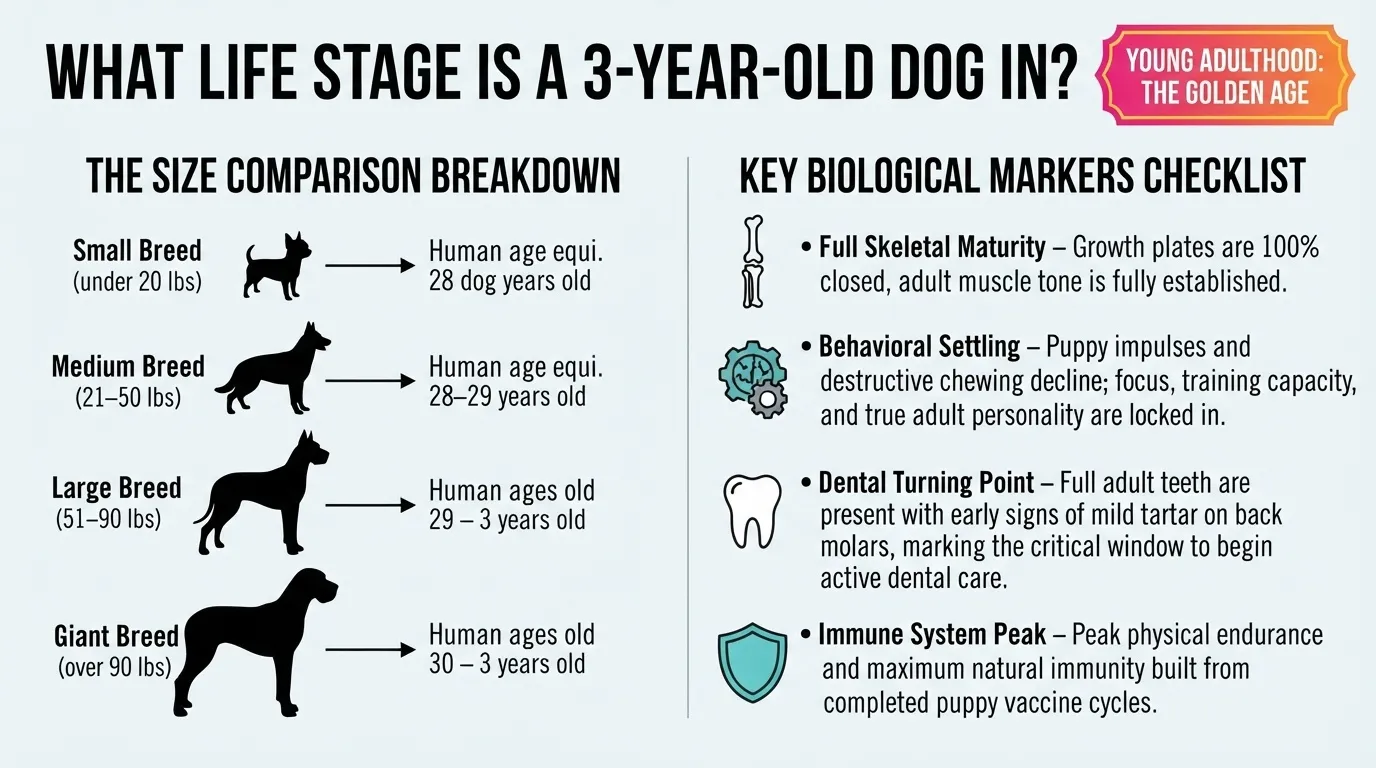
At 3 human years old, your dog has officially graduated from the erratic phases of adolescence and entered Young Adulthood. This is widely considered the “golden age” of canine development. Their bodies are fully formed, their immune systems are operating at peak efficiency, and their personalities are completely established.
Physical & Behavioral Markers at This Age
Recognizing the specific biological markers of a 3-year-old dog helps you understand why their care needs differ so much from a younger pup.
Skeletal and Muscle Maturity: By age 3, even the slowest-growing giant breeds have finished growing their skeletal frames. Their growth plates are entirely closed, and they have developed their final, mature muscle tone. They are at their absolute peak for physical endurance, strength, and structural stability.
Behavioral “Settling”: The sudden, unpredictable “zoomies” and destructive chewing of the puppy years naturally decline. A 3-year-old dog has developed a solid attention span, can regulate their impulses much better, and is highly receptive to advanced training. Their true adult personality—whether calm, protective, or highly social—is now fully locked in.
Dental Benchmarks: This is a critical physical turning point. According to the American Veterinary Dental College, by age 3, most dogs show the first visible signs of periodontal disease. You will notice mild tartar accumulation (light yellow or off-white shading) on the upper back molars, making this the ideal age to establish a strict dental brushing or cleaning routine.
Immune System Peak: A 3-year-old dog’s immune system is highly robust. They have built up strong antibody responses from their initial vaccine series and booster shots, making them highly resilient against common environmental pathogens compared to fragile puppies or senior dogs.
Frequently Asked Questions
No. The classic rule of multiplying a dog's age by 7 is an outdated myth. Veterinary research shows that dogs mature much faster during their first two years of life. By the time a dog reaches 3 human years, they are biologically closer to a human in their late twenties or early thirties, not a 21-year-old.
The weight-based life-stage calculation used by organizations like the AVMA and AAHA is highly accurate for daily pet care. It directly accounts for how a dog’s weight and metabolism affect their aging process. While genetic DNA calculations offer a look at cellular aging, the weight-based method remains the most reliable clinical standard for real-world health tracking.
Yes, significantly. Smaller breeds mature quickly in their first year but age much slower afterward, making a small dog roughly 28 human years old at age 3. Giant breeds take longer to fully grow but experience higher metabolic strain, pushing their biological age to around 30 human years by their third birthday.
A 3-year-old dog is firmly in the Young Adult life stage. They have completely outgrown puppyhood and adolescence, but they are still several years away from being considered mature or senior pets. This is their physical and behavioral peak.
🐾 Other Age Guides
What is 1 human year in dog years
Read More →
What is 9 dog years in human years
Read More →
What Is 12 Dog Years in Human Years
Read More →
what is 8 human years in dog years
Read More →