
What Is 18 Dog Years in Human Years? 2026 Guide

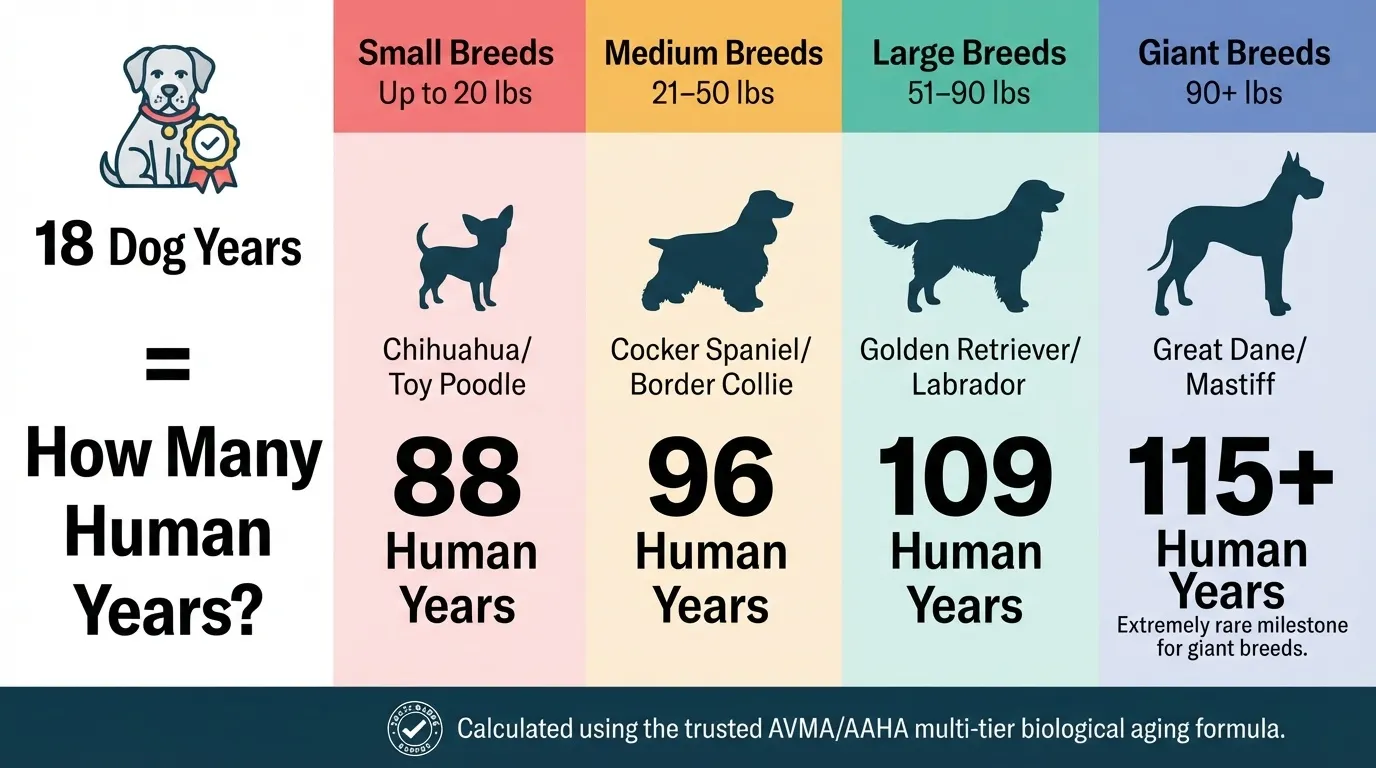
An educational infographic from Dog Ages Calculator showing how 18 dog years translates to human years across small (88 human years), medium (96), large (109), and giant breeds (115+) using the AVMA/AAHA aging formula.

If you are wondering what is 18 dog years in human years, an 18-year-old dog is exceptionally old. A useful human-age comparison is roughly 88 to 109+ human years, depending on the dog’s adult size and breed.

The traditional β€œmultiply by seven” rule would make an 18-year-old dog 126 human years old, but that simple calculation does not accurately reflect how dogs age. Dogs mature very rapidly during their first two years, and their aging pattern changes as they grow older. Smaller dogs also tend to live longer and may age more slowly in later life than large and giant breeds.

18 Dog Years in Human Years by Size

Dog SizeTypical WeightApprox. Human-Age Equivalent
SmallUnder 20 lbs / 9 kg~88 years
Medium21–50 lbs / 10–23 kg~96 years
Large51–90 lbs / 23–41 kg~106 years
GiantOver 90 lbs / 41+ kg~109+ years

These figures should be treated as general estimates rather than exact biological ages. An 18-year-old Chihuahua and an 18-year-old Great Dane have experienced very different aging patterns, and individual health can also make a significant difference.

What Does 18 Years Mean for a Dog?

At 18 years old, a dog is firmly in the very senior or geriatric stage of life. Reaching this age is uncommon, particularly for large and giant breeds. Your dog’s mobility, appetite, weight, sleep, hearing, vision, behavior, and overall comfort are more meaningful indicators of well-being than a human-age number alone.

The goal at this stage should be comfort, mobility, regular veterinary monitoring, and quality of life rather than simply trying to match the dog to a specific human birthday.

18 Dog Years to Human Years β€” By Size

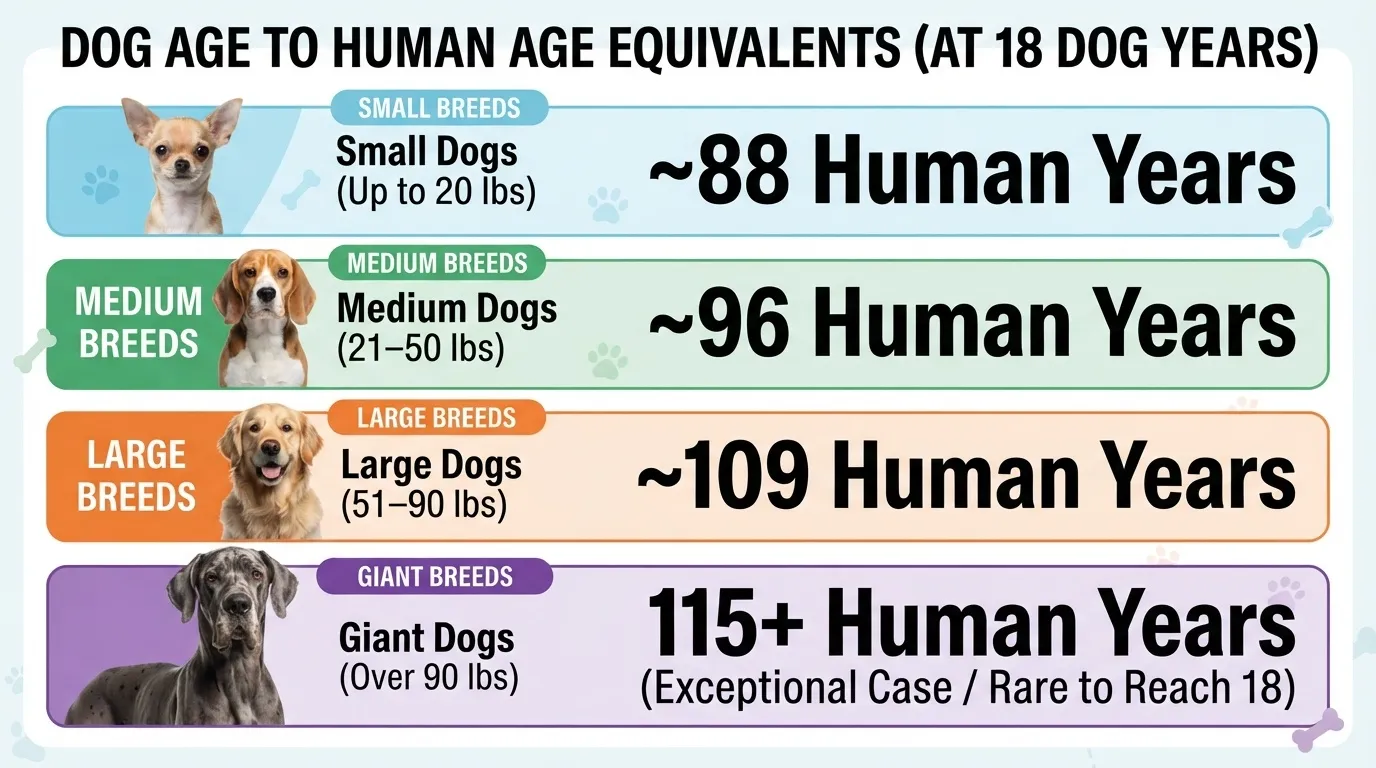
An infographic chart displaying dog age to human age equivalents at 18 dog years across small, medium, large, and giant breeds.
Dog Size & WeightEquivalent Human Age
Small dog (up to 20 lbs)~88 human years
Medium dog (21–50 lbs)~96 human years
Large dog (51–90 lbs)~109 human years
Giant dog (90+ lbs)Rare to reach 18; if reached, treat as 115+ years (exceptional case)

Seeing your dog reach 18 years old means you are caring for a true centenarian. Whether they are comparable to a human in their late 80s or someone who has lived past 100, reaching this age is an exceptional milestone that reflects incredible care, love, and a deeply dedicated family.

How Is This Calculated?

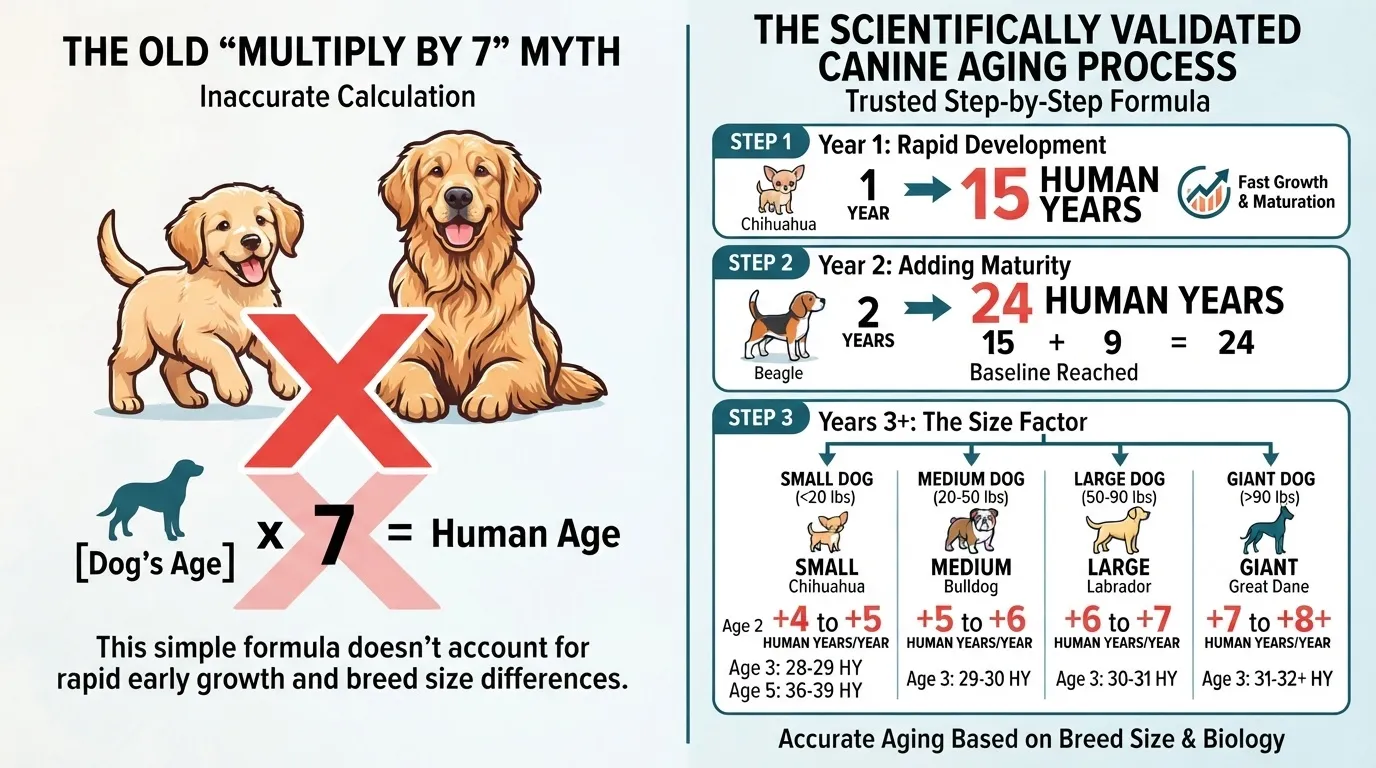
An informative infographic by dogagescalculator comparing the traditional 'multiply by 7' myth with the scientifically validated 3-step canine aging process based on breed size.

Why the “Multiply by 7” Rule Is a Myth

For decades, the standard formula was simple: take your dog’s age, multiply it by 7, and you have their human equivalent. While it is easy to calculate, this rule is highly inaccurate. It completely overlooks the fact that dogs mature incredibly fast in their first two years of life and that different weight classes age at entirely different rates. If the rule were true, a 1-year-old dog would look and act like a 7-year-old human child, when in reality, they are already physically mature enough to reproduce.

The AVMA/AAHA Method Trusted Formula

Veterinary authorities like the American Veterinary Medical Association (AVMA) and the American Animal Hospital Association (AAHA) use a much more accurate tiered system to calculate canine life stages:

  • Year 1: Counts as 15 human years (accounting for rapid growth and development from a puppy to an adolescent).

  • Year 2: Adds 9 more years, bringing the dog to 24 human years by their second birthday.

  • Year 3 and Beyond: Each additional year adds roughly 4 to 5 years for small and medium dogs, while large and giant breeds age at a faster rate of 6 to 8+ years annually.

Newer DNA-based studies tracking epigenetic changes (specifically canine DNA methylation) confirm this model. They show that dogs experience a steep biological aging curve in their youth that tapers off and stabilizes as they enter their senior years.

Which Dogs Are Most Likely to Reach 18 Years?

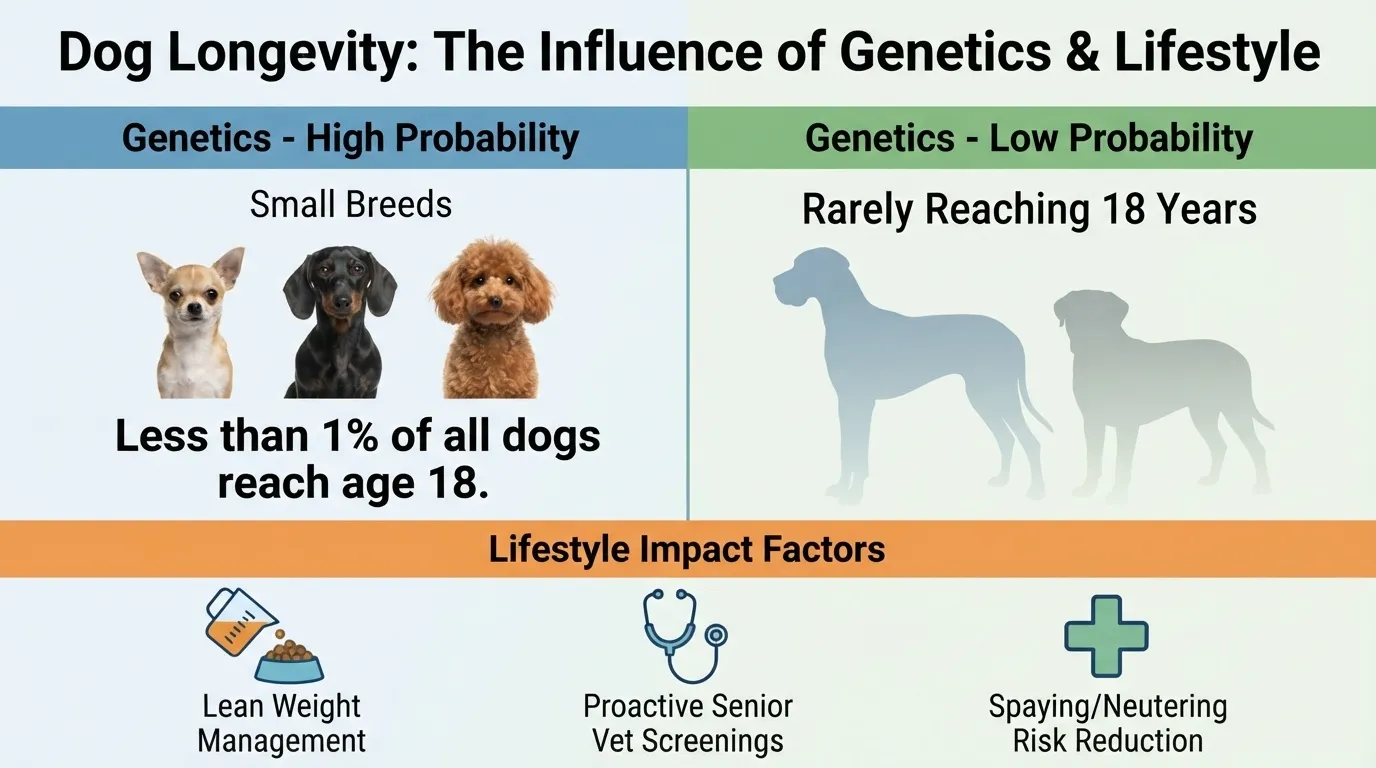
Infographic titled 'Dog Longevity: The Influence of Genetics & Lifestyle' showing small breeds like Chihuahuas, Dachshunds, and Poodles with a higher probability of reaching age 18, large breeds with a lower probability, and key lifestyle factors like weight management, vet screenings, and spaying/neutering.

While reaching 18 is an exceptional milestone, it is much more common in certain breeds than others. In fact, only a tiny fraction of the global dog populationβ€”estimated at less than 1%β€”ever manages to blow out 18 candles on their birthday cake.

The Role of Breed and Genetics

Genetics and body mass are the most significant limiting factors when it comes to extreme canine longevity.

  • Long-Living Small & Toy Breeds: Tiny dogs age much more slowly in their senior years. Breeds like Chihuahuas, Dachshunds, Toy Poodles, and Shih Tzus are the most frequent members of the 18+ club.

  • Breeds Rarely Reaching 18: Giant breeds experience rapid physiological aging. It is virtually unheard of for a Great Dane, Mastiff, or Saint Bernard to reach 18; for these breeds, living past 10 to 12 years is already considered a long life.

Lifestyle Factors (Beyond Breed)

While genetics set the baseline, daily lifestyle factors heavily influence whether a dog can maximize their natural lifespan:

  • Dietary Management: Keeping a senior dog lean prevents excess strain on joints and vital organs. Chronic obesity can shave up to 2 years off a dog’s life.

  • Proactive Vet Care: Regular blood work and senior screenings catch age-related issues like kidney disease or arthritis before they become unmanageable.

  • Spaying and Neutering: Studies indicate that altered dogs generally live longer, largely due to a reduced risk of reproductive cancers and life-threatening infections like pyometra.

A Note on the Longevity Record: For a long time, a Portuguese dog named Bobi made headlines with a claimed age of 31 years. However, following a thorough review by veterinarians and experts, Guinness World Records officially stripped Bobi of the title due to a lack of conclusive registration evidence. The long-standing verified record belongs to Bluey, an Australian Cattle Dog who lived to an incredible 29 years and 5 months.

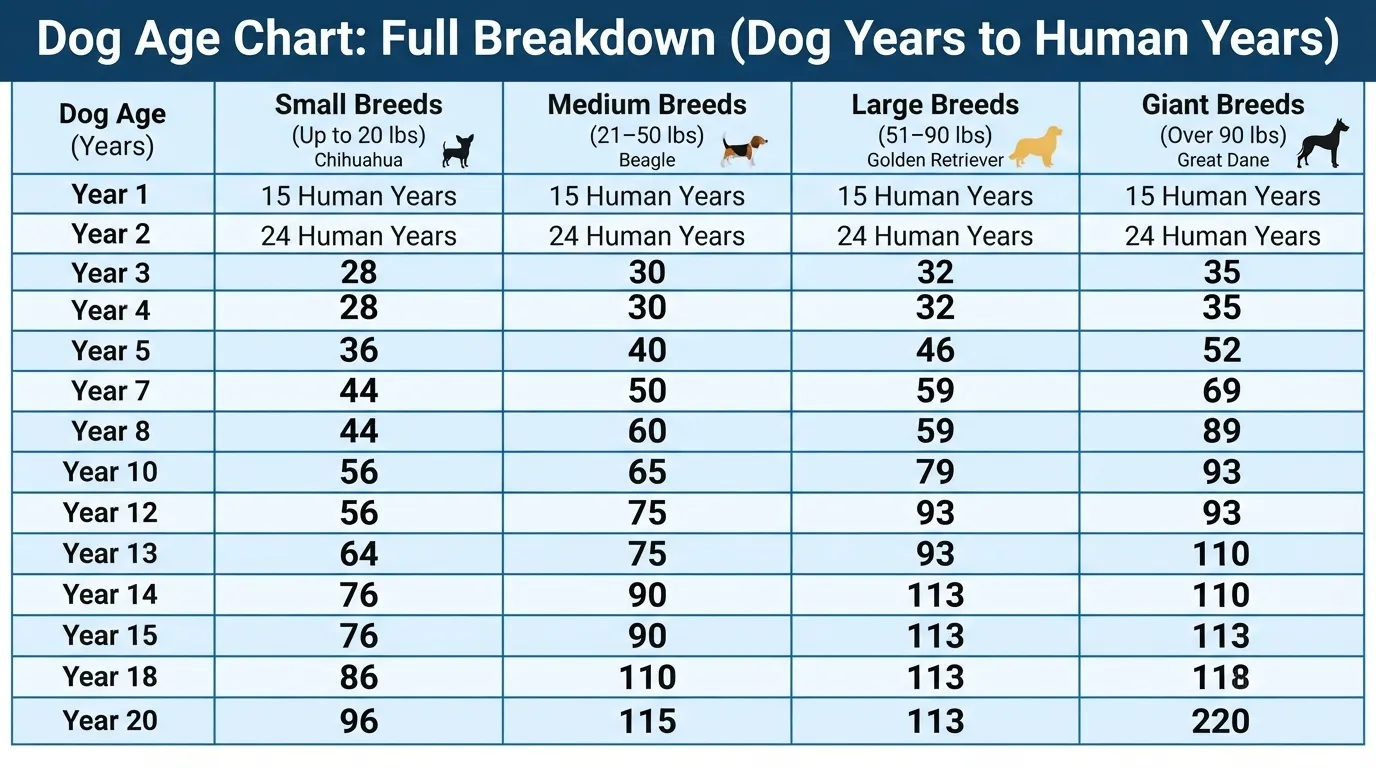
Dog Age Chart β€” Full Breakdown

A comprehensive Dog Age Chart comparing dog years to human years across four breed sizes: Small Breeds (up to 20 lbs), Medium Breeds (21-50 lbs), Large Breeds (51-90 lbs), and Giant Breeds (over 90 lbs), spanning Year 1 to Year 20.

While the complete 1–20 year life-stage chart for all dog sizes is available on our homepage calculator, it helps to see how the late senior years compare side-by-side.

Below is a focused look at the final life stages (ages 15 to 20) across different weight categories. To view the full, interactive lifetime breakdown from puppyhood onward, be sure to check out our complete Dog Age Calculator & Full Chart on the homepage.

Dog Age (Years)Small Breeds (Up to 20 lbs)Medium Breeds (21–50 lbs)Large Breeds (51–90 lbs)Giant Breeds (90+ lbs)
15~76 Human Years~83 Human Years~93 Human Years~101 Human Years
16~80 Human Years~87 Human Years~99 Human Years~108 Human Years
17~84 Human Years~92 Human Years~104 Human Years~114 Human Years
18~88 Human Years~96 Human Years~109 Human Years~115+ Human Years
19~92 Human Years~101 Human Years~115 Human Years~122+ Human Years
20~96 Human Years~105 Human Years~120 Human Years~130+ Human Years
Dog Age: 15 Years
Small (Up to 20 lbs) ~76 Human Years
Medium (21–50 lbs) ~83 Human Years
Large (51–90 lbs) ~93 Human Years
Giant (90+ lbs) ~101 Human Years
Dog Age: 16 Years
Small (Up to 20 lbs) ~80 Human Years
Medium (21–50 lbs) ~87 Human Years
Large (51–90 lbs) ~99 Human Years
Giant (90+ lbs) ~108 Human Years
Dog Age: 17 Years
Small (Up to 20 lbs) ~84 Human Years
Medium (21–50 lbs) ~92 Human Years
Large (51–90 lbs) ~104 Human Years
Giant (90+ lbs) ~114 Human Years

Frequently Asked Questions

Yes, 18 is exceptionally old for a dog. Regardless of breed size, a dog at 18 is well into their twilight senior years, equivalent to a human living into their late 80s, 90s, or even past 100. Less than 1% of all dogs reach this remarkable age, making it a rare and impressive milestone.

The official, longest-standing Guinness World Record for the oldest dog ever belongs to Bluey, an Australian Cattle Dog who lived an incredible 29 years and 5 months (1910–1939).

While a Portuguese dog named Bobi made headlines in 2023 with a claimed age of 31, Guinness World Records officially revoked the title following a thorough investigation due to a lack of conclusive registration and microchip evidence.

Yes, small dogs consistently outlive large and giant breeds. While large mammals (like elephants) generally outlive smaller ones (like mice), the opposite happens within the canine species.

Large dogs grow from puppies to giant adults at an accelerated rate, causing their bodies to experience higher oxidative stress and faster cellular aging. Because of this rapid physiological strain, giant breeds typically live 6 to 10 years, whereas small breeds routinely reach 14 to 16 years, and occasionally push past 18.

Comments

Leave a Comment

Scroll to Top