
18 Human Years to Dog Years – Complete Age Conversion Guide
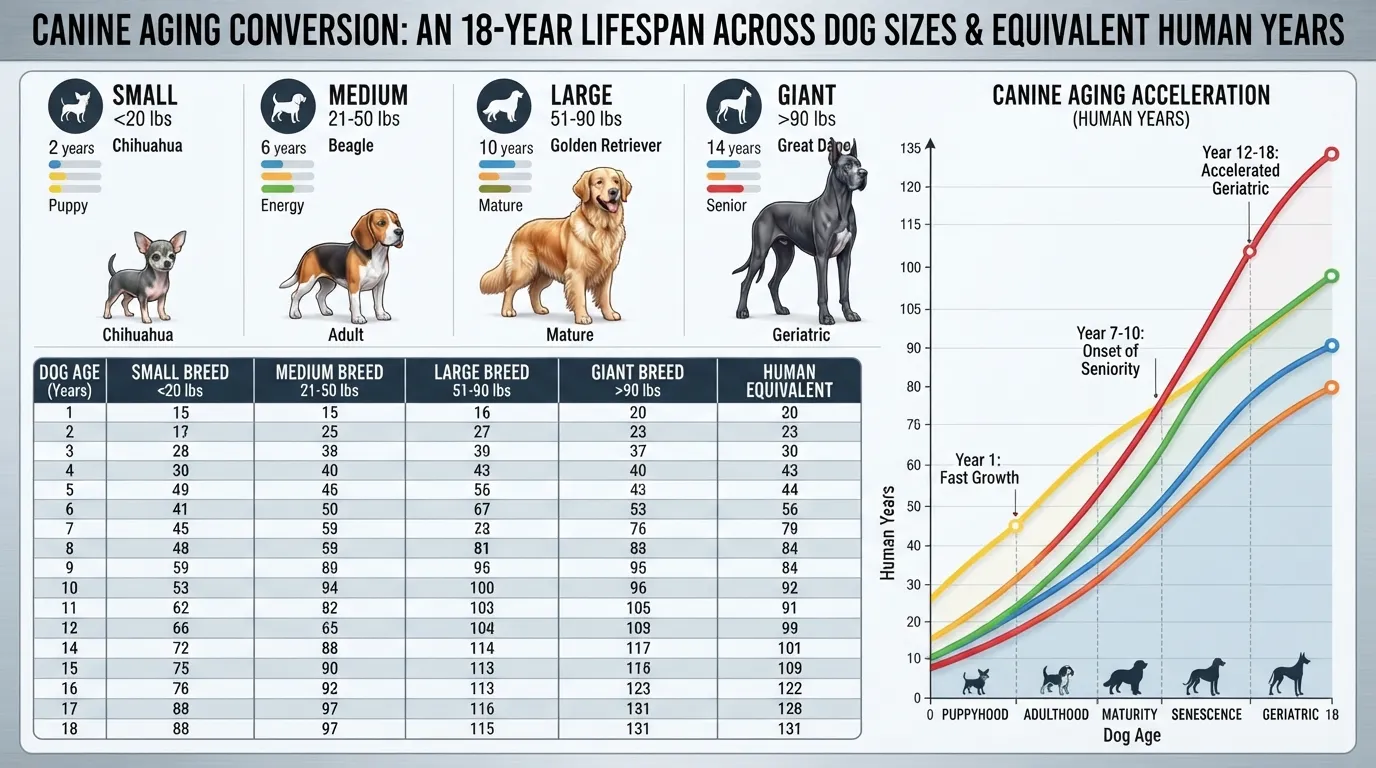
If you are wondering what 18 human years to dog years looks like, let us throw out the lazy old myth that one human year equals seven dog years. Biology does not work on a flat math equation.
According to American Veterinary Medical Association guidelines, dogs mature rapidly during their first two calendar years—reaching the equivalent of a 15-year-old human in year one, followed by another nine years of physical development in year two. After that initial sprint, the aging curve shifts gears entirely depending on your dog’s breed size and genetics.
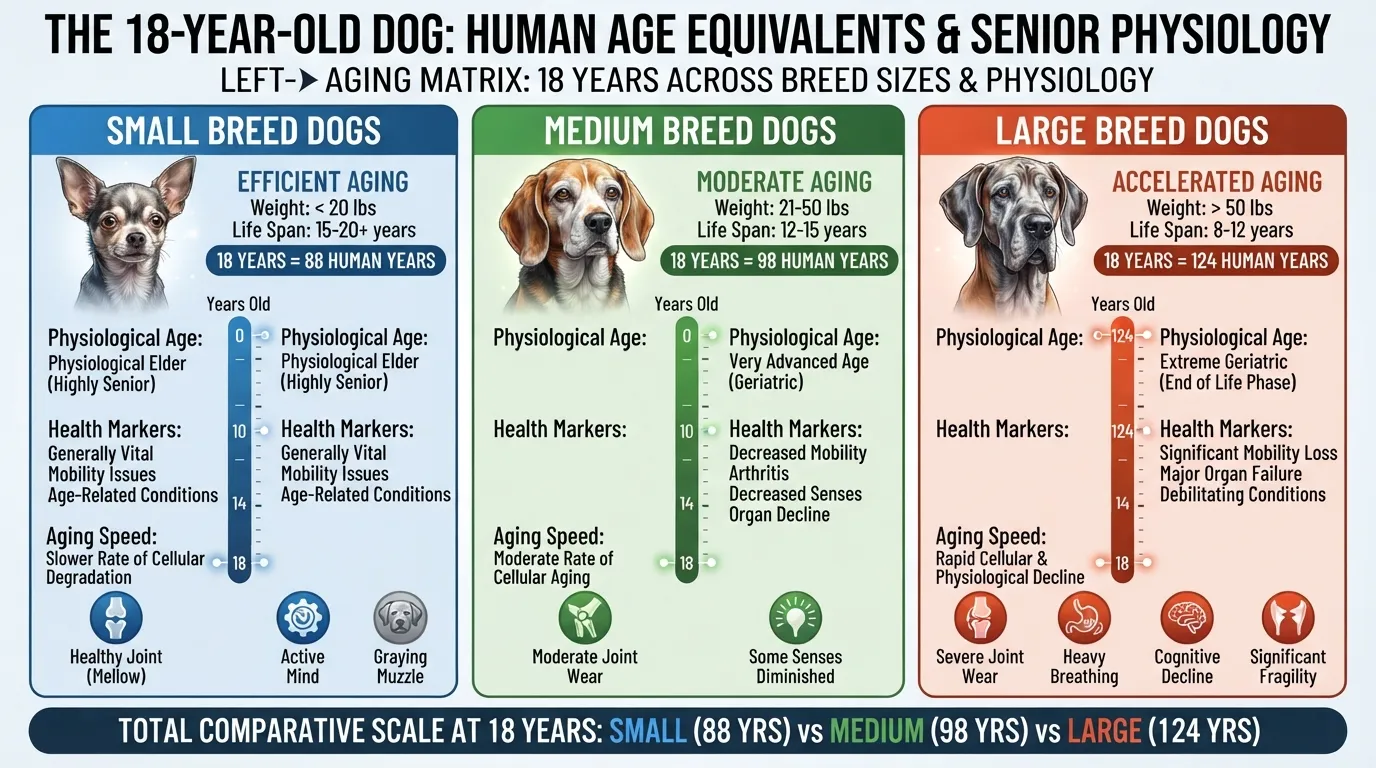
At 18 calendar years, your pup has entered deep senior territory. Using standard veterinary growth curves and life-stage models, here is how those 18 years break down:
Small Breeds (under 20 lbs): Roughly 88 to 92 in dog years. Small dogs age at a much steadier pace later in life, meaning an 18-year-old terrier or toy breed is comparable to a human in their late 80s enjoying a well-earned retirement.
Medium Breeds (21–50 lbs): Roughly 96 to 100 in dog years. Medium-sized dogs reaching this age are in advanced geriatric territory, requiring tailored joint support and gentle daily routines.
Large & Giant Breeds (over 50 lbs): Reaching 18 calendar years is exceptionally rare for big dogs. Their biological age easily surpasses 110+ years, putting them in an elite category of canine longevity that demands specialized veterinary oversight.
To understand what is happening beneath the surface, modern epigenetic clock research from UC San Diego shows that canine aging is closely tied to DNA methylation. Dogs age at lightning speed early on to reach adulthood quickly, and then the molecular clock slows down. At 18 years old, your loyal companion has navigated a full lifetime of changes, making it crucial to focus on comfort, pain management, and nutritional support tailored specifically to their advanced life stage.
How Dog Age Is Really Calculated
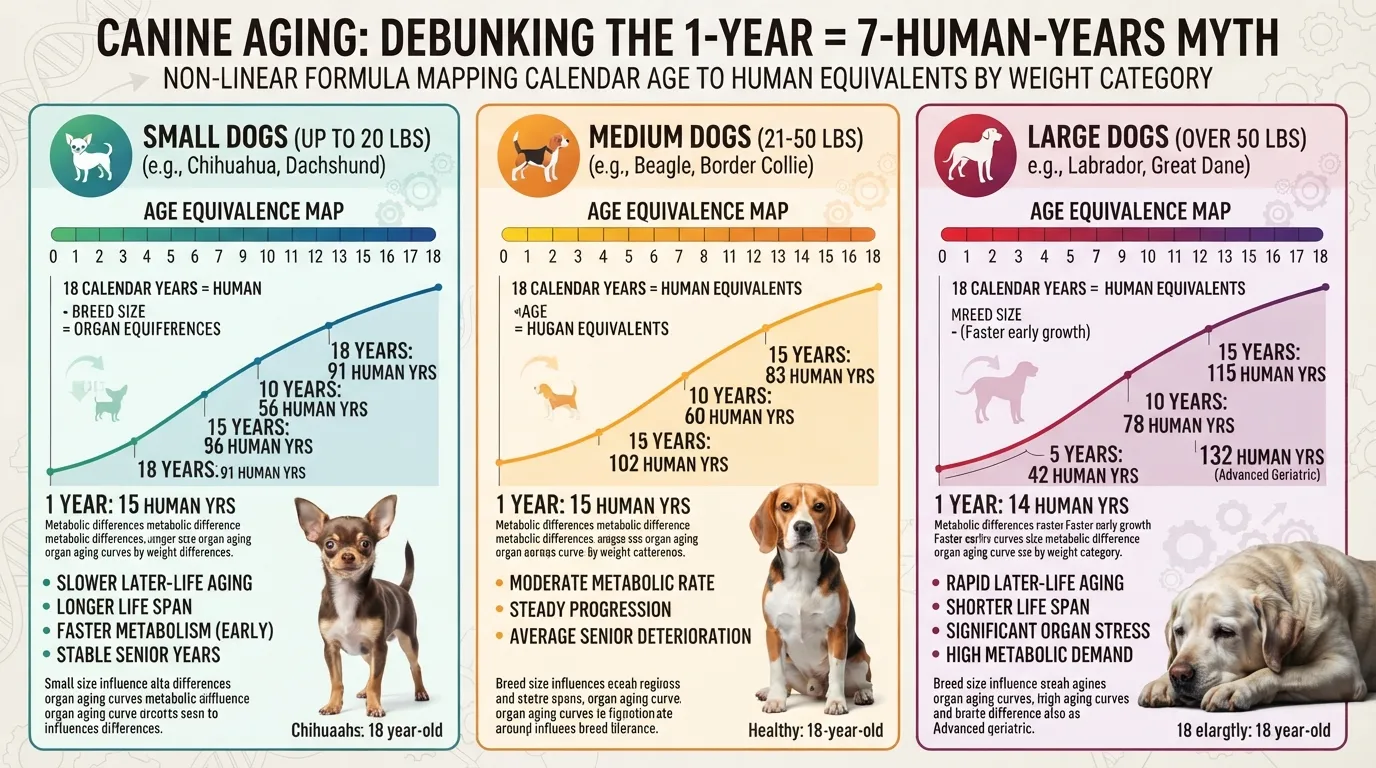
AVMA Guideline (15-9-5 Method)
Forget the outdated myth that one human year equals seven dog years. According to American Veterinary Medical Association guidelines, dogs mature at a much faster rate early on.
Year 1: Equals roughly 15 human years as puppies go through rapid growth and development.
Year 2: Adds another 9 human years, bringing a two-year-old dog to the biological equivalent of a 24-year-old human.
Each year after: Adds roughly 5 human years for every subsequent calendar year.
This tiered approach gives pet parents a realistic baseline for understanding where their dog stands physically and mentally.
Epigenetic Clock Formula (Science-Based)
Modern veterinary science looks deeper than simple calendar math by studying DNA methylation—chemical modifications to DNA that change gene activity over time. Researchers at UC San Diego developed an epigenetic clock formula using the natural logarithmic progression of a dog’s age ($16 \times \ln(\text{dog’s age}) + 31$) to map aging against human biological markers.
This science-backed method proves why the old multiply-by-seven rule is completely inaccurate. Dogs age at lightning speed during their first year of life to reach adulthood quickly, and then the molecular aging curve flattens out significantly as they enter maturity and seniorhood.
18 Human Years to Dog Years by Size/Breed
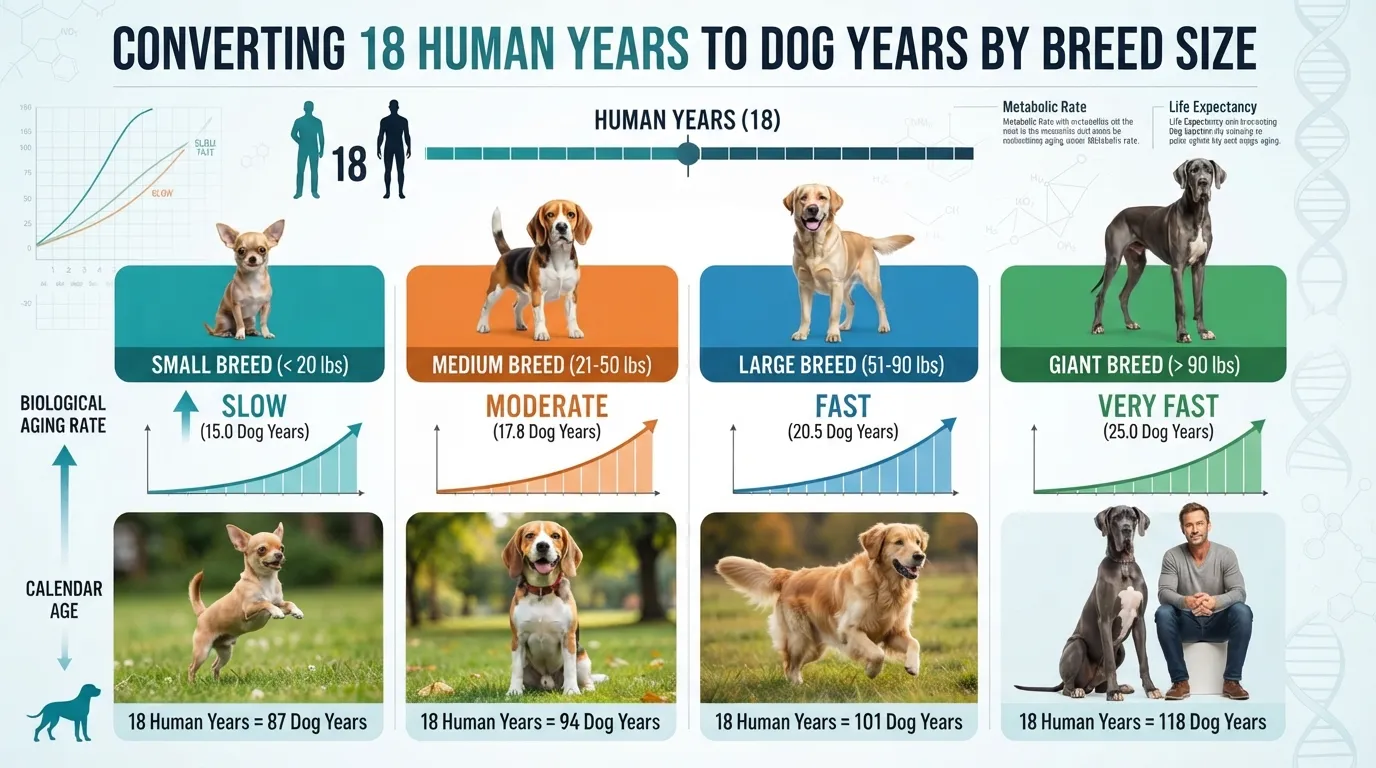
Size and genetics dictate how fast a dog ages once they move past young adulthood. While a small dog might live comfortably into their late teens, a giant breed faces a completely different biological timeline.
Small Breeds
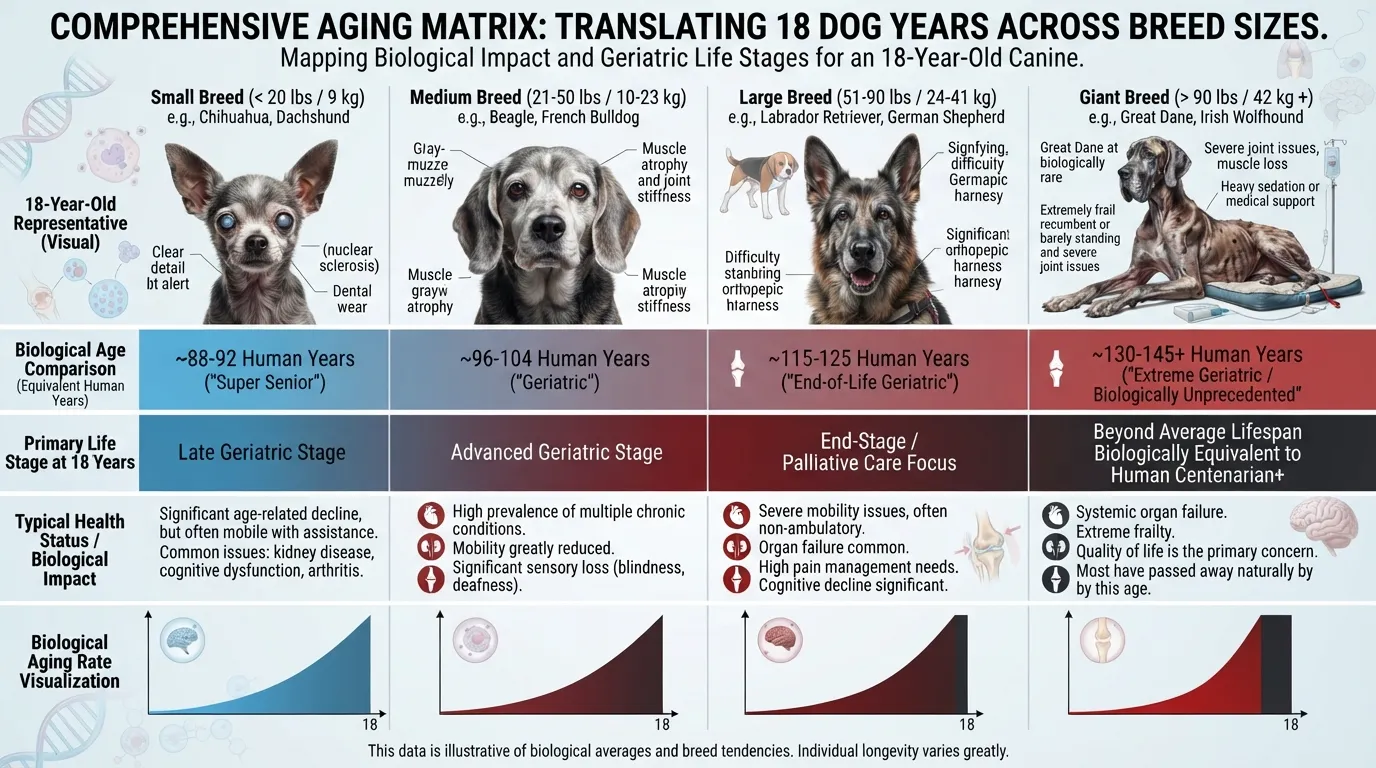
Small breeds (under 20 pounds, like Chihuahuas and Toy Poodles) age the slowest after their initial puppy growth phase. At 18 calendar years, a small dog is roughly 88 to 92 years old in human biological terms, enjoying a well-preserved and active senior lifestyle.
Medium Breeds
Medium breeds (21 to 50 pounds, such as Cocker Spaniels and Beagles) hit middle age and senior status a bit faster than smaller dogs. By 18 calendar years, a medium-sized dog reaches approximately 96 to 100 years old, entering advanced geriatric care.
Large Breeds
Large breeds (51 to 90 pounds, like Golden Retrievers and Boxers) age at an accelerated rate. Reaching 18 calendar years is a remarkable milestone for a large dog, placing their biological age well over 110+ years in exceptional longevity territory.
Giant Breeds
Giant breeds (over 90 pounds, including Mastiffs and Great Danes) have the fastest biological clocks. Surviving to 18 calendar years is extraordinarily rare, with their physical age scaling far beyond 120+ human years due to heavy physiological strain on their organs
Interactive Dog Age Calculator
Input your dog’s age below to instantly convert it both ways—whether you want to find out their human-equivalent age or figure out how calendar years translate based on modern veterinary science.
| Dog's Age (Calendar Years) | Small Breed Equivalent (< 20 lbs) | Medium Breed Equivalent (21–50 lbs) | Large Breed Equivalent (> 50 lbs) |
|---|---|---|---|
| 1 Year | 15 Human Years | 15 Human Years | 15 Human Years |
| 2 Years | 24 Human Years | 24 Human Years | 24 Human Years |
| 5 Years | 36 Human Years | 40 Human Years | 45 Human Years |
| 10 Years | 56 Human Years | 65 Human Years | 78 Human Years |
| 15 Years | 76 Human Years | 89 Human Years | 115 Human Years |
| 18 Years | 88 to 92 Human Years | 100 to 105 Human Years | 110+ Human Years |
What Life Stage Is a Dog at This Age?
Puppy, Teen, Adult, or Senior?
When a dog reaches 18 calendar years of age, they are far beyond the senior phase and have entered the geriatric or super-senior life stage. While a dog is typically considered a senior around age 7 or 8, hitting 18 puts them in a rare category similar to a human centenarian.
Specific physical/behavioral signs at this exact stage:
Sensory Decline: Noticeable clouding of the eyes (nuclear sclerosis or cataracts) alongside significant hearing loss or complete deafness.
Mobility Changes: Severe joint stiffness, muscle wasting in the hind legs, and potential canine cognitive dysfunction (doggy dementia) marked by pacing, confusion, or altered sleep cycles.
Behavioral Shifts: Increased attachment, deeper daytime sleeping patterns, and lower tolerance for sudden environmental changes or loud noises.
Health & Care Tips at This Specific Life Stage
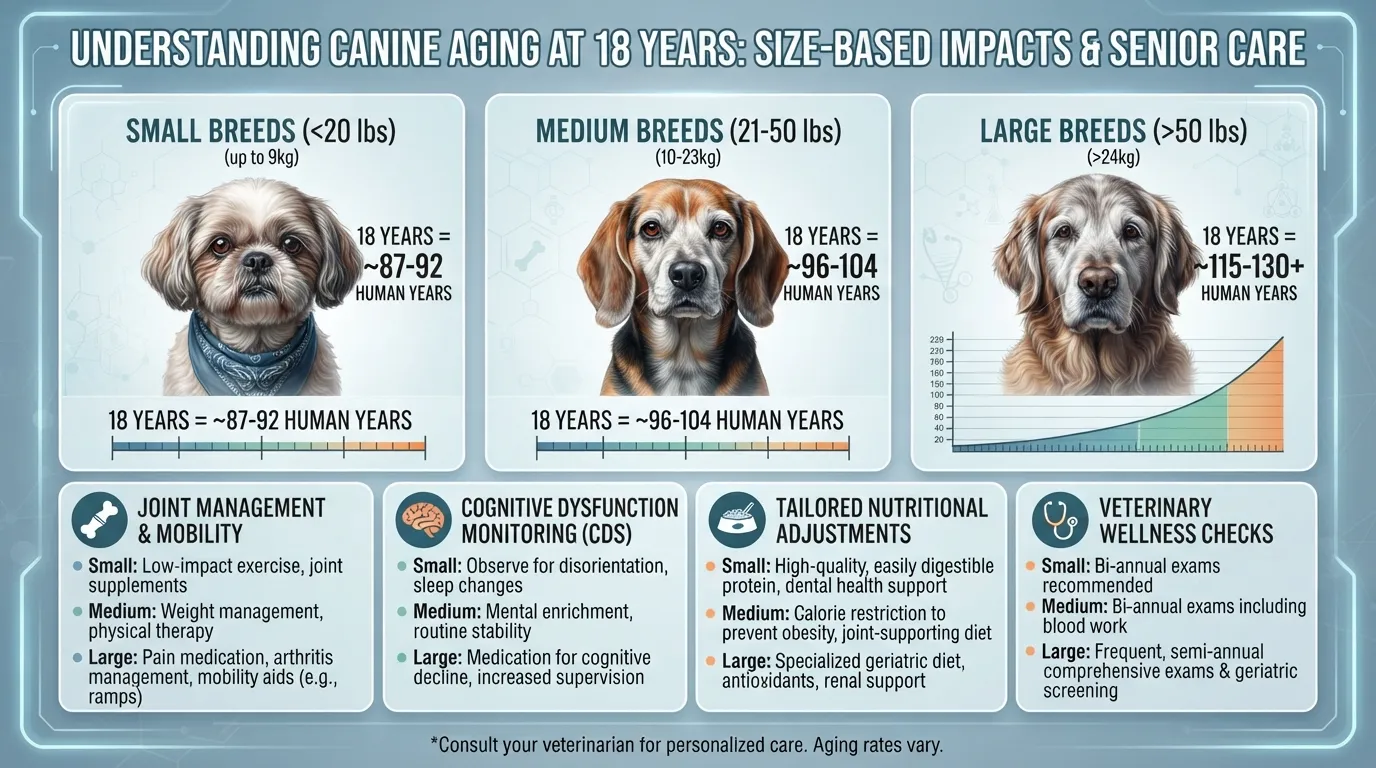
Caring for a dog at 18 calendar years of age requires a gentle, highly attentive approach focused entirely on comfort, pain management, and preserving their quality of life. At this advanced geriatric stage, small daily adjustments can make a massive difference in how comfortable your companion feels.
Vet checkup frequency for this stage: Schedule veterinary wellness exams every 3 to 6 months. Because health conditions can shift rapidly in super-senior dogs, frequent checkups allow your vet to catch pain, monitor kidney or heart function, and adjust medication dosages before issues become severe.
Diet adjustment specific to this stage: Transition to a highly digestible, nutrient-dense senior formula rich in Omega-3 fatty acids (EPA and DHA) to support brain function and joint mobility. If your dog has a poor appetite or missing teeth, consider switching to warmed wet food or adding a veterinary-approved bone broth to entice eating and maintain adequate hydration.
Exercise needs specific to this stage: Replace long, structured walks with short, leisurely potty breaks and gentle indoor wandering driven entirely by your dog’s pace. Protect their aging joints on slippery hardwood floors by laying down non-slip yoga mats or runners, and invest in an orthopedic memory foam bed to cushion pressure points.
FAQs
Is the 7-year rule accurate?
No, the traditional rule that one human year equals seven dog years is an oversimplified myth. Canine biology does not scale linearly. Dogs actually mature rapidly during their first two years of life—reaching the equivalent of a middle-aged human by age two—and then their aging rate slows down and varies significantly based on their adult body size.
Do small dogs age slower than large dogs?
Yes, small dog breeds generally age at a slower biological rate after their initial puppy years, which is why they enjoy much longer lifespans (often 14 to 16 years or more). Large and giant breeds experience accelerated biological aging relative to their size, resulting in much shorter average lifespans, where a dog becomes a senior much earlier in calendar years.
When is a dog considered senior?
Most dogs are officially classified as seniors when they reach roughly 7 to 8 years of age. However, this threshold shifts depending on breed size; smaller breeds might not show true geriatric signs until age 10 or 11, while giant breeds like Great Danes or Mastiffs often enter their senior years around age 5 or 6.
Does breed affect aging rate?
Yes, genetics and breed size play the most influential role in determining how fast a dog ages. Smaller gene pools and compact body masses sustain cellular repair mechanisms more efficiently over time, whereas larger breeds undergo rapid growth and metabolic stress that shortens their overall timeline.
🐾 Other Age Guides

I built Dogagescalculator.com to give dog owners honest, science-backed answers instead of the outdated "×7" myth. Every figure here is checked against AKC, AVMA, and published veterinary research.
More about the author & this site →
Comments