
What Is 4 Human Years in Dog Years?
Reviewed by Dr. Sarah Jenkins, Veterinary Content Advisor
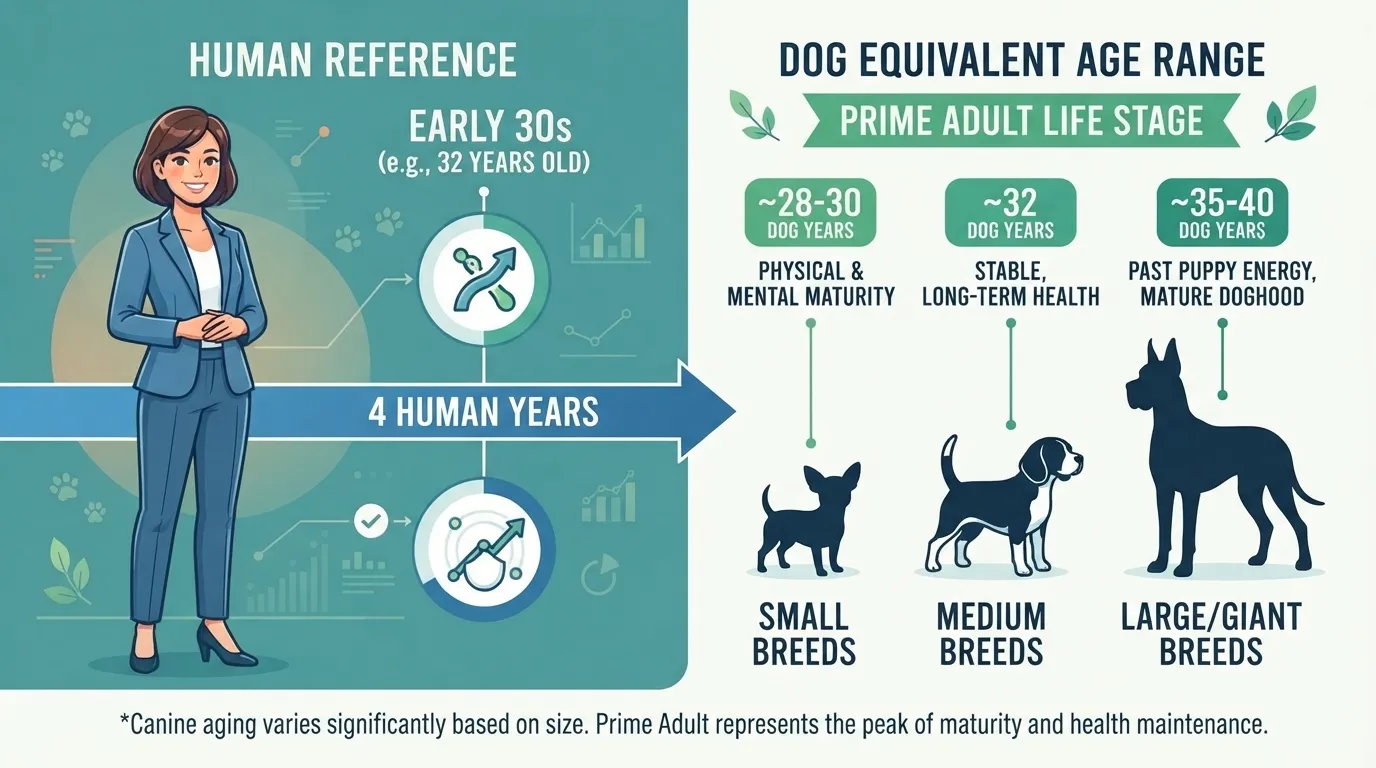
Direct Answer: When you ask, “what is 4 human years in dog years,” the answer depends on your dog’s size. Generally, a 4-year-old dog is roughly equivalent to a human in their early 30s. While small breeds reach this maturity slightly faster, large breeds age more slowly during these years.
Understanding the 4-Year Milestone
Forget the old “one human year equals seven dog years” rule. Modern veterinary science, supported by data from organizations like the AAHA, shows that dogs don’t age in a straight line.
At 4 years old, your dog has officially left the puppy and adolescent phases behind. They are now considered a “young adult.” Think of this as the prime of their life—they have the energy of a young adult, but their physical development is fully stabilized.
Why Size Changes the Math
You might notice your neighbor’s 4-year-old Great Dane acts differently than your 4-year-old Chihuahua. That’s because size dictates metabolic rate and biological maturity:
Small & Toy Breeds: These pups reach maturity faster. By age 4, they are often equivalent to a human in their early-to-mid 30s, essentially operating at a “peak performance” physical level.
Medium Breeds: They sit right in the middle, aligning closely with that early 30s human age marker.
Large & Giant Breeds: These dogs take longer to “grow into” themselves. At 4 years old, they are biologically similar to a human in their late 20s or very early 30s. They are still quite youthful compared to their smaller counterparts at the same chronological age.
What This Means for Your Dog’s Care
Since a 4-year-old dog is essentially a young adult, they require a different approach than a growing puppy. You should be shifting your focus toward long-term maintenance:
Weight Management: Metabolism starts to level off around this age. If you aren’t careful with calories, those extra pounds can creep on fast, putting stress on joints early.
Dental Health: By age 4, many dogs show early signs of plaque or tartar buildup. If you haven’t started a regular tooth-brushing routine, now is the best time to begin to prevent future dental disease.
Joint Support: Even if they are still zooming around the park, this is the perfect age to ensure they are on a high-quality diet that supports joint health, especially for larger breeds who will carry more weight over their lifetime.
At this stage, your dog is likely at their healthiest and most active. Regular annual check-ups are still vital, but you’re mostly looking to maintain that baseline of health rather than managing developmental growth spurts.
Understanding Dog Years
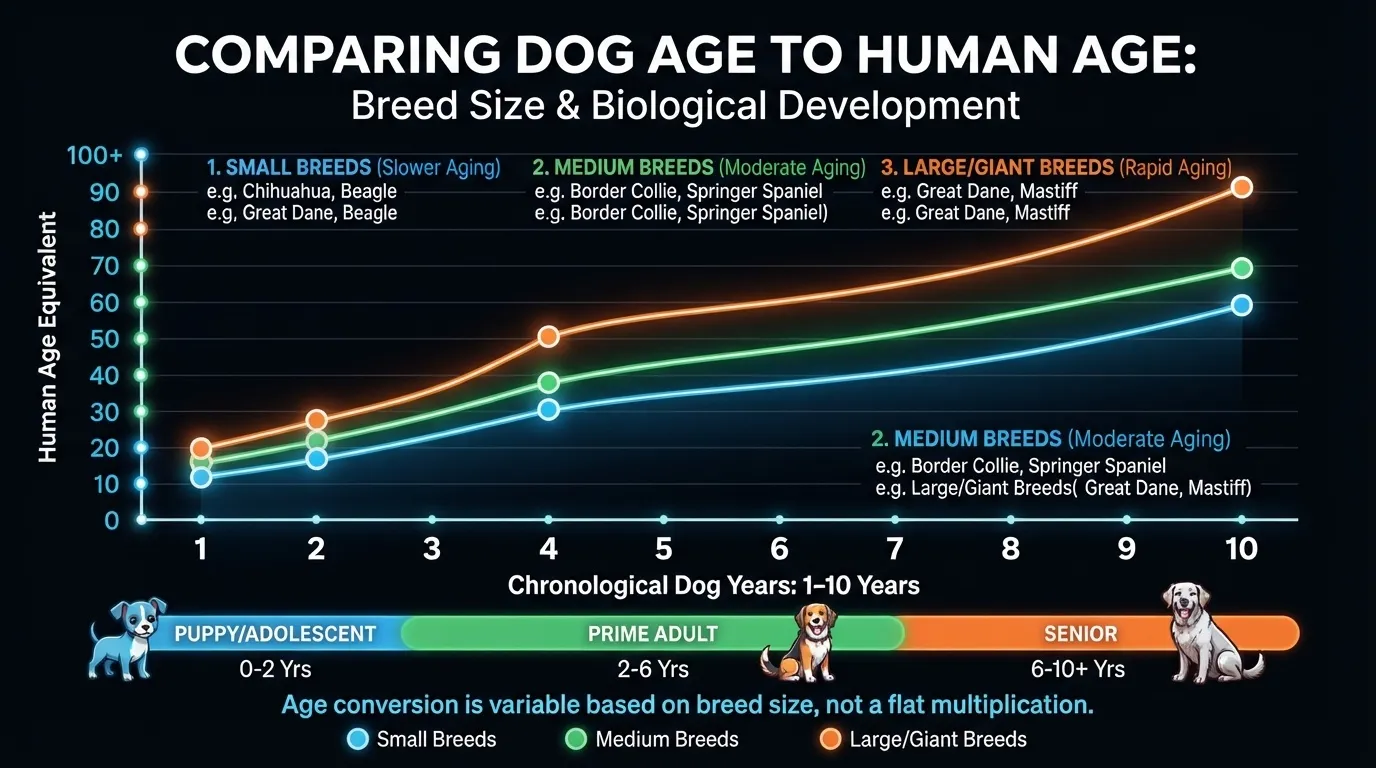
Many people still cling to the old idea that you simply multiply a dog’s age by seven to find their human equivalent. If you’ve heard this, it’s time to move past it. This “1 year equals 7 years” rule is scientifically inaccurate because it doesn’t account for the massive biological differences in how dogs mature compared to humans.
Dogs go through their “childhood” and “adolescence” phases much faster than we do. For example, a dog reaches sexual maturity within their first year, which is certainly not the case for a seven-year-old human child. Instead of a flat multiplication, experts now look at metabolic rates, size, and breed-specific lifespans to determine a dog’s true life stage.
What Is 4 Human Years in Dog Years
When you ask what is 4 human years in dog years, the answer depends heavily on your dog’s size. By the time a dog reaches their fourth birthday, they are no longer a puppy or a rowdy teenager. In human terms, a four-year-old dog is generally considered to be in their early-to-mid thirties—essentially a healthy, active young adult.
To give you a better idea of how this looks across different breeds, here is how those 4 years typically translate:
| Dog Size | Human Age Equivalent (at 4 Years Old) |
| Small Breeds | ~32 Years |
| Medium Breeds | ~33 Years |
| Large Breeds | ~35 Years |
At this stage, your dog is likely in their prime. They have moved past the intense puppy chewing phase and the high-energy demands of adolescence. Physically, they are fully developed, and their metabolism has stabilized. Because they are roughly in their early thirties, this is the perfect time to focus on preventative health—keeping up with dental cleanings, maintaining a healthy weight, and ensuring they get enough physical activity to keep their joints supple as they move toward their middle years.
The Real Science: DNA Methylation Formula
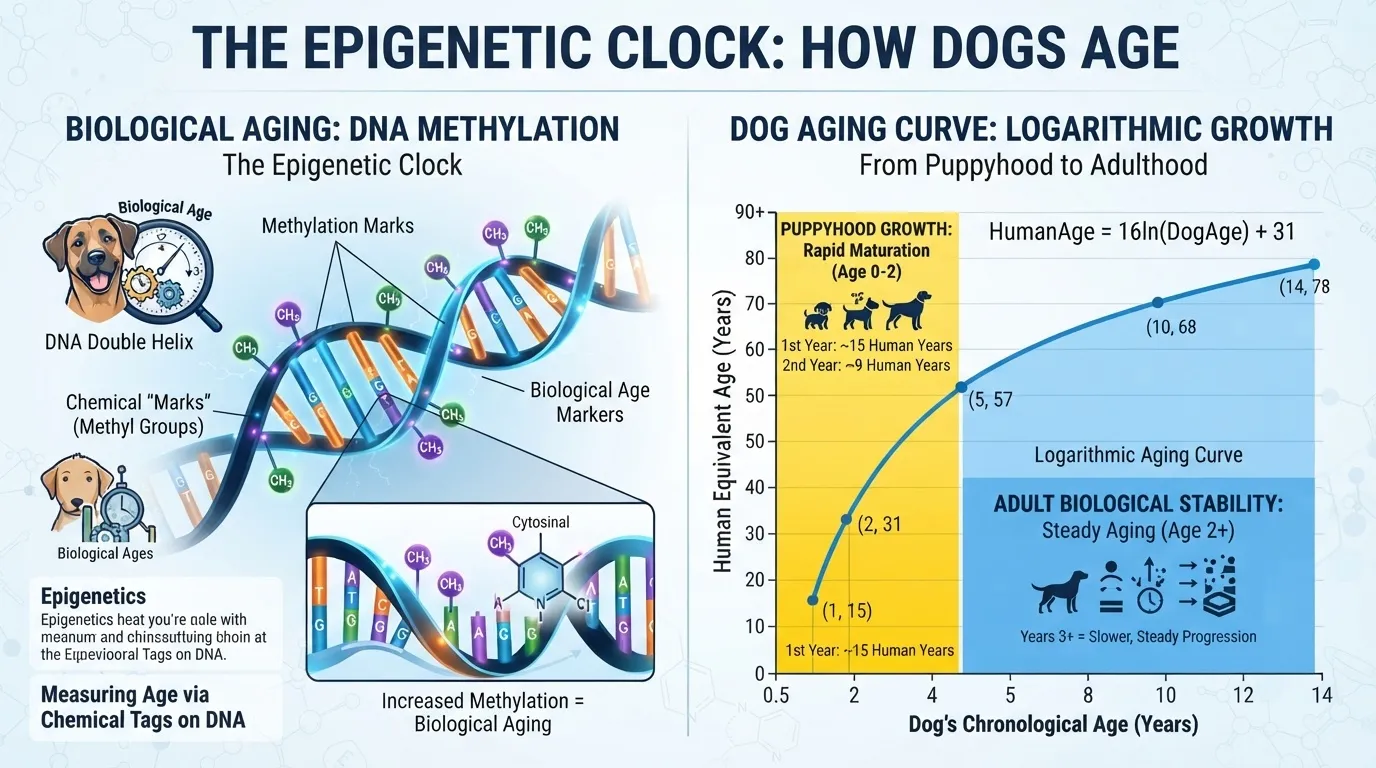
Forget the old “one human year equals seven dog years” rule. It’s a myth that doesn’t hold up in the real world. Veterinarians and researchers have moved on to more precise methods, specifically looking at DNA methylation.
Think of this like an internal biological clock. As dogs (and humans) age, our DNA accumulates chemical changes called methylation marks. By studying these specific markers, scientists can track the “epigenetic clock” of a dog with incredible accuracy. This method shows us that dogs age rapidly during their puppyhood and early years, then the process slows down significantly as they reach maturity.
How Researchers Calculate Real Dog Age
The most widely accepted scientific model today, popularized by researchers at the University of California, San Diego, uses a logarithmic formula. Instead of a flat multiplication, it accounts for the fact that a one-year-old dog is essentially a young adult, while a human of the same age is still a toddler.
The formula looks like this:
Human Age = 16 x ln(Dog Age) + 31
This formula recognizes that dogs reach sexual maturity much faster than humans. Once a dog hits that milestone, the “aging” rate levels off. This is why a small, active dog doesn’t age at the same speed as a massive, slow-metabolizing giant breed. While this formula works great for Labradors and similar breeds, keep in mind that smaller dogs often have longer lifespans, meaning their internal clock ticks a bit differently than a Great Dane’s.
Applying the Formula to 4 Human Years
If you’re wondering what is 4 human years in dog years, it’s a bit of a trick question because of how quickly dogs start their lives.
When a dog is 4 human years old, they are firmly in their “young adult” phase. They have long outgrown their puppy energy and are likely at the peak of their physical health. If we translate that 4-year human timeline into dog aging, here is where your pup stands:
Developmental Stage: Your dog is in their prime. They are mentally mature, physically stable, and have finished their growth spurts.
The “Age” Equivalent: Scientifically, a dog that has lived for about 4 human years is roughly equivalent to a human in their early 30s.
Health Focus: At this stage, your focus shifts from “puppy training” to “preventative maintenance.” This is the best time to start being proactive about joint health, maintaining a healthy weight, and keeping up with annual dental cleanings.
Basically, if your dog is 4 years old, they aren’t just a “child” anymore—they are an adult in the prime of their life. Treating them as such will help you adjust their nutrition, exercise, and medical needs to ensure they stay in that prime condition for as long as possible.
4 Human Years in Dog Years — Breed-Wise Breakdown
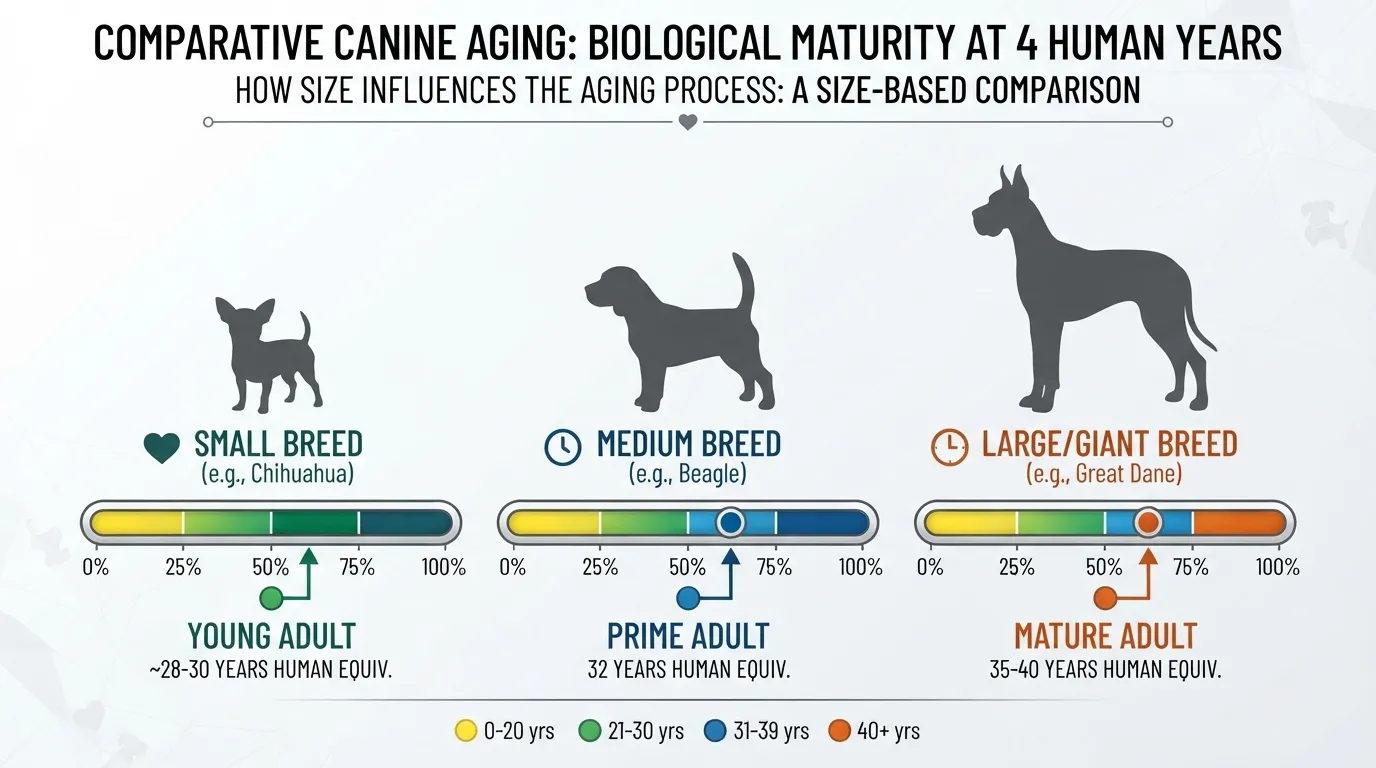
Because of their size and genetics, not all dogs age at the same speed. While the formula gives us a great baseline, we have to adjust for breed size. Smaller dogs tend to live much longer, meaning they age “slower” compared to large breeds that have a much shorter lifespan.
Small / Medium / Large Breed Table
| Breed Size | Biological Age (at 4 Years Old) | Life Stage |
| Small Breed | ~28–30 Human Years | Young Adult |
| Medium Breed | ~32 Human Years | Prime Adult |
| Large/Giant Breed | ~35–40 Human Years | Mature Adult |
Real-Life Comparison Example
Think of it this way: if you have a Chihuahua (small breed), at 4 years old, they are still very much in their youthful prime. They have years of vitality ahead. However, a Great Dane (giant breed) at 4 years old is already starting to enter their “middle age” transition.
This difference matters for your vet visits. A larger dog might need to start screening for age-related joint or heart issues earlier than a smaller dog. Keeping track of these biological differences ensures you are giving your best friend the specific care they need at every stage of their life.
What Life Stage Does This Represent?
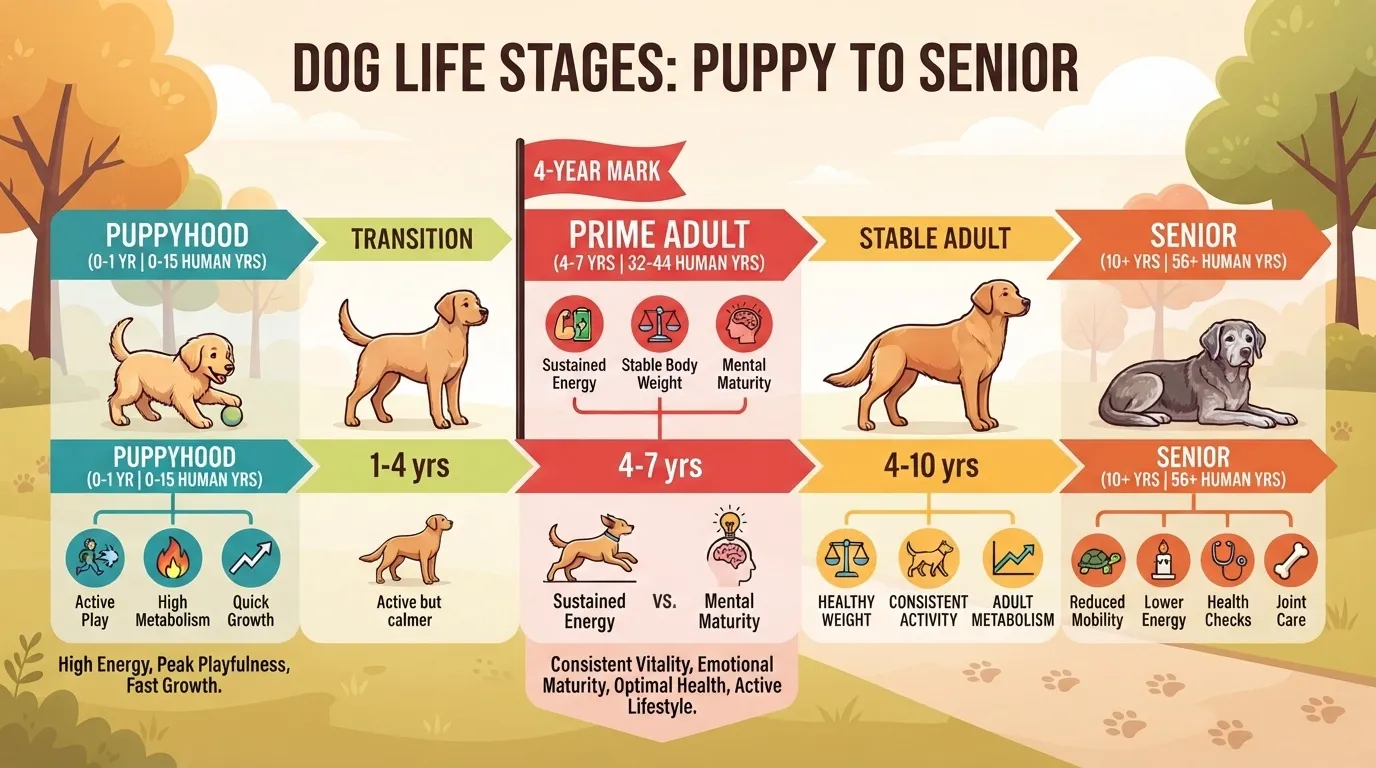
When you ask, “what is 4 human years in dog years,” you are looking at a dog in its absolute prime. By this point, the rapid growth phase of puppyhood and the “teenage” testing phase are long gone. Physiologically, your dog has reached full adult maturity. They are settled, their personality is set, and their metabolism has stabilized. While the exact age conversion varies by breed, most dogs at this stage are roughly equivalent to a human in their early to mid-30s. They have the stamina for long adventures but possess the emotional maturity that makes them reliable companions.
Behavior at This Stage
At 4 years old, most dogs have shed that frantic, destructive energy often seen in younger dogs. You will likely notice a more predictable routine. They are usually more focused during training sessions and are better at self-regulating when left alone for a few hours. However, they aren’t “old” by any means. They still have plenty of play drive and typically love engaging in high-energy activities like fetch, hiking, or agility work. If your dog is still acting hyperactive, it is often a sign they need more mental stimulation or structured exercise rather than a lack of maturity.
Specific Care Focus for This Exact Stage
Since your dog is in their prime, the goal of your care routine should be preventative maintenance rather than fixing immediate problems. Think of this as the “solid foundation” phase:
Joint and Mobility Support: Even if your dog runs perfectly fine, starting high-quality joint supplements (like Glucosamine or Chondroitin) now can pay off immensely later.
Weight Management: Metabolism starts to shift slightly at this age. Even a few extra pounds can put unnecessary stress on your dog’s frame. Keep a close eye on their body condition score and adjust portion sizes as needed.
Dental Health: By age 4, tartar buildup can start to become a real issue for many dogs. If you haven’t been brushing their teeth regularly, now is the time to start. A professional dental cleaning at the vet may be recommended if you see signs of redness or bad breath.
Consistent Wellness Checks: Since they are now a mature adult, annual blood work is a great idea. It helps establish a “baseline” for your dog’s health, making it much easier for your vet to spot subtle changes in the future.
Focusing on these areas now ensures that your dog stays in their prime condition for as long as possible, keeping those “golden years” further down the road.
The AVMA Method — Why It's Outdated
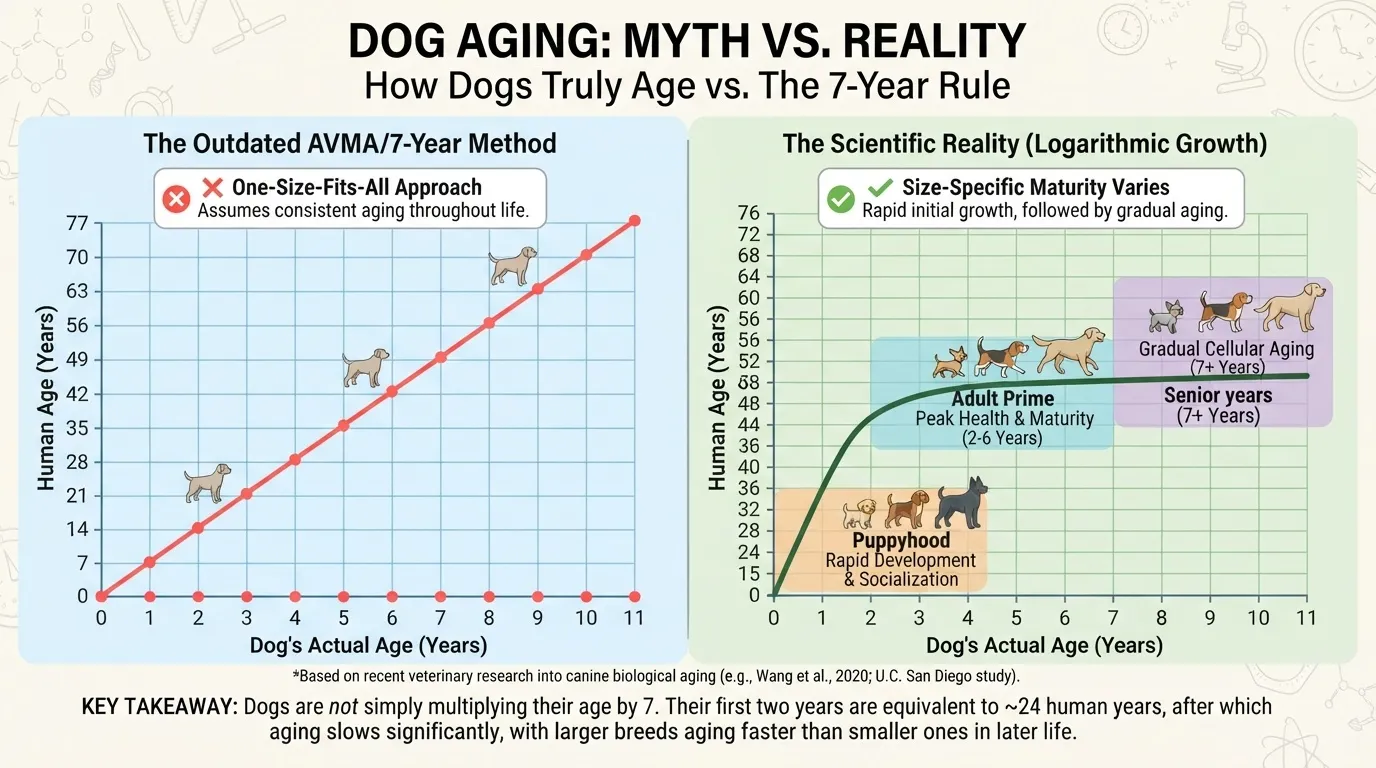
For years, many of us relied on the simple rule that “one human year equals seven dog years.” It was easy to remember and quick to calculate, which is why it became so popular. While it was widely repeated, the American Veterinary Medical Association (AVMA) and other leading organizations have moved away from this simplistic approach.
The problem with the “seven-year rule” is that it assumes dogs age at a constant, linear rate throughout their entire lives. Science tells us that just isn’t true. Dogs develop extremely rapidly in their first year—reaching the equivalent of a human teenager or young adult—and then the aging process slows down significantly.
Because of this, the seven-year method is now considered outdated for a few key reasons:
Ignores Development Milestones: A one-year-old dog is capable of reproducing and is physically mature, whereas a seven-year-old child is not. The old math completely fails to account for how fast puppies reach adulthood.
Neglects Breed Differences: This method applies the same math to a Chihuahua that it does to a Mastiff. We know that giant breeds have shorter life spans and age differently than small breeds, but the seven-year rule treated every dog as if they had the exact same biological clock.
Lacks Scientific Basis: There is no biological or genetic evidence to support a flat 1:7 ratio. Modern research, like the DNA methylation studies mentioned earlier, gives us a much clearer picture of how our pets age based on their actual internal clock, rather than an arbitrary number.
By moving toward more accurate, science-based models, we can provide better care for our dogs at every life stage. Instead of using a one-size-fits-all formula, it is much more effective to look at your dog’s specific breed, size, and current health status to determine how to best support them as they grow.
Use Our Interactive Dog Age Calculator
If you want to see exactly how your dog compares to human age milestones without doing the complex math yourself, our tool makes it instant and accurate. We have designed this calculator to go beyond simple multiplication, incorporating the scientific understanding of how different breeds mature at different speeds.
Whether you are curious about what is 4 human years in dog years for your energetic Terrier or your gentle Giant, the calculator provides a tailored look at your dog’s biological life stage.
How it works: Simply enter your dog’s current age and their approximate breed size.
Get instant results: The calculator adjusts for the rapid development of the first two years and the slower, more stable aging that follows.
Understand their needs: Along with the age, you will get insights into the specific health and behavioral needs associated with that life stage.
Stop guessing with the outdated seven-year rule. Use our Dog Age Calculator today to get a clearer picture of your dog’s health journey and ensure you are providing the best support for them at every stage of their prime.
Frequently Asked Questions
It isn't just one fixed number because biology doesn't work that way. While we often use "4 years" as a milestone for adulthood, the exact internal age of a dog depends on their breed and genetics. Think of it as a range rather than a single digit; at 4 years old, your dog has officially transitioned out of their youthful, high-growth phase and into a steady, mature adult life.
Breed size is one of the biggest factors in how fast a dog's "biological clock" ticks. Generally, smaller dogs have slower metabolic rates and different cellular repair processes, which allows them to live longer. Large breeds, on the other hand, go through their life stages much faster. Because they grow so quickly from puppyhood to a massive size, their bodies experience the effects of aging at an accelerated pace compared to smaller, lighter dogs.
Yes, they absolutely do. You can see this difference clearly as dogs get older. A small dog might remain sprightly and active well into their teens, while a giant breed may start showing signs of being a "senior" much earlier in life. This is why we don't use the old "seven-year rule"—it ignores the fact that a giant breed has a much shorter lifespan than a small breed. Tailoring your pet's care based on their size is the best way to help them stay healthy throughout their entire life.
Comments