What Is 13 Dog Years in Human Years? Exact Answer by Size & Breed
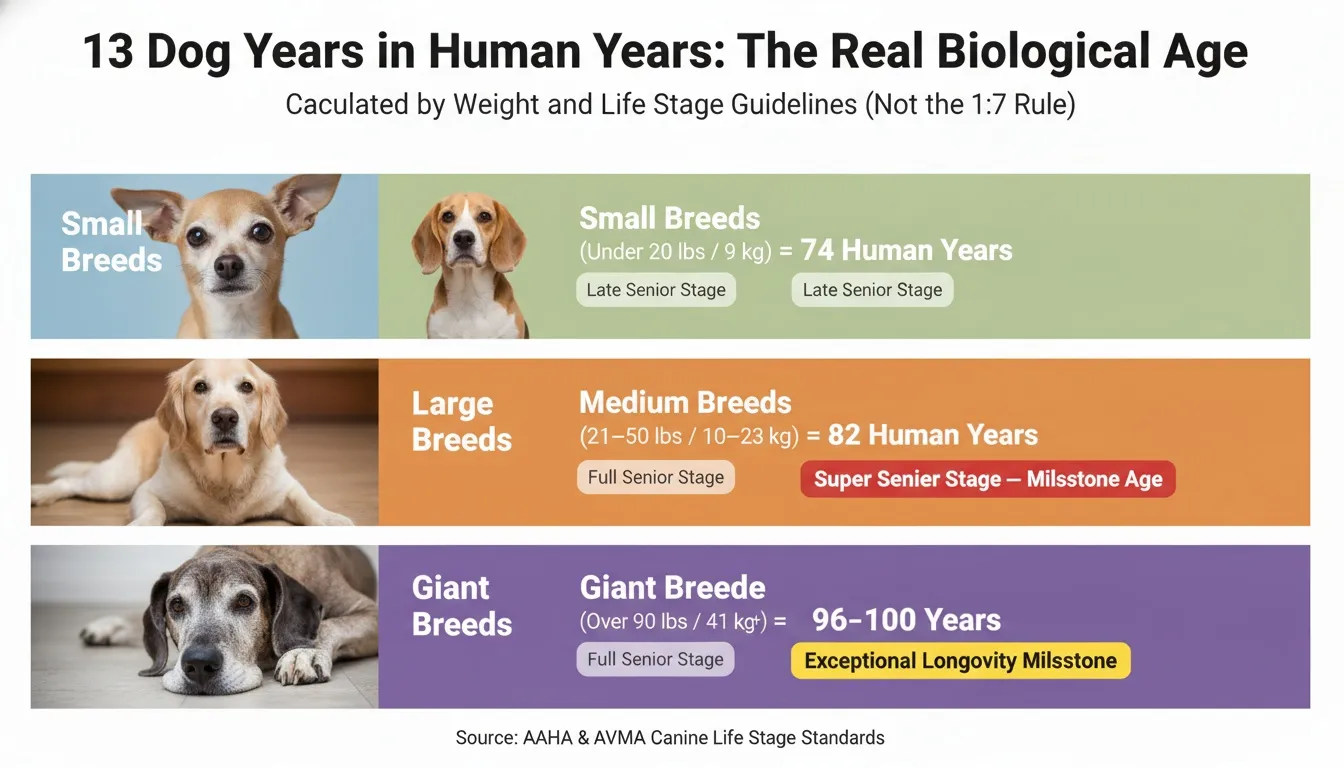
If you are wondering what is 13 dog years in human years, a 13-year-old dog is approximately 68 to 100 human years old, depending on their adult size and breed. Smaller dogs generally fall toward the younger end of the range, while large and giant breeds tend to have a higher human-age equivalent.
The traditional “multiply by seven” rule would make a 13-year-old dog 91 human years old, but this simple calculation does not account for the way dogs actually age. Dogs mature very quickly during their early years, while their later aging pattern can vary considerably based on size, breed, genetics, and overall health.
How Old Is a 13-Year-Old Dog by Size?
A size-based estimate provides a more useful comparison than applying the same formula to every dog. At 13 years old, most dogs are in their senior years, but their estimated human-equivalent age can differ significantly depending on their adult body size.
| Dog Size | Typical Weight | Estimated Human Age at 13 |
|---|---|---|
| Small | Under 20 lbs / 9 kg | ~68 years |
| Medium | 21–50 lbs / 10–23 kg | ~74 years |
| Large | 51–90 lbs / 23–41 kg | ~82 years |
| Giant | Over 90 lbs / 41+ kg | ~96–100 years |
These figures are estimates rather than exact biological ages. Dogs of the same age and size can still age differently because of breed, genetics, body condition, health history, and lifestyle.
If you want a personalized estimate based on your dog’s age and size, use our free dog age calculator.
How Is 13 Dog Years Calculated? Two Science-Backed Methods
Is content ko bilkul correct, professional aur scannable format me convert kar diya hai. Math formulas ko standard text aur simple formatting me badal diya hai taake read karne me asaani ho:
Method 1 — AVMA Size-Based Formula (Most Used)
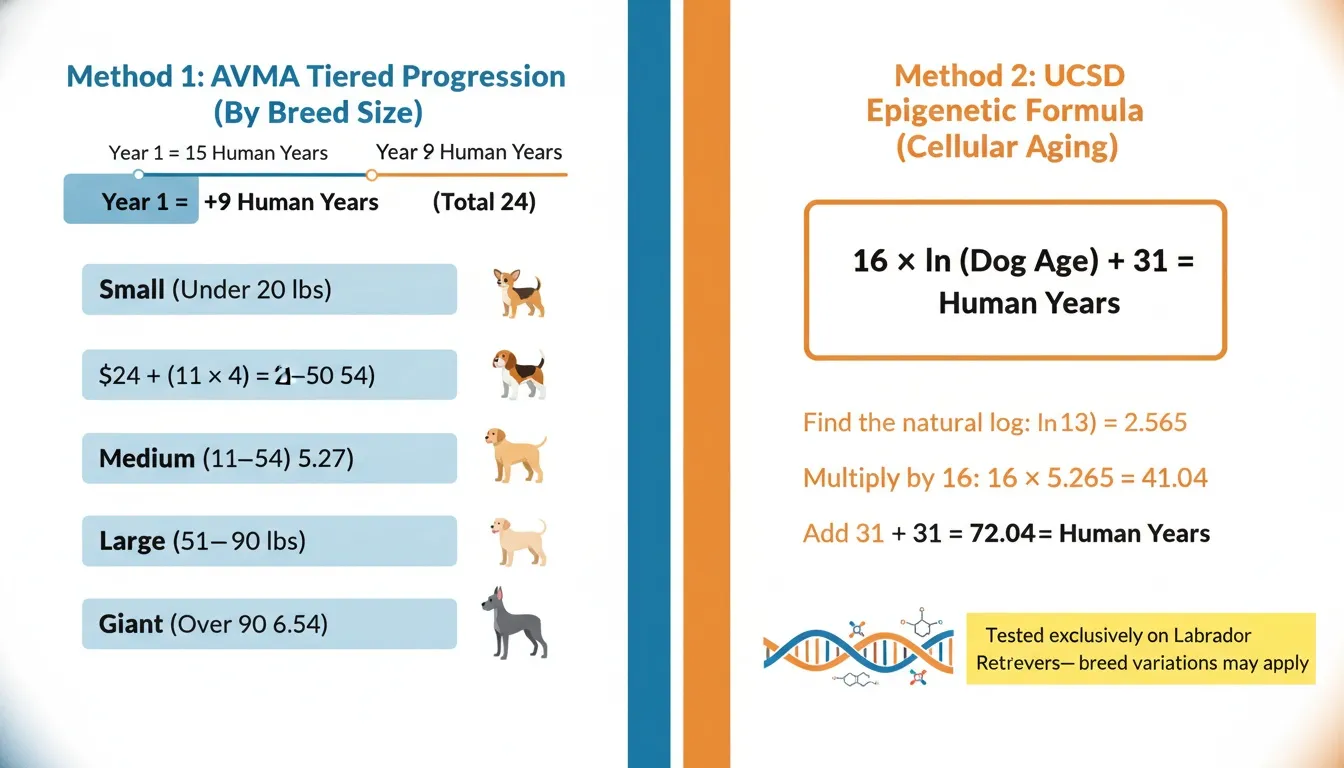
The American Veterinary Medical Association (AVMA) uses a tiered formula that accounts for the fact that dogs mature rapidly in their first two years, and larger breeds age faster later in life.
Year 1: Equals 15 human years (covers rapid childhood and adolescent growth).
Year 2: Adds 9 human years (reaching young adulthood at roughly 24 human years).
Year 3 onwards: Adds 4 to 5 years annually for small/medium dogs, and 5 to 6+ years for large/giant breeds.
Here is exactly how 13 dog years adds up step-by-step for each size category:
Small Dogs: 15 + 9 + (11 × 4) = 68 human years
Medium Dogs: 15 + 9 + (11 × 4.54) = 74 human years
Large Dogs: 15 + 9 + (11 × 5.27) = 82 human years
Giant Dogs: 15 + 9 + (11 × 6.54) = 96 human years
For more details on lifestyle stages, you can visit the AKC.org guidelines.
Method 2 — UC San Diego Logarithmic Formula
In 2020, researchers at the University of California, San Diego released a formula based on epigenetics—specifically tracking changes in canine DNA over time (chemical markers called methyl groups).
The scientific formula is:
16 × ln(dog age) + 31 = human years
Using this method, 13 dog years calculates to roughly 72 human years:
16 × ln(13) + 31 ➔ 16 × 2.565 + 31 = 72 human years
When to use it: This formula is highly accurate for measuring cellular-level aging and mapping out shared biological milestones between humans and dogs.
Limitations: The entire study was conducted exclusively on Labrador Retrievers. Because different breeds have vastly different lifespans (a Chihuahua lives much longer than a Great Dane), this formula does not yet accurately scale across all sizes.
13 Dog Years in Human Years — Breakdown by Size
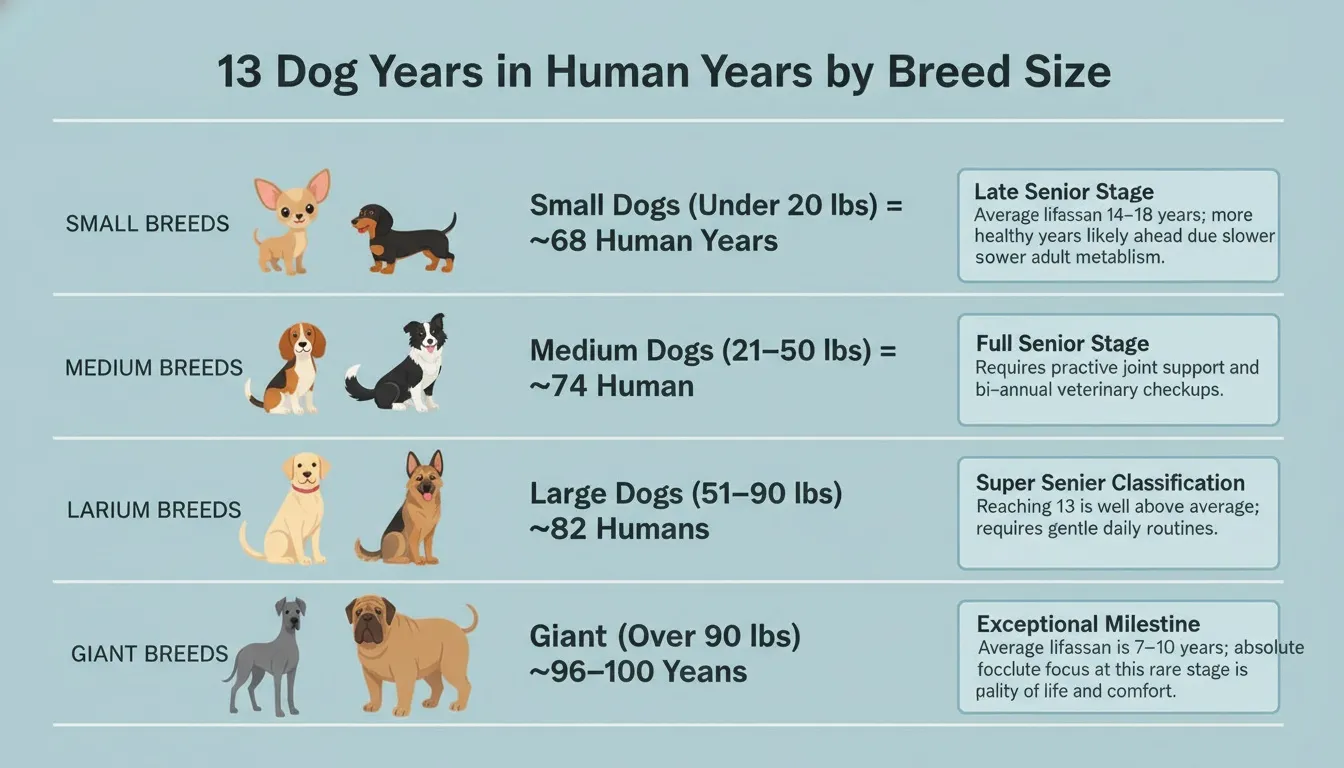
Small Dogs at 13 Years Chihuahua, Shih Tzu, Pomeranian, Dachshund
Human Equivalent: ~68 years
Why Small Dogs Age Slower: Smaller breeds experience a slower metabolic rate during adulthood compared to giant breeds, which minimizes cellular wear and tear over time.
Life Expectancy Context: With an average lifespan of 14 to 18 years, a 13-year-old small dog is in their late senior stage, but they likely still have several good years ahead of them.
Medium Dogs at 13 Years Beagle, Cocker Spaniel, Border Collie
Human Equivalent: ~74 years
Full Senior Stage: At 13, medium dogs have firmly entered their senior years.
Care Focus: This stage requires increased veterinary care. Bi-annual checkups, comprehensive blood panels, and proactive joint support become essential to manage the typical signs of canine aging.
Large Dogs at 13 Years Labrador, German Shepherd, Golden Retriever
Human Equivalent: ~82 years
Super Senior Classification: A large breed at 13 is considered a “super senior,” navigating the equivalent of their early 80s in human terms.
An Exceptional Milestone: Reaching 13 is well above the average life expectancy for large dogs. It is a testament to excellent genetics and high-quality care, requiring gentle routines to support their aging frames.
Giant Dogs at 13 Years Great Dane, Mastiff, St. Bernard, Irish Wolfhound
Human Equivalent: ~96–100 years
An Incredible Milestone: Given that the average lifespan for giant breeds is only 7 to 10 years, a giant dog reaching 13 is truly exceptional.
What to Focus On: At this rare stage, the absolute priority is palliative care and quality of life. Focus heavily on pain management, orthopedic bedding to protect fragile joints, and mental comfort.
Is a 13-Year-Old Dog Considered Old?
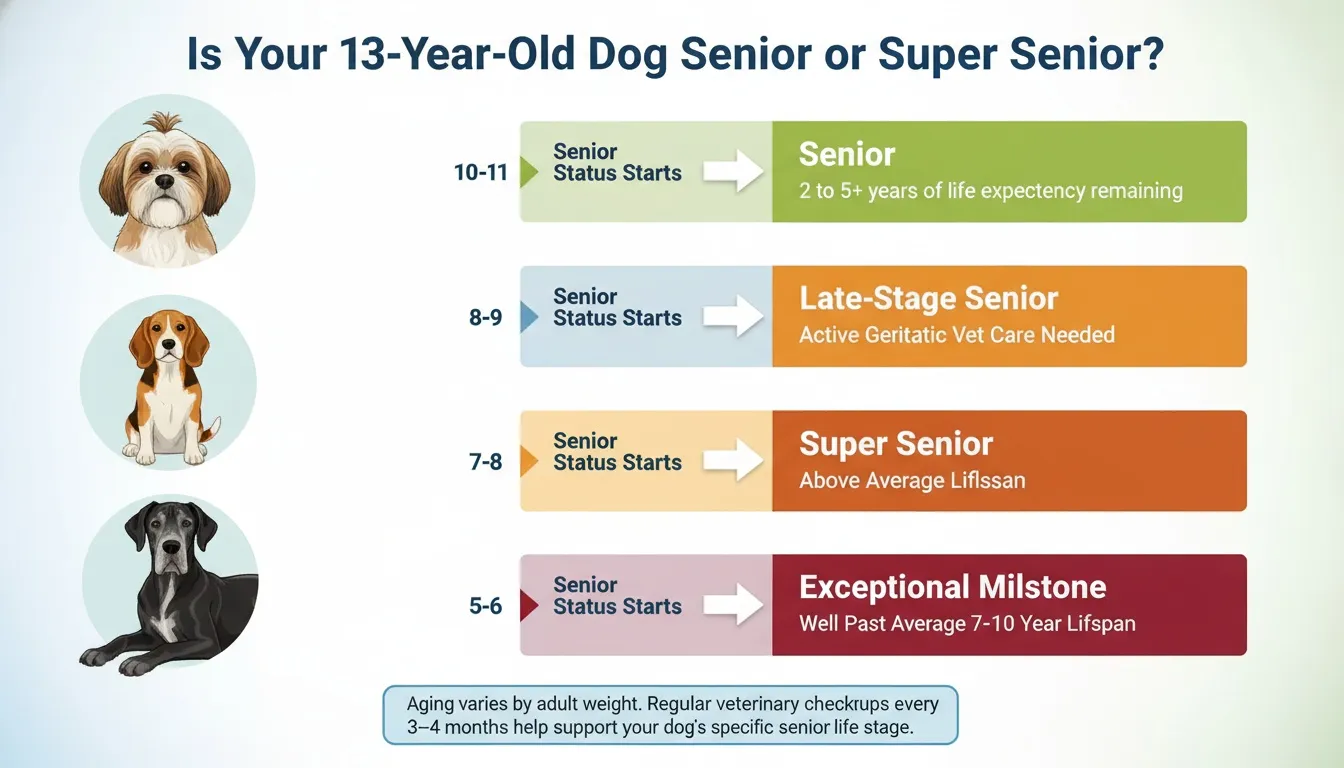
Life Stage Classification at 13 — Senior or Super Senior?
Yes, a 13-year-old dog is universally considered a senior, but their exact life stage classification depends heavily on their size category. While a small dog at 13 is just settled into their senior years, a large or giant breed at this age enters the “super senior” category.
| Size | Senior Starts | At 13 = Stage |
| Small | Age 10–11 | Senior |
| Medium | Age 8–9 | Senior |
| Large | Age 7–8 | Super Senior |
| Giant | Age 5–6 | Super Senior |
According to the American Veterinary Medical Association (AVMA), smaller dogs generally become seniors around 10 years old, while larger breeds reach this milestone much earlier, between 5 to 7 years of age. You can learn more about managing these stages from the AVMA Senior Pet Care guidelines.
How Long Will a 13-Year-Old Dog Live?
While it is natural to feel anxious about a senior dog’s timeline, remember that 13 is a milestone worth celebrating. How many years they have ahead varies by their build, but many dogs continue to live comfortable, happy lives well past this mark:
Small Dogs: Potentially 2 to 5 more years. Many small breeds happily reach 15, 16, or even older with proper management.
Medium Dogs: 1 to 3 more years on average. They are deeply in their golden years but can remain highly comfortable.
Large Dogs: 1 to 2 years, though some defy the odds and live longer with great joint care.
Giant Dogs: At 13, every single day is a beautiful milestone.
Every dog ages on their own terms. Beyond size alone, their life expectancy at this stage relies heavily on individual factors: maintaining an ideal body weight, eating a nutrient-dense senior diet, getting regular veterinary checkups, and enjoying gentle daily activity to keep their mind and body moving. Focus on the quality of their days, and celebrate the incredible bond you share.
Physical Signs of Aging in a 13-Year-Old Dog
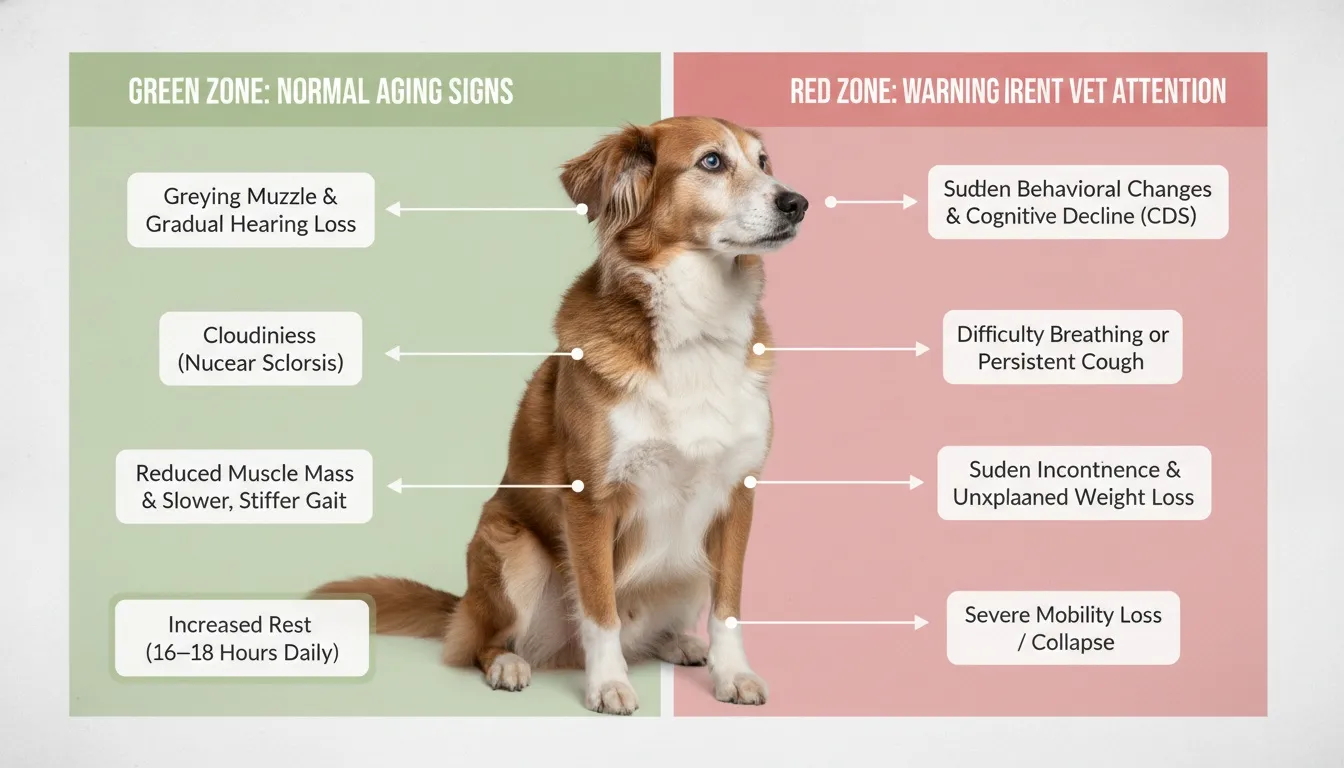
Normal Aging Signs at 13 — What to Expect
As dogs navigate their senior years, their bodies change in ways very similar to humans. Many of these adjustments are completely normal parts of the aging process:
Greying Muzzle and Coat: Silver fur usually appears first around the muzzle and eyebrows, gradually spreading across the face and chest.
Slower Pace & Stiff Joints: You will likely notice a slower walking pace and mild stiffness when they first wake up from a nap.
Gradual Hearing Loss: A natural, progressive decline in hearing is common, though it should happen gradually rather than overnight.
Reduced Muscle Mass: Senior dogs naturally lose some muscle tone, especially along their hind legs and spine.
Worn or Yellowing Teeth: Years of use leave teeth looking more yellowed, with natural wear on the edges.
Decreased Stamina: Your dog may show less interest in high-intensity play and tire much faster during routine walks.
Increased Sleep: Senior dogs need significantly more rest—sleeping 16 to 18 hours a day is completely normal.
Cloudy Eyes (Nuclear Sclerosis): A bluish, hazy tint in the pupils is often nuclear sclerosis—a normal aging of the lenses that does not cause complete blindness, unlike cataracts.
Pickier Appetite: A slight drop in appetite can happen as their sense of smell and taste naturally weakens.
Warning Signs That Need Immediate Vet Attention
While the signs above are normal, other changes point to pain or underlying medical conditions that require a veterinary visit:
Sudden Behavior Changes: Unexpected aggression, irritability, or extreme withdrawal often signals hidden physical pain.
Appetite Loss: Refusing food for 2 or more days requires a professional evaluation.
Breathing Difficulties: A persistent cough, heavy wheezing, or labored breathing can indicate heart or lung issues.
Rapid Weight Loss: Losing weight quickly without a change in diet is a major warning sign.
Sudden Incontinence: Accidentally leaking or losing bladder/bowel control out of nowhere points to medical or neurological issues rather than poor behavior.
Mobility Failure: Pronounced difficulty standing up, back-leg weakness, or sudden collapsing requires immediate attention.
Canine Cognitive Dysfunction (CDS) Signs
Often referred to as “dog dementia,” Canine Cognitive Dysfunction is highly common—over 50% of dogs over the age of 11 exhibit at least one sign of it. Watch out for these specific behavioral shifts:
Staring blankly at walls, corners, or into empty space.
Getting physically lost or trapped in familiar rooms (e.g., standing behind a door and forgetting how to back up).
Forgetting basic commands or house-training rules they knew for years.
A flipped sleep-wake cycle (pacing, whining, or staying awake all night, then sleeping deeply all day).
Unexplained anxiety, clinginess, or restlessness.
If you notice these cognitive shifts, a formal vet diagnosis is crucial. Modern supplements, dietary changes, and medications can significantly slow down the progression of CDS. Learn more about senior canine care and cognitive health from VCA Hospitals or the AVMA.
How to Care for a 13-Year-Old Dog — Vet-Approved Guide
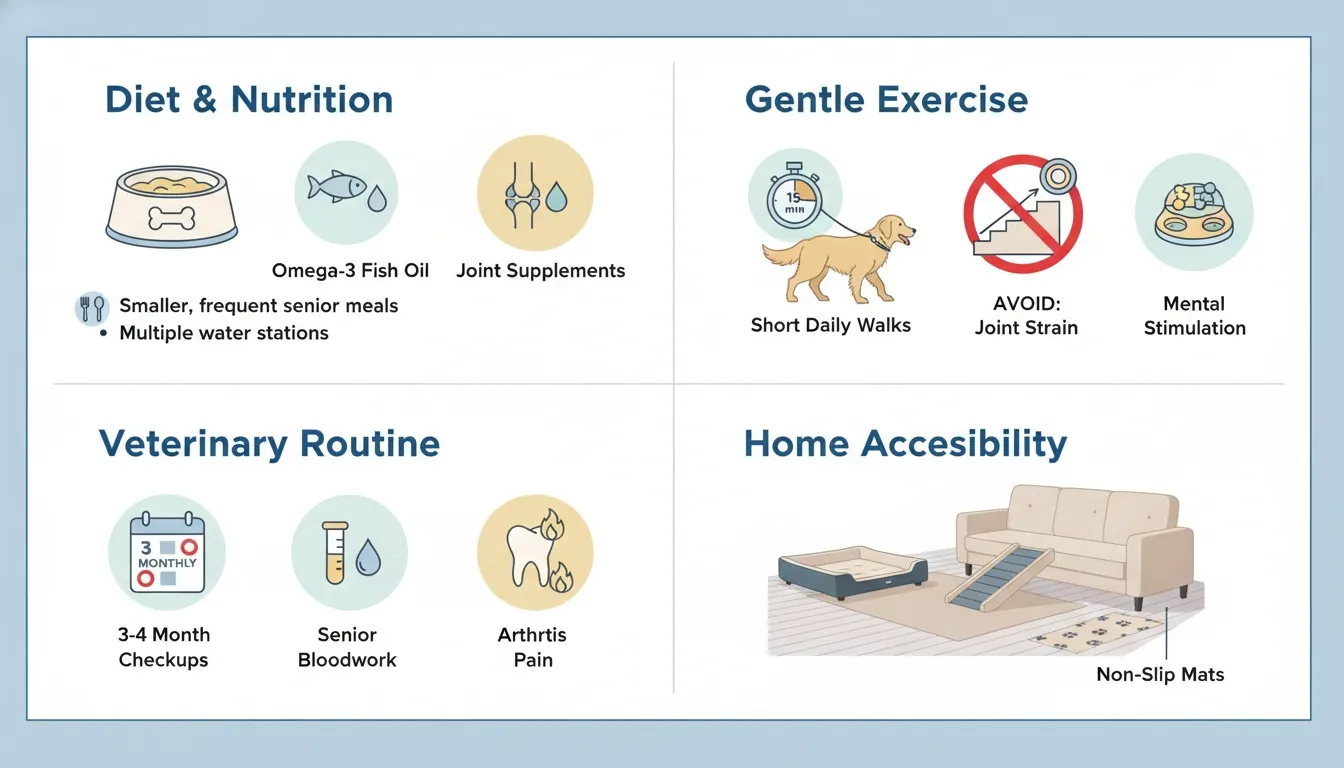
Diet & Nutrition at 13
As your dog reaches the human equivalent of their late 60s to 90s, their nutritional needs change drastically. Their metabolism slows down, and their organs require a more tailored balance of nutrients.
Switch to Senior Formulas: Transition to high-quality senior or super-senior dog food. These formulas typically feature highly digestible proteins, fewer calories to prevent unhealthy weight gain, and added joint protectants.
Smaller, More Frequent Meals: Dividing their daily food into 2 to 3 smaller portions makes digestion easier and keeps their energy levels stable throughout the day.
Monitor Vital Organs: Keep a close eye on liver and kidney health. If routine vet tests reveal early-stage kidney issues, your vet may recommend a therapeutic diet with controlled phosphorus and sodium levels.
Prioritize Hydration: Aging kidneys lose efficiency, making water intake critical. Ensure your dog always has easy access to clean water bowls in multiple rooms.
Targeted Supplements: Ask your veterinarian about integrating Omega-3 fatty acids (like fish oil) to fight inflammation, along with glucosamine and chondroitin to protect fragile joint cartilage.
Crucial Tip: Never change a senior dog’s diet suddenly or introduce random supplements without consulting your veterinarian first, as drastic shifts can trigger severe gastrointestinal upset or strain their organs.
Exercise for a 13-Year-Old Dog
Exercise is still incredibly important for keeping joints fluid and preventing muscle wasting, but your dog’s intense running days are behind them.
Short, Gentle Walks: Swap long excursions for brief 10 to 15-minute walks twice daily. Keeping the pace slow and allowing plenty of time for sniffing gives them an excellent low-intensity physical and mental workout.
Low-Impact Swimming: If your dog loves water and can safely manage it, gentle swimming is an exceptional way to maintain muscle mass without putting any stress on their joints.
Eliminate High-Impact Play: Avoid fetch, sudden jumping, and steep staircases. These activities put immense strain on aging spines and ligaments.
Engage Their Brain: When physical capacity decreases, turn to mental exercise. Use snuffle mats, simple food puzzle toys, and basic nose-work games (hiding a smelly treat nearby) to keep their mind sharp.
What to watch for: If your dog displays noticeable limping, heavy panting, or severe stiffness after a walk or the next morning, take that as a clear signal to reduce the duration and intensity of their next outing.
Vet Visit Schedule at 13
Waiting a full year between checkups is far too long for a 13-year-old dog. Because canine health can shift rapidly at this stage, the AVMA recommends transitioning to an increased veterinary schedule.
Visit Frequency: Schedule regular checkups every 3 to 4 months to catch underlying issues early.
Comprehensive Testing: Ensure each visit includes routine blood work, kidney and liver function panels, thyroid testing, and a blood pressure check.
Dental Evaluations: Periodontal disease accelerates quickly in older dogs, releasing bacteria into the bloodstream that can damage the heart and kidneys. Have their teeth checked at every single visit.
Proactive Pain Assessments: Work closely with your vet to evaluate them for hidden osteoarthritis pain. Modern veterinary medicine offers safe, highly effective daily anti-inflammatories and targeted monthly injections to keep your senior comfortable.
Home Comfort Adjustments
Making a few thoughtful modifications around the house can drastically improve your senior dog’s mobility, safety, and confidence.
Upgrade to Orthopedic Bedding: Provide a high-density, memory foam orthopedic bed. Supportive bedding insulates them from cold floors and relieves pressure points on arthritic hips and elbows.
Install Ramps and Steps: Place sturdy pet ramps or shallow steps next to the sofa, your bed, or the car to completely eliminate the impact of jumping.
Add Non-Slip Mats: Lay down yoga mats, runner rugs, or interlocking foam tiles over all hardwood, laminate, or tile flooring. Senior paws struggle to grip slick surfaces, and a single slip can cause severe joint injuries.
Create a Warm Haven: Senior dogs struggle to regulate their body temperature. Position their sleeping areas away from drafty doors, windows, or cold air conditioning vents.
Elevate Feeders: If your dog experiences neck, back, or shoulder stiffness, use a raised food and water bowl stand so they can eat comfortably without straining downward.
Managing Incontinence Compassionately
If your 13-year-old dog starts having accidents, remember it is a medical issue, not a behavioral one.
Establish a strict routine by taking them outside to eliminate every 3 to 4 hours.
Place absorbent dog training pads near doors and around their favorite sleeping spots.
Always consult your vet right away—many senior bladder issues can be easily managed or completely resolved with safe daily medications.
Dog Age Chart — 10 to 15 Years in Human Years All Sizes
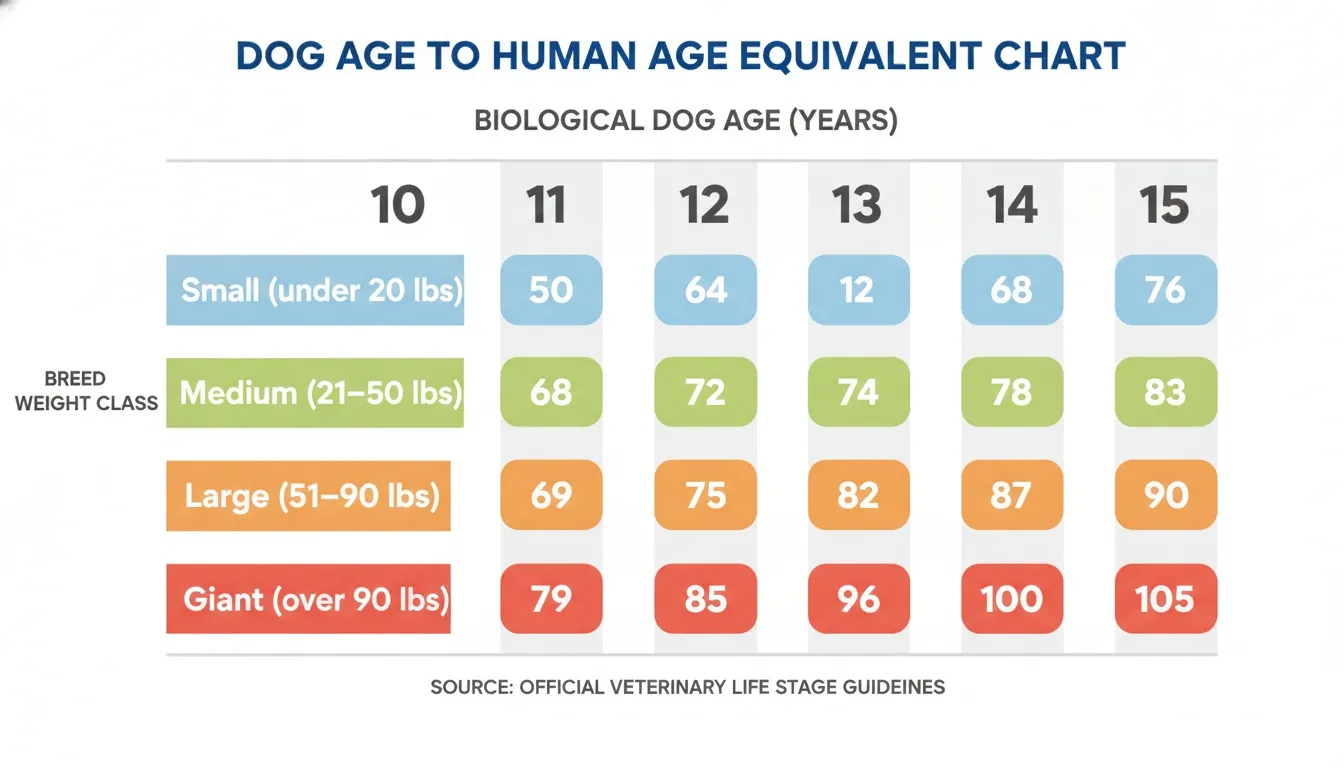
To help you see how your dog’s age compares to human milestones as they journey through their golden years, here is a quick-reference chart mapping out ages 10 to 15 across all four weight categories.
Dog Age to Human Years Converter
| Dog Age | Small (Under 20 lbs) | Medium (21–50 lbs) | Large (51–90 lbs) | Giant (Over 90 lbs) |
|---|---|---|---|---|
| 10 Years | 56 human years | 60 human years | 66 human years | 78 human years |
| 11 Years | 60 human years | 65 human years | 72 human years | 86 human years |
| 12 Years | 64 human years | 69 human years | 77 human years | 93 human years |
| 13 Years | 68 human years | 74 human years | 82 human years | 96 human years |
| 14 Years | 72 human years | 78 human years | 88 human years | 104 human years |
| 15 Years | 76 human years | 83 human years | 93 human years | 111 human years |
10 Years
Small (< 20 lbs)56 Years
Medium (21–50 lbs)60 Years
Large (51–90 lbs)66 Years
Giant (> 90 lbs)78 Years
11 Years
Small (< 20 lbs)60 Years
Medium (21–50 lbs)65 Years
Large (51–90 lbs)72 Years
Giant (> 90 lbs)86 Years
12 Years
Small (< 20 lbs)64 Years
Medium (21–50 lbs)69 Years
Large (51–90 lbs)77 Years
Giant (> 90 lbs)93 Years
13 Years
Small (< 20 lbs)68 Years
Medium (21–50 lbs)74 Years
Large (51–90 lbs)82 Years
Giant (> 90 lbs)96 Years
14 Years
Small (< 20 lbs)72 Years
Medium (21–50 lbs)78 Years
Large (51–90 lbs)88 Years
Giant (> 90 lbs)104 Years
15 Years
Small (< 20 lbs)76 Years
Medium (21–50 lbs)83 Years
Large (51–90 lbs)93 Years
Giant (> 90 lbs)111 Years
Source: Data adapted from the AAHA Canine Life Stage Guidelines. For a comprehensive look at the younger developmental years, view our Full 1–25 Year Chart on the main Dog Age Calculator page.
Popular Breeds — 13 Dog Years in Human Years Quick Reference
To see where your specific companion stands, here is a quick-reference breakdown of popular breeds at the 13-year milestone, including their typical life expectancies and current biological stages:
Dog Breed 13 Years Comparison Table
| Breed | Size | 13 Years = Human Age | Life Expectancy | At 13 = |
|---|---|---|---|---|
| Chihuahua | Small | ~68 years | 14–18 years | Senior |
| Shih Tzu | Small | ~68 years | 13–16 years | Senior |
| Beagle | Medium | ~74 years | 12–15 years | Senior |
| Cocker Spaniel | Medium | ~74 years | 12–15 years | Senior |
| Labrador Retriever | Large | ~82 years | 10–12 years | Super Senior |
| German Shepherd | Large | ~82 years | 9–13 years | Super Senior |
| Golden Retriever | Large | ~82 years | 10–12 years | Super Senior |
| Great Dane | Giant | ~96–100 years | 7–10 years | Exceptional |
Chihuahua
Size:Small
13 Yrs = Human Age:~68 years
Life Expectancy:14–18 years
At 13 =:Senior
Shih Tzu
Size:Small
13 Yrs = Human Age:~68 years
Life Expectancy:13–16 years
At 13 =:Senior
Beagle
Size:Medium
13 Yrs = Human Age:~74 years
Life Expectancy:12–15 years
At 13 =:Senior
Cocker Spaniel
Size:Medium
13 Yrs = Human Age:~74 years
Life Expectancy:12–15 years
At 13 =:Senior
Labrador Retriever
Size:Large
13 Yrs = Human Age:~82 years
Life Expectancy:10–12 years
At 13 =:Super Senior
German Shepherd
Size:Large
13 Yrs = Human Age:~82 years
Life Expectancy:9–13 years
At 13 =:Super Senior
Golden Retriever
Size:Large
13 Yrs = Human Age:~82 years
Life Expectancy:10–12 years
At 13 =:Super Senior
Great Dane
Size:Giant
13 Yrs = Human Age:~96–100 years
Life Expectancy:7–10 years
At 13 =:Exceptional
Note: The exact human equivalent and life stage classification may vary slightly for your individual dog based on their real-time weight, lifestyle history, and unique genetic background.
Quality of Life for a 13-Year-Old Dog — Honest Guide for Pet Parents
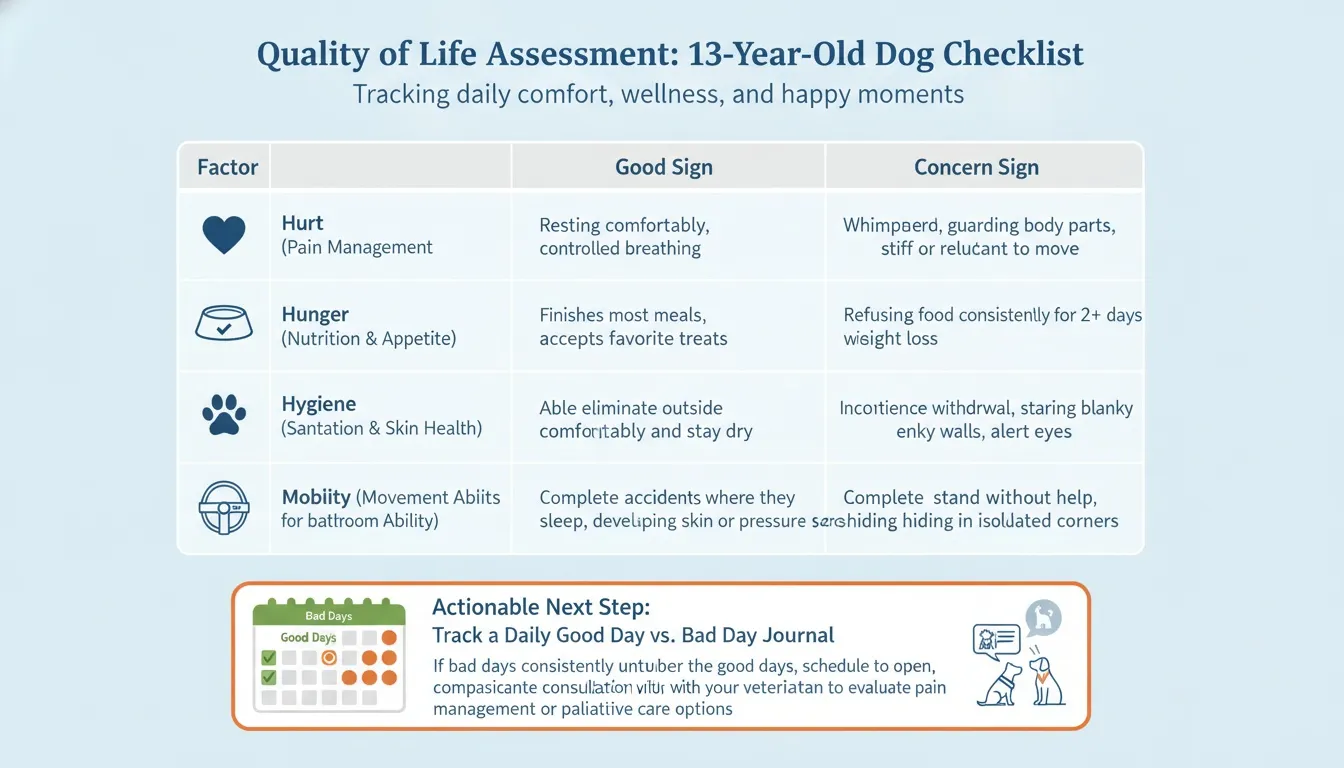
The 5-Point Quality of Life Checklist Vet-Recommended
Evaluating your senior dog’s daily comfort and joy can be emotionally challenging, but using objective criteria helps you make the best choices for them. Veterinarians rely on a structured checklist to evaluate whether a dog’s golden days are remaining peaceful and dignified.
Dog Quality of Life (QoL) Assessment Table
| Factor | Good Sign | Concern |
|---|---|---|
| Hurt | Pain is well-controlled; your dog rests comfortably and moves without clear distress. | Consistent crying, whimpering, guarding specific body parts, or refusing to move. |
| Hunger | Eating most meals willingly; maintaining an interest in favorite food or treats. | Refusing food consistently for 2 or more days; sharp, unmanaged weight loss. |
| Hygiene | Can be kept clean; able to eliminate properly and groom without distress. | Unable to stay clean; frequent accidents where they sleep, causing painful pressure sores. |
| Happiness | Responds to your presence; wags their tail, greets you, and shows interest in family life. | Completely withdrawn, hiding in corners, or showing zero response to family interactions. |
| Mobility | Can stand up on their own and walk outside safely for basic bathroom breaks. | Cannot rise without physical help on a regular basis; frequent falling or collapsing. |
Hurt
● Good Sign:
Pain is well-controlled; your dog rests comfortably and moves without clear distress.
● Concern:
Consistent crying, whimpering, guarding specific body parts, or refusing to move.
Hunger
● Good Sign:
Eating most meals willingly; maintaining an interest in favorite food or treats.
● Concern:
Refusing food consistently for 2 or more days; sharp, unmanaged weight loss.
Hygiene
● Good Sign:
Can be kept clean; able to eliminate properly and groom without distress.
● Concern:
Unable to stay clean; frequent accidents where they sleep, causing painful pressure sores.
Happiness
● Good Sign:
Responds to your presence; wags their tail, greets you, and shows interest in family life.
● Concern:
Completely withdrawn, hiding in corners, or showing zero response to family interactions.
Mobility
● Good Sign:
Can stand up on their own and walk outside safely for basic bathroom breaks.
● Concern:
Cannot rise without physical help on a regular basis; frequent falling or collapsing.
To help remove the guesswork, keep a simple “good day / bad day” journal on your calendar. Tracking this over time removes the fog of daily emotion and highlights clear trends. Bring this journal to your regular veterinary visits so you and your vet can make data-driven care decisions together.
If you start noticing that the bad days are consistently outnumbering the good days, this is the time to have an open, honest conversation with your veterinarian. While this is one of the hardest conversations you will ever have, ensuring your companion is free from prolonged suffering is the ultimate act of love. Your vet is there to support and guide you through these decisions with compassion, not judgment.
Frequently Asked Questions About 13 Dog Years
It is 68 human years for small dogs, 74 for medium, 82 for large, and 96 to 100 for giant breeds. This modern calculation is based on AAHA and AVMA size guidelines rather than the outdated 1:7 rule.
Yes, reaching 13 is a wonderful achievement. For medium and large breeds, hitting this milestone is a major victory. While small dogs frequently live to be 15 to 18 (making 13 a normal senior stage), large dogs at 13 are considered exceptional survivors.
It depends heavily on their size and overall health. Small dogs often have 2 to 5 more years ahead, medium dogs average 1 to 3 years, and large dogs typically have 1 to 2 years. For giant breeds, every single month is a milestone. Attentive daily care can make a significant difference in their remaining timeline.
A greying muzzle, slower movement, increased sleep, a slightly reduced appetite, mild hearing loss, and cloudiness in the eyes are all normal parts of the aging process. However, sudden changes—such as acute confusion, collapsing, or rapid weight loss—are warning signs that require immediate veterinary attention.
Yes, transitioning to a senior formula food is highly recommended. Offering smaller, more frequent meals can ease digestion, while targeted supplements like Omega-3 fatty acids and glucosamine provide vital joint support. Always consult your vet before making a switch, especially if your dog has underlying kidney or liver issues.
A 13-year-old dog should visit the vet every 3 to 4 months minimum. Health conditions can change rapidly at this stage of life. Routine blood work, dental checks, and pain assessments are essential components of senior care, not optional extras.
No. The old calculation method (13×7=91) is a myth that was never scientifically validated. The true human equivalent depends entirely on your dog's adult weight class—ranging from 68 human years for small dogs up to 100 human years for giant breeds.
🐾 Other Age Guides

Gulfam Haider Mehdi
Founder & Developer
I built Dogagescalculator.com to give dog owners honest, science-backed answers instead of the outdated "×7" myth. Every figure here is checked against AKC, AVMA, and published veterinary research.
More about the author & this site →📌 Featured Guides
how long do corgis live in human years
→
Nova Scotia Duck Tolling Retriever vs Golden Retriever
→
how long does it take a chihuahua to give birth
→
Mixed Breed Dog That Looks Like a Fox
→
Dog Years for Small Dogs
→
golden mini dachshund
→
what is 4 dog years in human years
→
how much does a mini australian shepherd weigh
→
how long do shih tzu live in human years
→
How to Tell How Old a Bird Is
→
Comments