
Siberian Husky vs Alaskan Husky: The Complete Comparison Guide
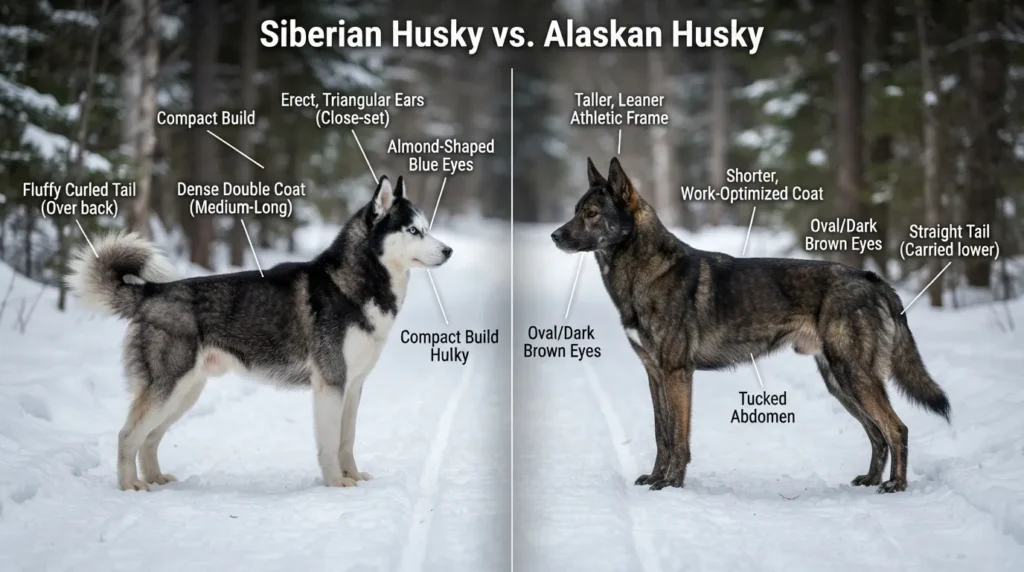
If you’re trying to tell a Siberian Husky and an Alaskan Husky apart, the single biggest difference comes down to paperwork versus purpose. The Siberian Husky is an officially recognized, purebred dog breed registered by the American Kennel Club (AKC) with strict visual standards. The Alaskan Husky, on the other hand, isn’t a recognized breed at all—it’s a working hybrid bred almost purely for sledding performance, speed, and endurance.
While they share a wolf-like northern aesthetic and boundless energy, their size, coat variations, temperament, and care needs differ in ways that matter directly to a potential owner. This guide breaks down how to identify both dogs, compares their physical traits and personalities, and helps you decide which husky best fits your home and lifestyle.
Siberian Husky vs Alaskan Husky at a Glance Comparison Table
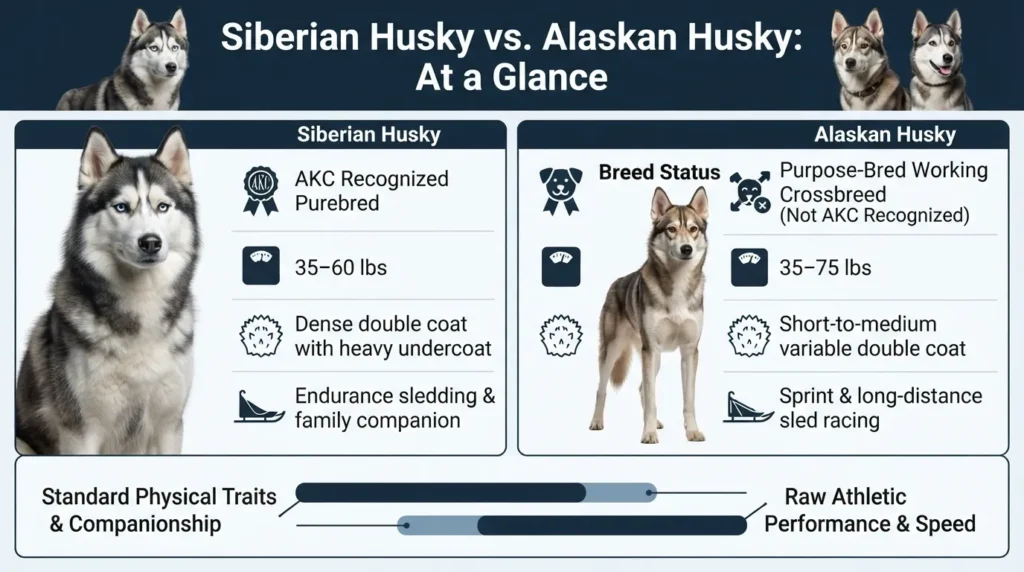
| Feature | Siberian Husky | Alaskan Husky |
|---|---|---|
| Breed Status | Purebred (recognized by AKC & UKC) | Working category / Category type (not a purebred) |
| Origin | Siberia, Russia (Chukchi people) | Alaska, United States |
| Height | 20 to 23.5 inches | 20 to 26 inches |
| Weight | 35 to 60 lbs | 35 to 75 lbs |
| Coat | Dense, double coat with thick undercoat | Variable double coat (short to medium, optimized for performance) |
| Colors | Black, gray, red, sable, pure white | Any color or pattern (no standard restrictions) |
| Eyes | Blue, brown, green, or heterochromatic (bi-eyed) | Usually brown, blue, or hazel |
| Lifespan | 12 to 14 years | 12 to 15 years |
| Purpose | Endurance sledding & companion dog | Pure working, sprint, and long-distance sled racing |
| Trainability | Moderate (intelligent, but independent & stubborn) | Moderate to high (driven, eager to work and run) |
| Price | $800 to $2,500+ | $500 to $1,500 (varies based on working lineage) |
What Is a Siberian Husky?
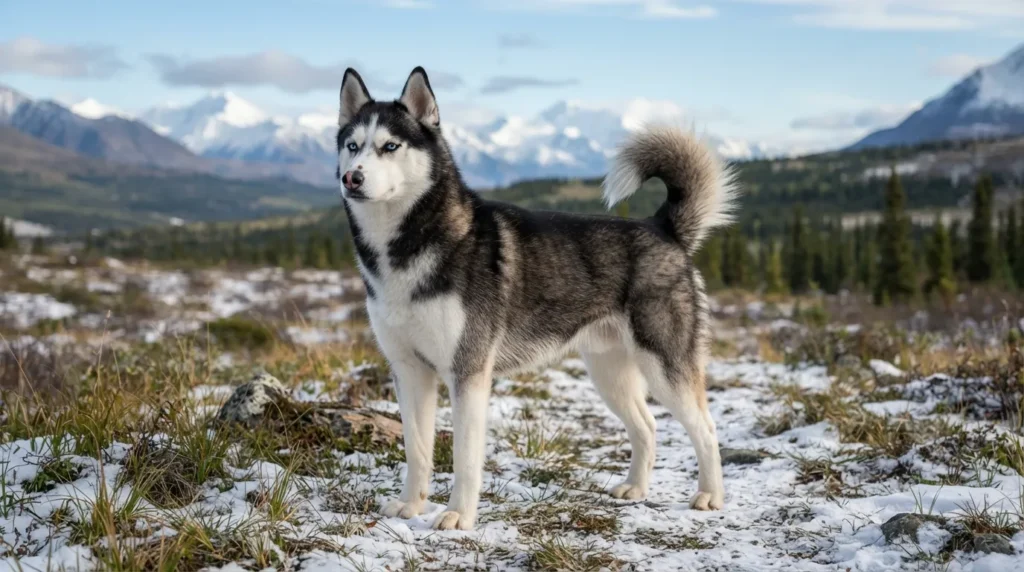
The Siberian Husky is a recognized purebred working dog officially registered by both the American Kennel Club (AKC) and the United Kingdom Kennel Club (UKC). Unlike working mixes or localized working lines, the Siberian Husky adheres to strict, standardized breed guidelines that define everything from its physical proportions to its temperament.
Centuries ago, the breed was developed by the nomadic Chukchi people of northeastern Siberia. They needed an enduring, resilient dog that could pull light loads over vast distances in extreme arctic conditions, while also acting as gentle family companions that slept alongside children to keep them warm during frozen nights.
Today’s Siberian Husky retains that exact balance of working power and social warmth. According to official AKC breed standards, here is how the physical baseline breaks down:
Height & Weight: Males typically stand 21 to 23.5 inches at the shoulder and weigh 45 to 60 pounds, while females measure 20 to 22 inches and weigh 35 to 50 pounds.
Build: Compact, medium-sized, and well-furred with a balanced, athletic frame that prioritizes endurance and grace over raw heavy lifting.
Coat: A thick double coat consisting of a soft, dense undercoat and straight guard hairs designed to withstand temperatures well below zero. Coats come in virtually all colors from black to pure white, often paired with striking facial markings or distinctive eye color patterns.
What Is an Alaskan Husky?
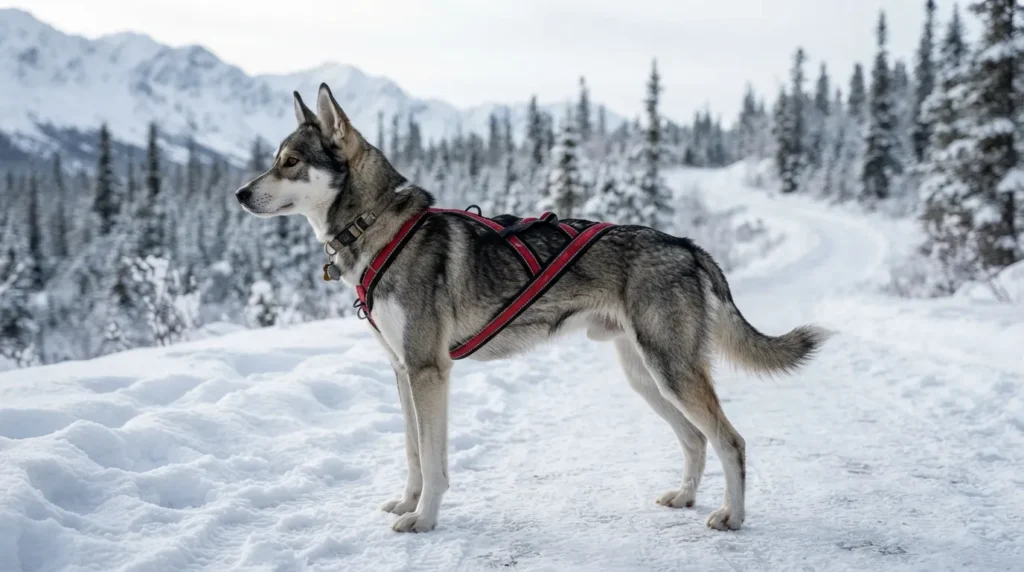
Unlike the Siberian Husky, an Alaskan Husky is not an officially recognized purebred breed. You won’t find them registered with the AKC or UKC. Instead, an Alaskan Husky is a performance type or category of working dog bred specifically for sled racing and pulling power.
Mushers deliberately cross-breed working lines to create the ultimate northern athlete. Traditional arctic spitz dogs were mixed with high-speed breeds—including German Shorthaired Pointers, Greyhounds, and Border Collies—to add explosive speed, endurance, and trainability.
Because there is no official breed standard, there is no single “look” for an Alaskan Husky. One dog might closely resemble a traditional wolf-like spitz, while another in the exact same racing team might be leaner, taller, short-haired, or have floppy ears.
For professional sled drivers, pedigree and papers take a backseat to real-world performance:
Speed and Endurance: Dogs are bred strictly for their cardiovascular capacity and ability to run long distances efficiently.
Durability: Durable paw pads, healthy joints, and weather-resistant coats matter far more than coat patterns or eye color.
Work Ethic: Mental toughness and a high natural drive to pull are prioritized above physical uniformity.
This distinction frequently confuses pet owners asking whether their dog is an Alaskan Husky or simply a mixed breed. While an Alaskan Husky is technically a crossbreed, it isn’t a random mutt. They are purpose-bred working lines with generations of performance genetics behind them.
Siberian Husky vs Alaskan Husky — Key Differences
Physical Appearance & Coat
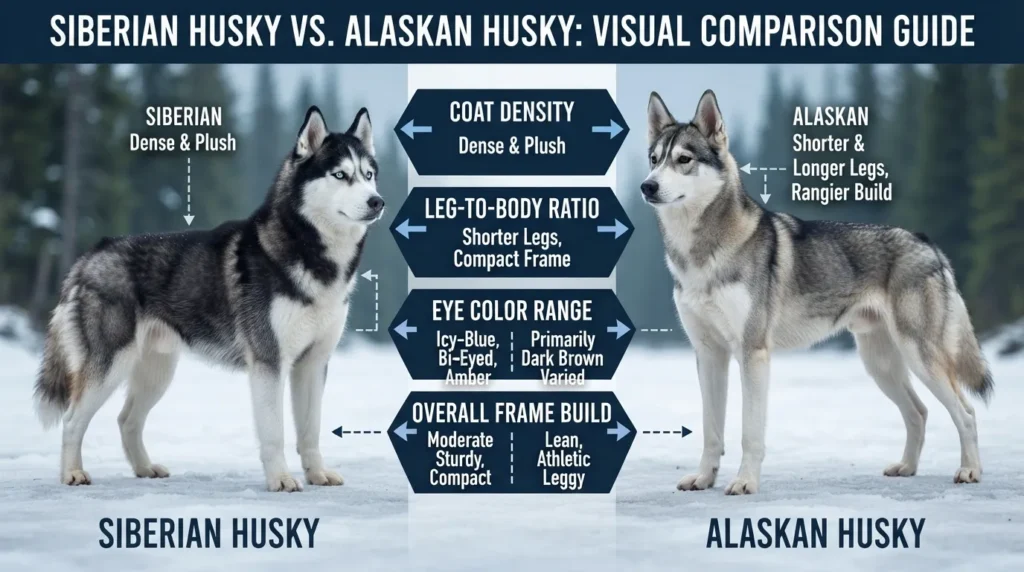
The Siberian Husky is built around a distinct, instantly recognizable breed standard. They feature a plush, double coat with a thick undercoat designed to withstand sub-zero cold, complemented by naturally erect ears and a fox-like, brush tail that curls gracefully over their back. Siberians show a broad spectrum of recognized colors, including black, pure white, red, agouti, and sable.
In contrast, the Alaskan Husky is bred strictly for performance rather than aesthetics. Their coats are generally shorter, thinner, and optimized to dissipate heat efficiently during high-speed exertion. Because the Alaskan is a functional working category rather than a recognized kennel club breed, their physical appearance varies dramatically from dog to dog, often presenting a much leaner, rangier profile.
Size & Weight
Siberian Huskies adhere strictly to standard size parameters established by major registries. Males typically stand 21 to 23.5 inches tall and weigh 45 to 60 pounds, while females reach 20 to 22 inches and weigh 35 to 50 pounds. Their frame is balanced, compact, and proportioned for endurance pulling without excess bulk.
Alaskan Huskies usually fall within a similar weight range of 35 to 55 pounds, but their actual dimensions vary widely. Without a rigid breed standard dictating height or mass, individual breeders focus purely on biomechanics. Consequently, Alaskans often feature longer legs, narrower chests, and a lighter chassis designed purely for speed and trail efficiency.
Eye Color
Striking eye colors are a celebrated hallmark of the Siberian Husky. Their eyes can be icy blue, warm brown, or a combination of both—a condition known as heterochromia where each eye is a different color, or split-colored within the same iris.
Alaskan Huskies predominantly feature dark or medium brown eyes. While blue or parti-colored eyes do appear occasionally in Alaskan lines, this is typically a structural remnant of Siberian Husky or Pointer ancestry rather than an intentional breeding target.
Temperament & Personality
Siberian Huskies are intensely pack-oriented and famously social, often extending a cheerful, friendly greeting to strangers and family members alike. Having lived as household companions alongside the Chukchi people for centuries, they retain a naturally outgoing, domesticated demeanor that fits well into active family settings.
Alaskan Huskies tend to be far more task-oriented and independent. Bred primarily in working kennels for competitive sled racing, their mental focus leans heavily toward work drive and team dynamics over household affection. While loyal to their handler, they are generally more reserved and less demonstrative in a traditional pet role.
Intelligence & Trainability
Both types of husky possess problem-solving intelligence coupled with a notorious independent streak. However, their focus manifests differently. Alaskan Huskies generally show higher biddability when it comes to directional cues and trail work, responding quickly to task-based training even if they lack interest in standard obedience drills.
Siberian Huskies are famous for applying their sharp intellect toward home-based mischief. Without adequate mental stimulation, their curiosity turns toward escape routes, door handles, and digging projects. Training a Siberian requires firm consistency, as they frequently evaluate whether a command aligns with their immediate interest.
Exercise Needs & Energy Levels
While both dogs require substantial physical activity, the Alaskan Husky operates at an entirely different athletic threshold. Bred specifically for long-distance sled racing, their stamina and daily energy reserves are exceptionally high, making them best suited for skijoring, trail running, or competitive endurance sports.
Siberian Huskies are undeniably high-energy working dogs, but their requirements are generally more manageable for a dedicated, active owner. Daily long walks, safe off-leash running in a securely fenced yard, and regular mental exercise are usually enough to keep a Siberian calm and settled indoors.
Health Issues & Lifespan
Siberian Huskies are generally robust dogs, but as a purebred line, they carry inherited risks for specific genetic conditions. Primary health concerns include hip dysplasia and hereditary eye disorders, particularly juvenile cataracts and Progressive Retinal Atrophy (PRA).
Alaskan Huskies benefit from a broader gene pool, often exhibiting hybrid vigor that reduces the rate of specific hereditary diseases. However, because many Alaskans actively work or race, they carry a higher incidence of operational injuries, such as shoulder strain, wrist issues, or gastric ulcers from high-stress competition.
If you are currently caring for a husky mix or purebred and want to track their life stage accuracy, use our Dog Age Calculator to see what age your Husky is in human years.
Grooming Needs
Maintaining a Siberian Husky requires a consistent grooming routine, particularly during seasonal coat shifts. Their dense double coat sheds moderately year-round and “blows” heavily twice a year, releasing large amounts of undercoat that must be brushed out with a rake and slicker brush to prevent matting.
Alaskan Huskies are substantially lower maintenance on the grooming table. Their shorter, single-layer or light double coat repels dirt naturally and loses far less hair during seasonal changes, requiring only occasional brushing to clear dead hair and maintain skin health.
Which Is Better for Sledding or Racing?
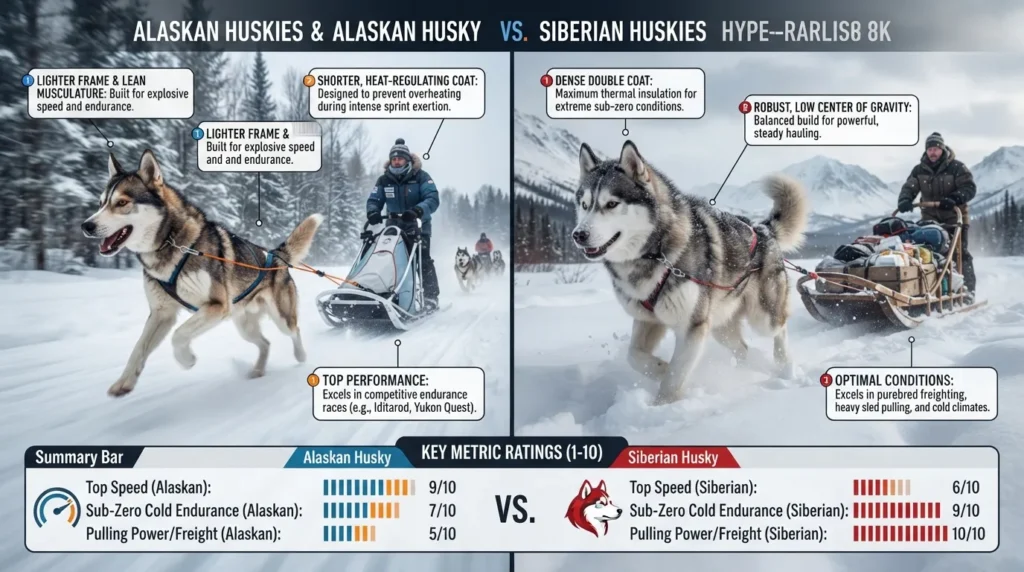
If pure competitive performance on the trail is the goal, the Alaskan Husky holds an undisputed dominance. Modern long-distance sled races like the 1,000-mile Iditarod and Yukon Quest are almost entirely swept by Alaskan Husky teams. Because mushers crossbreed them purely for athletic drive, aerobic capacity, and foot durability—incorporating genetics from Pointers, Greyhounds, and traditional Northern strains—the Alaskan functions as a high-performance running machine. They run faster, recover quicker, and burn energy with incredible metabolic efficiency over extreme distances.
The Siberian Husky, while the historic blueprint for Arctic transport, rarely competes in top-tier open-class long-distance racing today. As standard purebreds, Siberians maintain a strict physical standard that prioritizes an efficient, steady trot rather than raw explosive speed. However, they remain highly competitive in purebred-only sprint events, mid-distance recreational races, and heavy freight pulling where steady power and natural cold tolerance are paramount.
Beyond full-team sledding, both dogs excel in urban mushing and harness sports, though your choice depends on how much drive you can handle:
Skijoring & Bikejoring: The Alaskan Husky’s incredible forward impulse and desire to pull make it a favorite for solo cross-country skiers and mountain bikers. Siberian Huskies also love the job and are often easier to manage at the start line.
Canicross (Trail Running in Harness): Siberians are ideal for casual or semi-competitive trail runners looking for a consistent pulling partner. Alaskan Huskies are built for serious competitors chasing fast mile splits.
Weight-Pulling: Siberian Huskies use their low center of gravity and balanced frame to generate impressive short-distance pulling power on dry land or snow tracks.
Cold Tolerance & Climate Suitability
Siberian Husky
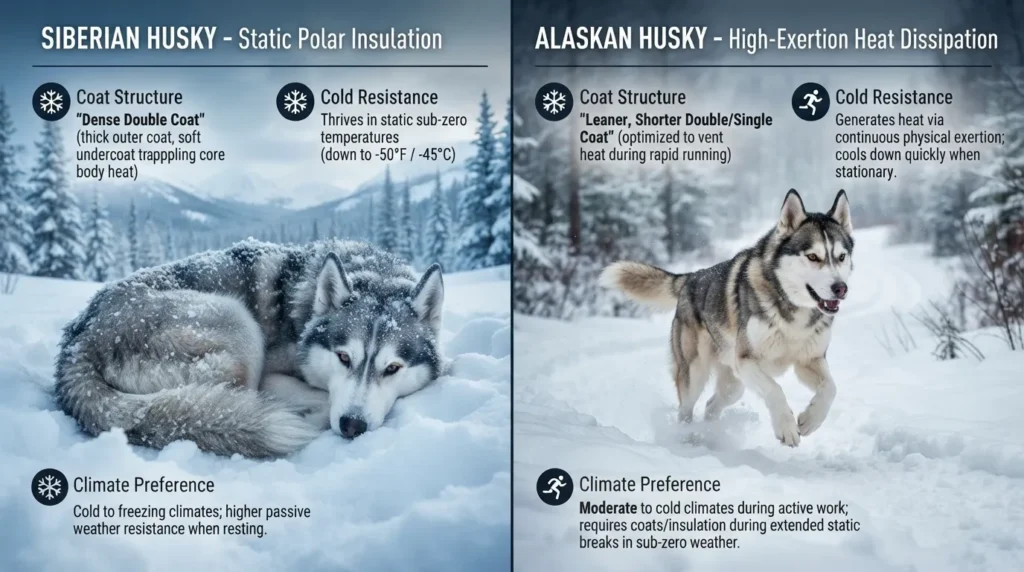
The Siberian Husky features a dense double coat designed for static thermal insulation in sub-zero environments. Their thick undercoat and weather-resistant guard hairs trap warmth effectively, allowing them to rest comfortably outside in freezing conditions without expending significant body energy just to stay warm.
Alaskan Husky
The Alaskan Husky relies more on physical activity than heavy insulation to manage internal body heat. Because they are bred with a leaner frame and typically lighter coat to prevent overheating while running, they generate heat through high exertion rather than passive retention. Sitting still in extreme arctic conditions causes an Alaskan to lose body heat much faster than a Siberian.
Takeaway
For sub-zero regions where dogs spend extended time outdoors in static environments, the Siberian Husky offers superior natural weather resistance. The Alaskan Husky thrives in moderate to cold climates during active work, but requires protective gear or insulated shelters during extended breaks in extreme cold.
Vocalization — Do They Howl or Bark?
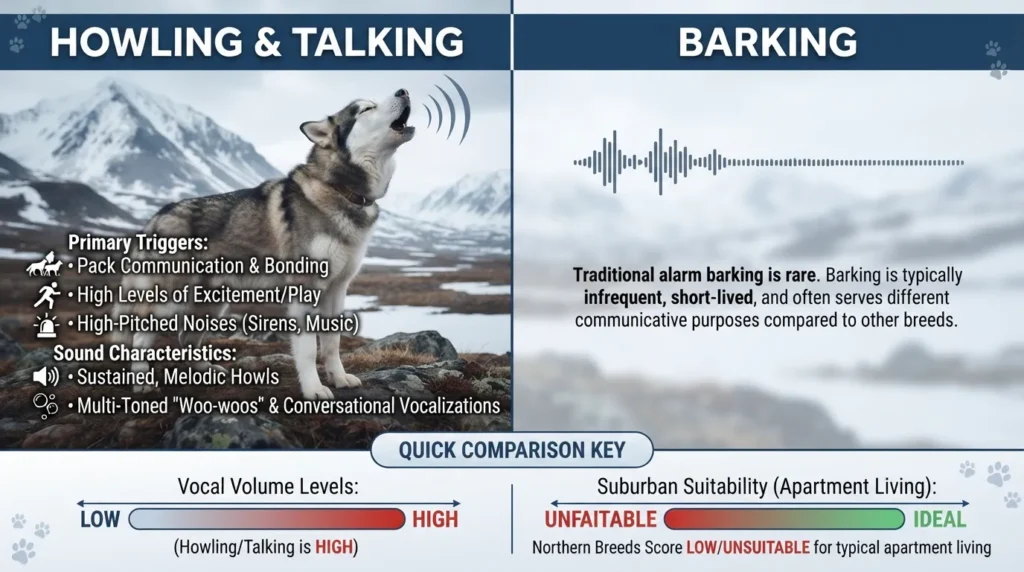
If you are looking for a quiet, subtle dog, neither of these breeds is a natural fit. Both the Siberian Husky and the Alaskan Husky display a strong instinct to howl rather than bark, a vocal habit traceably inherited from their ancestral working-pack roots. Instead of sharp, alarm-style barking, you can expect long, rhythmic howls, group choruses, and expressive vocalizations when they are excited, lonely, or communicating with their human pack.
Siberian Huskies are widely famous for being the chattier of the two. They regularly use a complex vocabulary of “talking,” groaning, and theatrical woo-woos to express everything from enthusiasm about a walk to protest over household rules.
Alaskan Huskies certainly howl—especially when working, hooked to a harness, or housed in a group kennel setting—but they tend to be less chatty in day-to-day home life. They generally direct their vocal energy into task anticipation rather than constant casual conversation with their handler.
Neither breed is ideal for quiet apartment living or tight suburban quarters with noise-sensitive neighbors. Unmet exercise needs or prolonged separation can quickly turn their charming “talking” habits into persistent, high-volume howling that carries straight through shared walls.
Which Husky Is Better as a Family Pet?
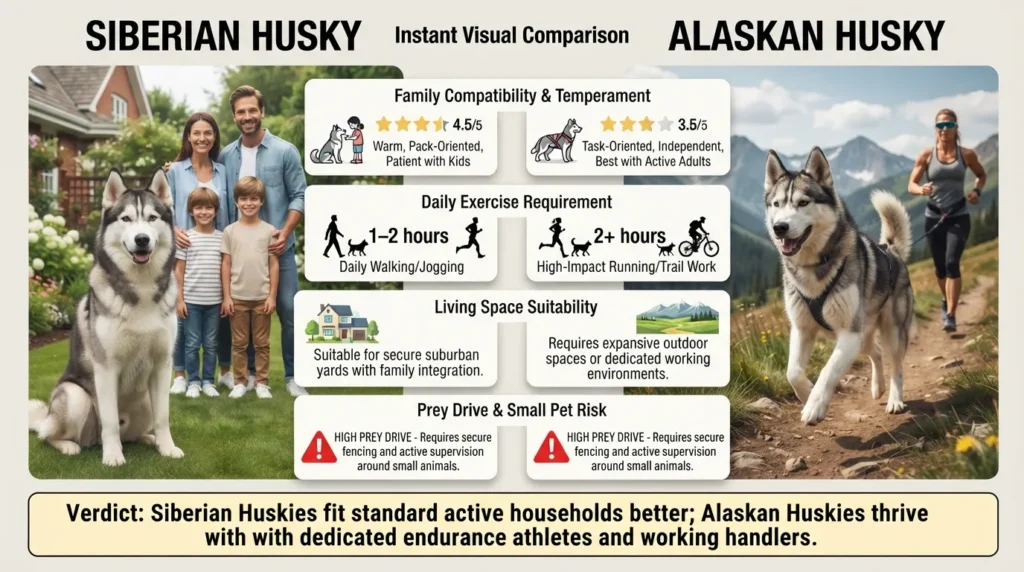
For the vast majority of households, the Siberian Husky is the better fit as a family companion. Siberians were specifically bred to live in close quarters with people, giving them a warm, pack-oriented personality that naturally integrates into human home life. The Alaskan Husky, on the other hand, is built primarily as a high-drive working athlete. Unless you run long distances daily or participate in sled sports, an Alaskan Husky’s intense drive and need for constant physical output can easily overwhelm a standard household, making them poorly suited for suburban or apartment living.
Both dogs possess a naturally high prey drive that requires careful management. Siberians will instinctively chase squirrels, rabbits, and sometimes neighborhood cats if left unsupervised. Alaskan Huskies often carry an even sharper, more independent hunting instinct due to their working ancestry, making them particularly risky around small pets or outdoor livestock unless rigorously socialized from puppyhood.
To decide which dog aligns with your daily routine, run through this quick checklist before bringing one home:
Daily Exercise Commitment: Can you dedicate 1 to 2 hours of moderate daily activity like walking or jogging (Siberian), or do you need a high-impact running partner for 2+ hours of intense trail work (Alaskan)?
Yard & Fence Security: Do you have a secure, high fence (at least 6 feet) with anti-dig barriers? Both breeds are notorious escape artists when bored.
Household Dynamics: Are there young children or small animals in the home? Siberians are generally more patient and outgoing with kids, while Alaskans tend to prefer a calm, structured, adult-oriented routine.
Owner Experience Level: Have you owned high-energy, independent working breeds before? Siberians need confident, consistent leadership, but Alaskans require an experienced handler who understands how to channel extreme working drive.
Climate & Living Space: Do you live in a climate where your dog can stay cool? Neither dog thrives in constant heat, and both require enough room—and time outdoors—to burn off mental energy safely.
Price Comparison

Siberian Husky Pricing
Expect to pay $800 to $1,800 when buying a Siberian Husky puppy from a reputable breeder. Prices often swing higher—sometimes up to $2,500—for rare coat colors like agouti or pure white, or for show-line puppies with champion bloodlines.
A purebred Siberian from a responsible breeder comes with official pedigree registration papers (AKC, UKC, or CKC) proving their lineage, along with health certifications for the parents. If you choose to adopt through a breed-specific rescue or local shelter, adoption fees usually range between $200 and $450. These fees generally cover initial vaccinations, microchipping, and spay/neuter procedures, making rescue a cost-effective path to bringing home a healthy purebred.
Alaskan Husky Pricing
Alaskan Huskies generally carry a lower initial purchase price, typically ranging from $200 to $600 for a companion or young trail dog. Rather than traditional pet breeders, Alaskans are sourced almost exclusively directly from working mushers, racing kennels, or sled dog outfitters.
Because the Alaskan Husky is a working crossbreed rather than a recognized kennel club breed, they do not come with registration papers or pedigree certificates. Instead of paying for a documented family tree, you are paying for athletic capability and lineage performance. Retiring sled dogs or younger dogs that lack the extreme drive required for competitive racing are frequently rehomed by mushers for modest adoption fees, offering an affordable option for active owners looking for a high-stamina companion.
Other Husky Types People Confuse With These Two
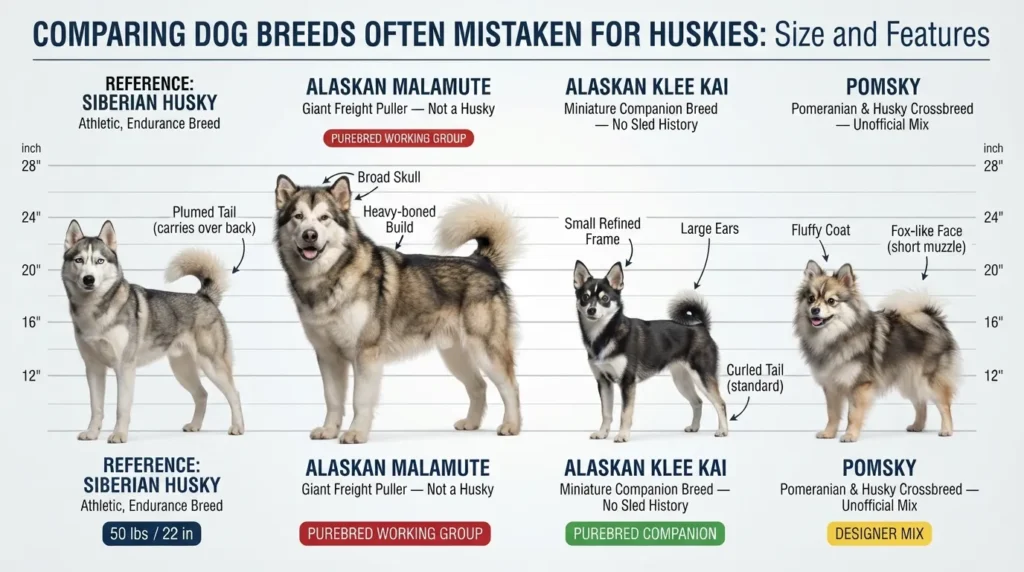
Quick Guide: Common “Husky” Confusion
Alaskan Malamute: A distinct, giant purebred freight-puller—much larger and heavier than a husky.
Alaskan Klee Kai: A small companion dog bred to look like a mini husky; entirely separate working lineage.
Pomsky & Husky Mixes: Designer crossbreeds combining Siberian Huskies with other breeds, not an official type or working strain.
It is easy to get mixed up when searching for northern breeds, as several dogs share similar facial markings and fluffy double coats. However, these distinct dogs are often mistakenly labeled as types of huskies:
Alaskan Malamute: Often mistaken for a giant Siberian, the Malamute is an official purebred dog with an entirely different job history. While huskies were built for speed and light sled loads, Malamutes were bred to haul massive freight across arctic terrain. They typically weigh between 75 and 100+ pounds, boasting a far heavier bone structure, broader head, and a tail that plumes over their back.
Alaskan Klee Kai: Developed in Alaska in the late 20th century, the Klee Kai was created specifically as a toy-to-standard-sized companion dog that mirrors the appearance of a Siberian Husky. Weighing anywhere from 10 to 20 pounds, they have no modern working sled history and belong to their own recognized breed line.
Pomsky & Designer Mixes: A “Pomsky” is a crossbreed between a Pomeranian and a Siberian Husky. While wildly popular as pets, they are mixed-breed dogs rather than an established strain or type of husky, and their size, coat style, and temperaments vary depending on individual genetic inheritance.
How to Tell If Your Husky Is Siberian or Alaskan Identification Checklist
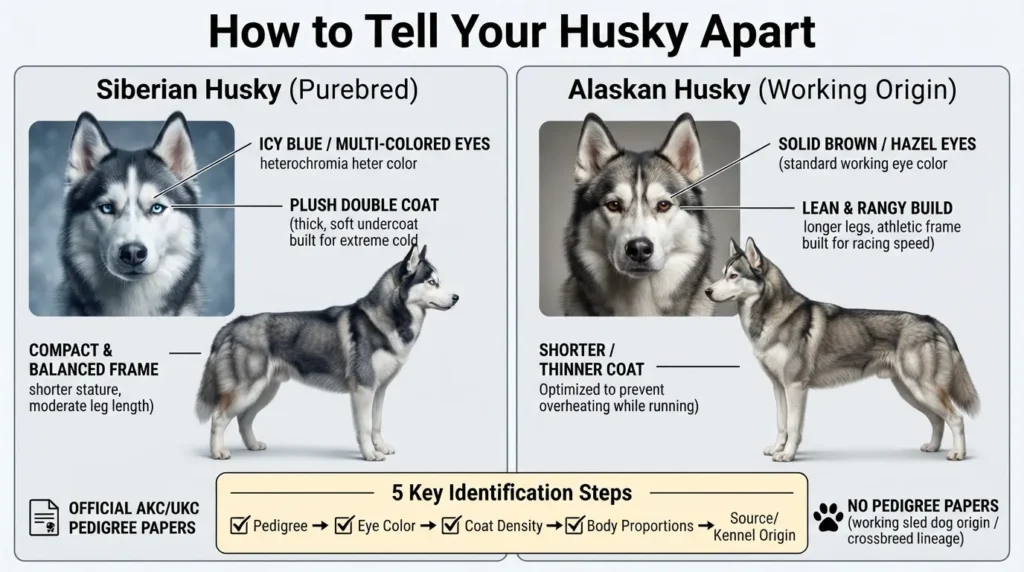
If you adopted a husky without clear pedigree records, figuring out whether you have a purebred Siberian or an Alaskan Husky comes down to evaluating specific physical traits and physical proportions.
Run through this practical checklist to help identify your dog’s likely background:
Pedigree and Registration Papers: Check for official registration documents from recognized registries like the AKC or UKC. A registered dog is guaranteed to be a Siberian Husky, as Alaskan Huskies are functional crossbreeds and cannot be registered as purebreds.
Eye Color and Markings: Look closely at their eyes. Icy blue, heterochromia (two different colored eyes), or intricate iris split-colors strongly point toward a Siberian Husky. Solid brown eyes are far more common in Alaskan Huskies.
Coat Density and Texture: Feel the coat. Siberian Huskies carry a distinctly plush, thick double coat with a dense undercoat designed for harsh polar weather. Alaskan Huskies usually have shorter, leaner, and less dense coats optimized for shedding heat while running.
Build and Leg Proportions: Evaluate their overall frame. Siberians possess a balanced, compact build with a moderate leg-to-body ratio. Alaskan Huskies appear noticeably leaner, rangier, and longer-legged, often looking more like a athletic hound or pointer mix built for pure speed.
Breeder or Rescue History: Trace the source of your dog. If your dog came from a working sled dog kennel, racing line, or a rural working pack, they are almost certainly an Alaskan Husky. If they were acquired from a show breeder, pet shop, or standard rescue, they are far more likely to be a Siberian.
A Quick Note on Genetics: While physical traits give strong hints, a reputable DNA test is the only 100% certain method to confirm your dog’s background—especially for mixed-origin working lines that share overlapping northern ancestry.
Frequently Asked Questions
No, the Alaskan Husky is not a recognized purebred dog. It is a category of working dog bred strictly for performance, athletic drive, and endurance rather than predictable physical traits or pedigree. Breeders intentionally cross traditional northern breeds like Siberian Huskies with Pointers, Greyhounds, and Hounds to produce optimal trail runners. Because they lack a rigid breed standard, major registries like the AKC and UKC do not register them as a distinct breed.
The Alaskan Husky is significantly faster, especially over mid and long distances. While Siberian Huskies were bred to pull moderate loads efficiently at a steady trot, Alaskan Huskies have been selectively bred over decades specifically for speed and power in competitive sled racing. Thanks to genetic contributions from faster hunting and sprinting breeds, Alaskans consistently outpace Siberians on both sprint courses and long-distance trails like the Iditarod.
Yes, they can be mixed, and in fact, Siberian genetics are already a foundational element of the Alaskan Husky line. Because the Alaskan Husky is a category defined by working capability rather than genetic purity, crossbreeding a Siberian Husky with an Alaskan Husky is common in working and racing kennels. The resulting puppies generally inherit strong pull drive, cold tolerance, and an athletic double coat.
The Siberian Husky is generally easier for a first-time dog owner, though both breeds present a steep learning curve. Siberians are standard domestic companions with more predictable temperaments, lower work drives, and an outgoing, friendly nature toward humans. Alaskan Huskies are built purely for extreme daily output and working environments; without intense physical jobs or hours of active exercise every day, they can easily become frustrated and destructive in a typical suburban home.
Alaskan Huskies usually have dark or medium brown eyes. However, blue or multi-colored eyes do occasionally appear in Alaskan litters. When an Alaskan Husky exhibits icy blue eyes or heterochromia, it is almost always due to inherited genetic markers from their Siberian Husky ancestors.
A purebred Siberian Husky puppy from a reputable AKC breeder typically costs between $800 and $2,000, depending on lineage, health clearances, and show potential. Alaskan Huskies are rarely sold through standard pet retail channels; working or racing kennels usually sell Alaskan puppies or working adults for $300 to $1,000, with prices heavily reflecting the performance track record of the parents rather than physical coat colors or registration papers.
Both types enjoy relatively long lifespans for medium-to-large dogs, typically living between 12 and 15 years. Siberian Huskies benefit from centuries of careful breed maintenance, though they carry slight risks for hereditary cataracts and hip dysplasia. Alaskan Huskies often benefit from hybrid vigor due to their varied gene pool, but their overall lifespan can be influenced by the physical wear and tear associated with high-intensity working or racing careers.
🐾 Other Age Guides

I built Dogagescalculator.com to give dog owners honest, science-backed answers instead of the outdated "×7" myth. Every figure here is checked against AKC, AVMA, and published veterinary research.
More about the author & this site →
Comments