Dog Years for Small Dogs: How to Calculate Your Small Dog's Age in Human Years
Vet-reviewed | Last Updated: July 2026
Small dogs age much slower than large breeds after their first two years of life. While the old “multiply by 7” rule would suggest a 10-year-old Chihuahua is 70 in human years, modern veterinary science puts them closer to 56. Calculating dog years for small dogs requires dropping outdated guesswork and using size-specific aging data that accounts for their longer lifespans and slower metabolic decline.
What Counts as a "Small Dog"?
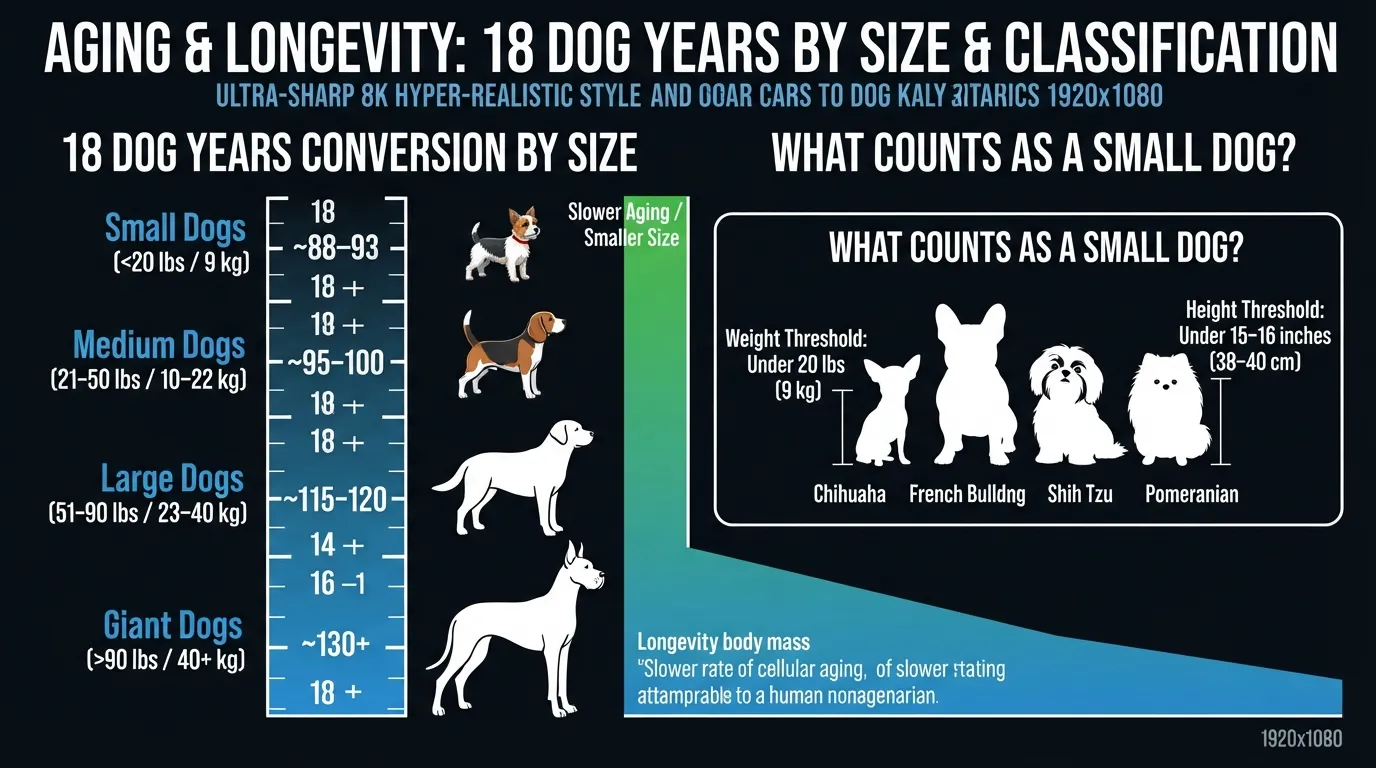
In veterinary medicine, a dog is classified as a “small breed” if its ideal adult weight stays under 22 pounds (10 kg). This weight threshold isn’t just about sizing for sweaters or lap-cuddling—it directly defines how your dog matures, ages, and handles life stages compared to medium or giant breeds.
While exact cutoffs can vary slightly between kennel clubs, standard guidelines from the American Kennel Club (AKC) place toy, miniature, and compact breeds firmly into this group.
Common examples of small dogs include:
Chihuahua (typically under 6 lbs)
Pomeranian (3 to 7 lbs)
Yorkshire Terrier (under 7 lbs)
Maltese (under 7 lbs)
Miniature Dachshund (11 lbs and under)
Shih Tzu (9 to 16 lbs)
Pug (14 to 18 lbs)
French Bulldog (typically under 22–28 lbs)
What If My Dog Is a Mixed Breed or the Size Is Unknown?
If you adopted a rescue or have a mixed breed with a mysterious family tree, figuring out their exact category can feel like a guessing game. Focus on their current weight if they’re over 12 to 18 months old, as most small breeds reach full physical maturity by their first birthday. For puppies, a vet can usually estimate adult frame size by evaluating paw size and joint thickness during a routine checkup.
If you aren’t sure where your dog fits on the weight spectrum, you don’t have to guess. Head over to our free input your pup’s exact weight or breed mix and get a customized, science-backed age calculation in seconds.
Dog Years for Small Dogs Chart 1–20 Years
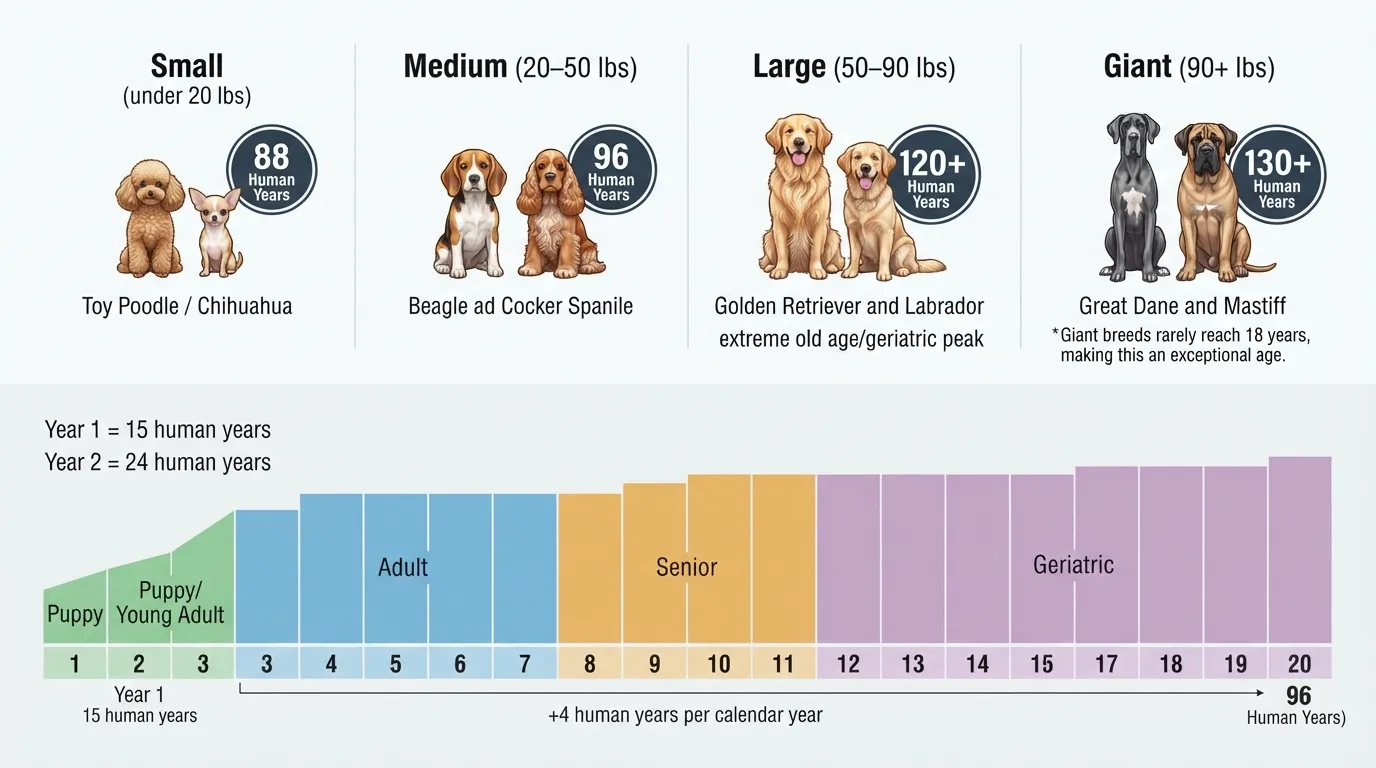
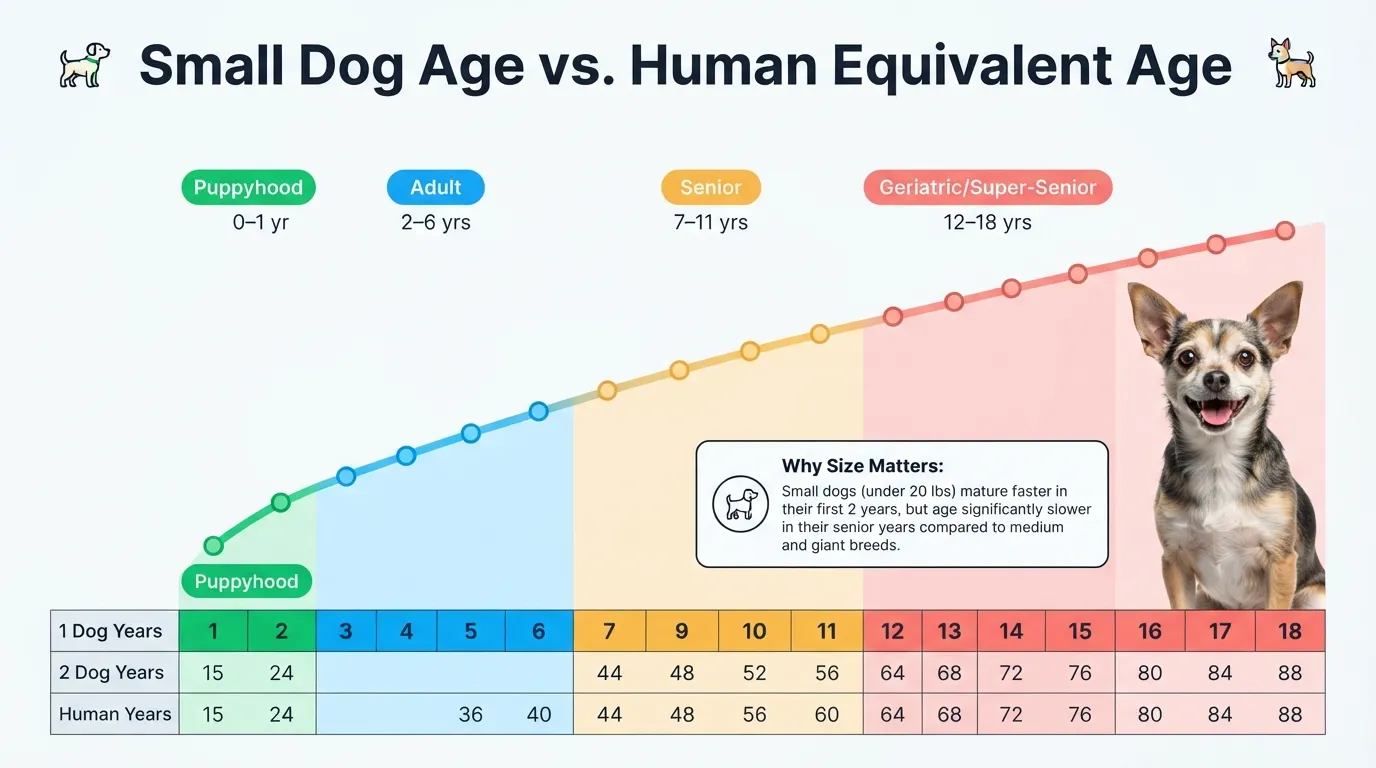
A small dog reaches human adulthood much faster than you might think, but their aging dramatically slows down once they pass their second birthday. Unlike large breeds that age rapidly throughout their lives, a small dog under 20 pounds spends most of their lifespan aging roughly 4 human years for every calendar year.
The chart below shows the true age conversion for small dogs from puppyhood up to 20 years, based on modern veterinary growth curves and epigenetic aging studies.
| Dog Age (Years) | Human Years (Small Dog < 20 lbs) | Life Stage |
|---|---|---|
| 1 | 15 | Young Adult |
| 2 | 24 | Adult |
| 3 | 28 | Adult |
| 4 | 32 | Adult |
| 5 | 36 | Adult |
| 6 | 40 | Adult |
| 7 | 44 | Mature Adult |
| 8 | 48 | Mature Adult |
| 9 | 52 | Senior |
| 10 | 56 | Senior |
| 11 | 60 | Senior |
| 12 | 64 | Senior |
| 13 | 68 | Super Senior |
| 14 | 72 | Super Senior |
| 15 | 76 | Super Senior |
| 16 | 80 | Super Senior |
| 17 | 84 | Centenarian |
| 18 | 88 | Centenarian |
| 19 | 92 | Centenarian |
| 20 | 96 | Centenarian |
| Dog Age | Human Years | Life Stage |
|---|---|---|
| 1 Year | 15 Yrs | Young Adult |
| 2 Years | 24 Yrs | Adult |
| 3 Years | 28 Yrs | Adult |
| 4 Years | 32 Yrs | Adult |
| 5 Years | 36 Yrs | Adult |
| 6 Years | 40 Yrs | Adult |
| 7 Years | 44 Yrs | Mature Adult |
| 8 Years | 48 Yrs | Mature Adult |
| 9 Years | 52 Yrs | Senior |
| 10 Years | 56 Yrs | Senior |
| Dog Age | Human Years | Life Stage |
|---|---|---|
| 11 Years | 60 Yrs | Senior |
| 12 Years | 64 Yrs | Senior |
| 13 Years | 68 Yrs | Super Senior |
| 14 Years | 72 Yrs | Super Senior |
| 15 Years | 76 Yrs | Super Senior |
| 16 Years | 80 Yrs | Super Senior |
| 17 Years | 84 Yrs | Centenarian |
| 18 Years | 88 Yrs | Centenarian |
| 19 Years | 92 Yrs | Centenarian |
| 20 Years | 96 Yrs | Centenarian |
Small Dog Puppy Age in Human Years (0–12 Months)
During their first 12 months, small dogs experience a massive developmental surge, hitting milestones in weeks that take human children years to reach. By the time a toy or small breed celebrates their first birthday, they have already developed the physical and reproductive maturity of a 15-year-old human teenager.
Because small puppies grow so rapidly, tracking their age month-by-month gives you a far more accurate picture of their real physical maturity:
| Puppy Age | Human Equivalent | Developmental Milestone |
|---|---|---|
| 2 Weeks | 1 Year | Eyes open, early motor skills developing |
| 1 Month | 3 Years | Weaning begins, active socialization window opens |
| 3 Months | 5 Years | Rapid learning phase, primary baby teeth in place |
| 6 Months | 10 Years | Teething completes, adolescent energy spikes |
| 9 Months | 13 Years | Sexual maturity reached, adult coat emerging |
| 12 Months | 15 Years | Skeletal growth complete, young adult stage begins |
Small vs Large Dog Aging — Quick Comparison
Small dogs age faster than large dogs during their first year of life, but they age significantly slower for the rest of their lives. While a 10-year-old Chihuahua is roughly equivalent to a 56-year-old human in their prime senior years, a 10-year-old Great Dane is already at an advanced human equivalent of 79 years.
This stark difference comes down to biological strain: giant breeds grow at accelerated rates, causing cellular wear and earlier onset of age-related conditions like canine cognitive dysfunction and arthritis.
Dog Age vs Human Age Comparison Chart
| Calendar Age | Small (<20 lbs) | Medium (21–50 lbs) | Large (51–90 lbs) | Giant (>90 lbs) |
|---|---|---|---|---|
| 1 Year | 15 human years | 15 human years | 15 human years | 12 human years |
| 5 Years | 36 human years | 37 human years | 40 human years | 45 human years |
| 10 Years | 56 human years | 60 human years | 66 human years | 79 human years |
| 15 Years | 76 human years | 83 human years | 93 human years | 115+ human years |
| 1 Year | 15 human years |
|---|---|
| 5 Years | 36 human years |
| 10 Years | 56 human years |
| 15 Years | 76 human years |
| 1 Year | 15 human years |
|---|---|
| 5 Years | 37 human years |
| 10 Years | 60 human years |
| 15 Years | 83 human years |
| 1 Year | 15 human years |
|---|---|
| 5 Years | 40 human years |
| 10 Years | 66 human years |
| 15 Years | 93 human years |
| 1 Year | 12 human years |
|---|---|
| 5 Years | 45 human years |
| 10 Years | 79 human years |
| 15 Years | 115+ human years |
Want to get the exact age calculation tailored specifically to your dog’s specific breed, weight, and birth date? Use our free, science-backed to instantly convert your pet’s age with complete precision.
Why the "1 Dog Year = 7 Human Years" Rule Is a Myth
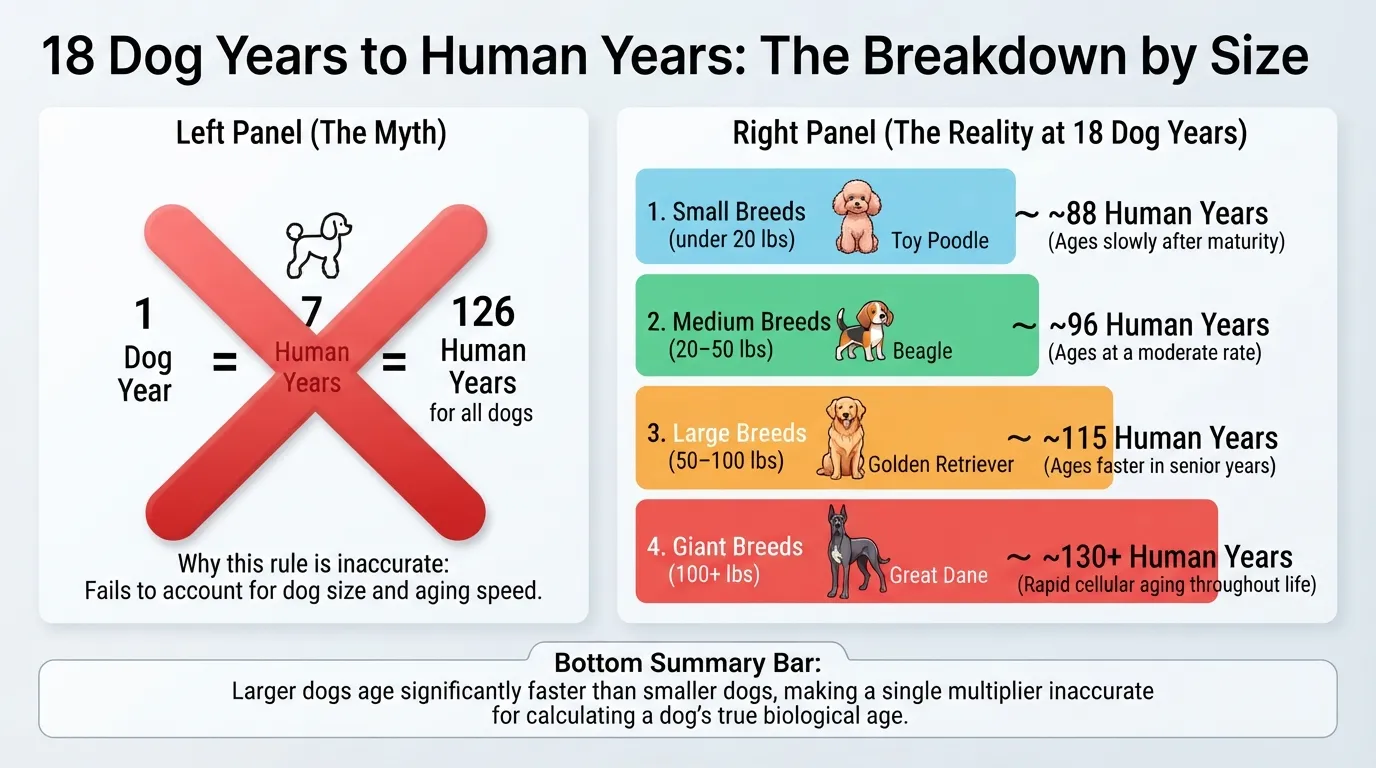
The popular “1 dog year equals 7 human years” rule originated as a mid-20th-century marketing shortcut based on dividing average human life expectancy (around 70 years) by average canine lifespan (10 years). Veterinary science has long debunked this simple multiplier because dogs do not age at a uniform, linear pace throughout their lives. Puppies mature extremely fast during their first two years, after which aging speed diverges dramatically based on a dog’s size and breed category.
How to Calculate Your Small Dog's Age in Human Years
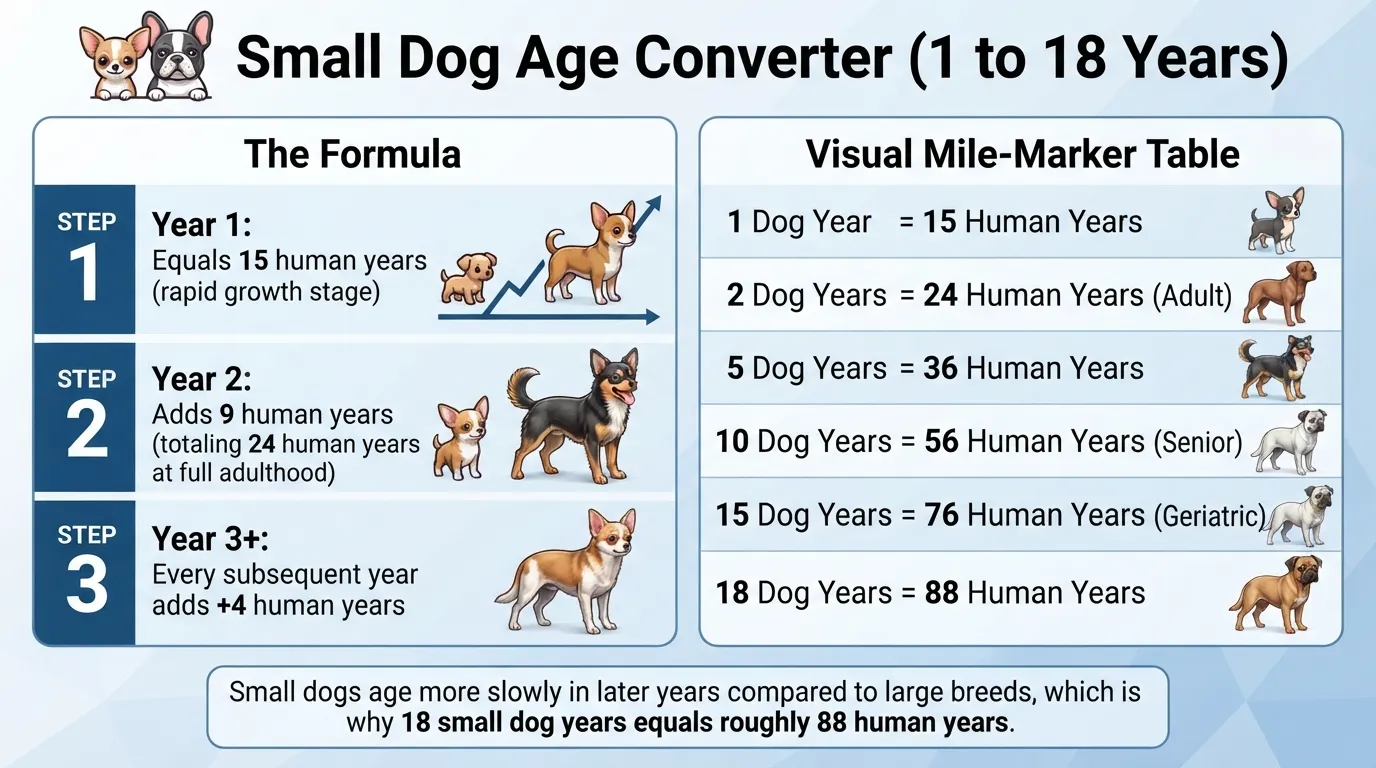
Small dogs age through a distinct two-phase process: a rapid surge during early development followed by a remarkably slow, steady pace throughout adulthood. While a large breed like a Great Dane might age six to eight human years for every calendar year after age two, a small breed settles into a gentle progression of roughly four human years per calendar year.
The Tiered Formula for Small Breeds
Calculating your small dog’s true age requires a tiered formula that accounts for their accelerated puppyhood and extended adult life stage.
Year 1 = 15 human years: A small dog completes infancy, childhood, and adolescence all within their first twelve months, reaching physical and sexual maturity around their first birthday.
Year 2 = +9 human years (Total: 24 human years): During their second year, young adult growth stabilizes and socio-behavioral maturation settles in, bringing them to the human equivalent of a 24-year-old.
Year 3 onward = ~4 human years per dog year: From age three forward, small breeds age at a predictable, baseline rate of about four human years for every calendar year they live.
Worked Example
To see how the math plays out in real life, let’s calculate the human age of a 7-year-old French Bulldog.
Calculate Year 1: The first year counts as 15 human years.
Add Year 2: Adding 9 years for the second year brings the total to 24 human years ($15 + 9$).
Calculate the remaining years: The dog has 5 remaining years (ages 3 through 7). Multiply those 5 years by the 4-year adult rate to get 20 human years ($5 \times 4$).
Sum the totals: Add the baseline 24 years to the remaining 20 years ($24 + 20$).
A 7-year-old Frenchie is 44 human years old—meaning they’ve officially entered their mature adult phase, but still have plenty of prime years ahead before reaching senior status.
If you want to skip the manual arithmetic and get an instant, exact result tailored specifically to your dog’s weight class and breed, you can run their details through our free dog age calculator to see where they land on the aging scale today.
Why Do Small Dogs Age Slower and Live Longer Than Big Dogs?
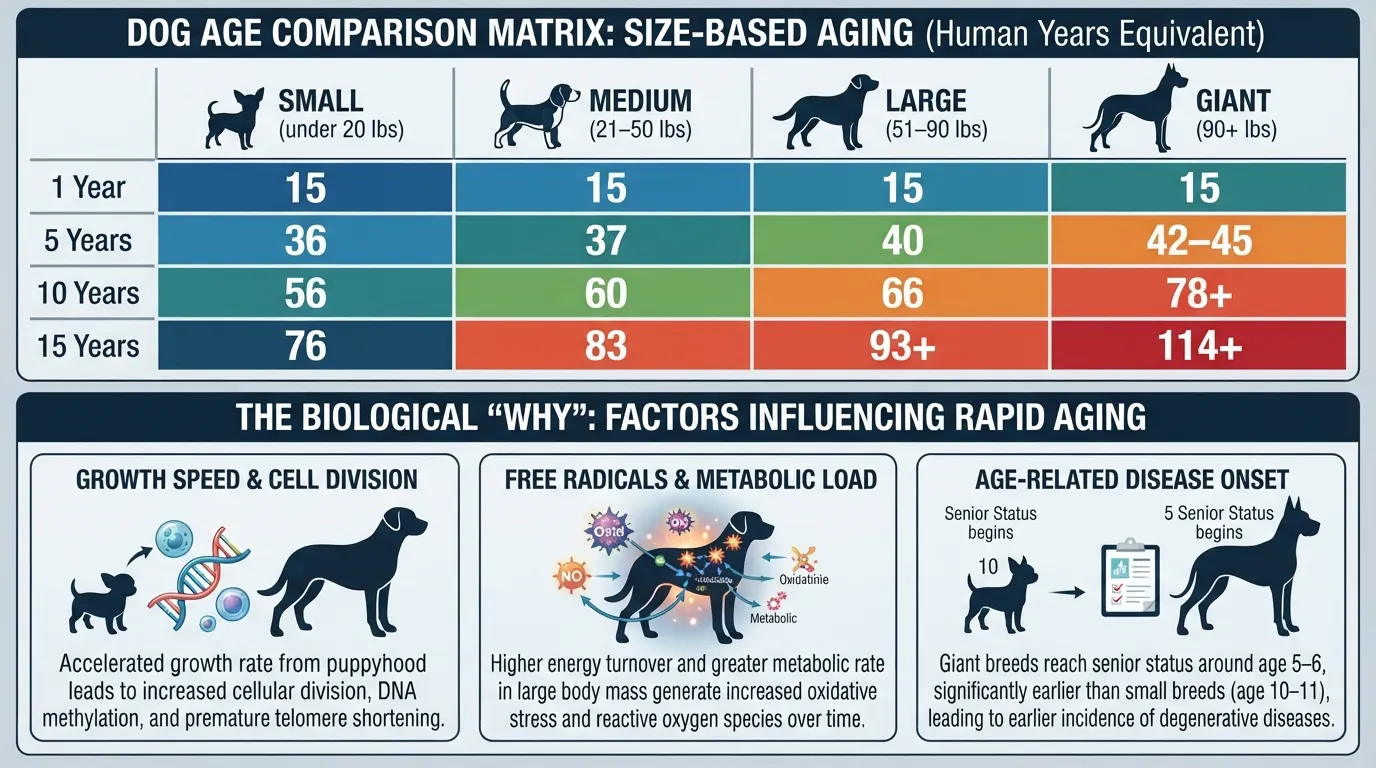
Small dogs live longer than large dogs because they age at a significantly slower rate during adulthood, benefiting from reduced metabolic stress, lower cell proliferation rates, and a lower incidence of fatal cancer. While a Great Dane ages roughly 8.4 human years for every calendar year, a Chihuahua or Toy Poodle ages only about 4.2 to 5 human years per calendar year once past puppyhood.
In most mammals—from mice to elephants—larger species live longer. Dogs are the primary evolutionary exception. Selective breeding created massive size disparities within a single species, completely altering how their bodies age.
Slower Post-Puppy Growth and Cellular Stress
Large dogs must grow at an extraordinary speed during their first year. A Mastiff puppy can gain over 200 pounds in 18 months, whereas a Pomeranian gains around 5 pounds.
According to research from evolutionary biologists and the landmark 2020 UC San Diego epigenetic clock study published in Cell Systems, rapid juvenile growth pushes large dogs’ cells into overdrive. This rapid cell division increases early oxidative damage and causes large dogs’ DNA methylation patterns—their cellular age—to accelerate sharply. Small dogs grow gradually, experiencing far less cellular strain and preserving their physiological reserve for later in life.
Lower Basal Metabolic Demand
Small dogs have higher heart rates than large dogs, but their total energy expenditure relative to cellular damage over a lifetime works out differently. Because small dogs don’t need to support massive bone mass, heavy organ systems, or rapid cell turnover, their tissue suffers less wear and tear.
As noted in American Kennel Club (AKC) health longevity data, small breeds retain healthier cardiac function, cleaner joint cartilage, and better-preserved metabolic markers well into their teens.
Drastically Reduced Cancer Mortality
Cancer is the single biggest factor shortening the lifespan of large and giant breeds. Veterinary oncology studies show that nearly 50% to 60% of large dogs (such as Golden Retrievers, Boxers, and Irish Wolfhounds) die of cancer.
For small dogs under 20 pounds, cancer accounts for only about 15% to 20% of deaths. Because small dogs undergo far fewer cell divisions across their lifetimes, they have fewer opportunities for DNA replication errors that lead to malignant tumors. Small dogs are more prone to manageable chronic issues like dental disease or mitral valve disease, which pet owners can treat effectively with veterinary support.
Real-World Longevity Limits
While the average lifespan for a 100-pound dog is 8 to 10 years, small dogs routinely cross into their late teens and early twenties.
Official Guinness World Records history demonstrates this stark gap: small dogs like TobyKeith, a Florida Chihuahua who reached 23 years of age, and Pebbles, a Toy Fox Terrier who lived past 22, highlight the biological ceiling of toy breeds. Giant breeds rarely make it past 12 years.
To see how your own small dog’s specific age converts using these biological growth curves, run their numbers through our free dog age calculator.
Does Spaying/Neutering Affect How a Small Dog Ages?
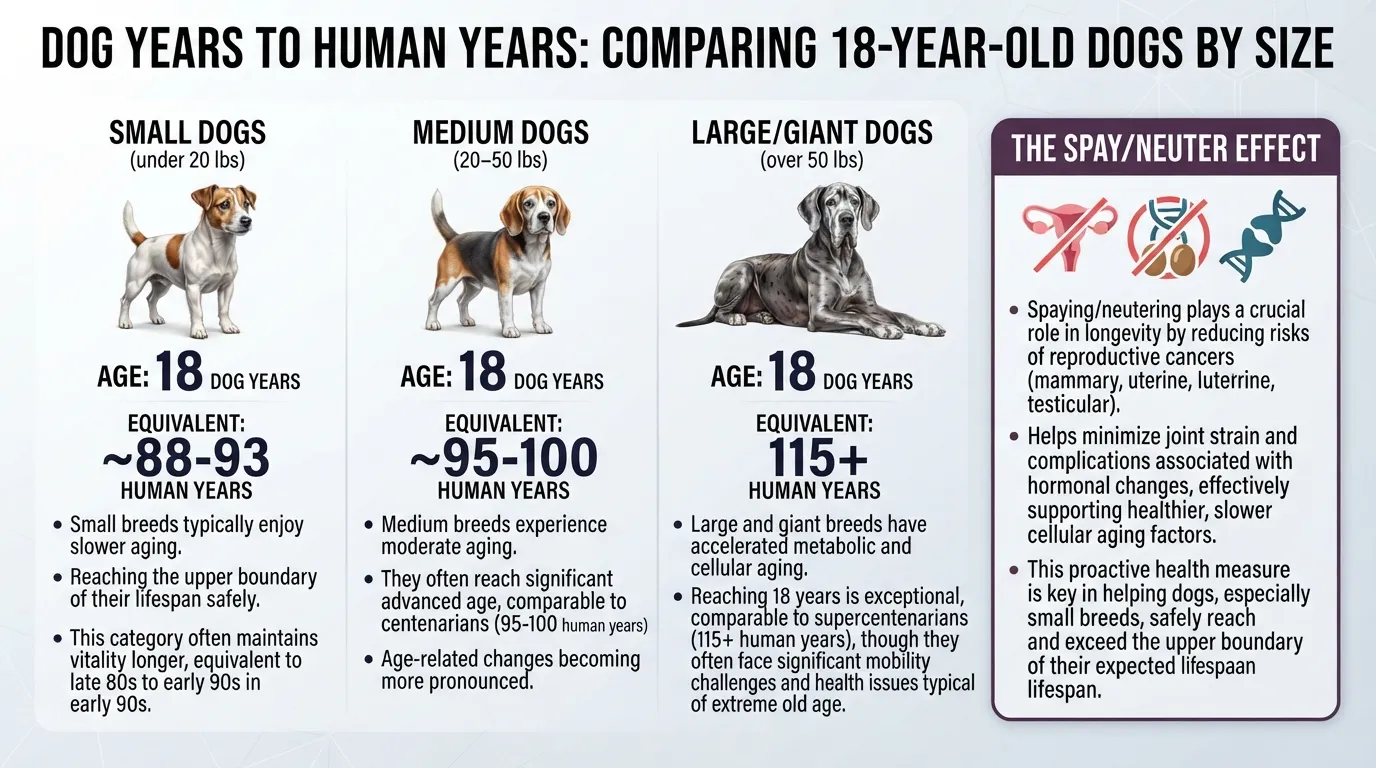
Yes, spaying or neutering directly influences how small dogs age, generally extending their lifespan by 10% to 20% compared to intact dogs. According to studies tracked by veterinary researchers and the AVMA, fixed small breeds benefit from a significantly lower risk of reproductive cancers, uterine infections like pyometra, and prostate issues. While altering can slightly slow a dog’s metabolic rate, small breeds face a much lower risk of joint strain from gonadectomy compared to large breeds, making spaying or neutering a net positive for their long-term health and longevity.
When Is a Small Dog Considered a Senior?
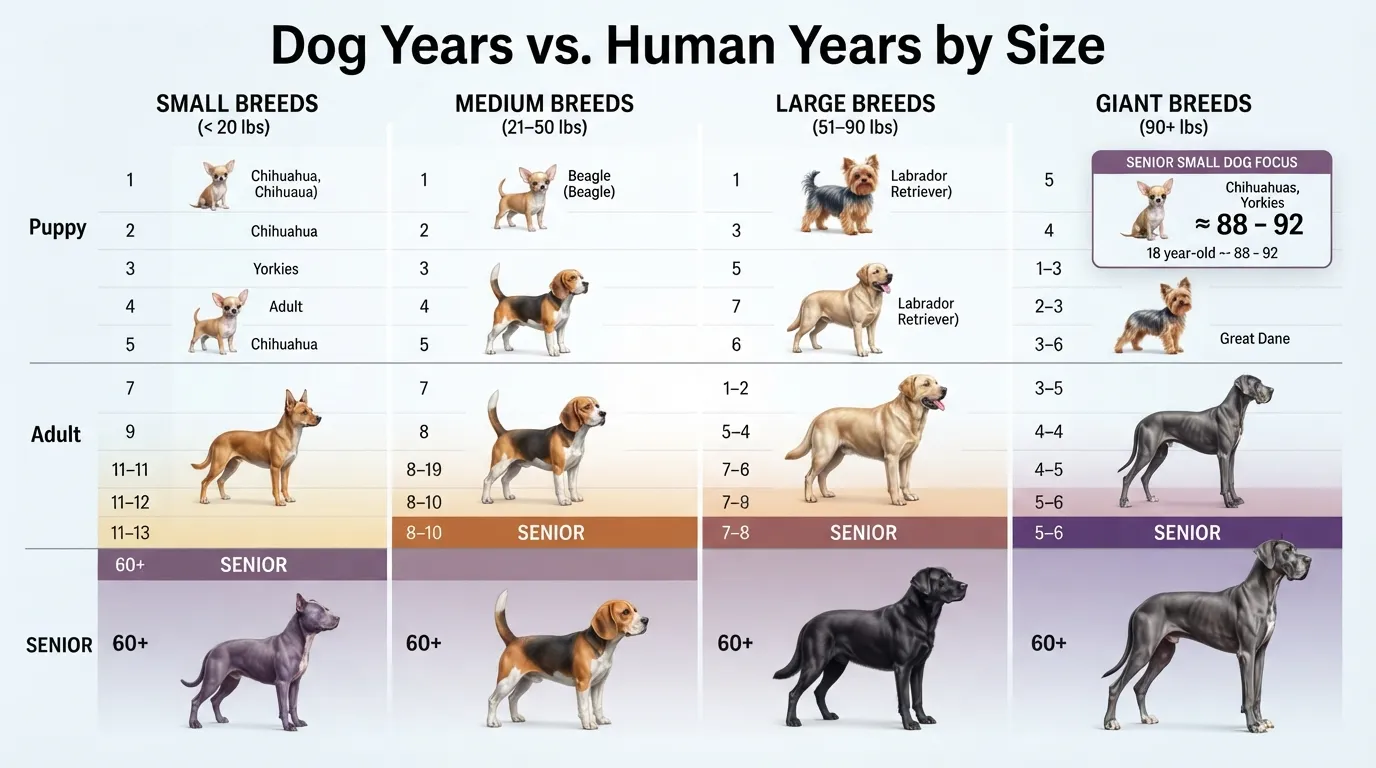
A small dog is generally considered a senior between 10 and 11 years of age. Thanks to their slower biological aging process, small breeds reach this milestone much later than large or giant dogs, who often transition into senior status between 5 and 8 years old.
According to veterinary guidelines from the American Veterinary Medical Association (AVMA), senior status marks the timeframe when age-related health changes begin to accelerate. For popular small breeds like Chihuahuas, Toy Poodles, and Dachshunds, this extended adulthood gives you nearly a full decade of prime adult life before specialized aging care becomes necessary.
The key driver behind this biological gap comes down to growth speed and metabolic stress. Giant breeds experience rapid, intense cell division during puppyhood that taxes their metabolic systems early on. Small dogs mature steadily and maintain less overall cellular wear, allowing their bodies to delay the physical decline that typically comes with age.
Signs Your Small Dog Is Entering Senior Years
The earliest physical signs that a small dog is entering their senior years include a graying muzzle, subtle shifts in daily activity, noticeable dental wear, and a hazy cloudiness in the eyes. Because small breeds often stay playful well into their teens, these four physical markers are usually your first true indicators of aging:
Graying muzzle and fur: Loss of pigment usually starts around the chin and lips around 8 to 10 years of age. Over time, this frosty graying spreads up the snout and around the eyes.
Slower activity and subtle stiffness: You might notice your dog hesitating before hopping onto the sofa, taking longer to stretch after a nap, or slowing their pace toward the end of a long walk.
Dental wear and tartar buildup: Decades of chewing lead to flattened tooth tips, gum recession, and persistent bad breath. Small breeds have crowded teeth that make them prone to periodontal issues, so dental changes often show up early in the aging process.
Cloudy eyes (Nuclear Sclerosis): A bluish-gray haze behind the pupil is a normal, non-painful hardening of the eye lens known as nuclear sclerosis. While it looks similar to cataracts, it rarely impairs a small dog’s day-to-day vision, though your vet should evaluate any eye changes during routine checkups.
Small Dog Breeds — Lifespan & Human-Year Age Comparison
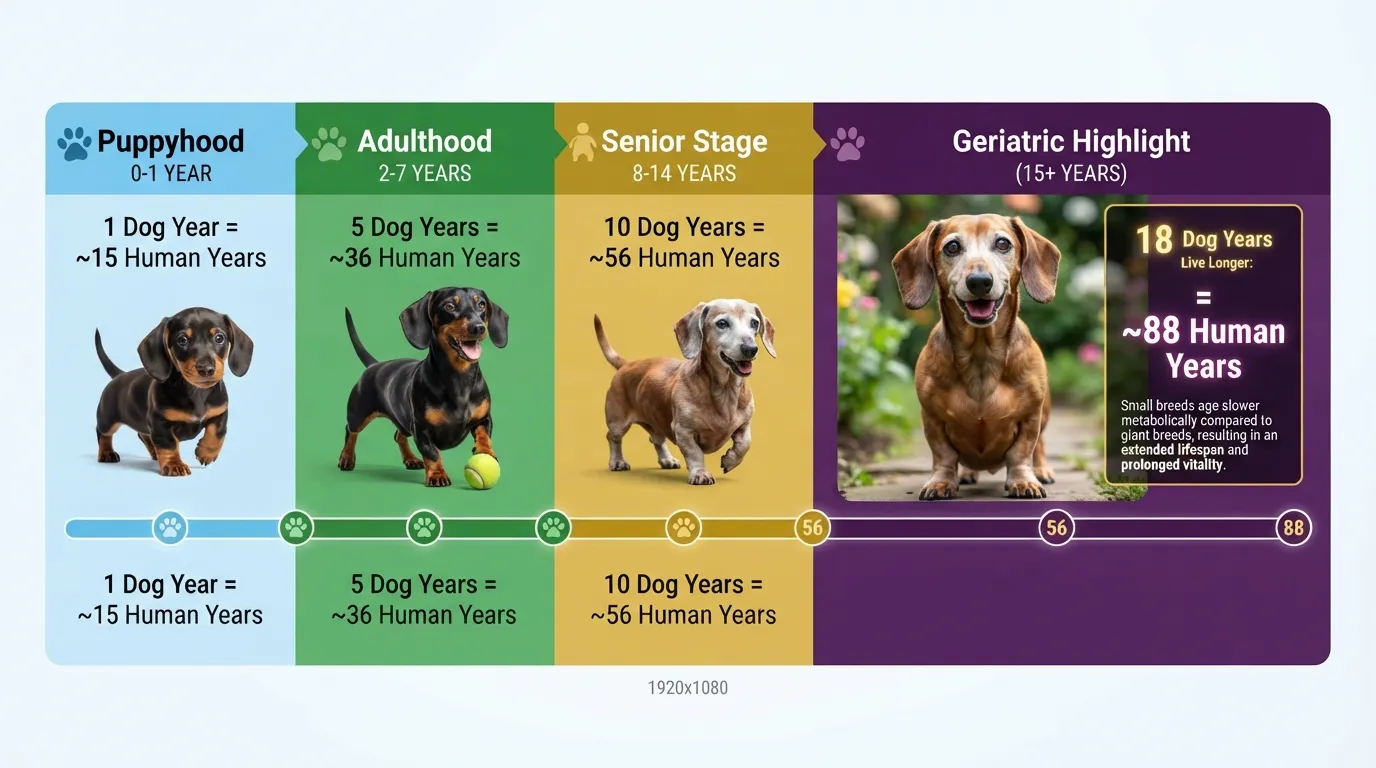
Small dog breeds live significantly longer than larger dogs, averaging a lifespan of 12 to 16 years compared to just 8 to 10 years for giant breeds. Because toy and miniature breeds age at a slower biological pace after their initial two-year growth spurt, calculating dog years for small dogs requires breed-specific guidelines rather than a one-size-fits-all formula.
Chihuahua
Chihuahuas boast one of the longest average lifespans in the canine world at 14 to 18 years, with many healthy individuals reaching their late teens. Veterinarians generally consider a Chihuahua to reach senior status at 10 to 11 years old.
For example, a 10-year-old Chihuahua is roughly equivalent to a 56-year-old human, having aged at roughly 4 human years per calendar year after reaching adulthood.
Pomeranian
Pomeranians have an average lifespan of 12 to 16 years when properly cared for and kept at a healthy body weight. Their aging trajectory classifies them as seniors around 10 years of age.
For instance, an 8-year-old Pomeranian translates to approximately 48 human years, marking the mature adult phase right before their senior transition begins.
Yorkshire Terrier
Yorkshire Terriers typically live between 13 and 16 years, enjoying an extended adulthood compared to medium and large breeds. A Yorkie officially enters its senior phase at around 10 years old.
A 12-year-old Yorkie is roughly 64 human years old in terms of organ function, joint wear, and metabolic health.
Shih Tzu
Shih Tzus have an average lifespan of 10 to 16 years, with most healthy dogs comfortably reaching 13 or 14 years. Due to their compact frame and potential for respiratory or joint sensitivity, vets classify them as seniors at 9 to 10 years old.
A 7-year-old Shih Tzu sits right on the edge of mature adulthood, matching a human age of approximately 44 years.
Maltese
Maltese dogs live an average of 12 to 15 years, with female Maltese often outliving males by a slight margin. They hit their senior milestones around 10 years old, when age-related dental and cardiac monitoring becomes especially crucial.
An 11-year-old Maltese corresponds to roughly 60 human years, making routine bi-annual vet checks essential for catching age-related shifts early.
Dachshund
Dachshunds—especially Miniature Dachshunds—frequently live 12 to 16 years, making them one of the heartiest small breeds despite their unique spinal geometry. They enter senior territory at 10 years of age.
A 14-year-old Dachshund equals roughly 72 human years, representing a well-advanced senior who needs lower-impact exercise and tailored nutrition.
Pug
Pugs have a slightly shorter average lifespan than other small breeds, typically living 12 to 15 years due to brachycephalic (flat-faced) health factors. They transition into their senior years earlier than standard toy breeds, at around 8 to 9 years old.
A 9-year-old Pug is biologically equivalent to a 52-year-old human, requiring close attention to weight management and respiratory health.
French Bulldog
French Bulldogs have an average lifespan of 10 to 12 years, which is notably shorter than most small breeds owing to structural and respiratory vulnerabilities. Vets consider a Frenchie a senior once they reach 7 to 8 years old.
An 8-year-old French Bulldog is roughly 48 human years old, entering their golden years noticeably earlier than a Chihuahua or Yorkie of the exact same age.
Life Stage Guide for Small Dogs Puppy → Senior
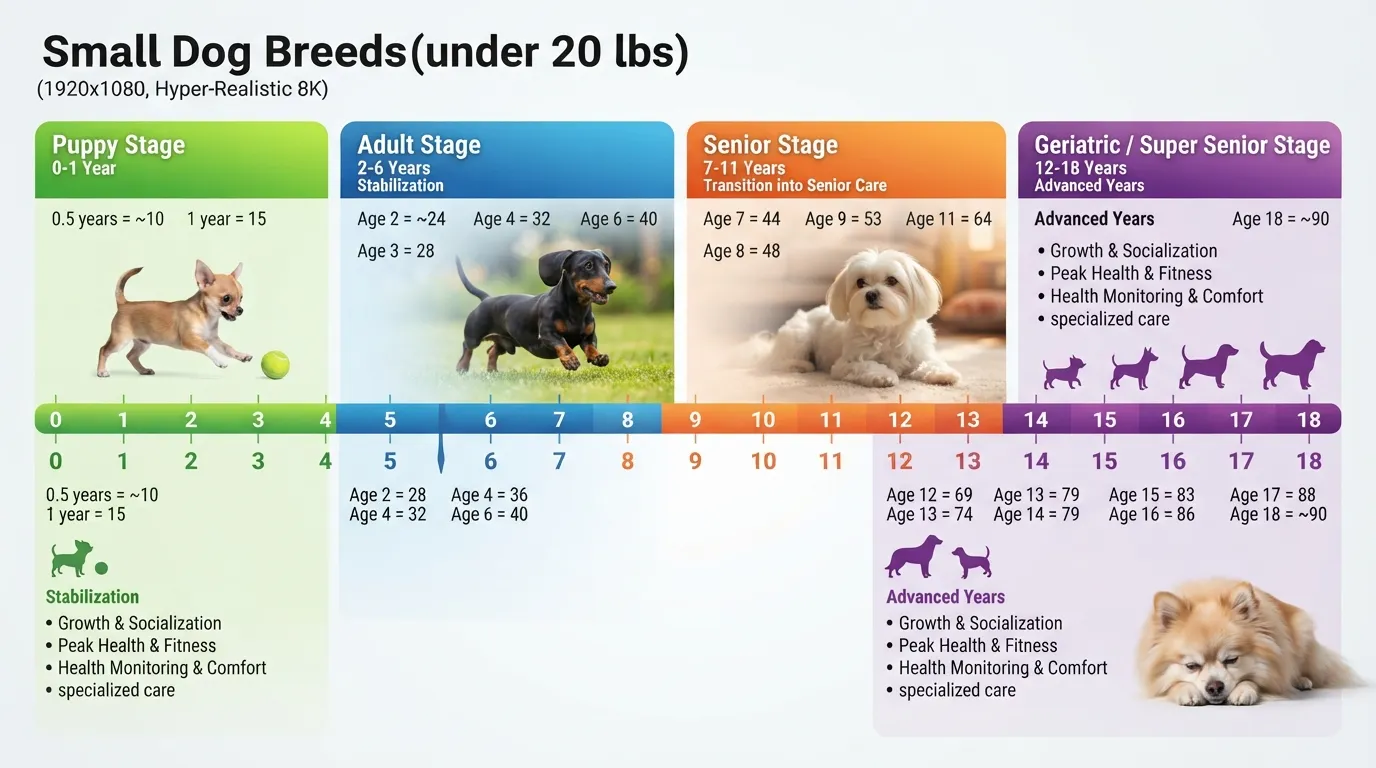
Small dogs move through life at a strikingly unique pace: they sprint through early development much faster than large breeds, but once they reach adulthood, their aging process slows down dramatically. While a Mastiff might be considered a senior by age six, a small dog under twenty pounds often enjoys active adult life well past its tenth birthday. Knowing which stage your small dog is in allows you to tailor their daily care, nutrition, and routine to match their exact biological age.
Puppy 0–1 year
Small-breed puppies experience an explosive growth phase, reaching up to 80% of their full adult weight within their first six months. By the time a Toy Poodle or Chihuahua reaches twelve months old, they have already completed the human equivalent of late adolescence around 15 years old . Because their tiny stomachs hold very little food, their high metabolism requires dense calorie intake to prevent sudden drops in blood sugar.
Care Priorities: Feed an official small-breed puppy formula high in protein and fat, spread across three to four meal sessions daily to prevent hypoglycemia.
Vet & Health Focus: Complete the core vaccine series (DHPP and Rabies) between 6 and 16 weeks, and schedule a spay/neuter consultation around 6 to 9 months based on your vet’s recommendation.
Exercise & Health Risks: Keep exercise sessions short—roughly five minutes per month of age twice a day—to protect developing joints. Watch closely for signs of dental crowding, as milk teeth that fail to fall out can permanently misalign adult bite patterns.
Adolescent 1–2 years
Between one and two years of age, small dogs transition from physical maturity to emotional and behavioral maturity, roughly matching a human in their late teens to early twenties. Physical growth stops during this window, but energy levels often peak as hormonal changes settle. This stage is critical for consolidating lifelong social habits and preventing behavioral issues like fear-based barking or boundary pushing.
Care Priorities: Transition from puppy food to an adult small-breed recipe around month twelve to prevent rapid, unwanted weight gain.
Vet & Health Focus: Schedule their first adult wellness checkup and booster shots at the one-year mark, and begin a daily home dental brushing routine.
Exercise & Health Risks: Provide at least 30 to 45 minutes of daily interactive play and mental stimulation through puzzle toys. Keep a close eye on kneecap stability during high-impact games; luxating patellas (slipping kneecaps) frequently manifest around this age.
Adult 2–7 years
The adult phase represents the longest, most stable biological period for small breeds, translating roughly to the mid-twenties through late forties in human years. Unlike large breeds whose body systems experience heavy wear and tear by age five, small dogs maintain peak cellular health and physical stamina throughout this multi-year plateau.
Care Priorities: Maintain precise portion control using a measuring scale rather than visual eye-balling, as even an extra ounce of kibble can lead to significant weight gain on a ten-pound dog.
Vet & Health Focus: Shift to annual vet checkups that include a thorough dental examination and annual blood screening to establish healthy baseline metrics.
Exercise & Health Risks: Aim for 45 to 60 minutes of varied daily exercise, such as walks and fetch. Obesity and periodontal disease are the two primary threats in this phase—over 80% of small dogs show active gum disease by age three if teeth aren’t brushed regularly.
Senior 10+ years
Small dogs generally enter their true senior phase around age ten—equivalent to roughly 56 human years—though many live vibrant lives past fifteen or sixteen. Thanks to lower levels of cellular stress and growth hormones over their lifespan, their organ systems age gradually, meaning proactive care during these golden years pays off directly in quality of life and longevity.
Care Priorities: Switch to a senior-specific small-breed diet fortified with joint supplements like glucosamine and omega-3 fatty acids, featuring smaller, softer kibble pieces if tooth loss has occurred.
Vet & Health Focus: Increase veterinary visits to twice a year for bi-annual physicals, senior blood panels, and early screening for kidney and heart function.
Exercise & Health Risks: Modify exercise to low-impact, consistent walks, avoiding long jumps or high-intensity sprints that stress aging joints. Be alert for common small-breed senior conditions, including mitral valve heart disease, tracheal collapse (indicated by a dry coughing sound), and progressive vision loss from cataracts.
Frequently Asked Questions About Dog Years for Small Dogs
Is 1 dog year really 7 human years?
No, the traditional 1:7 ratio is a popular myth. Small dogs mature rapidly in their first two years and then their aging slows down significantly compared to larger breeds.
| Dog Age | Traditional Formula | Actual Small Dog Age |
|---|---|---|
| 1 Year | 7 Human Years | 15 Human Years |
| 2 Years | 14 Human Years | 24 Human Years |
| 3+ Years | +7 Years / Year | +4 to +5 Years / Year |
How accurate is 15 human years for a 1-year-old small dog?
It is highly accurate according to modern veterinary research (including AVMA standards). During the first 12 months, a small dog undergoes skeletal growth, dental development, and sexual maturity equivalent to a 15-year-old human teenager.
Do small dogs really live longer than large dogs?
Yes, small dogs live significantly longer on average. While giant breeds age quickly at a cellular level, small breeds maintain slower physiological aging after maturity.
| Dog Size Category | Weight Range | Average Lifespan |
|---|---|---|
| Small Dogs | Under 20 lbs (9 kg) | 12 - 16+ Years |
| Large / Giant Dogs | Over 50 lbs (23 kg) | 7 - 11 Years |
At what age is a small dog considered old?
A small dog is generally considered a senior at 10 to 11 years old. Because of their extended lifespans, they reach senior status much later than large dogs (who are considered senior around 6-7 years).
How many dog years is 1 month/week for a small dog?
During puppyhood, aging happens rapidly week by week:
| Small Dog Time Unit | Equivalent Human Age |
|---|---|
| 1 Week (Puppy) | ~3.5 Human Months |
| 1 Month (Puppy) | ~1.25 Human Years |
| 1 Month (Adult 2+ yrs) | ~4 Human Months |
Does breed (not just size) affect how fast a dog ages?
Yes. While body weight is the dominant factor, genetics and breed-specific health traits play a key role. For example, Chihuahuas and Toy Poodles often live up to 18 years, whereas purebred small dogs prone to structural or cardiac issues may age slightly faster.
How accurate is the small dog years calculator?
Calculators based on non-linear weight-adjusted formulas offer a 90%+ reliable estimation. However, individual factors like dietary quality, daily exercise, dental hygiene, and preventive care can alter biological age compared to chronological age.
🐾 Other Age Guides

I built Dogagescalculator.com to give dog owners honest, science-backed answers instead of the outdated "×7" myth. Every figure here is checked against AKC, AVMA, and published veterinary research.
More about the author & this site →
Comments