
How to Tell How Old a Bird Is Complete Guide with Signs, Methods & Age Calculator
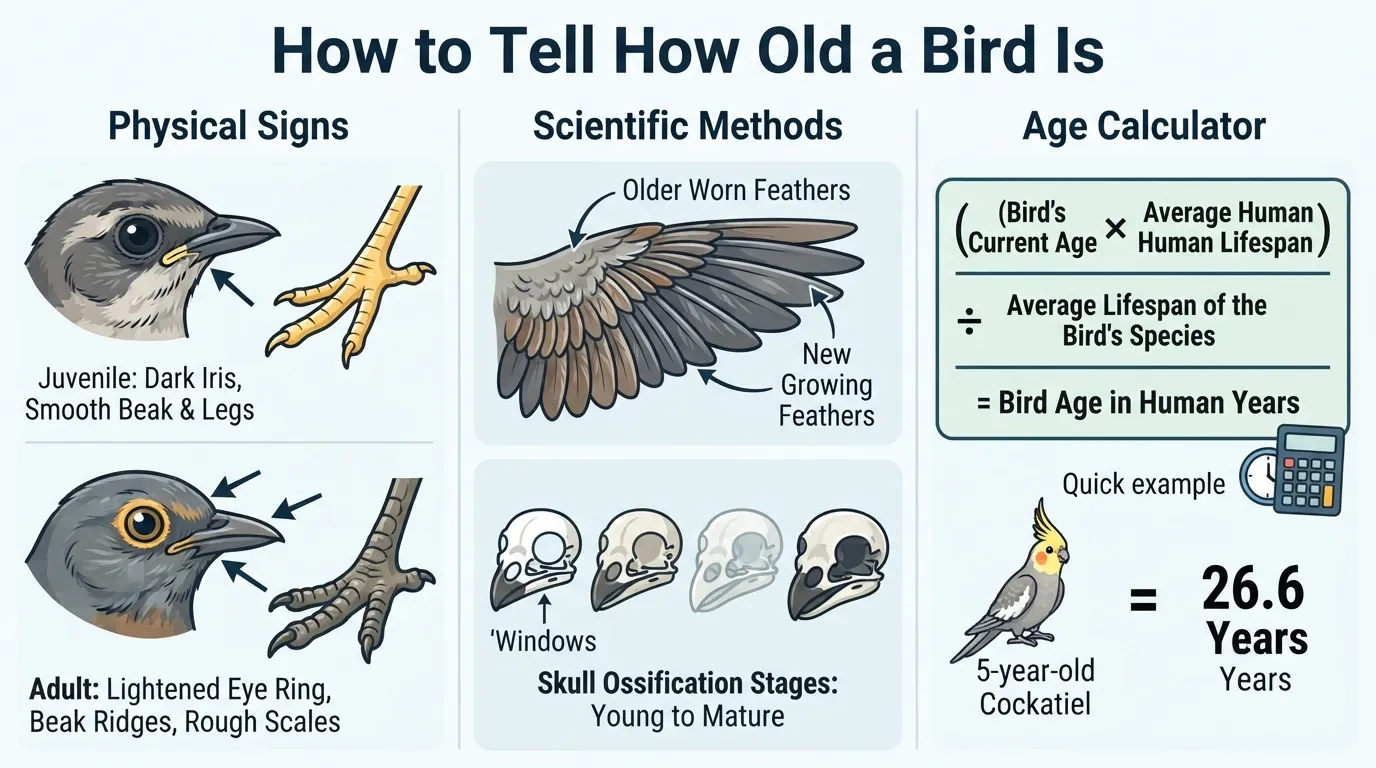
Determining how old a bird is can be difficult because birds do not age in the same visible way as humans. Some species show clear changes during their early development, while others may look almost identical for many years after reaching adulthood.
There is also no universal bird-years-to-human-years formula. A bird’s lifespan and aging process depend heavily on its species, size, genetics, environment, and overall health. A small songbird may live only a few years, while some parrots can live for several decades.
The best way to estimate a bird’s age is to examine clues such as plumage, eye color, beak development, legs and feet, behavior, and life-stage changes. In this guide, you’ll learn how to recognize these signs, understand bird age charts, and see how bird age compares with human age across different species.
Quick Answer: Key Signs of a Bird's Age
Convert Bird Age to Human Years — Try Our Free Calculator
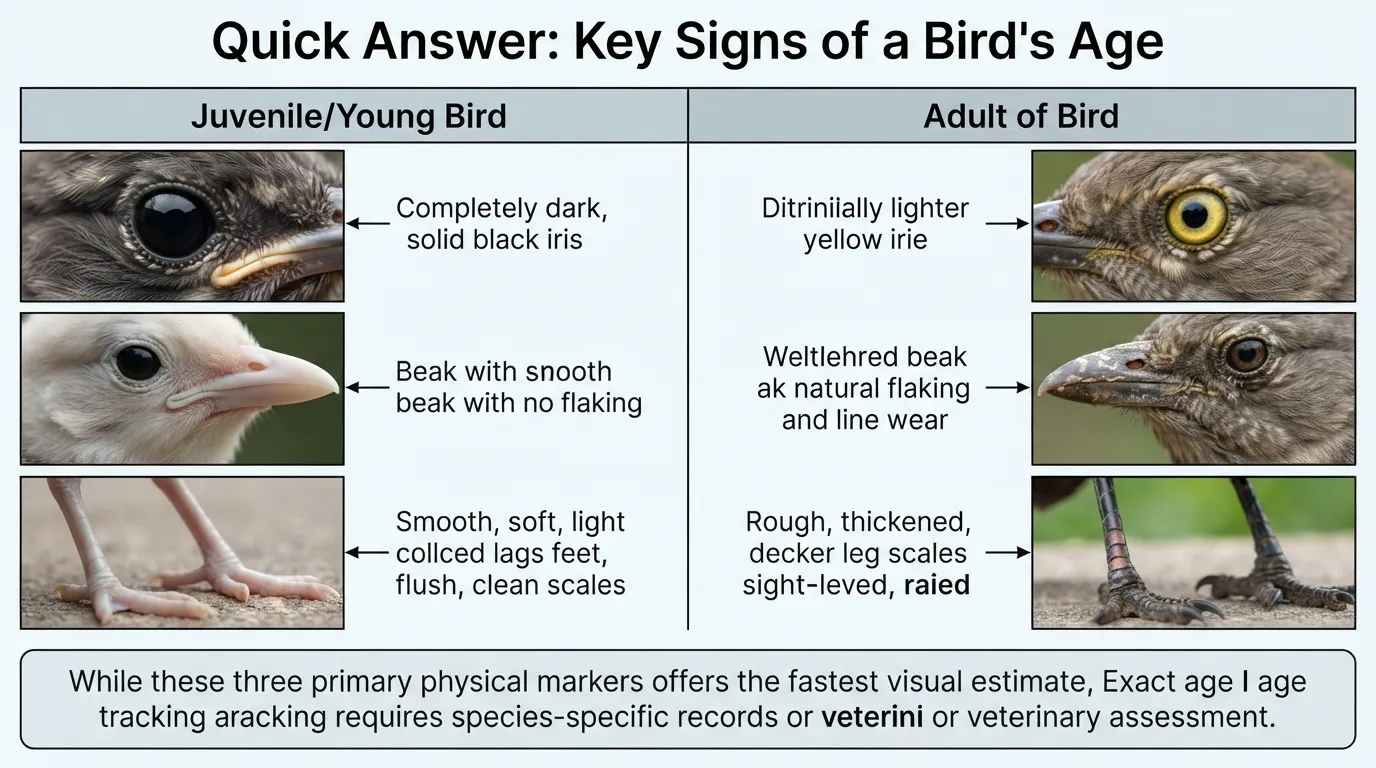
Determining a bird’s exact age is incredibly difficult once they pass maturity, but you can narrow down their life stage by evaluating five distinct physical and behavioral markers: eye color, feather condition, beak wear, leg scale texture, and vocalization patterns. While a chick is obvious, distinguishing a one-year-old from a five-year-old requires examining how time and environment have worn down these specific traits.
Here is exactly what to look for when figuring out how to tell how old a bird is:
Eye Color and Clarity: In many species, iris color changes dramatically as a bird matures. For example, young African Grey parrots start with dark grey or black irises that fade to pale yellow by age three, while young raptors often have light eyes that darken with age.
Feather Condition & Molt Pattern: Juvenile birds display pristine, uniform feathers from their first full set, which gradually give way to complex, sequential molt patterns as they age. Older birds may show more ragged flight feathers or minor discoloration if their grooming or nutritional absorption declines.
Beak Size & Shape: A young bird’s beak is typically smooth, soft-edged, and may still feature a residual “egg tooth” or soft gape at the corners of the mouth. As the bird uses its beak over the years, the keratin develops ridges, grooves, and visible layers from scraping against food and cuttlebones.
Feet & Scale Texture: Smooth, soft, pinkish legs generally point to a juvenile. Over time, a bird’s legs and feet accumulate layers of keratin, resulting in rougher, thicker, and more pronounced scales—often becoming noticeably darker or more calloused in senior birds.
Behavior & Vocalization: Young birds are notoriously clumsy, hyper-curious, and practice “sub-songs” (crude, quiet versions of adult calls). Mature and senior birds exhibit deliberate movements, established territorial behaviors, and clear, fully developed vocal repertoires.
Is It a Baby Bird? Identifying Life Stages First
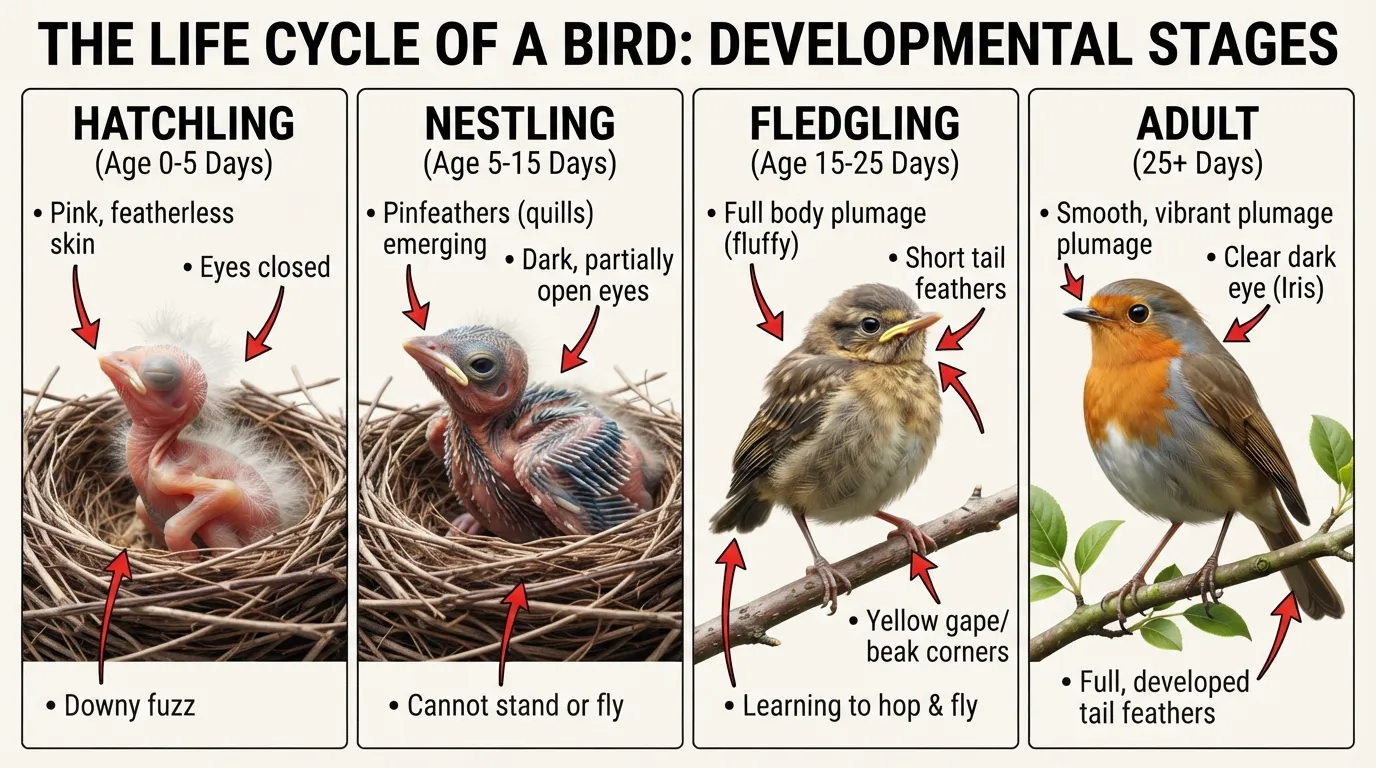
To figure out how to tell how old a bird is, you have to start with the broadest brushstrokes: their developmental life stage. For wild birds and many hand-raised pets, age determination isn’t about counting years; it’s about recognizing the rapid, highly distinct physical milestones that happen in the first few weeks of life.
Hatchling (0–3 days)
A hatchling is fresh out of the egg and entirely dependent on parental warmth. At this stage, birds are practically embryonic in appearance and lack any ability to regulate their own body temperature.
Look for these unmistakable signs of a hatchling:
Naked, translucent skin: They have little to no down feathers, making their pink or dark skin completely visible.
Closed eyes: Their eyes are sealed shut and look like large, dark bulges beneath the skin.
Weakness: They cannot stand or support their own heads; they can barely lift their gapes (mouths) to beg for food.
Nestling (4–9 days)
During the nestling phase, birds undergo a massive growth spurt. They are still confined to the nest, but they begin to look less like aliens and more like actual birds as their feathers start to develop under the surface.
You can identify a nestling by these key developmental markers:
Pinfeathers: Feathers begin to emerge inside protective, straw-like sheaths. These look like tiny, bluish-gray plastic tubes piercing through the skin.
Opening eyes: Their eyes will begin to slit open around day 4 or 5, becoming fully open and alert by day 9.
Better mobility: While they still cannot walk or fly, they can sit up on their haunches and actively vocalize for food.
Fledgling (9–14+ days)
A fledgling has officially outgrown the nest, even if they aren’t fully ready for prime-time flight. This is the stage where well-meaning humans often mistake a perfectly healthy baby bird for an injured adult.
If you see a bird on the ground with these traits, it’s a fledgling:
Short, stubby tails: Their body feathers are mostly un-sheathed, but their flight and tail feathers are still short and growing.
Fleshy gapes: The corners of their mouths (the rictus) still have bright, soft yellow or pink edges, which act as a target for parents feeding them on the ground.
Hop-and-flutter movement: They can hop, run, and flutter away from danger, but they cannot sustain vertical flight.
Juvenile vs. Adult Plumage
Once a bird leaves the fledgling stage, figuring out how to tell how old a bird is requires looking closely at feather quality and color patterns. Juvenile plumage is a bird’s first full set of feathers, and it serves a different purpose than adult feathers.
Texture and Quality: Juvenile feathers are structurally weaker, fluffier, and less insulated than adult feathers. Because they grow all at once on a limited nutritional budget, you will often see uniform growth bars across a juvenile’s tail.
Color Camouflage: Juvenile birds are usually duller, heavily streaked, or spotted to help them blend into the brush away from predators. For example, a juvenile American Robin sports a speckled breast that looks nothing like the solid, iconic brick-red chest of an adult.
Molt Timelines: Most songbirds undergo a partial molt a few months after fledging, swapping out their body feathers but keeping their juvenile wing and tail feathers until the following year. If you spot a bird with a patchy, transitioning coat of mixed dull and vibrant feathers, you are looking at a sub-adult.
How to Tell an Adult Bird's Age Wild Birds
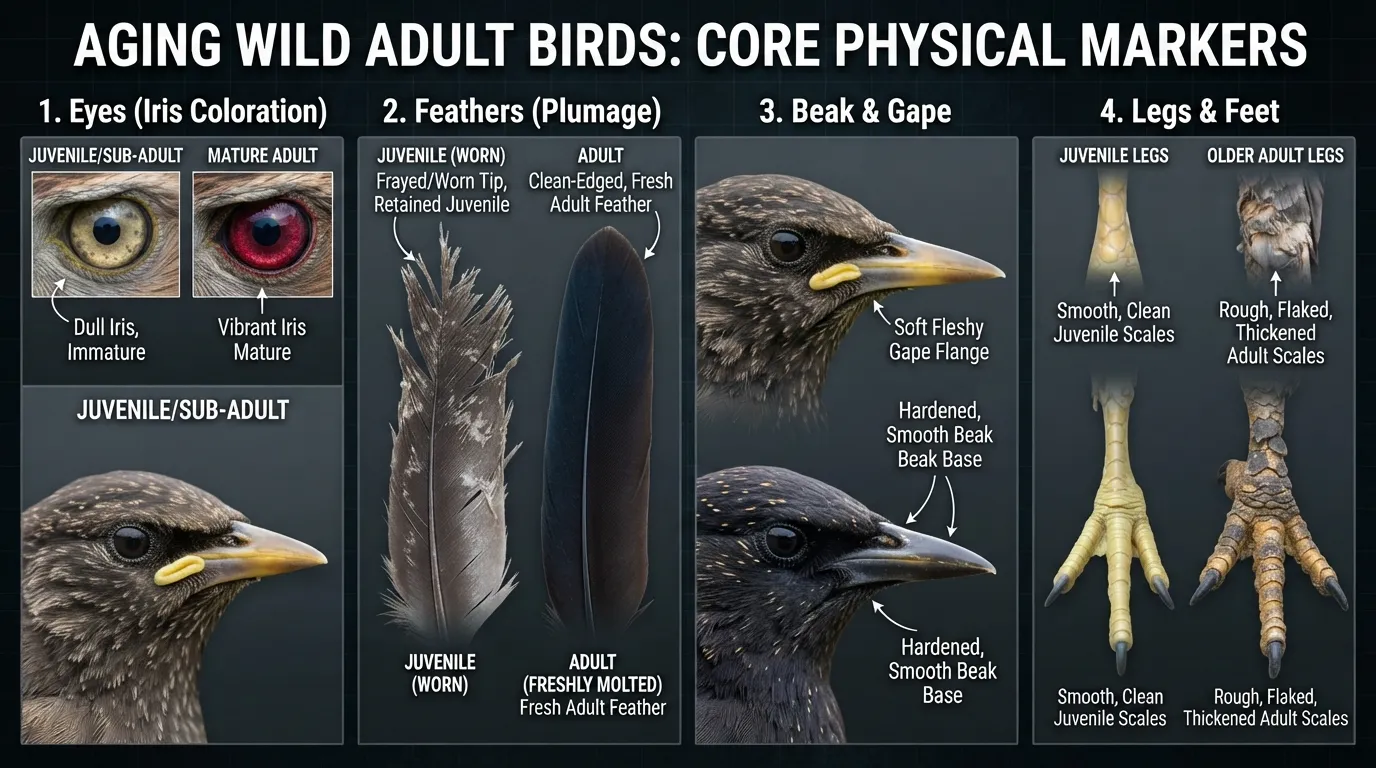
Determining the exact age of a wild adult bird is notoriously difficult because, unlike mammals, birds don’t get gray hair or wrinkles. However, by looking closely at specific physical markers and behavioral cues, you can narrow down a bird’s age from a broad “adult” category to a specific year or life stage.
Molt Pattern & Molt Limit The Feather Wear/Gap Technique
You can identify a bird’s age by looking for a “molt limit”—a distinct boundary on the wing where old, faded juvenile feathers sit right next to glossy, newly grown adult feathers. Because wild birds replace their feathers on predictable, seasonal schedules, these structural gaps tell a clear story.
The easiest way to spot this is the two-toned wing trick. During a partial molt, a young adult bird might replace its inner flight feathers (secondaries) but keep its birth feathers on the outer wing (primaries). The result is a sharp visual contrast: one section of the wing looks dull, frayed, and brown, while the adjacent section looks crisp and dark.
This technique is best visible in large birds, such as hawks, eagles, and vultures. Because large raptors require massive amounts of energy to grow feathers, they rarely replace an entire wing of plumage in a single year. Instead, they molt in sequential waves over two to three years, leaving a permanent, readable timeline of different-aged feathers across their wingspan.
Beak Size & Shape
A bird’s beak changes structurally as it transitions from a fledgling into a fully mature adult. Young birds often possess a softer, slightly swollen area at the base of the bill called the gape, which helps them beg for food.
As the bird reaches true adulthood, the beak becomes larger, thicker, and more calcified. In many species, the color shifts dramatically too. For instance, a young European Starling has a dark, muddy bill, whereas a breeding adult sports a bright, definitive yellow beak. Looking for crisp edges, a hardened texture, and species-specific adult color patterns will tell you if a bird has truly grown into its adult frame.
Eye Color by Species (Wild Birds Only)
For certain wild species, the eyes are a literal window into their age. Many birds are born with dark or dull irises that systematically lighten or change color as they secrete adult hormones over their first few years of life.
The Northern Goshawk is a classic textbook example of this biological clock:
Juvenile: Bright, watery yellow eyes.
Sub-adult (2–3 years): Deep orange irises.
Mature Adult (4+ years): Fierce, dark reddish-brown eyes.
Similar predictable shifts happen in species like the Red-tailed Hawk, Cooper’s Hawk, and even White-eyed Vireos. If you spot a raptor with stark yellow eyes, you are almost always looking at a younger bird navigating its first couple of years in the wild.
Behavioral & Vocal Clues
If a bird is too far away for you to inspect its feathers or eye color, you can gather clues by analyzing how it interacts with its environment. Time in the wild breeds efficiency, and age shows in a bird’s daily routine.
Energy Level: Younger adults are often high-energy, restless, and prone to making risky, erratic flights. Older adults are highly calculated, conserving energy unless hunting or defending territory.
Foraging Skill & Efficiency: Watch how a bird hunts or gathers seeds. An older herons or osprey will strike with lethal precision, succeeding on most attempts. A younger adult often misses its target, hesitates, or spends twice as much time actively searching for calories.
Vocalization Clarity: Young birds have to practice their songs. While a young adult can imitate its species’ call, the notes are often buzzy, fragmented, or lacks clarity. A fully mature bird delivers a flawless, robust, and confident melody to claim its territory.
Mating & Territorial Behavior: Experienced adults effortlessly dominate the best nesting sites and display highly fluid, practiced courtship rituals. Younger adults are frequently pushed to the fringes of a habitat and may appear clumsy or overly aggressive during territorial disputes.
Bird Banding / Leg Ring (The Most Accurate Method)
While visual clues give us an educated guess, the only way to know a wild bird’s exact age with 100% certainty is through bird banding (or ring recovery). This process involves researchers capturing a bird—often while it is still a chick in the nest—and attaching a lightweight, aluminum ring to its leg.
Each metal band is stamped with a completely unique tracking number. When the bird is recaptured or found by other ornithologists later in life, that number is logged into a central database, such as the USGS Bird Banding Laboratory. By comparing the encounter date to the original nesting capture date, scientists can calculate the bird’s precise age down to the exact month.
How to Tell a Pet Bird's Age Parrots, Budgies, Cockatiels, Canaries
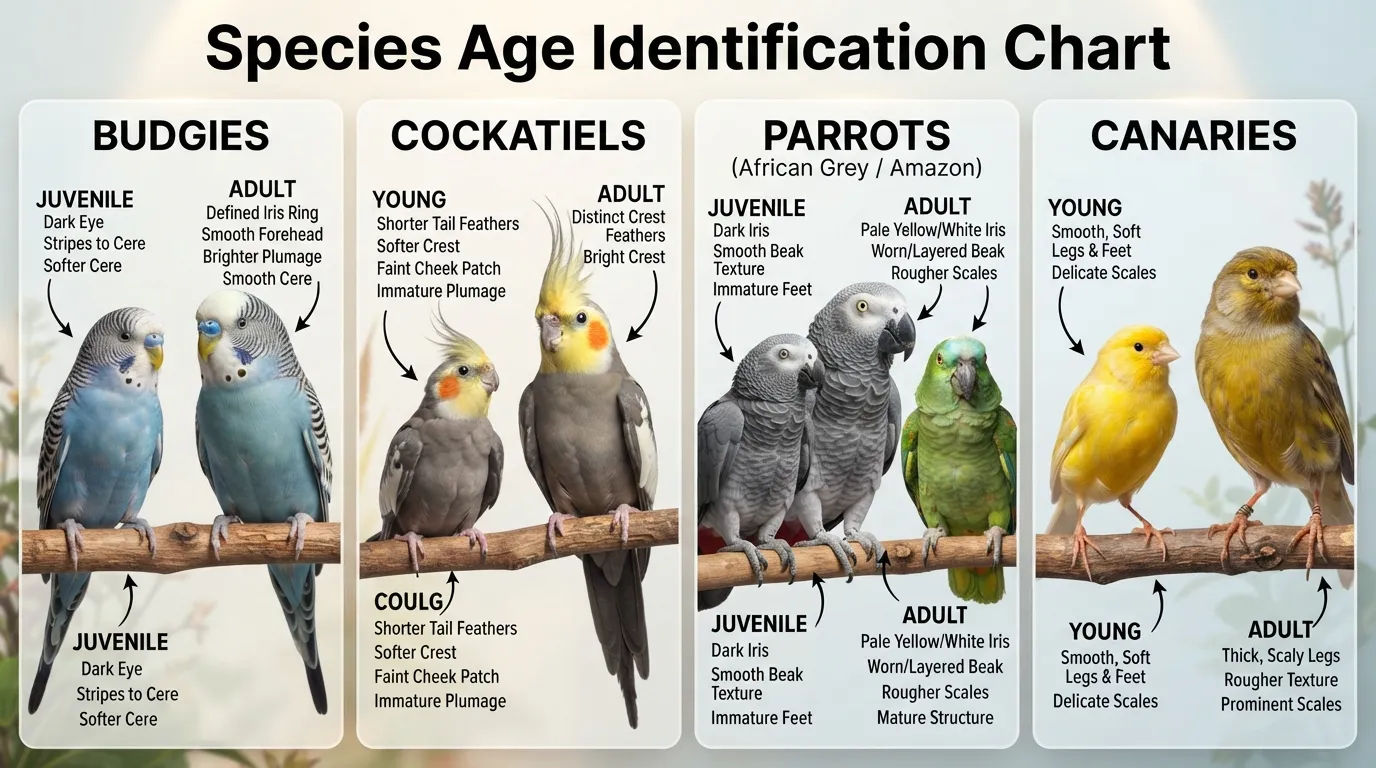
Determining the exact age of an adult companion bird is notoriously difficult, but you can narrow it down to a specific life stage by evaluating physical development milestones and behavioral shifts. While a chick’s age can often be pinned down to the week, tracking the age of an older bird relies on a combination of subtle clues left by their feathers, eyes, and skin.
Iris & Eye Color Timeline (Pet Birds)
An avian eye acts as a natural clock during the first few years of life. Most companion birds are born with completely dark eyes, with the iris gradually lightening or changing color as the bird matures into adulthood.
If you are trying to figure out how to tell how old a bird is, looking closely at the eyes is often the most reliable method for young birds.
Budgies: Baby budgies start with solid black eyes. Between 4 to 8 months of age, the dark iris begins to fade, revealing a light grey or white ring. If your budgie has a distinct white iris ring, they are at least 8 months old.
African Greys: These parrots undergo a dramatic transformation. Chicks under one year old have dark, charcoal-black eyes. By 1 year, the eye lightens to a dark grey. Between 2 to 3 years, it shifts to a pale straw-yellow, which locks in for the rest of their lives.
Macaws: Young macaws have dark brown eyes that slowly transition to a light grey, then to a creamy white, and finally to a distinct yellow by the time they reach sexual maturity around 3 to 5 years old.
Cap Feathers & Head Markings
A bird’s head markings frequently change during their very first molt, offering a clear line of demarcation between a juvenile and an adult.
Budgies: Look at the stripes on the forehead. Baby budgies have horizontal black bars running all the way down to their cere (the flesh above the beak). At around 3 to 4 months old, they undergo their first major molt, and these bars disappear, leaving a clean, solid yellow or white “cap.”
Cockatiels: Normal grey cockatiels can be aged by their facial mask. Juvenile males look identical to females, sporting dull grey faces. After their first molt at 6 to 9 months, young males lose the grey face feathers, replacing them with a vibrant, bright yellow mask.
Feet and Skin Texture
Once a bird passes its juvenile stages, eye color and feather patterns stabilize. To differentiate a young adult from an older senior bird, you have to look at the texture of the legs and feet.
Young birds have smooth, soft, and relatively spotless skin on their legs. As a bird ages and scales through years of perching, bathing, and climbing, the skin on the feet becomes noticeably thicker, rougher, and more heavily textured.
Expert Observation: Senior birds often develop heavy, raised scales, minor calluses, or a slightly dry, powdery appearance on their lower legs. Conversely, a bird with perfectly smooth, supple pink or grey feet is likely under a few years old.
Head Crest & Feather Vibrancy
Feather quality tells a story about a bird’s overall life stage and health. While an adult bird in peak condition will always look sleek, youth carries a specific type of pristine luster that fades slightly with extreme age.
Cockatiels: A juvenile cockatiel’s crest is typically shorter, sparser, and points more straight up. As they reach full physical maturity around 1 to 2 years, the crest feathers grow longer and develop a distinct, elegant forward curve.
General Vibrancy: Young adults possess highly vibrant, glossy plumage due to optimal nutrient absorption and vigorous preening. Geriatric birds may display slightly duller coloration, frayed edges, or slower feather replacement cycles during their annual molts.
Age-Range Behavior Guide
If physical clues leave you guessing, observing how a bird interacts with its environment provides excellent context clues regarding its life stage.
| Life Stage | Age Range | Typical Behavioral Indicators |
|---|---|---|
| Juvenile / Weanling | 2 to 6 months | Clumsy fliers; hyper-curious; explore everything with their tongue; prone to frequent daytime napping; highly submissive. |
| Adolescent / Sub-Adult | 6 months to 3 years | "Bluffing" phase (territorial nipping); high energy; testing boundaries; vocal experimentation and mimicry spikes. |
| Mature Adult | 3 to 15+ years (species dependent) | Predictable routines; established personalities; distinct bonded preferences; calmer but highly playful during structured times. |
| Senior / Geriatric | 15 to 40+ years (species dependent) | Extended sleep periods; preferred lower perches; less interest in intense destructive chewing; gentler disposition. |
Average Lifespan Table by Bird Species
Knowing how to tell how old a bird is requires understanding their specific timeline, as a “senior” finch is vastly different from a middle-aged parrot. Because birds show very few visible signs of aging once they reach adulthood, knowing their species’ typical life expectancy and developmental milestones is your best baseline for estimating their current stage of life.
The table below breaks down the lifespans and sexual maturity timelines for the most common companion bird species.
| Species | Lifespan Range | Average Lifespan | Sexual Maturity |
|---|---|---|---|
| Zebra Finch | 5 – 10 years | 7 years | 3 – 4 months |
| Canary | 8 – 12 years | 10 years | 9 – 12 months |
| Budgerigar (Budgie) | 7 – 15 years | 10 years | 6 – 8 months |
| Lovebird | 10 – 15 years | 12 years | 10 – 12 months |
| Cockatiel | 12 – 20 years | 15 years | 9 – 12 months |
| Green-Cheeked Conure | 15 – 25 years | 20 years | 1 – 2 years |
| African Grey Parrot | 40 – 60 years | 45 years | 4 – 6 years |
Note: A bird’s lifespan is highly dependent on diet and husbandry. While a wild or poorly nourished budgie might show signs of geriatric decline at just 5 years old, a well-cared-for pet on a high-quality pellet and fresh food diet can easily live past 15, delaying the physical markers of old age.
Convert Bird Age to Human Years — Try Our Free Calculator
While figuring out how to tell how old a bird is requires a bit of detective work, understanding what that age actually means in human terms is a different story. Birds age at vastly different rates than we do—a one-year-old finch is biologically much older than a one-year-old macaw.
Our free Bird Age to Human Years Calculator removes the guesswork, instantly translating your feathered friend’s life stage into human milestones.
👉 Try the Bird Age Calculator Now
How the Calculation Works
We don’t use a generic, “one size fits all” multiplier. A budgie might live for 10 years, while an Amazon parrot can easily reach 60. Instead, our calculator uses a proportional life expectancy formula to give you an accurate biological comparison:
Formula: (Bird’s Current Age × Average Human Lifespan) ÷ Average Lifespan of the Bird’s Species = Bird Age in Human Years
📊 The Math in Action
Let’s look at a 5-year-old Cockatiel. If we assume an average human lifespan of 80 years and a cockatiel’s average lifespan of 15 years, the formula looks like this:
👉 (5 × 80) ÷ 15 = 26.6 Human Years
By factoring in specific species data, the calculator tells you whether your bird is navigating the hormonal “teenage” years, enjoying prime adulthood, or entering their golden senior years.
When to See a Vet & Scientific Aging Methods
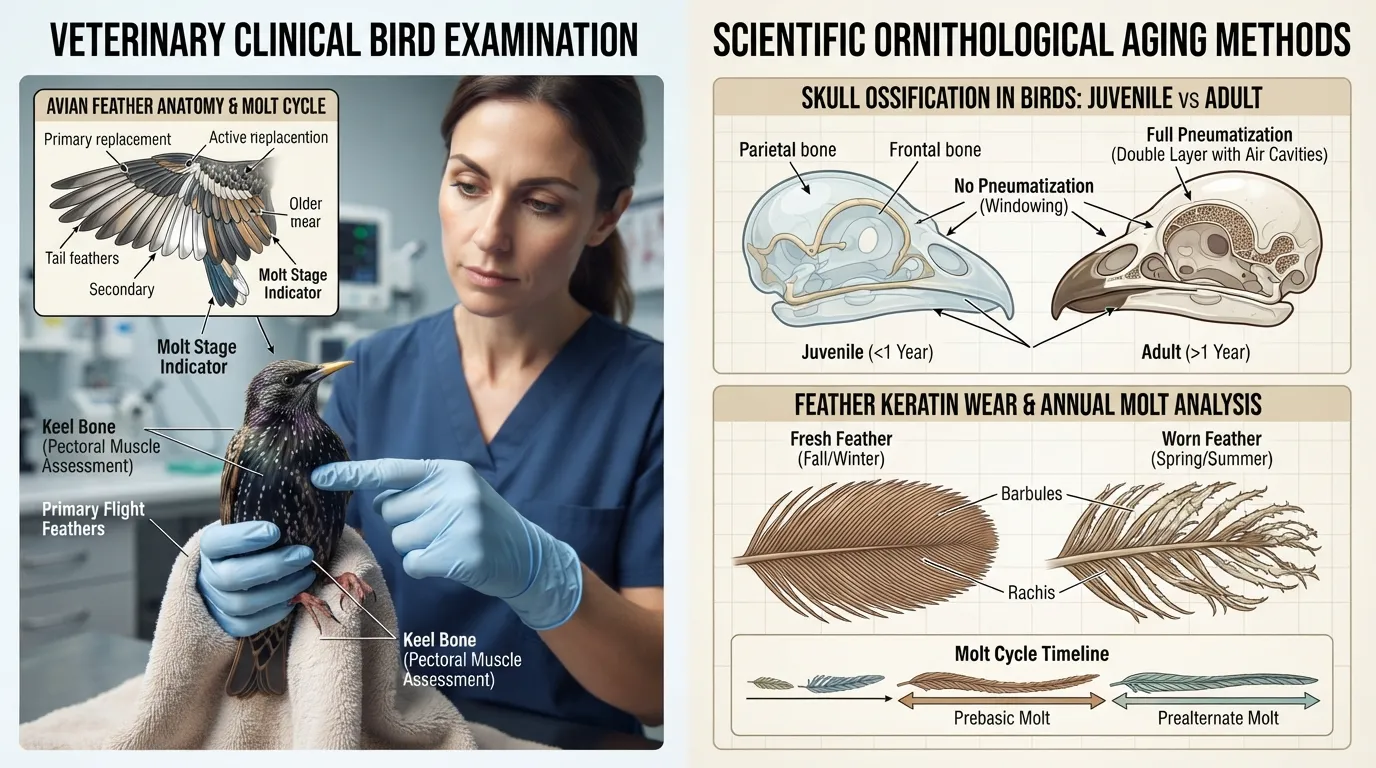
While physical clues offer great hints, pinpointing a bird’s exact age often requires a professional touch. Avian veterinarians use specific physiological markers during exams to evaluate a bird’s life stage. Two of the most reliable indicators they check are keel bone condition—where a young bird’s cartilage gradually ossifies into hardened bone as they mature—and the feather molt cycle, analyzing the wear and replacement patterns of primary flight feathers.
If you have a rescued bird or a species with no visible aging signs, a specialized avian vet can provide a much clearer picture of their health and biological age.
How Scientists Determine Bird Age
Professional ornithologists and master bird banders don’t guess; they rely on precise laboratory and field techniques to determine age.
Skull Ossification Analysis: Experts examine the density and layering of the skull bones. In young birds, the skull is a single thin layer, but it develops a dual-layer “pneumatized” structure with tiny air pockets as the bird matures.
Feather Keratin Analysis: By measuring the chemical composition and wear of the keratin proteins within a feather, scientists can map out exactly how many molt cycles a bird has undergone.
💡 The Expert Take: Because many adult parrots look identical at age 5 as they do at age 25, these advanced scientific methods—alongside DNA feather testing—are the only definitive ways to separate a mature adult from a senior bird.
Frequently Asked Questions
The quickest way is to look at the eyes and beak. In many young birds, the irises are entirely dark or black and will lighten to yellow, orange, or red as they reach adulthood. Additionally, juveniles often have smooth, pristine beaks and legs, whereas older birds display natural wear, flaking, or scaling.
No, not all species experience iris color changes. While it is a hallmark trait for African Greys (dark gray to pale yellow) and many raptors, other birds—like budgies and certain finches—retain the same dark eye color throughout their entire lives.
No, feet and scales can only provide a rough estimate, not a confirmation. While rough, thick, or heavily layered scales typically indicate an older bird, environmental factors like poor diet, lack of grooming surfaces, or low humidity can cause a young bird's feet to look prematurely aged.
The most accurate method is skull ossification analysis, which tracks how the bone layers of the skull fuse and develop air pockets over time. For living adult birds where this isn't possible, examining feather molt cycles and tracking specific feather replacement patterns offers the highest degree of precision.
Because parrot lifespans vary drastically by species, there is no single multiplier. A 10-year-old cockatiel (lifespan of ~15 years) is roughly equivalent to a 53-year-old human, whereas a 10-year-old macaw (lifespan of ~60 years) is biologically closer to a 13-year-old human teenager. Use a species-specific calculator for an accurate comparison.
🐾 Other Age Guides

Gulfam Haider Mehdi
Founder & Developer
I built Dogagescalculator.com to give dog owners honest, science-backed answers instead of the outdated "×7" myth. Every figure here is checked against AKC, AVMA, and published veterinary research.
More about the author & this site →📌 Featured Guides
What Is the Lifespan of a French Bulldog?
→
oldest historical picture of the breed shar pei
→
How to Tell the Age of a Dog
→
my dog has been bitten by a rat
→
How Long Do Cavalier King Charles Spaniels Live?
→
labrador dog years to human years
→
what is the lifespan of a basset hound
→
how much does a german shorthaired pointer weigh
→
What Is the Lifespan of a Miniature Poodle?
→
can you change a dog’s name after 2 years
→
Comments