
Labrador Dog Years to Human Years
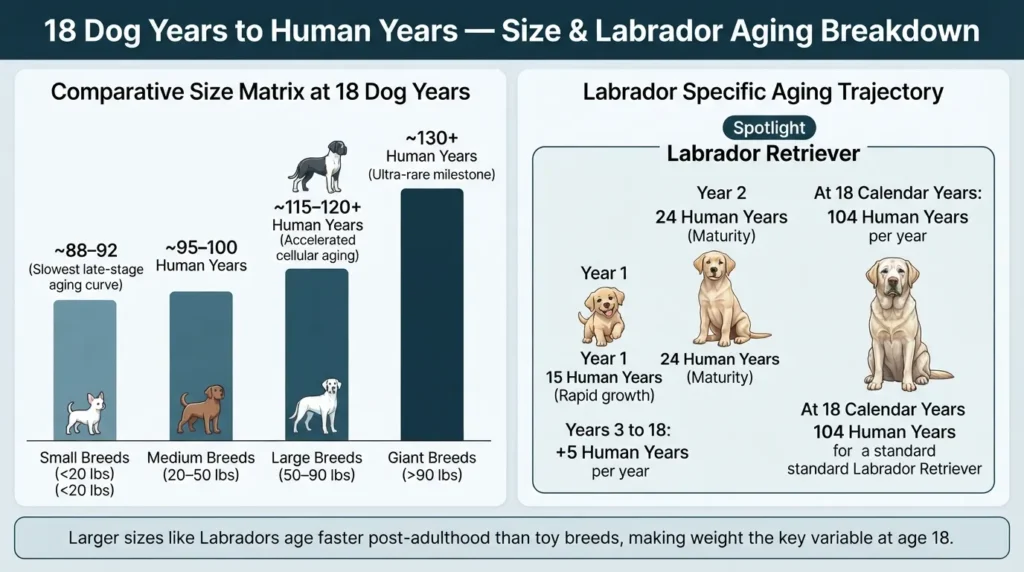
Thinking the old “multiply by 7” rule gives an accurate age for your Labrador? Because large breeds age faster than smaller dogs, that traditional formula misses the mark. This vet-reviewed guide breaks down the real biology behind your Lab’s aging process, complete with an accurate human age comparison chart based on current veterinary science.
Why the "1 Dog Year = 7 Human Years" Rule Is Wrong
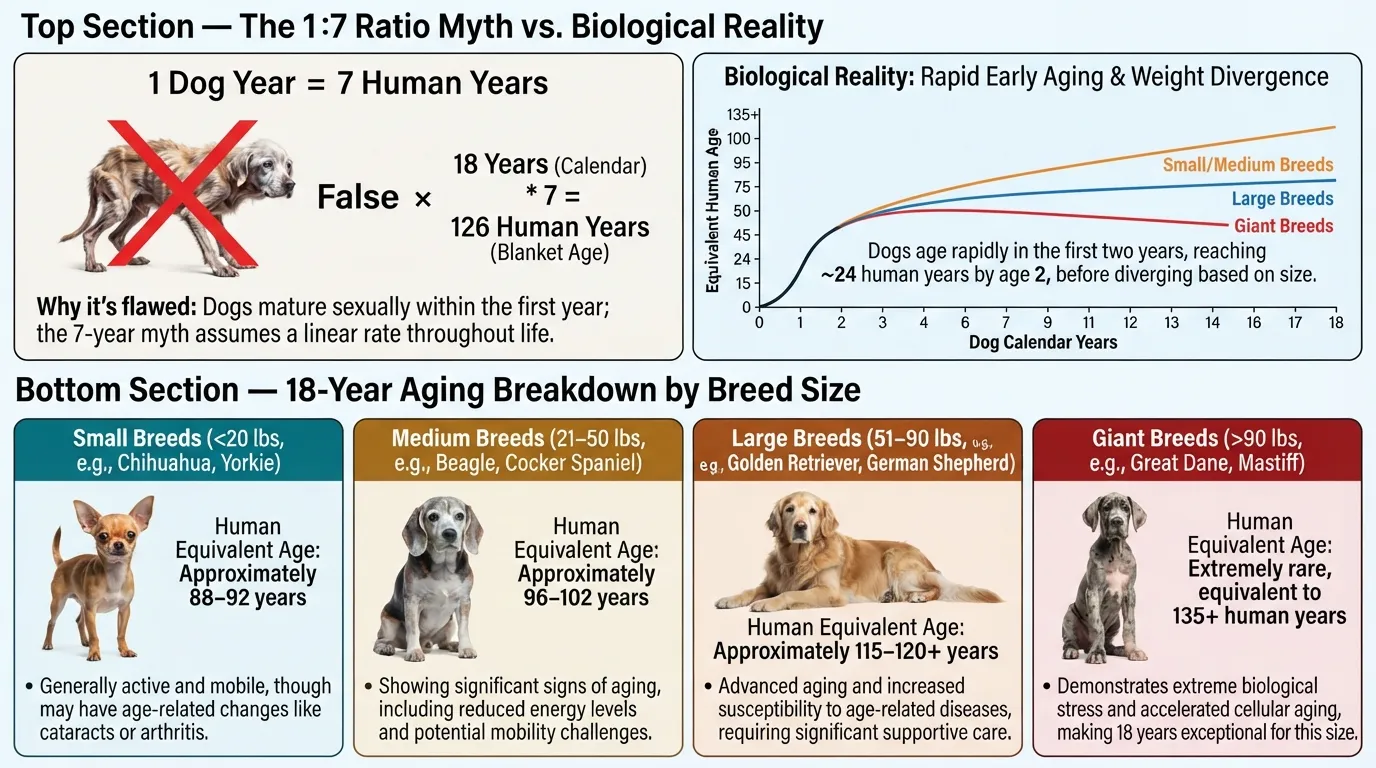
The idea that one dog year equals seven human years is one of the most persistent myths in pet care. While it offers a simple mental shortcut, veterinary science has proven that this linear formula is far from accurate—especially for medium-to-large breeds like Labradors.
Where the Myth Came From
The 7-year rule originated around the mid-20th century as a rough public health calculation. In the 1950s, the average human lifespan was around 70 years, while the average dog lived to about 10. Math-wise, a 1-to-7 ratio made sense on paper, and veterinarians used it as a simple rule of thumb to encourage owners to bring aging pets in for regular checkups. However, it was based purely on basic statistics rather than real canine biology.
Why Labradors Don’t Age at a Constant Rate
Dogs do not age on a straight, linear path. Their biological development occurs in a curve—experiencing a massive spike in growth during their early years before settling into a more gradual aging process. Applying a flat multiplier of seven ignores how rapidly a Labrador develops as a puppy and miscalculates their golden years.
Rapid early maturation: A Labrador completes the equivalent of human childhood, adolescence, and early adulthood in just their first two years of life. By age two, your Lab is biologically comparable to a 24-year-old human—far past the 14 human years the old rule suggests.
Stabilization in adulthood: After the rapid growth phase of years one and two, a Labrador’s biological aging settles down. During middle age, each calendar year adds roughly 5 human years rather than 7.
The impact of breed size: Larger dogs experience greater metabolic strain and cellular stress over time, meaning large breeds like Labradors reach senior milestones faster than smaller breeds like Chihuahuas, but slower than giant breeds like Great Danes.
The Real Science Behind Labrador Age Conversion
The AVMA Size-Based Method
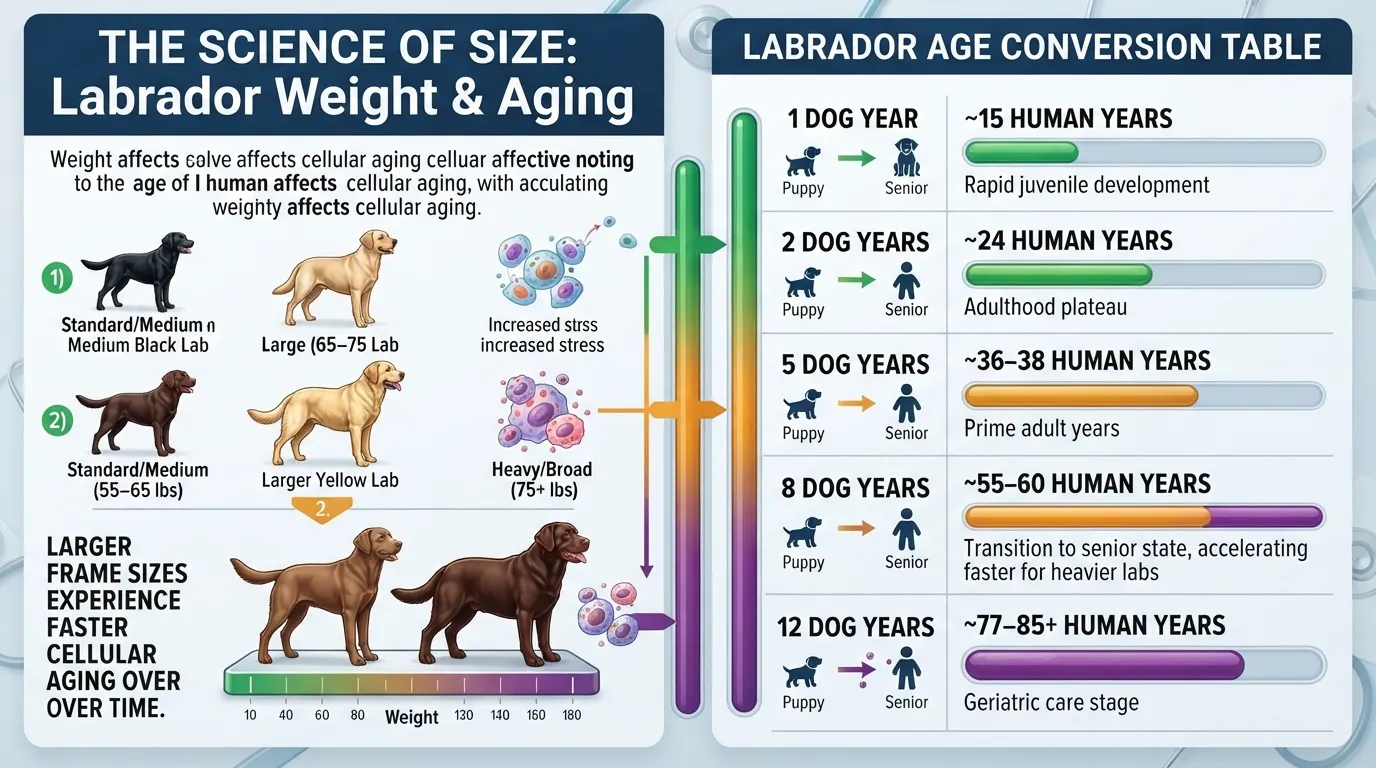
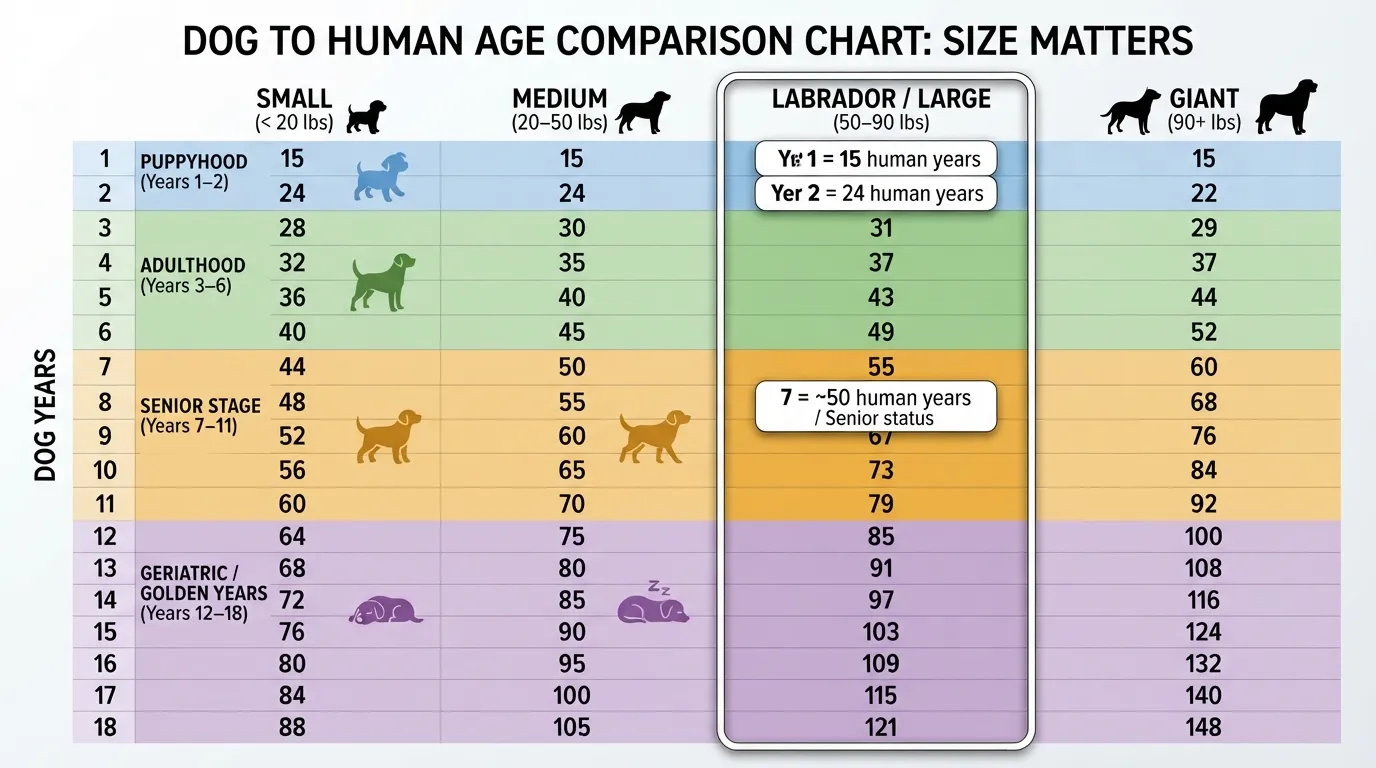
The American Veterinary Medical Association (AVMA) uses a physical milestone approach that accounts for breed size rather than a one-size-fits-all formula. Under this model, all dogs experience a rapid developmental spurt in their first two years, achieving sexual and physical maturity. However, once dogs reach adulthood, body weight becomes the primary driver of biological aging.
Because Labradors typically weigh between 55 and 80 pounds, they fall squarely into the “large breed” category. After age two, large breeds accumulate cellular wear and tear faster than small dogs, aging at an estimated rate of 5 human years for every calendar year.
The DNA Methylation / Epigenetic Clock Formula (UC San Diego Labrador Study)
To map canine aging at the genetic level, researchers at the University of California, San Diego (UCSD) turned to epigenetics—specifically measuring chemical changes on DNA known as DNA methylation. As dogs age, specific chemical tags (methyl groups) attach to their DNA at predictable rates, creating an ultra-precise “epigenetic clock.”
The Formula: $\text{Human Age} = 16 \times \ln(\text{Dog Age}) + 31$ (where $\ln$ is the natural logarithm of the dog’s age in years).
Why Researchers Specifically Studied Labradors: The UCSD team chose Labradors because their well-documented, uniform genetic background and popularity provided a clear control group, allowing scientists to track genetic aging markers without confounding breed variations.
While the epigenetic formula is groundbreaking for geneticists, calculating natural logarithms isn’t very convenient when you’re standing in the dog park. The AVMA size-based approach offers a much more practical, easy-to-use estimation for everyday pet owners, while arriving at nearly the exact same real-world life stages for adult Labradors.
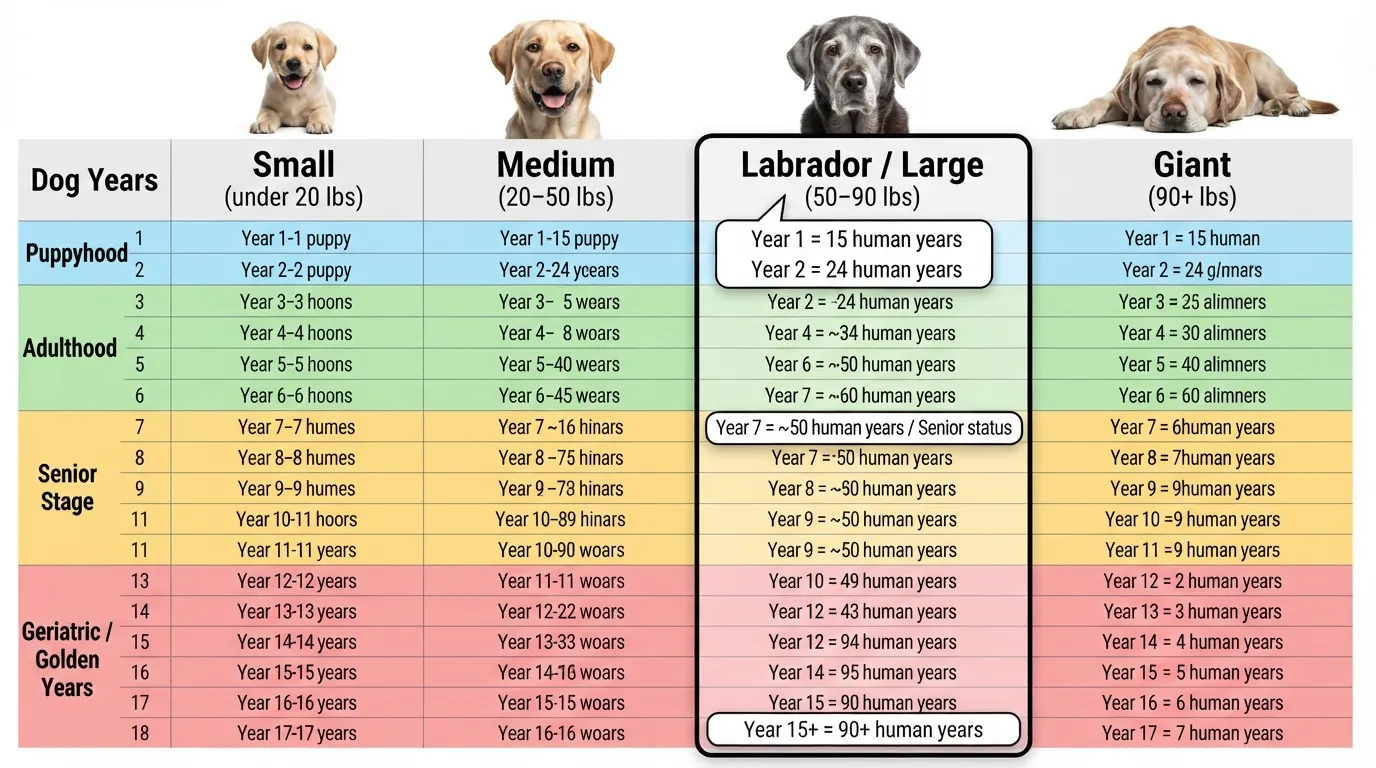
Labrador Dog Age to Human Age Chart & Life Stages Full Table, Year 1–15
Puppy Stage (0–2 years)
Human-Year Equivalent: 0 to 24 human years
Behavior & Growth Signs: During this phase, Labradors undergo intense physical and mental development. In their first year, you will see intense teething, excessive chewing, mouthing, and boundless energy. By year two, they reach their adult height and weight, though they often retain an over-enthusiastic, puppy-like playfulness.
Adolescent / Young Adult (2–3 years)
Human-Year Equivalent: 24 to 29 human years
Behavior & Growth Signs: While your Lab has reached their full physical frame and adult weight, their brain is still maturing. This phase is characterized by testing boundaries, selective hearing, and high physical stamina. Consistent training during this window is crucial to solidify good manners.
Adult Stage (3–7 years)
Human-Year Equivalent: 29 to 49 human years
Behavior & Growth Signs: This is the golden prime of a Labrador’s life. Their temperament settles into the sweet, stable disposition the breed is famous for. They maintain peak physical strength, athletic performance, and optimal health, balancing high outdoor energy with a calm demeanor indoors.
Senior Stage (8+ years)
Human-Year Equivalent: 54 to 89+ human years
Behavior & Growth Signs: As your Lab enters their senior years, subtle signs of biological aging begin to show. Common indicators include graying fur around the muzzle and eyes, slower movement when getting up after rest, joint stiffness, longer sleep cycles, and a gradual reduction in high-intensity exercise stamina.
| Dog Age (Years) | Human Equivalent (Formula 1) | Human Equivalent (Formula 2) | Life Stage |
|---|---|---|---|
| 1 Year | 15 years | 31 years | Puppy / Teenager |
| 2 Years | 24 years | 42 years | Adolescent / Young Adult |
| 3 Years | 29 years | 49 years | Early Adulthood |
| 4 Years | 34 years | 53 years | Prime Adult |
| 5 Years | 39 years | 57 years | Prime Adult |
| 6 Years | 44 years | 60 years | Mature Adult |
| 7 Years | 49 years | 62 years | Mature Adult |
| 8 Years | 54 years | 64 years | Senior |
| 9 Years | 59 years | 66 years | Senior |
| 10 Years | 64 years | 68 years | Senior |
| 11 Years | 69 years | 69 years | Geriatric |
| 12 Years | 74 years | 71 years | Geriatric |
| 13 Years | 79 years | 72 years | Super Senior |
| 14 Years | 84 years | 73 years | Super Senior |
| 15 Years | 89 years | 74 years | Super Senior |
| Dog Age: 1 Year | |
|---|---|
| Human Eq. (F1): | 15 years |
| Human Eq. (F2): | 31 years |
| Life Stage: | Puppy / Teenager |
| Dog Age: 2 Years | |
|---|---|
| Human Eq. (F1): | 24 years |
| Human Eq. (F2): | 42 years |
| Life Stage: | Adolescent / Young Adult |
| Dog Age: 3 Years | |
|---|---|
| Human Eq. (F1): | 29 years |
| Human Eq. (F2): | 49 years |
| Life Stage: | Early Adulthood |
| Dog Age: 4 Years | |
|---|---|
| Human Eq. (F1): | 34 years |
| Human Eq. (F2): | 53 years |
| Life Stage: | Prime Adult |
| Dog Age: 5 Years | |
|---|---|
| Human Eq. (F1): | 39 years |
| Human Eq. (F2): | 57 years |
| Life Stage: | Prime Adult |
| Dog Age: 6 Years | |
|---|---|
| Human Eq. (F1): | 44 years |
| Human Eq. (F2): | 60 years |
| Life Stage: | Mature Adult |
| Dog Age: 7 Years | |
|---|---|
| Human Eq. (F1): | 49 years |
| Human Eq. (F2): | 62 years |
| Life Stage: | Mature Adult |
| Dog Age: 8 Years | |
|---|---|
| Human Eq. (F1): | 54 years |
| Human Eq. (F2): | 64 years |
| Life Stage: | Senior |
| Dog Age: 9 Years | |
|---|---|
| Human Eq. (F1): | 59 years |
| Human Eq. (F2): | 66 years |
| Life Stage: | Senior |
| Dog Age: 10 Years | |
|---|---|
| Human Eq. (F1): | 64 years |
| Human Eq. (F2): | 68 years |
| Life Stage: | Senior |
| Dog Age: 11 Years | |
|---|---|
| Human Eq. (F1): | 69 years |
| Human Eq. (F2): | 69 years |
| Life Stage: | Geriatric |
| Dog Age: 12 Years | |
|---|---|
| Human Eq. (F1): | 74 years |
| Human Eq. (F2): | 71 years |
| Life Stage: | Geriatric |
| Dog Age: 13 Years | |
|---|---|
| Human Eq. (F1): | 79 years |
| Human Eq. (F2): | 72 years |
| Life Stage: | Super Senior |
| Dog Age: 14 Years | |
|---|---|
| Human Eq. (F1): | 84 years |
| Human Eq. (F2): | 73 years |
| Life Stage: | Super Senior |
| Dog Age: 15 Years | |
|---|---|
| Human Eq. (F1): | 89 years |
| Human Eq. (F2): | 74 years |
| Life Stage: | Super Senior |
Labrador Years to Human Years Calculator
How to Use the Calculator
Adjust the Age Slider: Set your Labrador’s current age in years (including half-years for younger pups or seniors).
Compare Results: The calculator automatically computes their human-equivalent age using both the AVMA Large-Breed Method (best for practical veterinary care) and the UCSD Epigenetic Formula (genetic DNA aging model).
Check the Life Stage: Look at the highlighted life stage to see where your Lab sits on their biological journey.
What Your Lab’s Human Age Means for Daily Care
Understanding your Labrador’s human-equivalent age helps you tailor their nutrition, exercise, and veterinary care to match their internal biological needs:
Young Adult (1–2 Human Equivalent: 15–24 Years): High physical energy requires structured exercise and high-protein nutrition to build lean muscle. Focus on joint-safe activities while their growth plates fully fuse.
Prime Adult (3–7 Human Equivalent: 29–49 Years): Maintain an optimal calorie balance to prevent weight gain—Labradors are genetically predisposed to obesity. Schedule routine annual vet exams and maintain consistent joint-support supplements.
Senior & Geriatric (8+ Human Equivalent: 54+ Years): Transition to bi-annual veterinary checkups. Watch for early signs of arthritis, shift to lower-impact exercises (like swimming), and adjust calorie intake to protect aging joints from excess load.
Do All Labradors Age the Same?
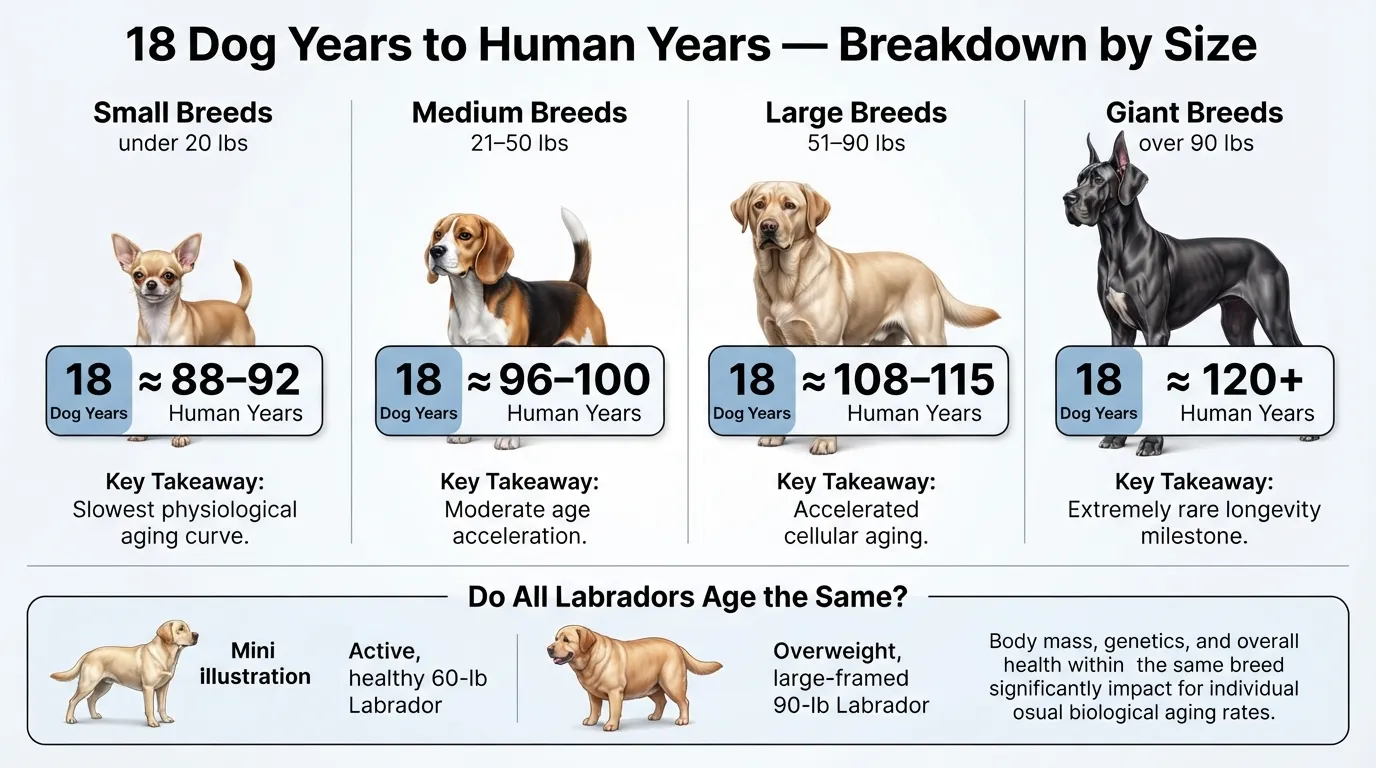
While size and breed genetics dictate the general aging curve for Labradors, individual dogs don’t all age at the exact same pace. Subtle differences in sex, strain, and spay/neuter history play a significant role in how your Lab experiences their biological years.
Male vs. Female Lifespan Difference
Generally, male and female Labradors share a similar average lifespan of approximately 12 years. However, veterinary data reveals slight nuances in how they age:
Skeletal Development: Male Labradors are typically larger and heavier (65 to 80+ lbs) than females (55 to 70 lbs). This extra weight places slightly more baseline stress on joints over time, making older males somewhat more susceptible to wear-and-tear mobility issues like arthritis.
Hormonal Differences: Intact females experience hormonal cycles that influence cellular health, while neutered/spayed status alters lifespan metrics slightly differently between sexes.
| Trait | English Labrador (Show Line) | American Labrador (Field Line) |
|---|---|---|
| Build & Weight | Stockier, heavier bone structure, broader chest | Leaner, lighter frame, longer legs |
| Activity & Metabolism | Calmer, lower energy output; higher risk of obesity | High drive, working athletic build, burns more calories |
| Aging Impact | Heavy weight creates more joint load in senior years | Higher risk of field sports injuries (ACL/CCL tears) early on |
| Average Lifespan | ~12.0 to 12.5 years | ~12.0 to 12.5 years |
| Build & Weight | |
|---|---|
| English Labrador: | Stockier, heavier bone structure, broader chest |
| American Labrador: | Leaner, lighter frame, longer legs |
| Activity & Metabolism | |
|---|---|
| English Labrador: | Calmer, lower energy output; higher risk of obesity |
| American Labrador: | High drive, working athletic build, burns more calories |
| Aging Impact | |
|---|---|
| English Labrador: | Heavy weight creates more joint load in senior years |
| American Labrador: | Higher risk of field sports injuries (ACL/CCL tears) early on |
| Average Lifespan | |
|---|---|
| English Labrador: | ~12.0 to 12.5 years |
| American Labrador: | ~12.0 to 12.5 years |
How Long Do Labradors Actually Live?
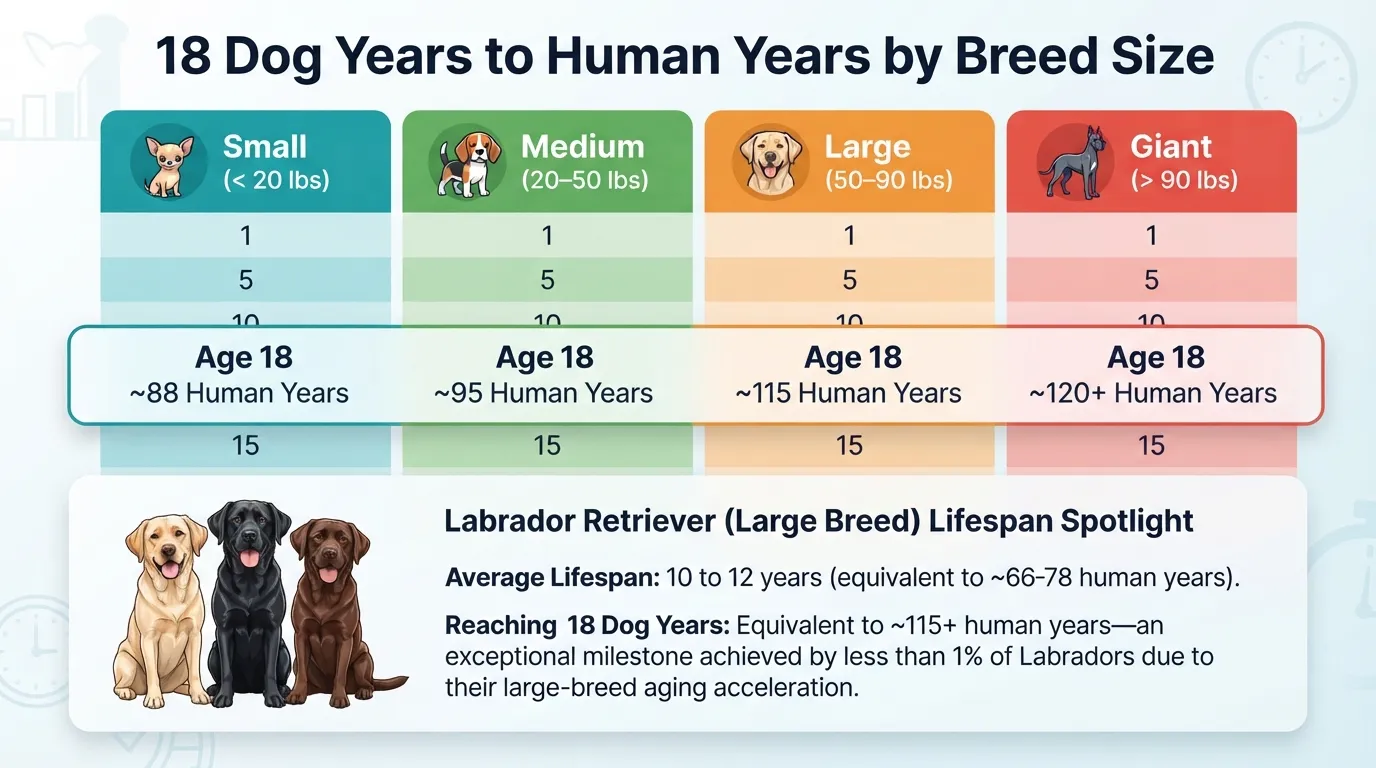
On average, a healthy Labrador Retriever has a lifespan of 10 to 12 years, though many reach 13 or 14 years with proper care. According to veterinary research, a Labrador’s average age at death is approximately 12 years. However, this lifespan varies significantly based on individual health, genetics, color variety, and daily maintenance.
For instance, a major UK study published in Canine Genetics and Epidemiology revealed that chocolate Labradors have a noticeably shorter average lifespan (10.7 years) compared to yellow and black Labradors (12.1 years), alongside a higher prevalence of skin and ear infections.
Can a Labrador Live 20 Years?
While it is extremely rare for a large-breed dog like a Labrador to reach 20 years, it is biologically possible. Reaching two decades is the canine equivalent of a human living past 110 years.
Guinness Record Holders: The oldest verified Labrador mix was Bella, an Australian Lab mix who lived to be 29 years and 193 days old. Among purebred Labradors, documented instances of dogs living past 18 or 19 years are exceptionally rare and typically involve a combination of extraordinary genetic lottery and meticulous lifelong health management.
Why 20 Is Hard to Reach: Because Labradors are large, fast-growing dogs, their cells undergo higher rates of metabolic stress over time. Senior Labradors frequently face age-related health challenges—such as joint degeneration, cardiovascular decline, cancer, and reduced kidney function—that make reaching 20 human years an extreme outlier.
Factors That Extend a Lab’s Lifespan
While you cannot rewrite your dog’s DNA, you can directly influence their biological longevity. Veterinary studies repeatedly highlight four key lifestyle factors that add quality years to a Labrador’s life:
Strict Weight Management: The single most impactful factor you control. The famous 14-year Purina Lifespan Study proved that dogs fed a calorie-restricted diet to maintain a lean body condition lived 1.8 years longer (and developed chronic joint diseases much later) than their overweight littermates.
High-Quality, Age-Appropriate Diet: Feeding a complete and balanced large-breed food enriched with Omega-3 fatty acids (EPA/DHA), antioxidants, and high-quality animal proteins protects cognitive function, skin integrity, and internal organs from cellular damage as your Lab ages.
Genetics & Health Screening: Responsible breeding dramatically reduces the risk of hereditary fatal conditions. Labradors bred from parents clear of exercise-induced collapse (EIC), progressive retinal atrophy (PRA), and certified clear of hip and elbow dysplasia have a significantly higher probability of reaching their full natural lifespan.
Proactive Preventive Vet Care: Regular annual (and bi-annual for seniors 8+) veterinary checkups allow early detection of common senior threats like arthritis, early-stage renal failure, cardiac issues, and tumors. Combined with routine dental cleanings, parasite prevention, and timely blood work, proactive care catches health declines long before they become life-threatening.
Age-Specific Care Essentials
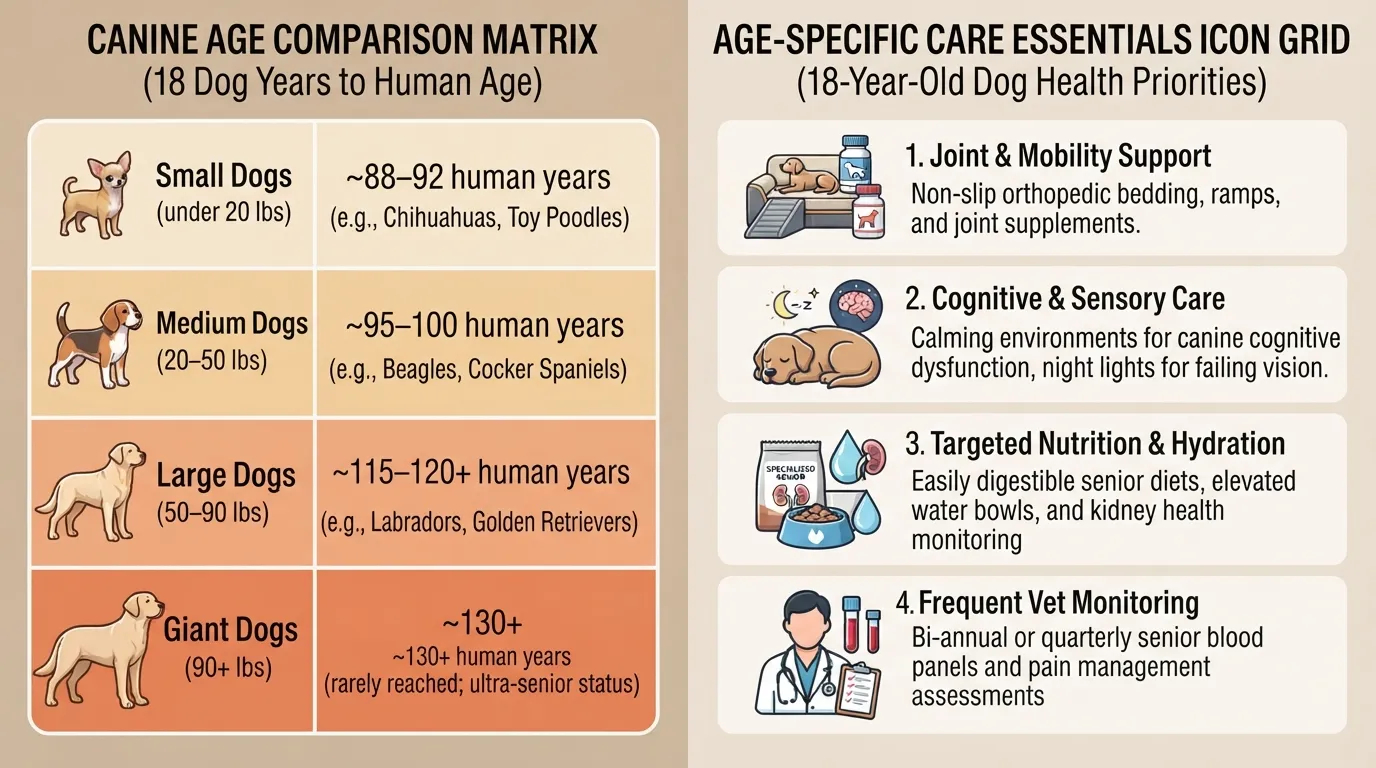
Managing your Labrador’s health requires shifting your care strategy as they transition through biological milestones. A routine that works for a 3-year-old athlete can lead to joint strain or weight gain in an 8-year-old senior.
At What Human-Year Age Should You Switch to Senior Food?
For Labradors, the transition to senior nutrition should occur around 7 to 8 dog years, which corresponds to roughly 50 to 54 human-equivalent years.
Because large breeds enter their senior years earlier than small dogs, waiting until age 10 can cause you to miss the critical window for joint and organ support.
Why Switch at Human Age 50+ (Dog Age 7–8)?
Slower Resting Metabolism: A Labrador’s metabolic rate slows down noticeably after age 7. Continuing to feed a dense adult maintenance kibble often triggers stealth weight gain, adding unnecessary load to aging joints.
Reduced Calorie Density & Higher Digestible Protein: Senior formulas lower overall calorie density while maintaining high-quality protein to prevent muscle wasting (sarcopenia).
Targeted Joint & Organ Protectants: Senior diets feature elevated levels of Omega-3 fatty acids (EPA/DHA), glucosamine, chondroitin, and controlled phosphorus levels to protect kidney function and ease arthritic inflammation.
| Trait | English Labrador (Show Line) | American Labrador (Field Line) |
|---|---|---|
| Build & Weight | Stockier, heavier bone structure, broader chest | Leaner, lighter frame, longer legs |
| Activity & Metabolism | Calmer, lower energy output; higher risk of obesity | High drive, working athletic build, burns more calories |
| Aging Impact | Heavy weight creates more joint load in senior years | Higher risk of field sports injuries (ACL/CCL tears) early on |
| Average Lifespan | ~12.0 to 12.5 years | ~12.0 to 12.5 years |
| Build & Weight | |
|---|---|
| English Labrador: | Stockier, heavier bone structure, broader chest |
| American Labrador: | Leaner, lighter frame, longer legs |
| Activity & Metabolism | |
|---|---|
| English Labrador: | Calmer, lower energy output; higher risk of obesity |
| American Labrador: | High drive, working athletic build, burns more calories |
| Aging Impact | |
|---|---|
| English Labrador: | Heavy weight creates more joint load in senior years |
| American Labrador: | Higher risk of field sports injuries (ACL/CCL tears) early on |
| Average Lifespan | |
|---|---|
| English Labrador: | ~12.0 to 12.5 years |
| American Labrador: | ~12.0 to 12.5 years |
Common Labrador Age Questions FAQ
Is a 2-year-old Lab still a puppy?
Physically, no—a 2-year-old Labrador has reached their full adult height and weight (roughly equivalent to a 24-year-old human). However, mentally and behaviorally, many 2-year-old Labs still display playful, high-energy “puppy-like” traits because their brains and impulse control continue to mature through age 3.
How old is a 12-year-old Lab in human years?
According to the AVMA large-breed aging model, a 12-year-old Labrador is equal to 74 human years, placing them firmly in the geriatric life stage. Under the UCSD Epigenetic DNA formula, a 12-year-old Lab translates to roughly 71 human years.
Is 1 dog year really 7 human years?
No. The “1 to 7” rule is an outdated myth that assumes dogs age at a constant rate. In reality, Labradors mature very rapidly in their first two years (reaching ~24 human years) before their aging slows down to approximately 5 human years per calendar year in adulthood.
How old is a 4-month-old Labrador puppy in human age?
A 4-month-old Labrador puppy is roughly equivalent to a 5-to-7-year-old human child. At this stage, they undergo rapid skeletal growth, lose their baby teeth, and require structured training and socialization.
🐾 Other Age Guides

I built Dogagescalculator.com to give dog owners honest, science-backed answers instead of the outdated "×7" myth. Every figure here is checked against AKC, AVMA, and published veterinary research.
More about the author & this site →
Comments