How Much Is a Cavalier King Charles Spaniel? 2026 Price & Cost Guide
Bringing a Cavalier King Charles Spaniel into your home is one of the most rewarding decisions a dog lover can make, but it comes with a real financial commitment. Expect to pay between $2,000 and $3,500 upfront for a healthy puppy from a responsible breeder in 2026. However, purchase price is only the starting line—first-year supplies, routine vet care, and breed-specific health testing quickly add to the total.
Understanding the true price tag helps you plan ahead and avoid heartbreak down the road. Below is a realistic breakdown of what you can expect to pay depending on where you source your Cavalier.
Cavalier King Charles Spaniel Price Overview (2026)
| Source / Tier | Average Price Range | What You Are Paying For |
|---|---|---|
| Adoption / Breed Rescue | $300 – $600 | Covers spay/neuter, initial vaccinations, microchip, and basic vet intake care. |
| Backyard Breeder / Online Ad | $800 – $1,500 | Often lacks essential cardiac screenings, MRI scans, or health guarantees. High risk of future medical bills. |
| Reputable Family Breeder | $2,000 – $3,500 | OFA/CHIC health-tested parents (hearts, eyes, hips, knees), socialized puppies, vaccines, and genetic testing. |
| Champion / Show Bloodline | $3,500 – $6,000+ | Top-tier pedigree, strict physical conformation standards, and comprehensive health lineage tracking. |
Why Reputable Breeders Charge $2,000 to $3,500
The price tag of an ethical Cavalier breeder directly reflects the immense medical investment required to breed this specific spaniel responsibly. Because Cavaliers carry genetic risks for Mitral Valve Disease (MVD) and Syringomyelia (SM), quality breeders spend thousands of dollars on annual veterinary cardiologist exams and specialist MRI scans for both parent dogs before breeding.
Buying cheap from an unverified seller often ends up costing far more in specialized veterinary care over time. [External link suggestion: AKC page on official Cavalier King Charles Spaniel health testing standards]
First-Year vs. Lifetime Financial Commitment
Beyond the initial purchase, the average first-year expenses—including puppy vaccinations, spaying or neutering, crates, high-quality food, and initial gear—typically total $1,200 to $2,000. Ongoing yearly maintenance averages $1,500 to $2,500 per year, with health insurance or emergency vet savings playing a vital role as your dog ages.
As your Cavalier matures from an energetic puppy into a gentle senior, their physical and dietary needs shift alongside their health demands. You can track your dog’s exact life stage and age equivalency anytime using our free Dog Age Calculator tool to help budget for stage-specific vet care and nutrition.
Quick Answer
A purebred Cavalier King Charles Spaniel price from a reputable breeder typically ranges from $2,500 to $3,500, though show-quality puppies can exceed $4,500. If you are wondering how much a Cavalier King Charles Spaniel costs in total for year one, plan for $4,000 to $6,000. This covers the initial puppy price, required health screenings, vaccinations, essential supplies, and first-year preventive vet care. Adopting from a breed rescue usually runs $300 to $600.
Cavalier King Charles Spaniel Puppy Price Breakdown
Price from a Reputable/Health-Tested Breeder
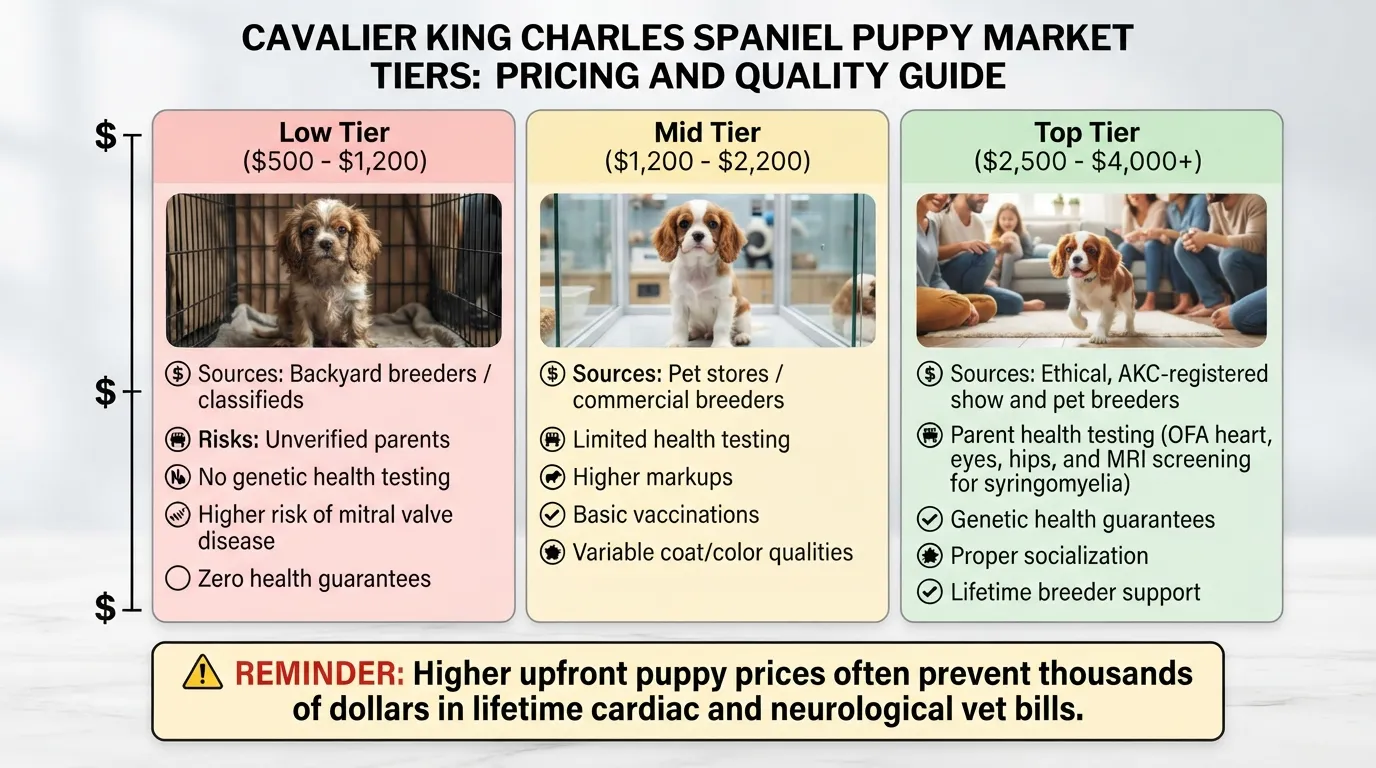
Expect to pay between $2,500 and $4,500 for a Cavalier puppy from a preservationist or health-focused breeder. Top-tier show lines or puppies with exceptional champion pedigrees often reach $5,000 or higher. While that price tag might seem steep at first glance, you are not just paying for a puppy—you are paying for expensive genetic health screening of both parent dogs.
Cavaliers are prone to severe inherited conditions, including early-onset Mitral Valve Disease (MVD), Syringomyelia (SM), Episodic Falling Syndrome, and juvenile cataracts. Ethical breeders spend thousands of dollars annually having board-certified veterinary cardiologists evaluate their breeding stock’s hearts and veterinary ophthalmologists clear their eyes. Paying a higher upfront price to a breeder who provides verifiable Orthopedic Foundation for Animals (OFA) or CHIC health clearances drastically reduces your chances of facing devastating heartbreak and five-figure vet bills down the road.
AKC Official Cavalier King Charles Spaniel Health Testing Recommendations
Price from a Backyard Breeder or Puppy Store Red Flags
Puppies sold by backyard breeders, classified sites, or pet stores generally range from $800 to $2,000. Commercial pet stores sometimes flip these same low-quality puppies for $3,000+ using high-pressure financing plans, despite having zero verifiable health testing on the parents.
Buying in this lower price bracket carries immense risk. Backyard breeders frequently skip costly heart auscultations by cardiologists and DNA screening, passing those hidden medical debts onto you. Watch out for these major red flags when evaluating price:
Unregistered “rare” colors: Be cautious of sellers charging extra for “chocolate,” “merle,” or “all-black” Cavaliers. These are non-standard colors often introduced by cross-breeding, and ethical breed clubs do not breed for them.
No OFA or CHIC numbers: If a seller says “both parents are healthy and vet checked,” ask for official OFA health registry certificates. A general vet checkup is not the same as a board-certified heart or eye clearance.
Puppies ready before 8 weeks: Responsible breeders keep Cavalier puppies with their mother and littermates until at least 8 to 10 weeks for proper social development.
No questions asked: A dedicated breeder will interview you to ensure your home is right for a lap dog. If they only care about receiving payment, walk away.
Adoption/Rescue Cost
Adopting a Cavalier through a shelter or breed-specific rescue typically costs between $300 and $600. This fee covers the dog’s spay/neuter surgery, current vaccinations, microchipping, heartworm testing, and any immediate veterinary care needed while in foster care.
Purebred puppies are quite rare in rescue organizations, but young adults, adults, and retired breeding dogs frequently need loving homes. Rescuing an adult Cavalier is a terrific option if you want to bypass the intense puppy stage and support dedicated volunteers who foster and rehabilitate dogs in need.
What’s Actually Included in the Puppy Price?
A reputable breeder’s price tag includes far more than just taking a puppy home. Below is a realistic breakdown of what a complete puppy package from a quality breeder should cover versus what you will need to fund yourself.
| Included Item | Estimated Value | Details & Notes |
|---|---|---|
| Health Guarantee | $500–$1,000+ | Written 2-to-3 year contract covering major genetic defects (MVD, SM, eye issues). |
| Core Vaccinations & Deworming | $100–$200 | First 1–2 rounds of DHPP vaccines, age-appropriate deworming, and health record. |
| Microchip & Registration | $40–$70 | Pre-inserted microchip with registration details ready to transfer to your name. |
| AKC Registration Papers | $35–$50 | Limited AKC registration papers (spay/neuter contract required). |
| Veterinary Health Certificate | $75–$120 | Full exam report completed by a licensed vet within days of release. |
| Puppy Starter Kit | $50–$100 | Sample bag of current food, familiar blanket with mother's scent, chew toys, and collar. |
| Health Guarantee | |
|---|---|
| Est. Value | $500–$1,000+ |
| Details | Written 2-to-3 year contract covering major genetic defects (MVD, SM, eye issues). |
| Core Vaccinations & Deworming | |
|---|---|
| Est. Value | $100–$200 |
| Details | First 1–2 rounds of DHPP vaccines, age-appropriate deworming, and health record. |
| Microchip & Registration | |
|---|---|
| Est. Value | $40–$70 |
| Details | Pre-inserted microchip with registration details ready to transfer to your name. |
| AKC Registration Papers | |
|---|---|
| Est. Value | $35–$50 |
| Details | Limited AKC registration papers (spay/neuter contract required). |
| Veterinary Health Certificate | |
|---|---|
| Est. Value | $75–$120 |
| Details | Full exam report completed by a licensed vet within days of release. |
| Puppy Starter Kit | |
|---|---|
| Est. Value | $50–$100 |
| Details | Sample bag of current food, familiar blanket with mother's scent, chew toys, and collar. |
If a breeder offers a low price but leaves out microchipping, basic vaccinations, or a written health guarantee, those initial savings disappear as soon as you pay for those services out-of-pocket at your first vet appointment.
Why Does the Price Vary So Much?
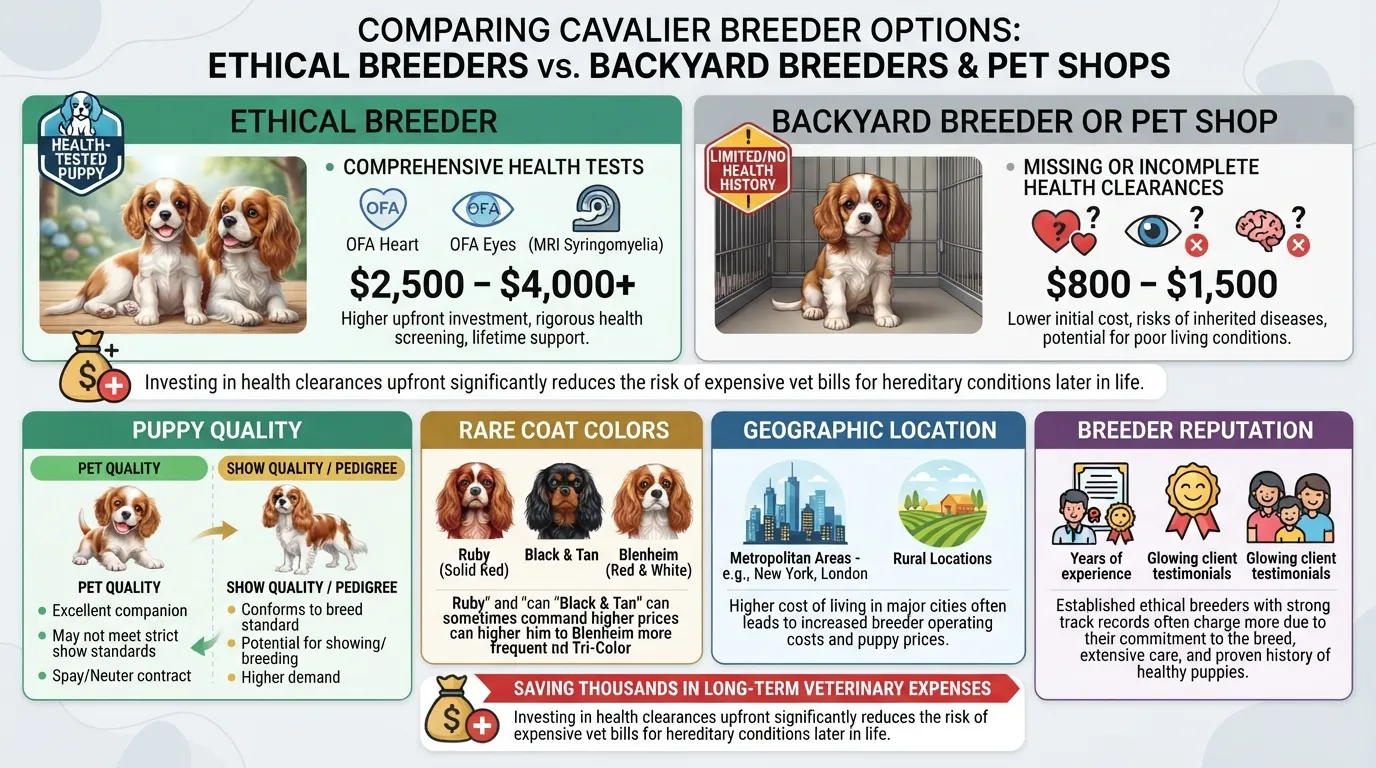
If you have spent any time browsing Cavalier listings, you have probably noticed a wild price gap. One breeder lists a puppy for $1,500, while another charges $4,500 for a dog that looks almost identical at first glance. That difference is rarely arbitrary.
Several distinct factors drive the cost of a Cavalier King Charles Spaniel up or down:
Pedigree and Bloodline: Puppies sired by AKC Grand Champions or imported European lines naturally command top dollar. Champion lines cost breeders tens of thousands of dollars to build, handle, and show, and those costs are reflected in the litter price (typically $3,000 to $5,000+).
Health Screening (The Real Cost Driver): This is where legitimate breeders separate themselves from backyard operations. Ethical Cavalier breeders pay thousands per litter to clear parents for breed-specific genetic hazards. That includes annual cardiac auscultation by a board-certified veterinary cardiologist, OFA eye and hip clearances, DNA panels for Episodic Falling and Curly Coat Dry Eye Syndrome, and ideally, an MRI scan to screen for Syringomyelia (SM). A puppy with fully health-cleared parents costs $2,500 to $4,000, but saves you massive vet bills down the road.
Age: Cavalier puppies aged 8–12 weeks carry the highest price tag. Older puppies (6–12 months) whose initial buyer backed out often drop to $1,000–$2,000. Retired breeding dogs or adult show dogs (usually 3–6 years old) are often rehomed by ethical breeders for $500–$1,200 after being spayed or neutered.
Male vs. Female: Females often cost $200 to $500 more than males due to higher demand from buyers who assume females are sweeter or easier to train. In reality, male Cavaliers are famously affectionate, clingy, and stable in temperament, making them an incredible value if you want to save on the upfront price.
[External link suggestion: AKC Parent Club health testing recommendations for Cavalier King Charles Spaniels]
Price by Coat Color Blenheim, Tricolor, Black & Tan, Ruby
The AKC recognizes four official coat colors for Cavaliers. While color should never take priority over health and temperament, supply and demand directly affect what you will pay at the breeder.
| Coat Color | Average Price Range | Demand & Availability Notes |
|---|---|---|
| Blenheim (Chestnut & White) | $2,000 – $3,500 | The classic, most common color. Easiest to find, but high demand keeps prices steady. |
| Tricolor (Black, White, & Tan) | $2,000 – $3,500 | Very common alongside Blenheim. Widely available from reputable show breeders. |
| Ruby (Solid Rich Red) | $2,500 – $4,500 | Wholecolor breedings are harder to produce cleanly without white patches. High demand, lower supply. |
| Black & Tan (Black with Tan Points) | $2,500 – $4,500 | The rarest of the four recognized colors. Smaller litter numbers drive up the price. |
Be extremely cautious of breeders charging inflated prices ($5,000+) for “rare” unofficial colors like Chocolate, All-Black, or Merle. These colors violate the breed standard, often stem from unauthorized cross-breeding, and frequently carry severe genetic health defects.
Beware: "Teacup" or "Mini" Cavalier Scams
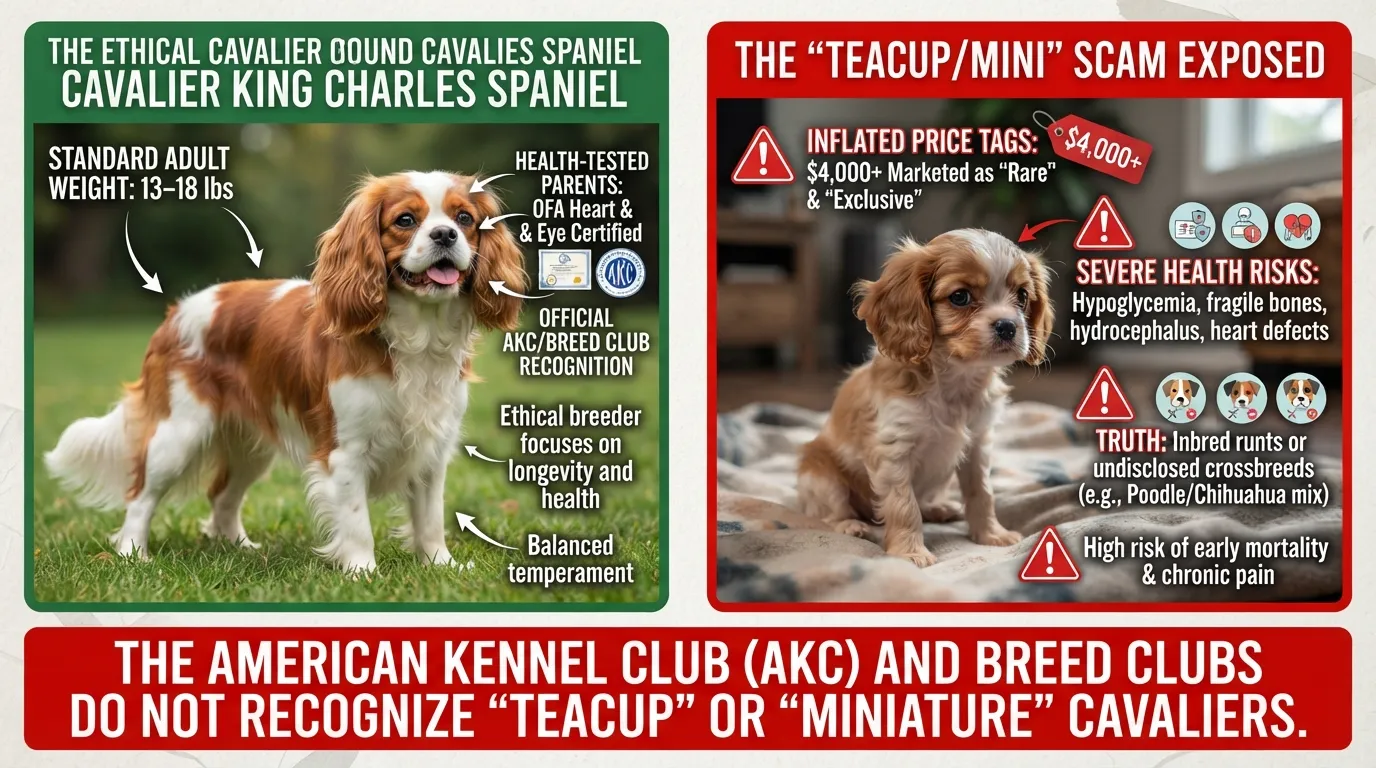
If you run across an ad for a “Teacup Cavalier” or a “Miniature King Charles” listed for $3,500 to $6,000+, close the tab immediately. Neither the American Kennel Club (AKC) nor any reputable international breed organization recognizes a teacup or mini variety of this breed. Standard Cavaliers are already petite dogs, naturally weighing between 13 and 18 pounds. Anyone marketing a “micro” or “teacup” version is either running a direct scam or using dangerous breeding practices to markup price tags.
Unethical breeders create these undersized puppies in one of two ways: they repeatedly pair the runts of frail litters, or they crossbreed Cavaliers with smaller breeds (like Chihuahuas or Toy Poodles) and lie about the lineage. In both scenarios, you are being asked to pay double the standard puppy price for a dog with an intentionally compromised genetic foundation.
Extreme downsizing causes severe medical problems in a breed that already carries genetic health vulnerabilities. Micro-sized Cavaliers frequently suffer from:
Severe Structural Defects: Open fontanelles (skulls that never fully close), fragile bone structures prone to fractures from minor jumps, and extreme dental crowding leading to early tooth loss.
Metabolic Instability: Critical drops in blood sugar (hypoglycemia) that can trigger seizures or coma if meals are missed by even an hour or two.
Compounded Neurological and Cardiac Issues: Shrinking the brain cavity heightens the risks of syringomyelia (fluid-filled spinal cysts) and congenital heart defects.
[External link suggestion: AKC official Cavalier King Charles Spaniel breed standard page]
Paying a premium for a “rare mini” usually leads to thousands of dollars in emergency veterinary bills within the puppy’s first year. If a seller claims their small puppies are rare imports, asks for non-refundable deposits through peer-to-peer cash apps, or charges extra based on “micro” sizing, walk away. A dedicated, preservation-minded breeder breeds solely for health, temperament, and structural integrity—never for unnatural size gimmicks.
Cavalier King Charles Spaniel Price by Country
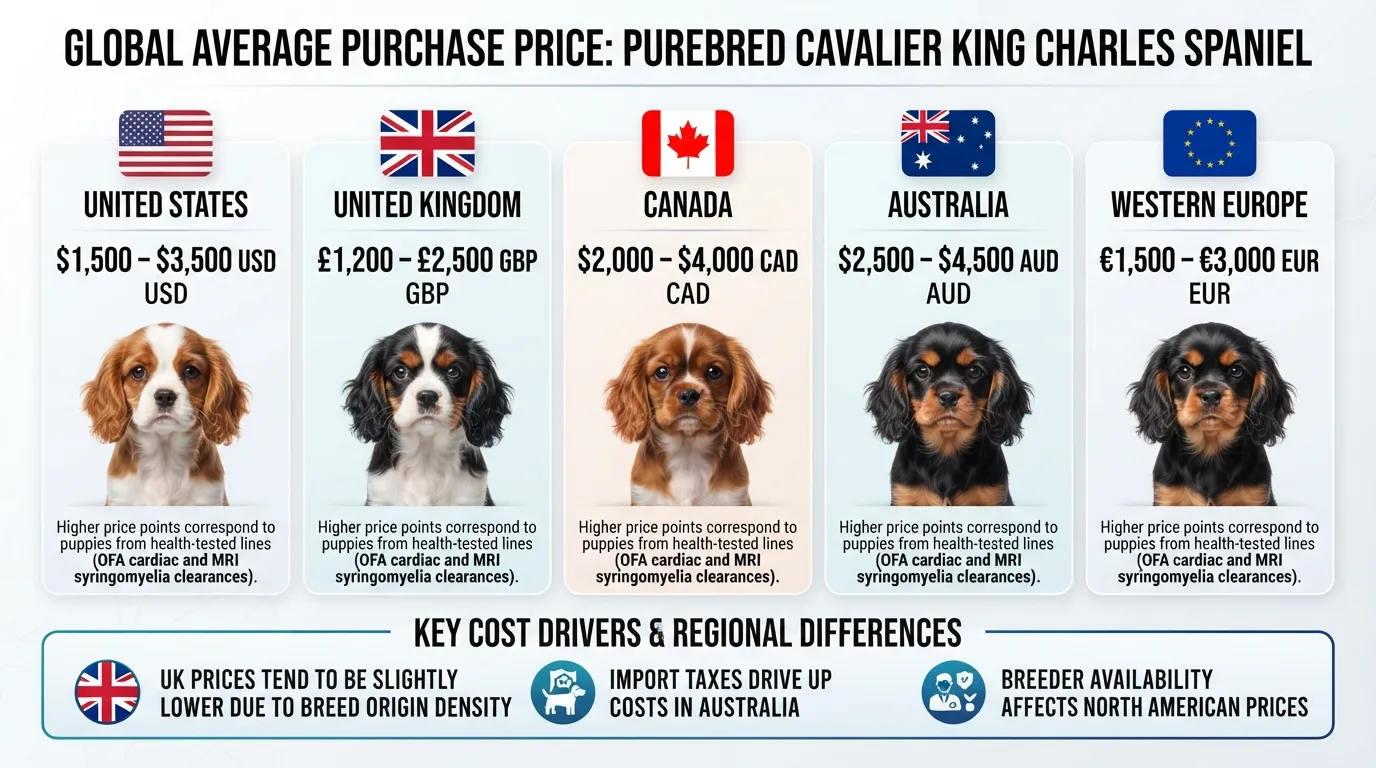
Prices for a health-tested Cavalier puppy vary significantly depending on where you live. Local breeding regulations, veterinary costs for compulsory health screenings (like cardiac clearings and MRI scans for syringomyelia), and general demand dictate the market rate in each region.
If you are importing a puppy or looking locally, here is what you can expect to pay across major international markets:
| Country | Price Range (Local Currency) | Average Price | Key Market Notes |
|---|---|---|---|
| United States | $1,800 – $3,500 | $2,500 | AKC-registered puppies with parental heart and eye clearances fall in this tier. Top preservation breeder lines can exceed $4,000. |
| United Kingdom | £1,200 – £2,500 | £1,800 | The breed's native home. KC-registered puppies with official heart scheme certificates sit at the higher end. |
| Canada | C$2,200 – C$4,000 | C$3,000 | CKC-registered litters usually reflect higher veterinary testing costs and limited litter availability across provinces. |
| Australia | A$3,000 – A$5,000 | A$3,500 | High demand and strict import laws drive up prices. DNA-tested companion puppies frequently reach A$4,500+. |
| Price Range | $1,800 – $3,500 |
| Avg. Price | $2,500 |
| Market Notes | AKC-registered puppies with parental heart and eye clearances fall in this tier. Top preservation breeder lines can exceed $4,000. |
| Price Range | £1,200 – £2,500 |
| Avg. Price | £1,800 |
| Market Notes | The breed's native home. KC-registered puppies with official heart scheme certificates sit at the higher end. |
| Price Range | C$2,200 – C$4,000 |
| Avg. Price | C$3,000 |
| Market Notes | CKC-registered litters usually reflect higher veterinary testing costs and limited litter availability across provinces. |
| Price Range | A$3,000 – A$5,000 |
| Avg. Price | A$3,500 |
| Market Notes | High demand and strict import laws drive up prices. DNA-tested companion puppies frequently reach A$4,500+. |
Geography also changes how much you will spend over your dog’s lifetime. Veterinary care and diagnostic screening costs in major metro areas (like New York, London, or Sydney) are often 30% to 50% higher than in rural regions.
When budgeting for a Cavalier across its 12 to 15-year lifespan, local currency differences matter less than the quality of early health testing. A slightly higher upfront price for a puppy from clear, screened parents saves thousands in specialized cardiac and neurological care down the road.
First-Year Total Cost of Owning a Cavalier
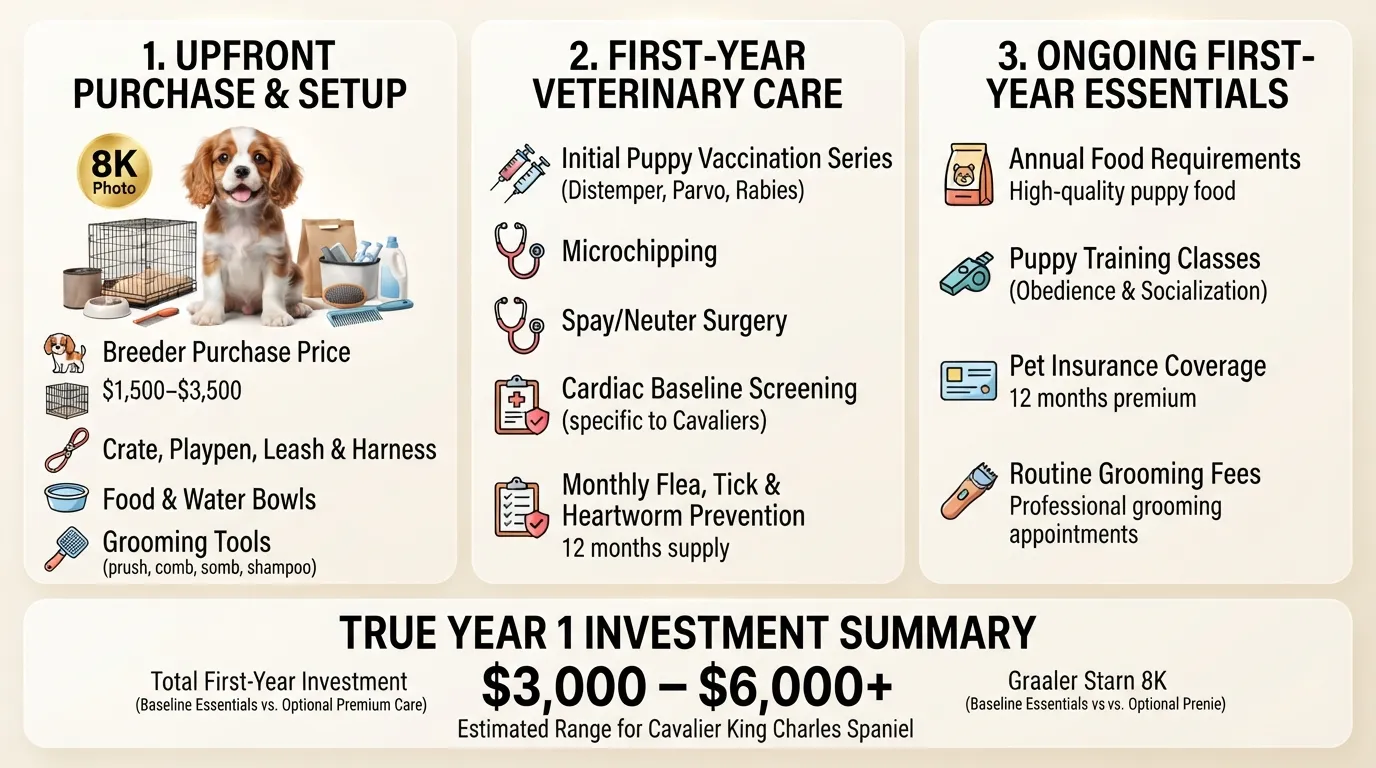
Bringing a Cavalier King Charles Spaniel puppy home involves far more than just paying the breeder’s purchase price. The first twelve months carry the highest financial outlay of your dog’s life as you build out their living space, establish medical care, and set up routine supplies. On average, expect to spend an additional $2,000 to $4,000 in your first year on top of the initial puppy price.
One-Time Setup Costs
Before your puppy sets foot inside your house, you need essential hardware and supplies. Cavaliers have specific needs: their long, silky coats require proper grooming tools, and their dropped ears demand dedicated maintenance supplies to prevent dampness and infections.
| Item | Estimated Cost | Notes |
|---|---|---|
| Crate with Divider | $40 – $90 | A 24-inch or 30-inch wire crate with a divider panel adjusts as your puppy grows. |
| Orthopedic Dog Bed | $30 – $70 | Memory foam supports joint health early on and gives them a soft resting space. |
| Spaniel-Specific Bowls | $15 – $30 | Narrow, deep stainless steel bowls keep their long ear feathering dry while eating and drinking. |
| Grooming Starter Kit | $25 – $50 | Includes a pin brush, slicker brush, metal comb, and styptic powder for nail trims. |
| Ear Cleaning Solution | $15 – $25 | Vet-approved drying solution essential for preventing moisture buildup in drop ears. |
| Harness, Collar & Leash | $30 – $50 | Use a padded harness for walks to protect their delicate neck and trachea from strain. |
| Puppy Toys & Chews | $35 – $65 | Soft plush toys for comforting and durable rubber toys for intense teething phases. |
| Total Setup Expenses | $190 – $385 | Baseline one-time investment before puppy arrival. |
Recurring First-Year Costs
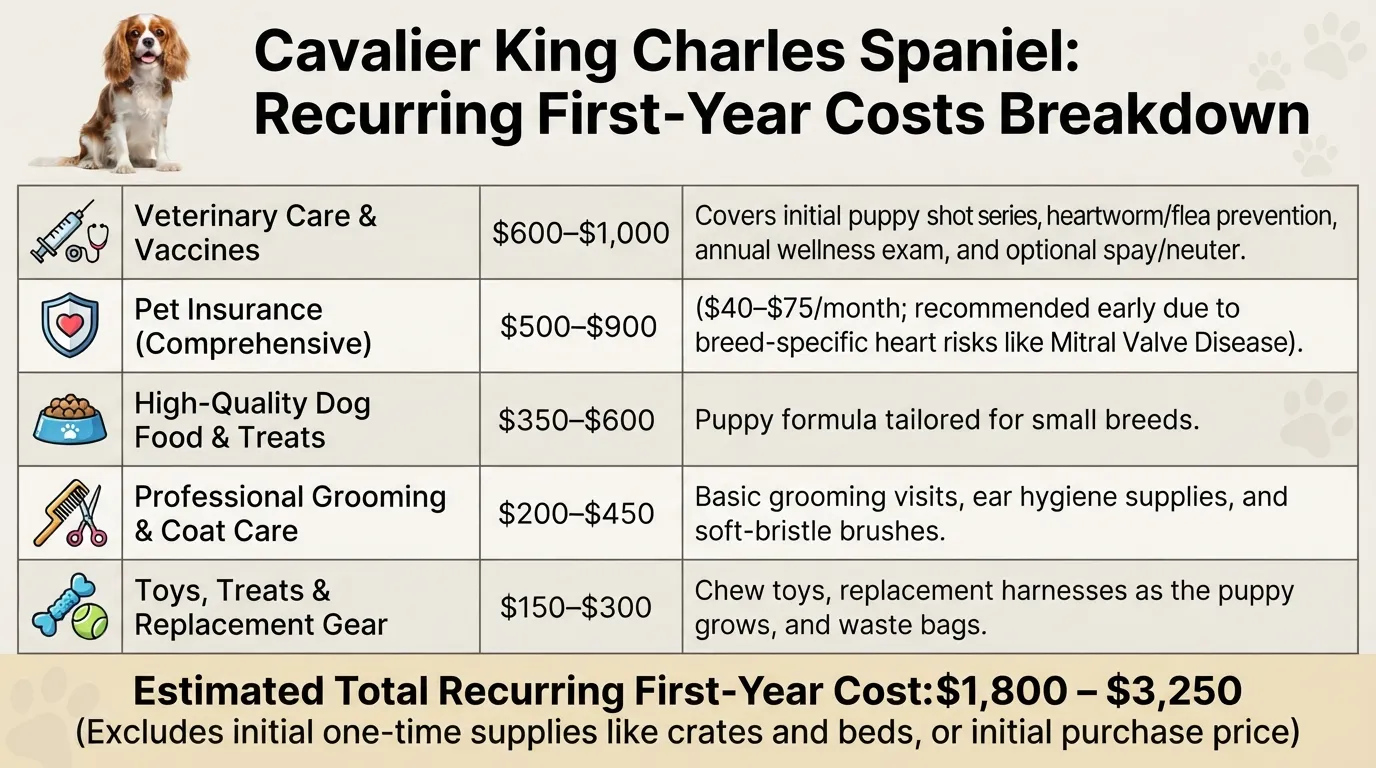
Once your puppy arrives, ongoing monthly maintenance begins immediately. Year one is particularly medical-heavy due to initial vaccination series, microchipping, heartworm preventatives, and spay or neuter surgery.
| Expense | Annual Cost | Notes |
|---|---|---|
| High-Quality Puppy Food | $350 – $600 | Premium small-breed puppy kibble formulated for proper growth rates. |
| Vet Visits & Vaccines | $300 – $600 | Covers 3–4 puppy wellness visits, core DHPP shots, rabies, and microchipping. |
| Pet Insurance | $480 – $900 | Running $40–$75 per month; vital to lock in coverage before heart conditions appear. |
| Spay / Neuter Surgery | $250 – $600 | Typically performed between 6 and 12 months based on your vet's recommendation. |
| Professional Grooming | $300 – $600 | Professional bath, sanitary trim, and ear cleanup every 6–8 weeks. |
| Flea, Tick & Heartworm | $180 – $300 | Year-round oral preventatives prescribed based on puppy weight. |
| Total Recurring Costs | $1,860 – $3,600 | Expected operational cost throughout the first 12 months. |
Shipping/Flight Nanny Cost out-of-state/country buyers
If your chosen breeder lives outside your immediate region, transporting your puppy home adds a distinct layer to your initial budget. You should never ship a Cavalier in cargo; as a mildly brachycephalic (short-muzzled) breed, temperature fluctuations and airway stress in cargo holds present serious health risks.
In-cabin flight nannies are the industry standard for safe transport. A professional courier flies with your puppy in the airplane cabin under their seat, handling feeding, hydration, and potty breaks during layovers.
Domestic Flight Nanny: Expect to pay $350 to $800 within the United States. This price generally includes the nanny’s fee, round-trip airfare, and the airline’s soft-sided pet carry-on ticket ($100–$125).
Ground Transport Services: Dedicated pet ground couriers charge between $300 and $600 depending on mileage. Ensure the driver uses climate-controlled vehicles and provides frequent exercise stops.
International Transport: Bringing a Cavalier in from reputable breeders in the UK or Europe can add $1,200 to $2,500+ in transport fees, international health certificates, and customs clearance duties.
When budgeting for transport, insist that the breeder or courier provides proof of direct, in-cabin service. Scammers frequently request fake “refundable crate deposits” or thermal shipping insurance via peer-to-peer payment apps, which is a major red flag in dog purchases.
Monthly & Annual Ongoing Cost After Year One
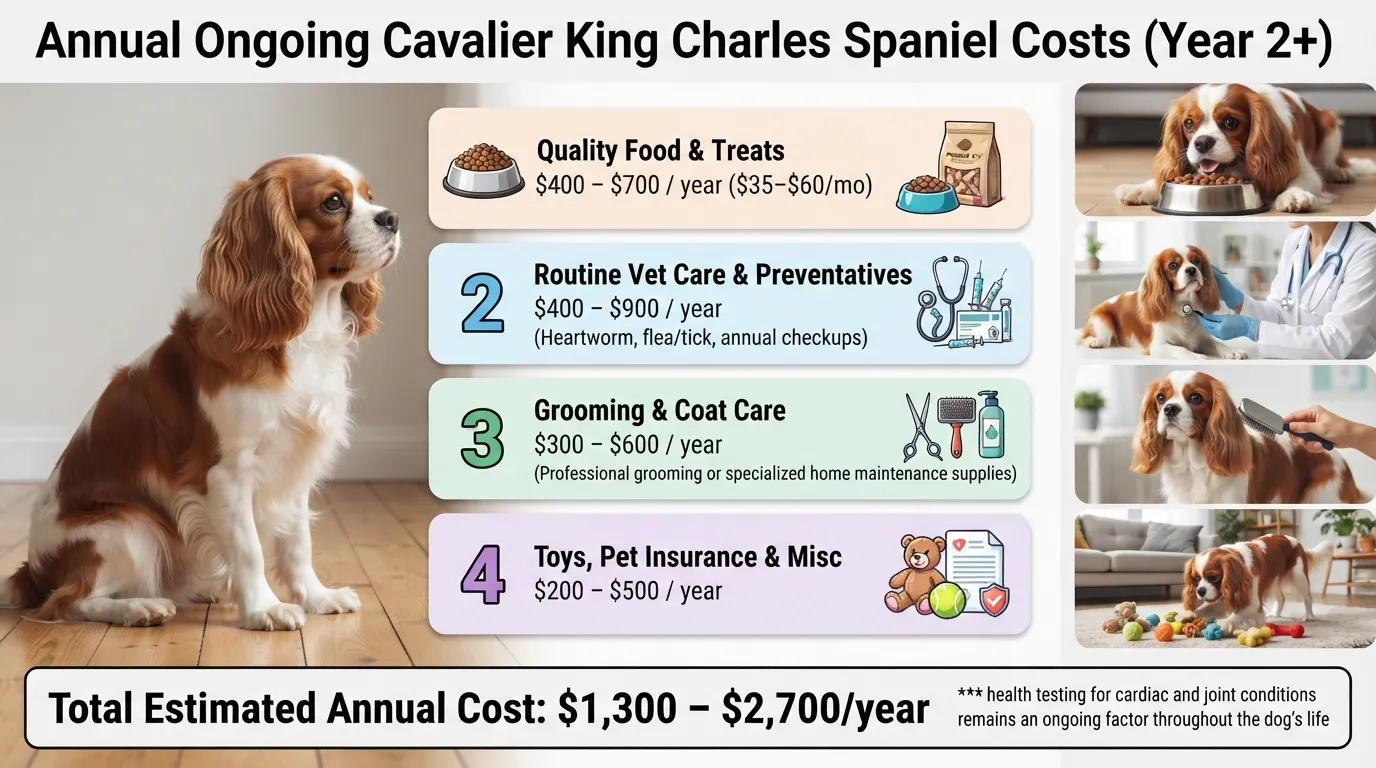
Once your Cavalier grows out of puppyhood and you have all the initial gear, your spending settles into a predictable routine. On average, a healthy adult Cavalier King Charles Spaniel costs between $130 and $275 per month ($1,560 to $3,300 per year) to care for properly.
Here is how those ongoing costs break down across the four primary expense categories:
High-Quality Food & Treats ($30–$60 / month): Because Cavaliers are a toy breed usually weighing 13 to 18 pounds, their food bill is fairly light. Expect to feed about 1 to 1.5 cups of high-quality kibble or fresh food daily. However, Cavaliers gain weight very easily, and extra pounds place severe strain on their joints and heart. Investing in a protein-rich, low-filler diet pays off in long-term health.
Pet Insurance ($45–$95 / month): For this specific breed, pet insurance should be treated as a fixed monthly necessity rather than a luxury. Cavaliers have high genetic risks for Mitral Valve Disease (MVD) and Syringomyelia (SM), both of which require expensive diagnostic testing and lifelong cardiac or neurological medications. Monthly premiums start lower for young dogs but increase as they age, making early enrollment critical before any symptoms are documented.
Grooming & Maintenance ($30–$70 / month): The breed’s silky coat and long feathering on the ears, legs, chest, and tail mat easily if neglected. A professional grooming session every 6 to 8 weeks averages $50 to $80 for a bath, sanitary trim, nail clip, and ear flush. You can trim this cost significantly by handling baths and weekly line-combing at home with a quality slicker brush and metal rake.
Routine Vet Care & Preventatives ($25–$50 / month average, paid annually as $300–$600): Annual wellness exams, routine vaccinations, and year-round heartworm, flea, and tick preventatives form your baseline medical budget. Starting around age 3, most veterinarians and breed experts recommend adding an annual cardiac auscultation (listening for heart murmurs with a stethoscope) to catch early signs of heart disease.
If your Cavalier stays healthy and you do basic grooming at home, you will land on the lower end of that budget. Keeping a separate emergency savings pool alongside your pet insurance policy ensures you are fully prepared as your dog enters their senior years.
Lifetime Cost of a Cavalier King Charles Spaniel 9–14 Years
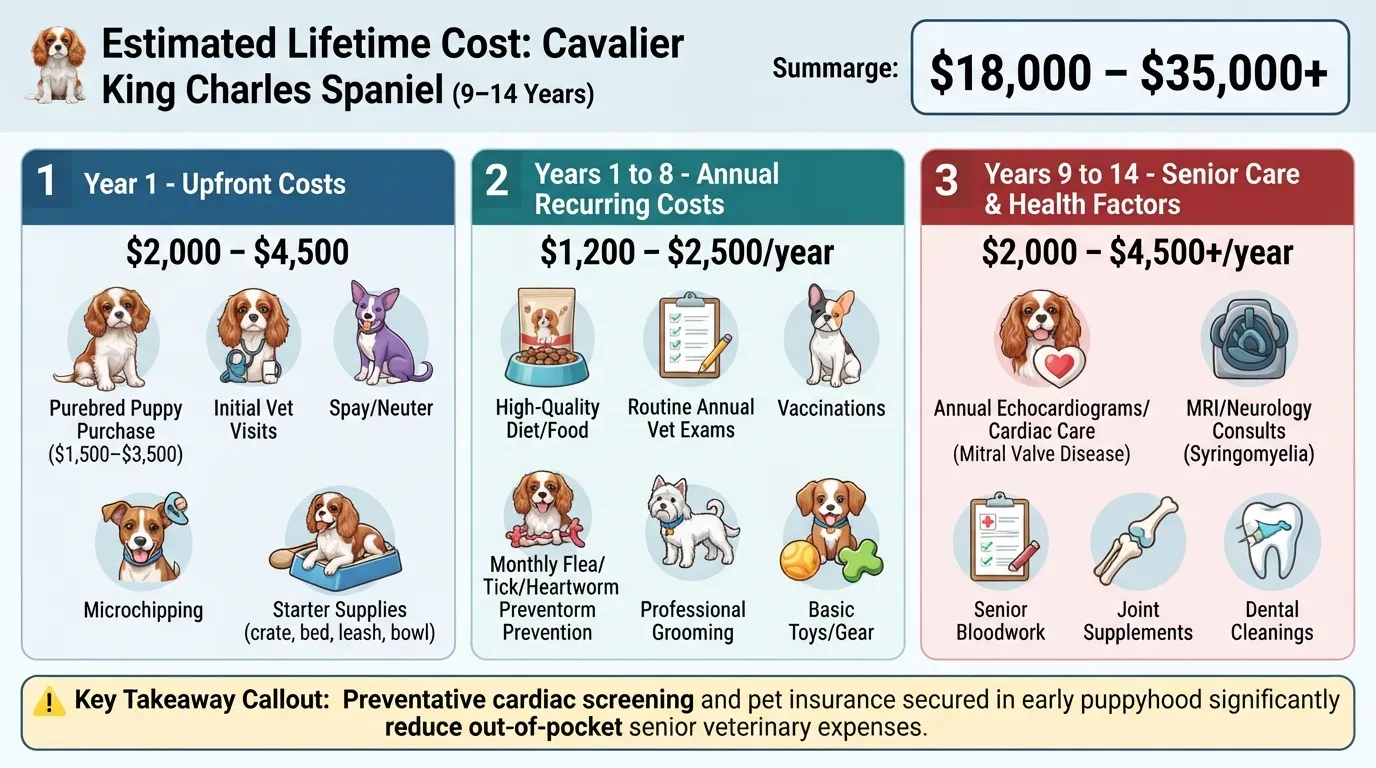
Owning a Cavalier King Charles Spaniel over their typical 9 to 14-year lifespan is a significant financial commitment. On average, you can expect to spend anywhere from $18,000 to over $45,000 in total costs over your dog’s life. Where you land on that spectrum depends almost entirely on one factor: genetic health outcomes and how early breed-specific conditions develop.
A healthy Cavalier with minimal medical complications falls into the lower lifetime estimate of $18,000 to $25,000. This baseline budget covers the initial puppy purchase price, high-quality small-breed nutrition, annual wellness exams, routine vaccinations, flea and tick preventatives, and professional grooming every six to eight weeks.
On the high end, lifetime costs can easily reach $35,000 to $50,000 or more. Because Cavaliers have high genetic rates of Mitral Valve Disease (MVD) and neurological conditions like Syringomyelia (SM), veterinary expenses can scale rapidly in their middle and late years. Daily heart medications (such as pimobendan), annual cardiology consultations, echocardiograms, and specialized care accumulate quickly without robust pet insurance.
Age-Stage Cost Breakdown
The financial commitment of a Cavalier shifts noticeably across three distinct life stages. Tracking your dog’s biological development with a dog age calculator helps you anticipate exactly when these lifestyle and budgetary transitions will occur.
Puppy Stage (Year 1): Expect to spend $3,500 to $6,500+ in the first twelve months. This includes the initial breeder purchase price ($1,500–$3,500), core puppy vaccination series, spay or neuter procedure, microchipping, basic obedience training, and starter gear like crates, harnesses, and beds.
Adult Stage (Years 2 to 7): Routine annual costs usually stabilize between $1,200 and $2,500 per year. Essential ongoing expenses include premium food, parasite preventatives, annual physicals with careful heart auscultations, and routine grooming to prevent coat matting.
Senior Stage (Years 8 to 14): Annual expenses typically climb to $2,500 to $6,000+ per year. As Cavaliers enter senior status, health requirements escalate to include bi-annual vet checks, senior blood work, dental cleanings, cardiac imaging, and prescription drugs for heart or joint care.
Buying vs Adopting — Which Is Cheaper?
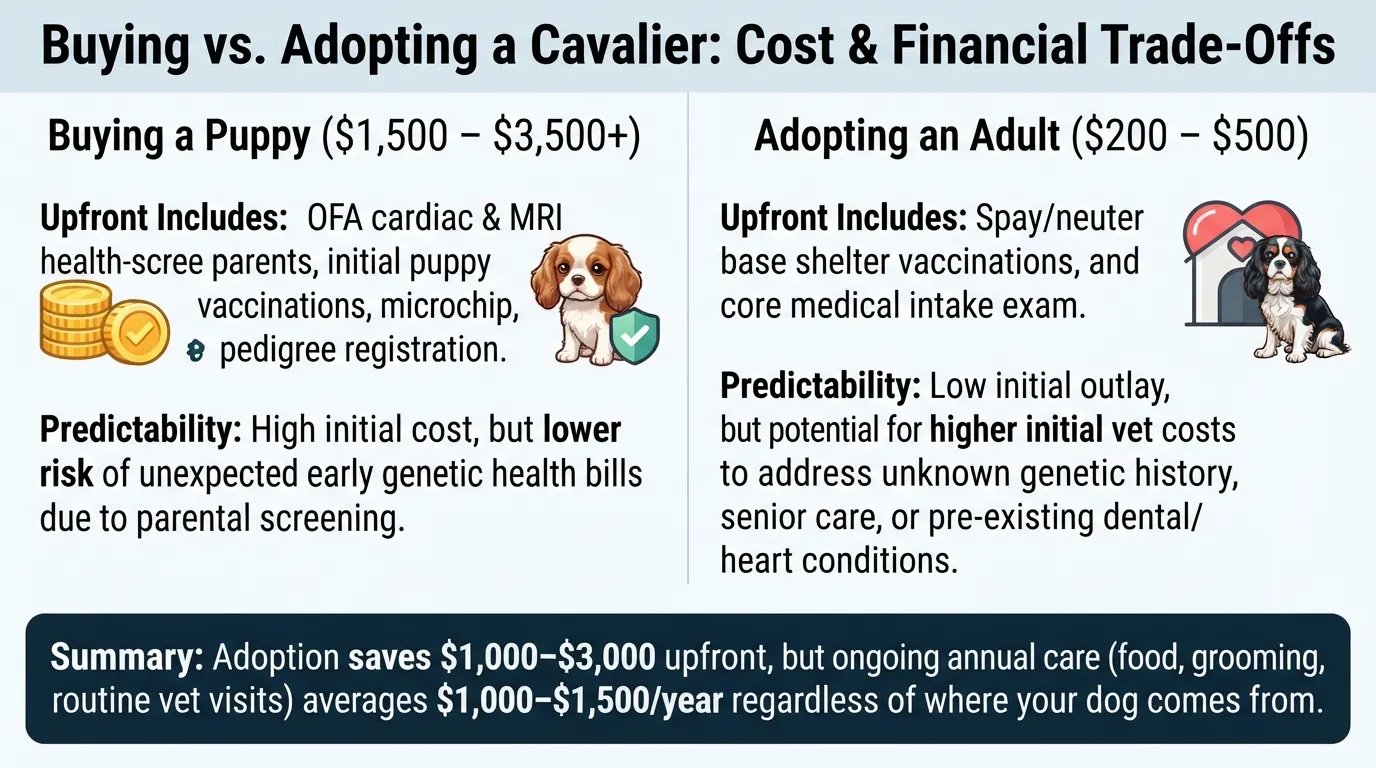
When looking strictly at upfront costs, adopting a Cavalier King Charles Spaniel is drastically cheaper than purchasing one from an ethical breeder. An adoption fee typically ranges between $250 and $600, whereas a puppy from a reputable, health-tested breeder costs $1,800 to $4,000+.
However, “cheaper” on day one doesn’t always translate to lower costs over the dog’s entire lifespan. Because Cavaliers are prone to serious hereditary conditions—most notably Mitral Valve Disease (MVD) and Syringomyelia (SM)—the source of your dog plays a massive role in your future veterinary bills.
An ethical breeder spends thousands screening sire and dam with cardiac auscultations, OFA eye exams, and MRI scans before breeding. Adoption rescues usually rehome adult dogs or surrenders with unknown genetic backgrounds, meaning you might face specialized cardiac or neurological care sooner in the dog’s life.
| Path | Upfront Cost | Pros | Cons |
|---|---|---|---|
| Adoption / Rescue | $250 – $600 | Includes spay/neuter, initial vaccines, microchip, and basic vetting; saves a dog in need. | Rare purebred availability; unknown genetic health history; higher likelihood of pre-existing adult conditions. |
| Reputable Breeder | $1,800 – $4,000+ | Multi-generational health testing (heart/eyes/hips); predictable temperament; health guarantee. | High initial purchase price; potential waitlist of 3 to 12 months. |
If you decide to adopt, turning to breed-specific rescues like Cavalier Rescue USA or national breed club networks is often safer than general shelters. These specialized organizations evaluate every incoming Cavalier for cardiac and neurological symptoms before placing them in foster homes, giving you a transparent picture of their current health status.
Another cost-effective middle ground is adopting a retired show or breeding dog directly from a preservation breeder. These adult Cavaliers are typically placed between $500 and $1,200, come with fully documented health testing histories, and are already house-trained.
How to Avoid Overpaying or Getting Scammed
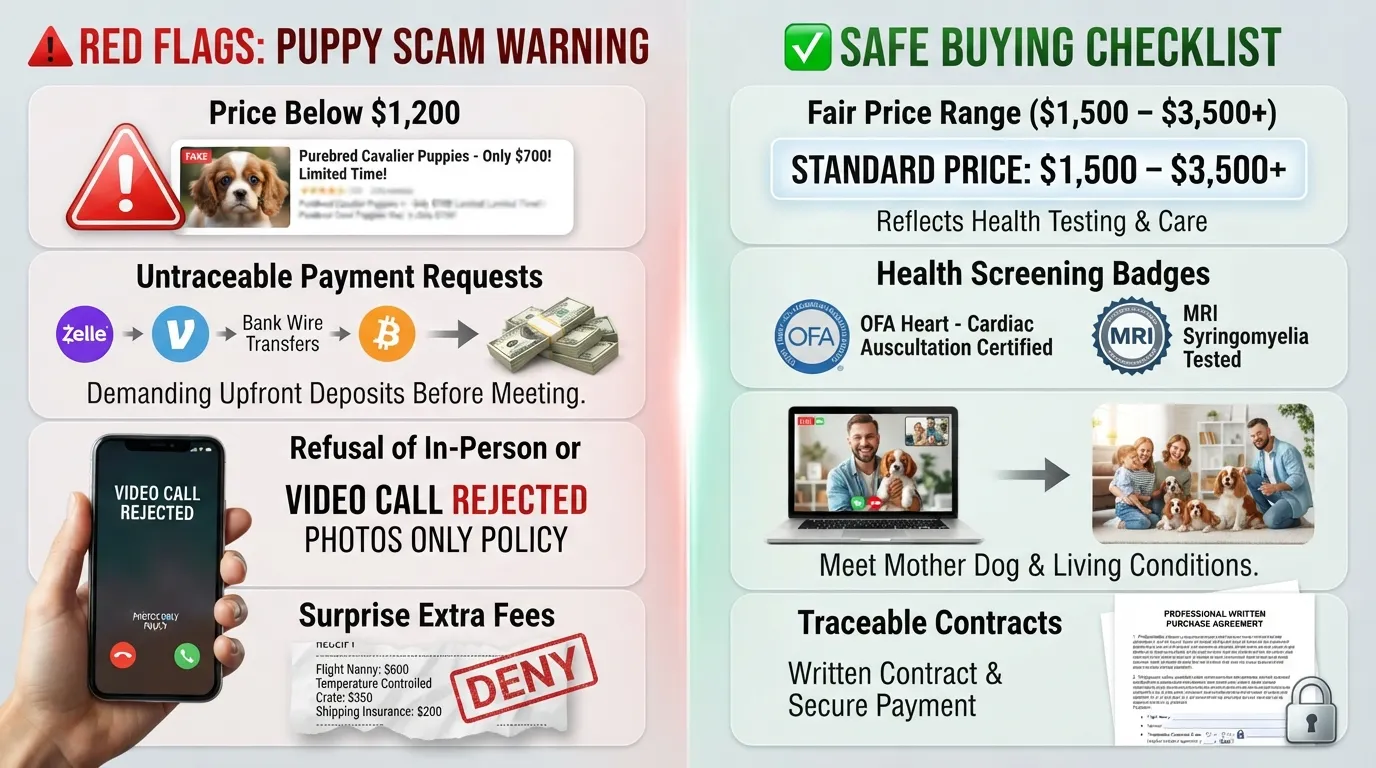
Because Cavaliers command high market prices—often ranging from $1,500 to $3,500 for a companion puppy from a reputable source—they are a primary target for online scammers and backyard breeders. Avoiding a bad deal comes down to knowing what real breeder verification looks like before any money changes hands.
A genuine breeder will never rush you, demand untraceable payment, or hesitate to share verifiable health documentation. Use this operational checklist to protect both your deposit and your future puppy’s health.
The Cavalier Buyer’s Verification Checklist
Demand Verifiable Board-Certified Health Clearances: Do not accept a generic “vet checked” note or a clean bill of health from a family veterinarian. Reputable breeders screen parents using board-certified specialists: an OFA heart clearance from a veterinary cardiologist (renewed annually) and an OFA/CERF eye exam from a board-certified ophthalmologist. They should also provide DNA testing for Episodic Falling Syndrome (EFS) and Curly Coat/Dry Eye Syndrome (CC/DE), along with patella clearance. Ask for the parents’ registered names or OFA/CHIC numbers so you can look up the test results directly on the official Orthopedic Foundation for Animals database.
Insist on Meeting the Mother and the Puppies: Always ask to see the mother with her litter, either in person at the breeder’s home or through a live video call. Scammers use stolen photos and videos pulled from Instagram or legitimate breeder websites. Pay attention to the environment: the mother should look healthy, comfortable, and well-cared for, not kept in crowded or unsanitary kennel conditions.
Refuse Wire-Only or Untraceable Payment Methods: A major red flag is a seller who insists on Zelle, Western Union, wire transfers, crypto, or gift cards, claiming they don’t accept standard deposit options. Legitimate breeders typically accept traceable payment options like personal checks, major credit cards, or secure banking services that offer purchase protection. Be equally cautious if you are asked to pay extra “emergency air freight” or “temperature-controlled crate fees” right before delivery.
Verify Independent Reviews and Breeder Credentials: Look for breeders registered with official breed clubs like the American Cavalier King Charles Spaniel Club (ACKCSC) or regional Cavalier preservation groups. Cross-reference the breeder’s name across independent forums, local Facebook groups, or community review boards to verify their history. A honest breeder will gladly provide contact references from families who purchased puppies from previous litters.
Watch Out for “Too Good to Be True” Bargain Prices: If you spot a “purebred AKC Cavalier puppy” listed for $400 to $800, proceed with extreme caution. Health testing a breeding pair—including regular cardiologist evaluations and potential MRI scans for Syringomyelia (SM)—costs thousands of dollars. Anyone selling puppies well below standard market cost is either running a deposit scam or cutting dangerous corners on health screening.
Not to Be Confused With: Cavapoo & Cavachon Pricing
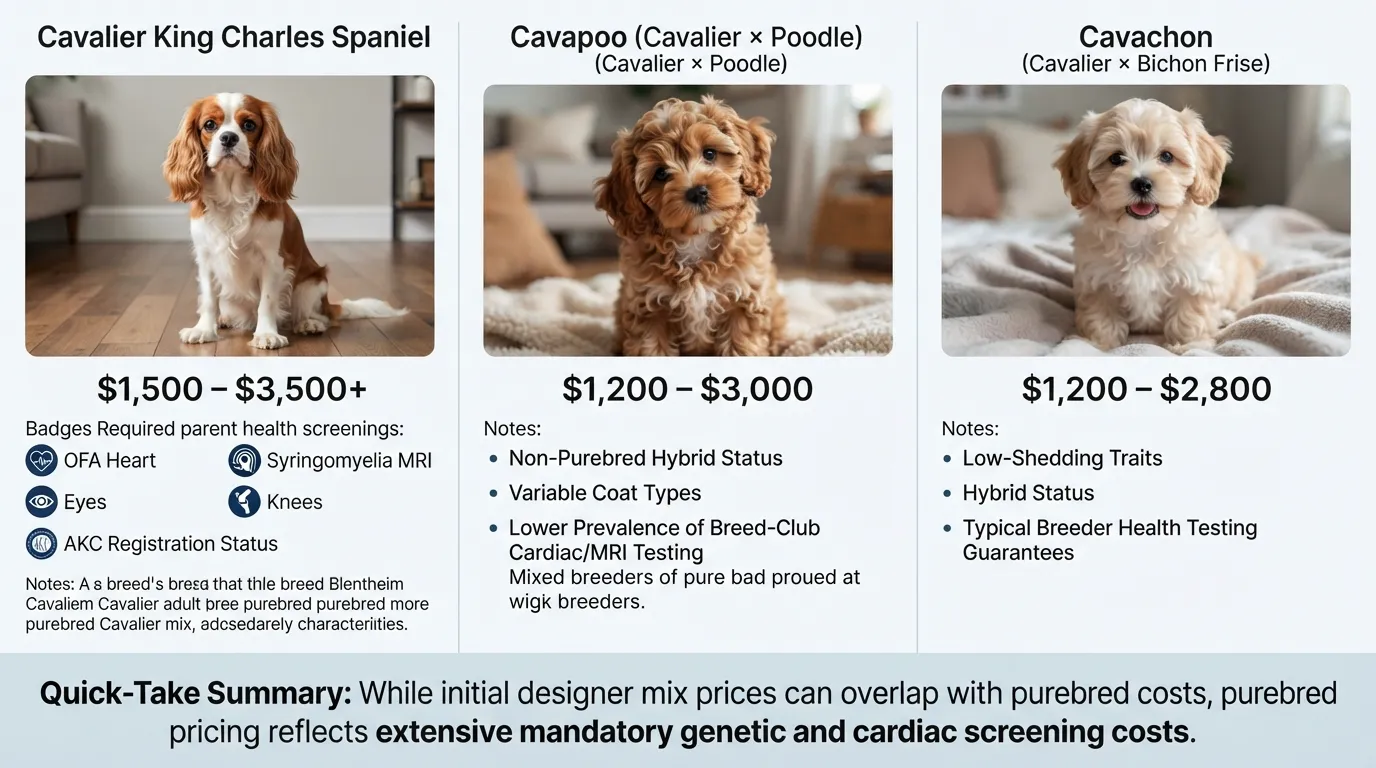
While purebred Cavalier King Charles Spaniels generally cost $1,500–$3,500+ from ethical breeders, popular designer mixes like Cavapoos (Cavalier × Poodle) and Cavachons (Cavalier × Bichon Frise) typically range from $1,200–$3,000, depending on coat color, generation, and backyard breeder demand.
If you are shopping for a mix rather than a purebred, keep in mind that hybrid puppies rarely come with standard breed-club health clearances—like official OFA cardiac or MRI syringomyelia screenings—which directly impacts both the initial puppy price and long-term vet bills.
Frequently Asked Questions
| Question | Answer |
|---|---|
| Is $1,500 too cheap for a Cavalier puppy? | Yes, $1,500 is unusually low for a health-tested, purebred Cavalier King Charles Spaniel from a reputable breeder. Breeders who complete genetic and health screenings (MRI for SM, cardiac clearings) typically charge $2,500 to $4,000+. Lower prices often signal backyard breeding or puppy mills. |
| Do Cavaliers need pet insurance? | Highly recommended. Cavaliers are prone to genetic health conditions like Syringomyelia (SM) and Mitral Valve Disease (MVD). Diagnostics and treatment for these conditions can quickly cost thousands of dollars, making comprehensive pet insurance invaluable. |
| How much is a Cavalier per month? | Expect to spend roughly $120 to $200 per month. This covers high-quality food, basic grooming, routine vet upkeep, monthly flea/heartworm prevention, and toys. First-year setup costs and emergency medical funds are separate. |
| Is "teacup Cavalier" real? | No. "Teacup Cavalier" is an unofficial marketing term, not an recognized breed standard. Unethical breeders often breed runts or deliberately introduce dwarfism to make smaller dogs, which leads to severe, lifelong health problems. |
| What's the cheapest legit way to get one? | Adopting through a breed-specific Cavalier rescue or local animal shelter is the most ethical and affordable option. Adoption fees generally range from $300 to $600, which usually covers vet checkups, vaccinations, and spay/neuter costs. |
| Is Cavalier King Charles Spaniel expensive to maintain? | Yes, compared to many other breeds. While their daily food needs are small, their potential long-term medical care, required heart/brain screenings, and professional grooming requirements place them in a higher maintenance cost tier. |
🐾 Other Age Guides

I built Dogagescalculator.com to give dog owners honest, science-backed answers instead of the outdated "×7" myth. Every figure here is checked against AKC, AVMA, and published veterinary research.
More about the author & this site →
Comments