
How Much Does a Bernese Mountain Dog Weigh? Full Growth & Weight Chart
An adult Bernese Mountain Dog typically weighs between 70 and 115 pounds once fully grown. Males are noticeably larger, weighing between 80 and 115 pounds, while females generally weigh between 70 and 95 pounds. Because they are a working giant breed, they grow rapidly in height during their first year but continue filling out muscle and chest depth until around two years of age.
Bernese Mountain Dog Weight Chart by Age
Birth Weight Newborn Puppy
A newborn Bernese Mountain Dog puppy typically weighs between 14 and 20 ounces (0.88 to 1.25 lbs / 0.40 to 0.57 kg) at birth. Puppies born into larger litters (which can sometimes reach up to 10 to 14 pups) often start on the smaller end of that spectrum, while smaller litters produce chunkier newborns.
During their first 48 hours, it’s completely normal for a newborn Berner to drop a few grams of birth weight before gaining it back. Once nursing is established, a healthy puppy gains roughly 10% of its body weight daily, doubling its birth weight within the first week to 10 days. By the time a litter reaches four weeks old, most pups weigh between 4 and 6 lbs (1.8 to 2.7 kg).
Male vs Female Weight Chart Birth → 24 Months
The following growth timeline tracks average target ranges for healthy Bernese Mountain Dogs from birth to full maturity.
| Age | Male Weight | Female Weight | ||
|---|---|---|---|---|
| lbs | kg | lbs | kg | |
| Birth | 0.9 – 1.3 lbs | 0.4 – 0.6 kg | 0.8 – 1.2 lbs | 0.4 – 0.5 kg |
| 1 Month (4 wks) | 4 – 8 lbs | 1.8 – 3.6 kg | 3.5 – 7 lbs | 1.6 – 3.2 kg |
| 2 Months (8 wks) | 15 – 24 lbs | 6.8 – 10.9 kg | 12 – 20 lbs | 5.4 – 9.1 kg |
| 3 Months | 25 – 38 lbs | 11.3 – 17.2 kg | 20 – 32 lbs | 9.1 – 14.5 kg |
| 4 Months | 38 – 52 lbs | 17.2 – 23.6 kg | 30 – 44 lbs | 13.6 – 20.0 kg |
| 5 Months | 48 – 65 lbs | 21.8 – 29.5 kg | 40 – 55 lbs | 18.1 – 24.9 kg |
| 6 Months | 58 – 78 lbs | 26.3 – 35.4 kg | 48 – 66 lbs | 21.8 – 29.9 kg |
| 7 Months | 64 – 84 lbs | 29.0 – 38.1 kg | 52 – 72 lbs | 23.6 – 32.7 kg |
| 8 Months | 70 – 90 lbs | 31.8 – 40.8 kg | 56 – 76 lbs | 25.4 – 34.5 kg |
| 9 Months | 74 – 96 lbs | 33.6 – 43.5 kg | 60 – 80 lbs | 27.2 – 36.3 kg |
| 10 Months | 78 – 100 lbs | 35.4 – 45.4 kg | 62 – 82 lbs | 28.1 – 37.2 kg |
| 11 Months | 80 – 104 lbs | 36.3 – 47.2 kg | 64 – 85 lbs | 29.0 – 38.6 kg |
| 12 Months (1 yr) | 82 – 108 lbs | 37.2 – 49.0 kg | 65 – 88 lbs | 29.5 – 39.9 kg |
| 18 Months | 85 – 112 lbs | 38.6 – 50.8 kg | 68 – 92 lbs | 30.8 – 41.7 kg |
| 24 Months (2 yrs) | 80 – 115 lbs | 36.3 – 52.2 kg | 70 – 95 lbs | 31.8 – 43.1 kg |
Male Weight Chart
| Age | Weight (lbs) | Weight (kg) |
|---|---|---|
| Birth | 0.9 – 1.3 lbs | 0.4 – 0.6 kg |
| 1 Month (4 wks) | 4 – 8 lbs | 1.8 – 3.6 kg |
| 2 Months (8 wks) | 15 – 24 lbs | 6.8 – 10.9 kg |
| 3 Months | 25 – 38 lbs | 11.3 – 17.2 kg |
| 4 Months | 38 – 52 lbs | 17.2 – 23.6 kg |
| 5 Months | 48 – 65 lbs | 21.8 – 29.5 kg |
| 6 Months | 58 – 78 lbs | 26.3 – 35.4 kg |
| 7 Months | 64 – 84 lbs | 29.0 – 38.1 kg |
| 8 Months | 70 – 90 lbs | 31.8 – 40.8 kg |
| 9 Months | 74 – 96 lbs | 33.6 – 43.5 kg |
| 10 Months | 78 – 100 lbs | 35.4 – 45.4 kg |
| 11 Months | 80 – 104 lbs | 36.3 – 47.2 kg |
| 12 Months (1 yr) | 82 – 108 lbs | 37.2 – 49.0 kg |
| 18 Months | 85 – 112 lbs | 38.6 – 50.8 kg |
| 24 Months (2 yrs) | 80 – 115 lbs | 36.3 – 52.2 kg |
Female Weight Chart
| Age | Weight (lbs) | Weight (kg) |
|---|---|---|
| Birth | 0.8 – 1.2 lbs | 0.4 – 0.5 kg |
| 1 Month (4 wks) | 3.5 – 7 lbs | 1.6 – 3.2 kg |
| 2 Months (8 wks) | 12 – 20 lbs | 5.4 – 9.1 kg |
| 3 Months | 20 – 32 lbs | 9.1 – 14.5 kg |
| 4 Months | 30 – 44 lbs | 13.6 – 20.0 kg |
| 5 Months | 40 – 55 lbs | 18.1 – 24.9 kg |
| 6 Months | 48 – 66 lbs | 21.8 – 29.9 kg |
| 7 Months | 52 – 72 lbs | 23.6 – 32.7 kg |
| 8 Months | 56 – 76 lbs | 25.4 – 34.5 kg |
| 9 Months | 60 – 80 lbs | 27.2 – 36.3 kg |
| 10 Months | 62 – 82 lbs | 28.1 – 37.2 kg |
| 11 Months | 64 – 85 lbs | 29.0 – 38.6 kg |
| 12 Months (1 yr) | 65 – 88 lbs | 29.5 – 39.9 kg |
| 18 Months | 68 – 92 lbs | 30.8 – 41.7 kg |
| 24 Months (2 yrs) | 70 – 95 lbs | 31.8 – 43.1 kg |
Note: These numbers serve as directional estimates, not rigid rules. Individual puppies grow in spurts rather than a straight line. Genetics, diet quality, overall health, and litter size all play a role in where your dog sits within these ranges. As long as your vet confirms your puppy’s Body Condition Score is on target, being slightly above or below these exact numbers is usually nothing to worry about.
When Do Bernese Mountain Dogs Stop Growing?
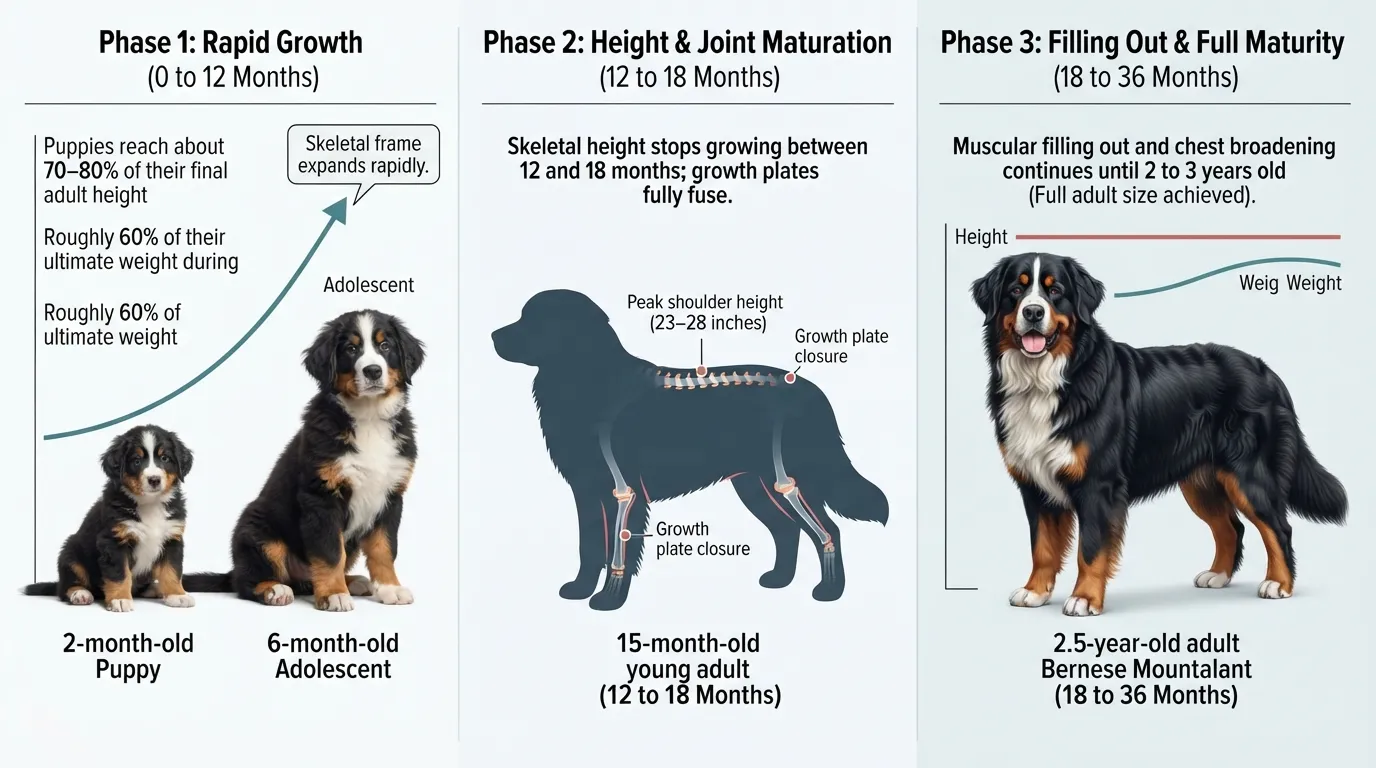
A Bernese Mountain Dog reaches its adult height around 12 months of age, but they aren’t done growing yet. Most Berners continue to fill out, gain muscle, and broaden in the chest until they are 18 to 24 months old—and some large males keep adding substance until 3 years.
Weight Maturity around 12 months
By their first birthday, most Bernese Mountain Dogs have reached roughly 80% to 90% of their final adult weight and essentially 100% of their adult height. A male usually weighs between 75 and 95 pounds at 12 months, while a female typically sits between 60 and 75 pounds.
At this stage, your puppy might look a bit lanky, leggy, or disproportionate—almost like a teenager who hit a sudden growth spurt. That’s completely normal. The vertical bone growth slows down dramatically after month 12 as the long bone growth plates close, shifting the body’s focus from getting taller to getting broader.
Chest/Frame Fill-Out 18-24 months
Between 18 and 24 months, your Berner undergoes its second major growth phase: filling out the frame. During these late months, the chest deepens, the ribcage expands, the shoulders thicken, and muscle mass develops across the rear quarters.
Physical Changes: The narrow “teenage” chest widens into the classic, sturdy Swiss working dog draft-frame.
Coat Development: Along with physical bulk, their thick double coat reaches full density during this period, which often gives them an even heavier appearance.
Weight Gain Rate: Weight gain slows from several pounds a week to a gradual 1 to 2 pounds a month until they settle into their ideal adult weight (80–115 lbs for males, 70–95 lbs for females).
If your 18-month-old Bernese still looks slender, don’t rush to overfeed them. Forcing rapid weight gain with extra calories before the skeleton fully matures puts dangerous stress on developing joints. Let the frame broaden naturally on a high-quality, large-breed diet.
How to Estimate Your Puppy's Adult Weight
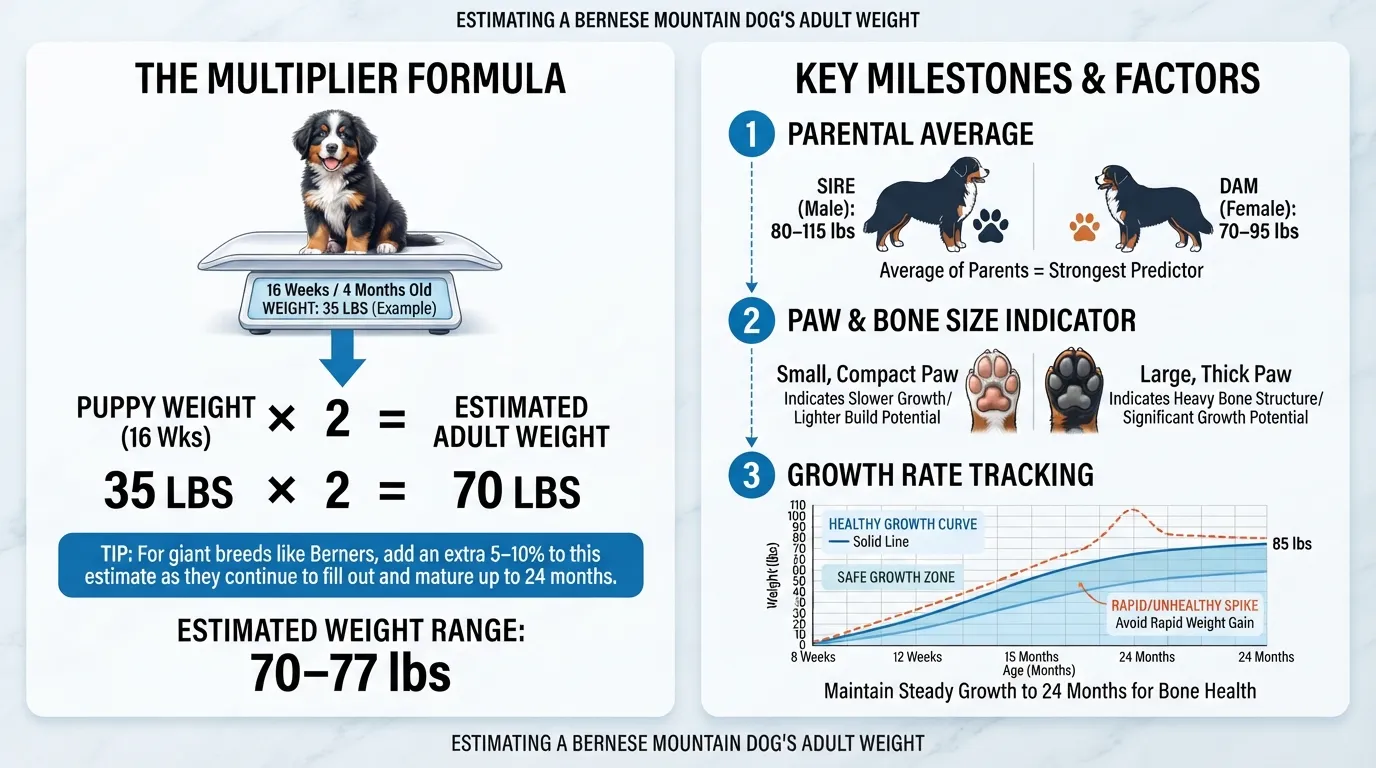
Predicting how big a Bernese Mountain Dog puppy will get comes down to three reliable methods: checking the parents’ weights, tracking their growth curve, and looking at physical cues like paw size. Because giant breeds grow rapidly for the first six months and continue filling out until age two, using a combination of these techniques gives you the most accurate estimate.
1. Parent and Breeder Weight Reference
The single best predictor of an adult Berner’s weight is the weight of its biological parents. Genetics determine roughly 80% to 90% of a dog’s ultimate size. Ask your breeder for the exact weight of both the sire and dam.
For Males: Expect your pup to end up close to the sire’s weight, typically within 5 to 10 pounds.
For Females: Look at the dam’s weight as your primary benchmark.
The Average Rule: If the parents vary widely in size, add their weights together and divide by two to find a realistic target weight for the litter.
2. Growth Chart Tracking Method
Bernese Mountain Dogs don’t grow at a steady rate; they undergo massive early growth spurts followed by a slow bulk-up period. A simple rule of thumb breeders use is to take your puppy’s weight at 4 months (16 weeks) and double it. This gives a rough baseline, though Berners often add another 10 to 15 pounds of lean muscle and chest width between 12 and 24 months.
Keeping a weekly weight log on a standard growth chart helps you see if your puppy is tracking along a normal trajectory or gaining too quickly, which can stress developing joints.
3. The Paw Size Check
While less scientifically precise than genetics, paw size offers a immediate visual clue during early puppyhood. Bernese puppies often look like they are wearing oversized boots because their skeletal frame grows in stages.
If your 12-week-old puppy still has prominent, bulky knuckle joints and wide paws relative to their leg thickness, they still have a significant amount of growing to do. Once their legs and joints smooth out and proportion naturally with the paw, their height growth is usually nearing completion.
How to Weigh a Large Dog at Home Practical Tip
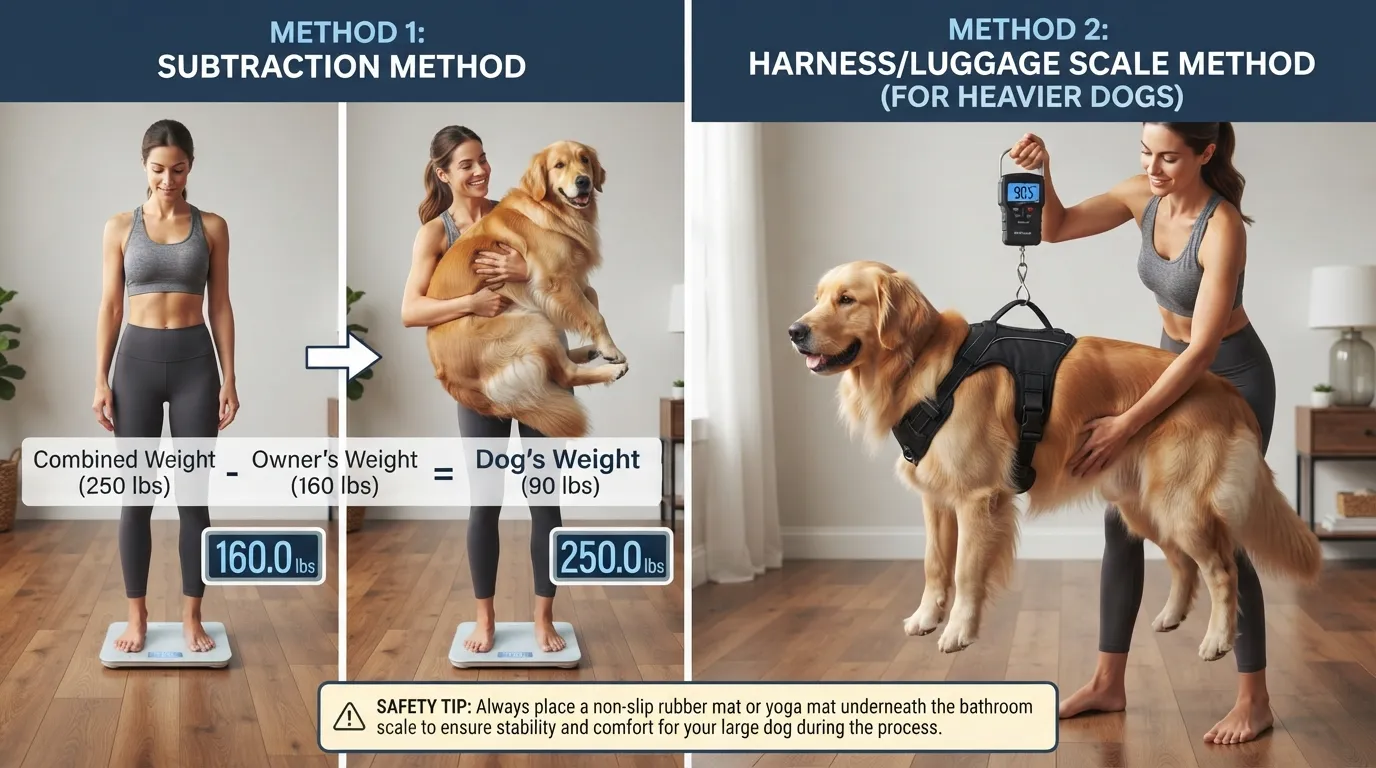
Weighing a Bernese Mountain Dog on a standard bathroom scale isn’t as straightforward as stepping onto the glass with a Chihuahua, but you don’t need a commercial vet scale to get an accurate number. The easiest way to do this at home is the subtractive method while your Berner is still small enough to lift safely—or with a simple modification once they outgrow your arms.
The Standard Hold-and-Step Method Puppies up to 50–60 lbs
For Bernese puppies under six or seven months old, you can easily weigh them using your home scale in three quick steps:
Weigh yourself first: Step onto the digital scale alone and write down your exact weight.
Pick up your puppy: Pick up your Berner puppy securely, supporting their chest and hindquarters, and step back onto the scale.
Do the math: Subtract your solo weight from the combined total. The difference is your puppy’s current weight.
Safety note: Once your young Berner hits 60 or 70 pounds, stop using this method. Lifting a heavy, squirming giant-breed pup off the ground increases the risk of dropping them or straining your lower back.
The Board Method For Full-Grown Adult Berners
When your Berner reaches 80 to 115+ pounds, you can create a simple makeshift platform scale at home instead of wrestling them onto a tiny surface:
Get a sturdy wooden board: Find a flat, solid piece of plywood or a wide wooden shelf board that is long and wide enough for your dog to stand on with all four paws (around 2×3 feet).
Weigh the board: Place the board flat on your digital scale and zero it out (tare function), or write down the board’s exact weight.
Position the board on the scale: Center the board carefully over the scale so it balances without tilting.
Lure your dog onto the board: Use a high-value treat to lure your dog to step onto the board and stand still for a few seconds.
Calculate the weight: Read the total weight on the display. If your scale didn’t zero out with the board on it, simply subtract the board’s weight from the final number.
Pro-Tip from Breeders: If home methods are too awkward for your fully grown adult dog, most veterinary clinics and large pet supply stores keep a walk-on electronic scale right in their lobby or waiting room. You can usually walk in and check your dog’s weight for free without an appointment.
Can a Bernese Mountain Dog Weigh More Than the Breed Standard? XL Berners
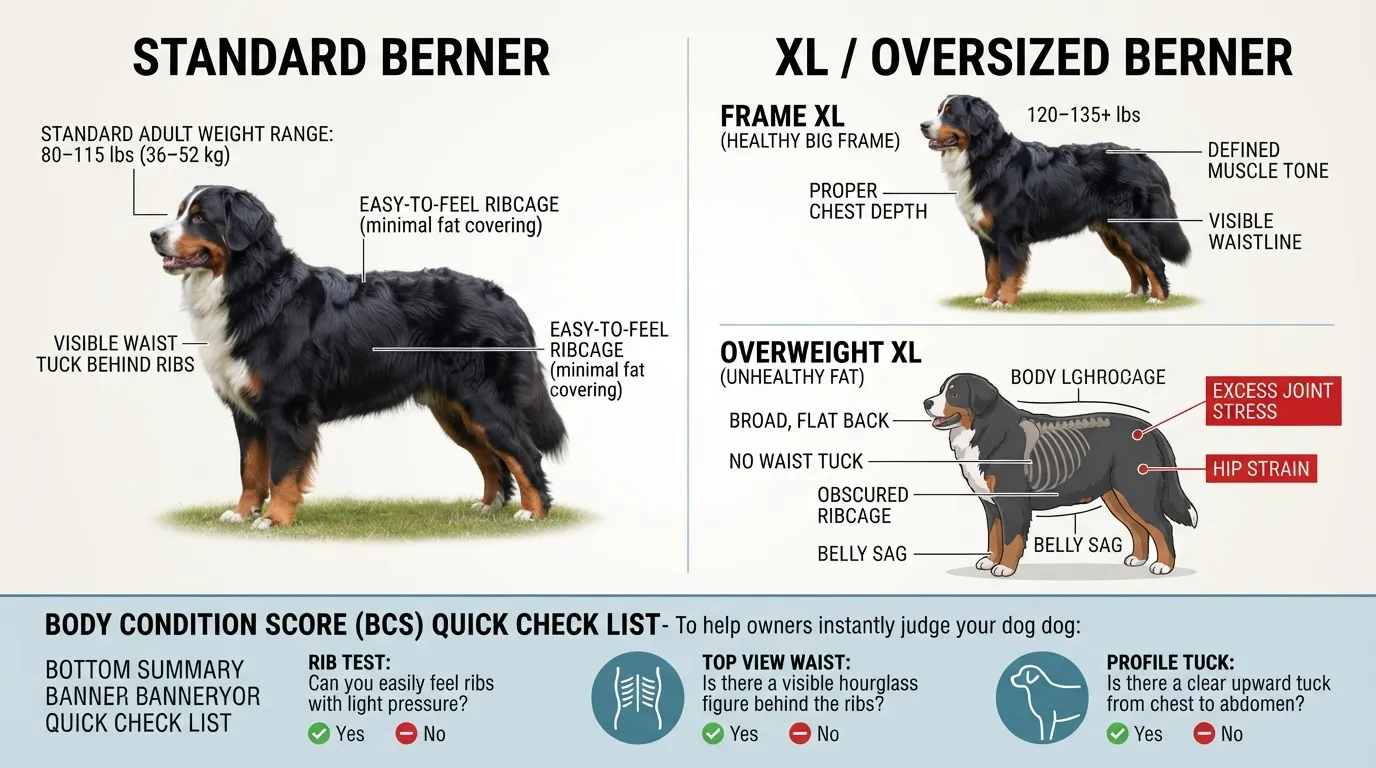
Yes, a Bernese Mountain Dog can certainly weigh more than the official breed standard top limits of 115 pounds for males and 95 pounds for females. It is actually fairly common to see healthy, big-boned males reach 120 to 130 pounds—sometimes even more—without being overweight.
Why Some Bernese Mountain Dogs Exceed 115–120 lbs
Genetics and Working Lines: European breeding lines and traditional draft-working lineages often produce dogs with heavier bone density, wider skulls, and deeper chests than standard American show lines.
Spay/Neuter Timing: Dogs fixed before their growth plates fully close (typically around 18 to 24 months) often grow taller than normal because the hormonal signal to stop leg bone growth is delayed.
Simple Overfeeding: Caloric intake during the growth phase plays a huge role. If a puppy gets excess calories, they may gain fat alongside frame growth, leading to an artificially inflated weight.
Healthy XL Berners vs. Concerning Oversized Cases
Distinguishing between a naturally large, well-proportioned Berner and an overweight one comes down to body condition rather than the number on the scale.
Healthy XL Berners: A naturally large dog carries their extra weight in dense bone and lean muscle. When looking at them from above, you should still see a subtle waist, and you ought to feel their ribs with light pressure through their dense coat without digging through fat padding.
Concerning XL Cases: If a Berner’s back looks flat like a tabletop, their ribs are hidden beneath a thick layer of fat, or they struggle to rise after resting, the extra weight isn’t frame—it’s excess body fat. On a giant breed prone to hip dysplasia and cruciate injuries, even 5 to 10 extra pounds of fat drastically accelerates joint breakdown and shortens their lifespan.
Is My Bernese Mountain Dog Overweight or Underweight?
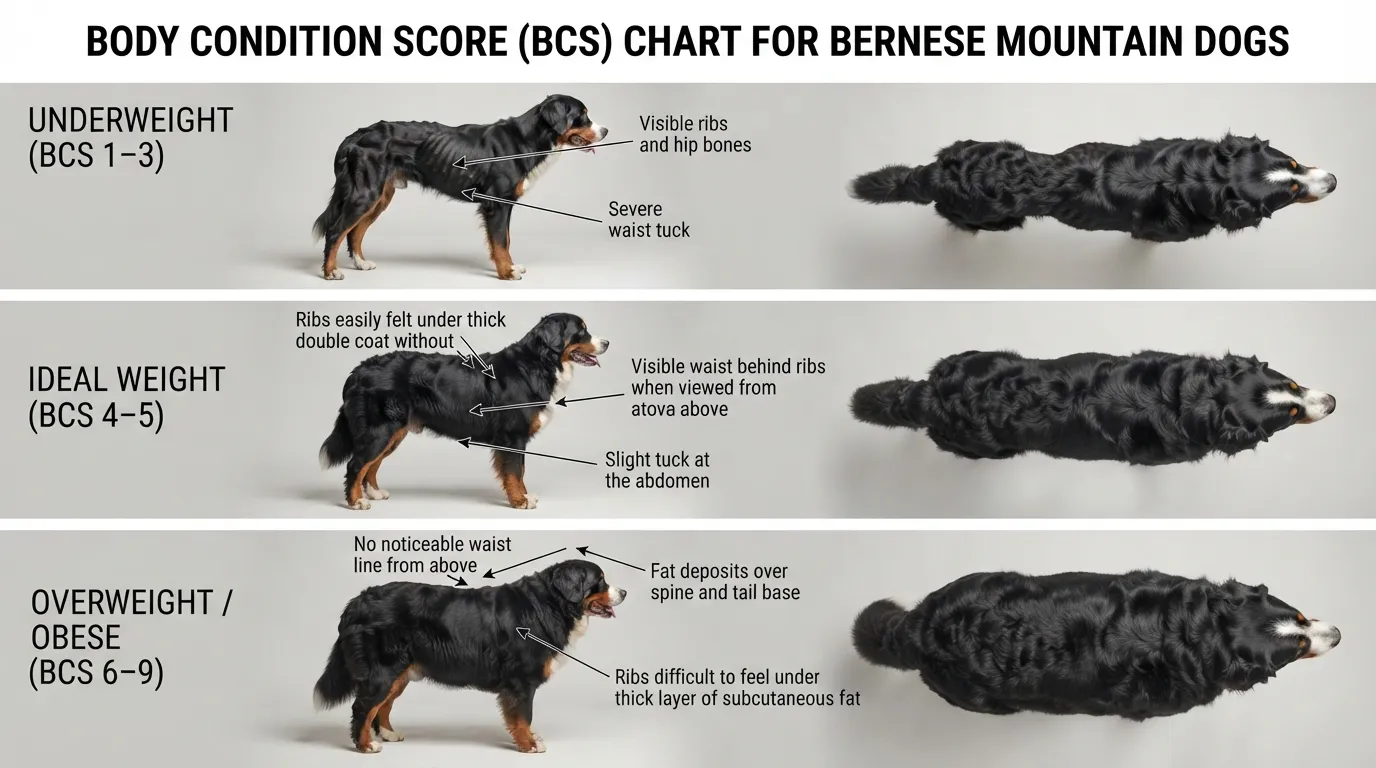
An adult male Bernese Mountain Dog generally weighs between 80 and 115 pounds, while females typically range from 70 to 95 pounds. However, relying strictly on the bathroom scale can be misleading because bone density and overall frame size vary significantly from dog to dog. Assessing body condition visually and by touch gives a far more accurate picture of whether your Berner is at a healthy weight.
Body Condition Score Check
The thick, heavy double coat of a Bernese Mountain Dog makes it almost impossible to judge their body condition by eye alone. You need to use your hands to perform a hands-on rib, waist, and belly tuck test.
The Rib Test: Run your hands gently down your dog’s ribcage. You should easily feel individual ribs covered by a thin layer of fat, similar to feeling the back of your knuckles when your hand is open flat. If the ribs feel like a smooth, padded mattress, your Berner is carrying extra weight. If they feel sharp and prominent, like a tight fist, your dog is underweight.
The Waist Check: Stand directly over your dog and look down through their fur (you may need to press the hair flat against their sides). A healthy Bernese will have a subtle, visible indentation behind the ribcage marking the waist. A straight boxy shape or bulging sides indicates overweight territory.
The Belly Tuck: Look at your dog from the side at eye level. The abdomen should gently slope upward from the end of the chest toward the hind legs. If the bottom line runs completely straight or sags downward, your dog is likely holding onto excess fat.
Signs & Risks of Being Underweight
While obesity gets most of the attention in large breeds, an underweight Bernese Mountain Dog faces equally serious health complications. A dog that drops significantly below their target weight lacks the body fat needed for insulation, energy reserves, and proper organ function.
Physical Indicators: Beyond sharp, protruding ribs and hip bones, an underweight Berner will often show dull, dry fur, frequent lethargy, loss of muscular mass along the thighs and lower back, and poor cold tolerance.
Health Risks: Chronic underweight status weakens the immune system, leaving large dogs more vulnerable to opportunistic infections. It can also cause muscle wasting, delayed healing from minor injuries, and hormonal imbalances that affect growth in puppies or reproductive health in breeding stock.
Underlying Causes: Sudden or unexplained weight loss often points to underlying medical issues like intestinal parasites, exocrine pancreatic insufficiency (EPI), food sensitivities, thyroid dysfunction, or severe dental pain. If increasing quality calorie intake doesn’t yield steady progress, a vet visit is essential.
Factors That Affect a Bernese Mountain Dog's Weight
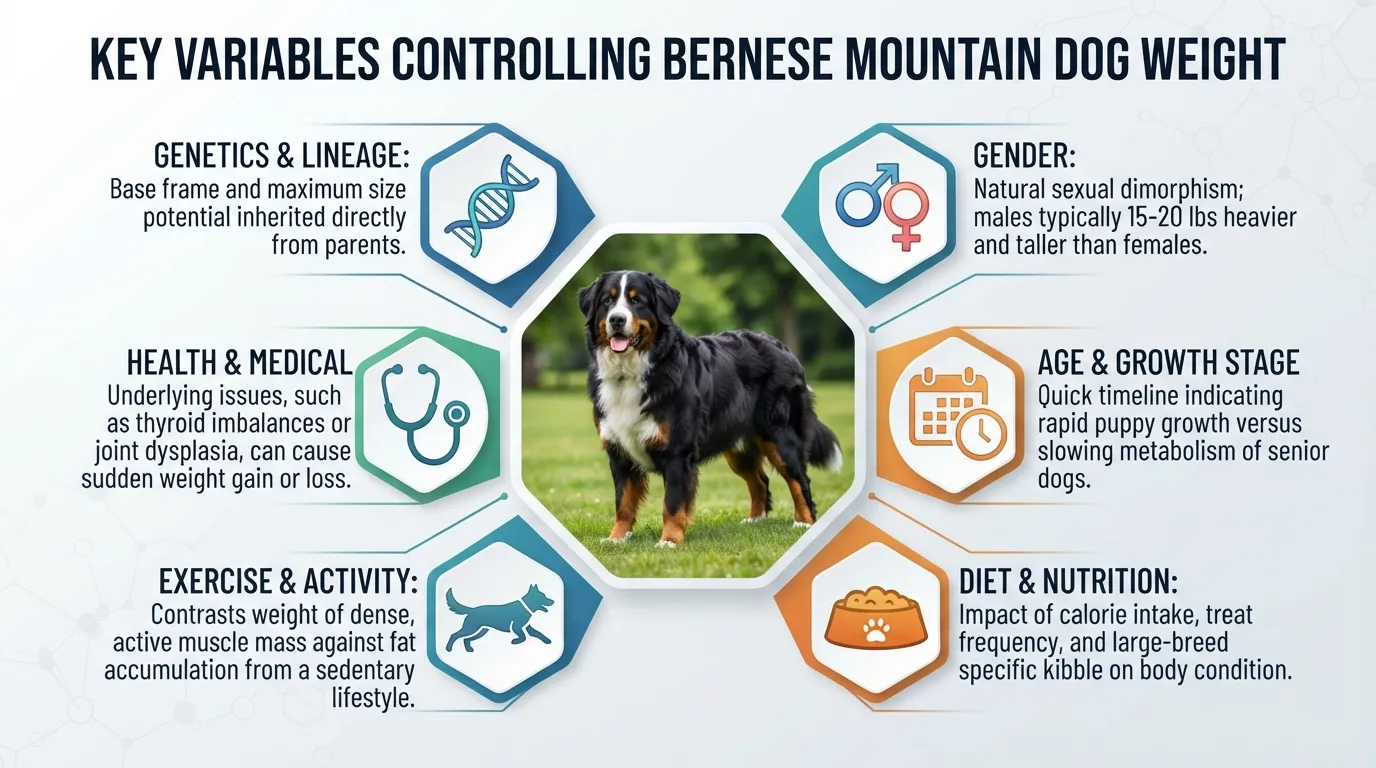
A Bernese Mountain Dog’s weight is primarily shaped by four key factors: genetics, diet, spay/neuter timing, and exercise levels. While lineage sets the structural ceiling for how big your dog can naturally grow, daily management and surgical choices decide whether they reach that potential healthily or carry unnecessary extra pounds.
Genetics and Lineage
Genetics is the single biggest predictor of your Berner’s adult size. Puppies born to heavy-boned, working-line parents tend to land on the higher end of the weight spectrum—often over 100 pounds for males—while show lines or dogs with lighter-framed parents stay closer to the lower boundary of the standard. If you want a realistic preview of your pup’s final size, look at the sire and dam; apple-tree genetics rarely yield anything far from the parent stock.
Diet and Nutrition
Large-breed working dogs burn energy quickly as pups, but their metabolism slows considerably once they hit maturity. Feeding a diet that isn’t specifically formulated for giant breeds can lead to rapid early growth spouts, which puts severe stress on developing joints. Overfeeding protein or calicium-heavy foods in puppyhood won’t make a Berner taller—it simply increases their risk of early obesity and skeletal disorders like hip dysplasia.
Spay and Neuter Timing
Desexing your Bernese Mountain Dog alters their hormonal balance, which directly impacts metabolic rate and growth plate closure. Neutering or spaying too early (before 12 to 18 months, when the growth plates officially close) can cause the long bones to continue growing taller than intended, often producing a rangier, lighter-muscled frame. Conversely, desexed Berners experience a slight drop in basal metabolic rate, meaning they require roughly 10% to 20% fewer daily calories post-surgery to avoid fast weight gain.
Exercise Level and Muscle Mass
Muscle weighs more than fat, and an active Bernese Mountain Dog will naturally carry a heavier, denser body weight while maintaining a trim waistline. Regular, moderate exercise builds the dense muscular shoulder assembly and strong hindquarters typical of the breed. On the flip side, a sedentary Berner will quickly trade functional muscle mass for soft fat tissue, showing up as a high number on the vet’s scale for all the wrong reasons.
Why Senior Berners Experience Weight Shifts
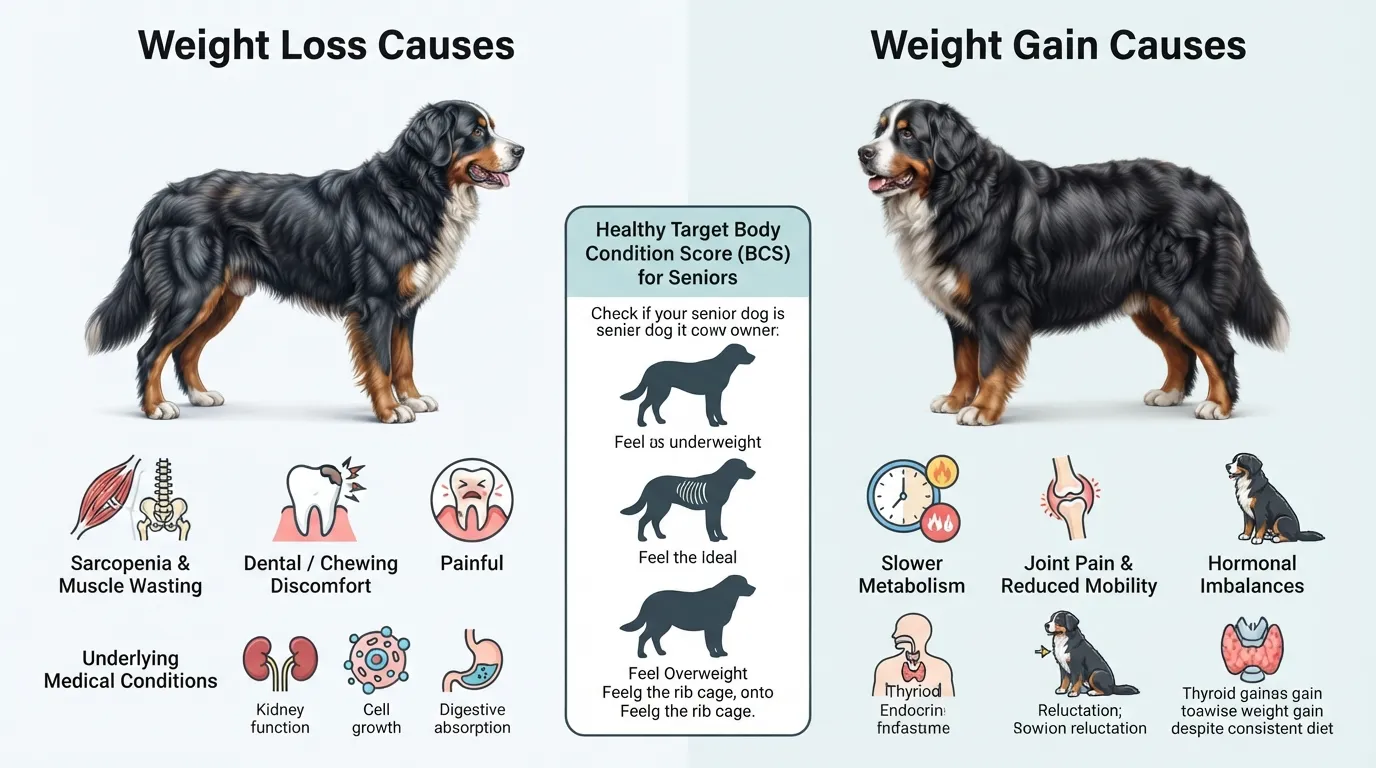
Muscle Loss (Sarcopenia): As Berners hit 7–8 years old, natural aging causes a decrease in muscle tissue. Even if a senior dog looks the same size, they may weigh less because muscle weighs more than fat.
Metabolism Slowdown: Their internal engine slows down considerably in old age. If their activity drops due to stiff joints but their calorie intake remains high, they might actually gain fat while losing vital muscle tissue.
Underlying Health Conditions: Unexplained weight loss in a senior Berner is often the first visible indicator of common late-life conditions like kidney disease, heart issues, arthritis pain, or cancer.
Simple Monitoring Tips for Senior Dogs
Weigh Them Monthly: Take your senior Berner to the vet for a routine scale check every 4 to 6 weeks. Gradual weight drops are hard to notice visually under their thick double coat.
Use the Rib Test: Gently press along their ribcage. You should feel the ribs under a thin layer of fat without having to press hard. If the ribs feel sharp or overly prominent, they are losing too much weight.
Adjust Diet, Not Just Portions: Instead of simply cutting food down when they slow down, switch to a high-quality senior formula rich in digestible protein to help maintain lean muscle while managing overall calorie intake.
Track Joint Mobility: Pain from hip dysplasia or arthritis can make standing to eat uncomfortable. Elevating their food and water bowls can encourage a struggling senior to eat their full meal comfortably.
Bernese Mountain Dog vs Other Giant Breeds Weight Comparison Table
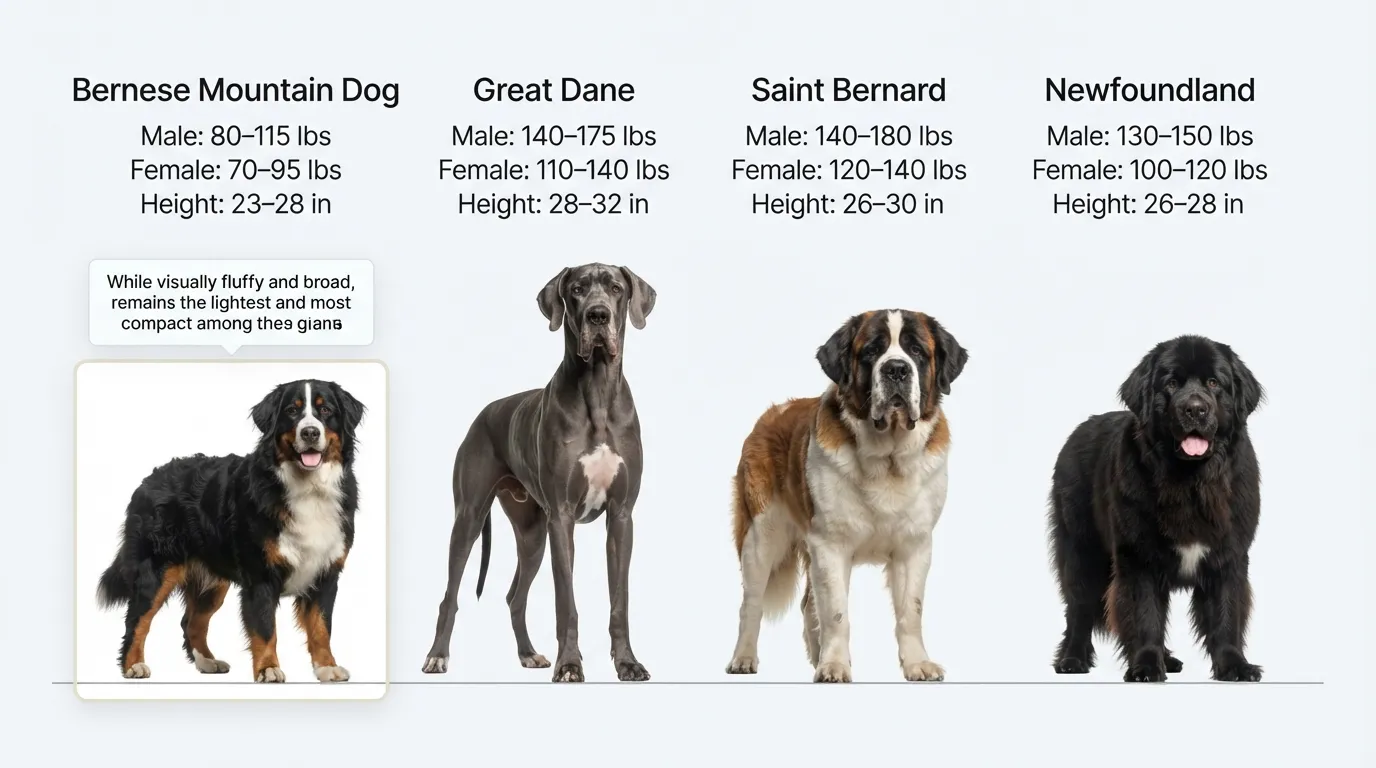
A full-grown Bernese Mountain Dog typically weighs between 70 to 115 pounds, placing them squarely in the giant breed category—though they are actually on the lighter, more agile end of the working group compared to true gentle titans like the Mastiff or Saint Bernard.
Here is how a healthy adult Berner compares to other popular giant breeds in average weight and frame size:
| Dog Breed | Average Male Weight | Average Female Weight | General Frame & Build |
|---|---|---|---|
| Bernese Mountain Dog | 80 – 115 lbs | 70 – 95 lbs | Heavy-boned, sturdy, compact giant build |
| Great Dane | 140 – 175 lbs | 110 – 140 lbs | Tall, lean, leggy, and muscular |
| Saint Bernard | 140 – 180 lbs | 120 – 140 lbs | Massive, extremely heavy-boned, stocky build |
| Newfoundland | 130 – 150 lbs | 100 – 120 lbs | Broad, heavy-coated, deep-chested swimmer’s build |
Weight-Related Health Concerns
Excess weight is the single biggest threat to a Bernese Mountain Dog’s overall lifespan and daily comfort. Because these dogs carry heavy frames by nature, carrying even an extra 5 to 10 pounds multiplies stress on their joints and internal organs, triggering or worsening several serious health conditions.
Hip & Elbow Dysplasia
Hip and elbow dysplasia occur when the hip socket or elbow joint develops abnormally, leading to friction, pain, and early-onset arthritis. While genetics set the foundation for dysplasia, extra weight is what speeds up joint destruction.
When a Bernese puppy gains weight too quickly, their rapidly growing bones cannot support the excess mass, putting uneven pressure on developing cartilage. Keeping your Berner at a lean, healthy weight reduces mechanical load on their joints, delaying the onset of stiffness and keeping them mobile far into their senior years.
Bloat Gastric Dilatation-Volvulus
Bloat, or GDV, is a life-threatening medical emergency where the stomach fills with gas and twists on itself, cutting off blood flow. Deep-chested giant breeds like Berners are already at high risk, but overweight dogs face even greater danger.
Excess abdominal fat crowds the stomach compartment and weakens the tissues holding it in place. Gulping food quickly—a common behavior in food-motivated or overweight dogs—further elevates risk. Feeding measured meals using a slow-feeder bowl and keeping your dog lean are critical daily habits to help prevent bloat.
Von Willebrand Disease
Von Willebrand Disease (vWD) is an inherited blood clotting disorder similar to hemophilia in humans. While extra weight does not directly cause vWD, overweight Bernese Mountain Dogs facing joint issues or bloat often require routine surgeries, pain management, or emergency procedures where proper blood clotting is essential.
A dog with vWD carrying excess weight is at higher risk for severe joint bleeding after simple stumbles or minor injuries, making weight management a non-negotiable part of keeping them safe and sound.
Bernese Mountain Dog vs Other Giant Breeds Weight Comparison Table
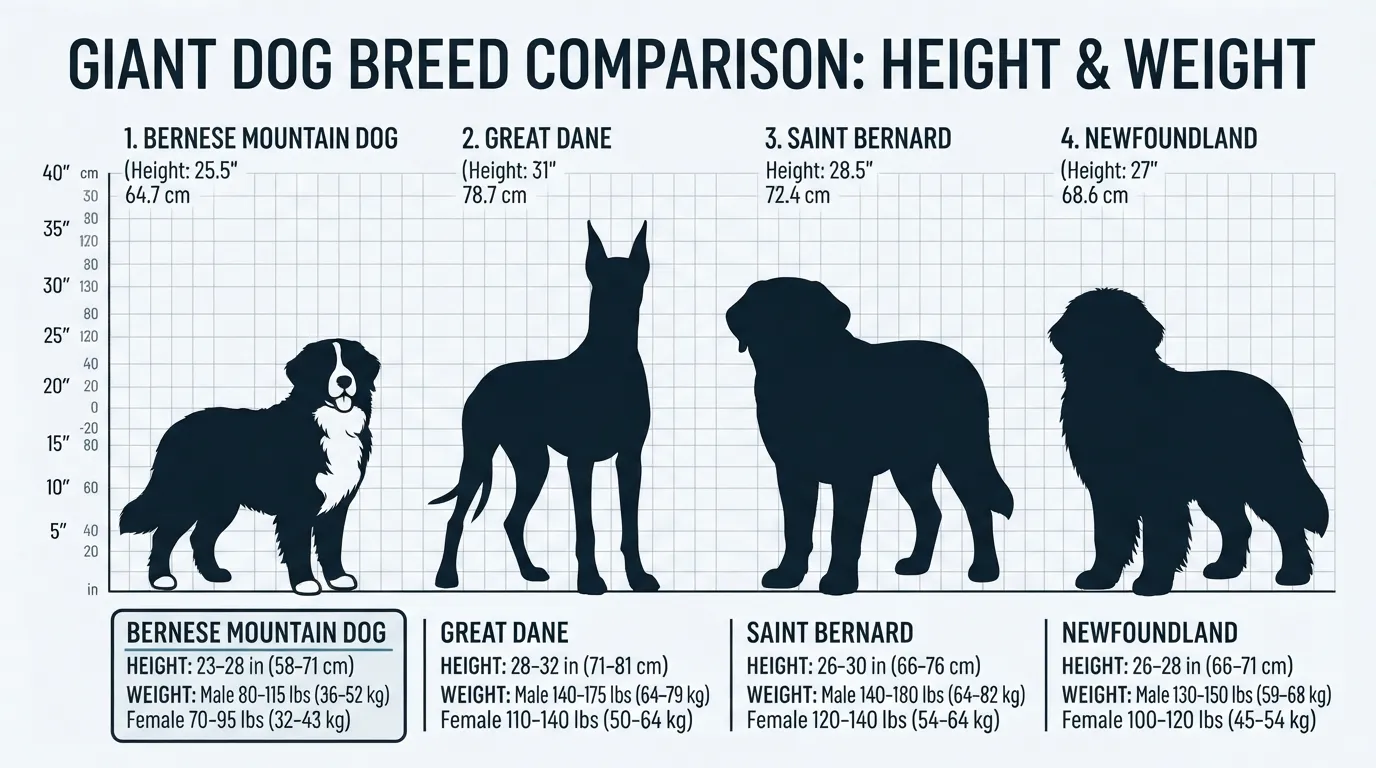
While Bernese Mountain Dogs are large, heavy-boned working dogs, they are actually on the lighter side of the giant breed spectrum. A fully grown Bernese typically weighs between 70 and 115 pounds, whereas breeds like the Saint Bernard or Great Dane regularly cross the 140-pound mark.
The table below shows how an adult Bernese compares in weight and height to other well-known giant breeds according to official kennel club standards:
| Dog Breed | Average Male Weight | Average Female Weight | Average Height at Shoulder |
|---|---|---|---|
| Bernese Mountain Dog | 80 – 115 lbs (36 – 52 kg) | 70 – 95 lbs (32 – 43 kg) | 23 – 28 inches |
| Great Dane | 140 – 175 lbs (63 – 79 kg) | 110 – 140 lbs (50 – 63 kg) | 28 – 32 inches |
| Saint Bernard | 140 – 180 lbs (63 – 81 kg) | 120 – 140 lbs (54 – 63 kg) | 26 – 30 inches |
| Newfoundland | 130 – 150 lbs (59 – 68 kg) | 100 – 120 lbs (45 – 54 kg) | 26 – 28 inches |
Because Berners carry a thick, double coat, they often look just as large as a Newfoundland or Saint Bernard at first glance. However, under all that fluff, their underlying bone structure is more compact, making them easier to manage than the true heavyweight mastiff breeds.
How Much Should I Feed My Bernese Mountain Dog? Concrete Feeding Chart

An adult Bernese Mountain Dog needs between 3 to 5 cups of high-quality large-breed dry food per day, divided into two meals. The exact portion depends primarily on your dog’s age, target body weight, and daily activity level.
The general daily feeding guidelines based on adult weight and life stage break down as follows:
| Weight Range | Puppy Daily Amount (3–12 months) | Adult Daily Amount (1–6 years) | Senior Daily Amount (7+ years) |
|---|---|---|---|
| 70 – 85 lbs | 3.5 – 4.5 cups (420 – 540g) | 3.0 – 3.75 cups (360 – 450g) | 2.5 – 3.0 cups (300 – 360g) |
| 85 – 100 lbs | 4.5 – 5.5 cups (540 – 660g) | 3.75 – 4.5 cups (450 – 540g) | 3.0 – 3.5 cups (360 – 420g) |
| 100 – 115+ lbs | 5.5 – 6.5 cups (660 – 780g) | 4.5 – 5.25 cups (540 – 630g) | 3.5 – 4.0 cups (420 – 480g) |
Puppy vs. Adult vs. Senior Feeding Needs
Puppies (Up to 18–24 Months): Growing Berner puppies need a formula specially balanced for large or giant breeds. Keeping growth slow and steady is crucial to avoid putting excess stress on their rapidly developing joints and hips. Avoid high-calorie growth formulas that cause rapid weight gain.
Adults (1 to 6 Years): Active adults need balanced protein and fat to maintain lean muscle without adding extra body fat. Split their total daily food allowance into at least two separate meals to lower the risk of Bloat (Gastric Dilation-Volvulus), a life-threatening condition common in deep-chested breeds.
Seniors (7+ Years): Metabolism naturally slows down as your dog ages and moves less. Senior Berners usually require around 20% fewer calories per day than active adults, alongside foods enriched with joint-support ingredients like glucosamine and chondroitin.
Always check your specific kibble’s caloric density (kcal/cup), as calorie content varies across brands. Keep snacks and training treats to under 10% of their total daily calorie intake to prevent unintended weight gain.
Frequently Asked Questions
| Question | Answer |
|---|---|
| What is the heaviest a Bernese Mountain Dog can get? | While average males weigh up to 115 lbs, exceptionally large Bernese Mountain Dogs can reach 120 – 140+ lbs depending on genetics and frame size. |
| Do male or female Bernese Mountain Dogs weigh more? | Male Bernese Mountain Dogs are noticeably heavier (80 – 115 lbs) compared to females (70 – 95 lbs) and have a larger, heavier-boned frame. |
| At what age is a Bernese Mountain Dog full grown? | They usually reach their full height around 12 to 15 months, but continue to fill out in chest width and body weight until 2 to 3 years of age. |
| How much should a 6-month-old Bernese Mountain Dog weigh? | A 6-month-old puppy typically weighs between 50 and 75 lbs, gaining roughly 2 to 3 lbs per week during peak growth. |
| How much do Bernese Mountain Dog puppies weigh at birth? | Newborn Bernese Mountain Dog puppies typically weigh between 1 to 1.5 lbs (16 to 24 ounces) at birth. |
| Is a 100 lb Bernese Mountain Dog overweight? | Not necessarily. For an adult male, 100 lbs is well within the healthy range (80 – 115 lbs). For an adult female, it may be slightly heavy depending on her height and frame. |
🐾 Other Age Guides

I built Dogagescalculator.com to give dog owners honest, science-backed answers instead of the outdated "×7" myth. Every figure here is checked against AKC, AVMA, and published veterinary research.
More about the author & this site →
Comments