Yorkie Dog Years to Human Years: Free Calculator & Complete Age Chart
If you still multiply your Yorkshire Terrier’s age by seven to find their human equivalent, you are getting a wildly inaccurate number. That old rule treats every dog identically, ignoring the biological reality that a 7-pound toy breed ages on a completely different trajectory than a 70-pound Retriever.
Your Yorkie actually packs most of their physical development into their first 12 to 24 months before settling into a surprisingly gradual aging pace.
This guide breaks down the science of converting yorkie dog years to human years. You will discover official American Veterinary Medical Association (AVMA) guidelines, cutting-edge genetic research, and a realistic look at Yorkie life stages and lifespan expectations.
Use our free age calculator above to pinpoint your Yorkie’s exact human age in seconds, then read on to see how your tiny companion’s biological clock really ticks.
Yorkie Age Calculator — Find Your Dog's Human Age Instantly
How Accurate Is This Calculator?
This calculator gives you a highly reliable estimate based on modern veterinary aging guidelines and toy-breed growth patterns. That said, no digital tool can account for every single variable in your dog’s life.
Your Yorkie’s true biological age depends on a mix of genetics, diet, daily exercise, dental health, and preventative medical care. Think of this result as a clear biological benchmark to help you tailor your care routines, rather than an exact medical pinpoint.
Quick Answer: Common Yorkie Ages Converted
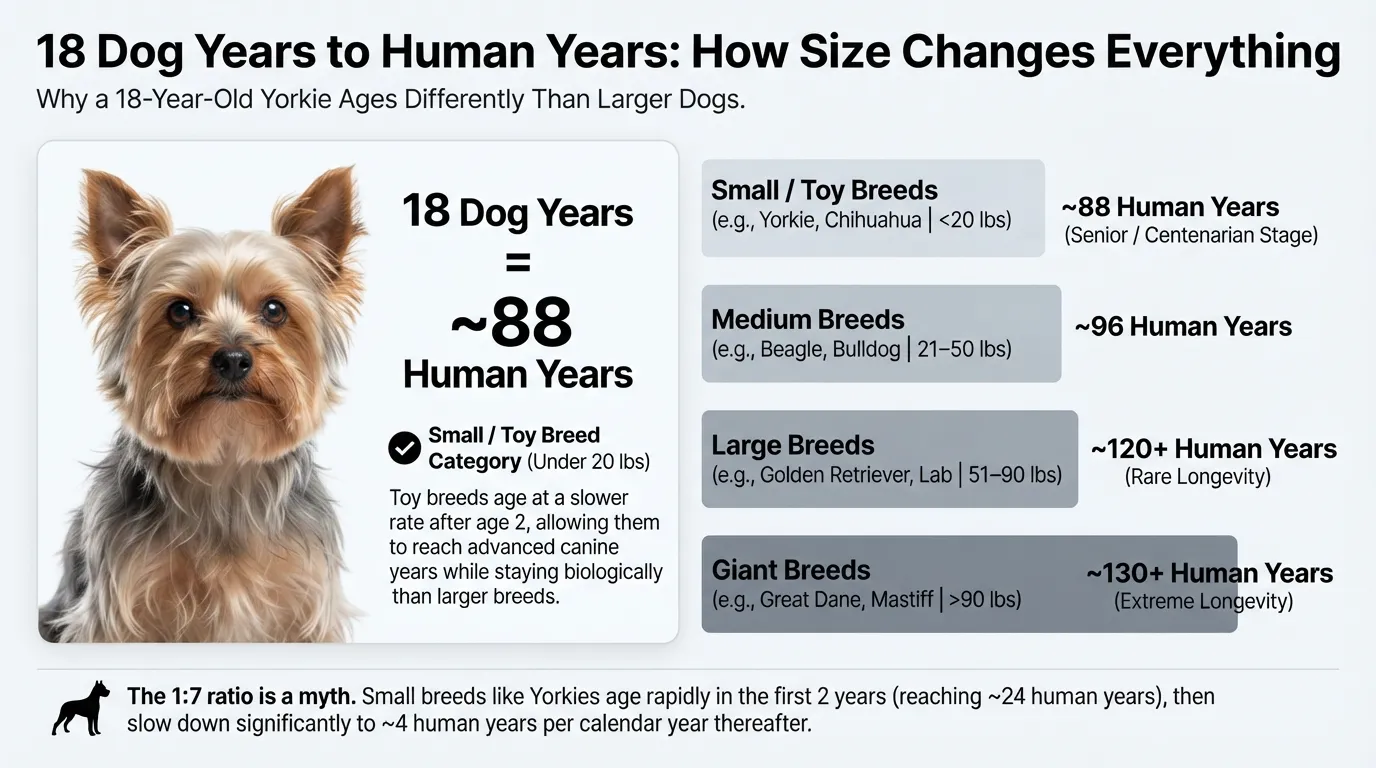
Converting Yorkie dog years to human years requires looking beyond the old “multiply by seven” rule. Small toy breeds like Yorkshire Terriers mature rapidly during their first two years before settling into a much slower aging pace than larger dogs.
Here is a quick breakdown of how common Yorkie ages translate into human years, based on standard American Veterinary Medical Association (AVMA) guidelines:
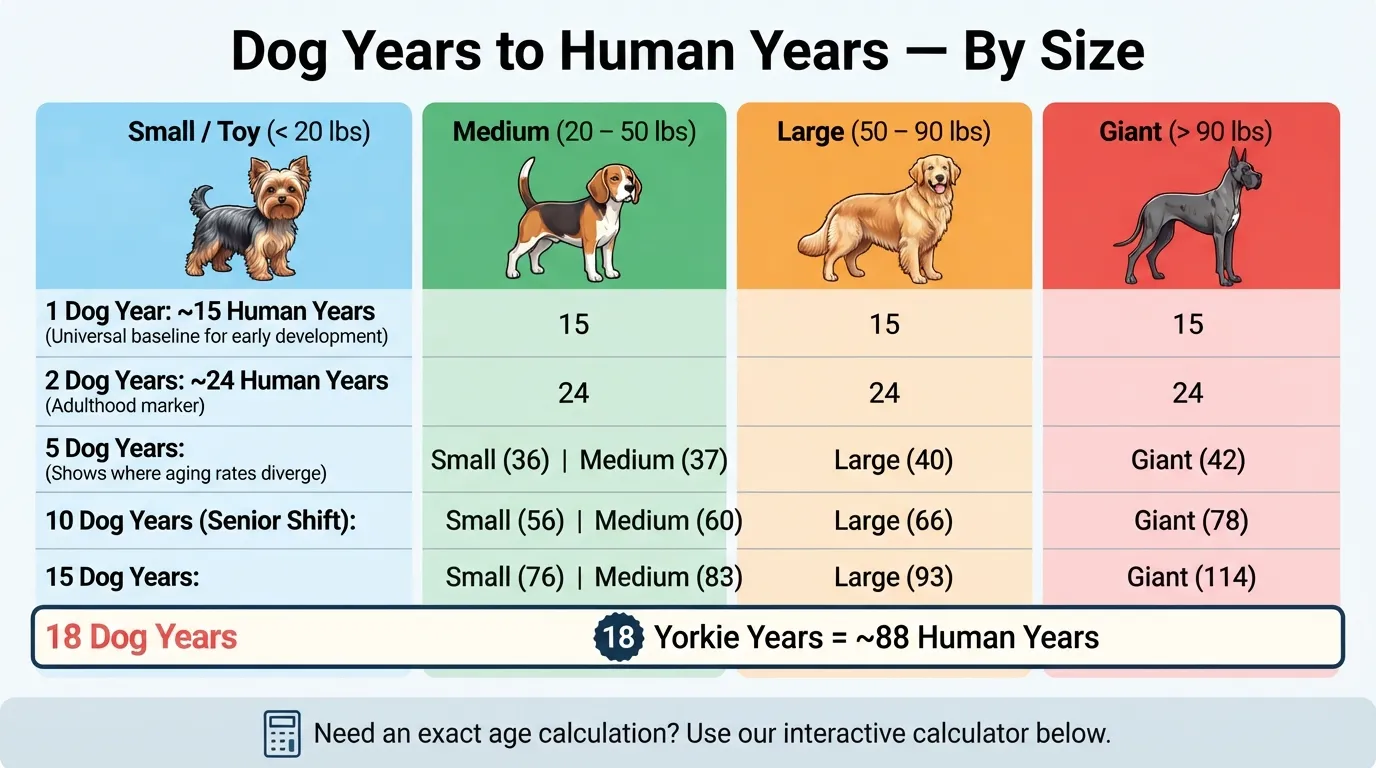
1 Yorkie year = ~15 human years
2 Yorkie years = ~24 human years
5 Yorkie years = ~36 human years
10 Yorkie years = ~56 human years
15 Yorkie years = ~76 human years
Because your Yorkie ages roughly four to five human years for every calendar year after age two, their aging curve stays relatively gentle. That slower pace in mid-to-late adulthood explains why so many toy terriers comfortably reach their mid-teens with great quality of life.
Why the "1 Dog Year = 7 Human Years" Rule Doesn't Work for Yorkies
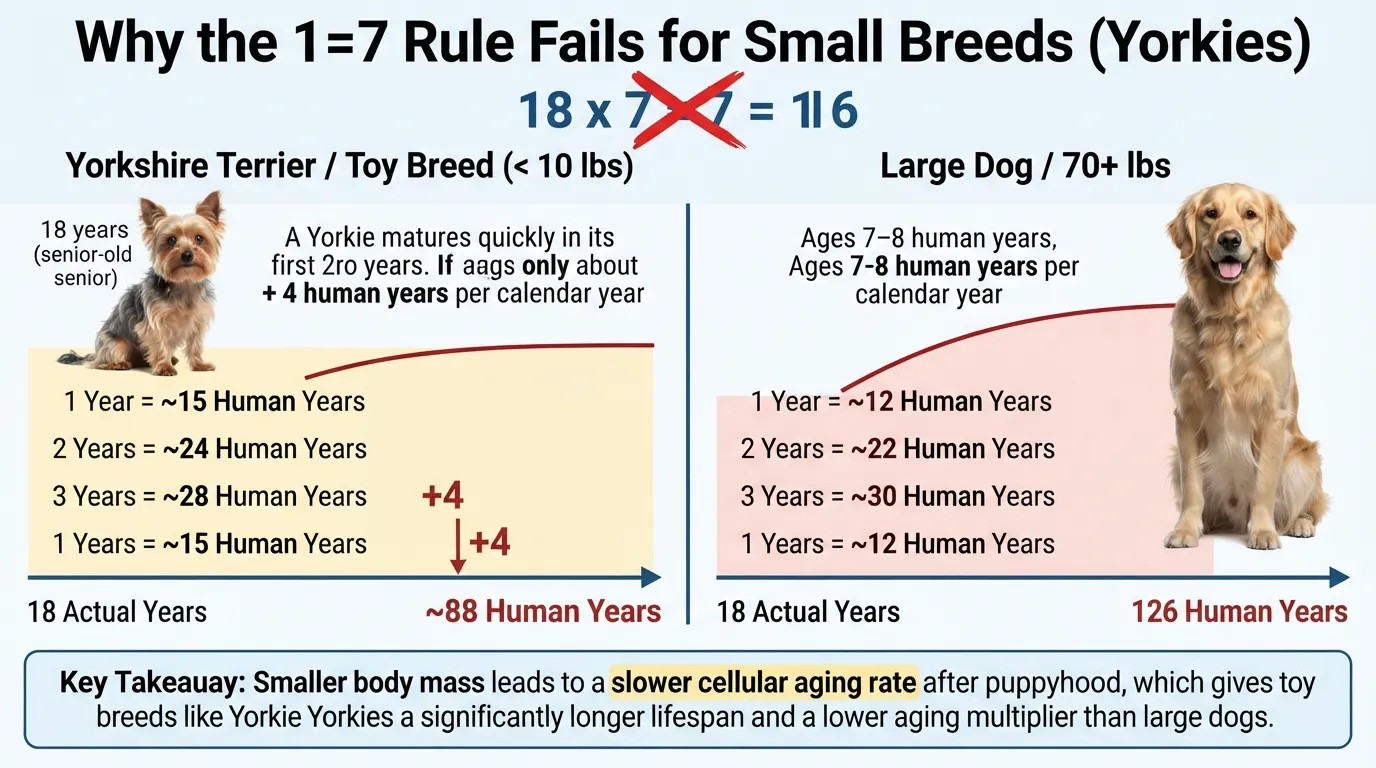
Most of us grew up hearing that every calendar year equals seven human years. If you use that math when converting Yorkie dog years to human years, a 10-year-old Yorkshire Terrier would be 70, and a 15-year-old would be 105.
That simple multiplication completely misses how toy breeds actually grow, mature, and age.
Where This Old Rule Came From
The “1 to 7” rule popped up in the 1950s. It wasn’t derived from veterinary medicine or biological research. Instead, it was a rough marketing rule of thumb based on a simple statistic: the average human lived about 70 years, and the average dog lived about 10.
Dividing 70 by 10 gave the public a convenient mental shortcut. The problem is that it treats a 4-pound Yorkie and a 140-pound Mastiff as if their bodies age at the exact same rate.
Why Small Breeds Like Yorkies Age Differently
Canine aging isn’t a straight line. Toy breeds follow a unique biological curve—they race through childhood, then settle into a much slower aging process throughout adulthood.
Rapid maturity in the first two years: A Yorkie reaches physical and reproductive maturity fast. By their first birthday, a Yorkie is biologically equivalent to a 15-year-old human teenager. By age two, they are roughly equal to a 24-year-old adult.
Slower aging after adulthood: Once a Yorkie hits full adulthood, their biological clock decelerates significantly. While a large dog might age 7 to 8 human years for every calendar year after age two, a Yorkie only ticks up roughly 4 to 5 human years annually.
Toy breeds outlive large breeds: Longevity research reveals that rapid growth in large dogs is linked to higher cellular turnover and earlier age-related illness. Because Yorkies weigh only 4 to 7 pounds, their tiny frames experience far less metabolic strain over time.
This distinct aging curve isn’t limited to Yorkies; fellow toy companions like Chihuahuas, Pomeranians, and Maltese follow almost the exact same developmental timeline and share similar 12-to-16-year lifespans.
The Science Behind Dog Age Conversion
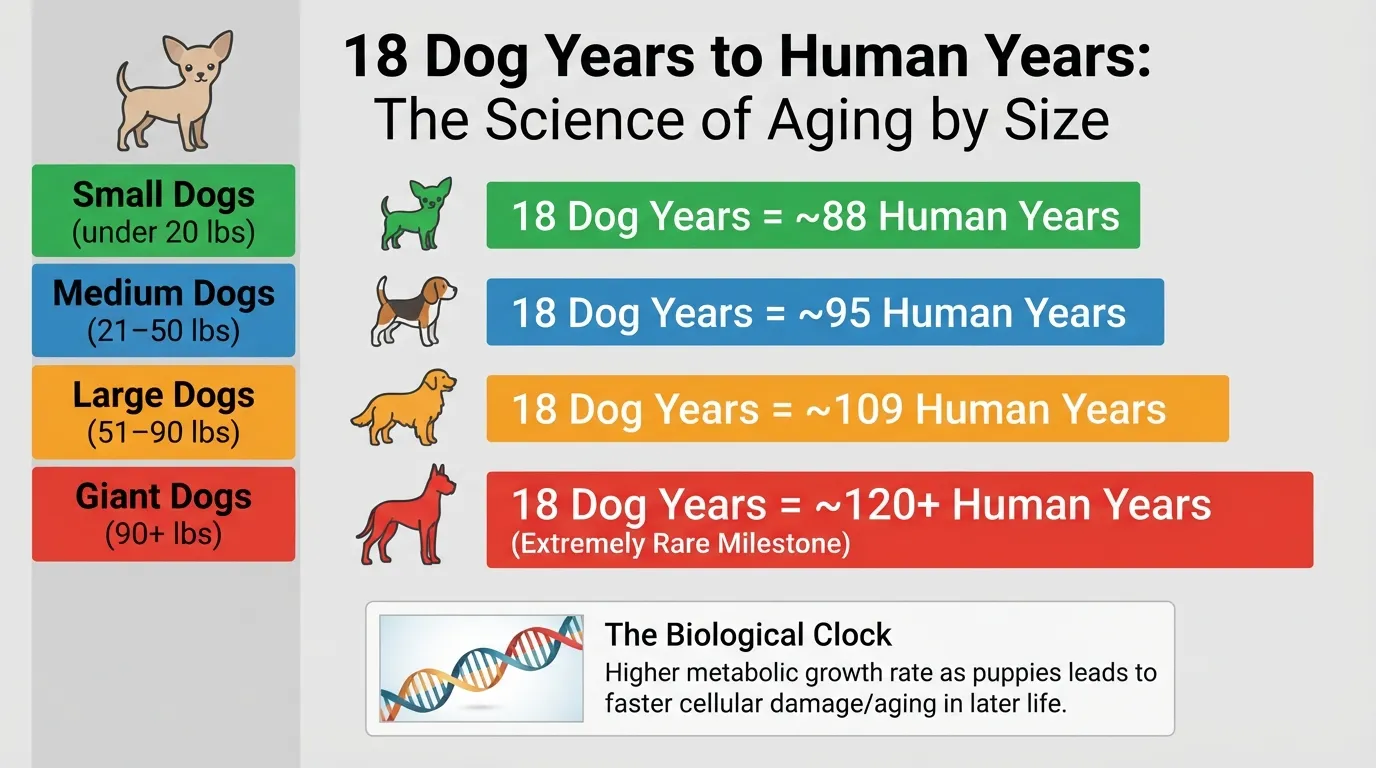
Converting yorkie dog years to human years requires moving past the outdated 1950s myth that one dog year equals seven human years. Canine development is non-linear—dogs grow rapidly during infancy and early youth before their aging rate stabilizes. Modern veterinary science relies on two main frameworks to map this growth accurately.
AVMA’s Official Guideline 15-9-5 rule
The American Veterinary Medical Association (AVMA) provides a widely accepted baseline that accounts for the rapid early development of canines. Rather than multiplying by a flat number, this model breaks physical growth down by milestone stages:
Year 1 equals 15 human years: A puppy reaches adolescent maturity within its first twelve months.
Year 2 adds roughly 9 human years: By age two, a dog is roughly equivalent in physical maturity to a 24-year-old human adult.
Year 3 and beyond add roughly 5 human years each: Once full physical maturity is reached, aging settles into a steady yearly pace.
This framework gives a far more realistic estimate of a dog’s biological age than legacy rules of thumb.
The Epigenetic DNA Methylation Formula
In 2019, researchers at the University of California, San Diego introduced a precise molecular approach to tracking canine aging. By studying DNA methylation—chemical tags that accumulate on DNA over time to reveal true biological age—the team developed a natural logarithm formula:
To put this formula into plain terms, the logarithmic function $(\ln)$ reflects how cellular aging starts extremely fast in early puppyhood and decelerates as time goes on. A one-year-old dog has already reached a biological milestone roughly equal to a 31-year-old human, but their cellular aging rate slows drastically for the remainder of their lifespan.
While this study examined Labrador Retrievers, it established the most scientifically grounded foundation available for understanding canine DNA aging.
How This Applies Specifically to Yorkies
Toy breeds follow a distinct physiological aging curve compared to larger dogs. A Yorkshire Terrier rapidly matures through its puppy phase during months 1 through 12, but once past young adulthood, its metabolic aging rate slows down significantly.
Rapid early maturation: Yorkies reach sexual and structural maturity quickly, matching adult physiological markers within their first two years.
Slower senior decline: After reaching adulthood, a Yorkie’s cellular aging proceeds at a gentler rate than that of a medium or giant breed.
Impact of body mass on lifespan: Longevity research indicates that every additional 4.4 pounds of body mass correlates with roughly one less month of life expectancy. Because Yorkies typically weigh under 7 pounds, they avoid the accelerated age-related wear that heavier dogs experience.
This unique growth curve explains why a well-cared-for Yorkshire Terrier routinely reaches 12 to 16 years of age, with many thriving well into their late teens.
Yorkie Age Chart: Dog Years to Human Years
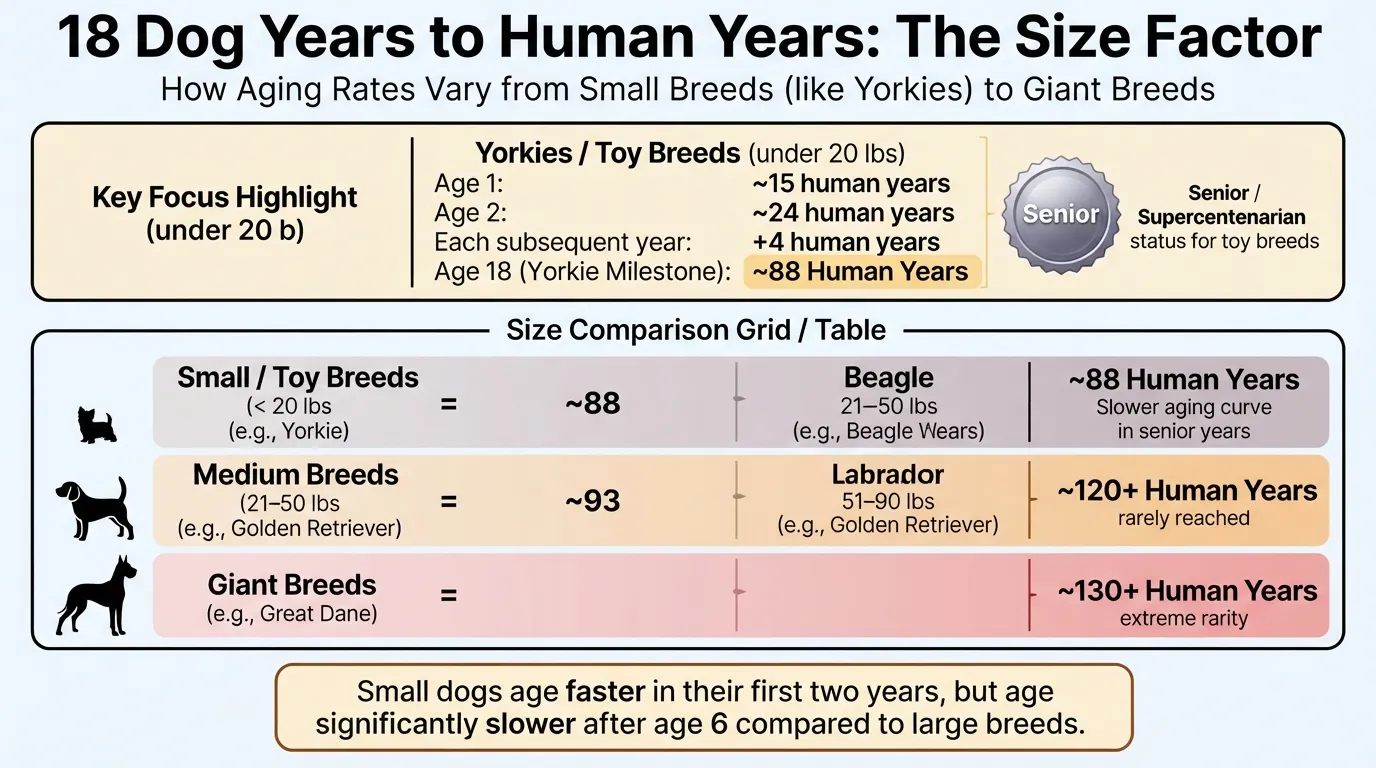
To give you a quick, reliable snapshot without doing mental math, here is a complete age conversion chart tailored for Yorkshire Terriers. It reflects the faster physical maturation during a Yorkie’s early months paired with their slower aging rate during adulthood.
| Yorkie Age (Actual Years) | Estimated Human Age Equivalent | Life Stage |
|---|---|---|
| 6 Months | 10 years | Puppy |
| 1 Year | 15 years | Young Adult |
| 2 Years | 24 years | Adult |
| 3 Years | 29 years | Adult |
| 4 Years | 34 years | Adult |
| 5 Years | 39 years | Adult |
| 6 Years | 44 years | Adult |
| 7 Years | 49 years | Mature Adult |
| 8 Years | 54 years | Senior |
| 9 Years | 59 years | Senior |
| 10 Years | 64 years | Senior |
| 11 Years | 69 years | Senior |
| 12 Years | 74 years | Senior |
| 13 Years | 79 years | Geriatric |
| 14 Years | 84 years | Geriatric |
| 15 Years | 89 years | Geriatric |
| 16 Years | 94 years | Geriatric |
| 17 Years | 99 years | Geriatric |
| 18 Years | 104 years | Centenarian |
| 19 Years | 109 years | Centenarian |
| 20 Years | 114 years | Centenarian |
Downloadable & Shareable Yorkie Age Chart
Save this visual guide to your phone or pin it on Pinterest to keep quick track of your dog’s milestones as they grow.
Feel free to download, print, or share this chart with fellow Yorkie owners, breeders, and dog lovers!
Does Size Matter? Teacup vs Standard Yorkie Aging
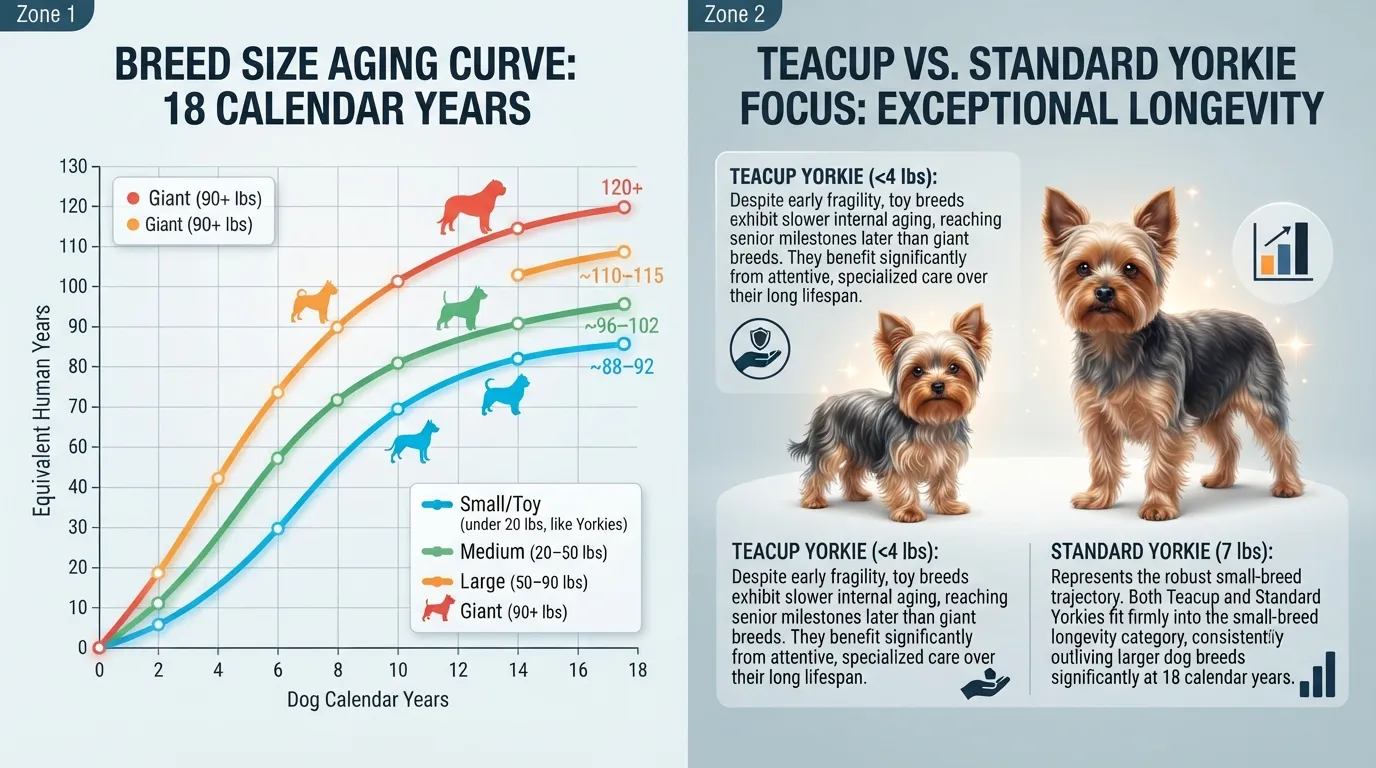
While toy breeds as a rule outlive giant breeds, extreme size variations within the Yorkshire Terrier breed complicate aging.
A standard Yorkie typically weighs 4 to 7 pounds. At this size, your dog hits the longevity sweet spot for canines. Research shows that for every 4.4 pounds of body mass a dog species gains, their overall life expectancy drops by roughly one month. Small body mass means less physiological strain on organs during growth, slower cell degradation, and a significantly longer adult life stage.
“Teacup” Yorkies, however, present a different aging curve. Unofficial “teacups” — dogs bred to weigh under 4 pounds — do not age faster biologically, but they face structural health vulnerabilities that frequently impact their lifespan:
Hypoglycemia risk: Tiny muscle mass makes storing glucose difficult, causing sudden blood sugar drops even into adulthood.
Fragile skeletal structure: Bones are far thinner, increasing the risk of traumatic injuries and early-onset luxating patellas (dislocated kneecaps).
Severe dental crowding: An ultra-small jaw leads to crowded teeth, accelerating periodontal disease and systemic inflammation earlier in life.
Congenital defects: Unethical miniaturization often passes down genetic issues like portosystemic (liver) shunts and collapsing tracheas.
Because of these complications, standard Yorkies routinely live 13 to 16 years, whereas micro-sized Yorkies often average 11 to 13 years without meticulous daily care. When calculating age in human years, a standard Yorkie follows the typical small-breed aging formula, but extra-small dogs require earlier veterinary monitoring for senior-related conditions.
What About Yorkie Mixes Yorkiepoo, Morkie, etc.?
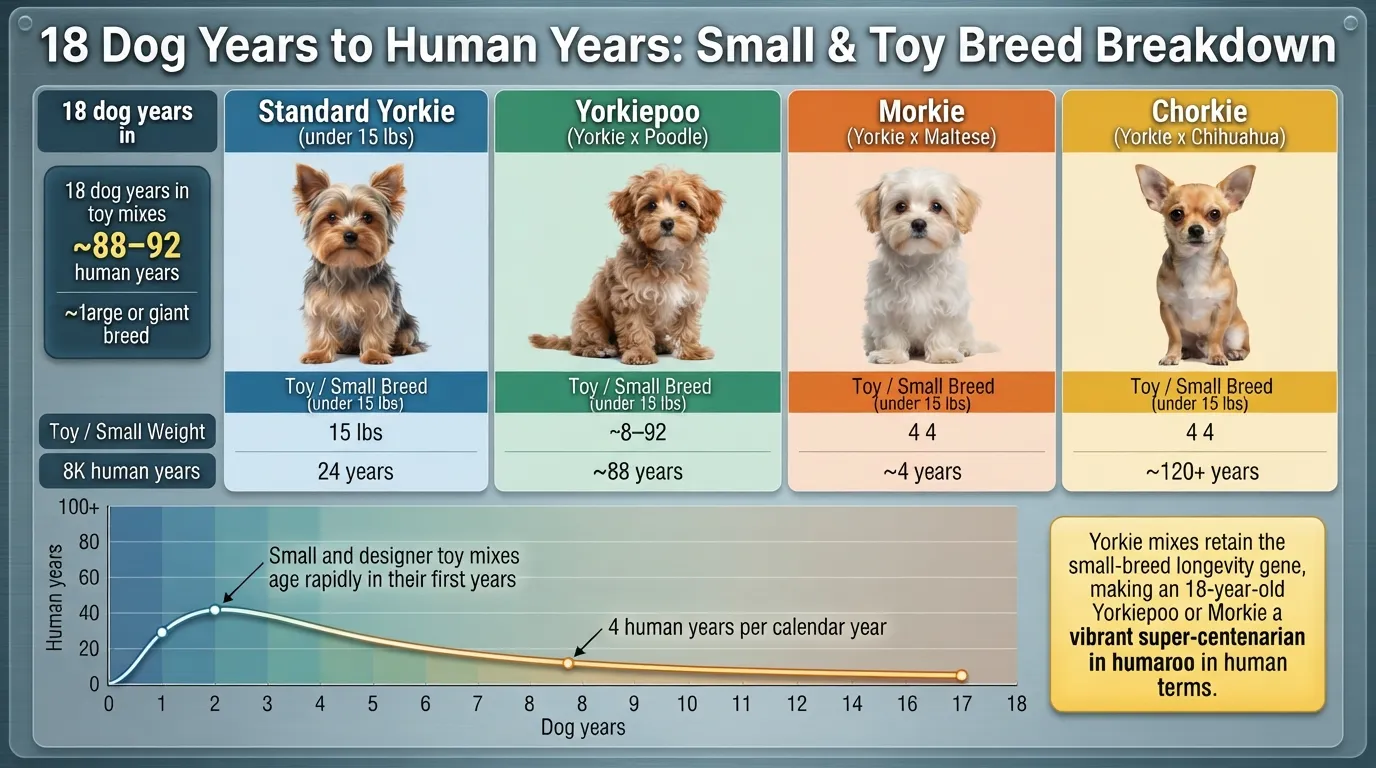
Calculating dog years for a Yorkie crossbreed like a Yorkiepoo (Yorkshire Terrier + Poodle), Morkie (Yorkshire Terrier + Maltese), or Chorkie (Yorkshire Terrier + Chihuahua) follows the exact same small-breed aging logic. Because these parent breeds all fall into the toy or small-dog category, their physical development and aging rate mirror a purebred Yorkie almost identically.
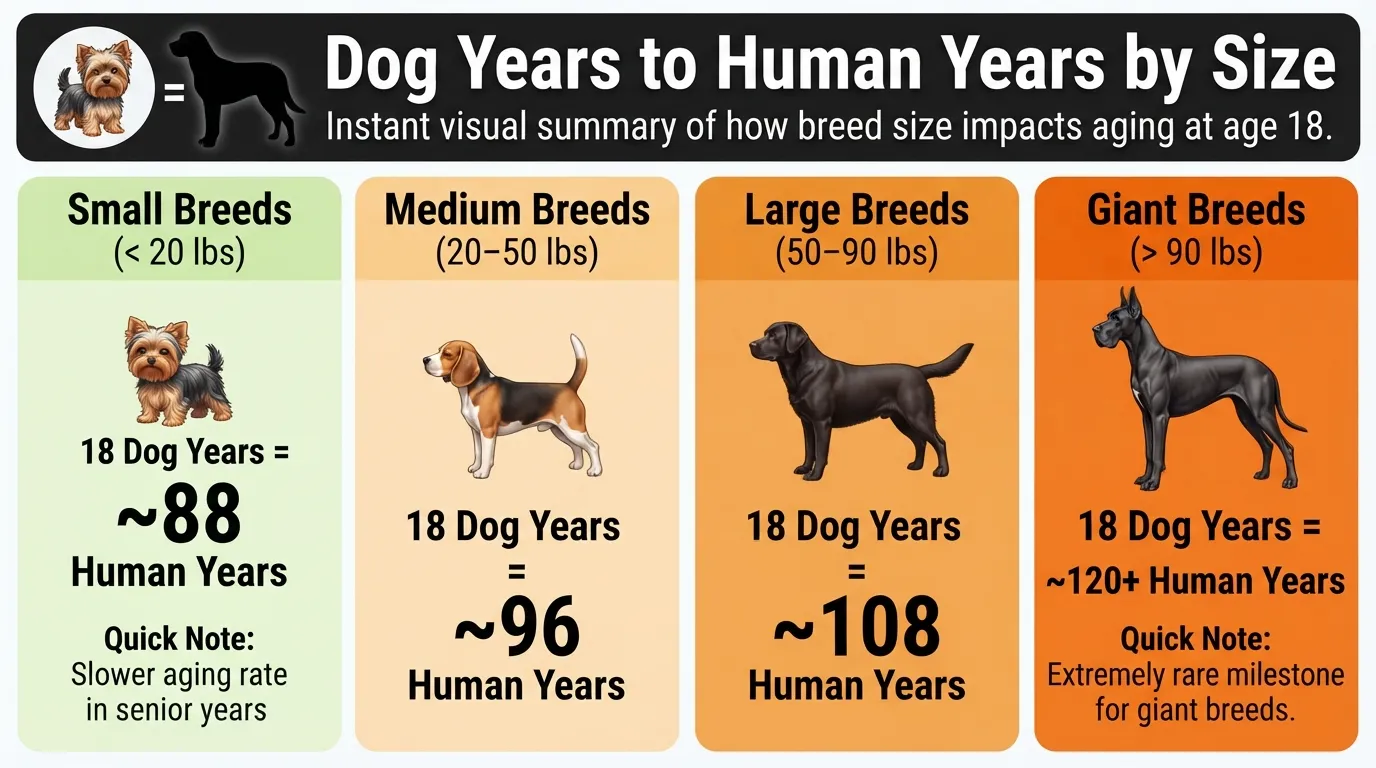
Your Yorkie mix will still reach adulthood around 12 months, transition to senior status around age 8, and enjoy a similar average lifespan of 12 to 16 years. The age calculator at the top of this page gives an accurate estimate for any small Yorkie hybrid weighing under 20 pounds.
Note on mixed breed sizes: If your Yorkie is crossed with a larger breed—such as a Medium Poodle or a Beagle—their overall adult weight will change their aging curve. Dogs over 20 to 25 pounds mature and age faster in human-equivalent years than true toy breeds, so their estimated age may skew slightly lower in senior years.
Yorkie Life Stages Explained
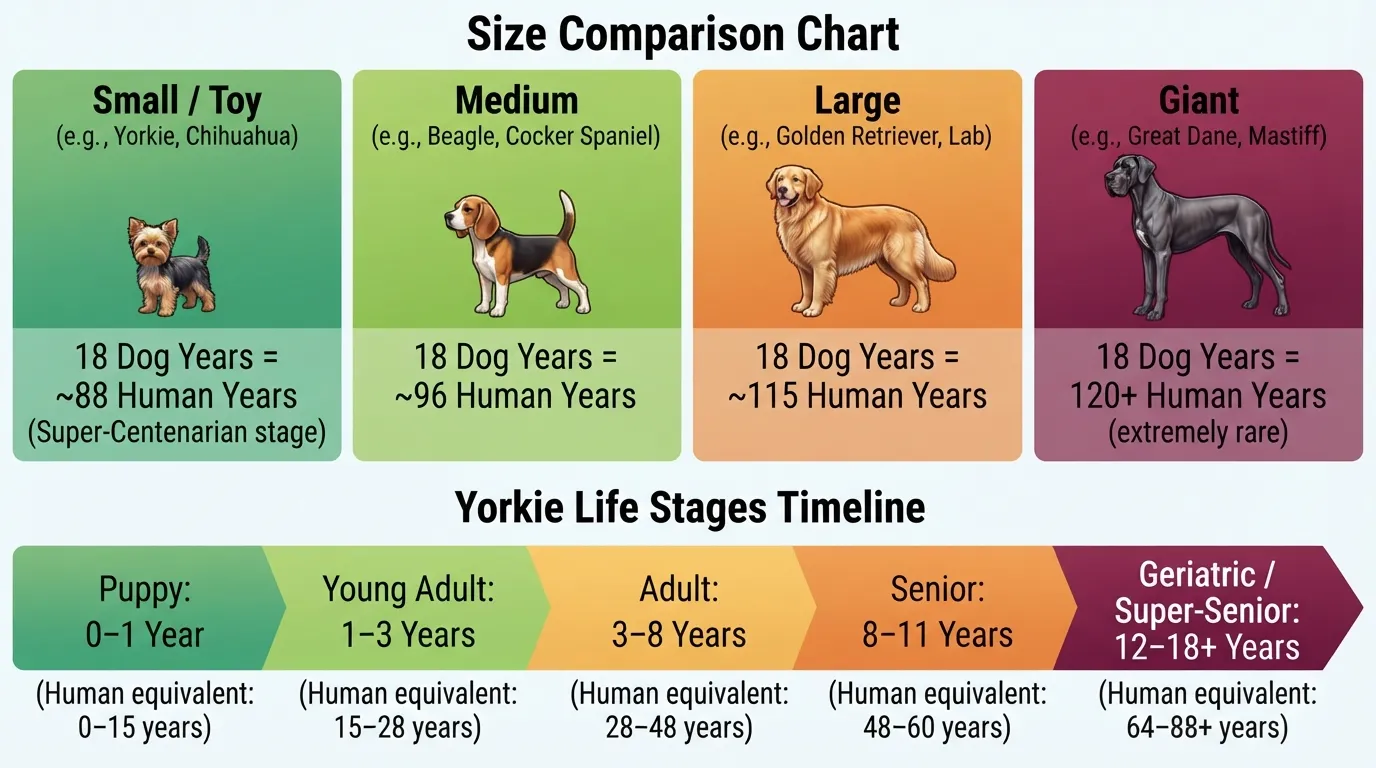
Yorkies grow up fast in their first 12 to 24 months, then settle into a long, slow aging process. Understanding these distinct life stages helps you adjust your care as your Yorkie dog years to human years transition unfolds.
Puppy Stage 0-1 Year — Rapid Growth
Your Yorkie undergoes more physical transformation in this first year than during any other period of their life.
Birth to 8 Weeks: Newborn Yorkies weigh just 3 to 5 ounces. They rely entirely on their mother for warmth and milk until weaning begins around 4 to 6 weeks.
8 Weeks: Most puppies go to their forever homes around this time. They are tiny, curious, and need frequent, small meals to prevent sudden drops in blood sugar (hypoglycemia).
Teething 4-8 Months: Baby teeth fall out as adult teeth push through. Provide soft, safe chew toys to protect your furniture and relieve gum discomfort.
Full Size Milestones 8-12 Months: Most Yorkies reach their full adult weight and height between 8 and 12 months, usually topping out between 4 and 7 pounds.
Adult Stage 1-8 Years — Prime of Life
Once your Yorkie reaches age one, they enter a long, steady plateau of adult energy and health.
Behavior: Adult Yorkies keep their signature feisty terrier personality. They are alert, energetic, and fiercely loyal, often acting like giant dogs in tiny bodies.
Care Needs: Focus on high-quality nutrition tailored for toy breeds, daily interactive play, and regular dental care. Because toy breeds are prone to tartar buildup and luxating patellas (slipping kneecaps), routine annual vet checkups are essential during these prime years.
Senior Stage 8+ Years — Golden Years
Yorkies are generally considered seniors around age 8, though many maintain a playful, spirited attitude well past double digits.
Signs of Aging: You may notice slight clouding in their eyes, graying facial hair, slower movement, or changes in sleeping patterns. Dental issues can also become more pronounced if not managed early.
Care Adjustments: Switch to a senior toy-breed diet, place ramps or pet steps near furniture to protect their joints, and increase vet visits to twice a year. Routine screenings for heart issues, kidney function, and vision changes help catch potential problems early.
What Age Is a Yorkie Considered a Senior?
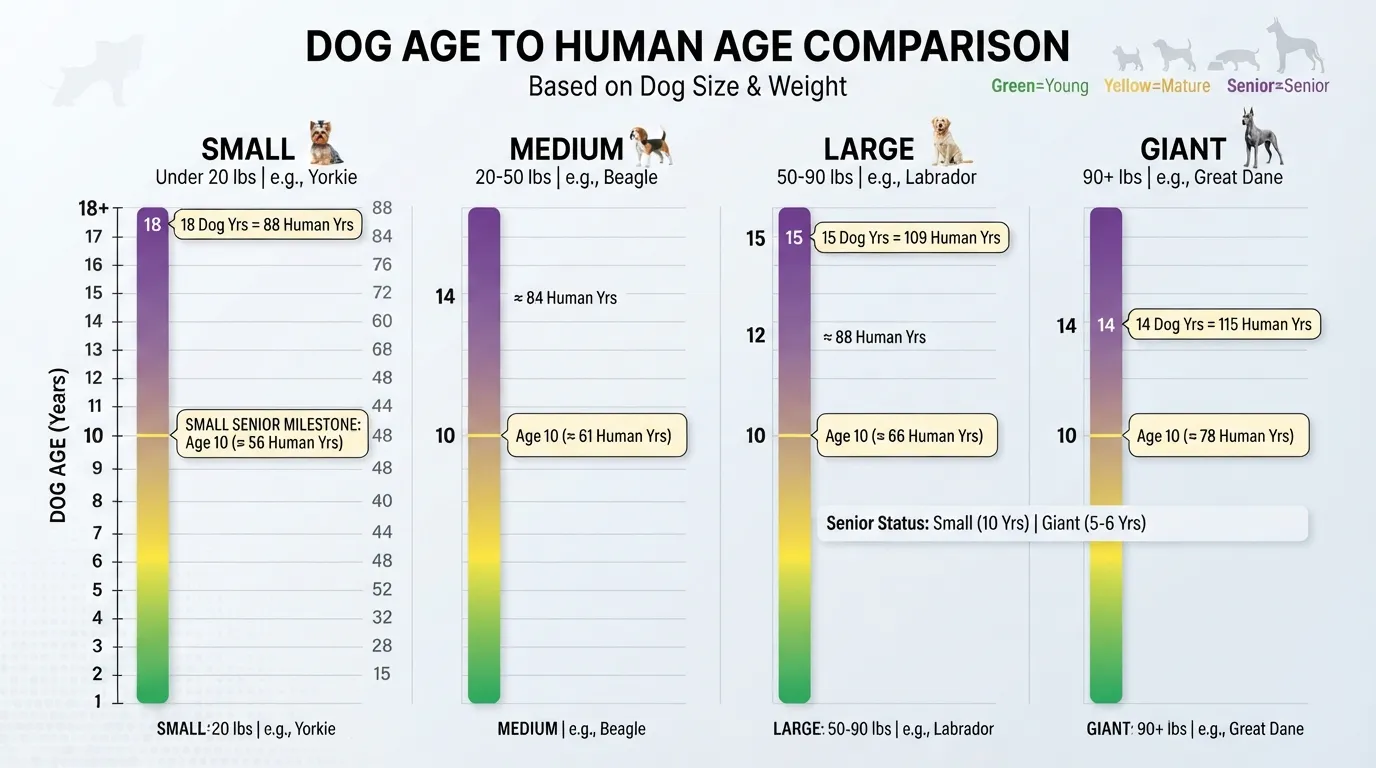
Yorkies are generally considered senior dogs when they reach 8 years of age, though some veterinarians mark the transition as early as age 7.
Because toy breeds age more slowly than larger dogs during their adult years, an 8-year-old Yorkie is roughly equivalent to a human in their late 40s. They still have plenty of vitality left, but their body requirements start shifting. Metabolic rates slow down, joints benefit from extra support, and routine dental care becomes vital to protect against gum disease.
Veterinary organizations like the American Veterinary Medical Association (AVMA) and the American Kennel Club emphasize the 7- to 8-year mark so owners can proactively adjust wellness plans, scheduling bi-annual checkups to catch age-related health changes early.
Factors That Affect a Yorkie's Aging Rate
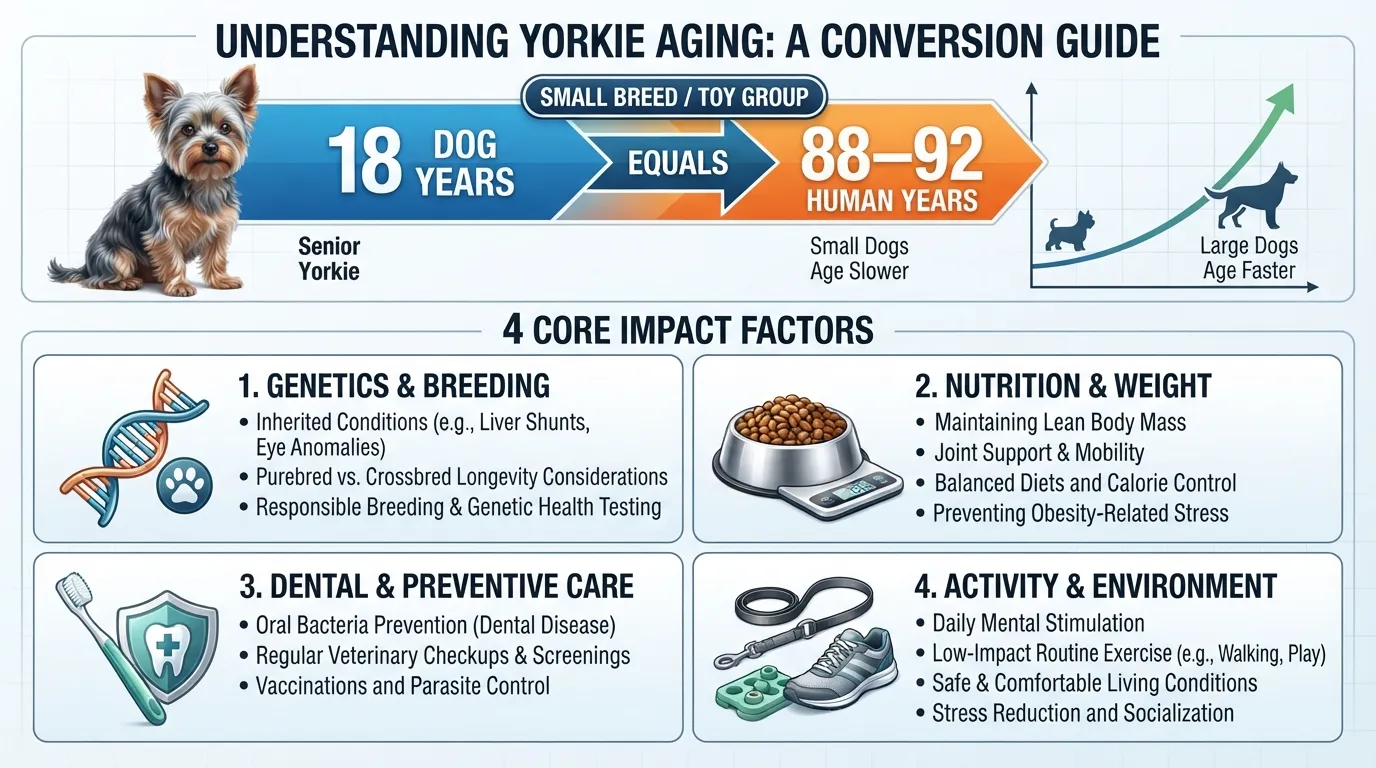
Calculating your yorkie dog years to human years gives you a solid baseline, but biological aging varies from dog to dog. Small breeds naturally enjoy longer lifespans than large dogs, yet specific daily habits heavily influence how quickly your companion actually ages.
Genetics
Inherited traits set the baseline for your dog’s longevity. Reputable breeders screen for hereditary conditions common in toy breeds—such as luxating patellas, portosystemic shunts, and tracheal collapse—that cause premature physical wear. A puppy born from healthy lineage starts with a clear physiological advantage.
Diet & Weight Management
Carrying excess body mass accelerates joint degradation and organ strain, which speeds up biological aging.
Calorie precision: A single extra pound on a 6-pound Yorkie adds roughly 16% more body weight, putting severe stress on tiny joints and lungs.
Targeted nutrition: High-quality protein preserves lean muscle mass, while omega-3 fatty acids protect aging joints and brain health.
Exercise & Mental Stimulation
Regular movement keeps joints fluid, preserves cardiovascular strength, and maintains muscle tone into late adulthood. Two short daily walks matched to your dog’s pace work far better than sporadic high-intensity exertion. Brain work matters just as much; food puzzles and scent games build cognitive resilience, helping stave off age-related mental decline.
Preventive Vet Care
Routine veterinary oversight catches health shifts before they become irreversible problems.
Dental hygiene: Crowded teeth make Yorkies prone to severe periodontal disease. Oral bacteria frequently enter the bloodstream, directly damaging the heart and kidneys.
Senior screening: Bi-annual checkups starting around age seven allow your vet to spot early renal changes, cardiac murmurs, or metabolic shifts via routine blood work.
Average Yorkie Lifespan — How Long Do Yorkies Live?
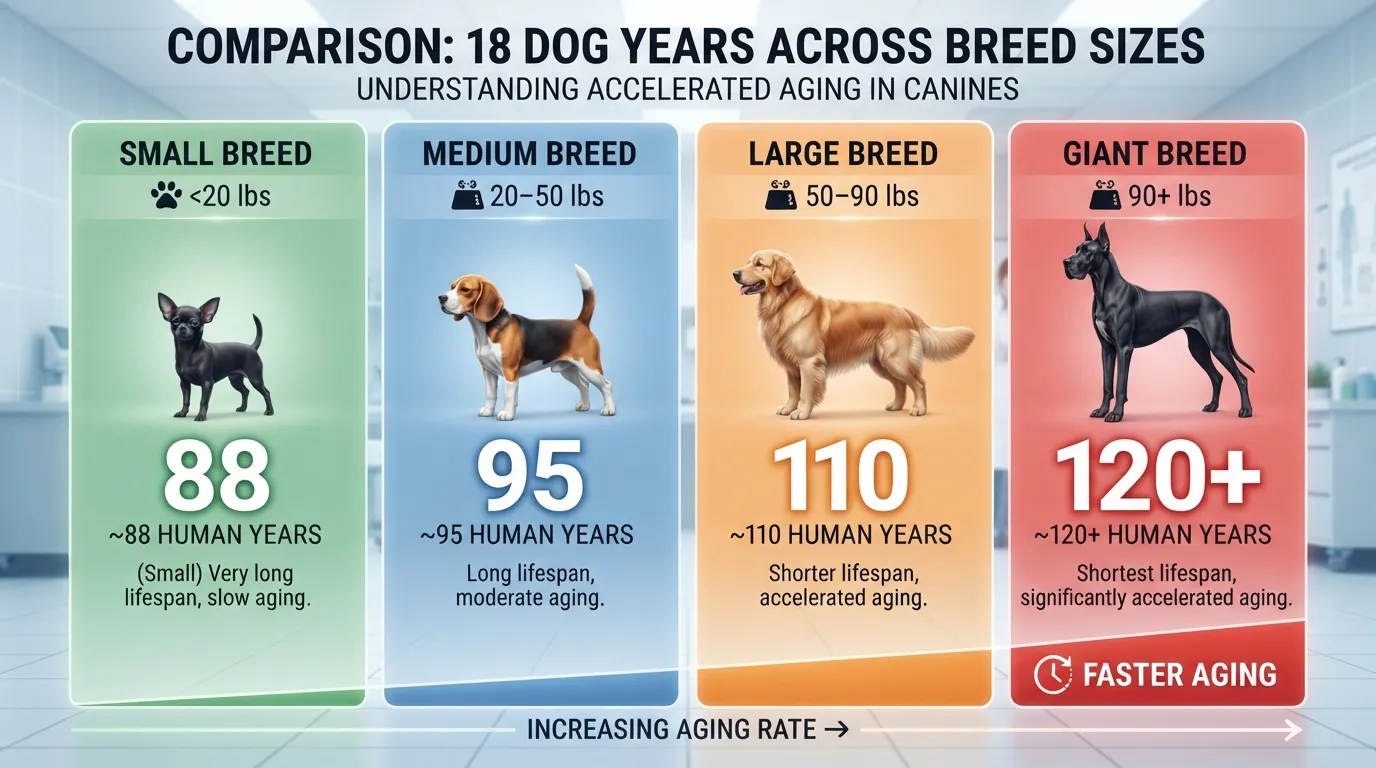
On average, a healthy Yorkshire Terrier lives between 12 and 16 years. That is significantly longer than the average lifespan of larger breeds, which typically ranges from 8 to 12 years. With exceptional care, regular vet checkups, and a bit of good genetics, some Yorkies even reach 17 or 18 years old.
Why do these tiny dogs outlive giant breeds by such a wide margin? It boils down to how different body sizes age:
Slowed biological aging: While toy breeds mature quickly during their first two years, their aging process slows down considerably as adults.
The body mass effect: Longevity research shows that every 4.4 pounds of body mass in dogs is associated with roughly one less month of life expectancy. Because Yorkies usually weigh between 4 and 7 pounds, their small frame places far less wear and tear on their organs and cardiovascular system over time.
While genetics set the baseline, daily care determines where your dog falls on that spectrum. Attentive dental care, weight management, and early screening for common toy-breed health issues go a long way toward helping your Yorkie reach their late teens.
How to Help Your Yorkie Age Healthily Tips by Life Stage
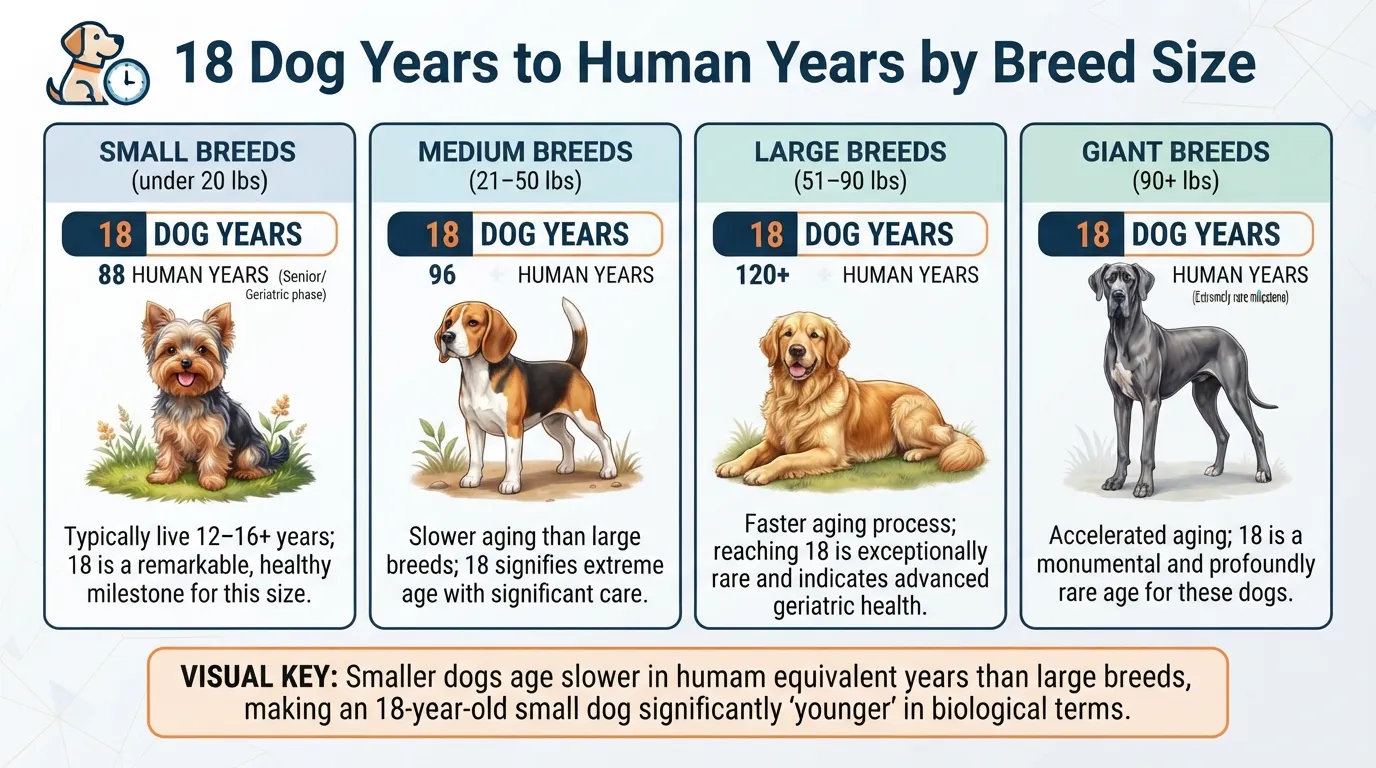
Converting your Yorkie dog years to human years gives you a helpful lens into what your dog is experiencing physically. Because a 1-year-old Yorkie is already equivalent to a human teenager, while an 8-year-old is entering their senior era, their daily care needs shift significantly over time.
Here are practical, stage-by-stage focus areas to support your Yorkie’s health and longevity.
Puppyhood (0–1 Year | ~0 to 15 Human Years): Build the Foundation
Protect tiny joints: Avoid letting your puppy leap off high couches or beds. Toy breeds are prone to patellar luxation (slipping kneecaps), and early impact can strain developing joints.
Prioritize dental habits early: Get your puppy used to daily tooth brushing immediately. Small mouths mean crowded teeth, making Yorkies notoriously susceptible to severe periodontal disease later in life.
Maintain steady calories: Toy puppies have minimal fat stores and can quickly develop hypoglycemia (low blood sugar). Feed high-quality puppy food on a consistent, frequent schedule.
Adulthood (1–8 Years | ~24 to 54 Human Years): Maintain Peak Wellness
Schedule routine dental cleanings: Brushing helps, but professional veterinary cleanings are essential for preventing bacteria from damaging organs like the heart and kidneys as your dog ages.
Keep weight strictly in check: Even a single extra pound on a 6-pound Yorkie adds massive strain to their spine and respiratory system, increasing the risk of tracheal collapse.
Incorporate low-impact exercise: Daily 20-to-30-minute walks keep muscle tone strong without exhausting their compact frames.
Senior Years (8+ Years | ~54+ Human Years): Adapt for Comfort and Longevity
Switch to bi-annual vet checkups: Catching subtle changes in kidney function, cardiac health, or blood sugar early makes a massive difference in treatment success.
Add joint support and ramp access: Place pet steps next to furniture so your senior doesn’t have to jump. Ask your vet about omega-3 fatty acids or joint supplements to soothe stiff hips.
Monitor vision and cognitive shifts: If your older Yorkie seems hesitant in the dark or bumps into furniture, schedule an eye exam—cataracts and dry eye are common in aging toy breeds.
Frequently Asked Questions
| Question | Answer |
|---|---|
| Is my 1-year-old Yorkie really 15 in human years? | Yes, a 1-year-old Yorkie is roughly equivalent to a 15-year-old human. Small breeds develop rapidly during their first year of life. |
| How old is a 10-year-old Yorkie in human years? | A 10-year-old Yorkie is approximately 56 in human years. Because toy breeds age slower in adult years, they stay younger relative to larger dogs. |
| Do Yorkies age slower than big dogs? | Yes. While toy breeds mature quickly in their first 2 years, their cellular aging slows down significantly afterward, granting them longer lifespans (12–15+ years). |
| At what age is a Yorkie a senior? | Yorkies are generally considered senior dogs when they reach 10 years of age, though senior care considerations can begin around age 8 to 9. |
| Is the 7-year rule ever accurate? | No, the 7-year rule is an oversimplification. It fails to account for breed size variations and rapid initial puppy growth. |
| Does a teacup Yorkie age differently? | Chronologically they age at a similar rate, but Teacup Yorkies often face health vulnerabilities that can affect their life expectancy and senior care timing. |
🐾 Other Age Guides

I built Dogagescalculator.com to give dog owners honest, science-backed answers instead of the outdated "×7" myth. Every figure here is checked against AKC, AVMA, and published veterinary research.
More about the author & this site →
Comments