
how much does a mini australian shepherd weigh
How Much Does a Mini Australian Shepherd Weigh? Full Weight Guide + Growth Chart
An adult Miniature Australian Shepherd (officially recognized as the Miniature American Shepherd by the AKC) typically weighs between 20 and 40 pounds (9 to 18 kg) at full maturity. According to breed standards from the American Kennel Club and American Stock Dog Registry, both males and females share this same target range, standing 13 to 18 inches tall at the shoulder.
Where your dog lands within that 20-pound spectrum comes down to a few key factors: parental genetics, daily nutrition and activity levels, and sex—with males usually carrying broader, heavier bone structures and females showing a slightly more refined build. While most pups hit their full height around 12 months, they continue filling out with lean muscle until roughly 18 months old.
Mini Australian Shepherd Average Weight
An adult Miniature Australian Shepherd typically weighs between 20 and 40 pounds (9 to 18 kg) and stands 13 to 18 inches tall at the shoulder. Both male and female Mini Aussies fit within this same official height and weight bracket, though males lean toward the heavier end of the scale due to thicker bone density and broader muscle structure.
| Measurement | Imperial Standard | Metric Standard |
|---|---|---|
| Adult Weight | 20 – 40 lbs | 9 – 18 kg |
| Height at Shoulder | 13 – 18 in | 33 – 46 cm |
| Measurement | Imperial Standard |
|---|---|
| Adult Weight | 20 – 40 lbs |
| Height at Shoulder | 13 – 18 in |
| Measurement | Metric Standard |
|---|---|
| Adult Weight | 9 – 18 kg |
| Height at Shoulder | 33 – 46 cm |
Mini Australian Shepherd Weight Chart by Age (Growth Timeline)
Mini Aussie puppies grow at a remarkably fast pace during their first six months, often doubling their weight between 8 weeks and 4 months before slowing down into a steady filling-out phase. Because individual growth trajectories depend heavily on bloodlines and adult size expectations, tracking your puppy’s progress against typical monthly weight ranges helps ensure they stay on a healthy track.
The table below outlines the expected growth ranges for Miniature Australian Shepherds from early puppyhood through full physical maturity:
| Age | Expected Weight (lbs) | Expected Weight (kg) |
|---|---|---|
| 2 Months (8 weeks) | 4 – 8 lbs | 1.8 – 3.6 kg |
| 3 Months | 8 – 15 lbs | 3.6 – 6.8 kg |
| 4 Months | 12 – 22 lbs | 5.4 – 10.0 kg |
| 6 Months | 16 – 30 lbs | 7.3 – 13.6 kg |
| 9 Months | 18 – 35 lbs | 8.2 – 15.9 kg |
| 12 Months (1 Year) | 20 – 38 lbs | 9.1 – 17.2 kg |
| 18 Months | 20 – 40 lbs | 9.1 – 18.1 kg |
| Age | Expected Weight (lbs) |
|---|---|
| 2 Months (8 weeks) | 4 – 8 lbs |
| 3 Months | 8 – 15 lbs |
| 4 Months | 12 – 22 lbs |
| 6 Months | 16 – 30 lbs |
| 9 Months | 18 – 35 lbs |
| 12 Months (1 Year) | 20 – 38 lbs |
| 18 Months | 20 – 40 lbs |
| Age | Expected Weight (kg) |
|---|---|
| 2 Months (8 weeks) | 1.8 – 3.6 kg |
| 3 Months | 3.6 – 6.8 kg |
| 4 Months | 5.4 – 10.0 kg |
| 6 Months | 7.3 – 13.6 kg |
| 9 Months | 8.2 – 15.9 kg |
| 12 Months (1 Year) | 9.1 – 17.2 kg |
| 18 Months | 9.1 – 18.1 kg |
What Affects a Mini Australian Shepherd's Weight?
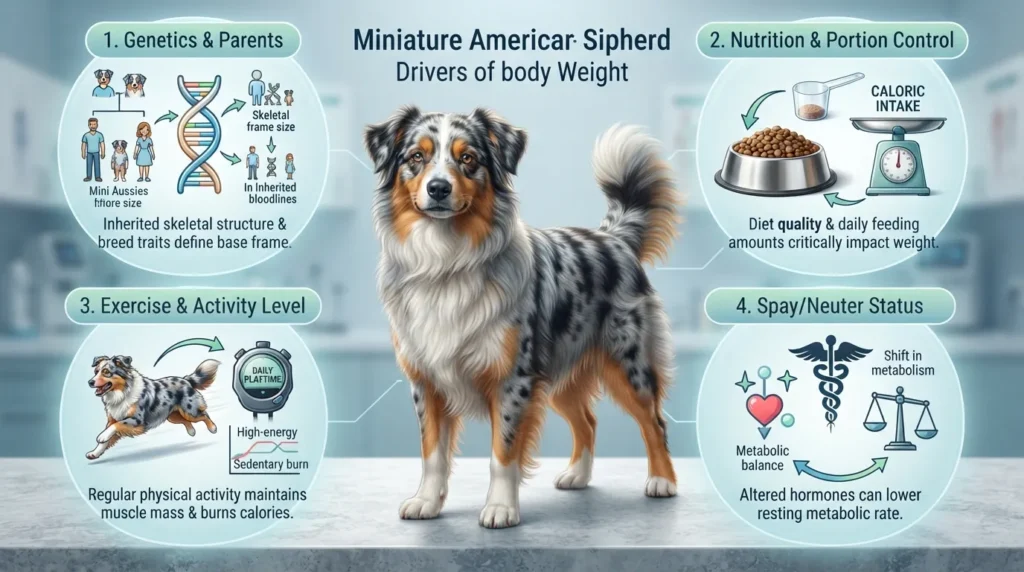
While breed standards set a clear target range, where your individual Mini Aussie falls between 20 and 40 pounds comes down to a blend of biology, lifestyle, and health history. Understanding these key variables helps you distinguish between natural genetic variation and unneeded weight gain.
Genetics & Parent Size
Genetics is the single biggest factor determining your Mini Aussie’s final frame. Pups inherited from smaller working-line parents naturally tend to stay toward the 20 to 25-pound mark, while those from heavier-boned lines often settle closer to 35 or 40 pounds.
It is also completely normal for puppies from the same litter to vary significantly in weight. Genetic traits recombine differently in every pup, meaning a single litter can produce one dog that tops out at 22 pounds and another that reaches 36 pounds at full maturity.
Diet & Nutrition
The caloric density and quality of your dog’s daily food directly impact their body condition. Feeding high-protein, age-appropriate food ensures proper bone density and lean muscle development during early growth spurts.
Overfeeding during puppyhood does not make a Mini Aussie grow taller or bigger framed—it simply packs on excess fat, puts unnecessary stress on developing growth plates, and increases the risk of early-onset joint issues.
Exercise & Activity Level
Mini Aussies are high-energy working dogs built for agility and endurance. A well-exercised Mini Aussie burns excess calories and develops dense, heavy muscle tissue, keeping them lean and firm.
In contrast, a sedentary lifestyle often leads to weight gain without an increase in muscle mass. A dog that appears “heavy” without the underlying muscle structure to support it is likely carrying unhealthy body fat.
Spay/Neuter Status
Desexing your dog alters their metabolic rate. Spaying or neutering reduces sex hormone production, which can slow down metabolism by roughly 10% to 20% and increase appetite in some individuals.
While altering your dog does not automatically cause weight gain, owners should monitor food intake and adjust daily portion sizes post-surgery to maintain a ideal body condition score.
Does Coat Color Affect Weight?
No, coat color has absolutely zero effect on a Mini Australian Shepherd’s weight or physical size. Whether your dog is a blue merle, red merle, black tricolor, or red tricolor, pigment genes operate completely independently from the genes that control skeleton size and muscle mass.
Any noticeable size differences between dogs of different colors are purely coincidental or driven by the specific genetic lines of their individual parents.
Mini Australian Shepherd vs Standard Australian Shepherd Weight
The main difference between a Miniature Australian Shepherd (Miniature American Shepherd) and a Standard Australian Shepherd is sheer physical scale. While both breeds share the same athletic proportions, intelligence, and high-drive working coat, the Standard Australian Shepherd is built on a significantly larger, heavier frame.
| Feature | Miniature Australian Shepherd | Standard Australian Shepherd |
|---|---|---|
| Weight (Imperial) | 20 – 40 lbs | 40 – 65 lbs |
| Weight (Metric) | 9 – 18 kg | 18 – 29 kg |
| Height at Shoulder (Imperial) | 13 – 18 in | 18 – 23 in |
| Height at Shoulder (Metric) | 33 – 46 cm | 46 – 58 cm |
| Overall Build | Compact, sturdy, light-to-medium bone | Medium-to-large, heavy bone, substantial power |
| Feature | Miniature Australian Shepherd |
|---|---|
| Weight (Imperial) | 20 – 40 lbs |
| Weight (Metric) | 9 – 18 kg |
| Height at Shoulder (Imperial) | 13 – 18 in |
| Height at Shoulder (Metric) | 33 – 46 cm |
| Overall Build | Compact, sturdy, light-to-medium bone |
| Feature | Standard Australian Shepherd |
|---|---|
| Weight (Imperial) | 40 – 65 lbs |
| Weight (Metric) | 18 – 29 kg |
| Height at Shoulder (Imperial) | 18 – 23 in |
| Height at Shoulder (Metric) | 46 – 58 cm |
| Overall Build | Medium-to-large, heavy bone, substantial power |
Mini Aussie vs Toy/Teacup Australian Shepherd Weight
While the Miniature Australian Shepherd is an officially recognized breed with clear weight boundaries, “Toy” and “Teacup” variants sit outside standard kennel club registries. Understanding these size differences helps set realistic expectations for your dog’s size and health.
The table below breaks down how these unofficial size categories compare to a standard Mini Aussie:
| Size Category | Average Weight | Height at Shoulder | Registry Status |
|---|---|---|---|
| Miniature Australian Shepherd | 20 – 40 lbs (9 – 18 kg) | 13 – 18 inches | Recognized (AKC / ASDR) |
| Toy Australian Shepherd | 10 – 20 lbs (4.5 – 9 kg) | 10 – 14 inches | ASDR only (Not AKC) |
| Teacup Australian Shepherd | Under 10 lbs (Under 4.5 kg) | Under 10 inches | Unofficial marketing term |
| Miniature Australian Shepherd | |
|---|---|
| Average Weight | 20 – 40 lbs (9 – 18 kg) |
| Height at Shoulder | 13 – 18 inches |
| Registry Status | Recognized (AKC / ASDR) |
| Toy Australian Shepherd | |
|---|---|
| Average Weight | 10 – 20 lbs (4.5 – 9 kg) |
| Height at Shoulder | 10 – 14 inches |
| Registry Status | ASDR only (Not AKC) |
| Teacup Australian Shepherd | |
|---|---|
| Average Weight | Under 10 lbs (Under 4.5 kg) |
| Height at Shoulder | Under 10 inches |
| Registry Status | Unofficial marketing term |
Is My Mini Australian Shepherd Underweight or Overweight?
Because Mini Aussies naturally vary in bone structure and possess a thick double coat, relying solely on the bathroom scale won’t tell you the whole story. Evaluating your dog’s Body Condition Score (BCS) through sight and hands-on touch is the most accurate way to confirm whether their weight is on track.
Signs of a Healthy Weight
A Mini Aussie at an ideal weight carries a lean, athletic frame shielded by muscle—not excess fat.
To run a quick check at home, look for these key visual and physical markers:
The Rib Test: You should easily feel their ribs using light finger pressure, covered only by a thin layer of skin and fat. The ribs should feel like the knuckles on the back of your flat hand.
Visible Waist Tuck: Looking down at your dog from above, you should see a clear, defined “hourglass” waistline behind the ribcage before the hips start.
Abdominal Tuck: Viewing your dog from the side, their abdomen should slope upward from the chest toward the hind legs rather than running flat across.
Energy and Agility: An ideal-weight Mini Aussie moves effortlessly, leaps comfortably without hesitation, and doesn’t get winded during routine play.
Signs of Overweight
It is surprisingly easy for a double-coated breed to pack on extra pounds without an owner noticing right away. A Mini Aussie is carrying excess body fat if:
Unreachable Ribs: You have to press firmly to feel the ribs through a thick layer of fat.
Loss of Waistline: Their body forms a blocky, continuous cylinder from shoulders to hips when viewed from above, with no visible waist tuck.
Fat Deposits: Broad pads of fat build up over the lumbar region (lower back) and tail base, creating a flat or rounded back profile.
Lethargy and Heavy Breathing: Your dog tires quickly on normal walks, pants excessively after mild exercise, or struggles to jump onto the couch or car.
Signs of Underweight
While less common than obesity, an underweight Mini Aussie lacks the necessary muscle mass to support an active lifestyle. Key signs include:
Prominent Bones: Ribs, spine, and hip bones protrude noticeably and are easily visible through the coat without needing to feel for them.
Exaggerated Tuck: An extreme waist tuck from above and a sharp, severe abdominal tuck from the side that leaves the flank area looking hollow.
Muscle Wasting: Loss of muscle mass along the thighs, shoulders, and head, making the dog look frail rather than athletic.
Dull Coat: A dry, brittle outer coat with thin undercoat density caused by nutritional deficiencies or poor fat absorption.
When to See a Vet
If your Mini Aussie falls significantly outside their expected weight range or fails to show a clear waist tuck despite feeding appropriate rations, schedule an evaluation with your veterinarian.
Sudden or unexplained weight loss can point to underlying health issues such as intestinal parasites, food intolerances, or metabolic disorders like thyroid dysfunction. Conversely, persistent weight gain despite strict caloric control often signals hypothyroidism, Cushing’s disease, or joint pain that reduces mobility. Your vet can perform targeted blood work, rule out medical triggers, and design a precise feeding plan tailored to your dog’s unique metabolic needs.
Estimating Weight for an Adopted or Rescue Mini Aussi No Birth Date?
If you’ve adopted a rescue Mini Aussie without official birth paperwork, figuring out their future adult weight can feel tricky. Because growth projections depend heavily on knowing your puppy’s current age, getting a realistic age estimate first is the key to understanding if your new dog is still growing or already at their full size.
The Teeth-Check Method
Dental development is the most reliable biological indicator for estimating a young dog’s age up to one year:
Under 4 Months: Puppies still have small, sharp baby (deciduous) teeth with no permanent adult teeth visible.
4 to 6 Months: Baby teeth start falling out as permanent adult incisors and canines erupt through the gums.
6 to 12 Months: All 42 permanent adult teeth are fully present, bright white, and clean with zero wear.
1 to 2 Years: Adult teeth remain clean and intact, though back molars may begin showing slight dulling or minor tartar buildup.
The Veterinary Estimate Approach
When dental clues aren’t fully clear, a hands-on assessment by a veterinarian gives you the most accurate overall picture.
A vet evaluates a combination of physical markers:
Growth Plate Examination: A quick X-ray of the long leg bones shows whether the cartilage growth plates are still open (confirming a dog under 12 months) or completely fused.
Muscle Tone & Coat Development: Younger Mini Aussies carry softer, leaner muscle structure and a lighter coat, whereas mature dogs display dense muscle mass and a fully feathered double coat.
Structural Frame Size: A vet can assess frame width to determine if your rescue is naturally a smaller 22-pound dog or a larger 38-pound individual recovering from temporary weight loss.
Using the Calculator for Rescue Pups
Once your vet gives you a reasonable age baseline (such as estimating your pup at around 16 to 20 weeks), plug that age along with their current weight into our interactive Mini Aussie Weight Calculator to project their remaining growth path.
If your vet confirms your rescue is already over 12 to 18 months old, their current weight on the scale reflects their full adult frame size. At that point, shift your focus from growth tracking to monitoring their body condition score so they stay fit and healthy.
Frequently Asked Questions
How heavy is a full grown Mini Aussie?
A full-grown Miniature Australian Shepherd weighs between 20 and 40 pounds (9 to 18 kg) at full physical maturity. Both males and females fall within this same official weight range, standing 13 to 18 inches tall at the shoulder. Most reach their full skeletal height by 12 months and fill out to their final adult weight between 12 and 18 months of age.
Are Mini Australian Shepherds big?
No, Mini Australian Shepherds are not big dogs. They are classified as a small-to-medium working breed. Standing 13 to 18 inches tall and weighing 20 to 40 pounds, they have a compact, sturdy frame designed for agility and endurance. They are significantly smaller than Standard Australian Shepherds (which weigh 40 to 65 pounds), making them a manageable size for house living while keeping the athleticism of a true herding dog.
Do Mini Aussies bark a lot?
Mini Aussies tend to be moderate-to-frequent barkers if their mental and physical energy needs aren’t met. As herding dogs, they naturally use vocalizations to communicate, alert their owners to visitors, or express boredom and excitement. Daily mental stimulation, structured exercise, and early vocal training keep excessive barking to a minimum.
Is an Aussie a medium or large dog?
A Standard Australian Shepherd is considered a medium-to-large breed (weighing 40 to 65 pounds), while a Miniature Australian Shepherd is a small-to-medium breed (20 to 40 pounds). Both share identical working intelligence and proportions, but the Mini stays within a smaller physical footprint.
What is the rarest Aussie color?
Solid red (liver) with no white or copper markings is the rarest coat color in both Standard and Miniature Australian Shepherds. Because red is a recessive gene and solid patterns are also recessive, inheriting both traits simultaneously from both parents is statistically uncommon. Dilute colors (like yellow or sable) also occur occasionally but are unstandardized fault colors for registry show rings.
At what age do Aussies calm down?
Most Mini Aussies begin to show noticeable emotional maturity and settled energy levels between 2 and 3 years of age. While their physical growth stops around 12 to 18 months, their high-drive herding instincts keep them in an energetic “teenager” phase until about age 2. Consistent training, job-focused activities (like agility or trick training), and regular daily workouts help manage their high drive through these early years.
Final Thoughts
Tracking your Mini Australian Shepherd’s weight from early puppyhood through full physical maturity ensures they grow on a healthy, steady curve. Remember that an adult Mini Aussie should weigh between 20 and 40 pounds (9 to 18 kg) and stand 13 to 18 inches tall at the shoulder. Rather than aiming for an exact number on the scale, focus on keeping your dog at an ideal body condition score with a visible waistline, clear abdominal tuck, and easily felt ribs under a thin layer of fat.
If you are currently raising a growing puppy or tracking a rescue pup’s progress, use our interactive Mini Aussie Weight Calculator above to project their final adult size based on real breed growth data.
Looking to track growth for other herding or medium-sized breeds? Check out our related pet care calculators and growth guides:
Australian Shepherd Age & Weight Calculator
Border Collie Puppy Growth & Size Guide
🐾 Other Age Guides

I built Dogagescalculator.com to give dog owners honest, science-backed answers instead of the outdated "×7" myth. Every figure here is checked against AKC, AVMA, and published veterinary research.
More about the author & this site →
Comments