
31 Years in Dog Years: How Old Is That in Human Years?
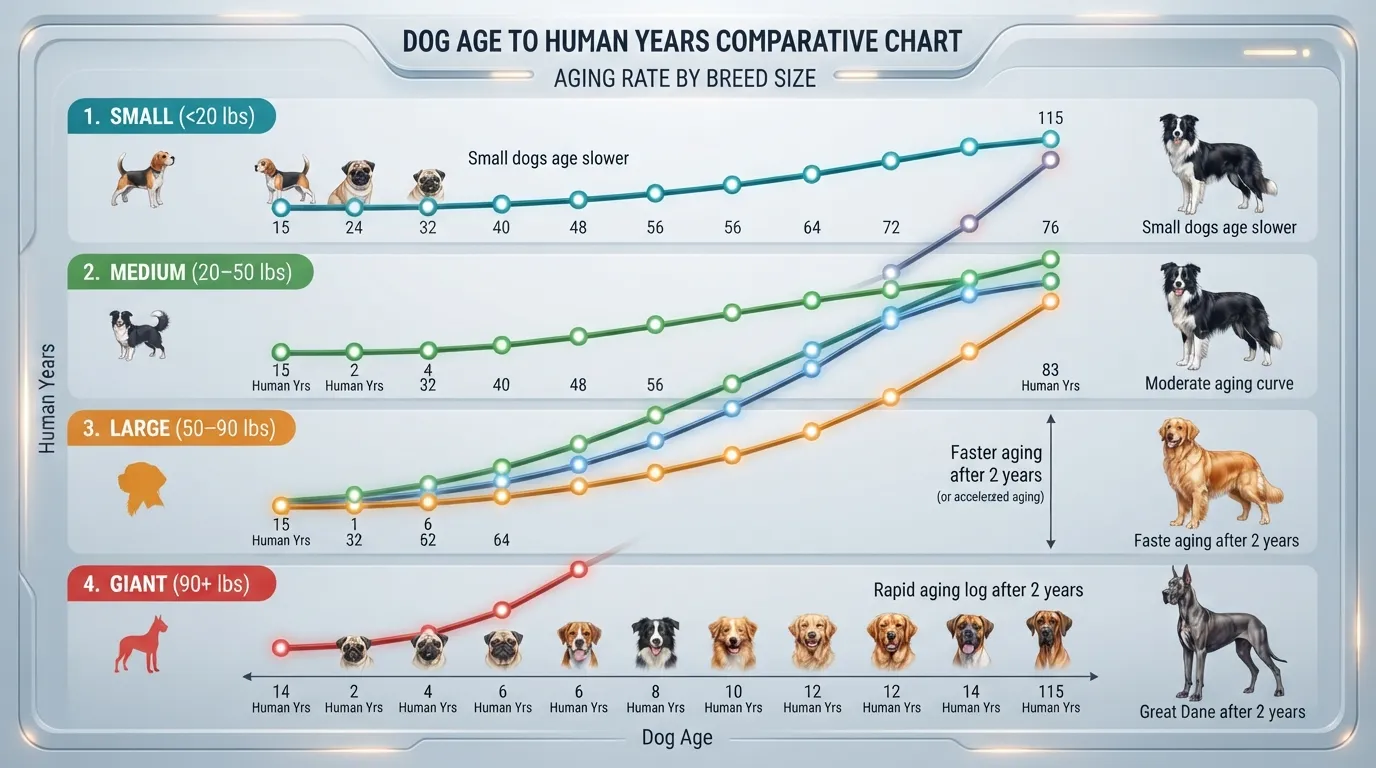
31 in dog years equals roughly 3 to 4 actual calendar years, depending heavily on your dog’s size and breed category.
For giant breeds, 31 dog years happens around calendar age 3, whereas small and medium dogs hit 31 during their 4th calendar year.
The old “multiply by 7” rule gives inaccurate results, failing to reflect how rapidly dogs mature during their first two years of life.
A dog at 31 human-equivalent years is a young adult, possessing peak physical health, full muscle development, and settled behavior.
What Does "Dog Years" Actually Mean?
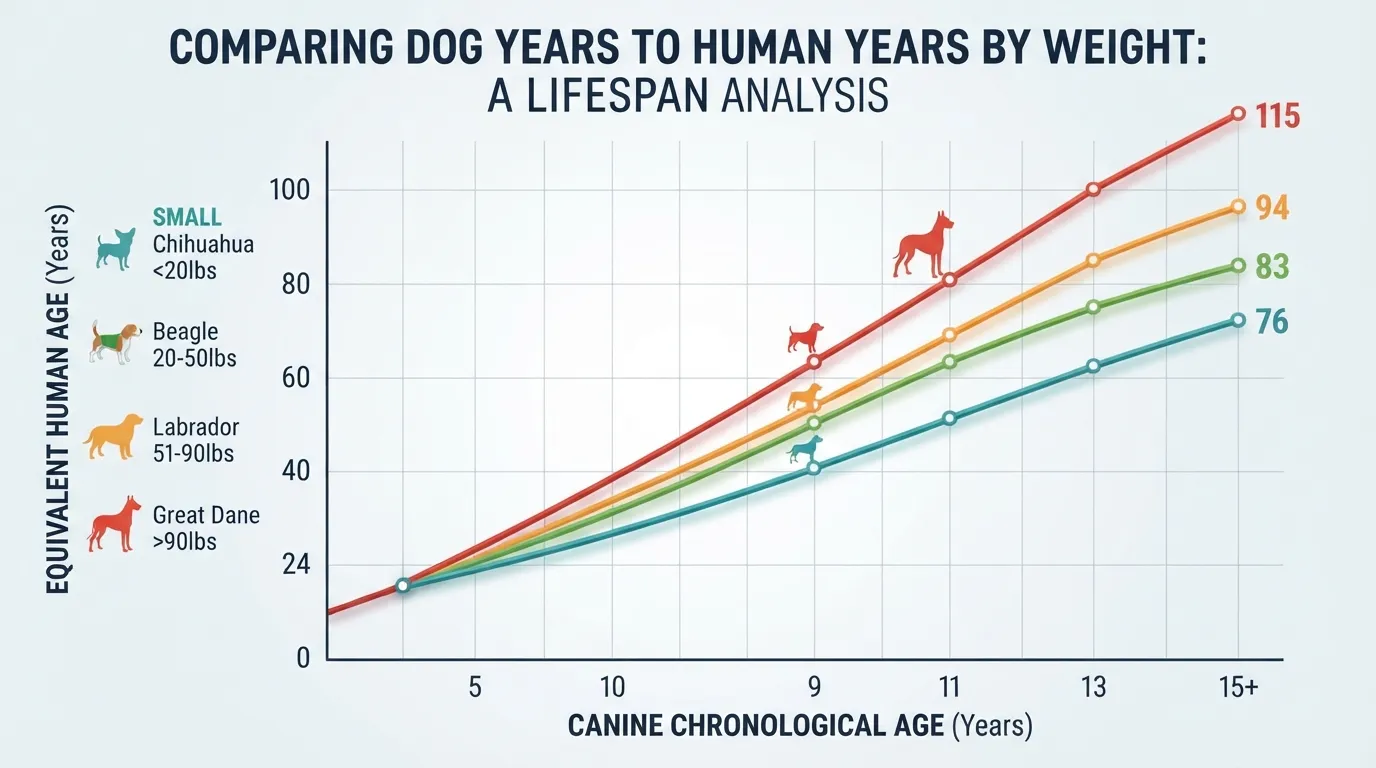
“Dog years” is a standard comparative measurement used by veterinarians and pet owners to translate a dog’s biological age into its equivalent human age. Because dogs mature and age much faster than humans, this term provides a relatable framework to understand your dog’s physical development, emotional maturity, and healthcare requirements relative to human life stages.
Simple Definition of Dog Years
Simply put, a “dog year” measures the rate at which a dog’s body develops and ages relative to a human calendar year.
It is not a literal measurement of time, but rather a physiological age conversion. For example, when a dog reaches31 in dog years, it does not mean they have lived for 31 actual calendar years. Instead, it means their organs, immune system, joint health, and biological markers resemble those of a 31-year-old human.
The Origin and History of Dog Years
The concept of measuring dog years dates back centuries, evolving from early medieval estimates to modern veterinary science:
Medieval Inscriptions (1268): One of the earliest documented attempts to compare human and animal lifespans appears in an inscription at Westminster Abbey from 1268, which suggested a 9-to-1 ratio between human and canine life spans.
The 1950s “7-Year Rule” Myth: The famous 1 human year = 7 dog years rule gained massive popularity in the mid-20th century. During the 1950s, the average human lifespan was roughly 70 years, while the average domestic dog lived about 10 years. Dividing 70 by 10 yielded a simple 7:1 ratio. While easy to remember, it was scientifically flawed because it assumed dogs age at a flat, constant rate throughout their lives.
Modern Veterinary Science: In 1953, French researcher A. Lebeau published the first empirical life-stage study showing that dogs mature at an accelerated rate during their first two years before their aging process slows down. Today, modern organizations like the American Animal Hospital Association (AAHA) and epigenetic DNA research teams use dynamic, size-based curves instead of fixed multipliers to determine true canine age.
Is It Even Possible for a Dog to Live 31 Years?
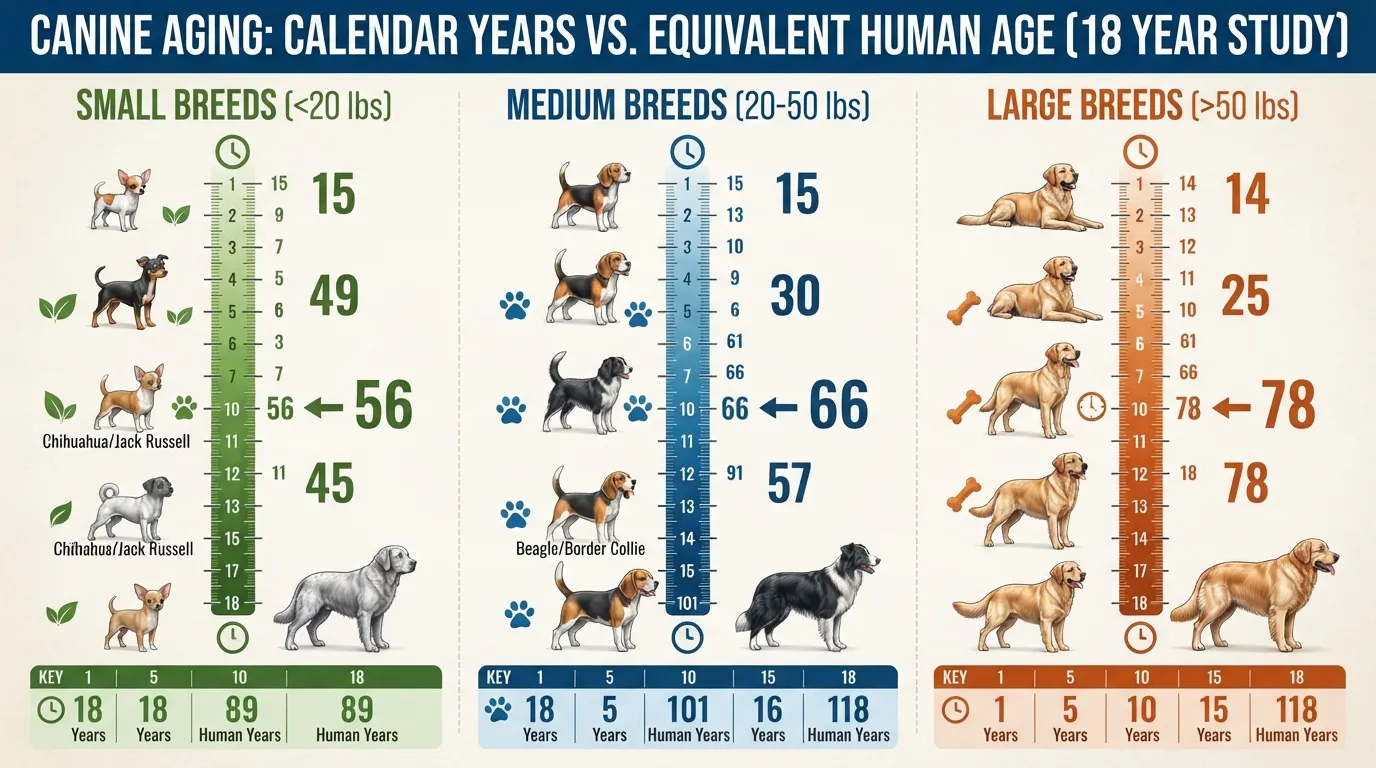
If you mean 31 human-equivalent dog years, then absolutely—almost every healthy dog easily reaches and passes this biological milestone around their 3rd or 4th calendar birthday.
However, if you are asking whether a dog can live to 31 actual calendar years, the short answer is that while claims exist, it is extraordinarily improbable. The vast majority of domestic dogs live between 10 and 15 calendar years, making a 31-year lifespan a massive biological outlier—roughly equivalent to a human living to 150.
World’s Oldest Dog – Bobi’s Record (31 Years, 165 Days)
In 2023, a purebred Rafeiro do Alentejo (a Portuguese livestock guardian dog) named Bobi made international headlines when he passed away at an alleged age of 31 years and 165 days. His owner attributed his incredible longevity to a peaceful rural life, freedom to roam, and eating fresh, unseasoned human food rather than commercial kibble.
The Controversy: Following his death, international veterinarians raised serious doubts about Bobi’s true age, noting that his breed typically lives only 12 to 14 years. Skeptics pointed out that photos of Bobi in the 1990s showed white paws, whereas the elderly dog had solid dark paws.
The Guinness Verdict: In early 2024, Guinness World Records officially conducted an investigation and formally stripped Bobi of his title, stating there was insufficient microchip evidence to verify his actual birth date.
The True Official Record Holder: With Bobi’s title revoked, the official Guinness World Record for the oldest verified dog ever returned to Bluey, an Australian Cattle Dog who lived 29 years and 5 months (1910–1939).
Which Breeds Can Live This Long?
While reaching 31 calendar years remains largely unverified in modern veterinary history, small working and terrier breeds consistently hold the records for coming closest.
Average vs. Extreme Record Lifespans: While the average domestic dog lives 10 to 13 calendar years (roughly 60 to 75 dog years), extreme record-holders consistently push into their late twenties.
Small Working Breeds: Breeds like Australian Cattle Dogs, Chihuahuas, Toy Poodles, and Rat Terriers hold almost all documented longevity records. Their lighter body weight places drastically less wear and tear on their cardiovascular system and joints over time.
Why Size Dictates Longevity: Giant breeds (like Great Danes or Mastiffs) age rapidly at a cellular level, rarely living past 8 to 10 calendar years. Small dogs age far more gradually after reaching adulthood, giving them the highest statistical likelihood of reaching extreme ages.
Why Do Dogs Age Faster Than Humans?
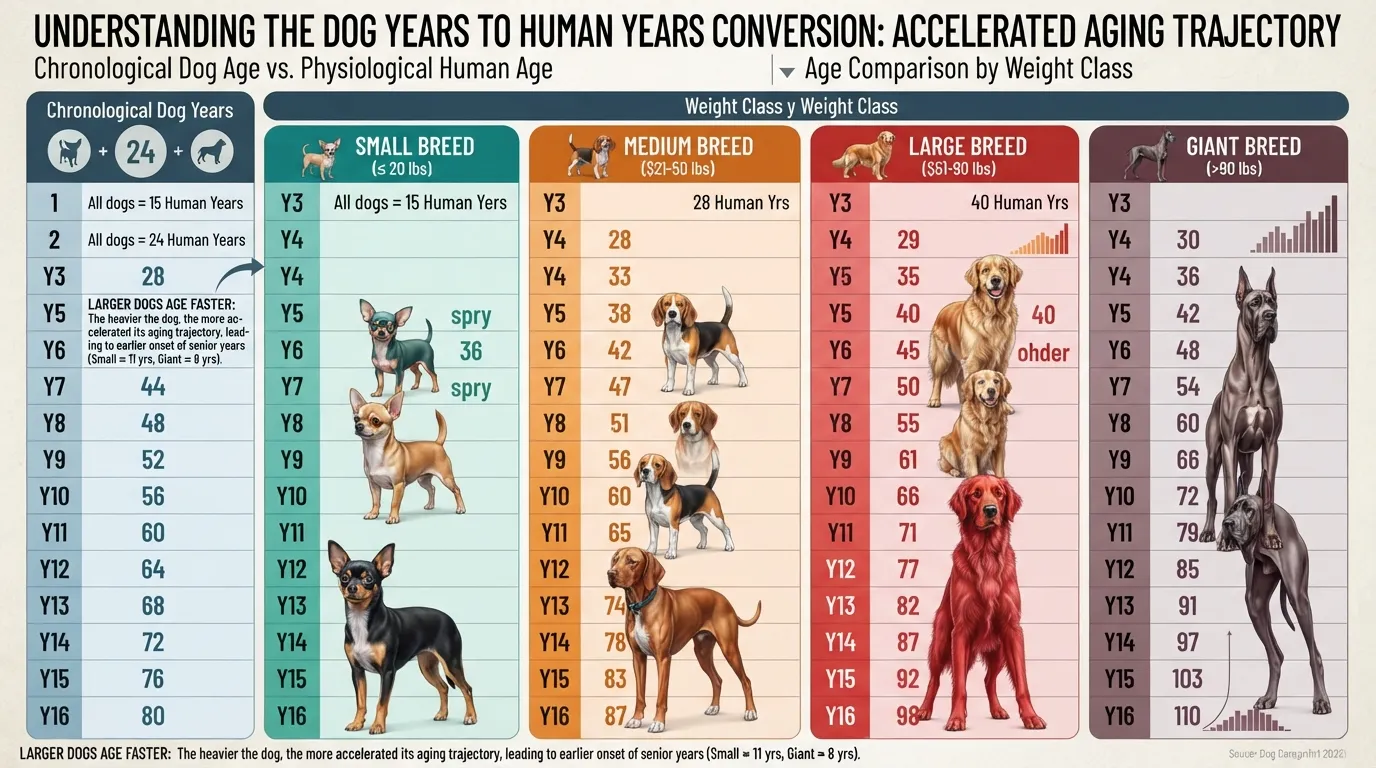
Dogs age faster than humans because their evolutionary biological clock operates on an accelerated timeline. From a higher metabolic rate to rapid early growth and shorter cellular lifespans, every aspect of canine biology is built for speed rather than longevity.
1. Accelerated Metabolism and Higher Heart Rates
A dog’s internal engine runs significantly faster than a human’s. An adult dog’s resting heart rate ranges between 60 and 140 beats per minute (depending on size), compared to 60 to 100 in humans. They also have a slightly higher baseline body temperature (101°F to 102.5°F).
While this supercharged metabolic rate powers their boundless energy, it also accelerates physiological “wear and tear” on their internal organs, leading to faster cellular damage over time.
2. Rapid Early Growth and Hormonal Surges
In humans, reaching sexual and physical maturity takes roughly 15 to 18 years. Dogs achieve full sexual maturity within their first 6 to 12 months, and complete physical growth by age 2.
This rapid early development requires massive surges of growth hormones, such as Insulin-like Growth Factor 1 (IGF-1). While IGF-1 builds bones and muscles quickly during puppyhood, sustained high levels of growth signaling are linked across species to accelerated aging and an increased risk of age-related cellular damage later in life.
3. Rapid Telomere Attrition
At the cellular level, aging is driven by microscopic caps on the ends of chromosomes called telomeres. Every time a cell divides, its telomeres shorten until the cell can no longer replicate safely.
Research shows that canine telomeres degrade up to 10 times faster than human telomeres. This rapid cellular decay means canine organs, joints, and immune systems reach senescence in a fraction of the time human cells do.
4. The Body Size Factor: Why Big Dogs Age Even Faster
While dogs as a species age faster than humans, body size within the canine species flips a general rule of nature. In the broader animal kingdom, large mammals (like elephants and whales) outlive smaller ones (like mice). In dogs, the exact opposite occurs:
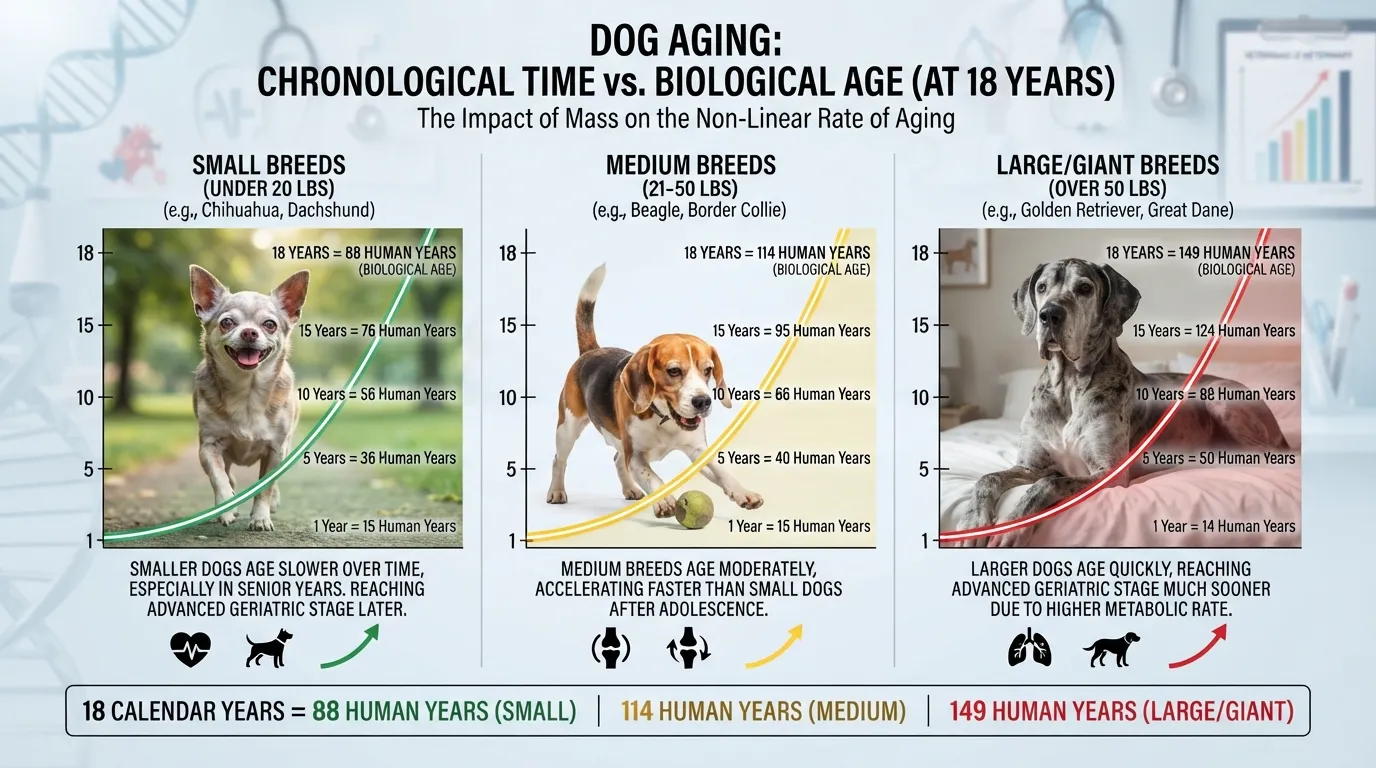
Small Dogs (<20 lbs): Experience a controlled, gradual growth phase. They mature early and then age slowly, often living 12 to 16+ years.
Large & Giant Breeds (50–100+ lbs): Undergo explosive growth—a Great Dane puppy can gain over 100 pounds in its first year alone. This intense growth rate requires extreme cellular division, putting extra stress on their skeletal and cardiovascular systems and accelerating their biological clock much faster than small breeds.
How to Calculate Dog Years to Human Years
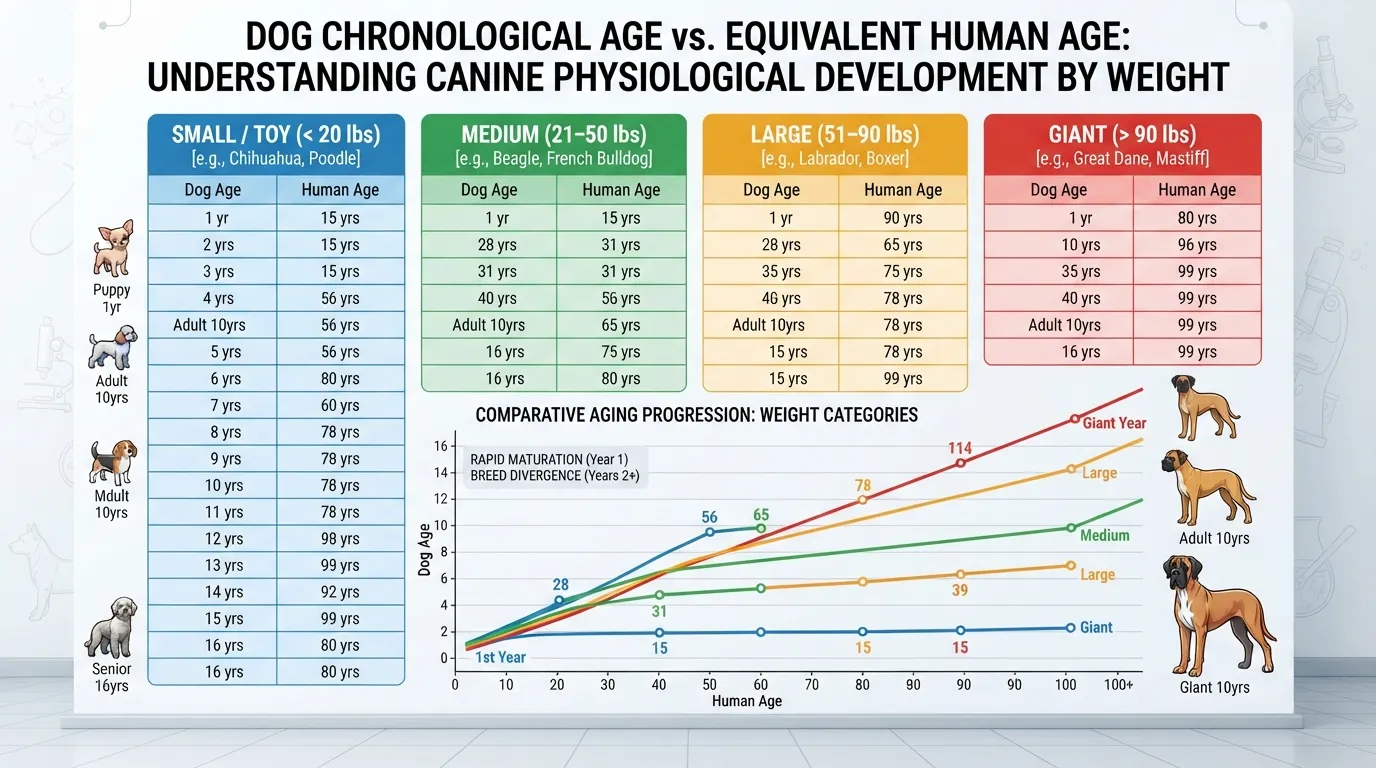
Calculating your dog’s true biological age requires choosing the right mathematical approach. Over the decades, methods have evolved from oversimplified pop-culture rules to sophisticated DNA epigenetic tracking.
The Old “Multiply by 7” Rule (Why It’s Wrong)
For generations, pet owners relied on a simple rule of thumb: 1 calendar year = 7 dog years.
While mathematically convenient, this formula is biologically inaccurate. It assumes dogs age at a static, linear rate throughout their lives. Under this math, a 1-year-old dog would equal a 7-year-old child—yet a 1-year-old dog has already reached sexual maturity and complete physical independence. The 7x rule drastically underestimates early puppy development while overestimating the aging process of older, small-breed dogs.
The AVMA Formula (The 15-9-5 Method)
To fix the flaws of the linear model, veterinary organizations like the American Veterinary Medical Association (AVMA) developed a staged formula that mirrors actual biological development:
Year 1: Counts as 15 human years (rapid physical growth and sexual maturation).
Year 2: Adds 9 human years (bringing a 2-year-old dog to 24 human years).
Year 3+: Adds roughly 4 to 5 human years per calendar year for small-to-medium breeds.
Applying the AVMA Formula to Hit ~31 Dog Years
To see how a dog reaches roughly 31 human years, apply the 15-9-5 calculation across their first three to four calendar years:
The 2019 UCSD Epigenetic Formula: Human Age = 16 x ln(Dog Age) + 31
In 2019, researchers at the University of California, San Diego (UCSD) introduced a cutting-edge formula based on DNA methylation. By tracking chemical changes on genome markers in Labrador Retrievers, they derived a logarithmic formula:
Human-Equivalent Age = 16 x ln(Actual Calendar Age) + 31
(where “ln” is the natural logarithm of the dog’s calendar age)
Because this logarithmic equation accounts for near-instantaneous cellular maturation during infancy, a 1-year-old dog instantly measures at 31 human-equivalent years on a DNA level (16 x ln(1) + 31 = 31, because ln(1) = 0). While brilliant for cellular tracking, vets caution that this formula tends to “front-load” age too heavily for everyday health assessments across non-retriever breeds.
3-Formula Comparison Table
Here is how each calculation method converts actual calendar years into human years for a typical medium-sized dog:
| Actual Age | Old 7-Year Rule | AAHA Method (Standard) | Epigenetic Clock (DNA) |
|---|---|---|---|
| 1 Year | 7 human years | 15 human years | 31 human years |
| 2 Years | 14 human years | 24 human years | 42 human years |
| 3 Years | 21 human years | 28 human years | 48.5 human years |
| 3.5 Years | 24.5 human years | ~31 human years | 51 human years |
| 4 Years | 28 human years | 33 human years | 53 human years |
| 5 Years | 35 human years | 37 human years | 56.8 human years |
31 Years in Dog Years by Size & Breed
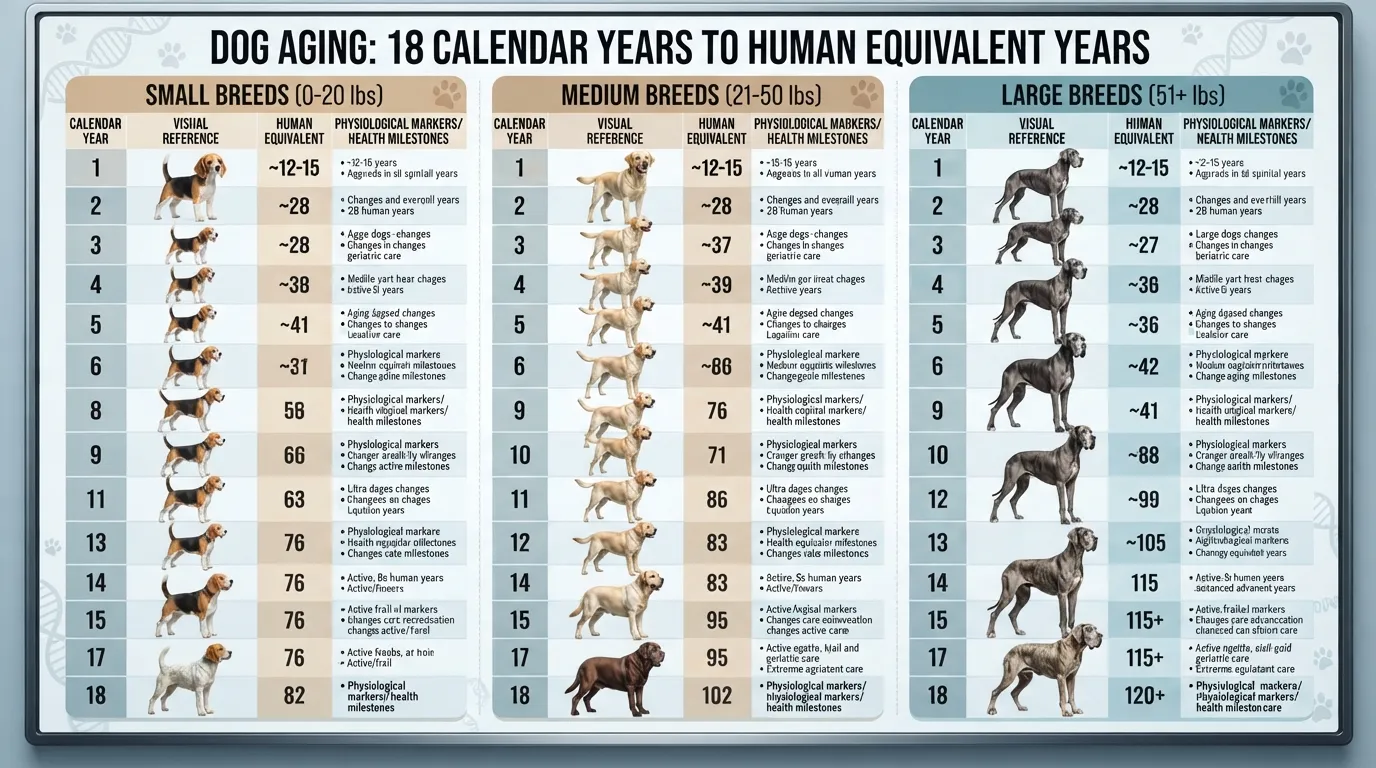
While all dogs mature quickly during their first two years, their aging trajectories split significantly based on adult frame and weight. A small dog reaches 31 human years at a slightly different calendar age than a giant breed—and their overall likelihood of reaching extreme ages differs even more.
Small Dogs (Under 20 lbs)
Small breeds like Chihuahuas, Toy Poodles, and Dachshunds reach 31 in dog years between 3.5 and 4 calendar years of age.
Because toy and small breeds age at a gradual pace of roughly 4 human years per calendar year after adulthood, hitting 31 dog years is just the opening chapter of a long life. Small dogs frequently enjoy lifespans of 14 to 18 calendar years (translating to 72 to 88+ dog years).
Medium Dogs (21–50 lbs)
Medium-sized dogs such as Beagles, Border Collies, and Cocker Spaniels hit 31 in dog years right around 3.5 calendar years of age.
Their growth rate sits squarely in the middle of the canine spectrum: they mature rapidly through age 2 (hitting 24 dog years) and then gain about 4.5 to 5 human years per calendar year thereafter. Their average natural lifespan spans 12 to 15 calendar years.
Large Dogs (51–100 lbs)
Large breeds like Golden Retrievers, Labradors, and German Shepherds reach 31 in dog years right around their 3rd birthday (3 calendar years).
Because large dogs carry more mass, their cellular workload increases faster once they reach physical maturity. After age 2, they age at a rate of roughly 5 to 6 human years per calendar year. Most large breeds live an average of 10 to 12 calendar years (roughly 75 to 85 dog years).
Giant Dogs (100+ lbs)
Giant breeds like Great Danes, Mastiffs, and Irish Wolfhounds reach 31 in dog years around 2.5 to 3 calendar years of age.
Their rapid early development and sheer metabolic burden cause them to age at an accelerated rate of 6 to 7 human years for every calendar year after age 2. As a result, a 3-year-old Great Dane is biologically older than a 3-year-old Chihuahua. Giant breeds typically have the shortest lifespans, averaging 7 to 10 calendar years.
How Breed Affects Lifespan Within Each Size
Reaching 31 Human-Equivalent Dog Years (Calendar Age 3–4): Completely realistic for 100% of breeds. Every healthy dog easily reaches 31 dog years in early young adulthood.
Reaching 31 Actual Calendar Years:
Small Working & Toy Breeds (Realistic Anomalies): Chihuahuas, Toy Poodles, and Australian Cattle Dogs hold almost all verified longevity records (living into their late twenties). Reaching 20+ actual years is rare, but biologically possible for this group.
Medium Breeds (Extremely Unlikely): Breeds like Beagles or Terriers can occasionally reach 18 to 20 actual calendar years with meticulous care, but reaching 25 to 31 actual years is nearly unheard of.
Large & Giant Breeds (Biologically Impossible): For a Great Dane, Bernese Mountain Dog, or Mastiff, surviving to 31 actual calendar years is biologically impossible. Their rapid cellular aging, structural joint strain, and elevated cancer risks cap even the healthiest individuals around 12 to 14 calendar years.
Full Dog Age Chart – 1 to 32 Dog Years
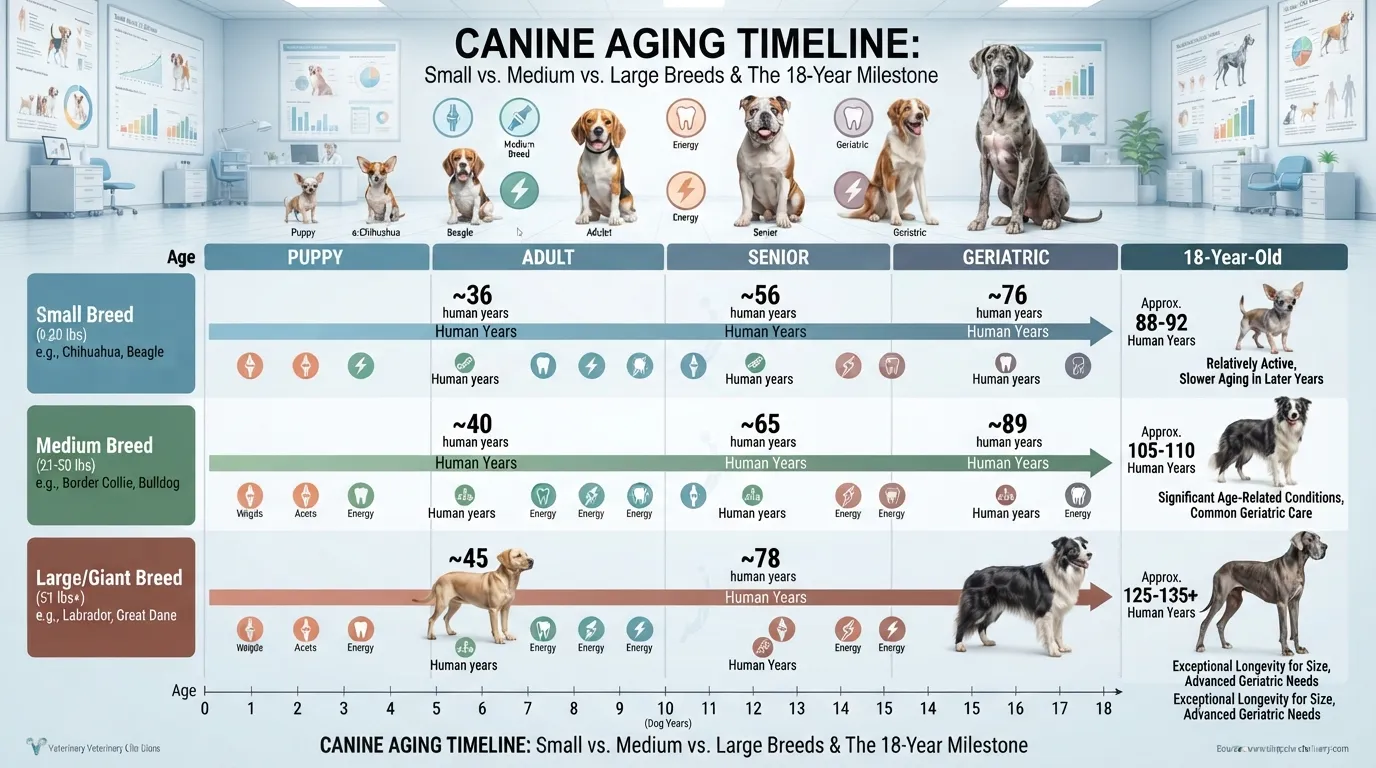
To easily look up your dog’s human-equivalent age, use this comprehensive reference table based on American Veterinary Medical Association (AVMA) guidelines.
It maps your dog’s actual calendar years against their equivalent human years across all four primary weight categories, highlighting the milestone where your dog reaches 31 dog years.
| Calendar Age (Years) | Small Breeds (<20 lbs) | Medium Breeds (21–50 lbs) | Large Breeds (51–100 lbs) | Giant Breeds (100+ lbs) |
|---|---|---|---|---|
| 1 Year | 15 human yrs | 15 human yrs | 15 human yrs | 15 human yrs |
| 2 Years | 24 human yrs | 24 human yrs | 24 human yrs | 24 human yrs |
| 3 Years | 28 human yrs | 28.5 human yrs | 29 human yrs | 31 human yrs |
| 3.5 Years | 30 human yrs | 31 human yrs | 32 human yrs | 34.5 human yrs |
| 4 Years | 32 human yrs | 33 human yrs | 35 human yrs | 38 human yrs |
| 5 Years | 36 human yrs | 37 human yrs | 40 human yrs | 45 human yrs |
| 6 Years | 40 human yrs | 42 human yrs | 45 human yrs | 52 human yrs |
| 7 Years | 44 human yrs | 47 human yrs | 50 human yrs | 59 human yrs |
| 8 Years | 48 human yrs | 51 human yrs | 55 human yrs | 66 human yrs |
| 9 Years | 52 human yrs | 56 human yrs | 61 human yrs | 73 human yrs |
| 10 Years | 56 human yrs | 60 human yrs | 66 human yrs | 79 human yrs |
| 11 Years | 60 human yrs | 65 human yrs | 72 human yrs | 86 human yrs |
| 12 Years | 64 human yrs | 69 human yrs | 77 human yrs | 93 human yrs |
| 13 Years | 68 human yrs | 74 human yrs | 82 human yrs | 100 human yrs |
| 14 Years | 72 human yrs | 78 human yrs | 88 human yrs | 107 human yrs |
| 15 Years | 76 human yrs | 83 human yrs | 93 human yrs | 114 human yrs |
Try It Yourself – Dog Age Calculator Tool
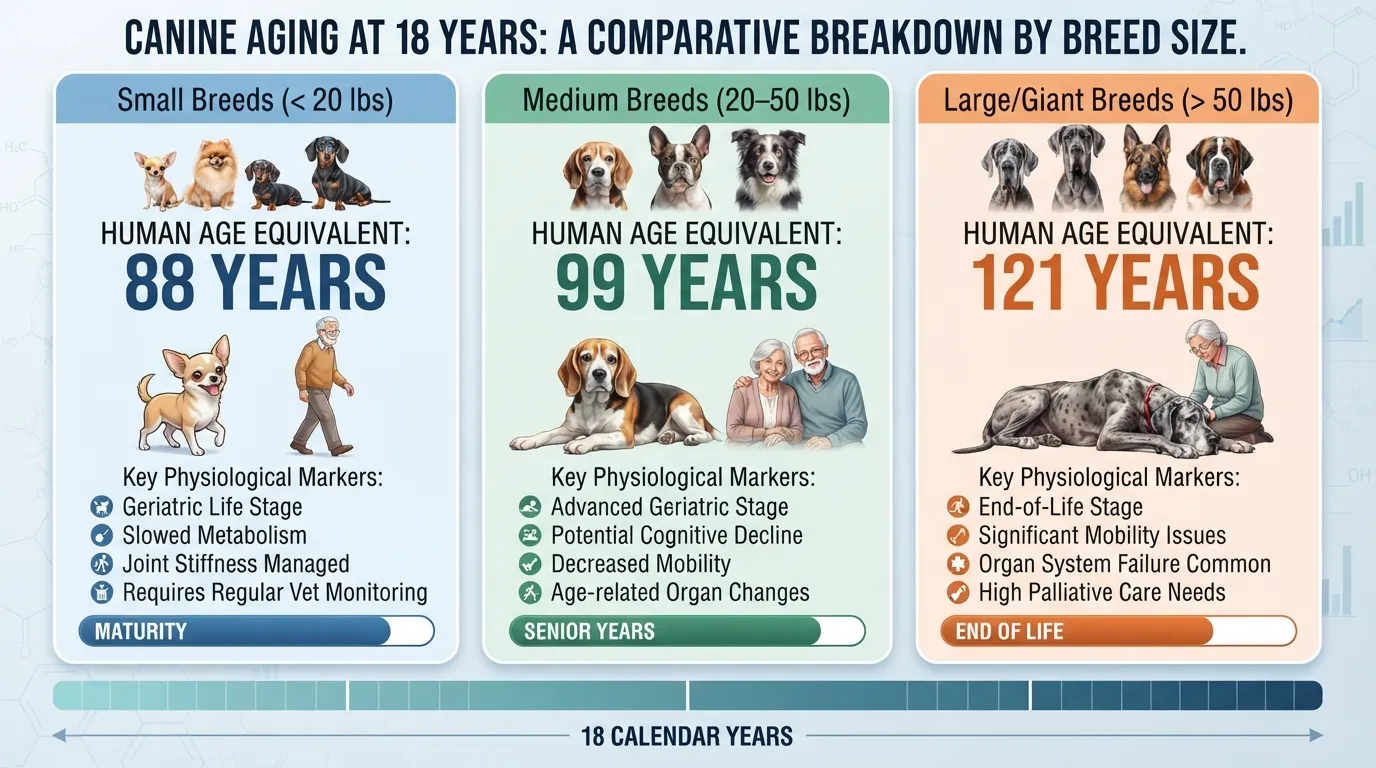
Skip the manual formulas and instant-calculate your dog’s true biological age.
Select your dog’s calendar age and adult weight category below to get an accurate, size-adjusted human year equivalent based on official American Veterinary Medical Association (AVMA) guidelines.
| Life Stage | Calendar Span | Small (<20 lbs) | Medium (21-50 lbs) | Large (51-100 lbs) | Giant (100+ lbs) |
|---|---|---|---|---|---|
| Puppy / Junior | 0 - 1 years | 15 yrs | 15 yrs | 14 yrs | 12 yrs |
| Young Adult | 1 - 2 years | 24 yrs total | 24 yrs total | 23 yrs total | 22 yrs total |
| Mature Baseline | 2+ years | +4 yrs / yr | +5 yrs / yr | +6 yrs / yr | +7.5 yrs / yr |
The 5 Life Stages of a Dog's Life
As your dog moves from puppyhood to their golden years, their physical body, energy levels, and health requirements shift significantly. Understanding these five primary life stages helps you provide tailored nutrition, training, and veterinary care throughout their life.
1. Puppyhood (Birth to 6–12 Months)
Behavior: High curiosity, rapid learning, intense play bursts followed by heavy sleep, and social exploration. Teething and mouthy behaviors are common.
Health: Requires a series of core vaccinations, parasite prevention, rapid bone/muscle growth support via dedicated puppy nutrition, and early socialization.
2. Adolescence (6 Months to 18–24 Months)
Behavior: Hormonal surges, testing boundaries, potential temporary training regression, and high physical energy as sexual maturity is reached.
Health: Spay/neuter decisions are typically made during or just after this window. Requires high-protein adult food transition and consistent mental stimulation.
3. Young Adulthood (1.5 to 3–4 Years)
Behavior: Emotional maturity stabilizes. Behavior becomes predictable, settled, and focused. This is the stage where dogs reach ~28 to 31 in human years.
Health: Peak physical condition and immunity. Care focuses on routine annual checkups, dental maintenance, maintaining lean body mass, and regular exercise.
4. Middle Age (3–4 Years to 6–8 Years)
Behavior: Calm, routine-oriented, and content with steady daily activity. High focus during training and working activities.
Health: Early subtle metabolic slowing begins. Focus shifts toward weight management, preventative blood screening, joint support, and routine dental cleanings.
5. Senior Years (6 to 10+ Years, depending on size)
Behavior: Increased sleeping time, lower stamina, mild stiffness, and reduced tolerance for loud or chaotic environments.
Health: Higher incidence of arthritis, vision/hearing changes, kidney function shifts, and cognitive decline. Requires biannual wellness exams and senior diets.
What Does Extreme Old Age Mean for Your Dog's Health?
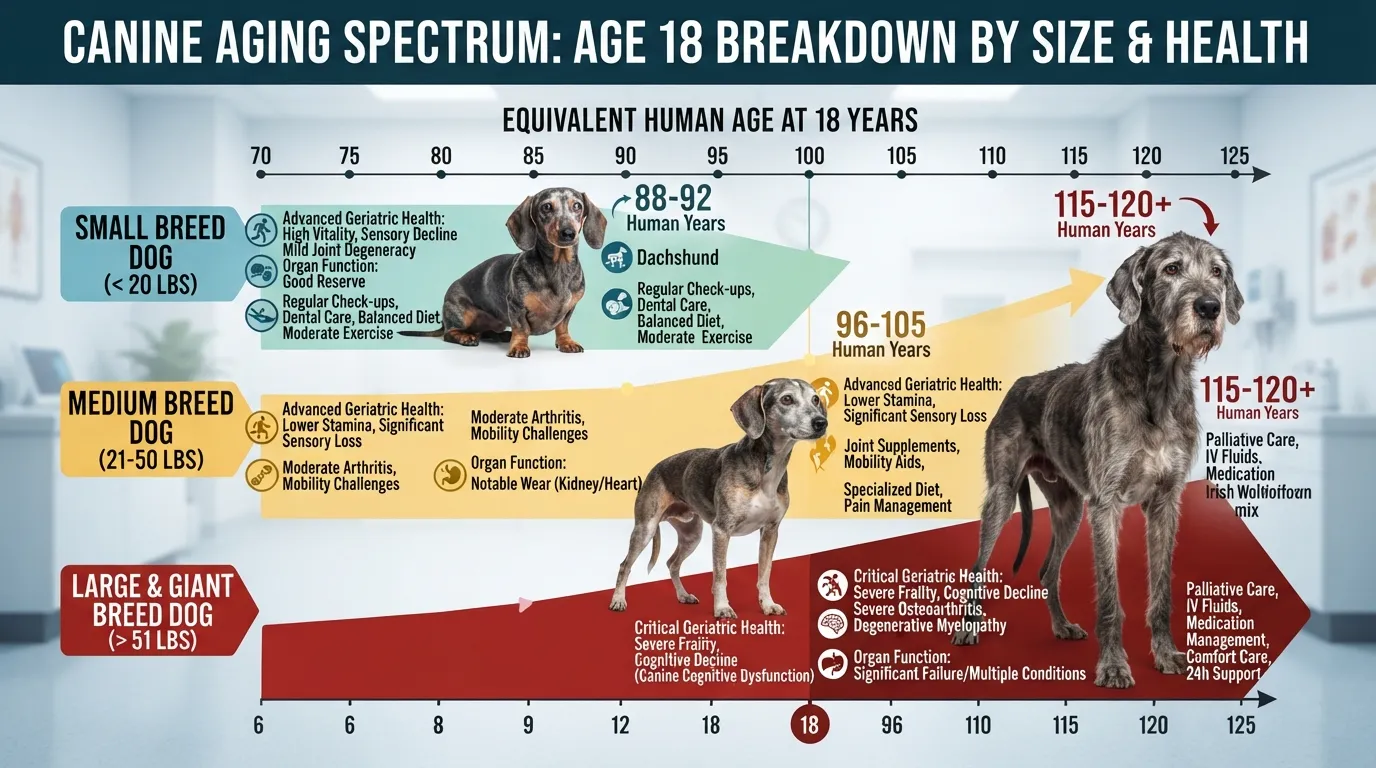
While reaching 31 in dog years (around 3.5 actual calendar years) represents a dog in peak physical condition, reaching senior or extreme calendar age (10 to 15+ actual years) brings significant biological shifts. As dogs enter their senior years, their organ function slows, joints undergo natural wear and tear, and their immune system requires extra support.
Signs of Aging in Senior Dogs
Recognizing the early signs of aging allows you to make timely adjustments to your dog’s lifestyle and care plan:
Mobility Changes & Joint Stiffness: Difficulty rising after naps, hesitating before climbing stairs, or a slower pace on daily walks often point to early osteoarthritis or joint inflammation.
Cognitive Changes: Senior dogs may experience Canine Cognitive Dysfunction (CCD), exhibiting restlessness at night, confusion in familiar places, or altered sleeping patterns.
Changes in Vision and Hearing: Cloudiness in the lenses (nuclear sclerosis or cataracts) and diminished response to everyday voice commands are common as dogs age.
Weight Fluctuation & Muscle Loss: A slowing metabolism can lead to unexpected weight gain, while advanced aging often causes loss of lean muscle mass along the spine and legs.
Dental Issues & Bad Breath: Accumulated tartar, gum disease, or tooth decay become more prevalent in older dogs, directly impacting their ability to chew comfortably.
Tips to Help Your Dog Live Longer
While genetics play a role in longevity, daily care habits significantly influence how gracefully and comfortably your dog ages:
Maintain an Ideal Body Weight: Studies consistently show that keeping your dog lean can extend their lifespan by up to 1.8 years compared to overweight dogs. Excess weight strains joints, hearts, and metabolic health.
Prioritize Daily Low-Impact Exercise: Regular, moderate activity—such as steady daily walks—keeps joints lubricated, maintains muscle tone, and supports cardiovascular health without causing joint trauma.
Invest in Proactive Dental Hygiene: Bacteria from untreated periodontal disease can enter the bloodstream and impact major organs like the heart, liver, and kidneys. Daily brushing and professional cleanings are essential.
Schedule Biannual Senior Veterinary Checkups: Because dogs age much faster than humans, visiting the vet twice a year allows for early detection of kidney, thyroid, or cardiac changes through routine bloodwork.
Enrich Their Environment: Keep senior minds sharp with puzzle toys, gentle scent games, and continued social interactions to support brain function and mental health.
For comprehensive, peer-reviewed resources on managing senior canine health, explore the official guidelines provided by the American Animal Hospital Association (AAHA) Senior Care Guidelines.
Frequently Asked Questions FAQs
How old is 31 in dog years in human years?
If a dog is 31 in dog years (human-equivalent age), they are roughly 3.5 actual calendar years old for a medium breed (around 3 years for large breeds and 3.5 to 4 years for small breeds). Conversely, if a dog were to live 31 actual calendar years, that would equal roughly 150 to 180+ human years depending on size.
How old is 30 years for a dog?
If a dog reaches 30 in dog years, they are biologically 3 to 3.5 actual calendar years old—a young adult dog in their prime. If referring to 30 actual calendar years, this equals roughly 145 to 160+ human years, an age achieved only by extreme record-holders like Bluey (29.5 years).
How old is a dog at 31?
A dog at 31 dog years is a young adult dog, roughly equivalent to a 31-year-old human. At this stage (around 3 to 3.5 calendar years), they have completed physical and emotional development, leaving puppy behaviors behind while maintaining peak energy and stamina.
How old is 32 years in dog years?
A dog that is 32 in dog years corresponds to approximately 3.5 to 4 actual calendar years of age for small-to-medium breeds. If calculating 32 actual calendar years into dog years, it translates to roughly 160 to 190 human-equivalent years.
How old is a 30-year-old dog?
A dog that has lived 30 actual calendar years is equivalent to a human living to 150+ years old. This is an extraordinary rarity; almost all dogs live between 10 and 15 calendar years.
How old is 200 years in dog years?
There are two ways to interpret this:
200 Human-Equivalent Dog Years: A dog reaching a biological age of 200 human years would be roughly 28 to 32 actual calendar years old (or around 25 years for giant breeds).
200 Actual Calendar Years: If a dog could live 200 actual calendar years, using standard veterinary aging models, that would equal over 1,000+ human years—a purely theoretical number, as no mammal reaches such an age.
🐾 Other Age Guides

I built Dogagescalculator.com to give dog owners honest, science-backed answers instead of the outdated "×7" myth. Every figure here is checked against AKC, AVMA, and published veterinary research.
More about the author & this site →
Comments