
36 Dog Years to Human Years – What Does It Really Mean?
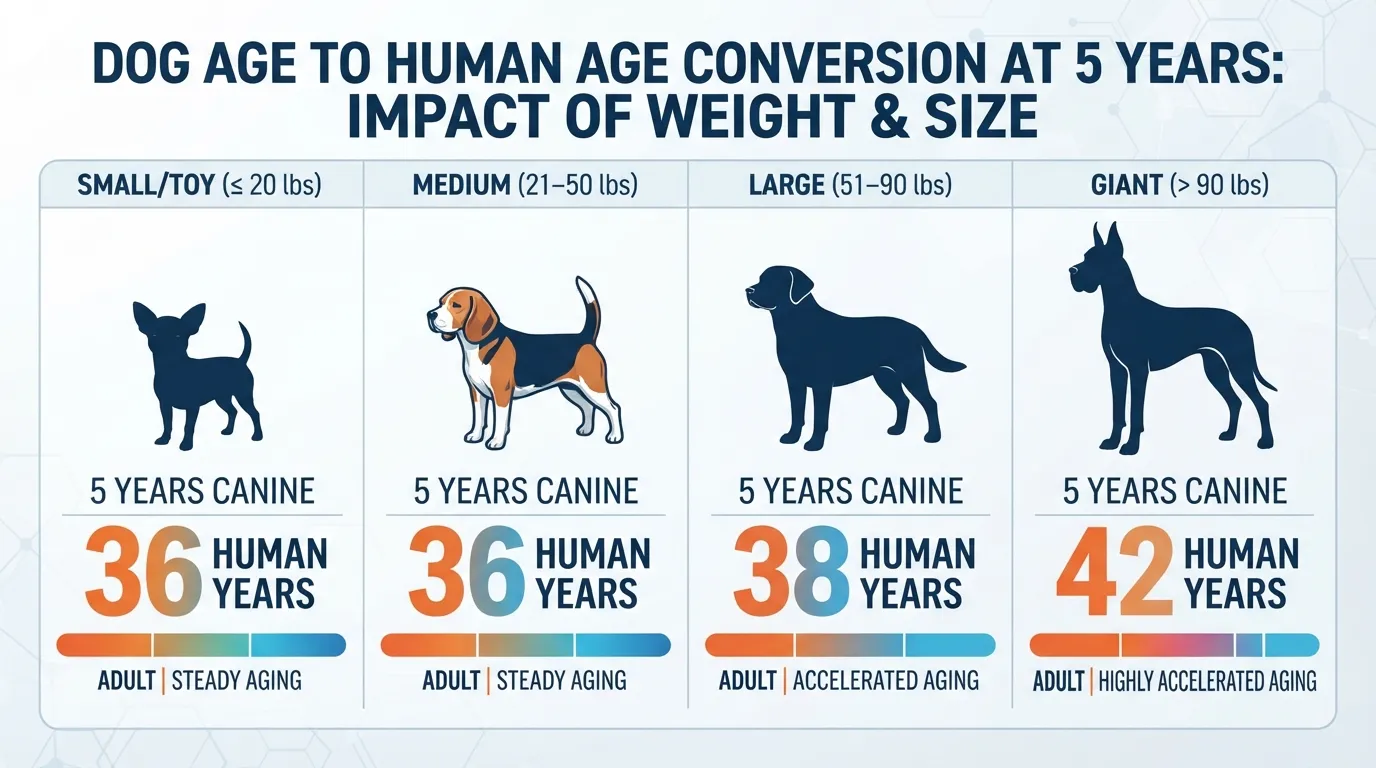
A dog at 36 human-equivalent dog years is roughly 4 to 5 actual calendar years old (around 5 calendar years for small breeds, 4.5 for medium breeds, and 4 for large breeds).
While the old “multiply by 7” rule calculated a 5-year-old dog at 35 human years, modern veterinary science uses the staged AVMA 15-9-5 formula to reflect rapid early puppy growth. Based on vet-approved developmental data, a dog at 36 dog years has entered physical maturity as a fully settled, healthy young adult.
How Is Dog Age Calculated in Human Years?
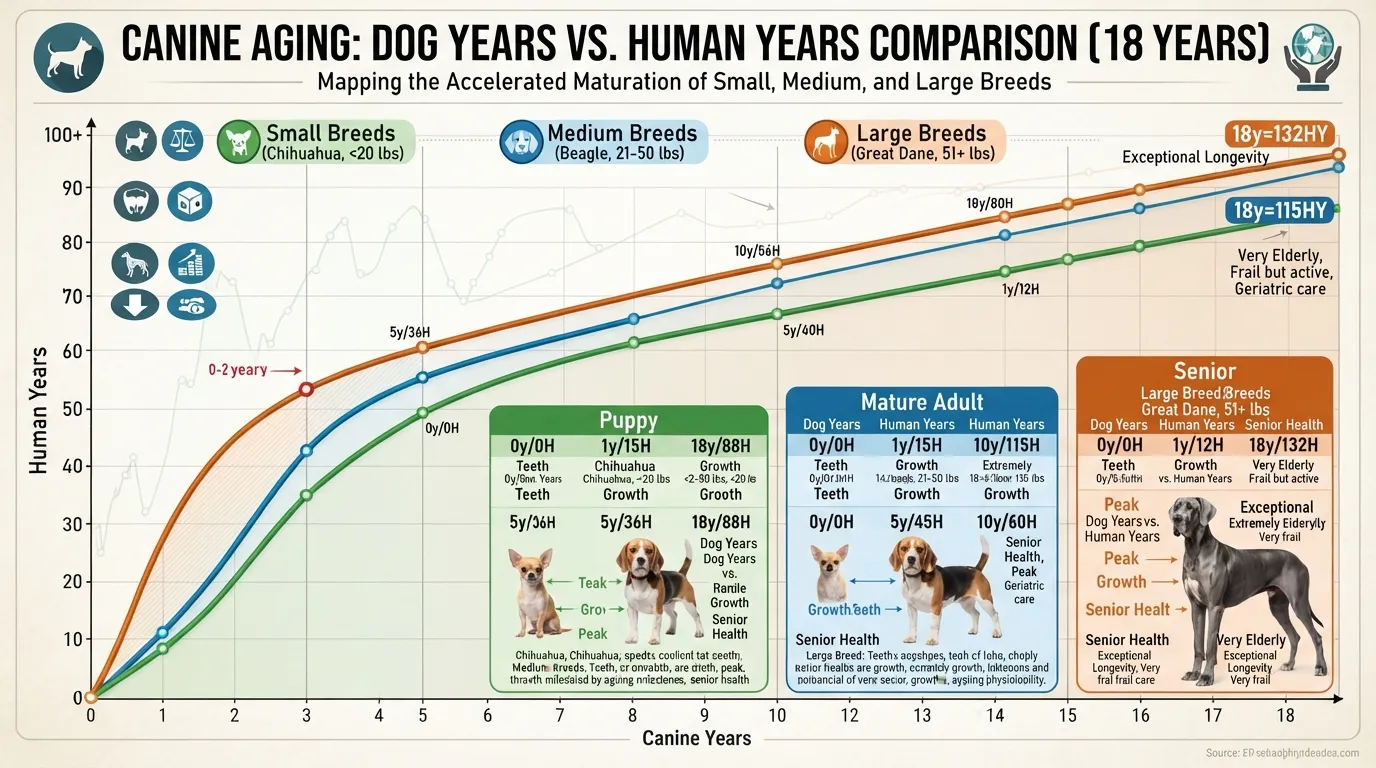
Calculating a dog’s true biological age requires moving past popular culture myths and looking at veterinary growth stages and genetic research.
The Old “1 Dog Year = 7 Human Years” Myth
For decades, pet owners assumed that one calendar year in a dog’s life equaled seven years in a human’s life.
The 1950s Origin: This concept arose during the 1950s as a marketing heuristic. At the time, the average human life expectancy was roughly 70 years, while the average domestic dog lived about 10 years. Marketing campaigns and pet care guides popularized the simple 7:1 ratio to encourage dog owners to seek annual veterinary checkups.
Why It Is Inaccurate: The 7-year multiplier assumes a flat, linear aging process. Under this logic, a 1-year-old dog has the physical and emotional maturity of a 7-year-old child. In reality, a 1-year-old dog has already reached full sexual maturity and physical independence, proving that early canine development happens far faster than a linear 7x math model suggests.
The New AVMA/AKC Formula
To align calculations with real physiological development, major veterinary organizations—including the American Veterinary Medical Association (AVMA) and the American Kennel Club (AKC)—adopted a staged calculation model:
Year 1: Counts as 15 human years (reflecting rapid early infancy, growth, and pubertal development).
Year 2: Adds 9 human years (bringing a 2-year-old dog to 24 human years).
Every Year After (Year 3+): Adds approximately 5 human years per calendar year for average-sized breeds.
36 Dog Years to Human Years – Full Calculation Breakdown
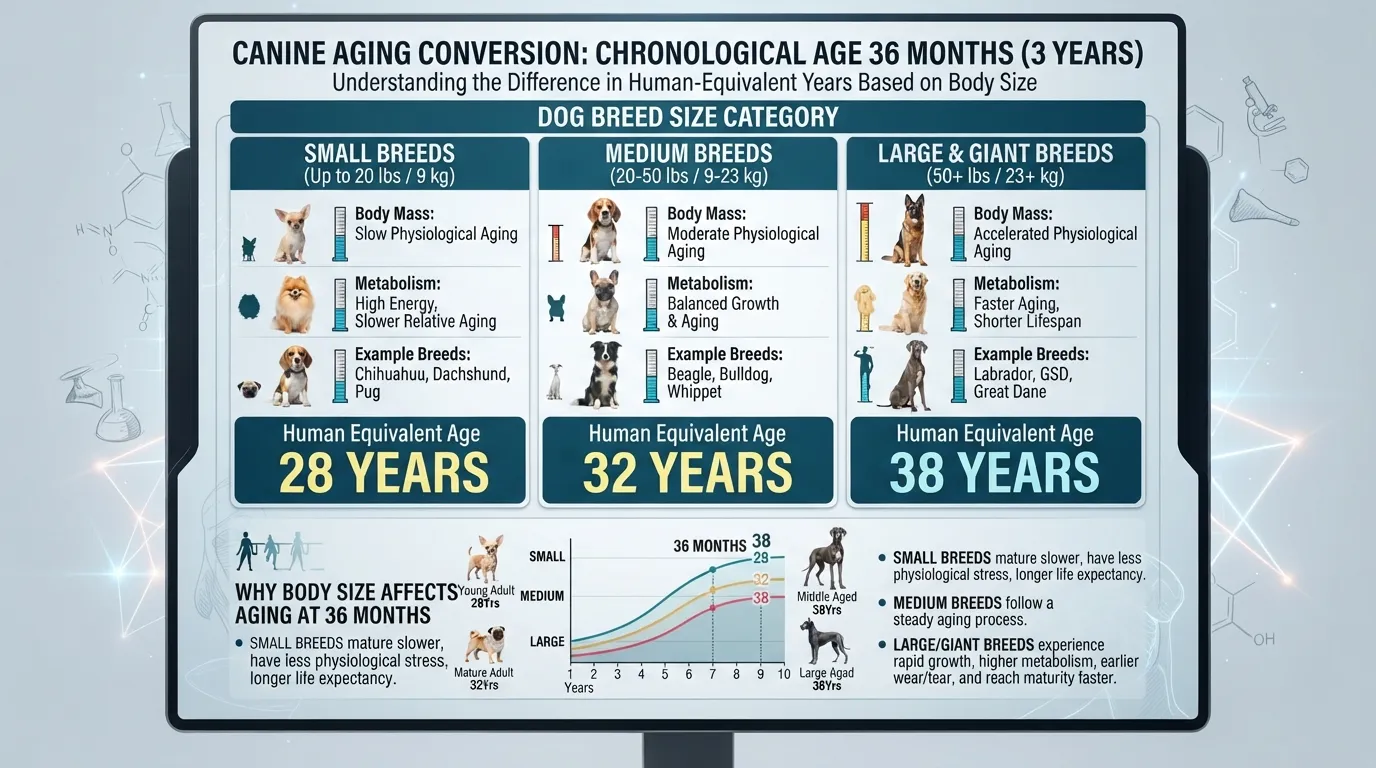
To calculate how your dog reaches 36 human-equivalent years, we apply the standard veterinary model step-by-step:
Step-by-Step Math Process
Step 1 (Year 1): The first year of life accounts for rapid juvenile growth and physical maturation, equaling 15 human years.
Step 2 (Year 2): The second year adds 9 human years, bringing the cumulative total to 24 human years ($15 + 9 = 24$).
Step 3 (Years 3 and 4): Each subsequent calendar year adds approximately 5 human years for average-sized breeds.
Year 3: 24 + 5 = 29 human years
Year 4: 29 + 5 = 34 human years
Step 4 (Final Adjustment): Adding approximately 5 months (or 0.4 of a year) adds the final 2 human years ($34 + 2 = 36$).
Dog Age to Human Age Chart
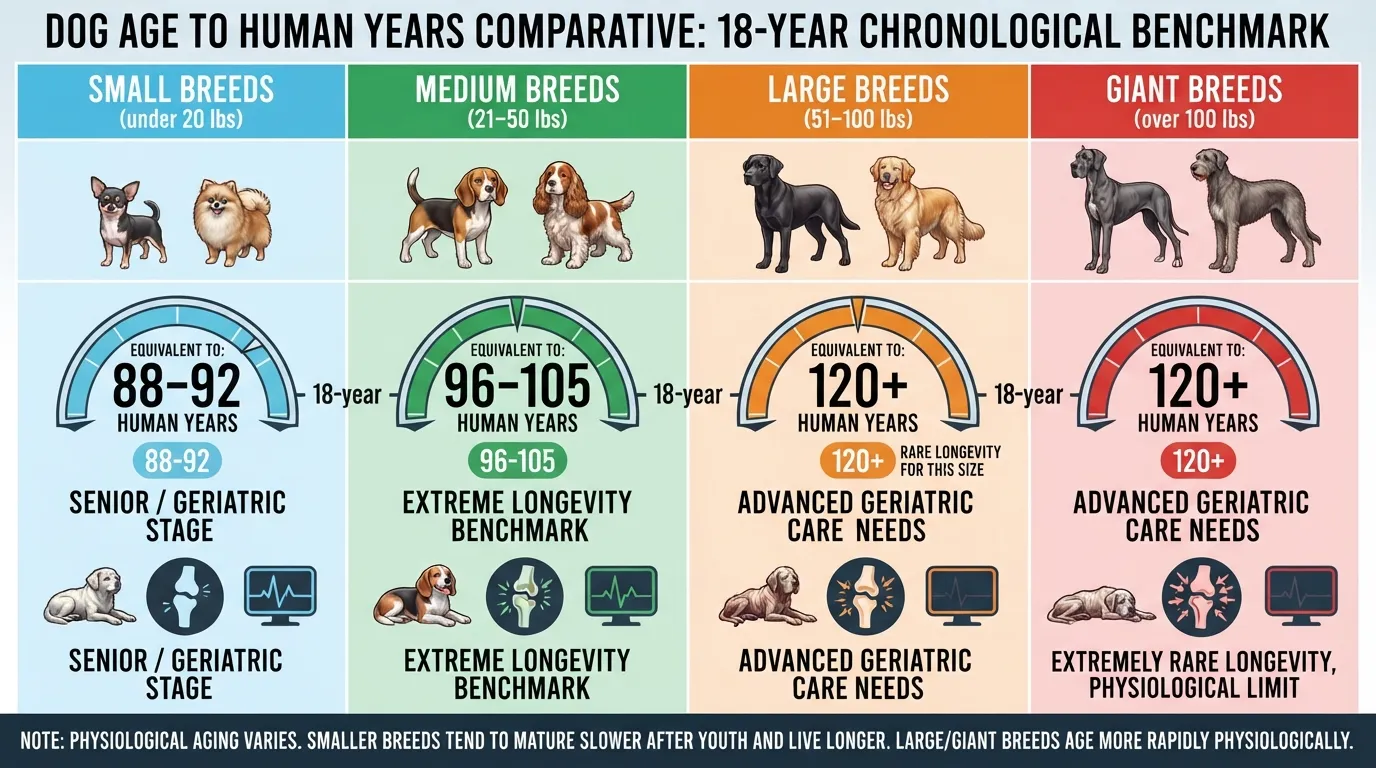
Because aging varies significantly by weight class, comparing calendar years to human years requires a size-adjusted breakdown. Below are the charts mapping your dog’s age using American Veterinary Medical Association (AVMA) standards.
| Dog Age (Calendar Years) | Small Breed (<20 lbs) | Medium Breed (21–50 lbs) | Large Breed (51–100 lbs) |
|---|---|---|---|
| 1 Year | 15 human yrs | 15 human yrs | 15 human yrs |
| 2 Years | 24 human yrs | 24 human yrs | 24 human yrs |
| 3 Years | 28 human yrs | 29 human yrs | 30 human yrs |
| 4 Years | 32 human yrs | 34 human yrs | 36 human yrs |
| 5 Years | 36 human yrs | 39 human yrs | 42 human yrs |
| 6 Years | 40 human yrs | 44 human yrs | 48 human yrs |
| 7 Years | 44 human yrs | 49 human yrs | 54 human yrs |
| 8 Years | 48 human yrs | 54 human yrs | 60 human yrs |
| 9 Years | 52 human yrs | 59 human yrs | 66 human yrs |
| 10 Years | 56 human yrs | 64 human yrs | 72 human yrs |
| 11 Years | 60 human yrs | 69 human yrs | 78 human yrs |
| 12 Years | 64 human yrs | 74 human yrs | 84 human yrs |
| 13 Years | 68 human yrs | 79 human yrs | 90 human yrs |
| 14 Years | 72 human yrs | 84 human yrs | 96 human yrs |
| 15 Years | 76 human yrs | 89 human yrs | 102 human yrs |
| 16 Years | 80 human yrs | 94 human yrs | 108 human yrs |
| 17 Years | 84 human yrs | 99 human yrs | 114 human yrs |
| 18 Years | 88 human yrs | 104 human yrs | 120 human yrs |
| 19 Years | 92 human yrs | 109 human yrs | 126 human yrs |
| 20 Years | 96 human yrs | 114 human yrs | 132 human yrs |
Does Dog Size Affect Human Year Conversion?
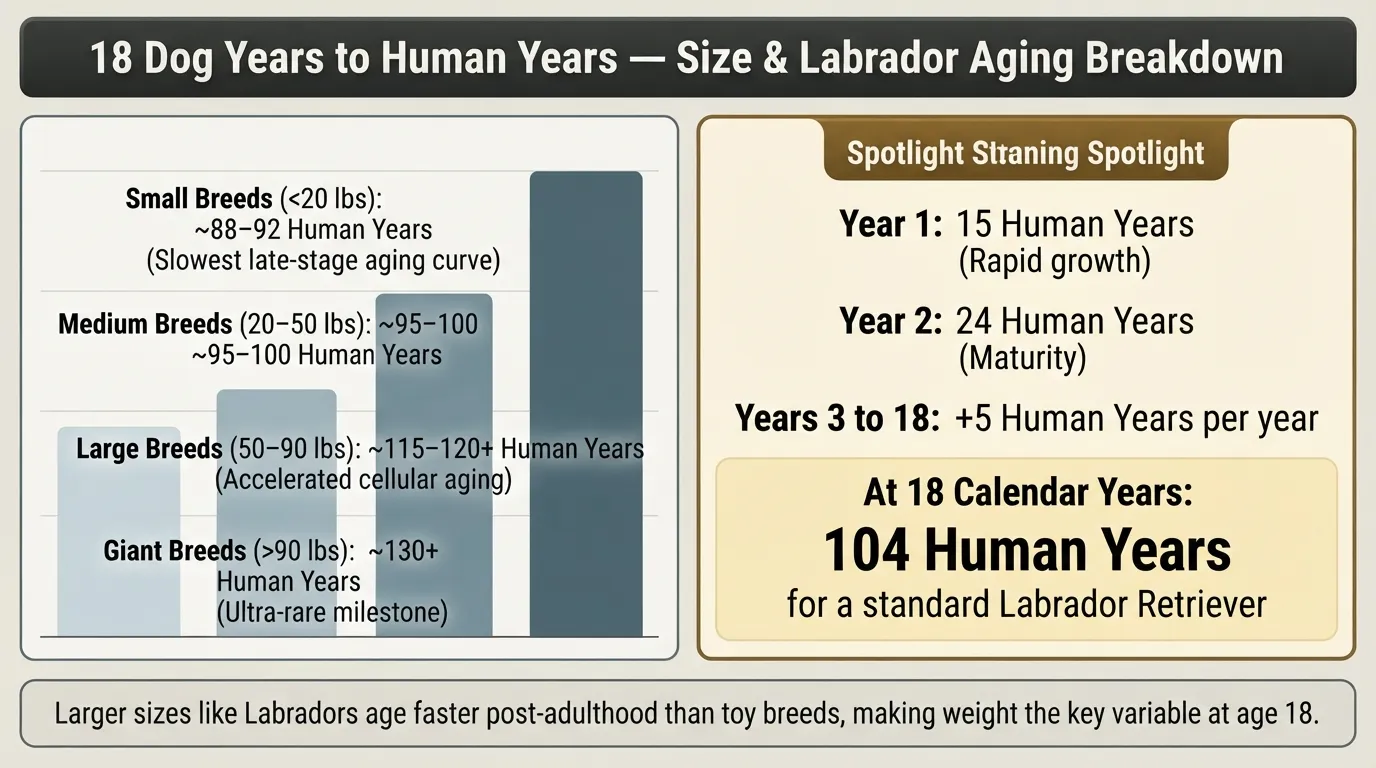
Yes, dog size is the single most significant factor in determining how fast a dog ages into human years. While all dogs mature at similar rapid rates during their first two years of life, their biological trajectories divide sharply once they reach adulthood.
Small Breeds Age Slower
Small and toy breeds (under 20 lbs), such as Chihuahuas, Toy Poodles, and Miniature Dachshunds, age at a much slower rate after reaching maturity—gaining only about 4 human-equivalent years per calendar year. Because their cellular wear and tear accumulates gradually, small breeds routinely reach 14 to 18 calendar years (equivalent to 72 to 88+ human years).
Large Breeds Age Faster
Large breeds (51–100 lbs), such as Golden Retrievers, Labradors, and German Shepherds, age acceleratedly after maturity—gaining roughly 5 to 6 human years every calendar year. Their higher metabolic demands and structural stress mean they enter their senior years around 7 or 8 calendar years old.
Giant Breed Example (Great Dane)
Giant breeds (100+ lbs), including Great Danes, Mastiffs, and Irish Wolfhounds, experience the most rapid cellular aging process in the canine world:
A 1-year-old Great Dane is roughly equivalent to a 15-year-old human.
By 3 calendar years, a Great Dane hits 31 human years.
By 6 calendar years, they are already 52 human years old (entering early senior stage).
By 10 calendar years, they reach nearly 80 human-equivalent years.
Because giant breeds add 6 to 7 human years for every calendar year after age 2, their average lifespan ranges between 7 and 10 calendar years.
Body Mass & Lifespan Science
In most of the animal kingdom (such as mammals like elephants versus mice), larger species live longer than smaller ones. Domestic dogs are a fascinating exception to this rule: within the same species, larger body mass correlates with a shorter lifespan.
Research published in The American Naturalist and studies led by evolutionary biologists at the University of Göttingen demonstrate that large and giant dogs die younger primarily because they age at an accelerated rate.
Cellular Multiplication Rate: Giant breeds grow from tiny puppies to 100+ lb adults in under 18 months. This extreme growth speed requires elevated concentrations of IGF-1 (Insulin-like Growth Factor 1), a hormone that promotes rapid cell proliferation.
Free Radical Damage: High cell turnover rates generate greater oxidative stress, making larger dogs biologically older on a cellular level much earlier in life.
Disease Susceptibility: This rapid physiological growth makes large and giant dogs significantly more susceptible to age-related conditions—especially cancer, heart failure, and degenerative joint disease—at an earlier calendar age than small breeds.
Is a 36-Year-Old Dog Even Possible? Real-World Context
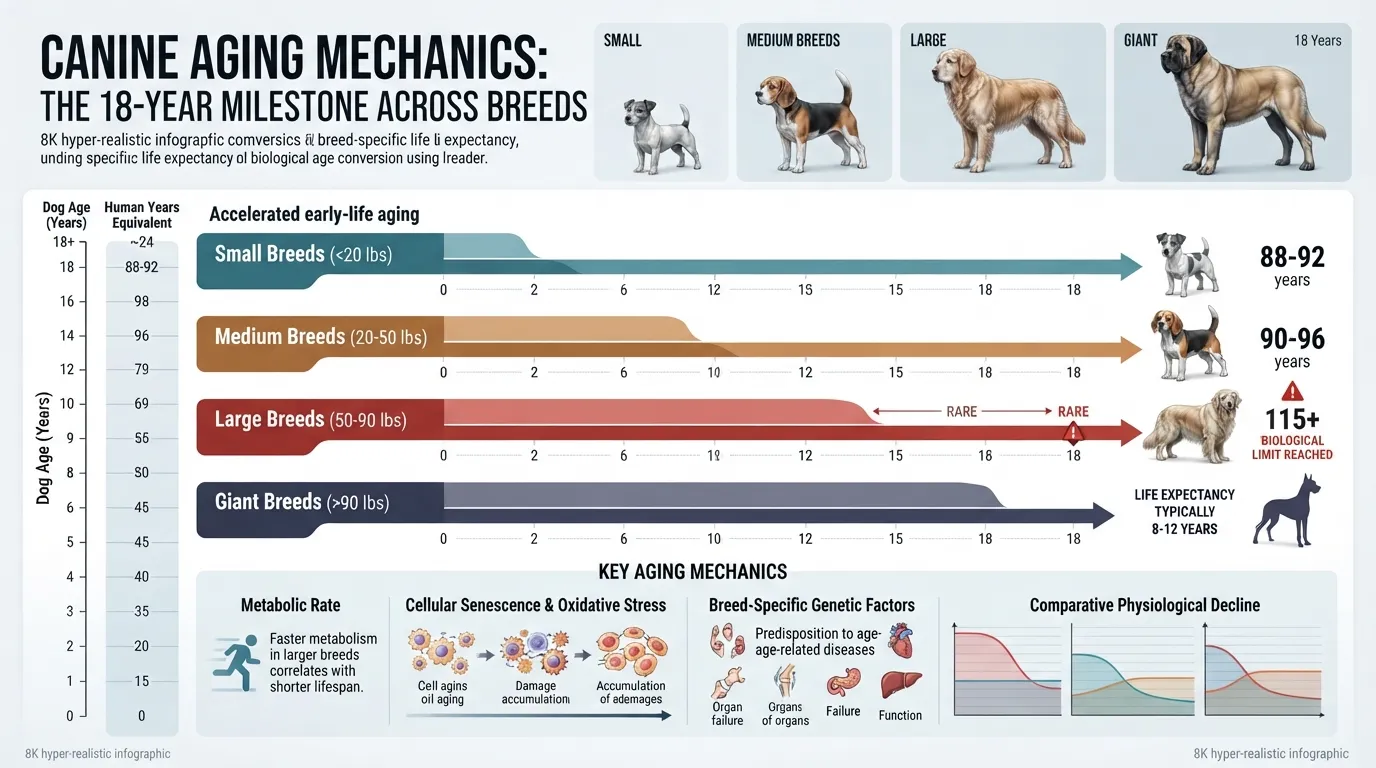
When pet owners search for “36 dog years,” they are almost always looking for one of two completely different things:
Calculated Intent (36 Human-Equivalent Years): A young adult dog that is roughly 4 to 5 actual calendar years old.
Literal Intent (36 Actual Calendar Years): A dog that has physically survived for 36 full calendar years on Earth.
Understanding the difference between biological calculation and literal longevity clarifies what is scientifically possible.
Clarifying “36”: Literal vs. Calculated Intent
Calculated Intent (100% Real & Universal): Every single healthy dog will comfortably reach 36 human-equivalent years. Depending on frame and size, this milestone happens when your dog is between 4 and 5 calendar years old. At 36 dog years, your pet is a vibrant, physically prime young adult.
Literal Intent (Biologically Near-Impossible): Surviving to 36 actual calendar years is an extreme biological anomaly. In human terms, an actual 36-calendar-year-old small dog would be equivalent to a human living well past 160 years old.
The Oldest Dog on Record (Real-World Examples)
To put a 36-calendar-year lifespan into perspective, consider the verified extremes of canine longevity:
Bluey (29 Years, 5 Months): For nearly a century, the official Guinness World Record for the oldest verified dog belonged to Bluey, an Australian Cattle Dog who lived from 1910 to 1939 in Victoria, Australia. Working out in the fields, Bluey reached nearly 29.5 calendar years—translating to roughly 160+ human-equivalent years.
Bobi (Unverified/Controversial Claim): In 2023, a Rafeiro do Alentejo named Bobi from Portugal gained global attention with claims of reaching 31 calendar years. However, following formal investigations regarding missing microchip verification and lack of conclusive medical records, Guinness World Records officially suspended and ultimately revoked the title in early 2024.
| Breed Size Category | Average Lifespan | Realistic Maximum Calendar Age | Biological Limit |
|---|---|---|---|
| Small / Toy Breeds (<20 lbs) | 14–18 calendar yrs | 18–22 calendar yrs | Very rare individuals reach 24–29 years |
| Medium Breeds (21–50 lbs) | 12–15 calendar yrs | 15–18 calendar yrs | Extremely rare individuals reach 20 years |
| Large Breeds (51–100 lbs) | 10–12 calendar yrs | 13–15 calendar yrs | Biological cap around 16 years |
| Giant Breeds (100+ lbs) | 7–10 calendar yrs | 10–12 calendar yrs | Biological cap around 13 years |
What Life Stage Does This Represent?
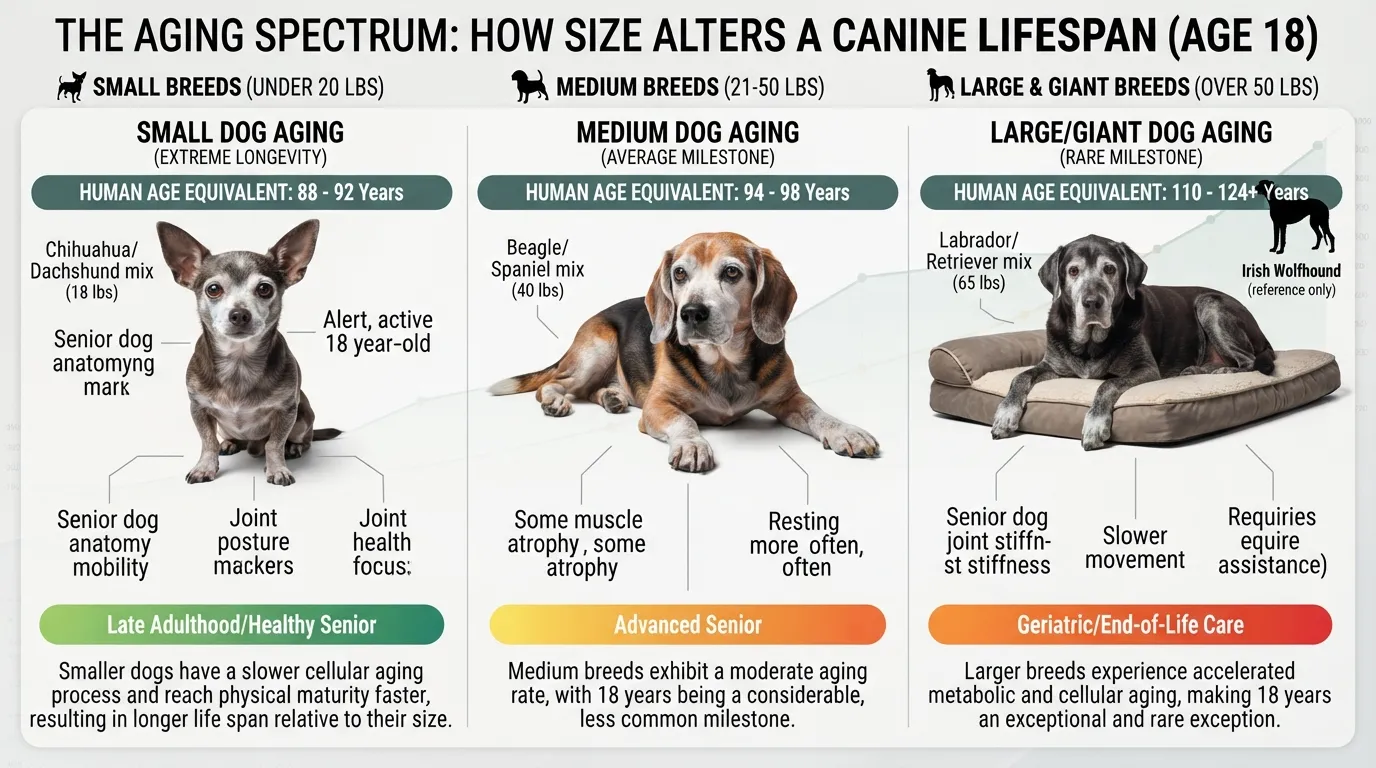
Understanding which life stage “36” represents depends on whether you mean 36 human-equivalent dog years (a 4- to 5-year-old dog) or 36 actual calendar years on Earth.
Here is how both interpretations break down in terms of biological development and relatable human comparisons:
Scenario A: 36 Human-Equivalent Dog Years (Actual Age: 4–5 Years)
If your dog is roughly 4 to 5 calendar years old, they have reached 36 in dog years. Biologically, this places them squarely in the Prime Young Adulthood stage.
Developmental Milestones: Puppy behaviors and adolescent hormonal surges are long gone. Your dog has reached complete mental maturity, emotional stability, and peak physical strength. Their immune system is robust, and their energy is consistent and controllable.
Relatable Human Comparison: This represents a human in their mid-30s (around 35–36 years old). They are in the prime of life—settled in their routines, physically capable, confident, and experiencing optimal health.
Scenario B: 36 Actual Calendar Years (Human Equivalent: 160+ Years)
If a dog were to survive for 36 full calendar years, they would far surpass standard “Senior” or “Super-Senior” designations, entering a theoretical Centenarian / Extreme Longevity stage.
The Canine Aging Stages Context:
Puppyhood: Birth to 1 year
Adult Stage: 1 to 6 years
Senior Stage: 7 to 10 years (equivalent to humans in their 60s–70s)
Super-Senior Stage: 11 to 15+ years (equivalent to humans in their late 70s to 90s—the great-grandparent stage)
Extreme Longevity (36 Calendar Years): Beyond 150+ human-equivalent years
Relatable Human Comparison: This stage goes far beyond a typical great-grandparent or senior citizen. In human terms, a 36-calendar-year-old dog is comparable to a 160- to 190-year-old human supercentenarian. It represents an extraordinary biological marvel that breaks all standard mammalian lifespans.
Frequently Asked Questions
How old is a 36 year old dog?
Depending on whether you mean actual calendar years or human-equivalent years:
36 Dog Years (Human Equivalent): Your dog is roughly 4 to 5 actual calendar years old—a healthy, fully matured adult in their prime.
36 Actual Calendar Years: This would equal roughly 160 to 228 human years. No verified domestic dog has officially reached 36 actual calendar years; the oldest verified dog on record lived 29.5 calendar years.
How old is 200 years in dog years?
200 Human-Equivalent Dog Years: This corresponds to an actual calendar age of roughly 28 to 32 years for a small-to-medium dog (around the absolute theoretical limit of canine lifespan).
200 Actual Calendar Years: If a dog lived 200 actual calendar years, it would translate to over 1,000 human-equivalent years, which is biologically impossible for any mammal.
How old is 90 years old in dog years?
90 Human-Equivalent Dog Years: A dog that is “90 in dog years” is roughly 13 to 16 actual calendar years old (depending on size and breed). This places them firmly in the geriatric or super-senior stage.
90 Actual Calendar Years: If a dog lived 90 actual calendar years, that would equal over 450 human-equivalent years.
Is 7 dog years 1 human year?
No. The “1 human year = 7 dog years” rule is an outdated myth created in the 1950s as a rough rule of thumb. Modern veterinary medicine relies on the AVMA standard (15 human years for Year 1, 9 years for Year 2, and roughly 4–5 years per year after) or DNA-based epigenetic clock formulas because dogs mature far faster in their first two years than humans do.
Is 14 very old for a dog?
Yes. Reaching 14 calendar years is equivalent to 72 to 96+ human years depending on weight class:
Small breeds (<20 lbs) at 14 calendar years are considered seniors (~72 human years) and can often live several years longer.
Medium and Large breeds (20+ lbs) at 14 calendar years are considered super-seniors or geriatric (~84 to 96+ human years), as most large breeds average 10 to 12 years.
🐾 Other Age Guides

I built Dogagescalculator.com to give dog owners honest, science-backed answers instead of the outdated "×7" myth. Every figure here is checked against AKC, AVMA, and published veterinary research.
More about the author & this site →
Comments