What Is 1 Dog Year in Human Years?
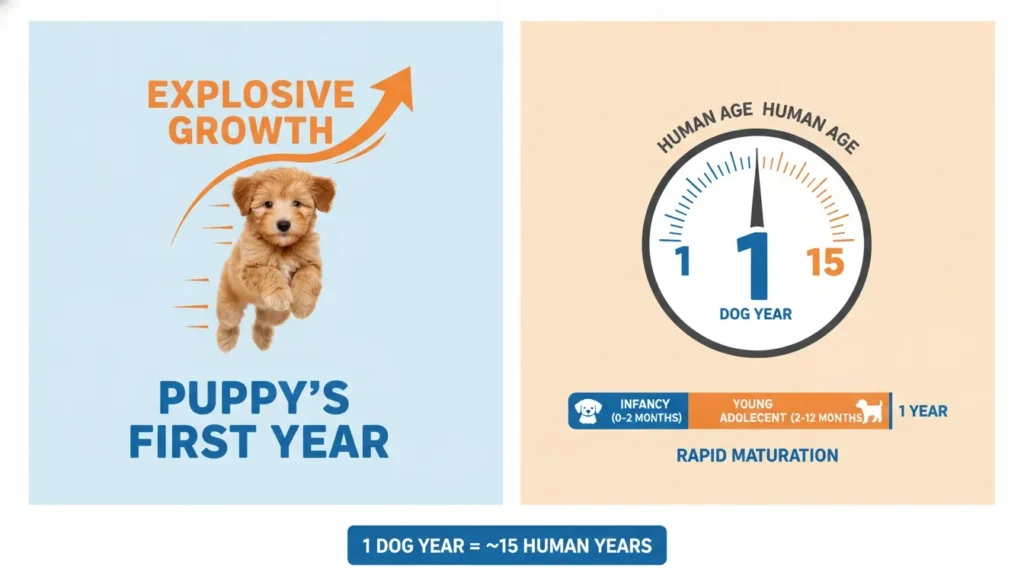
Quick Answer: 1 Dog Year = 15 Human Years
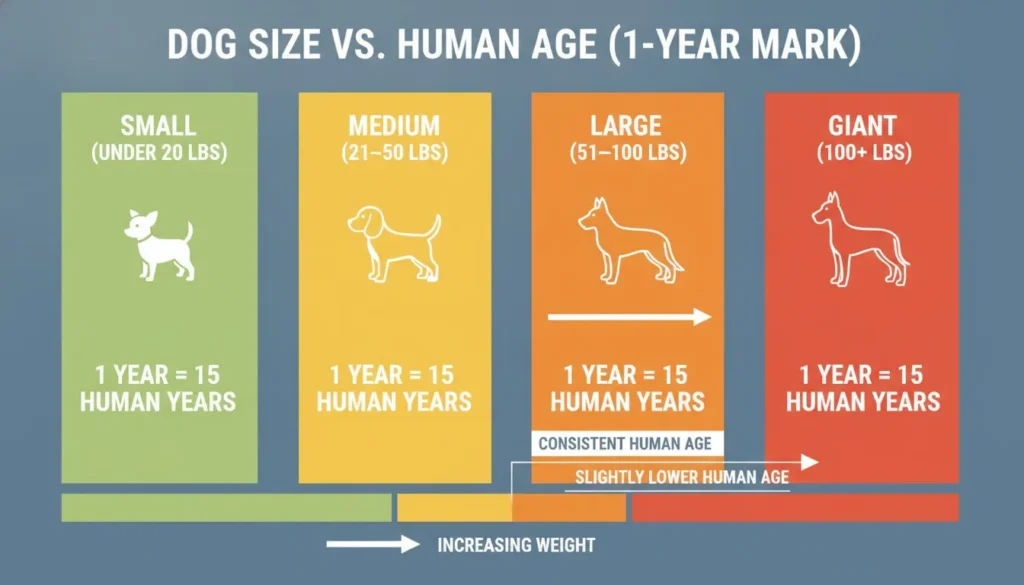
| Dog Size | Weight | 1 Dog Year = |
|---|---|---|
| Small | Under 20 lbs | 15 human years |
| Medium | 21–50 lbs | 15 human years |
| Large | 51–100 lbs | 15 human years |
| Giant | 100+ lbs | 12 human years |
If you’re wondering how many dog years are in one human year, there isn’t a simple 7-to-1 conversion. A 1-year-old dog is roughly equivalent to a human teenager, but the exact human-equivalent age varies by breed and size as dogs get older. Small, medium, large, and giant dogs all age differently, so understanding your dog’s size is key to estimating their human age accurately.
Why Is 1 Dog Year Equal to 15 Human Years?
The Old “Multiply by 7” Rule Is Wrong
People often believe the myth that one dog year equals seven human years. This simple math ignores the fact that dogs mature much faster than humans during their early stages of life. The American Kennel Club (AKC) explains that this rule is inaccurate because it fails to account for the unique way different breeds mature and age.
What Science Actually Says
The American Veterinary Medical Association (AVMA) uses a tiered model to track progress, which places the first year of a dog’s life at 15 human years and the second year at an additional 9 years. Scientists have also developed more complex formulas, such as the UC San Diego 2020 study which uses the equation 16×ln(dog age)+31 to calculate age based on DNA methylation. These modern methods provide a far more accurate view of how a dog’s biological clock moves compared to ours.
Why Do Dogs Age So Fast in Year One?
Puppies undergo an incredible transformation during their first 12 months that would take a human over a decade to complete. By the time they turn one, most dogs have replaced their baby teeth, reached sexual maturity, and hit their full adult height. Because of this explosive puppy development, a 1-year-old dog is biologically similar to a 15-year-old human teenager.
What Does a 1-Year-Old Dog Look Like in Human Terms?
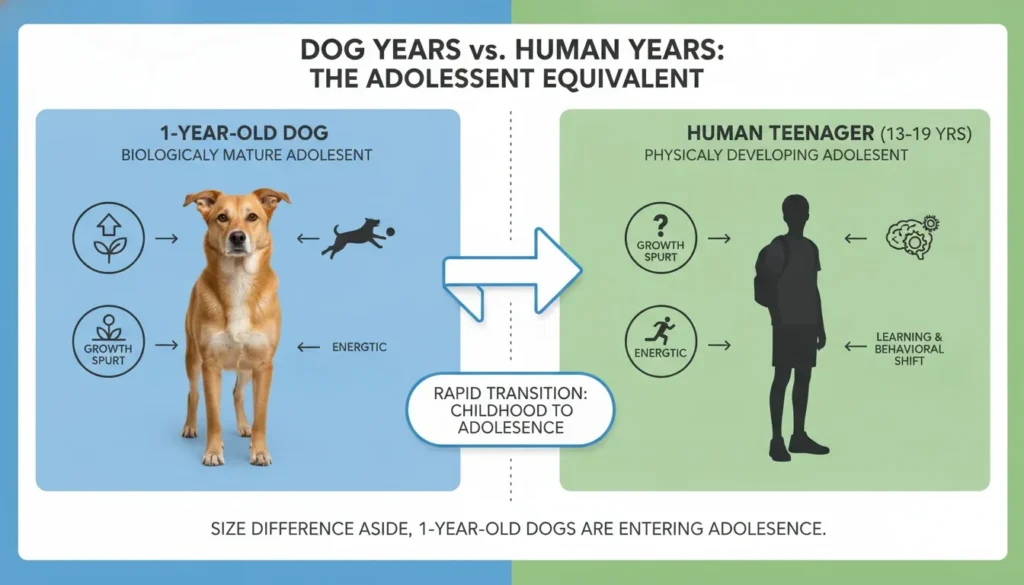
Your 1-year-old dog is essentially a 15-year-old human teenager. They are physically mature in many ways, but they are still emotionally immature and learning how to navigate the world. Expect plenty of high energy and the occasional moment of confusion as they transition into their next dog life stage.
Think of this time as the awkward teen phase where they are technically adults but still act like puppies. They are easily distracted by everything and still have a lot of growing up to do mentally. Here is what is happening physically at this age:
Adult teeth are fully in and settled.
Reproductive maturity has been reached.
Full adult height is generally achieved for most breeds.
Brain development is still ongoing, which explains some of that classic teenage behavior.
1-Year-Old Dog Human Age by Breed Size — Full Breakdown
Small Dogs (Under 20 lbs) at 1 Year
A small 1-year-old dog is equivalent to 15 human years. Common breeds in this group include the Chihuahua, Pomeranian, and Yorkshire Terrier. At this stage, these dogs are typically finished with their primary growth spurts and are transitioning into young adulthood.
Medium Dogs (21–50 lbs) at 1 Year
Medium-sized breeds like the Beagle, Cocker Spaniel, and Border Collie reach 15 human years when they hit their first birthday. These dogs are energetic, social, and likely settling into their permanent adult personality. Consistent training and regular exercise are still vital to keep them happy and balanced.
Large Dogs (51–100 lbs) at 1 Year
Large breeds, such as the German Shepherd, Labrador, and Golden Retriever, also align with 15 human years at the 12-month mark. Despite their size, these dogs are technically still maturing internally. Keep an eye on their joints and maintain a healthy weight to support their long-term health.
Giant Dogs (100+ lbs) at 1 Year
Giant breeds like the Great Dane, Mastiff, and Saint Bernard equal 12 human years at age one. This slightly lower number exists because these massive dogs have a much more compressed lifespan compared to smaller breeds. They essentially reach senior life stages much sooner, so early health monitoring is key for their well-being.
Dog Age Chart — Year 1 to Year 5 All Sizes
Dog Age Chart — Years 1 to 5 (All Sizes)
| Dog Age | Small | Medium | Large | Giant |
|---|---|---|---|---|
| 1 year | 15 | 15 | 15 | 12 |
| 2 years | 24 | 24 | 24 | 22 |
| 3 years | 28 | 28 | 28 | 31 |
| 4 years | 32 | 33 | 35 | 37 |
| 5 years | 36 | 37 | 40 | 42 |
Values in human years | Based on AKC & AVMA guidelines | Giant = 100+ lbs | Small = under 20 lbs
Tracking dog aging shows that growth rates shift significantly once your pet matures past the puppy life stage. While small breeds stay younger longer, giant breeds age faster by the time they reach five years old. Seeing the full dog human age progression helps you provide the right care for every stage of your companion’s life.
Click here to view the full chart and use our main calculator page
What Should You Do When Your Dog Turns 1?
Vet Checkup at 1 Year
Schedule an annual wellness exam to review your dog’s health history and set up a plan for the adult years. This visit is the perfect time to discuss vaccinations and parasite prevention. You can learn more about managing long-term health through the AVMA senior pet care resources.
Switch from Puppy Food to Adult Food
Puppy food contains extra calories and nutrients needed for intense growth, which can lead to obesity once a dog matures. Transition your dog to adult food over a 7-day period by slowly mixing the new diet with the old to avoid stomach upset. Choose a formula specifically balanced for your dog’s size, as large breeds need different joint support than small ones.
Spay or Neuter Timing
Talk to your vet about the right age for these procedures based on your specific breed and health needs. Every dog develops differently, so your vet will help you weigh the health pros and cons for your unique pup. There is no one-size-fits-all timeline for this decision.
Training at the “Teenage” Stage
One-year-old dogs are often in their “teenage” phase, meaning they might test boundaries or ignore commands they used to know. Keep your training sessions short, fun, and focused on positive reinforcement to maintain a strong bond.
Practice basic obedience commands in new locations to build their focus.
Stick to a predictable daily routine so your dog knows what to expect.
Reward desired behaviors immediately with high-value treats or praise.
Exercise Needs at Age 1
Most adult dogs thrive with 30 to 60 minutes of daily activity, depending on their energy levels and breed. Avoid high-impact exercises like long-distance jogging or heavy jumping, especially for large breeds whose joints are still developing. Focus on balanced activities like brisk walks, scent games, or swimming to keep them fit without putting too much strain on their bodies.
Calculate Your Dog's Exact Human Age
Getting a general idea is helpful, but every dog ages at a slightly different pace based on their specific breed and lifestyle. Using a personalized calculator gives you a much better picture of where your best friend is on their life journey.
Frequently Asked Questions
No — the 7x rule is outdated. According to AVMA guidelines, the first year equals 15 human years because puppies develop far faster than humans in their first 12 months.
Technically no — most dogs are considered adolescents or young adults at 1 year. They have adult teeth and full height, but their behavior and brain development are still maturing.
For most sizes, 1 dog year = 15 human years. Giant breeds (100+ lbs) are slightly lower at around 12 human years because their overall lifespan is shorter.
A 1-year-old dog is in the adolescent stage — equivalent to a human teenager. Full physical growth is mostly complete, but emotional maturity and behavioral training are still developing.
Use the UC San Diego epigenetic formula: human age = 16 × ln(dog age) + 31. Or use our free calculator above for a size and breed-specific result.
🐾 Other Age Guides

Gulfam Haider Mehdi
Founder & Developer
I built Dogagescalculator.com to give dog owners honest, science-backed answers instead of the outdated "×7" myth. Every figure here is checked against AKC, AVMA, and published veterinary research.
More about the author & this site →📌 Featured Guides
What Is 11 Dog Years in Human Years
→
What Is 12 Dog Years in Human Years
→
what is the lifespan of a yorkie dog
→
What Is 12 Human Years in Dog Years
→
how old should a german shepherd be to breed
→
How to Tell How Old a Bird Is
→
how much does a german shorthaired pointer weigh
→
chihuahua dog years to human years
→
when do dogs start going grey
→
9 human years to dog years
→
Comments