Golden Retriever Puppy Feeding Guide: How Much, How Often & When to Switch to Adult Food
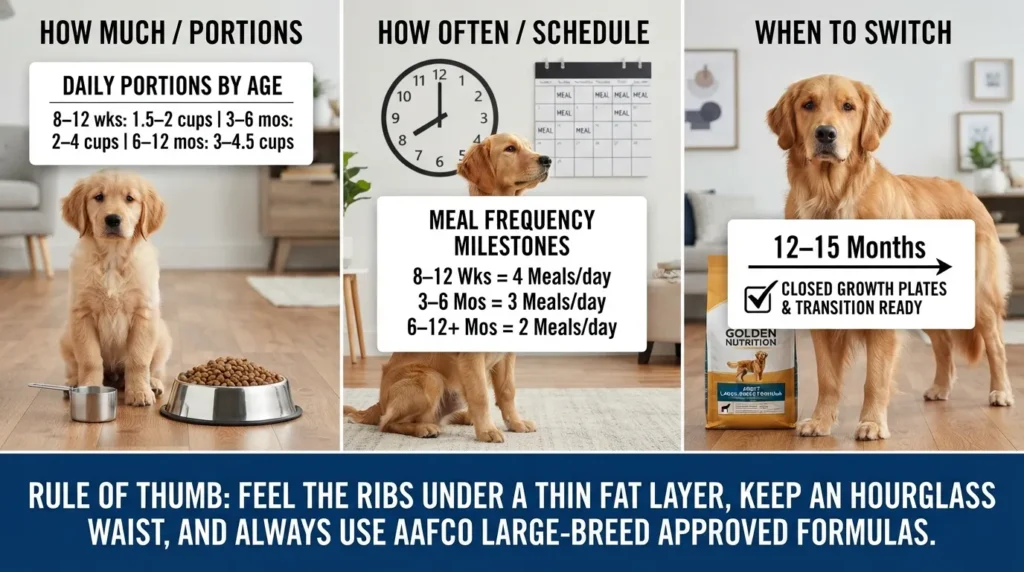
Bringing home a Golden Retriever puppy is an absolute joy, but standing in your kitchen wondering if you’re overfeeding or underfeeding that fast-growing fuzzball can feel overwhelming. Golden puppies grow rapidly, often gaining up to two pounds a week during peak growth spurts. Getting their nutrition right isn’t just about satisfying a wagging tail—it’s crucial for building healthy joints and preventing long-term skeletal issues like hip dysplasia.
This guide breaks down exact feeding amounts, daily schedule adjustments as your pup matures, and the precise moment to safely transition to adult kibble.
Here is what we’ll cover:
Puppy Feeding Chart: Recommended daily portions by age and target adult weight
Feeding Schedule: How many meals per day at 2, 4, and 6+ months
Large-Breed Kibble: Why calcium-to-phosphorus ratios matter for Goldens
The Adult Transition: How to switch food without triggering upset stomachs
Golden Retriever Puppy Feeding Chart by Age & Weight
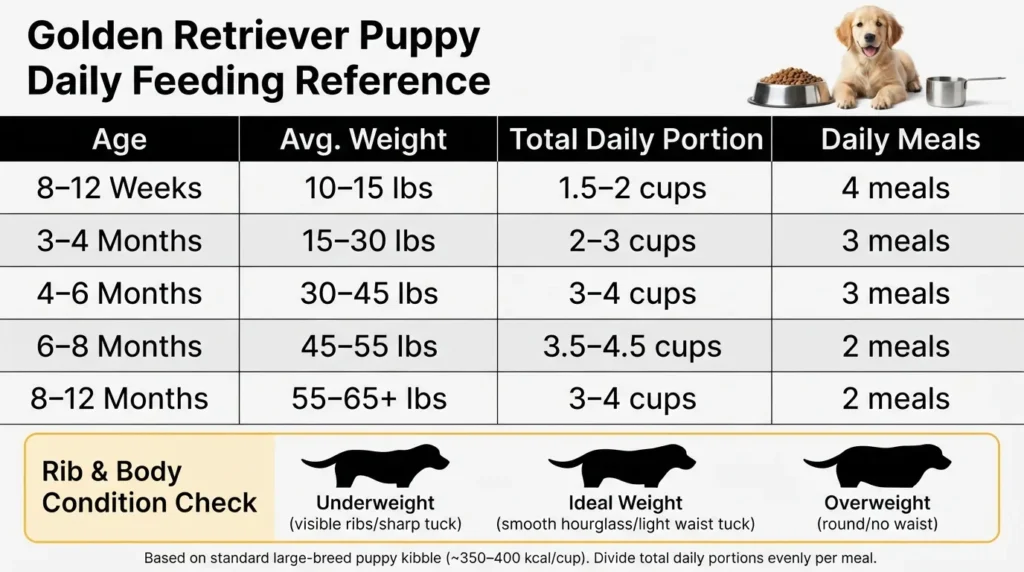
Feeding a Golden Retriever puppy isn’t a one-size-fits-all math equation. Because Goldens grow so rapidly during their first year, their daily caloric needs shift almost monthly.
To keep your puppy growing at a safe, steady rate—without putting unnecessary stress on developing joints—use this breakdown as your starting point.
Feeding Chart Table
The portions below reflect total daily food amounts using a standard, high-quality large-breed puppy kibble (roughly 350–400 kcal per cup).
| Age | Average Weight | Total Daily Portion | Daily Meals |
|---|---|---|---|
| 8–12 Weeks | 10–15 lbs | 1.5–2 cups | 4 meals |
| 3–4 Months | 15–30 lbs | 2–3 cups | 3 meals |
| 4–6 Months | 30–45 lbs | 3–4 cups | 3 meals |
| 6–8 Months | 45–55 lbs | 3.5–4.5 cups | 2 meals |
| 8–12 Months | 55–65+ lbs | 3–4 cups | 2 meals |
Note: Always divide the total daily cups evenly across the recommended number of meals for the day.
How to Read and Adjust the Chart for Your Puppy
Think of any golden retriever puppy feeding chart as a baseline, not a strict law. A puppy’s body condition tells you far more than a printed guideline on a bag ever will.
You should easily feel your puppy’s ribs under a thin layer of fat, but you shouldn’t see them prominently sticking out. Looking down from above, your Golden should have an hourglass shape with a noticeable tuck at the waist.
If your pup feels bony: Increase their total daily allowance by about 10–15% for a week and check their condition again.
If they lose that waistline: Cut back by 10% and hold off on heavy training treats for a few days.
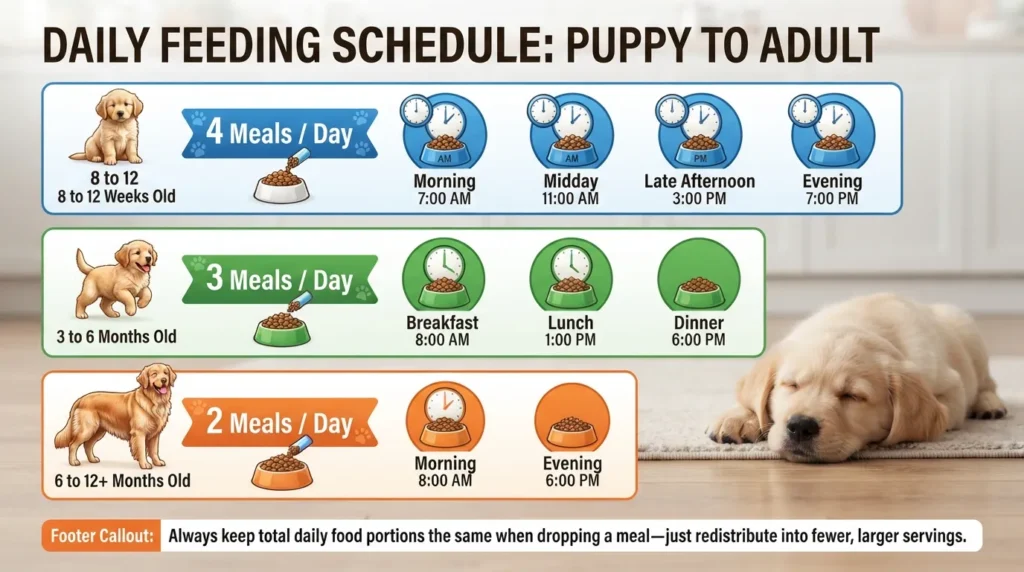
When shifting meal frequency: When moving from 3 meals down to 2 around the 6-month mark, keep the total daily cup count the same—just divide it into two larger portions instead of three smaller ones.
Adjustments should always be gradual. A sudden spike in calories can trigger diarrhea, while overfeeding large-breed pups speeds up bone growth too fast, raising the risk of hip dysplasia.
Factors That Change How Much Your Puppy Needs
Two Golden Retriever puppies from the same litter can have surprisingly different daily calorie requirements. A few key variables explain why:
Activity level & metabolism: A high-energy puppy spending hours retrieving tennis balls in the yard burns calories significantly faster than a mellow pup content with short block walks. Energetic pups often require the higher end of the chart’s feeding range.
Spay/neuter status: Desexing alters a puppy’s hormonal balance and slows down their baseline metabolism. Most vets recommend reducing daily food portions by 10–20% after spay or neuter surgery to prevent rapid, unhealthy weight gain.
Male vs. female portion differences: Male Goldens generally carry more muscle mass and mature into larger adult frames (65–75 lbs) than females (55–65 lbs). Males typically require portions at the top end of the age bracket by 5 to 6 months.
Food quality & calorie density: Kibble formulas vary wildly in caloric density. A dense, high-protein large-breed kibble might pack 450 kcal per cup, while a lighter formula offers only 330 kcal. Always double-check the metabolizable energy (ME) rating on your bag’s nutrition label before setting portions.
Golden Retriever Puppy Feeding Schedule Meal Frequency by Age
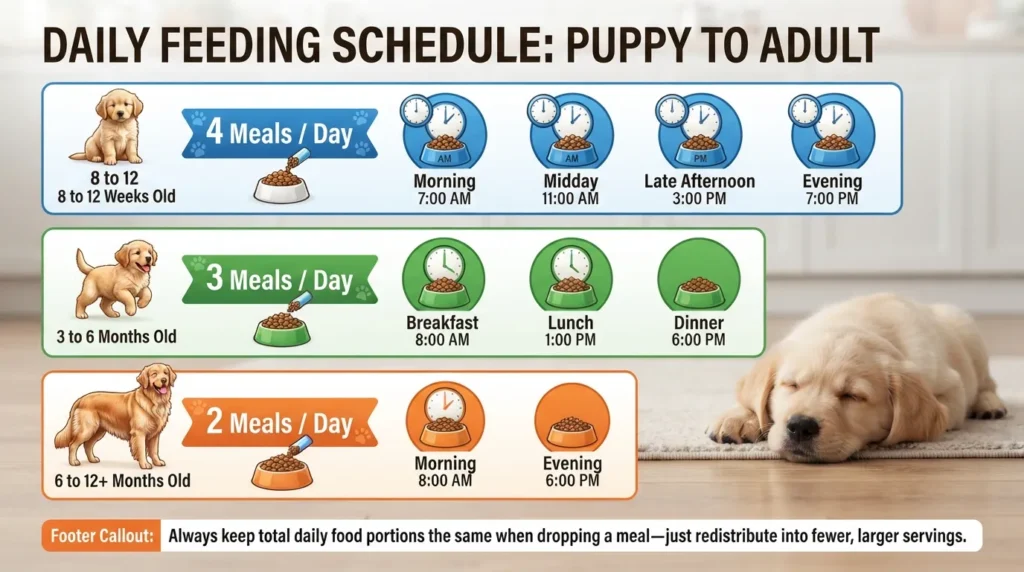
Establish a predictable golden retriever puppy feeding schedule from the moment you bring your pup home at eight weeks. Young Goldens have tiny stomachs and massive energy needs, so spacing out their food prevents bloated bellies while keeping their blood sugar steady.
Here is the daily meal frequency breakdown based on your puppy’s growth stage:
8 to 12 weeks old: 4 meals per day (Morning, Midday, Late Afternoon, Evening)
3 to 6 months old: 3 meals per day (Breakfast, Lunch, Dinner)
6 to 12+ months old: 2 meals per day (Morning and Evening)
Once your Golden Retriever reaches 12 to 14 months of age, you can maintain a standard adult routine of two meals a day for the rest of their adult life.
Why Meal Frequency Decreases as Your Puppy Grows
During their first few months, a Golden Retriever puppy grows at a staggering rate, often gaining two to three pounds a week. However, an eight-week-old puppy’s stomach is only about the size of an egg. Feeding them their entire daily calorie intake in one or two giant portions would overload their digestive system, leading to loose stools, stomach upset, or painful bloating.
As your Golden grows, their stomach capacity expands, and their rapid growth rate begins to taper off. By six months, their digestion is mature enough to handle larger portions spaced further apart, allowing you to safely reduce the number of feedings while maintaining their total daily caloric intake.
Setting Consistent Meal Times
Puppies thrive on routine, and your feeding schedule directly dictates your house-training success. Feeding your Golden at the exact same times every day creates predictable bathroom habits, since puppies usually need to eliminate 15 to 30 minutes after eating.
A solid 3-meal-a-day schedule for a 4-month-old Golden Retriever looks like this:
Breakfast: 7:00 AM (Followed immediately by a potty break)
Lunch: 12:30 PM (Followed by naptime and a potty break)
Dinner: 6:00 PM (Allows enough time to digest and poop before bedtime)
Avoid feeding your puppy right before crate time or late at night. Picking up the food bowl by 6:00 PM or 6:30 PM gives their digestive system enough time to process the meal before lights-out, reducing middle-of-the-night potty trips.
Signs It’s Time to Drop a Meal
You don’t need to force a schedule change overnight. Your puppy will usually show clear physical and behavioral signs when they are ready to transition from four meals down to three, or three down to two:
Picking at mid-day meals: They start ignoring their lunchtime bowl or only eat a few bites before walking away.
Slower eating pace: They lose the urgency they usually show during mealtime, especially at the middle meal of the day.
Loose stools later in the day: If their evening stool is consistently soft despite a clean bill of health, their stomach may be receiving food too frequently.
Unplanned weight gain: Their body condition score starts leaning soft or round because their metabolism is shifting toward juvenile growth.
When you notice these signs—typically around 12 weeks for dropping to three meals, and around 6 months for dropping to two—simply combine the mid-day portion into the morning and evening meals over a 5 to 7 day transition period.
Why Golden Retrievers Need Large-Breed Puppy Food
Golden Retrievers don’t just grow—they skyrocket. A seven-week-old puppy weighing 10 pounds can easily hit 60 to 70 pounds by their first birthday. Because they grow so fast over a relatively short window, feeding a generic “all life stages” or small-breed puppy food is one of the biggest mistakes a new Golden owner can make.
Standard puppy foods are packed with extra calories and dense minerals designed to fuel rapid growth. But for a large breed like a Golden Retriever, growing too fast is dangerous. It puts massive strain on developing bones, cartilage, and soft tissues, dramatically increasing the risk of painful structural conditions like hip dysplasia, elbow dysplasia, and osteochondrosis desicans (OCD). Large-breed puppy formulas are specially engineered to slow down that rate of growth—allowing your puppy to reach their full genetic size safely without sacrificing bone integrity.
Controlled Calcium & Phosphorus for Joint Health
When it comes to skeletal development, calcium and phosphorus are the two most critical minerals to monitor. Adult dogs can regulate how much calcium their intestines absorb, but young puppies can’t—their bodies absorb almost all of the calcium they consume. If a Golden Retriever puppy gets too much calcium, their body deposits it directly into developing bone tissue, leading to abnormal bone growth, joint malformations, and premature plate closure.
According to veterinary nutrition guidelines established by the American Association of Feed Control Officials (AAFCO), large-breed puppy foods must strictly limit calcium and maintain a precise calcium-to-phosphorus ratio:
Optimal Calcium Content: Standard puppy foods often contain up to 2% calcium on a dry-matter basis. Large-breed puppy formulas strictly cap calcium between 1.0% and 1.5% (ideally around 1.2%).
Target Calcium-to-Phosphorus Ratio: Look for a ratio between 1.1:1 and 1.3:1. This balance ensures proper mineral absorption without overloading the skeletal framework.
Caloric Density: Large-breed formulas contain slightly fewer calories per cup than standard puppy food, helping prevent excess weight gain that adds unnecessary pressure on immature joints.
AAFCO Growth Statement — What Label to Look For
Never rely on marketing terms like “veterinarian recommended” or “premium formula” on the front of the bag. To guarantee a food is genuinely safe for a growing Golden Retriever, turn the bag over and find the AAFCO Nutritional Adequacy Statement in the fine print on the back or side panel.
You need to see one specific phrasing:
” [Food Name] is formulated to meet the nutritional levels established by the AAFCO Dog Food Nutrient Profiles for growth/all life stages including growth of large size dogs (70 lbs. or more as an adult).“
If the label states “except for growth of large size dogs,” put it back on the shelf. That formula contains calcium levels that are too high for your Golden.
Dry, Wet, or Mixed Feeding?
Dry Kibble (Recommended Base): High-quality dry kibble is the most practical, cost-effective base for large-breed puppies. It supports dental health through mechanical chewing and makes measuring exact daily caloric intake straightforward.
Wet Canned Food: Excellent as a high-protein topper or for encouraging reluctant eaters, but feeding an all-wet diet to a growing Golden Retriever gets prohibitively expensive and makes controlling caloric intake trickier.
Mixed Feeding: Adding 10–20% wet food or warm water to dry kibble enhances palatability and adds beneficial hydration. Just be sure to reduce the kibble portion accordingly so you don’t accidentally overfeed.
How to Tell If You're Overfeeding or Underfeeding Your Puppy
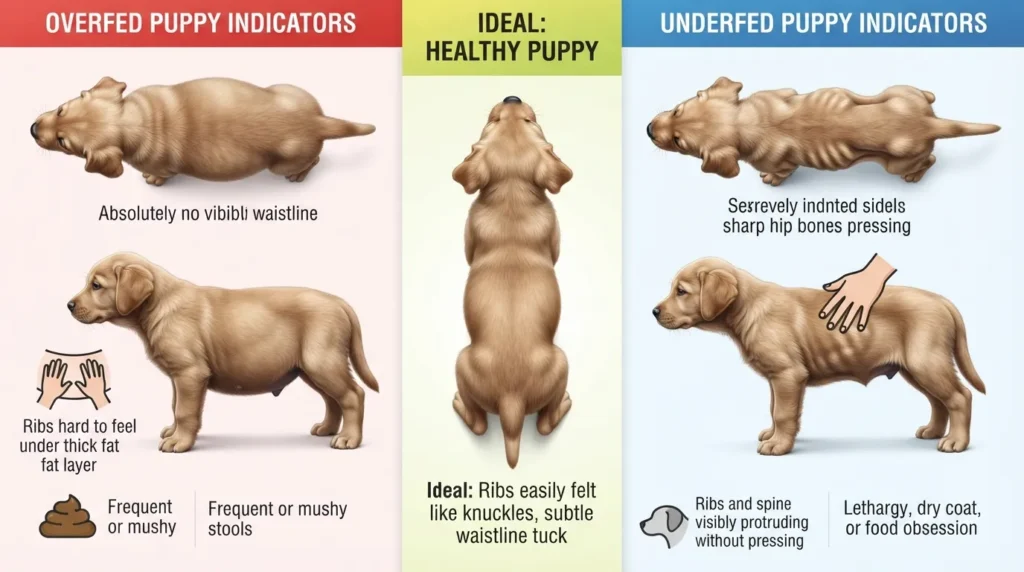
Measuring cups and food bag guidelines give you a great baseline, but they don’t account for your specific puppy’s individual metabolism, daily exercise, or rapid growth spurts. The most reliable way to figure out if you’re serving the right portion is to look directly at your puppy’s physical condition and daily digestive health.
Body Condition Score — Visual & Touch Check
Veterinarians use a 9-point Body Condition Score (BCS) system to evaluate weight, but you can perform a quick hands-on assessment at home every week:
The Rib Test: Run your hands gently over your puppy’s ribs. You should be able to feel each rib under a thin layer of fat without pressing hard—similar to how the back of your hand feels over your knuckles. If you have to dig your fingers in to feel bones, your pup is carrying too much weight; if the ribs are prominent and sharp, they’re underfed.
The Top-Down Sight Check: Stand directly over your puppy while they’re standing upright. You should see an obvious “waist” tucking in behind their ribcage and before their hips, creating an hourglass shape.
The Profile View: Look at your puppy from the side. The abdomen should slope upward from the end of the chest to the hind legs (an abdominal tuck) rather than hanging straight or bulging downward.
Signs of Overfeeding
It’s easy to accidentally overfeed a growing pup, especially when training treats start piling up throughout the day. Watch for these common signs:
Frequent, soft, or loose stools: Overloading a puppy’s developing digestive system speeds up transit time, leading to mushy or unformed poops even if they don’t have an underlying illness.
Loss of a visible waistline: The body begins to look blocky or cylindrical from above, and the ribs become difficult to feel under a thick layer of fat.
Excessive, rapid weight gain: While puppies need to grow, putting on fat too quickly places unnecessary stress on developing bones and joints—a major risk factor for large-breed growth disorders like hip dysplasia.
Lethargy after meals: A healthy puppy usually experiences a brief burst of energy after eating; excessive heaviness or flat-out exhaustion right after a meal can indicate an overfilled stomach.
Signs of Underfeeding
Puppies burn an incredible amount of energy exploring, playing, and building muscle. If they aren’t receiving enough total calories or vital nutrients, their bodies will show clear warning signals:
Visible ribs, spine, or hip bones: Seeing prominent bone structures from a distance—rather than just feeling them during a touch check—means your puppy lacks adequate fat reserves.
Constant scavenging or food obsession: While most puppies love food, an underfed puppy will frantically search for scraps, eat non-food items, or show noticeable anxiety around mealtime.
Stunted growth or poor muscle development: The puppy appears noticeably smaller or thinner than expected for their age and breed development milestones.
Dull coat and low energy: A lack of essential fatty acids and calories leads to a dry, brittle coat, flaky skin, and a lack of playful stamina during normal wake cycles.
If you suspect your puppy is underweight or overgrown despite following feeding guidelines, consult your veterinarian to rule out internal parasites or underlying absorption issues before drastically increasing or cutting their daily rations.
When to Switch a Golden Retriever to Adult Food
Knowing when to switch a Golden Retriever to adult food comes down to one core biological truth: Goldens are a large breed, and their bones and joints need time to mature properly.
Transitioning them too early starves their developing body of vital nutrients, while switching too late can lead to excessive weight gain and joint stress.
Ideal Age Range: 12–15 Months
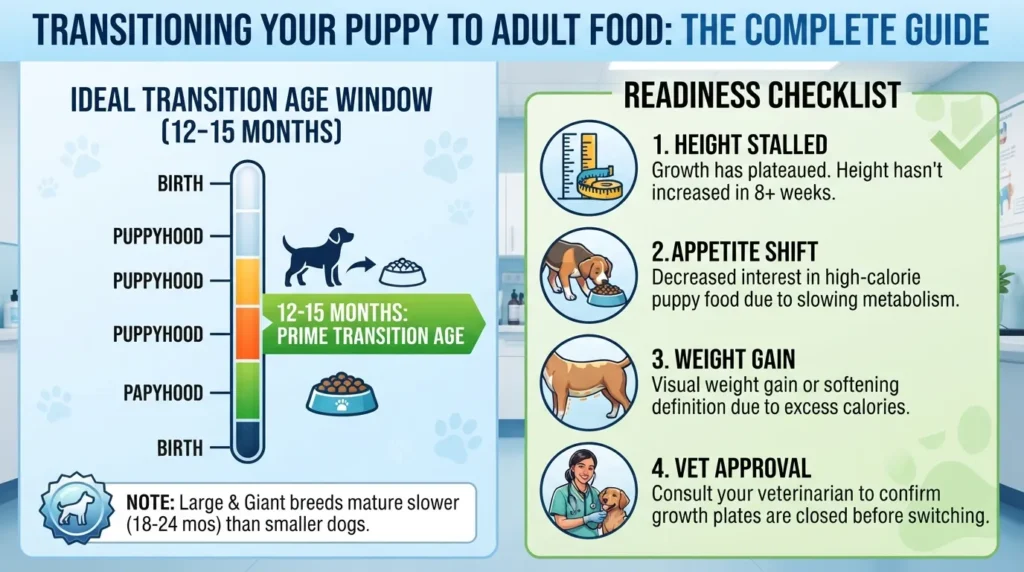
For most Goldens, the ideal window to transition from puppy kibble to an adult recipe is between 12 and 15 months of age.
Unlike small breeds that finish growing around their first birthday, large breeds like Golden Retrievers continue building skeletal frame and lean muscle well past 12 months. Standard puppy formulas contain higher protein, fat, and calcium levels designed to support rapid growth. By 12 to 15 months, your Golden’s growth plates are largely closed, and their growth rate slows dramatically, making those dense calories unnecessary.
Every dog develops at an individual pace:
12 Months: The earliest recommended milestone for lower-energy or average-sized Goldens who have reached their adult height.
14 to 15 Months: Ideal for working lines, highly active Goldens, or larger-framed dogs that need extra time to fill out safely without putting excess weight on developing joints.
18 Months: Rarely necessary, but occasionally recommended by veterinarians for late-maturing males or dogs recovering from specific orthopedic conditions.
Signs Your Puppy Is Ready
Instead of relying solely on the calendar, look for physical and behavioral cues that indicate your Golden Retriever’s adult food age has arrived:
Height Growth Has Stalled: Your dog hasn’t gained measurable height at the shoulder for at least 8 to 12 weeks, even if they are still slowly gaining muscular density.
Picking at Puppy Food: They suddenly leave food behind or seem unenthusiastic about meals they used to inhale. High-calorie puppy food may leave them feeling overly full as their metabolism slows down.
Unwanted Weight Gain: Your Golden starts filling out too quickly around the waist or ribcage despite receiving the exact same daily portion.
Firm, Stable Digestion: Their stool is consistently firm and healthy on their current food, showing their digestive tract is mature and ready to handle a protein and calorie shift.
If you notice these signs in the 12-to-15-month range, schedule a quick check-in with your veterinarian to confirm their growth plates have closed before making the switch.
How to Transition Your Golden Retriever to Adult Dog Food
Switching your Golden Retriever from nutrient-dense puppy kibble to an adult formula is a major milestone, but doing it too fast is a fast track to severe diarrhea, vomiting, and loss of appetite. A Golden’s gastrointestinal tract is famously sensitive, particularly when shifting caloric densities or protein sources.
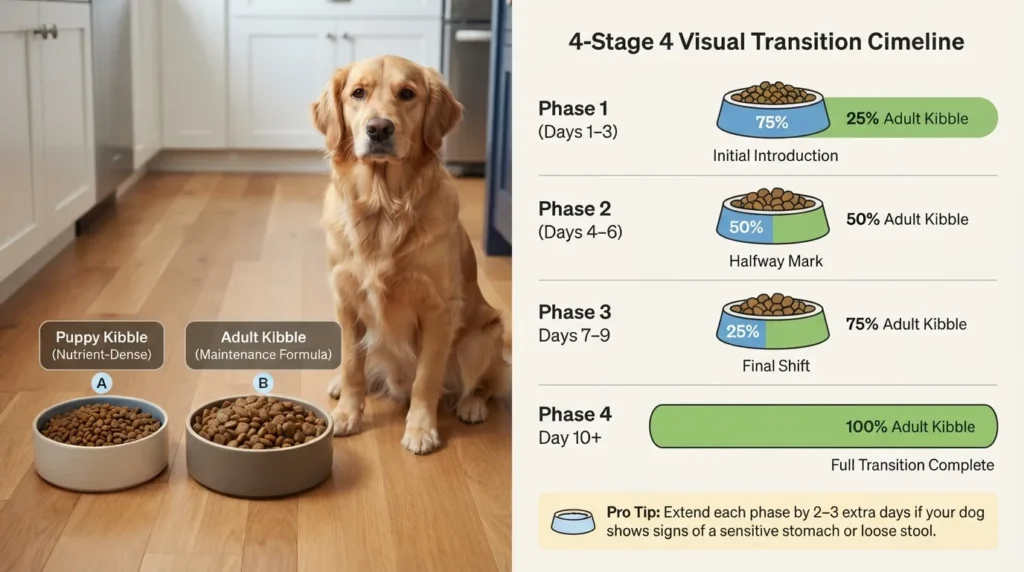
The secret to a seamless transition is patience. Instead of making a sudden swap, slowly blend increasing amounts of the adult food into your puppy’s current kibble over a period of 7 to 10 days. This gradual shift gives your dog’s gut microbiome time to adapt to the new ingredient profile without triggering digestive distress.
7–10 Day Gradual Transition Table
To ensure your Golden Retriever’s stomach handles the switch smoothly, follow this step-by-step feeding ratio over a minimum of seven days. If your pup has a notoriously sensitive stomach, stretch each phase out by an extra day or two.
| Transition Phase | Timeline | Puppy Food (%) | Adult Food (%) |
|---|---|---|---|
| Phase 1: Introduction | Days 1–3 | 75% | 25% |
| Phase 2: Halfway Mark | Days 4–6 | 50% | 50% |
| Phase 3: Final Shift | Days 7–9 | 25% | 75% |
| Phase 4: Complete Switch | Day 10+ | 0% | 100% |
Keep a close eye on your puppy’s stool consistency at every stage before advancing to the next ratio. If their stool remains firm, move forward on schedule.
What to Do If Your Puppy Has an Upset Stomach During Transition
Even with a careful schedule, loose stools or mild gas can happen. If your Golden Retriever shows signs of an upset stomach during the transition, use these practical steps to get them back on track:
Pause and hit rewind: Don’t abandon the switch entirely. Immediately step back to the previous meal ratio where their stool was firm and hold there for 3 to 4 days until their digestive system settles.
Add a natural stool binder: Stir a tablespoon of 100% pure canned pumpkin puree (not pumpkin pie filling) or a vet-recommended canine probiotic into their daily meals to soothe inflamed intestines.
Offer a bland diet if needed: If your puppy develops active diarrhea or vomits, hold off on kibble for 12 to 24 hours. Reintroduce simple, plain boiled chicken breast mixed with white rice in a 1:2 ratio for a few days before restarting the transition very slowly.
Monitor hydration closely: Ensure your puppy has access to clean, fresh water at all times to prevent dehydration while their tummy settles.
While mild softness in stool can occur during diet changes, severe lethargy, continuous vomiting, or watery diarrhea lasting more than 48 hours are red flags. In those situations, stop the new food immediately and contact your veterinarian for advice.
Choosing the Best Adult Food for Your Golden Retriever
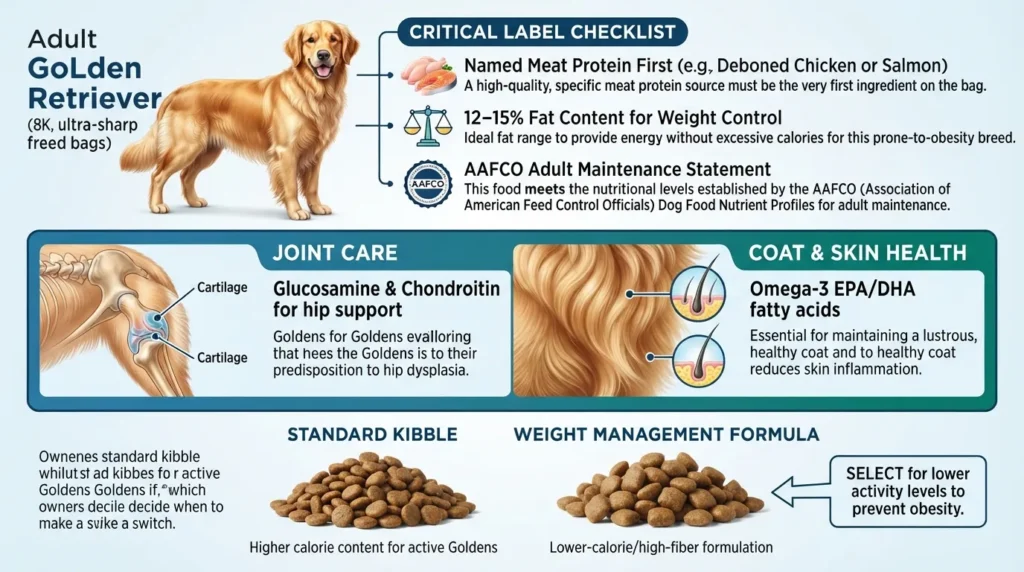
Switching your Golden Retriever to adult food is a major milestone, but picking the right kibble out of hundreds of options can feel overwhelming. Goldens are athletic, deep-chested dogs with two very specific breed tendencies: a high genetic risk for hip and elbow dysplasia, and an infamous appetite that makes them prone to obesity. Finding the best adult dog food for a Golden Retriever means looking past flashy marketing and focusing on protein quality, joint support, and precise caloric balance.
What to Look for on the Label
Not all adult dog foods are created equal, and front-of-bag claims rarely tell the full story. Flip the bag over and check the ingredient list and guaranteed analysis for these non-negotiables:
Named Animal Protein First: Look for specific whole meats or concentrated meals as the top ingredient—such as deboned chicken, turkey, or salmon. Avoid generic labels like “poultry meal” or “meat digest.”
AAFCO Statement of Nutritional Adequacy: Ensure the label explicitly states the food meets the nutritional profiles established by the Association of American Feed Control Officials (AAFCO) for adult maintenance.
Built-In Joint Support: Glucosamine and chondroitin sulfate help maintain cartilage and joint mobility in large breeds. While senior dogs may eventually need targeted supplements, having baseline amounts in daily kibble provides continuous support.
Omega-3 Fatty Acids: Sourced from fish oil or flaxseed, EPA and DHA promote a dense, water-repellent coat while keeping skin inflammation in check.
Moderate Fat and Moderate Calories: Unless your Golden works as a hunting or field dog, look for fat levels around 12% to 15% to match their daily energy burn.
Weight Management Formulas
Golden Retrievers are famous for convincing their owners they are constantly starving. However, carrying even two or three extra pounds places tremendous stress on their joints and can measurably shorten their lifespan. If your dog loses their visible waistline or their ribs become difficult to feel under that thick double coat, switching to a specialized weight management formula is often the smartest move.
Weight management kibble reduces calorie density while increasing dietary fiber and lean protein. High fiber helps your dog feel physically full after meals without piling on extra calories, while high protein prevents muscle loss during weight reduction. Look for formulas that include L-carnitine, an amino acid that helps metabolize fat while preserving lean body mass. Always measure portions with an actual measuring cup or kitchen scale rather than eyeballing it, as a few extra kibbles at every meal quickly add up over time.
General Feeding & Growth Tips for a Healthy Golden Retriever
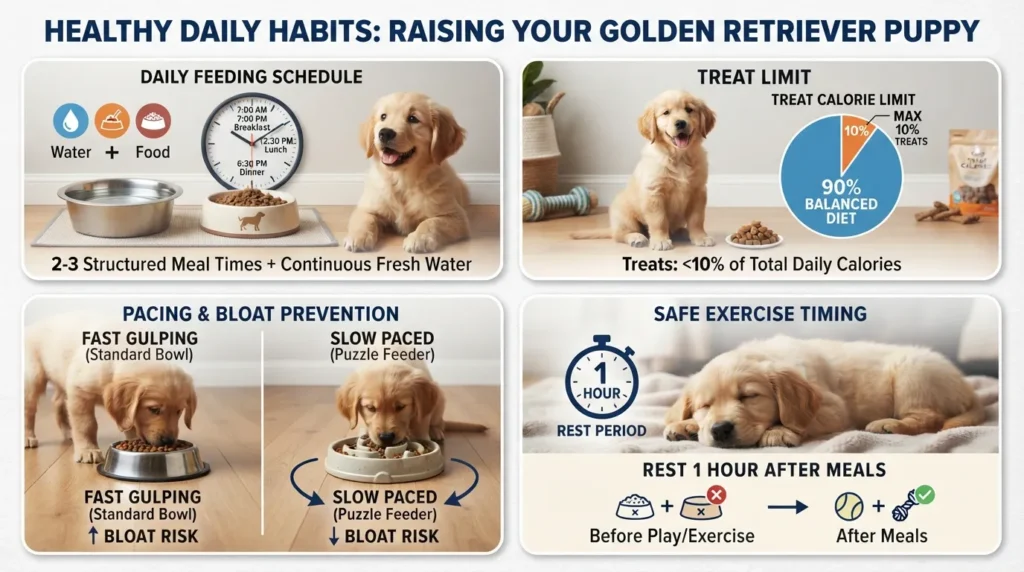
Keeping a Golden Retriever healthy requires more than just pouring food into a bowl at set times. Golden puppies grow rapidly, and their bodies undergo massive developmental shifts in their first 18 to 24 months. Managing their daily habits properly helps ensure strong joints, balanced growth, and a lower risk of lifelong health issues.
Here are the essential growth and feeding tips every Golden owner should follow:
Provide Constant Access to Fresh Water: Puppies burn through energy fast and need continuous hydration to support digestion and cellular growth. Always keep a clean bowl of fresh water nearby, especially after meals and play sessions.
Cap Treats at 10% of Daily Calories: It is easy to overdo treats during training, but excess calories can throw off their balanced diet and cause unhealthy weight gain. Subtract training treats from their overall daily kibble allotment to keep their calorie count in check.
Time Exercise Around Meals: Never let a Golden Retriever run, leap, or engage in vigorous play right before or for at least one hour after a heavy meal. Allowing their stomach time to settle dramatically reduces the risk of dangerous digestive complications.
Preventing Fast Eating & Bloat Risk
Golden Retrievers are notoriously food-motivated. Many will inhale an entire bowl of kibble in under thirty seconds, swallowing huge amounts of air in the process. This rapid eating isn’t just a messy habit—it directly increases the risk of Gastric Dilation-Volvulus (GDV), commonly known as bloat. Bloat occurs when the stomach fills with gas and twists, creating a life-threatening medical emergency.
To slow down a fast eater and protect your dog’s gut, switch from a standard stainless steel bowl to a slow-feeder puzzle bowl. You can also spread their meal out across a baking sheet, use a weighted wobbling feeder, or freeze their kibble inside a durable rubber toy mixed with a little water or bone broth. Breaking their daily food requirement into three or four smaller meals throughout the day, rather than one or two large feedings, further reduces pressure on their stomach.
Foods Golden Retrievers Should Never Eat
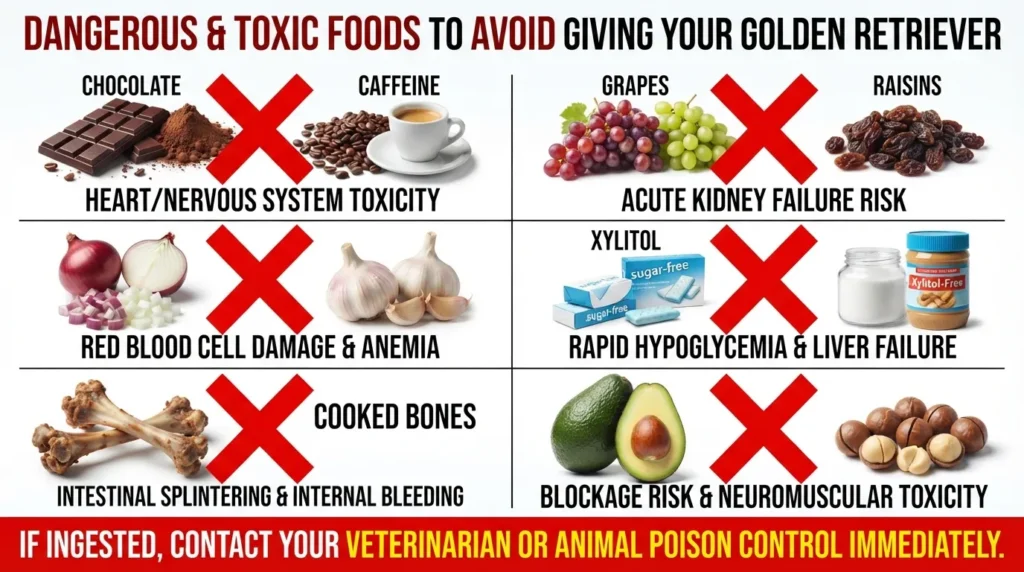
Golden Retrievers are famous for their black-hole stomachs. Given the chance, most Goldens will happily vacuum up whatever falls off your kitchen counter, regardless of whether it’s safe for them. However, several common household foods are genuinely toxic to dogs—ranging from mild stomach upset to rapid, fatal organ failure.
If you suspect your Golden Retriever has eaten any of the items below, skip the wait-and-see approach. Contact your veterinarian or the ASPCA Animal Poison Control Center immediately.
Xylitol (Wood Sugar / Birch Sugar): Found in sugar-free gum, peanut butter, baked goods, and some toothpaste. Xylitol triggers a massive, sudden insulin release in dogs, causing severe hypoglycemia (low blood sugar) within 30 to 60 minutes, followed by liver failure. Always check your peanut butter label before putting it in a Kong.
Chocolate, Coffee, and Caffeine: Contains methylxanthines (specifically theobromine and caffeine). Dark chocolate and cocoa powder are the most dangerous. Ingestion causes vomiting, diarrhea, rapid heart rate, tremors, seizures, and potential death.
Grapes and Raisins: Highly toxic to dogs, even in tiny amounts. The exact mechanism isn’t fully understood, but grape toxicity causes acute, irreversible kidney failure. There is no safe dosage—a single raisin can be dangerous for a sensitive dog.
Onions, Garlic, Chives, and Leeks: All members of the Allium family destroy a dog’s red blood cells, leading to hemolytic anemia. While garlic is slightly more potent than onion, both fresh and powdered forms (like garlic powder in table scraps) are hazardous.
Macadamia Nuts: Causes acute neuromuscular weakness, tremors, hyperthermia (high body temperature), and vomiting. While rarely fatal, it causes severe distress within 12 hours of ingestion.
Alcohol: Dogs’ kidneys and livers cannot process ethanol. Even small amounts of liquor, beer, wine, or raw yeast dough (which produces alcohol in the stomach) can cause dangerous drops in blood pressure, body temperature, and respiratory failure.
Cooked Bones: While raw, soft bones are sometimes used in specific diets, cooked bones from chicken, turkey, or pork become brittle and splinter easily. These splinters can puncture your Golden’s mouth, esophagus, stomach, or intestines, causing life-threatening internal bleeding.
Avocado: Contains persin, a fungicidal toxin found mostly in the pit, skin, and leaves. While the flesh itself has lower concentrations, the large pit presents a massive intestinal blockage risk for a breed known to swallow things whole.
Cooked Fats and High-Sodium Foods: Excessive fat trimmings, bacon, and greasy table scraps can trigger severe, painful pancreatitis (inflammation of the pancreas) in Golden Retrievers, requiring emergency hospitalization.
Frequently Asked Questions
| Questions (Golden Retriever Puppy Feeding Guide) | Answers |
|---|---|
| How much should I feed my golden retriever puppy? |
In our golden retriever puppy feeding guide, a puppy needs 1.5 to 4 cups of large-breed puppy food daily, divided into 3 to 4 scheduled meals depending on age and growth stage. |
| Can I free-feed my golden retriever puppy? |
No, a strict golden retriever puppy feeding guide avoids free-feeding. Golden Retrievers overeat easily, which causes rapid growth and significantly increases risks of hip dysplasia and bloat. |
| Does a male vs female golden retriever eat differently? |
Yes, male Golden Retrievers typically require slightly larger portions in a golden retriever puppy feeding guide plan because they grow bigger and carry more lean body muscle. |
| What happens if I switch to adult food too early? |
Switching too early violates core golden retriever puppy feeding guide principles by depriving growing pups of precise calcium and phosphorus ratios vital for healthy bone density. |
| How many calories does an adult golden retriever need per day? |
After graduating from a golden retriever puppy feeding guide schedule, an active adult Golden Retriever (55–75 lbs) requires around 1,300 to 1,740 calories per day based on AAHA standards. |
🐾 Other Age Guides

I built Dogagescalculator.com to give dog owners honest, science-backed answers instead of the outdated "×7" myth. Every figure here is checked against AKC, AVMA, and published veterinary research.
More about the author & this site →
Comments