
Dog Calorie Calculator — How Many Calories Does Your Dog Need Per Day?
Feeding your dog the right amount shouldn’t feel like a high-school algebra test. Whether you are trying to help a chubby Golden Retriever shed a few pounds, fueling an energetic Border Collie, or making sure a growing puppy gets enough energy, getting their daily calorie count right is the single most effective way to protect their long-term health.
Enter your dog’s weight, life stage, activity level, and spay/neuter status below to calculate their exact daily caloric target based on standard veterinary energy formulas.
Science-Backed: Uses standard AAHA and WSAVA Resting Energy Requirement (RER) formulas.
Life-Stage Aware: Adjusts multiplier factors for puppies, seniors, and active dogs.
Breed & Body Condition Sensitive: Tailors output to account for spay/neuter status and target weight.
100% Free & Instant: Immediate answers without paywalls or sign-ups.
Quick Answer Snapshot
On average, a healthy, spayed or neutered adult dog requires approximately 25 to 30 kcal per pound of body weight per day (or roughly 55 to 65 kcal per kg). However, this figure fluctuates significantly based on activity level, age, metabolic rate, and body condition. A sedentary senior dog may only need 20 kcal/lb, while a high-energy working dog can easily require upwards of 40 kcal/lb.
Daily Calorie & Food Reference Table
This reference table uses standard veterinary RER formulas and MER multipliers to show daily caloric targets and estimated kibble portions:
| Weight (lbs / kg) | Life Stage & Activity Level | Spay / Neuter Status | Daily Calorie Goal (kcal/day) | Daily Food Portion (~375 kcal/cup) | Max Daily Treats (10% limit) |
|---|---|---|---|---|---|
| 10 lbs (4.5 kg) | Adult - Low Activity | Neutered / Spayed | ~200 - 230 kcal | ~0.5 - 0.6 Cups (60g) | Max 22 kcal |
| 20 lbs (9.1 kg) | Adult - Moderate Activity | Neutered / Spayed | ~380 - 430 kcal | ~1.0 - 1.1 Cups (110g) | Max 40 kcal |
| 45 lbs (20.4 kg) | Adult - Moderate Activity | Neutered / Spayed | ~700 - 780 kcal | ~1.8 - 2.0 Cups (200g) | Max 75 kcal |
| 45 lbs (20.4 kg) | Adult - Weight Loss Goal | Neutered / Spayed | ~550 - 620 kcal | ~1.5 Cups (150g) | Max 60 kcal |
| 45 lbs (20.4 kg) | Active / Working Dog | Intact / Active | ~950 - 1100 kcal | ~2.5 - 3.0 Cups (280g) | Max 100 kcal |
| 70 lbs (31.8 kg) | Adult - Moderate Activity | Neutered / Spayed | ~980 - 1080 kcal | ~2.6 - 2.8 Cups (285g) | Max 100 kcal |
| 100 lbs (45.4 kg) | Adult - Moderate Activity | Neutered / Spayed | ~1280 - 1400 kcal | ~3.4 - 3.7 Cups (370g) | Max 130 kcal |
Interactive Dog Calorie Calculator Widget
Below is the complete, ready-to-use HTML/JavaScript code for the calculator widget (styled specifically with colo
Dog Calorie Calculator
Estimated Daily Need:
0 kcal / day
Is This Calculator Accurate? Why You Can Trust These Results
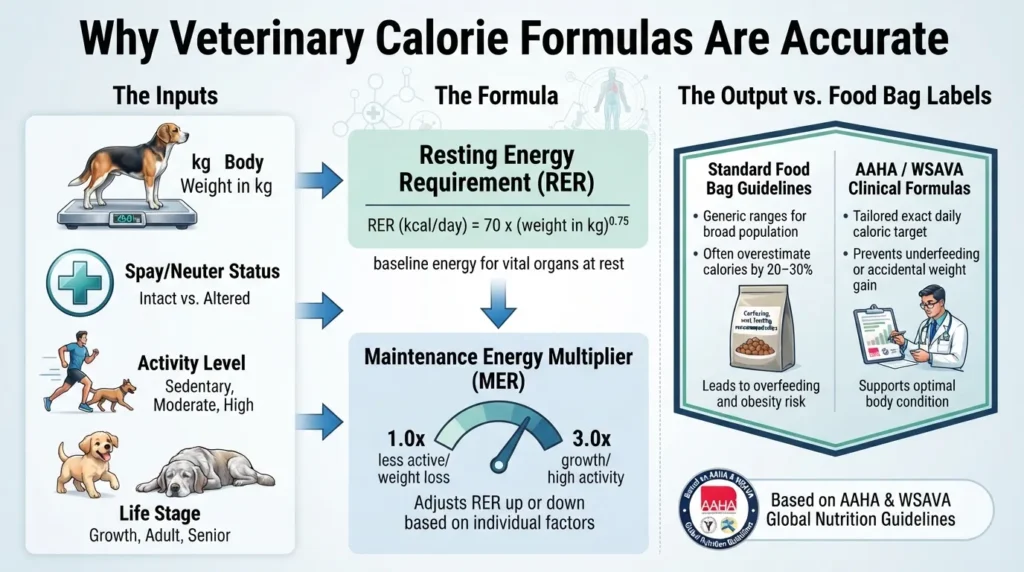
You don’t want a random guess when it comes to your dog’s daily meals. Feeding too little risks nutritional deficiencies and muscle loss, while feeding even slightly too much leads to slow weight gain that stresses aging joints. Every calculation generated on this page comes directly from established veterinary formulas—the exact same clinical standards your local vet uses during a routine checkup.
Based on AAHA & WSAVA Global Nutrition Guidelines
This tool directly implements the official nutrition framework created by the American Animal Hospital Association (AAHA) and the World Small Animal Veterinary Association (WSAVA). Rather than relying on static pet food bag charts—which often overestimate caloric needs by 20% to 30% to fit the “average” dog—our calculator factors in the physiological changes that alter metabolism.
Spay/Neuter Adjustments: Removing reproductive hormones reduces a dog’s baseline metabolic rate by roughly 15% to 25%, meaning intact dogs inherently burn more calories at rest.
Life Stage Metabolic Shifts: Growing puppies need nearly double the calories per pound compared to adults, while senior dogs experience metabolic slowdown and loss of lean muscle mass.
Body Condition Scoring (BCS): A dog needing weight loss requires a calorie deficit built off their ideal weight, not their current heavy weight.
RER/MER Formula Used by Veterinarians Worldwide
To deliver precise calorie targets, we use the standard two-step energy calculation taught in veterinary schools globally. First, we determine your dog’s Resting Energy Requirement (RER)—the absolute minimum calories needed to sustain vital organs like the heart, lungs, and brain at complete rest.
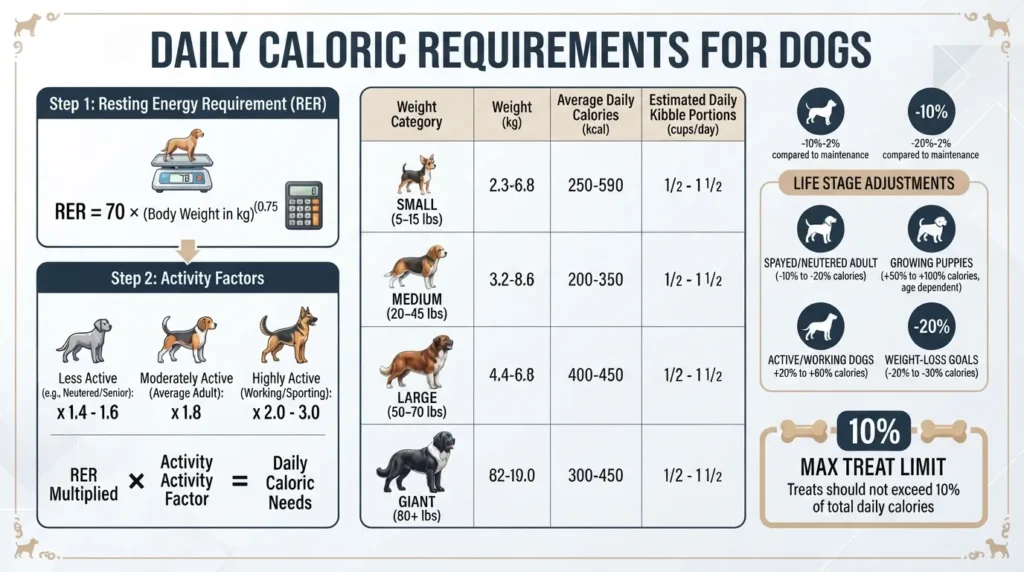
RER = 70 x (body weight in kg)^0.75
Once we have the baseline RER, we multiply it by a specific Maintenance Energy Requirement (MER) factor tailored to your dog’s daily life:
Inactive or Prone to Obesity: RER x 1.0 to 1.2
Neutered Adult (Normal Activity): RER x 1.6
Intact Adult (Normal Activity): RER x 1.8
High-Active / Working Dog: RER x 2.0 to 3.0+
For instance, a spayed 45-lb (20.4 kg) adult dog has an RER of roughly 670 kcal. Applying the standard 1.6 x RER neutered adult multiplier yields a daily target of approximately 1,072 total calories. This scientific baseline gives you complete confidence that your dog is getting exact, tailor-made nutrition.
Calorie Needs by Popular Dog Breeds
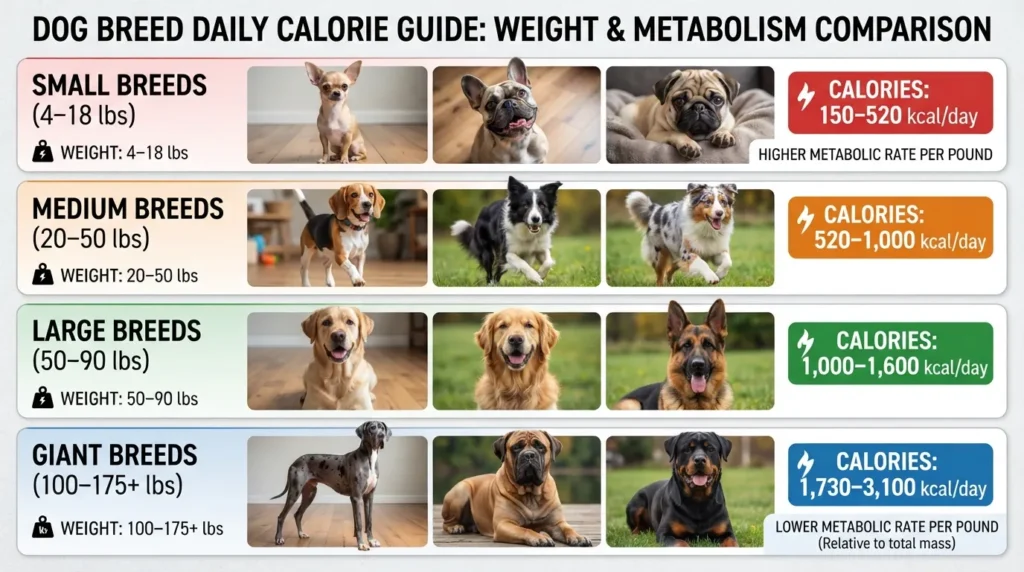
Breed size plays a massive role in setting your dog’s daily calorie targets. Small dogs burn energy at a surprisingly fast metabolic rate per pound, whereas giant breeds require vast totals of energy but have much slower baseline metabolisms relative to their massive body size.
Below are average daily calorie ranges for popular breeds across four major weight classes, based on spayed/neutered adults with typical daily activity.
Small Breed
Small and toy breeds have small stomachs but fiery metabolisms. Because their body surface area is large relative to their overall weight, they lose heat quickly and burn calories faster per pound than larger dogs.
Pro Tip: Breeds prone to lower activity levels or obesity, like Pugs and French Bulldogs, often need calculations near the lower end of their estimated range to prevent gradual weight gain.
Medium Breed
Medium-sized dogs often balance high energy levels with moderate body mass. Active working or herding breeds in this category will frequently lean toward the higher end of these estimates.
Large Breed
Large dogs carry significant muscle and skeletal weight, meaning their overall daily caloric intake is high even if their metabolism per pound is slower than a small breed’s.
Giant Breed
Giant breeds have the lowest metabolic rate per pound of body weight, but their sheer mass requires substantial total energy. Feeding giant breeds requires precise monitoring to prevent excess weight that stresses rapidly aging joints.
How Many Calories Does a Dog Need? (Quick Reference by Weight)
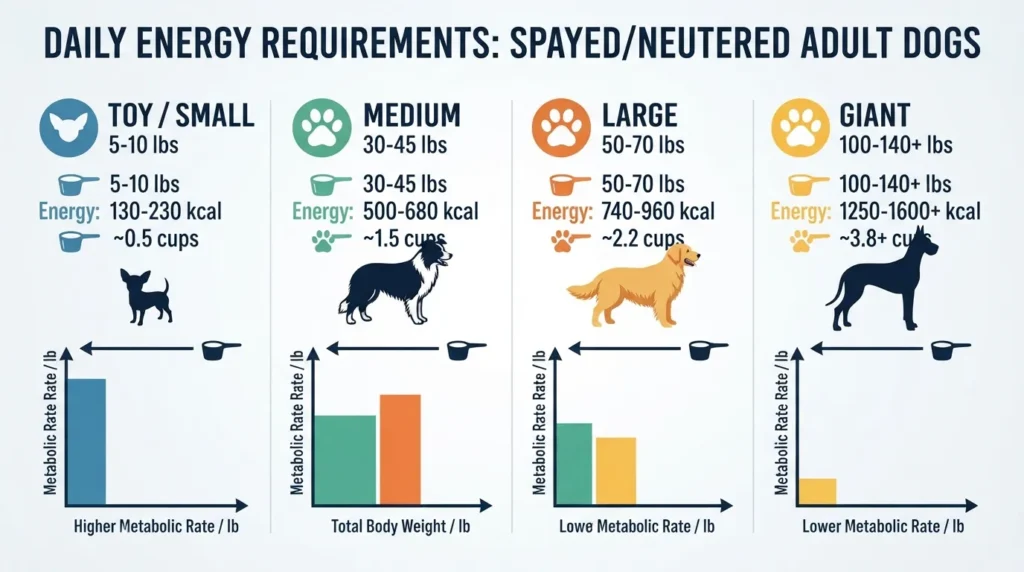
A dog’s weight is the single biggest factor in determining their daily energy requirements. However, metabolic rates don’t scale in a straight line—a 100-pound dog doesn’t need ten times the calories of a 10-pound dog. Smaller breeds have much faster metabolisms per pound of body weight, while giant breeds require fewer calories relative to their massive size.
Calorie Needs Table — Small, Medium, Large & Giant Dogs
The estimated daily energy targets below are based on standard veterinary Resting Energy Requirement (RER) and Maintenance Energy Requirement (MER) formulas for healthy, spayed or neutered adult dogs at a normal activity level.
Keep in mind that these figures represent a baseline starting point for an average adult pet. According to AAHA nutrition guidelines, individual calorie needs can vary by up to 20% above or below these estimates depending on your dog’s age, spay/neuter status, temperament, and daily activity.
How to Calculate Your Dog's Calorie Needs Formula Explained Simply
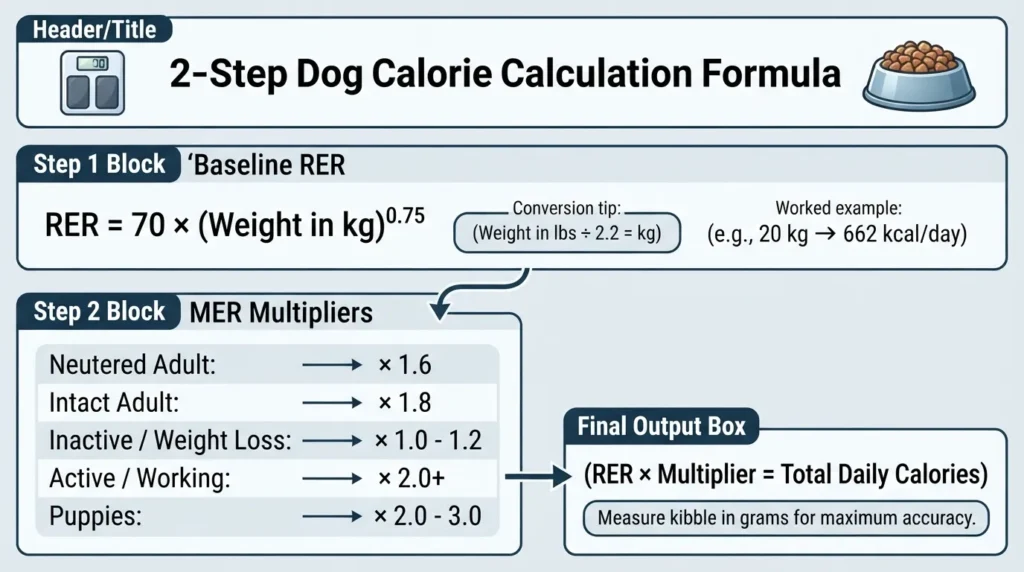
Determining your dog’s daily calorie requirement involves a straightforward two-step veterinary formula. Instead of relying on crude estimates based solely on body weight, veterinary nutritionists first calculate baseline energy needs at rest and then adjust that number according to your dog’s specific lifestyle, age, and physical condition.
Step 1 — Find RER
Your dog’s Resting Energy Requirement (RER) represents the basic amount of energy needed to sustain essential body functions—such as breathing, digestion, heart circulation, and brain function—while at complete rest in a neutral temperature environment.
According to AAHA and WSAVA clinical guidelines, RER is calculated using an exponent-based formula that accounts for metabolic surface area:
RER = 70 x (body weight in kg)^0.75
To find your dog’s weight in kilograms, simply divide their weight in pounds by 2.2 (for example, a 44-lb dog is 20 kg). Raising that kilogram weight to the 0.75 power adjusts for the fact that smaller animals have a higher metabolic rate per pound than larger animals.
Step 2 — Apply MER Multiplier
Once you have established the baseline RER, you must multiply it by a Maintenance Energy Requirement (MER) factor. The MER factor accounts for daily physical activity, life stage, intact status, and weight targets:
Neutered Adult (Normal Activity): RER x 1.6
Intact Adult (Normal Activity): RER x 1.8
Sedentary or Inactive Adult: RER x 1.2 to 1.4
Weight Loss Target: RER x 1.0
Active / Working Dog: RER x 2.0 to 3.0+
Puppy (Under 4 months): RER x 3.0
Puppy (4 to 12 months): RER x 2.0
Worked Example (20kg dog)
Here is how the two-step formula works in practice for a neutered adult dog weighing 20 kg (approx. 44 lbs) with normal daily activity:
Calculate RER:
First, calculate 20 raised to the 0.75 power, which equals approximately 9.457.
Multiply 70 by 9.457 to get an RER of 662 kcal/day.
Apply MER Multiplier:
Take the RER of 662 kcal and multiply it by the standard neutered adult factor of 1.6.
662 x 1.6 = 1,059 kcal/day.
This 20 kg neutered adult dog requires approximately 1,060 calories per day to maintain a stable, healthy weight.
Calorie Needs by Life Stage
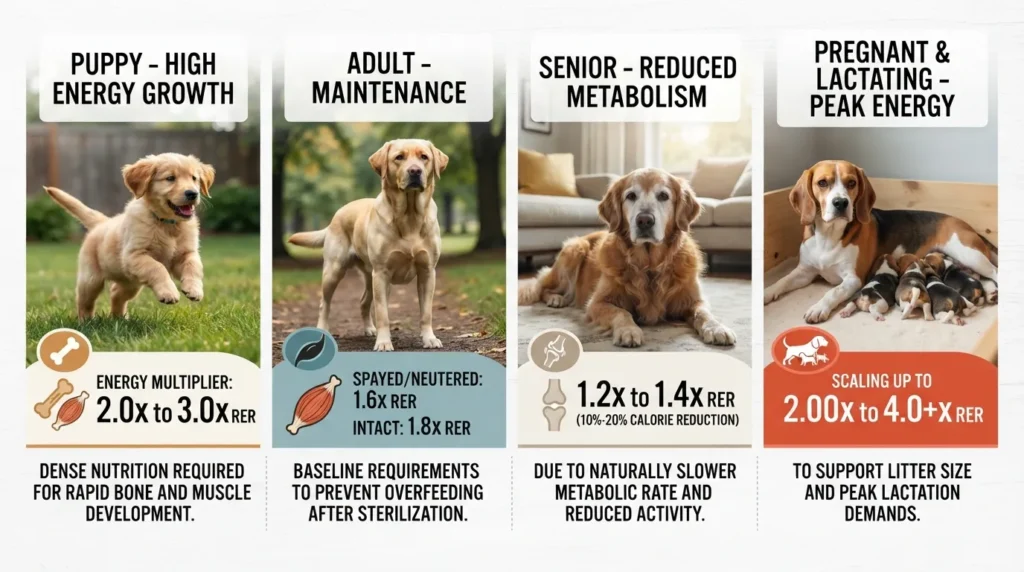
A dog’s nutritional requirements shift dramatically as they move through life. Feeding a growing puppy the same caloric density as a sedentary senior—or treating an adult dog like a nursing mother—inevitably leads to developmental issues or unhealthy weight gain.
Puppy
Puppies are rapidly building bone, muscle, and organ tissue, which requires immense energy. According to AAHA guidelines, puppies under four months old need roughly 3 times their Resting Energy Requirement (RER), which gradually drops to 2 times RER as they approach four to twelve months.
Because their small stomachs can’t hold massive quantities at once, these calories must be spaced across three to four daily meals. Underfeeding during this window can stunt growth, while overfeeding large-breed puppies can trigger skeletal disorders like hip dysplasia.
Adult
Once a dog reaches full skeletal maturity—around 12 months for small breeds and up to 18 to 24 months for giant breeds—their calories shift from supporting growth to maintaining healthy body tissue.
Spayed or Neutered Adults: Require approximately 1.6 x RER. The removal of reproductive hormones slows baseline metabolism, making portion control critical.
Intact Adults: Require approximately 1.8 x RER, as their active reproductive system burns slightly more energy at rest.
Active or Working Dogs: Can require anywhere from 2.0 to 3.0+ x RER depending on daily output, such as hunting, agility training, or working cattle.
Senior
As dogs reach their senior years (typically age 7 or older, depending on breed size), their metabolic rate naturally slows down by about 10% to 20%. Senior dogs generally thrive on 1.2 to 1.4 x RER, reflecting decreased daily movement and a natural decline in muscle mass.
However, senior calorie management is a balancing act. While many older dogs become inactive and gain weight easily, others lose appetite or muscle mass due to age-related conditions and require higher caloric density to prevent muscle wasting.
Pregnant & Lactating
Reproduction places the absolute highest metabolic demand on a female dog’s body. During the first six weeks of pregnancy, energy needs remain close to normal adult maintenance. However, during the final three weeks—when fetuses gain most of their weight—she requires roughly 1.5 to 3.0 x RER.
Once she gives birth and begins nursing, energy demands peak sharply:
1 to 4 Weeks Post-Partum: Needs jump to 2.0 to 4.0+ x RER, scaling directly with litter size.
Peak Lactation: A mother nursing a large litter may need up to 4 to 8 times her normal baseline RER.
Feeding Strategy: Offer nutrient-dense puppy kibble free-choice (free-feeding) during peak nursing to help her maintain body condition without digestive distress.
Does Spaying/Neutering Affect Calorie Needs?
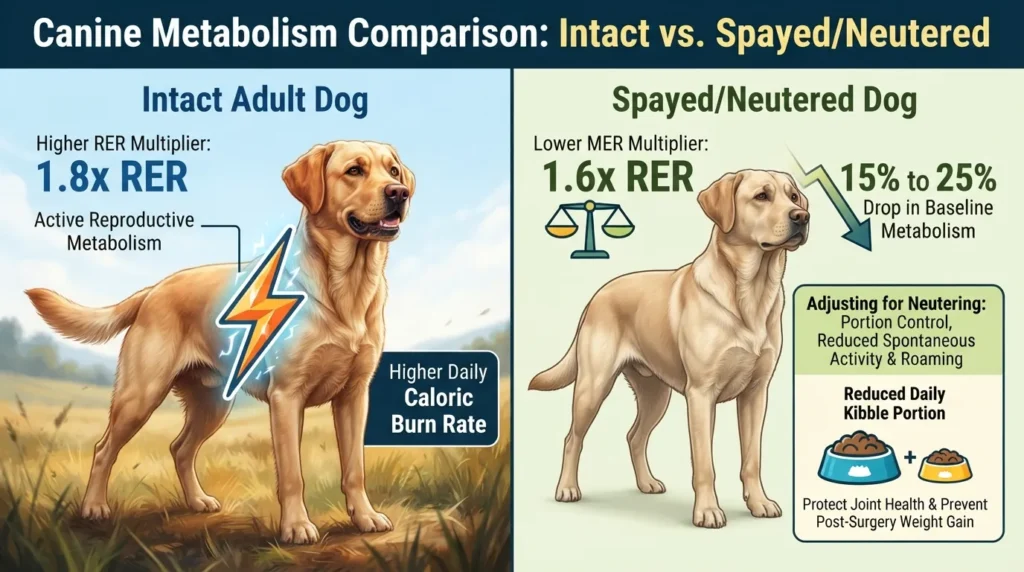
Yes, spaying or neutering significantly reduces a dog’s daily calorie requirements. Once a dog is altered, their resting metabolic rate drops because they are no longer expending energy on reproductive hormone production and sexual behaviors.
According to veterinary nutrition guidelines from the AAHA and WSAVA, spayed or neutered dogs generally require 15% to 25% fewer calories per day than intact dogs of the exact same weight and activity level.
Metabolic Slowdown: Intact dogs have higher basal metabolic rates driven by estrogen or testosterone. Removing these hormones lowers the resting energy baseline (RER multiplier drops from 1.8 down to 1.6).
Activity Changes: Altered dogs often exhibit decreased roaming behavior and lower overall spontaneous activity, further reducing daily energy expenditure.
Weight Gain Risk: Because metabolism slows down while appetite often increases after surgery, keeping an altered dog on an intact feeding schedule almost always leads to gradual obesity.
If your dog was recently spayed or neutered, adjust their calorie intake downward right away rather than waiting for unwanted weight gain to occur.
How Activity Level Changes Your Dog's Calorie Needs
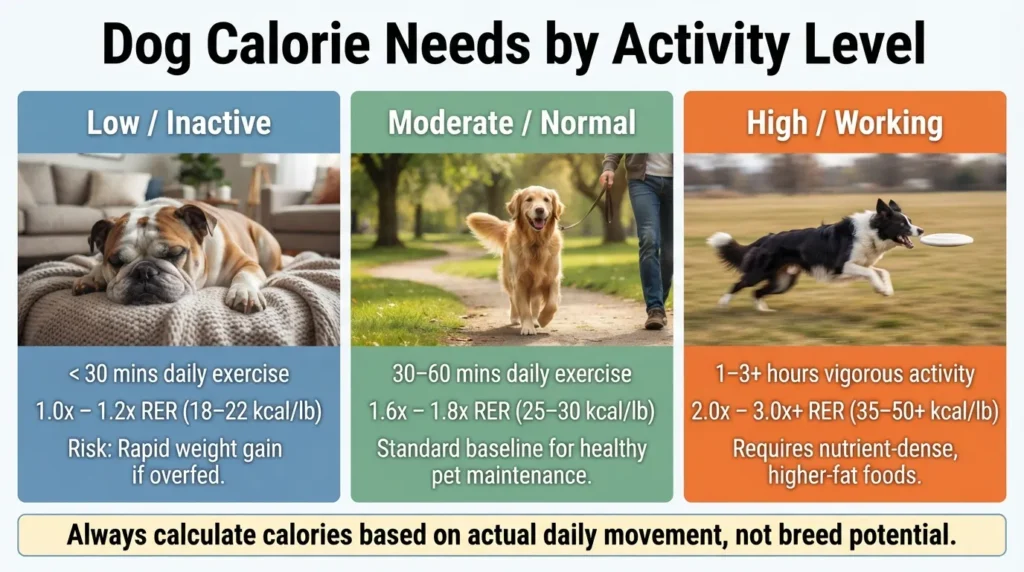
A dog’s daily energy expenditure isn’t static—it shifts dramatically based on how much physical work they do each day. Running the same calorie calculation for a couch-bound senior and a hunting dog results in either rapid weight gain or dangerous muscle wasting. Adjusting daily calories according to actual movement patterns ensures your dog stays at a healthy body condition score.
Low
Dogs in this category spend the majority of their day resting, sleeping, or enjoying light indoor wandering with under 30 minutes of total outdoor walking time. This includes most senior dogs, dogs recovering from surgery, or breeds with naturally sedentary habits like Bulldogs.
Their metabolic rate is low, requiring only RER x 1.0 to 1.2 (roughly 18 to 22 kcal per pound of body weight). Feeding a low-activity dog standard adult portions easily leads to stealth weight gain, as excess calories are stored directly as fat rather than burned through exercise.
Moderate
This is the standard baseline for typical companion dogs. A moderately active dog gets between 30 to 60 minutes of daily physical exercise, such as brisk neighborhood walks, playing fetch in the yard, or light dog park socialization.
Their energy demands align with standard maintenance guidelines, calculated at RER x 1.6 for spayed/neutered adults and RER x 1.8 for intact adults (roughly 25 to 30 kcal per pound). This provides just enough fuel to maintain lean muscle mass and energy levels without creating a calorie surplus.
High/Working Dogs
Dogs in this tier engage in intense physical exertion for 1 to 3+ hours daily. Examples include working herding breeds, active hunting dogs, agility competitors, or companions who go on long hikes and running trips.
Their elevated muscle activity and rapid oxygen consumption burn calories fast, requiring an energy multiplier of RER x 2.0 to 3.0+ (often 35 to 50+ kcal per pound). Feeding high-activity dogs nutrient-dense food with a higher fat-to-protein ratio helps sustain their stamina without requiring massive bulk volumes of kibble.
Wet vs Dry vs Raw vs Homemade — Do Calories Differ by Food Type?
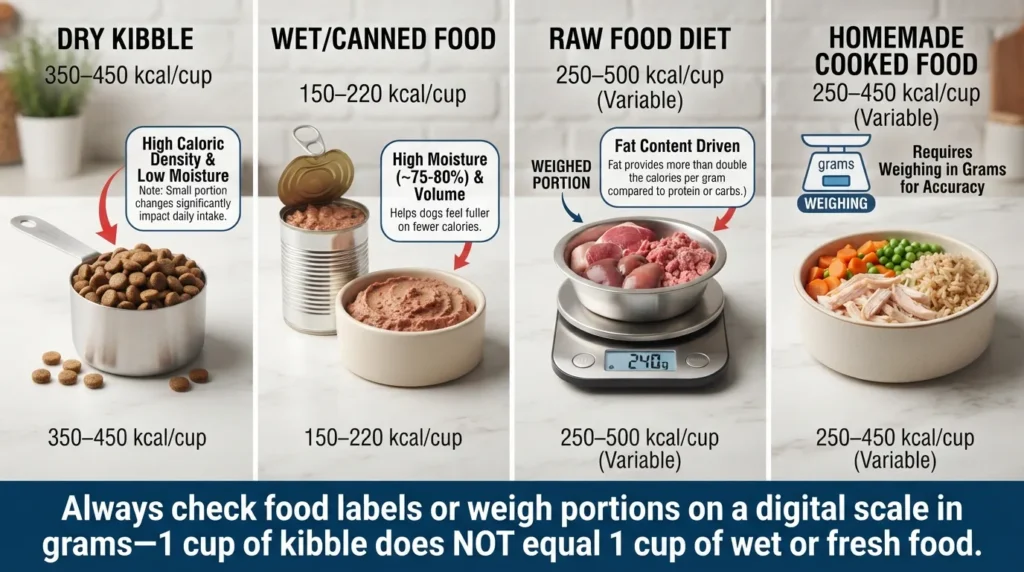
The short answer is yes—caloric density varies drastically depending on the type of diet you feed your dog. A single measuring cup filled with dry kibble contains vastly more calories than the same cup filled with wet canned food, primarily because of water weight. Understanding these differences prevents accidental underfeeding or overfeeding when switching between diet formats.
Dry Kibble
Dry kibble is the most nutrient-dense and calorie-concentrated diet option available. Because moisture is extracted during manufacturing, kibble packs a high caloric load into a small volume—typically averaging 350 to 450 kcal per cup.
Portion Control: Small volume changes make a massive difference; mismeasuring kibble by just a quarter cup can accidentally add 100+ calories a day.
Storage & Convenience: Easy to measure and store, making precise daily feeding straightforward.
Density Variation: High-fat or active-dog formulas can reach up to 500 kcal per cup, while weight-management kibbles drop closer to 270 kcal per cup.
Wet/Canned
Canned dog food is roughly 75% to 80% water, making it significantly less calorie-dense by volume than kibble. A standard 13-ounce can generally delivers around 300 to 375 kcal, while a full measuring cup of wet food averages only 150 to 220 kcal.
Satiety & Weight Loss: The high moisture content adds physical volume without adding calories, helping overweight dogs feel full on fewer calories.
Ideal for Seniors: Wet food works exceptionally well for aging pets with dental issues or diminished appetites.
Mixed Feeding: If you mix wet food into kibble, you must calculate the calories of both to avoid creeping weight gain.
Raw & Homemade
Raw and cooked homemade diets vary the most in energy concentration because they depend entirely on the specific proteins and fats used. A lean turkey and pumpkin recipe will contain far fewer calories per cup than a raw beef, organ meat, and tallow mixture.
Caloric Variability: Homemade meals generally range from 250 to 500 kcal per cup, depending heavily on the fat percentage of the meat.
Fat Sensitivity: Fat provides more than double the calories per gram compared to protein or carbohydrates (9 kcal/g vs. 4 kcal/g), making fat content the primary calorie driver in raw diets.
Precision Weighing: Volume measurements (cups) are unreliable for raw and fresh food; using a digital kitchen scale to measure in grams is essential for tracking real intake.
Converting Calories to Actual Food — Cups, Grams & Cans
Converting Calories to Actual Food — Cups, Grams & Cans
Knowing your dog’s daily calorie target is only half the battle. To actually put that number to use, you have to translate kilocalories into real-world portions like scoops of kibble or cans of wet food.
Find Calories Per Cup/Can
Look closely at the back or side panel of your dog’s food bag or can for the guaranteed analysis and nutritional adequacy statement. You are looking for the caloric density, which is always printed as kilocalories per kilogram (kcal/kg) alongside a common measurement like kcal/cup or kcal/can.
Dry Kibble: Most standard dry adult dog foods range between 350 and 450 kcal per 8-oz measuring cup, though weight-loss formulas can drop to 280 kcal/cup and active/performance formulas can exceed 500 kcal/cup.
Canned/Wet Food: A standard 13-oz can usually contains between 300 and 450 kcal per can, while smaller 3.5-oz trays often hover around 80 to 100 kcal.
Grams for Accuracy: For absolute precision, use the kcal/kg number with a digital kitchen scale—volume cups can vary by up to 20% depending on kibble size and how tightly it settles.
Conversion Formula
Turning target calories into exact daily food portions requires a simple division formula:
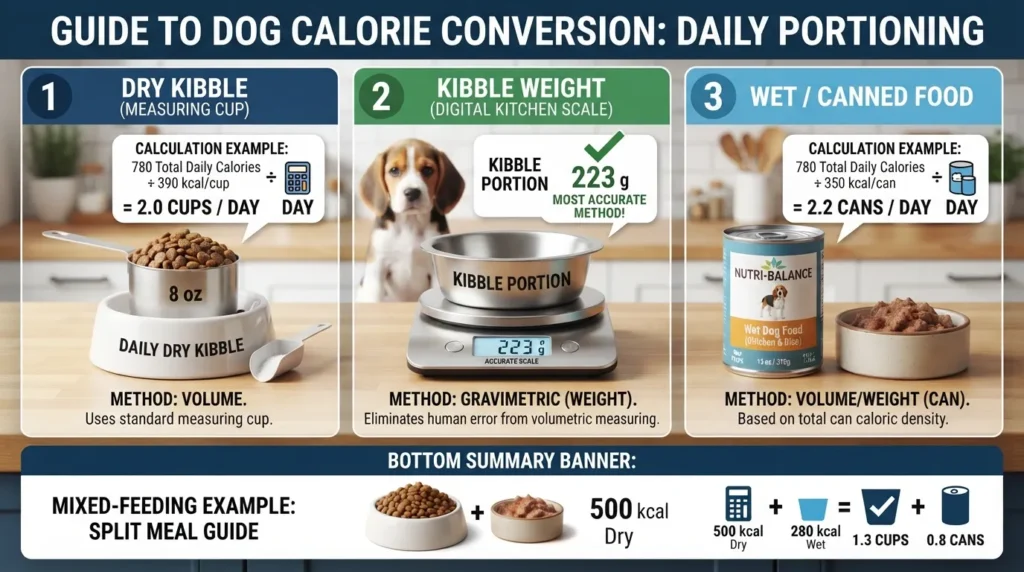
Daily Food Portion = Daily Target Calories / Calories Per Unit (Cup, Can, or Gram)
If you feed a mixed diet (both dry kibble and canned wet food), decide on the ratio first (e.g., 70% dry calories and 30% wet calories), calculate each portion separately using the formula, and add them together.
Worked Example
Let’s look at a concrete example using an adult, neutered 45-lb (20.4 kg) dog with a recommended daily target of 780 kcal/day.
Kibble-Only Feeding: The dog eats a standard kibble rated at 390 kcal per cup. Dividing 780 kcal by 390 kcal/cup equals exactly 2.0 cups per day (or 1.0 cup per meal for a twice-a-day schedule).
Weighing in Grams: That same kibble is rated at 3,500 kcal/kg (which is 3.5 kcal per gram). Dividing 780 kcal by 3.5 kcal/g equals 223 grams per day.
Mixed Kibble + Canned Meal: You want to give 500 kcal from dry kibble and 280 kcal from canned food (rated at 350 kcal per can). That works out to roughly 1.3 cups of kibble plus 0.8 cans of wet food daily.
Adjusting Calories for Weight Loss or Weight Gain
Once you know your dog’s baseline calories, adjusting their intake for weight management requires a steady, deliberate approach. Cutting portions too drastically or overfeeding too fast can trigger metabolic distress, liver issues, or severe loss of lean muscle.
Safe Weight Loss
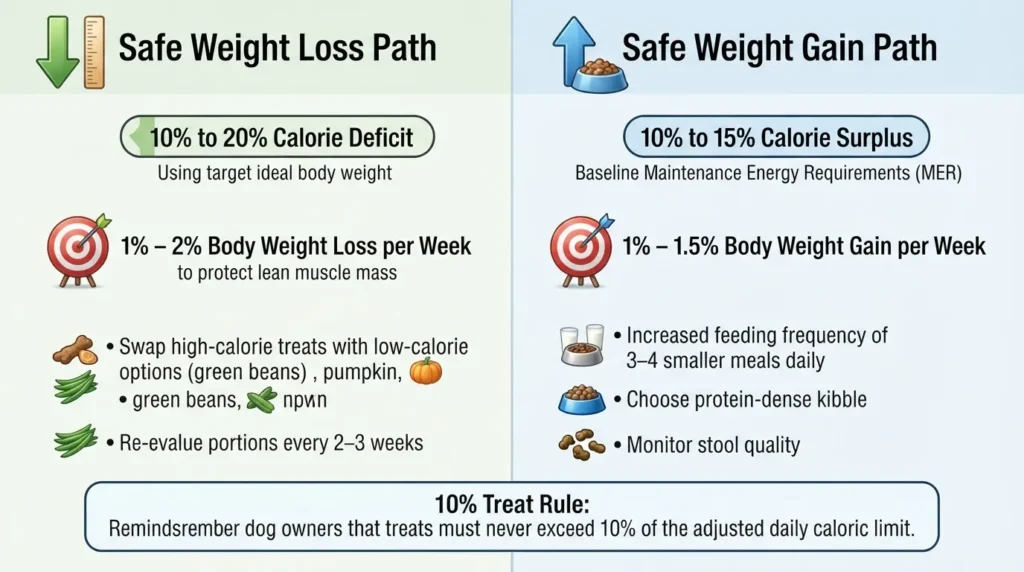
If your dog needs to trim down, start by reducing their daily intake by 10% to 20% below their Maintenance Energy Requirement (MER). Veterinary guidelines from the AAHA recommend aiming for a gradual loss of 1% to 2% of total body weight per week. Losing weight faster than this often causes loss of lean muscle mass rather than fat stores.
Base Calories on Target Weight: Calculate RER using your dog’s ideal goal weight, not their current weight.
Swap High-Calorie Treats: Replace commercial biscuits with low-calorie alternatives like fresh green beans or plain canned pumpkin.
Keep the 10% Rule: Ensure treats never make up more than 10% of their total daily caloric intake.
Re-evaluate Every 2–3 Weeks: As your dog loses weight, their baseline RER decreases, so adjust meal portions downward accordingly.
Safe Weight Gain
Underweight dogs require an incremental calorie boost to rebuild muscle and healthy fat reserves safely. Increase their baseline intake by 10% to 15% above MER, monitoring their progress weekly. Rapid weight gain can overload their digestive system and lead to severe GI upset or diarrhea.
Increase Feeding Frequency: Divide their total daily calories into three or four smaller meals instead of one or two large feedings.
Choose Nutrient-Dense Foods: Feed a high-protein, high-fat food formulated for active adults or growth to increase calories per cup without dramatically increasing bulk.
Track Lean Muscle Growth: Weigh your dog every 7 to 10 days, aiming for a smooth gain of 1% to 1.5% of body weight per week.
Monitor Stool Quality: Loose stools usually mean you are increasing calorie volume faster than their digestive tract can absorb.
Do Treats Count Toward Daily Calories?
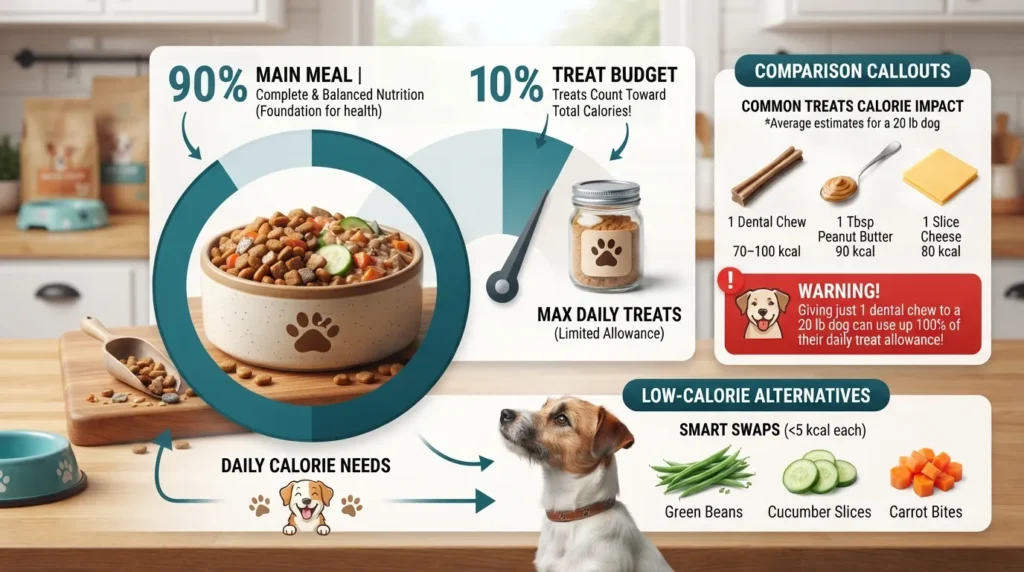
Yes, every single treat counts toward your dog’s daily calorie limit. Whether it’s a dental chew, a training reward, or a piece of cheese dropped from the dinner table, those extra calories directly impact your dog’s energy balance.
Veterinarians universally recommend following the 10% rule: treats should never make up more than 10% of your dog’s total daily caloric intake. The remaining 90% of their calories must come from a complete and balanced dog food to ensure they receive all necessary vitamins, minerals, and essential nutrients.
Overfeeding treats is one of the most common causes of unexpected weight gain in dogs. Here is a quick look at how fast common rewards can add up against a typical target:
1 Dental Chew: ~60 to 100 kcal
1 Peanut Butter Spoon (1 tbsp): ~90 to 100 kcal
1 Slice of Cheddar Cheese: ~80 kcal
1 Small Biscuit: ~20 to 40 kcal
If a 20-lb dog needs around 400 calories a day, their daily treat budget is just 40 calories. Giving them just one dental chew or a single slice of cheese uses up—or completely exceeds—their treat limit for the entire day.
To keep rewards fun without causing weight gain, break larger treats into tiny bite-sized pieces or switch to low-calorie options like fresh cucumber slices, green beans, or plain air-popped popcorn. You can also set aside a portion of your dog’s measured daily kibble and use those individual pieces as rewards throughout the day.
Common Feeding Measurement Mistakes That Cause Overfeeding
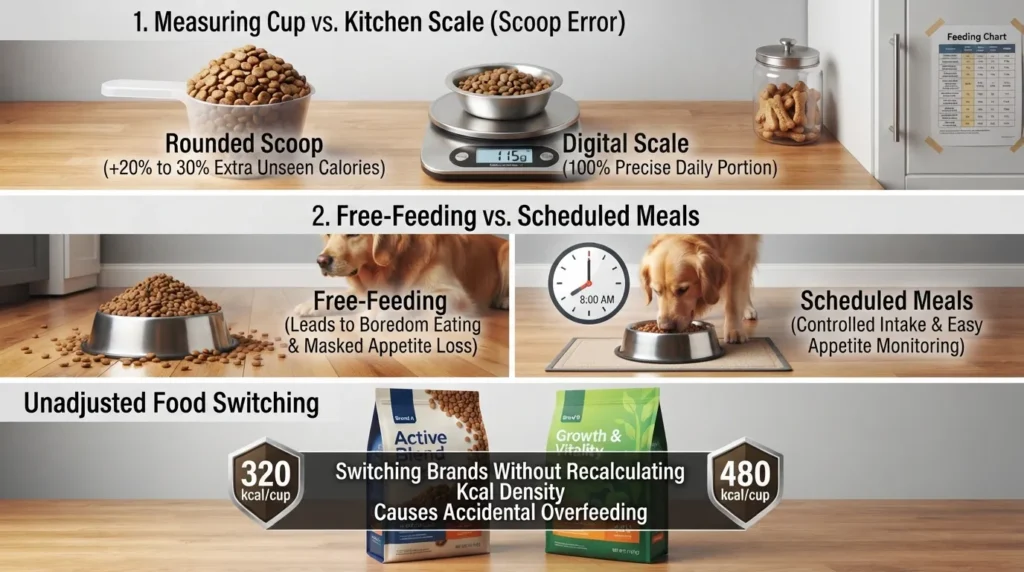
Even with an accurate daily calorie target, subtle errors in how you measure and schedule meals can quietly add hundreds of unwanted calories every week. Overfeeding is rarely intentional. Most owners simply rely on imprecise measurement habits that skew daily intake far beyond what their dog actually needs.
Scoop vs Scale
Using a plastic measuring cup seems foolproof, but it is one of the leading causes of unintentional overfeeding. Volume measurements vary dramatically based on kibble shape, density, and how tightly packed the cup is. A heavy hand or a slightly rounded scoop can easily add an extra 20% to 30% to every meal.
Weighing food on a digital kitchen scale in grams is the gold standard used by veterinary nutritionists. Grams measure exact mass rather than volume, ensuring your dog gets the precise caloric amount every single time regardless of kibble size.
Free-Feeding
Leaving a bowl filled with food all day deprives you of crucial control over your dog’s caloric intake. Most dogs eat out of boredom or opportunity rather than true metabolic hunger, making self-regulation nearly impossible for all but a few breeds.
Scheduled meal feeding—offering specific portions two to three times daily and picking up leftover food after 20 minutes—prevents passive overeating. It also provides an immediate warning sign if your dog suddenly loses their appetite, which free-feeding easily masks.
Not Adjusting After Food Switch
Assuming “a cup is a cup” across different dog food brands is a costly mistake. Caloric density varies wildly between formulations; one brand may contain 320 kcal per cup, while a dense active-dog or grain-free formula might pack 480 kcal into that same cup.
Whenever you transition to a new bag or brand, check the caloric density listed on the back panel (expressed as kcal/kg or kcal/cup). Re-measure your dog’s daily portion based on the new calorie count rather than maintaining their old cup volume.
Forgetting to Recalculate
A dog’s caloric needs are not static. As dogs age, transition from puppyhood to adulthood, or undergo spay/neuter surgery, their baseline metabolic rate shifts significantly.
Continuing to feed an adult dog the high-calorie portions they required as a six-month-old puppy inevitably leads to rapid weight gain. Recalculate your dog’s caloric baseline every six months, after any lifestyle shift, or whenever your veterinarian records a change in their Body Condition Score.
Frequently Asked Questions
Smaller dogs have a significantly higher metabolic rate per pound than larger breeds. A 10 lb Toy Poodle might need around 35–40 calories per pound, whereas a 100 lb Mastiff may only need 15–20 calories per pound. Standard RER formulas account for this difference by calculating energy requirements based on exponential body mass rather than linear weight.
This calculator provides a highly accurate baseline because it uses standard veterinary Resting Energy Requirement (RER) formulas published by AAHA and WSAVA. However, every dog's individual metabolism, health conditions, and environment vary. Treat this number as a reliable starting point and adjust based on your dog's weight progress over time.
Puppies need significantly more calories than adult dogs to support proper bone and organ development. Puppies under 4 months old require about 3.0 times their baseline RER, while puppies from 4 months up to adult maturity require roughly 2.0 times RER. Select the exact puppy age range in our calculator to get an adjusted target.
For safe weight loss, a dog should typically consume 1.0 to 1.2 times their RER based on their target ideal weight, not their current weight. Reducing daily food intake to around 80% to 85% of their maintenance needs creates a safe calorie deficit without causing nutritional starvation or rapid muscle loss.
You should recalculate your dog's daily calories whenever there is a major life shift, such as moving from puppyhood to adulthood, turning senior (around age 7+), getting spayed or neutered, or undergoing a noticeable change in activity levels. Routine weigh-ins every 3 to 6 months are ideal for fine-tuning intake.
Yes, but you must calculate each dog's caloric requirement individually. Dogs in the same household often have different body weights, activity levels, ages, and spay/neuter statuses, meaning free-feeding or giving them identical food portions can lead to overfeeding one while underfeeding the other.
Yes, treats must always be factored into your dog's total daily calorie limit. Veterinary guidelines recommend that treats, table scraps, and chew sticks should never make up more than 10% of your dog's total daily caloric allowance to prevent nutritional imbalances.
🐾 Other Age Guides

I built Dogagescalculator.com to give dog owners honest, science-backed answers instead of the outdated "×7" myth. Every figure here is checked against AKC, AVMA, and published veterinary research.
More about the author & this site →
Comments