
30 in Dog Years: How Old Is That in Human Years?
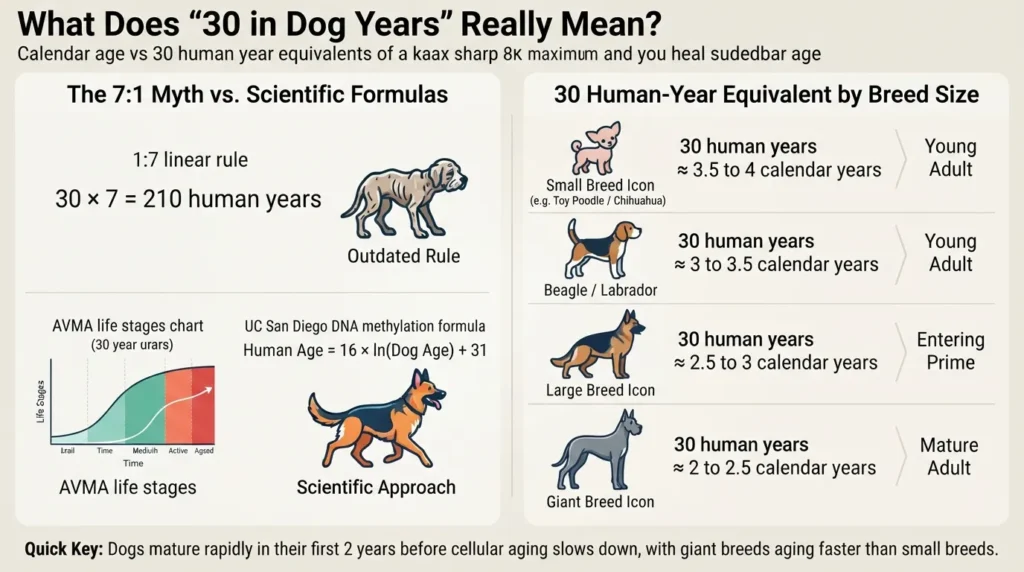
Under the traditional 7:1 rule, 30 dog years equals 210 human years. However, modern veterinary science reveals that canine aging isn’t linear. According to peer-reviewed DNA methylation research and American Animal Hospital Association (AAHA) guidelines, a dog in their very first calendar year is already equivalent to about 30 human years due to rapid early cellular development.
Use our free calculator below to get your dog’s exact age based on their size, breed, and real calendar years.
30 Dog Years = How Many Human Years? The 7:1 Rule, Explained
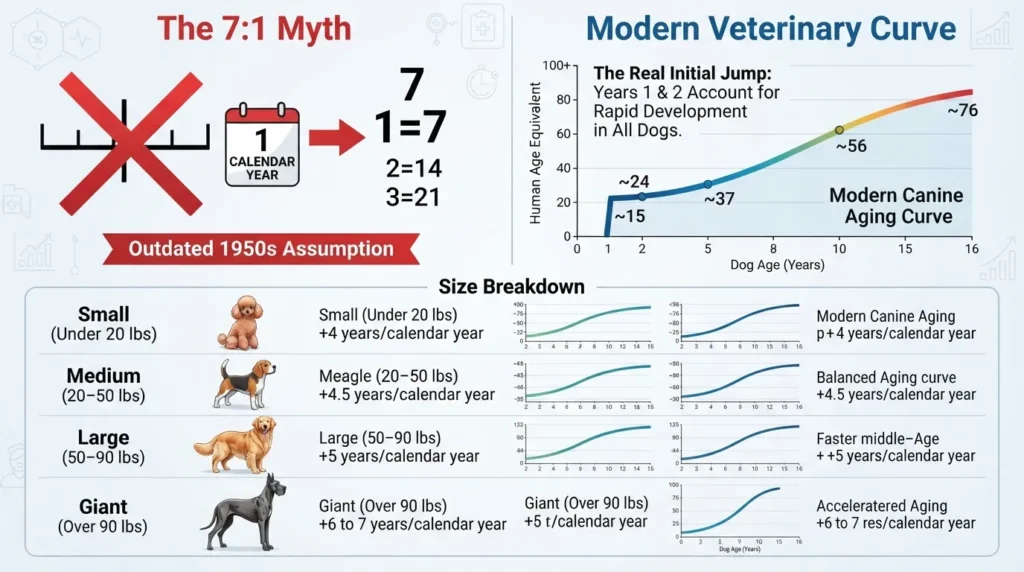
If you strictly apply the old “multiply by seven” rule, 30 dog years would equal a mind-boggling 210 human years. In reality, no dog reaches 30 calendar years—the oldest officially recorded dog in history, an Australian Cattle Dog named Bluey, lived to 29.5 years. But the broader issue isn’t just the extreme math; it’s that the standard 7:1 formula completely misrepresents how dogs actually age.
To calculate your dog’s true human age equivalent, it helps to understand where this popular rule of thumb came from and why modern veterinary science has officially moved past it.
Where the 7:1 Myth Came From
The 7:1 ratio emerged around the mid-20th century as a quick rule of thumb rather than a scientific measurement. In the 1950s, as commercial pet care improved and veterinary medicine advanced, dogs began living noticeably longer lives.
To encourage owners to bring their pets in for annual wellness exams, veterinary practices and health campaigns began using a basic mathematical average: if the average human lived roughly 70 years and the average dog lived about 10, then one dog year was equal to seven human years. The formula was simple, memorable, and caught on globally—even though veterinarians always knew it was a vast oversimplification.
Why This Rule Is Inaccurate
The fundamental flaw in the 7:1 rule is that canine aging is non-linear. A dog does not age at a steady, predictable rate across its lifespan. Instead, dogs undergo a massive spike in biological development early on, followed by a slower, more gradual aging process in their middle and senior years.
According to life stage guidelines established by the American Animal Hospital Association (AAHA), a dog’s biological timeline breaks down the 7:1 rule in a few key ways:
Rapid early development: A puppy reaches sexual and physical maturity by age one—roughly equivalent to a 15-year-old human teenager. Under the 7:1 rule, a one-year-old dog would only be 7 years old, a stage where human children are nowhere near physical or reproductive maturity.
The two-year jump: By two years old, a dog is approximately 24 in human years. They have completed nearly all of their rapid adult development, meaning their aging rate slows down significantly from year three onward.
Ignoring breed size: The 7:1 rule treats every dog the same. In reality, a 10-pound Toy Poodle and a 130-pound Mastiff age at vastly different rates after reaching maturity, with giant breeds aging much faster than smaller ones.
Recent genetic research—such as the DNA methylation aging study published by Wang et al. in Cell Systems—confirms that a dog’s molecular clock runs exceptionally fast during early puppyhood and tapers off later in life. Relying on a fixed 7:1 multiplier completely misses this biological curve.
The Scientific Way: What "30" Actually Means for Your Dog
The old rule of multiplying your dog’s age by 7 is officially outdated. Canine aging isn’t linear—dogs mature at an accelerated pace during their first two years of life, after which their biological aging slows down significantly. To get an accurate calculation, veterinary researchers rely on two scientific models rather than simple multiplication.
AVMA Method (Size-Based Calculation)
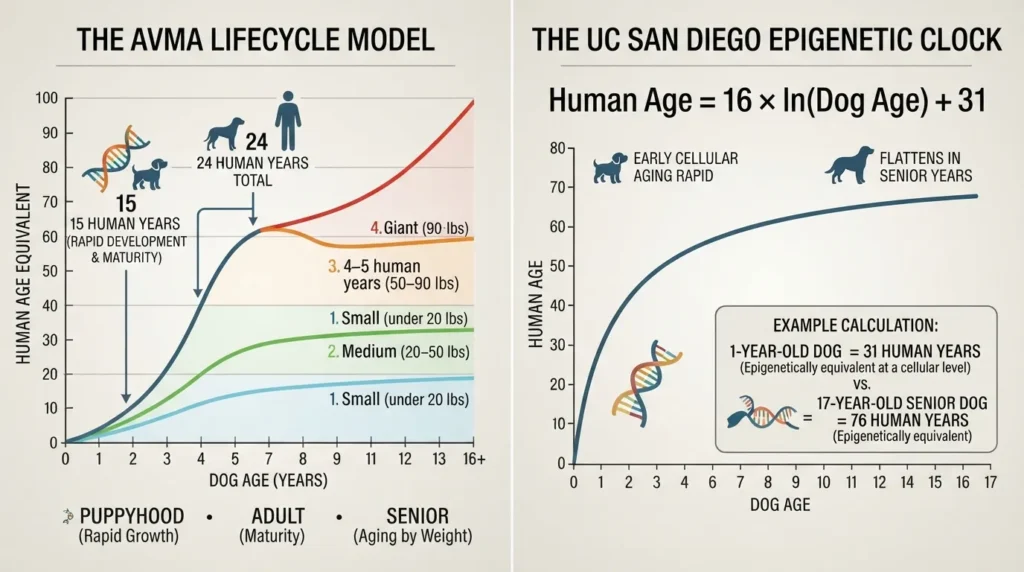
The American Veterinary Medical Association (AVMA) outlines a standardized aging framework based on natural biological milestones across a dog’s lifespan:
Year 1: The first year of a dog’s life equals roughly 15 human years. During this period, a puppy experiences rapid physical, hormonal, and behavioral development equivalent to human childhood and early adolescence.
Year 2: The second year adds approximately 9 human years (reaching roughly 24 human years total), bringing your dog into young adulthood.
Each Year After (3+): Every additional calendar year adds about 4 to 5 human years, depending on your dog’s size, breed, and weight category. Small dogs age slower past year two, whereas giant breeds age faster.
Using this baseline, a 17-year-old dog has reached roughly 84 to 90 human years, depending on whether they fall into a small, medium, or large size bracket.
UC San Diego DNA Methylation Formula
In 2020, researchers at the University of California, San Diego published a groundbreaking study in Cell Systems led by Dr. Tina Wang. By analyzing epigenetic clocks—specifically changes in DNA methylation patterns over time—scientists developed a precise mathematical formula comparing canine and human aging at a cellular level.
The scientific formula is expressed as:
Human Age = 16 × ln(Dog Age) + 31
(Where ln represents the natural logarithm of the dog’s age in calendar years.)
Real Example Calculation:
To find the biological human age equivalent for a 17-year-old dog:
Find the natural log of 17: ln(17) ≈ 2.833
Multiply by 16: 16 × 2.833 = 45.33
Add 31: 45.33 + 31 = 76.3 human years
This genetic formula reveals that cellular aging in dogs slows down dramatically as they enter senior status, showing that a 17-year-old dog shares cellular methylation patterns similar to a human in their mid-to-late 70s.
Reverse Meaning — If Your Dog Is 1 Year Old, Why Is That "30 in Dog Years"?
It is easy to get confused when turning the formula around. When people ask what 17 dog years in human years translates to, they are mapping a dog’s calendar age onto human life stages. But when someone says a 1-year-old dog is “30 in dog years,” they are using pop-culture math backward to describe how far along the dog is in its own development.
Rapid Growth in Year One
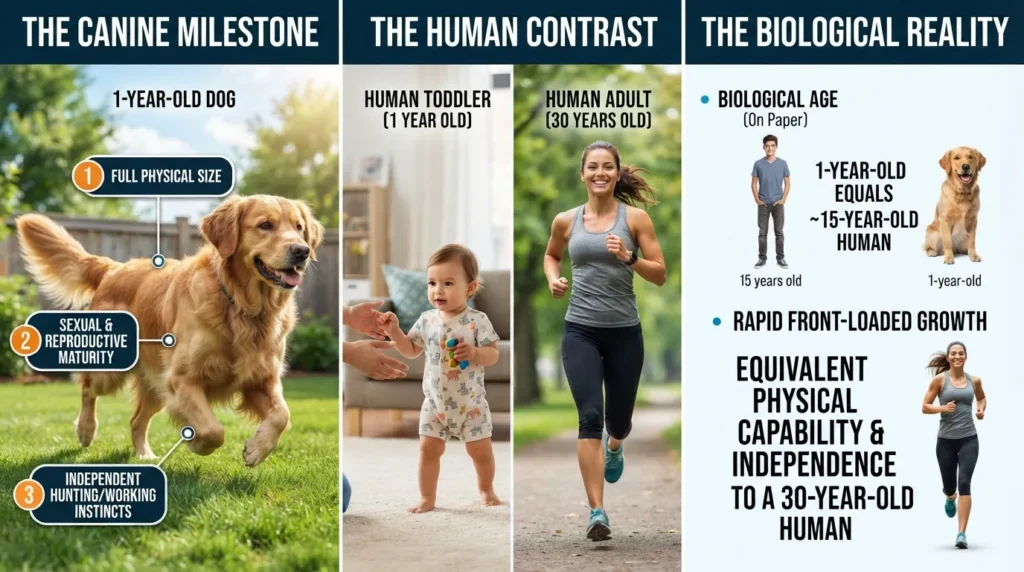
A 1-year-old pup isn’t anywhere near a human toddler. By their first birthday, dogs hit full physical size, reach sexual maturity, and possess adult instincts—milestones humans don’t cross until their late teens or early twenties.
Human 1-Year-Old: Just learning to walk, completely dependent on parents, years away from physical or hormonal maturity.
Dog 1-Year-Old: Fully capable of reproducing, running at full speed, and hunting or working independently.
Clearing Up the Confusion
This gap in development is why old-school charts simplified a 1-year-old dog as feeling like a “30-year-old human” in terms of independence and energy. Veterinary guidelines from the American Animal Hospital Association (AAHA) put a 1-year-old dog closer to a 15-year-old human biologically, but the point remains: canine growth is front-loaded. They rush through childhood in 12 months, then slow their pace for the rest of their senior years.
30 Human Years in Dog Years by Size & Breed (Comparison Table)
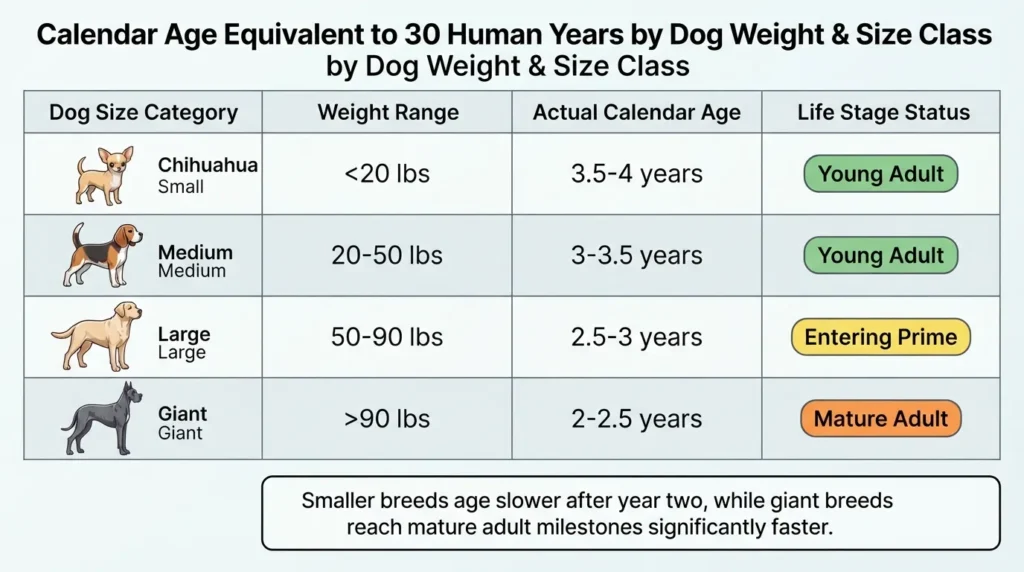
If your dog was a human in their 30s, how old would they actually be in calendar years? Because size directly dictates canine biology, a 30-human-year equivalent looks completely different for a Toy Poodle than it does for a Mastiff.
| Dog Size Category | Weight Range | Human Age Equivalent: 30 Years Old | Seniority Stage |
|---|---|---|---|
| Small Breeds | Under 20 lbs | ~3.5 to 4 calendar years | Young Adult |
| Medium Breeds | 20 to 50 lbs | ~3 to 3.5 calendar years | Young Adult |
| Large Breeds | 50 to 90 lbs | ~2.5 to 3 calendar years | Entering Prime |
| Giant Breeds | Over 90 lbs | ~2 to 2.5 calendar years | Mature Adult |
Why Size Matters in Dog Aging
Smaller dogs live significantly longer than larger dogs, creating a fascinating biological paradox. In almost every other mammal species, larger animals outlive smaller ones—whales outlive mice, and elephants outlive cats. Dogs flip this rule on its head.
According to veterinary research into canine lifespans, large and giant breeds age at a faster biological rate. Big dogs grow rapidly from puppyhood, which puts immense oxidative stress on their cells and causes their bodies to wear down earlier. Small dogs mature quickly in their first year or two, but their biological clock slows to a crawl afterward, allowing them to reach milestones like 17 dog years far more frequently than giant breeds.
Real Breed Examples
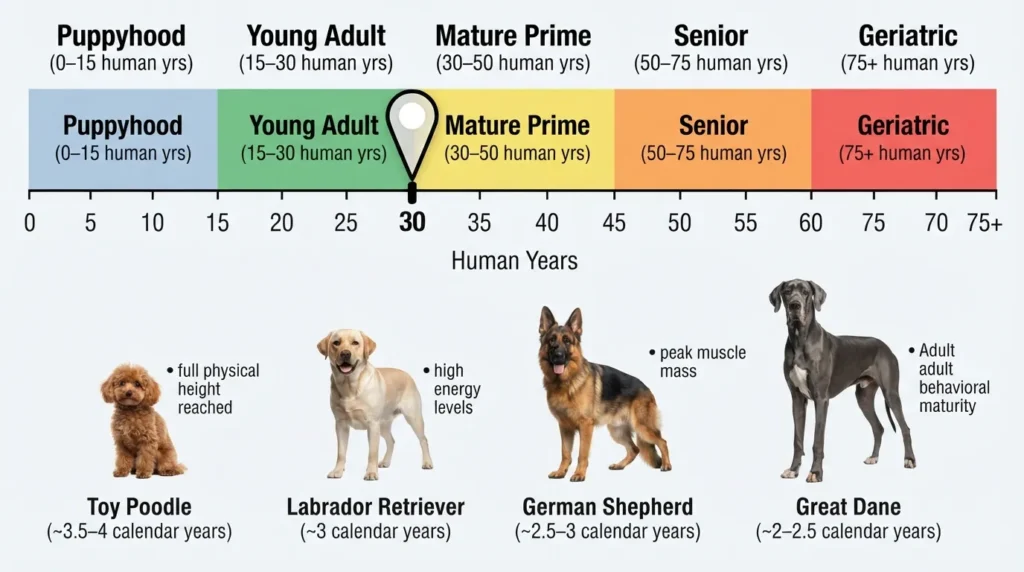
Chihuahua: Highly resilient small dogs that age very slowly past year two. A Chihuahua reaching 30 human years is barely out of early adulthood (around 3.5 actual years old), and it’s not unusual for this breed to reach an actual age of 17 to 20 calendar years.
Labrador Retriever: As a classic medium-to-large breed, a Lab hits the 30-human-year mark right around 3 calendar years of age. They maintain a balanced, predictable aging curve throughout their lives.
German Shepherd: Falling into the large breed category, German Shepherds experience slightly faster cellular strain. They hit their 30-human-year milestone at roughly 2.5 to 3 years old, requiring joint care attention earlier in life than smaller breeds.
Great Dane: As a giant breed, a Great Dane ages at a dramatically accelerated pace. By the time a Great Dane reaches just 2 to 2.5 actual calendar years, their physiological age already mirrors a 30-year-old human.
What Life Stage Is a "30-Dog-Year-Old" Dog In?
A dog at 17 calendar years—or roughly 76 to 90 human years depending on size—is firmly in the geriatric stage of life. This goes beyond the general “senior” designation. In veterinary medicine, geriatric dogs have surpassed their average breed expectancy and entered a phase where body systems naturally slow down and require specialized, gentle support.
Signs & Health Checklist at This Life Stage
At this advanced age, physical and cognitive changes become part of daily life. Catching these early helps keep your senior companion comfortable and pain-free.
Energy level & behavior changes: You’ll notice much longer sleep cycles, slower morning wake-ups, and occasional confusion or pacing (signs of canine cognitive dysfunction).
Joint/mobility signs: Stiffness when standing up, hesitation before stairs, slipping on hardwood floors, or loss of muscle mass in the hind legs.
Dental health: Heavy tartar buildup, persistent bad breath, sensitive gums, or dropping kibble while eating due to mouth discomfort.
Vision/hearing changes: A cloudy or bluish appearance in the lenses (lenticular sclerosis or cataracts), bumping into furniture in dim lighting, or failing to respond to verbal cues.
Weight & metabolism changes: Sudden weight loss from muscle wasting or weight gain due to reduced activity and a slowing metabolism.
Recommended vet checkup frequency: At least every 6 months—or every 3 to 4 months if managing chronic conditions like kidney disease or arthritis—to monitor bloodwork and pain levels.
Is This Considered Senior?
Yes, but more accurately, a 17-year-old dog in human years is considered geriatric. According to American Animal Hospital Association (AAHA) Senior Care Guidelines, dogs enter their senior years during the last 25% of their estimated lifespan, typically around ages 7 to 10 depending on size. Reaching 17 means your dog has well exceeded standard senior status and requires daily hospice-style comfort management.
How Much Longer Will My Dog Live? (+ Quick Tips)
Every day with a 17-year-old dog is a milestone. While exact timelines vary, understanding where your dog stands helps you plan the best care possible.
Small breeds (under 20 lbs): May live several more months up to a year or two with proper senior care.
Medium breeds (20–50 lbs): Typically near the upper limit of their life expectancy, making comfort management the top priority.
Large/Giant breeds (50+ lbs): Exceptionally rare at 17 years; care focuses entirely on pain relief and quality of life.
Factors affecting longevity: Genetics play a massive role, but consistent joint care, controlled calorie intake, early disease management, and a stress-free home environment significantly influence how well a dog ages.
Switch to a senior diet: Feed easily digestible, high-quality protein tailored for low activity levels and joint support.
Keep up routine vet visits: Schedule blood panels every 6 months to spot organ changes before outward symptoms appear.
Adjust their environment: Place non-slip rugs over smooth floors and provide orthopedic beds in quiet, warm areas.
Modify daily movement: Swap long walks for short, frequent “sniffathons” to keep joints moving without causing fatigue.
Real-World Example: Dogs Who Lived to 30 "Dog Years" and Beyond
Reaching 17 calendar years—roughly 76 to 90 human years—is an impressive milestone, but a few extraordinary dogs have pushed the boundaries of canine longevity even further. While extreme lifespans are rare outliers, these real-world examples give us valuable insights into what makes extreme longevity possible.
Bobi (31 years, 165 days): A Rafeiro do Alentejo from Portugal who lived to be over 31 calendar years old. According to his owner, Bobi roamed freely in a peaceful rural environment, ate unseasoned human food, and lived a completely stress-free life alongside other animals.
Bluey (29 years, 5 months): An Australian Cattle Dog who held the official record for world’s oldest dog for nearly a century. Bluey spent almost 20 years working livestock in the Australian outback, keeping active, lean, and engaged every single day.
Maggie (30 years): An Australian Kelpie who lived on a dairy farm in Victoria, Australia. Though unverified by official records, her owner reported she worked on the farm up until her final years, maintaining a routine filled with constant exercise and raw, fresh nutrition.
While these record-breaking ages seem almost unbelievable, they highlight a clear pattern: a powerful combination of robust genetics, a lean daily diet, regular low-impact activity, and a calm, loving environment can help dogs maximize their natural biological lifespan.
Frequently Asked Questions
Is 30 in dog years old?
If you mean 30 calendar years for a dog, that is exceptionally rare—equivalent to over 130+ human years! However, if you mean a dog that equals 30 human years, that corresponds to a young adult dog around 3 calendar years old. A 17-year-old dog, on the other hand, is roughly 76 to 90 human years old and is considered very geriatric.
What is 1 dog year in human years?
According to American Veterinary Medical Association (AVMA) guidelines, the first year of a dog's life equals roughly 15 human years. The second year adds about 9 human years, and every subsequent year adds about 4 to 5 human years depending on your dog's size.
How accurate is the 7-year rule?
The traditional "1 dog year = 7 human years" rule is an oversimplification and largely inaccurate. Dogs mature very rapidly in their first two years of life, after which biological aging slows down. A simple 7-to-1 multiplier ignores initial growth spurts and breed size differences entirely.
Does breed/size affect the dog years calculation?
Yes, significantly. Small dogs age slower in their later years compared to large or giant breeds. For instance, calculating 17 dog years in human years yields about 84 human years for a small dog under 20 lbs, but up to 90+ human years for larger breeds.
What is the most accurate dog age formula?
The most accurate genetic model is the UC San Diego DNA Methylation Formula: Human Age = 16 × ln(Dog Age) + 31. Based on cellular aging clocks, it calculates logarithmic biological aging rather than relying on linear estimates.
Can a dog really live to 30 human years?
If asking about 30 calendar years of life, yes—though extremely rare, documented cases like Bobi and Maggie show dogs reaching 30 calendar years. If asking about reaching the equivalent of 30 human years biologically, almost all dogs reach that stage by their third calendar year.
🐾 Other Age Guides

I built Dogagescalculator.com to give dog owners honest, science-backed answers instead of the outdated "×7" myth. Every figure here is checked against AKC, AVMA, and published veterinary research.
More about the author & this site →
Comments