
22 Years in Dog Years – What Does It Really Mean in Human Years?
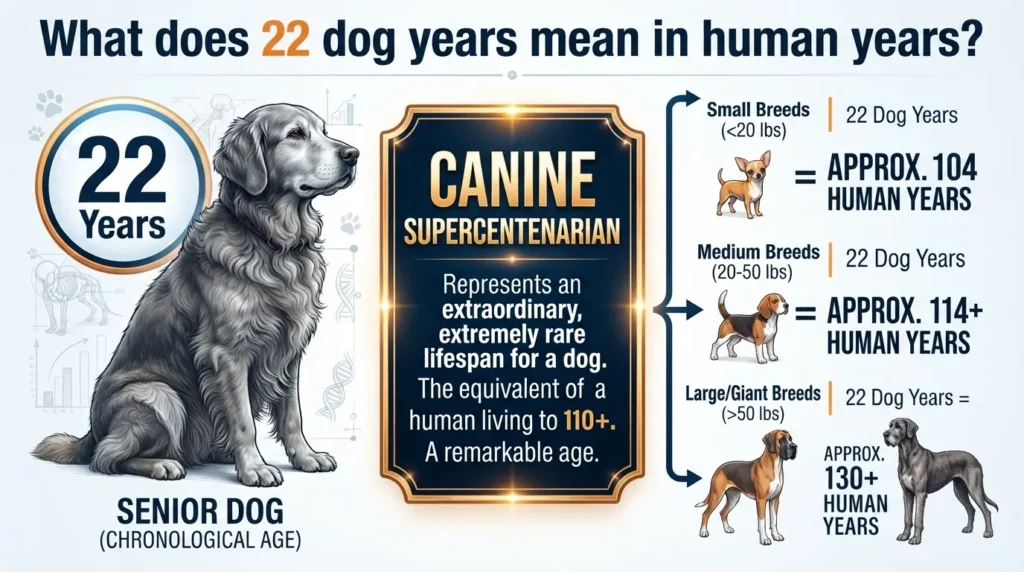
Reaching 22 years of age is a monumental milestone for any dog. If your canine companion has reached this incredible age, you are looking at an extraordinary feat of canine longevity. But what does that actually mean in human terms, and how do we accurately translate a dog’s golden years into our own timeline?
🐾 Quick Answer
A 22-year-old dog is approximately 104 to 166 in human years, depending primarily on their size and breed:
Small Breeds (under 20 lbs): ~104 human years
Medium Breeds (20–50 lbs): ~120 human years
Large Breeds (50+ lbs): ~140–166 human years
Hitting 22 years in dog years makes your pet a true super-centenarian in the canine world!
22 Dog Years by Size Full Breakdown
Reaching 22 calendar years is an extraordinary milestone for any dog. In human terms, a 22-year-old dog isn’t just a senior—they are a supercentenarian. Translating 22 dog years in human years isn’t a one-size-fits-all calculation because a dog’s biological aging rate depends heavily on their weight and breed size.
According to aging models aligned with American Animal Hospital Association (AAHA) canine life stage guidelines, here is how a 22-year-old dog in human years breaks down across different size categories:
| Size Category | Weight Range | Equivalent Human Age |
|---|---|---|
| Small Breeds | Under 20 lbs (e.g., Chihuahua, Toy Poodle) | ~104 human years |
| Medium Breeds | 20 to 50 lbs (e.g., Beagle, Cocker Spaniel) | ~114 human years |
| Large Breeds | 51 to 90 lbs (e.g., Golden Retriever, German Shepherd) | ~132 human years |
| Giant Breeds | Over 90 lbs (e.g., Great Dane, Mastiff) | ~166 human years |
While it is exceptionally rare for large or giant breeds to reach 22 calendar years, small dogs occasionally reach this age thanks to their slower cellular aging process.
Why the Number Changes So Much by Size
It seems counterintuitive—across most of the animal kingdom, larger species outlive smaller ones (elephants drastically outlive mice). In domestic dogs, however, the rule reverses entirely.
Larger dogs age at a significantly faster metabolic rate. Big puppies undergo rapid growth spurts to reach adult size, putting immense physiological strain on their cells early in life. Evolutionary biologists studying canine longevity have found that for every additional 4.4 pounds of adult body weight, a dog’s life expectancy drops by roughly one month.
This accelerated biological clock means a giant breed’s body undergoes age-related cellular degradation much faster than a small toy breed. By the time a small dog reaches a human equivalent of 104 years at age 22, a giant breed—if they were to beat astronomical biological odds to reach that same birthday—would biologically equate to a 166-year-old human.
Is It Even Possible for a Dog to Live to 22 Years?
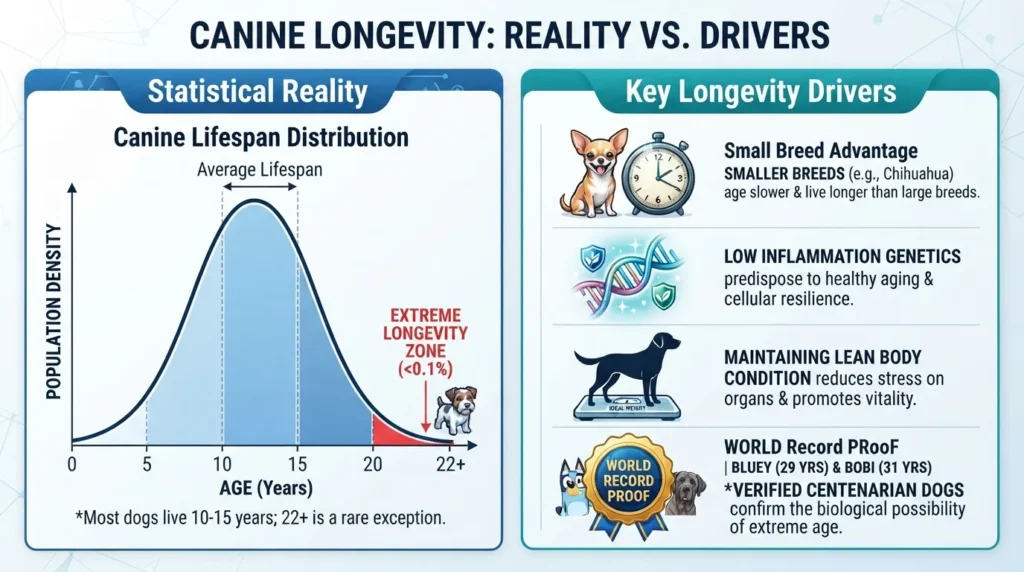
Hitting 22 years of age is the canine equivalent of a human becoming a supercentenarian—reaching 110 years old or beyond. While exceptionally rare, it is entirely possible for a dog to live to 22, provided the right mix of genetics, preventive healthcare, and daily environment align.
Statistical Rarity of a 22-Year-Old Dog
Most dogs live between 10 and 15 years, according to lifespan data tracked by the American Veterinary Medical Association (AVMA). Reaching age 22 puts a dog far outside the standard bell curve.
Statistically, less than 0.1% of all domestic dogs ever cross the two-decade mark. In human terms, a 22-year-old dog has survived decades past their expected natural life stage, operating on DNA that ages with remarkable slow-motion precision.
The World’s Oldest Dogs on Record
If 22 sounds implausible, real-world longevity records prove that canine biology can occasionally reach astounding lengths. Guinness World Records has documented several extreme cases of canine longevity:
Bluey (29 years, 5 months): An Australian Cattle Dog who worked livestock for nearly 20 years, holding the record for almost a century as the oldest verified dog in history.
Bobi (31 years, 165 days): A Rafeiro do Alentejo from Portugal who garnered worldwide attention after living past 31 years in a calm, rural environment on an unprocessed diet.
Chihuahua and Toy Mixes: Scores of unverified but vet-documented mixed-breed dogs routinely reach 20 to 23 years, especially when kept active and lean.
These record-holders share a common thread: low stress, lean body mass, consistent activity, and strong, low-inflammation genetics.
Which Breeds and Sizes Are Most Likely to Reach 22?
Size is the single largest factor determining whether a dog can reach 22 years in dog years. Large and giant breeds—like Great Danes or Mastiffs—age at a accelerated metabolic rate, rarely living past 10 to 12 years. Small and toy breeds, however, age much slower after their initial growth period.
The breeds statistically most likely to reach their early twenties include:
Chihuahuas & Toy Poodles: Small body sizes mean less cellular stress over time, allowing their organs to function decades longer than average.
Jack Russell Terriers & Rat Terriers: High-energy, resilient working terriers built with strong cardiovascular systems and low rates of congenital disease.
Australian Cattle Dogs & Australian Shepherds: Medium-sized herding breeds known for exceptional genetic stamina and active lifestyles.
Small Mixed Breeds (“Mutts”): Benefit from heterosis (hybrid vigor), which reduces the chance of inheriting double copies of disease-causing recessive genes.
If you have a 22-year-old dog sleeping at your feet right now, you are holding hands with a genuine medical marvel.
The Real Math – Why the "7-Year Rule" Fails at This Age
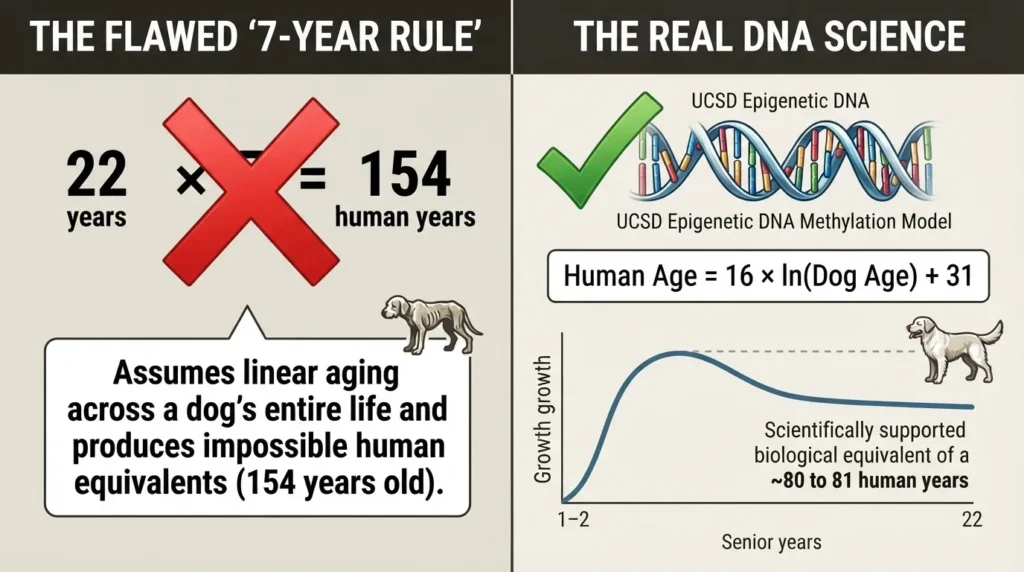
For decades, popular culture relied on a simple formula: one dog year equals seven human years. That rule was a helpful shorthand for estimating a young dog’s development, but for extreme seniors, the arithmetic breaks down entirely.
If you apply that old math to a 22-year-old dog, the calculation suggests 22 × 7 = 154 human years. No human in recorded history has ever lived to 154. Applying a flat multiplier assumes dogs age at a constant rate throughout their entire lives, which simply does not match how mammalian bodies age.
In 2020, researchers at the University of California, San Diego published a landmark epigenetic study in Cell Systems that changed how we measure canine age. By tracking chemical marks on canine DNA (DNA methylation patterns), the team mapped how dogs age at a cellular level compared to humans. Their findings revealed that dogs age extraordinarily fast during their first two years, after which the aging curve flattens significantly.
To accurately map a dog’s age using this cellular clock, scientists developed a logarithmic formula:
Human Age = 16 × ln(Dog Age) + 31
Here is how that math works out for a 22-year-old dog:
Step 1: Calculate the natural logarithm (ln) of the dog’s age. The natural log of 22 is approximately 3.091.
Step 2: Multiply that number by 16 (3.091 × 16 = 49.456).
Step 3: Add 31 (49.456 + 31 = 80.456).
Based on this DNA methylation model, a 22-year-old dog corresponds to roughly 80 to 81 human years.
While this formula provides a far more scientifically accurate representation than the old 7-year rule, it does have limitations. The UC San Diego study focused primarily on Labrador Retrievers. Because breed size, genetics, and metabolic rates heavily influence how rapidly a dog ages, a 22-year-old toy breed may physically resemble an 80-year-old human, whereas larger breeds rarely reach this age due to faster physiological aging.
Life Stage, Care & Comfort at 22 Years

Reaching 22 years in dog years places your companion squarely in the “super senior” or geriatric life stage. According to American Animal Hospital Association (AAHA) guidelines, dogs enter their senior phase in the final 25% of their expected lifespan, making a 22-year-old dog a rare and deeply cherished milestone. At this age, physical and behavioral changes are pronounced. You will likely notice clouded lenses (nuclear sclerosis or cataracts), significant hearing loss, muscle wasting, and cognitive changes like altered sleep cycles or occasional pacing.
Caring for a dog at this advanced age requires subtle shifts in daily routines, starting with nutrition, gentle movement, and medical oversight:
Dietary Adjustments: Senior dogs often experience reduced appetite and difficulty digesting complex proteins. Transition to highly digestible, senior-specific meals or warm, moisture-rich foods to encourage eating while protecting fragile kidneys.
Modified Exercise: Physical activity should be slow, controlled, and brief. Low-impact 5-to-10-minute strolls help keep joints lubricated without causing exhaustion or distress.
Increased Vet Visits: While adult dogs need annual checkups, a 22-year-old dog benefits from veterinary checkups every 3 to 6 months. Frequent visits allow your vet to monitor organ function, manage hidden arthritis pain, and adjust medications promptly.
Simple adjustments around the house can dramatically improve day-to-day comfort. Lay down non-slip runner rugs over hardwood or tiled floors to give weak joints traction and prevent scary slips. Place orthopedic beds with low borders in easily accessible, draft-free spots, and elevate food and water bowls so your dog does not have to strain their neck or front legs to eat.
Navigating this final life stage also means regularly evaluating your dog’s quality of life. Use objective measures like the HHHHHMM Scale (Hurt, Hunger, Hydration, Hygiene, Happiness, Mobility, More Good Days Than Bad) to track their wellbeing. When bad days consistently outweigh the good, or when mobility and appetite fail despite veterinary intervention, schedule a compassionate conversation with your vet to discuss pain management, palliative care, or peaceful end-of-life options.
22 Dog Years vs Nearby Ages
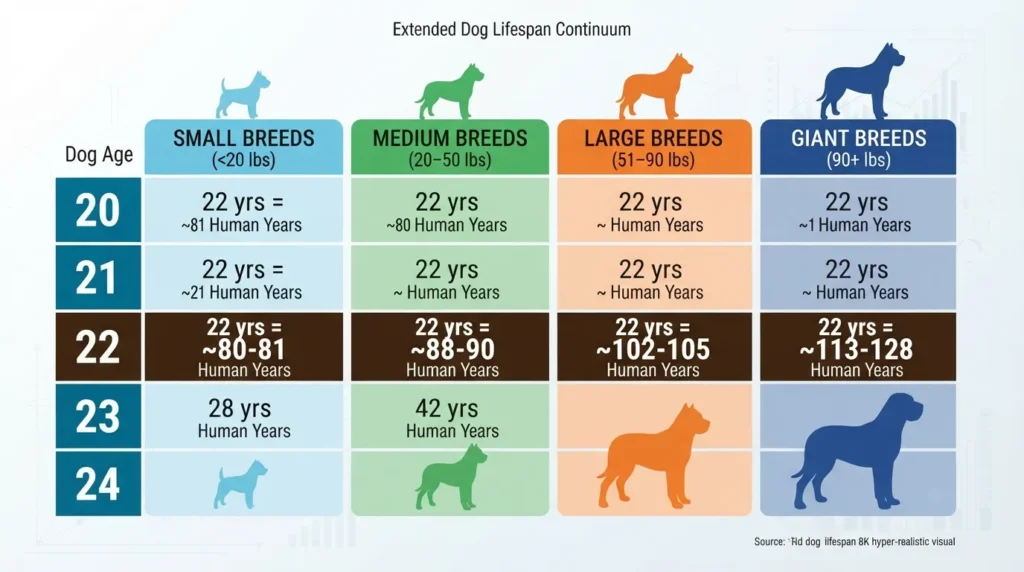
To understand where a 22-year-old dog sits on the aging spectrum, it helps to look at the surrounding years. Because canine aging slows down dramatically in extreme senior years, the biological gap between a 20-year-old dog and a 24-year-old dog isn’t as massive as you might think, but weight class still dictates the physical toll.
According to life stage guidelines from the American Animal Hospital Association (AAHA), smaller dogs age far more gradually in their senior years compared to larger breeds. The chart below breaks down how 22 dog years in human years compares to surrounding milestone ages based on weight and genetic aging patterns.
| Dog Age | Small Breeds (<20 lbs) | Medium Breeds (20–50 lbs) | Large Breeds (51–90 lbs) | Giant Breeds (90+ lbs) |
|---|---|---|---|---|
| 20 Years | ~78 human years | ~90 human years | ~105 human years | ~120 human years |
| 21 Years | ~79 human years | ~93 human years | ~109 human years | ~124 human years |
| 22 Years | ~80–81 human years | ~96 human years | ~113 human years | ~128 human years |
| 23 Years | ~82 human years | ~99 human years | ~117 human years | ~132 human years |
| 24 Years | ~83 human years | ~102 human years | ~121 human years | ~136 human years |
Note: Large and giant breeds exceedingly rarely reach 20+ years due to rapid cellular aging, so numbers past age 20 represent estimated biological equivalents based on canine life stage models.
As the table shows, a 22-year-old dog in a toy or small breed frame physically mirrors a human entering their early 80s. For a small dog, moving from age 20 to 22 adds roughly two to three equivalent human years, whereas that same two-year stretch for a medium or large dog represents a massive jump in physiological strain.
Frequently Asked Questions About 22 Dog Years
What is 22 years in dog years in human years?
Based on the latest UC San Diego DNA methylation study, a 22-year-old dog is equal to roughly 80 to 81 human years. While traditional calculations like the old "multiply by 7" rule incorrectly suggest 154 human years, cellular aging models show that a dog's aging slows down significantly after their early years.
Is it common or realistic for a dog to live to 22 years?
Reaching 22 dog years is exceptionally rare and represents the upper extreme of canine lifespan. It occurs almost exclusively in small or toy breeds—such as Chihuahuas, Toy Poodles, or Dachshunds—due to their slower metabolic aging process compared to medium and large breeds.
Does breed size change how we calculate 22 years in dog years?
Yes, breed size plays a massive role. Large and giant breeds age much faster at a physical level than smaller breeds.
If a large breed dog were to reach 22 dog years, their biological wear-and-tear would mirror a human well over 100 years old, whereas a toy breed at age 22 feels more like an 80-year-old human senior.
What special care does a 22-year-old dog need?
A dog at 22 years requires specialized senior care focused on comfort and mobility. Key needs include orthopedic bedding, soft or easily digestible senior food, non-slip floor rugs to assist weakened joints, and regular check-ups with a veterinarian to manage age-related conditions like arthritis or sensory loss.
🐾 Other Age Guides

I built Dogagescalculator.com to give dog owners honest, science-backed answers instead of the outdated "×7" myth. Every figure here is checked against AKC, AVMA, and published veterinary research.
More about the author & this site →
Comments