
25 in Dog Years: How Old Is That Really in Human Years?
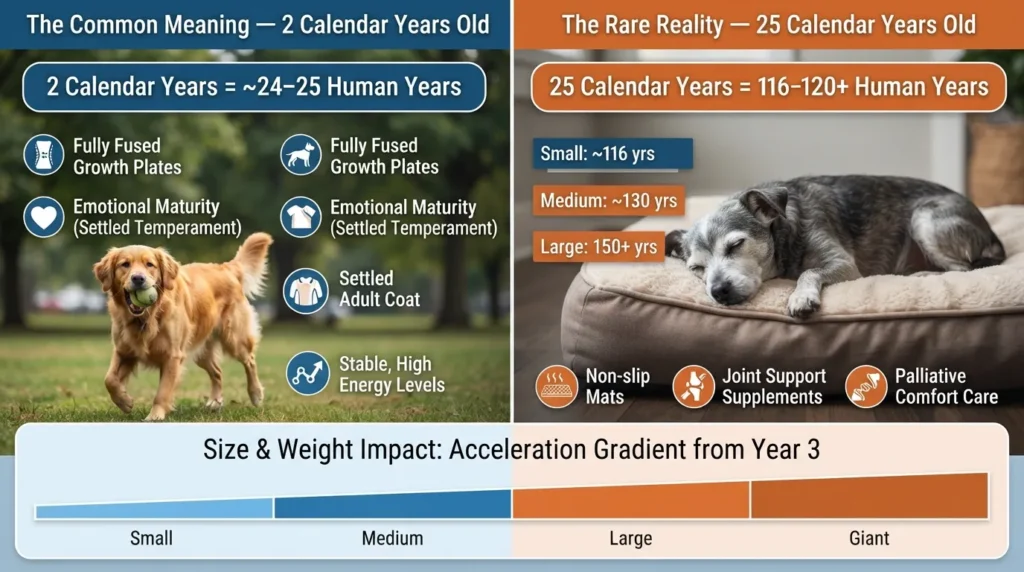
When people say a dog is “25 in dog years,” they usually mean the dog is roughly 2 calendar years old—which translates to about 24 or 25 human years under American Veterinary Medical Association (AVMA) aging guidelines. While exact numbers vary slightly by size and breed, a 2-year-old pup is right at the peak of young adulthood.
(Note: If your dog is literally 25 calendar years old rather than 25 “human equivalent” years, jump to our ultra-senior dog section below.)
Quick Answer — What Age Is "25" in Dog Years?
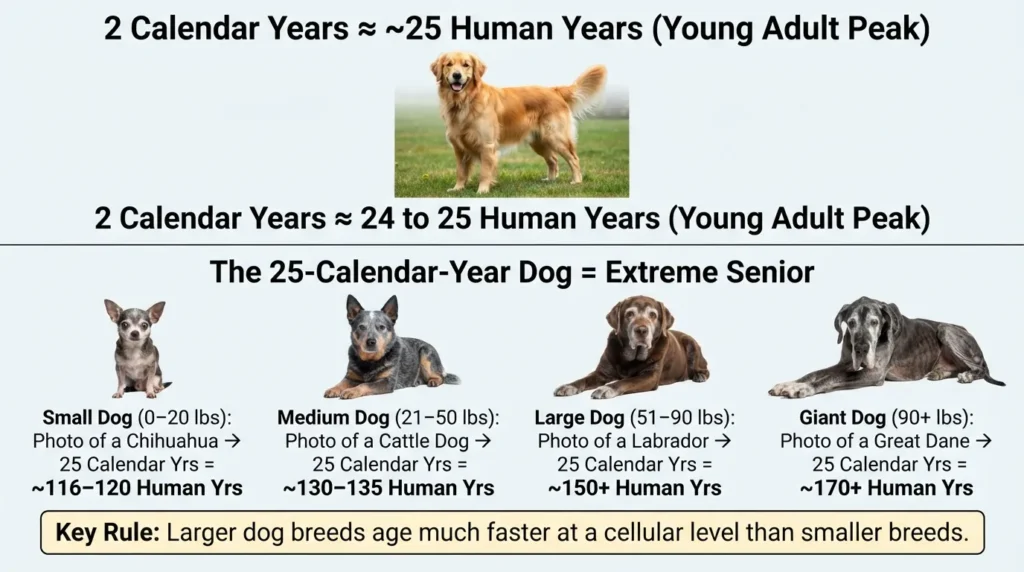
When pet parents ask about a dog reaching 25 in human years, or wonder what 17 dog years in human years translates to on a human calendar, the answer depends entirely on the dog’s size. According to the American Animal Hospital Association (AAHA) canine life stage guidelines, dogs don’t age at a flat 7-to-1 ratio. Their biological clock ticks differently depending on their weight class.
Here is what reaching an advanced equivalent age looks like across weight categories:
Small dogs (0–20 lbs): A 17-year-old dog in human years equals roughly 84 human years. If a small dog were to reach 25 actual calendar years, they would be sitting at approximately 116 to 120 human years.
Medium dogs (21–50 lbs): At 17 calendar years, a medium dog is around 92 human years old. Reaching 25 calendar years translates to roughly 130 to 135 human years.
Large dogs (51–90 lbs): Reaching 17 dog years equals about 104 human years for a large breed. By 25 calendar years, their physiological equivalent exceeds 150 human years.
Giant dogs (90+ lbs): At 17 years, a giant breed reaches over 120 human years. By 25 calendar years, their biological age equivalent is well beyond 170 human years.
Key Takeaway: Larger breeds age much faster at a cellular level than smaller breeds. While a small terrier at 17 calendar years is equivalent to a human in their mid-80s, a large or giant breed reaches senior status and advanced human-year equivalents significantly earlier in life.
How This Number Is Calculated
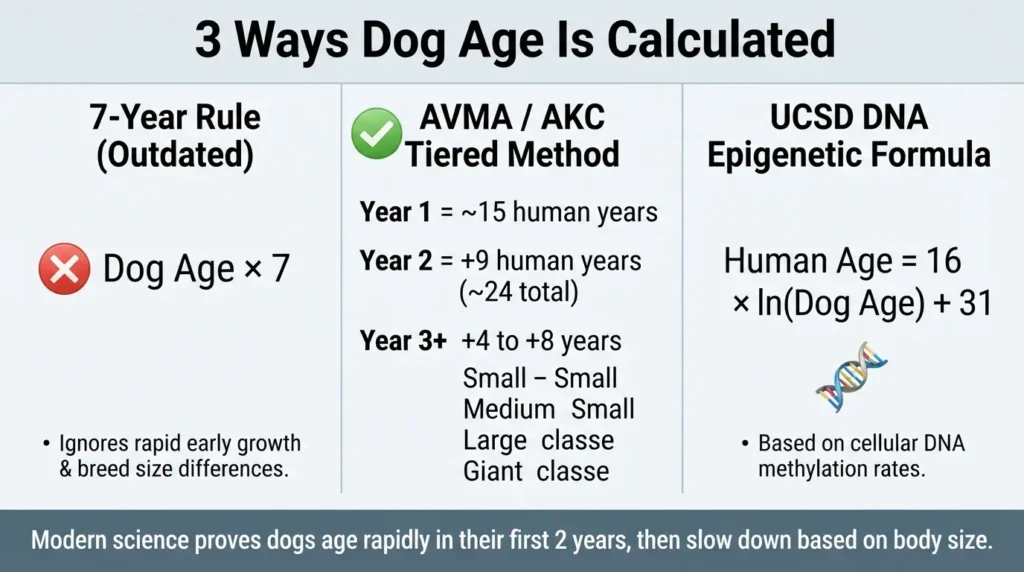
The Myth of the “1 Dog Year = 7 Human Years” Rule
For decades, the standard rule of thumb was simple: multiply your dog’s age by seven. If you have a 17-year-old dog in human years, the old math would suggest they are equivalent to a 119-year-old person.
This seven-year rule likely originated in the mid-20th century as a simple heuristic—roughly comparing a human’s 70-year life expectancy to a dog’s 10-year average. While easy to remember, it completely ignores how canine biology actually works.
Why the 7-Year Rule Is Outdated
The main flaw in the traditional rule is that dogs do not age at a linear rate.
A dog experiences rapid physical and developmental growth in their first two years of life, reaching young adulthood while a human child would still be in elementary school. After those initial developmental spikes, aging slows down significantly—and diverges based heavily on body size and breed. Smaller dogs age much slower in their senior years compared to giant breeds like Great Danes or Mastiffs.
The Standard AVMA and AKC Guidelines
To reflect real canine development, organizations like the American Veterinary Medical Association (AVMA) and the American Kennel Club (AKC) recommend a tiered, size-adjusted method:
Year 1: The first year equals roughly 15 human years, accounting for rapid growth and sexual maturity.
Year 2: The second year adds about 9 human years, bringing a two-year-old dog to roughly 24 human years.
Year 3 and Beyond: Each subsequent year adds between 4 to 8 human years, depending on the dog’s size class (small, medium, large, or giant).
By this standard, a 17-dog-year mark reflects a dog that has reached an exceptional, venerable senior milestone—roughly 84 to 100+ human years depending on their weight class.
The Epigenetic (DNA) Formula
In recent years, researchers at the University of California, San Diego (UCSD) introduced a more precise scientific approach published in Cell Systems (Wang et al.). Instead of tracking physical milestones, researchers measured DNA methylation—epigenetic changes that act as a chemical clock for cellular age in both humans and dogs.
Their natural logarithm formula calculates physiological age as follows:
Human Age = 16 * ln(Dog Age) + 31
For a 17-year-old dog, the breakdown works out like this:
Calculate the natural logarithm of 17: ln(17) ≈ 2.833
Multiply by 16: 16 * 2.833 ≈ 45.33
Add 31: 45.33 + 31 = 76.33
This yields approximately 76 human years at a cellular level.
Study Limitations: While groundbreaking, this epigenetic study was conducted exclusively on Labrador Retrievers. Because Labradors represent a single medium-large breed size, the formula does not fully account for the prolonged lifespans typical of toy breeds or the shorter life expectancies of giant breeds.
Dog Age Chart — Real Age vs. Human Years
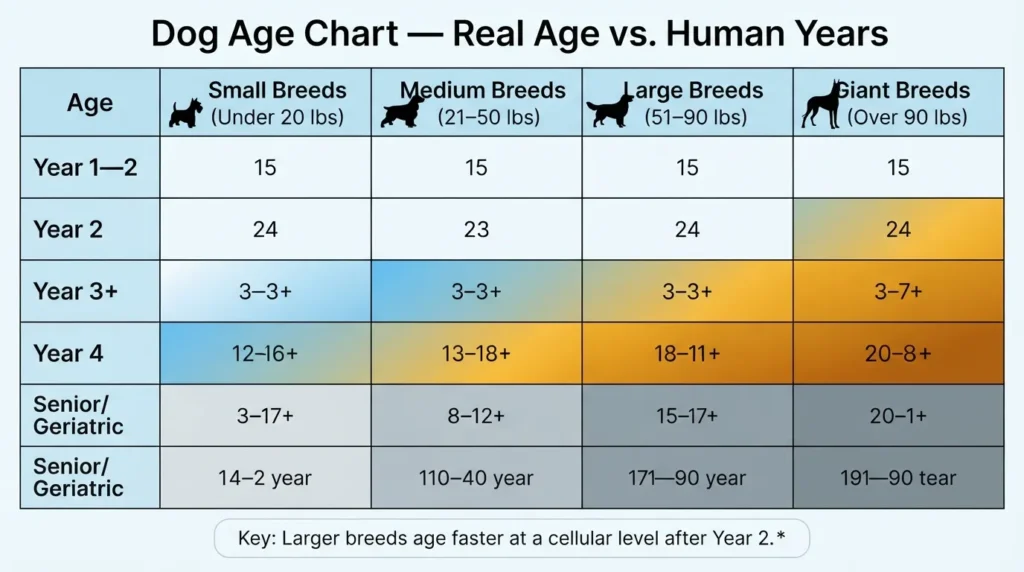
Understanding how your dog matures during their early years sets the baseline for calculating their human age equivalent later in life. This chart breaks down developmental age from Year 1 to Year 4 across different size categories using American Animal Hospital Association (AAHA) guidelines.
| Dog's Real Age | Small (under 20 lbs) | Medium (21–50 lbs) | Large (51–90 lbs) | Giant (over 90 lbs) |
|---|---|---|---|---|
| Year 1 | 15 | 15 | 15 | 15 |
| Year 2 | 24 | 24 | 24 | ~25 |
| Year 3 | 28 | 28 | 28 | 31 |
| Year 4 | 32 | 32 | 33 | 38 |
Note: The bigger the breed, the faster this number is reached. While all dogs age at roughly the same rapid rate through year two, larger and giant breeds accelerate their aging process significantly by year three and four compared to smaller dogs.
If Your Dog Is Literally 25 Years Old
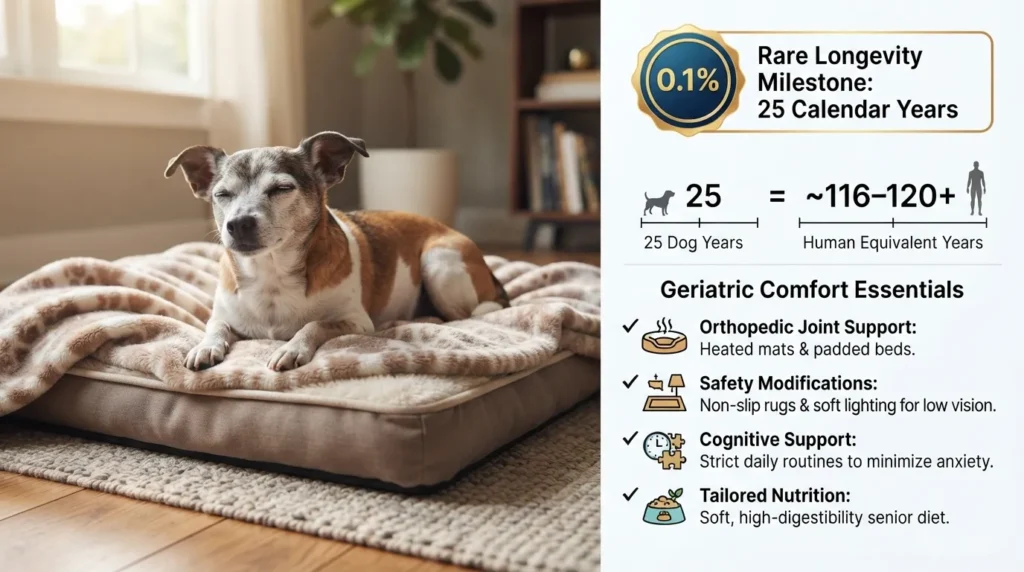
How Rare Is a 25-Year-Old Dog?
Reaching 25 calendar years is an extraordinary milestone for a dog. To put that in perspective, the average canine lifespan across all breeds sits between 10 and 13 years.
A dog living to a quarter-century is roughly equivalent to a human celebrating their 120th birthday. It happens, but it puts your dog in the top fraction of a fraction of one percent of the global canine population. If your companion is anywhere near this milestone, you are witnessing a rare medical marvel.
Which Breeds Can Realistically Reach This Age?
While any dog can occasionally defy genetic odds through exceptional care, certain dog breeds are biologically built to last longer. You almost never see giant breeds like Great Danes or Mastiffs cross into their late teens, let alone their twenties.
Breeds with documented potential to push past 20 years include:
Chihuahuas and Toy Poodles: Small bodies put far less mechanical stress on organs and joints over time.
Australian Cattle Dogs: Famous for high stamina, robust genetics, and active lifestyles.
Jack Russell Terriers: Remarkably resilient working dogs with low rates of congenital heart issues.
Dachshunds: Small frame seniors that frequently reach 18 to 20 years when weight is kept under control.
World’s Oldest Recorded Dogs
Guinness World Records and veterinary history books have documented a handful of dogs that broke through the 20-year ceiling:
Bobi (31 years, 165 days): A purebred Rafeiro do Alentejo from Portugal, recognized as the verified oldest dog ever recorded.
Bluey (29 years, 5 months): An Australian Cattle Dog who held the official record for nearly a century after working cattle and sheep until 1939.
Tukey (26+ years): A miniature Dachshund from the United States that maintained remarkable mobility well into his late twenties.
Human-Year Equivalent at Age 25
Calculating human years for a 25-year-old dog depends on the model you use, but all of them point to an extreme centenarian status.
Using the AVMA size-adjusted guidelines for small dogs (where each year after year two adds roughly 4 human years), a 25-year-old dog is approximately 116 to 120 human years old.
Using the epigenetic DNA methylation formula from UCSD (Human Age = 16 * ln(Dog Age) + 31):
Calculate natural logarithm: ln(25) ≈ 3.219
Multiply by 16: 16 * 3.219 ≈ 51.50
Add 31: 51.50 + 31 = 82.5
This places a 25-year-old dog around 82 to 83 human years at a cellular DNA level, though their physical organ system strain reflects a much higher age.
Geriatric-Stage Health Awareness
Caring for a dog in their nineties or centenarian equivalent requires shifting from preventative wellness to palliative comfort. At this stage, cognitive dysfunction (canine dementia), severe arthritis, vision loss, and kidney changes are virtually guaranteed.
Focus heavily on environment modification: non-slip rugs over hardwood floors, orthopedic beds placed away from drafts, heated mats for stiff joints, and keeping daily routines strictly consistent to minimize anxiety. Every extra day with a dog at this age is a gift—celebrate their resilience, but keep their physical ease as your primary guide.
What Life Stage Is a Dog at ~2 Years 25 Human Years?
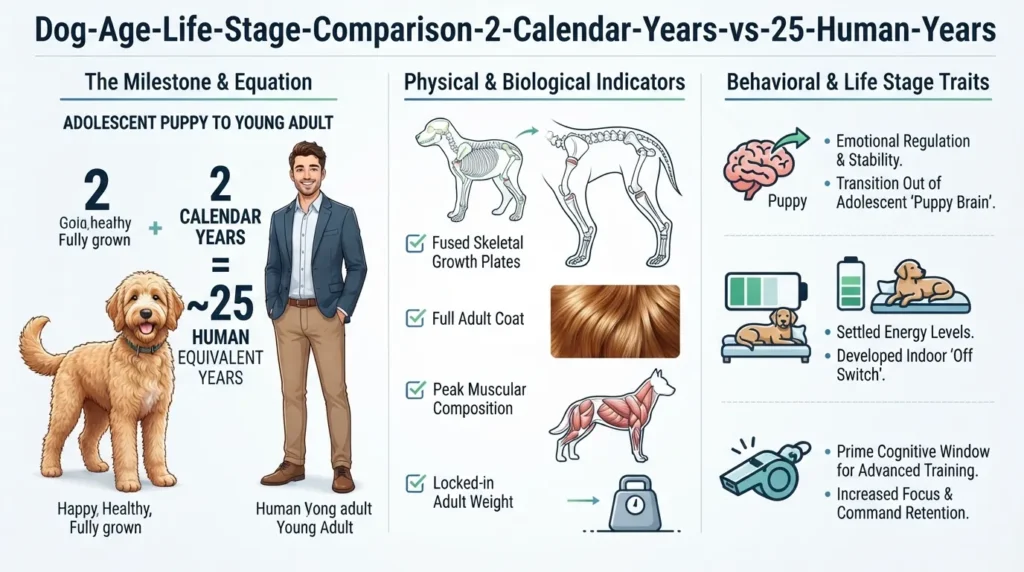
The Adolescent-to-Young-Adult Transition
At two calendar years—roughly equivalent to 25 human years under American Animal Hospital Association (AAHA) guidelines—your dog officially crosses the threshold from rebellious teenager to fully formed young adult.
This transition marks a major biological pivot. While your dog may have looked like a full-grown adult months ago, their brain and nervous system were still catching up. Reaching two years means their physical growth plates have fused, their hormone levels are settling, and their emotional regulation is finally catching up to their physical size.
Behavioral Changes to Expect
If you’ve spent the last year dealing with random bouts of selective hearing, you can breathe a small sigh of relief. Around the two-year mark, most dogs trade frantic puppy brain for a grounded, steady confidence.
You’ll likely notice three distinct behavioral shifts:
Settled Energy Levels: They still have plenty of stamina for hiking or fetch, but they develop a natural “off switch” indoors.
Social Maturity: Their interactions with other dogs become more fixed. You might see a slight shift from wanting to play with every dog on the sidewalk to being more selective about their canine friends.
Testing Boundaries: Young adult dogs often test their freedom to see if rules established in puppyhood still apply. Consistent, gentle boundaries keep them on track.
Why This Age Is Critical for Training
Two years old is a unique window of opportunity for behavioral conditioning. Because your dog’s cognitive processing is now fully mature, they hold focus longer and absorb complex commands faster than a easily distracted puppy ever could.
This is the prime stage to solidify lifelong habits, master advanced recall, or curb subtle behavioral issues like reactive barking or leash pulling before those patterns become deeply ingrained adult habits.
Physical Maturity Markers
Physically, a two-year-old dog has reached complete structural development.
According to veterinary standards, large and giant breeds finish closing their skeletal growth plates between 18 and 24 months, while small breeds hit this milestone even earlier. At this stage, your dog has filled out with lean muscle mass, established their permanent adult coat, and locked in their baseline adult weight.
Use Our Free Dog Age Calculator

Want to skip the manual math? Use our custom calculator to find your dog’s exact age in human years within seconds.
Instead of relying on outdated multipliers, our tool factors in your dog’s weight category or breed alongside their exact birth date (or current age in calendar years). This gives you an accurate, scientifically grounded age tailored specifically to your dog’s unique biological footprint.
Frequently Asked Questions
Q: How old is a dog that's 25 in human years?
A 25-year-old dog in human years is equivalent to a human aged roughly 120 to 140+ years old, depending on the dog's size and breed category.
Q: Is a 25-year-old dog in human years considered unusually old?
Yes, reaching 25 calendar years is an exceptionally rare lifespan milestone achieved by less than 0.1% of domestic dogs worldwide.
Q: Do small dogs reach 25 human years more often than large dogs?
Yes, toy and small breeds age much slower after year two, making them significantly more likely to reach extreme senior ages like 25 calendar years.
Q: What is the oldest recorded age a dog has ever lived?
According to Guinness World Records, the oldest verified dog lived to 31 years and 165 days, which translates to well over 150 human years.
Q: Can my dog really live to be 25 years old?
While rare, dogs can reach 25 calendar years with optimal genetics, proactive senior vet care, low-stress environments, and balanced high-quality nutrition.
🐾 Other Age Guides

I built Dogagescalculator.com to give dog owners honest, science-backed answers instead of the outdated "×7" myth. Every figure here is checked against AKC, AVMA, and published veterinary research.
More about the author & this site →
Comments