
What Is 1 Human Year in Dog Years?
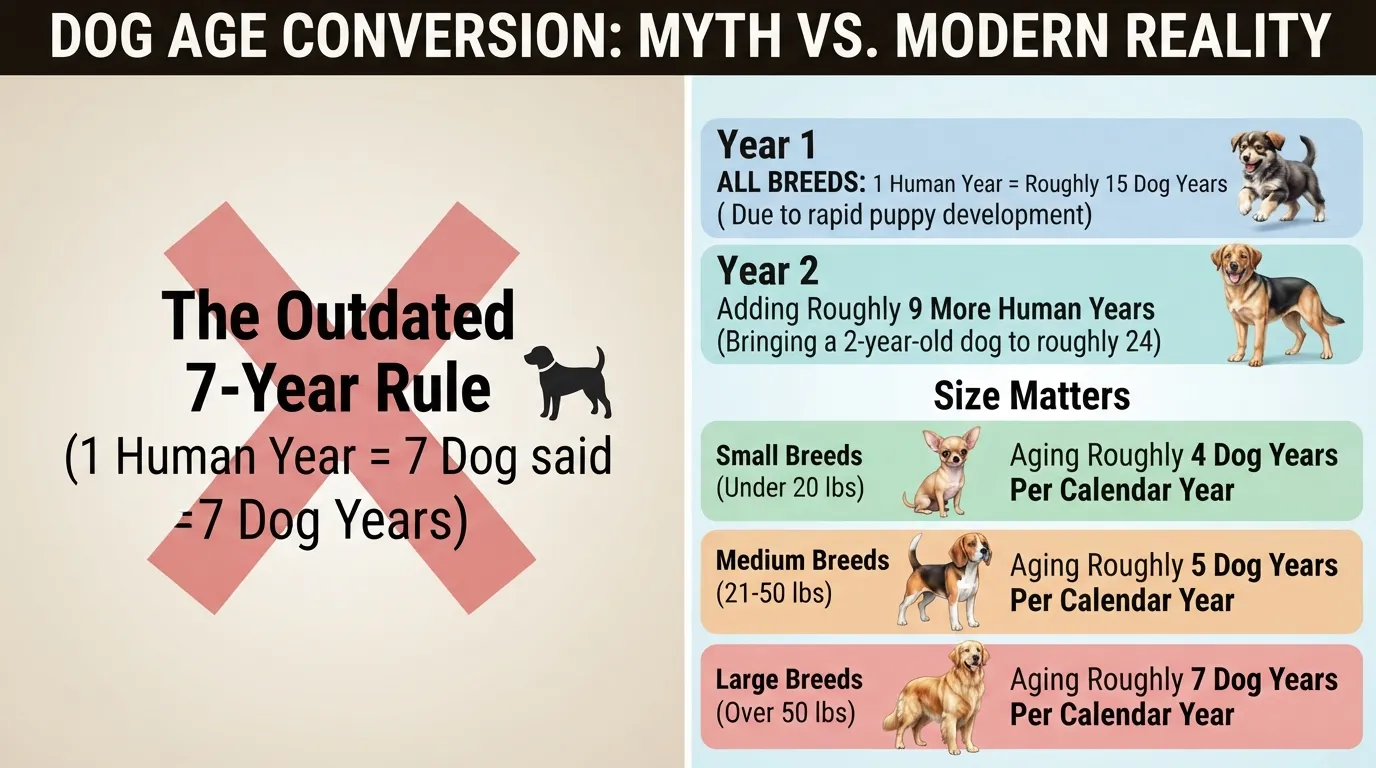
If you are wondering what is 1 human year in dog years, there is no scientifically exact one-to-one conversion. The familiar “1 human year equals 7 dog years” rule is only a rough historical shortcut and does not accurately describe how dogs age.
Dogs mature much faster than humans during their first year of life. A puppy can go through major physical and behavioral changes in just a few months, including rapid growth, teething, socialization, and increasing independence. Because of this, 1 human year cannot simply be converted into a fixed number of dog years.
How Does 1 Human Year Compare With Dog Age?
The difference becomes clearer when comparing developmental stages. A 1-year-old human is still a baby, while a dog can reach adolescence or even young adulthood within its first calendar year. This is why dog-age conversion works differently from a simple 7-to-1 calculation.
| Human Age | Dog Developmental Stage | What It Means |
|---|---|---|
| 1 human year | Very early puppy development | Rapid physical, social, and behavioral growth |
| 7 human years | Young puppy stage | Continued development and learning |
| 15 human years | About 1 dog year | Major transition toward canine adolescence and adulthood |
So, 1 human year does not equal a fixed number of dog years. The relationship between human and canine age changes throughout life, with the biggest differences occurring during puppyhood. Breed, adult size, genetics, and overall health can also influence how a dog ages.
If you are trying to convert your dog’s actual age into human years, use our free dog age calculator for a size- and age-based estimate.
The "7 Dog Years = 1 Human Year" Myth — Is It True?
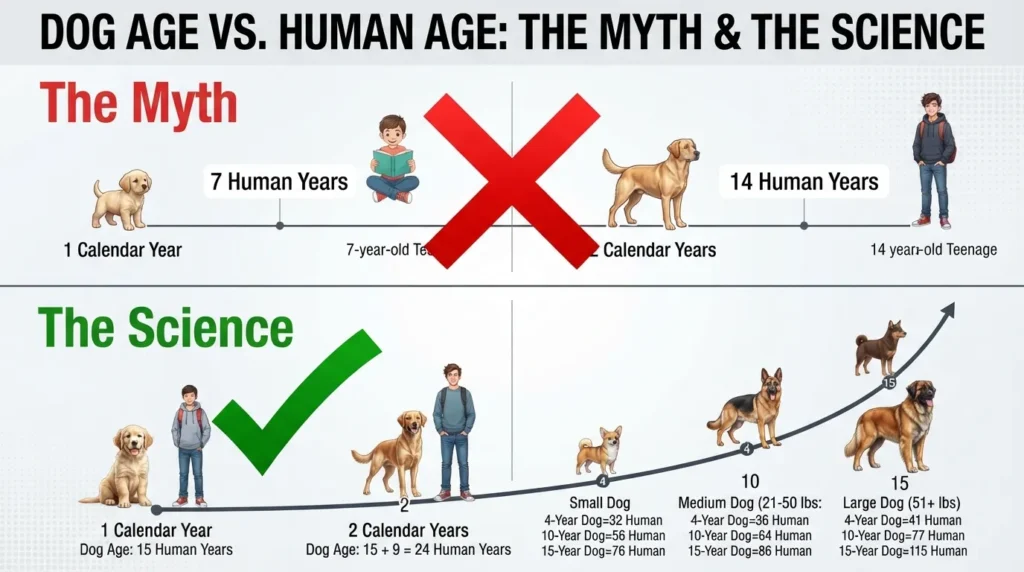
Almost everyone grew up believing that a single year for us equals seven years for our pups. It’s a neat, tidy math trick, but it is completely wrong. While it’s a helpful baseline for a quick guess, relying on it means you are likely miscalculating your dog’s true biological age.
Where the 7-year rule came from
We can trace this myth back to the mid-20th century. Around the 1950s, veterinarians and pet food companies noticed that the average human lived to about 70, while the average dog lived to about 10.
Someone did the quick division, realized 70 divided by 10 equals 7, and a marketing classic was born. It was a clever way to encourage owners to bring their pets in for annual checkups, but it completely ignored how dogs actually grow and age.
Why it’s scientifically inaccurate (non-linear aging)
Dogs do not age at a steady, predictable pace. In reality, their development is front-loaded. A puppy matures incredibly fast during its first year of life, hitting milestones that would take a human child more than a decade to reach.
A prominent 2020 study by researchers at the University of California San Diego looked at changes in canine DNA to track biological aging. They discovered that a 1-year-old dog actually has a biological age closer to a 30-year-old human.
After that massive initial spike, a dog’s aging process slows down significantly. If you stick to the old rule, you’ll overestimate a young adult dog’s age and vastly underestimate the senior status of an older, large-breed dog. Aging is non-linear, which is why a simple multiplier just doesn’t work.
The Real Formula: How Scientists Actually Calculate It
The Epigenetic (Methylation) Formula
Forget everything you’ve heard about multiplying your dog’s age by seven. For decades, that was the standard rule of thumb, but it doesn’t align with actual canine biology. Dogs don’t age at a constant, steady rate compared to us; instead, they mature incredibly fast in their early life and then slow down significantly as they grow older.
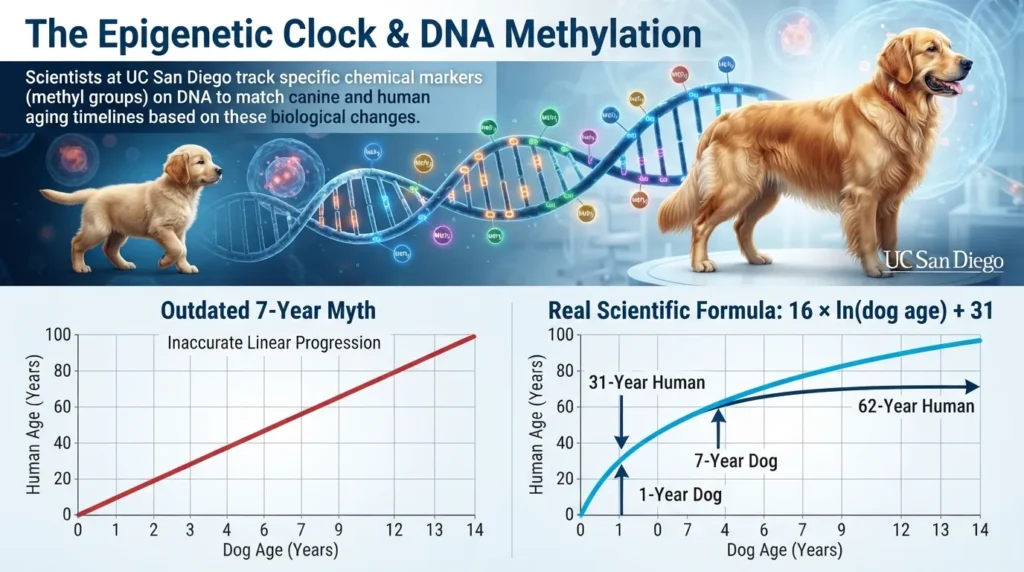
To find out exactly how this works, a team of researchers conducted a groundbreaking 2020 UC San Diego study published in Cell Systems. By tracking chemical modifications in the genome called DNA methylation—essentially “wrinkles” in the DNA that change predictably over time—scientists built a highly accurate “epigenetic clock.”
The researchers analyzed blood samples from 104 Labrador Retrievers ranging from puppies to senior dogs and compared them to 320 humans. What they discovered fundamentally changed how we answer the classic question: what is 1 human year in dog years? The data revealed that canine aging follows a logarithmic curve rather than a straight line, which led to the creation of a brand-new mathematical formula.
The official scientific equation is:
Human Age = 16 × ln(Dog Age) + 31
Note: The “$\ln$” in this formula represents the natural logarithm, a mathematical function that accounts for the rapid initial spike and subsequent plateauing of a dog’s biological aging process.
Simple Example Calculation
While that formula might look intimidating if you haven’t sat in a math class recently, it’s actually simple to break down using a standard scientific calculator. Let’s look at a few real-world examples to see how this plays out for your pup.
If you are wondering what is 1 human year in dog years according to actual science, you just plug the number 1 into the formula. Because the natural log of 1 is exactly 0, the math looks like this:
$$16 \times 0 + 31 = 31$$
This means a 1-year-old dog is biologically equivalent to a 31-year-old human. This makes perfect sense when you consider that a one-year-old dog is already fully grown and physically capable of having puppies, which is certainly not true for a 7-year-old human child!
By the time your dog hits their next birthday, the aging process already begins to decelerate. For a 2-year-old dog, the natural log of 2 is roughly 0.693. Multiplying that by 16 and adding 31 brings the total to 42 human years. While they aged 31 human years in their very first year of life, they only aged 11 human years during their second.
1 Human Year in Dog Years — Stage by Stage
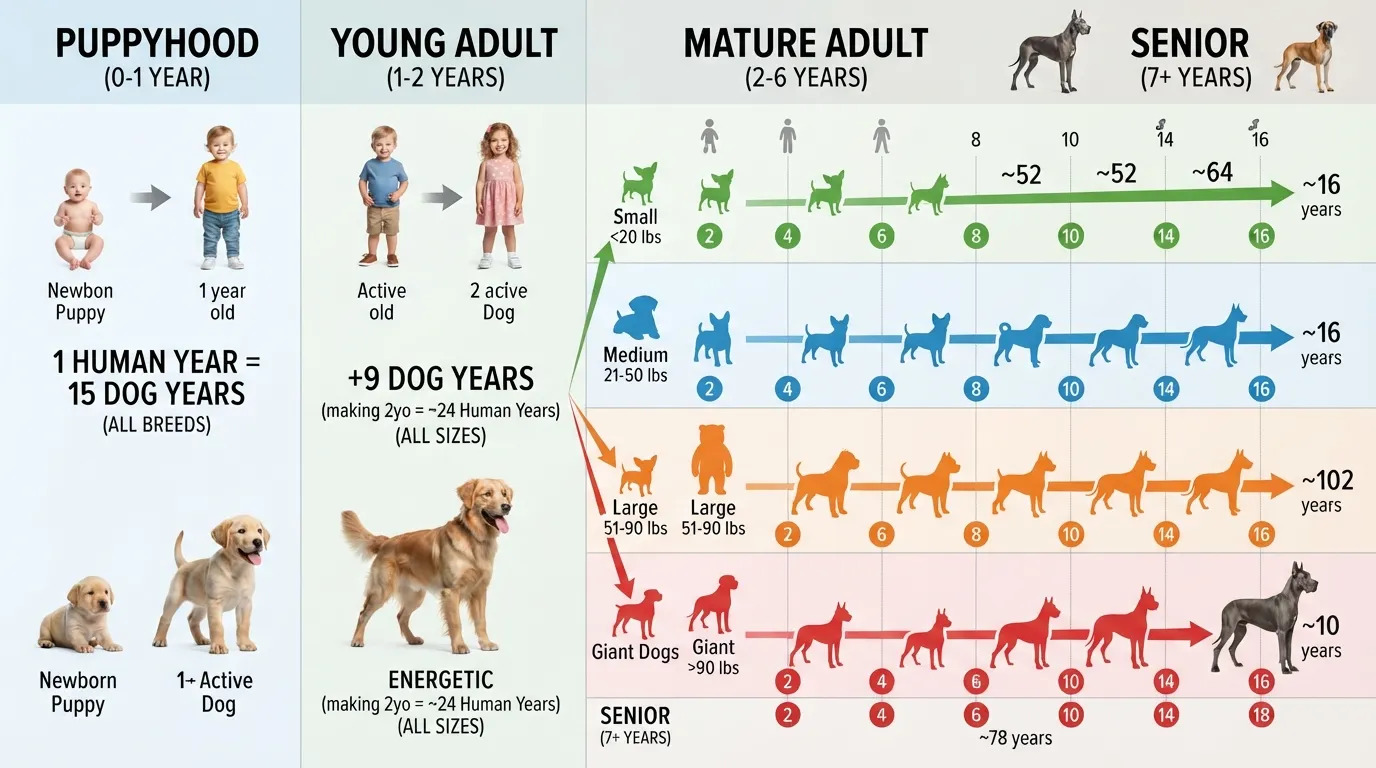
If you’ve ever wondered exactly what is 1 human year in dog years, the old “multiply by 7” rule doesn’t give you the whole picture. Dogs age at wildly different rates depending on their stage of life, meaning a single calendar year can mean something completely different for a puppy versus a senior.
During puppy stage
A dog’s first year is a massive developmental sprint. During this puppy stage, 1 human year equals roughly 15 dog years. Your tiny pup grows into a fully capable adolescent in just 12 months, hitting physical and social milestones that take humans over a decade to reach.
During adult stage
Once your dog clears their second year, the biological brakes kick in. During the adult stage, 1 human year equals about 4 to 5 dog years. This is the maintenance phase where their physical maturity stabilizes, and they enjoy their peak energy and strength.
During senior stage
As your companion crosses into their golden years, the conversion shifts again, largely based on their weight and breed. During the senior stage, 1 human year equals about 6 to 8 dog years for large and giant breeds, while smaller dogs might continue to age at a gentler rate of just 4 dog years per calendar year.
Human Year Passed vs Dog Year Equivalent:
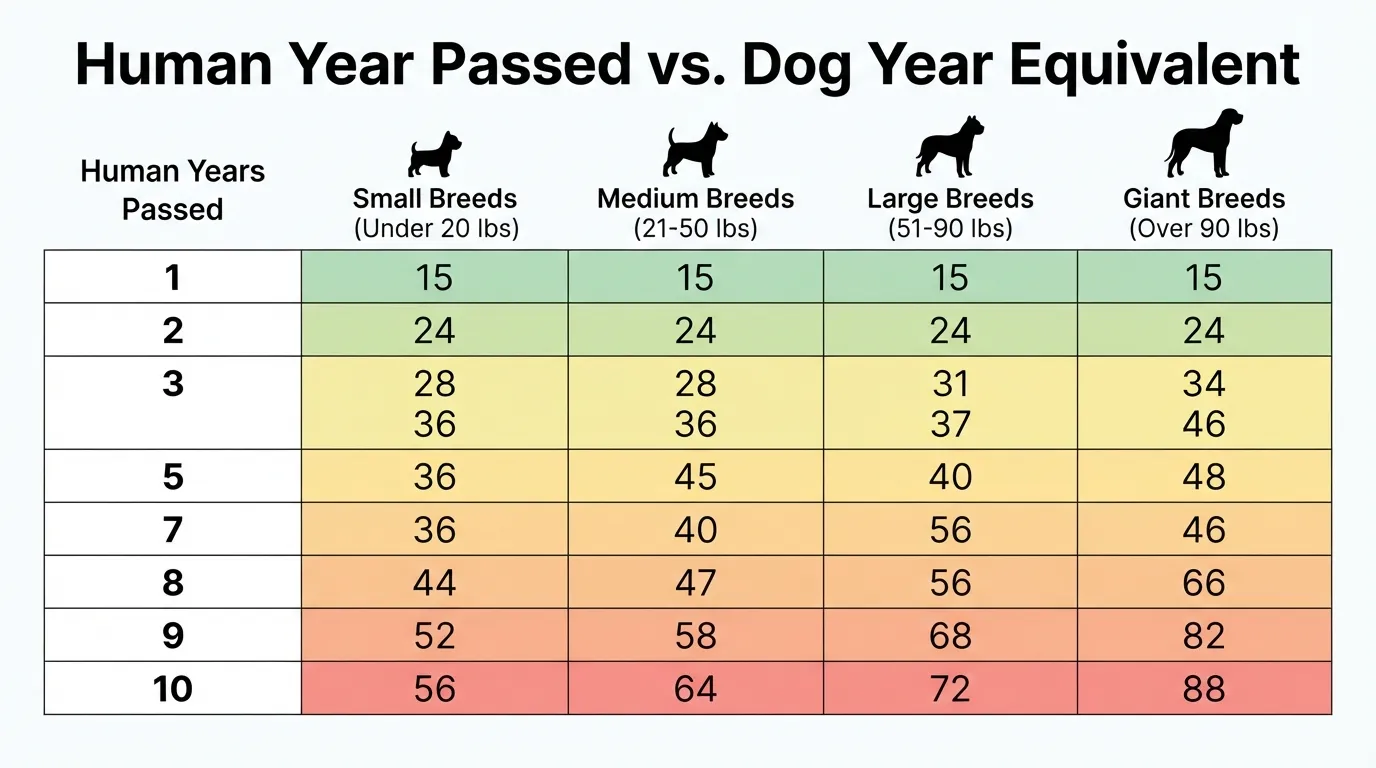
| Human Years Passed | Dog's Life Stage | Equivalent Dog Years Added | Total Cumulative Age |
|---|---|---|---|
| Year 1 | Puppy / Adolescent | 15 years | 15 years old |
| Year 2 | Young Adult | 9 years | 24 years old |
| Years 3 – 6 | Prime Adult | 4 – 5 years annually | 28 – 44 years old |
| Years 7+ | Senior / Golden Years | 4 years (Small) / 6 – 8 years (Large) annually | 48+ years old |
Human Year: Year 1
Dog's Life Stage:
Puppy / Adolescent
Years Added:
15 years
Total Age:
15 years old
Human Year: Year 2
Dog's Life Stage:
Young Adult
Years Added:
9 years
Total Age:
24 years old
Human Years: Years 3 – 6
Dog's Life Stage:
Prime Adult
Years Added:
4 – 5 years annually
Total Age:
28 – 44 years old
Human Years: Years 7+
Dog's Life Stage:
Senior / Golden Years
Years Added:
4 yrs (Small) / 6–8 yrs (Large)
Total Age:
48+ years old
Why the number shifts (fast early aging, slower later): Dogs compress their entire childhood, puberty, and teenage rebellion into their first 24 months. A landmark 2020 study by researchers at the University of California San Diego analyzed canine DNA and confirmed that young dogs map onto human age markers at an incredibly accelerated rate, which tapers off drastically as their cellular aging slows down later in life.
Quick simple-math version for casual readers (no formula needed): If you just want a quick, no-fuss estimate without looking at a complex chart, use this mental shortcut: count your dog’s first birthday as 15, their second birthday as 9 (putting them at 24), and then simply add 4 years for every birthday after that.
Does Dog Size or Breed Change the Answer?
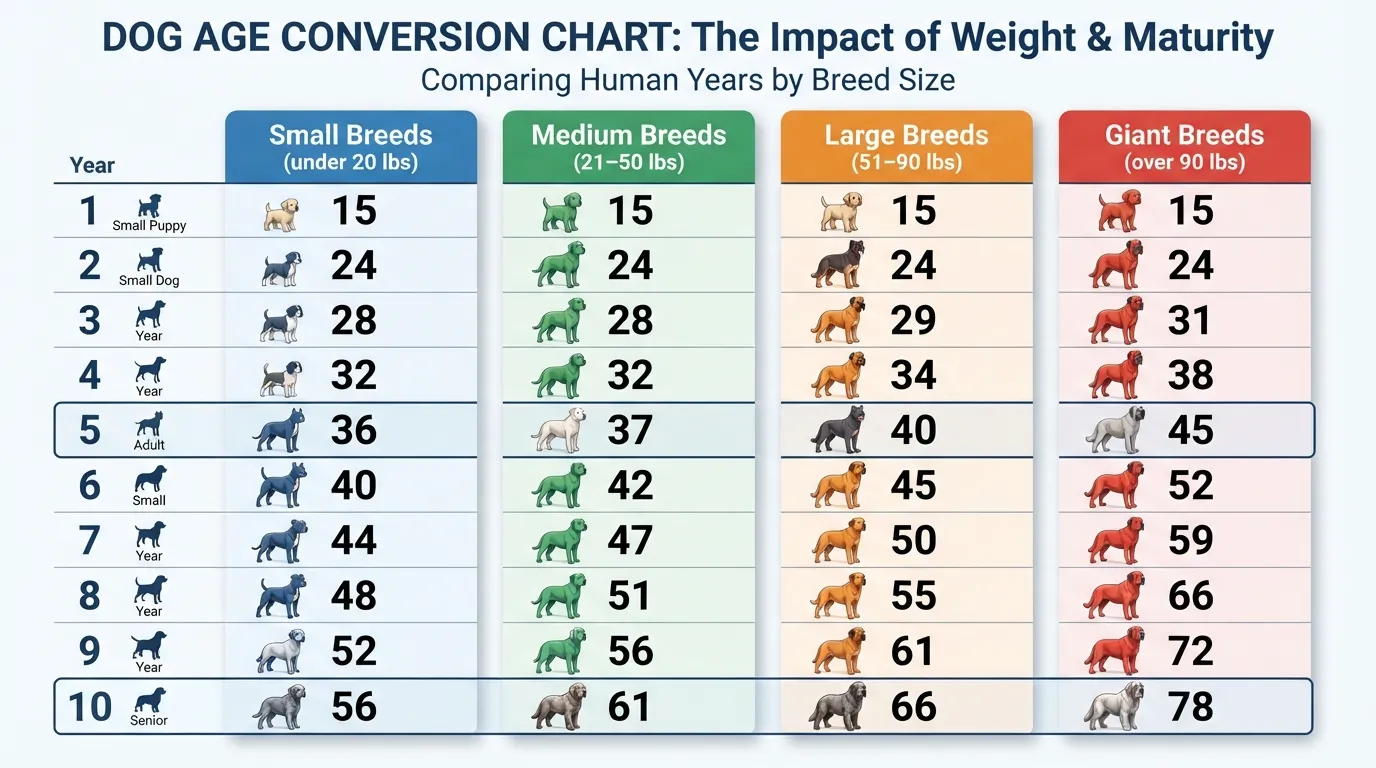
The short answer is yes—massively. While we often look for a universal formula to answer what is 1 human year in dog years, the reality is that a dog’s adult weight dictates how they age.
Small dogs tend to live much longer and age slower after their first two years, while giant breeds experience accelerated biological aging. Because of this, a five-year-old Chihuahua is vastly different in “human years” than a five-year-old Great Dane.
Small breeds
Dogs weighing under 20 pounds—like Chihuahuas, Pomeranians, and Yorkies—have the longest lifespans. During their first year, they mature quickly to reach adulthood, but then their biological clock slows down significantly.
Once they hit maturity, small dogs age roughly 4 dog years for every 1 human year. This slow pace is why it is not uncommon to see small breeds living vibrant lives well into their mid-teens.
Medium breeds
This category covers dogs weighing 21 to 50 pounds, including popular family pets like Border Collies, French Bulldogs, and Cocker Spaniels. They represent the literal middle ground of the canine aging spectrum.
Medium dogs follow a steady, predictable aging curve. For most of their adult lives, you can estimate that 1 human year equals about 5 to 6 dog years.
Large breeds
Large dogs, weighing between 51 to 90 pounds, include breeds like Golden Retrievers, Labradors, and German Shepherds. These dogs carry more physical mass, which unfortunately puts more strain on their bodies over time.
For these dogs, senior status hits much earlier than it does for smaller pups. After their initial growth spurt, large breeds age at a rate of roughly 6 to 7 dog years per calendar year.
Giant breeds
Dogs weighing over 90 pounds—such as Great Danes, Mastiffs, and Newfoundlands—have the shortest lifespans in the canine world. Their bodies grow at an astonishing rate during their first two years, and the intense cellular growth takes a toll.
Giant breeds age at a rapid pace of 7 to 8 dog years for every 1 human year. Because they age so quickly, a giant breed dog is often considered a senior by the time they turn five or six.
To help you visualize exactly how these differences stack up as your pet grows, the American Animal Hospital Association provides a definitive breakdown. You can review the AAHA canine life stage guidelines chart to see how your dog’s specific age converts based on their size category:
Dog Age to Human Years Converter
| Dog Age (Chronological) | Small Breeds (<20 lbs) | Medium Breeds (21-50 lbs) | Large Breeds (51-90 lbs) | Giant Breeds (>90 lbs) |
|---|---|---|---|---|
| 1 Year | 15 Human Years | 15 Human Years | 15 Human Years | 12 Human Years |
| 2 Years | 24 Human Years | 24 Human Years | 24 Human Years | 22 Human Years |
| 3 Years | 28 Human Years | 28 Human Years | 28 Human Years | 31 Human Years |
| 5 Years | 36 Human Years | 37 Human Years | 40 Human Years | 49 Human Years |
| 7 Years | 44 Human Years | 47 Human Years | 52 Human Years | 67 Human Years |
| 10 Years | 56 Human Years | 60 Human Years | 71 Human Years | 96 Human Years |
1 Year (Dog Age)
Small (<20 lbs): 15 Human Years
Medium (21-50 lbs): 15 Human Years
Large (51-90 lbs): 15 Human Years
Giant (>90 lbs): 12 Human Years
2 Years (Dog Age)
Small (<20 lbs): 24 Human Years
Medium (21-50 lbs): 24 Human Years
Large (51-90 lbs): 24 Human Years
Giant (>90 lbs): 22 Human Years
3 Years (Dog Age)
Small (<20 lbs): 28 Human Years
Medium (21-50 lbs): 28 Human Years
Large (51-90 lbs): 28 Human Years
Giant (>90 lbs): 31 Human Years
5 Years (Dog Age)
Small (<20 lbs): 36 Human Years
Medium (21-50 lbs): 37 Human Years
Large (51-90 lbs): 40 Human Years
Giant (>90 lbs): 49 Human Years
7 Years (Dog Age)
Small (<20 lbs): 44 Human Years
Medium (21-50 lbs): 47 Human Years
Large (51-90 lbs): 52 Human Years
Giant (>90 lbs): 67 Human Years
10 Years (Dog Age)
Small (<20 lbs): 56 Human Years
Medium (21-50 lbs): 60 Human Years
Large (51-90 lbs): 71 Human Years
Giant (>90 lbs): 96 Human Years
Why This Number Actually Matters for Your Dog's Health
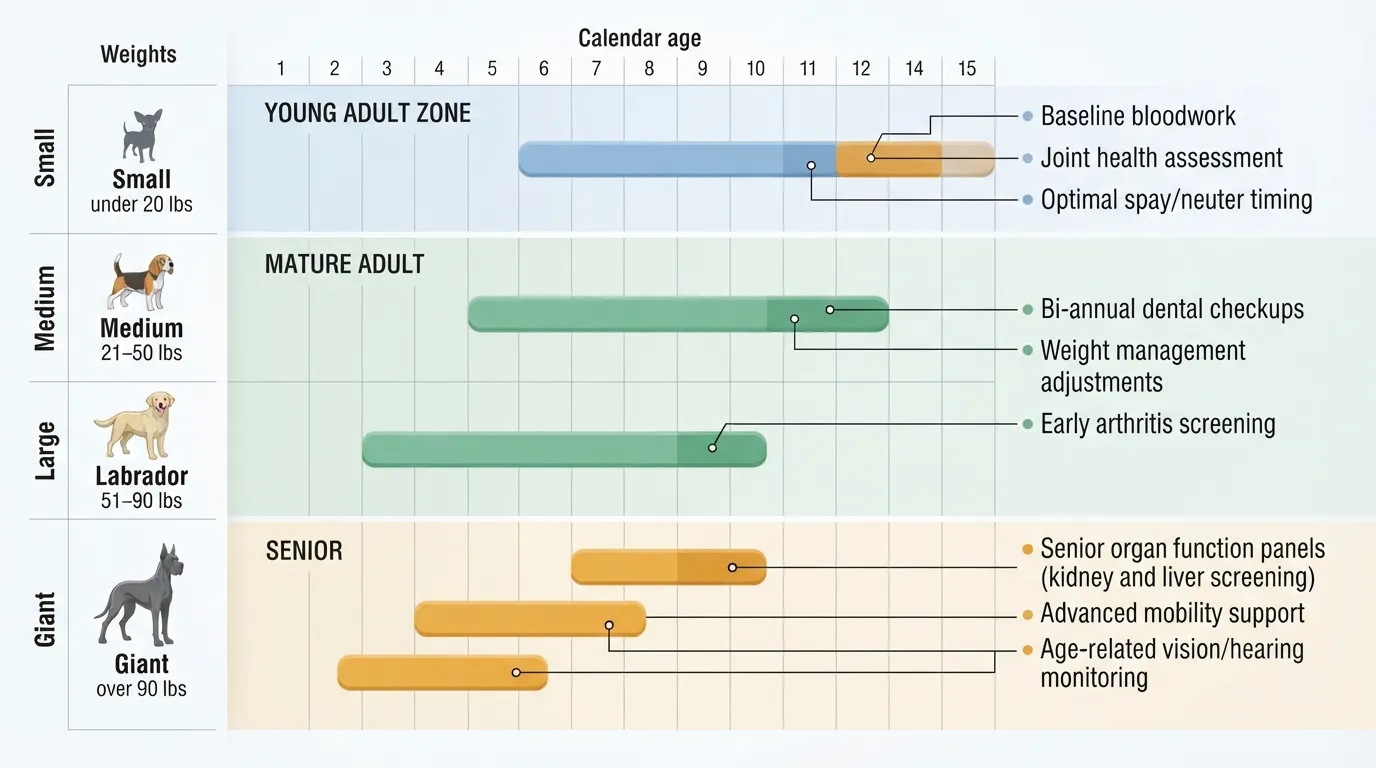
Understanding what is 1 human year in dog years isn’t just a fun trivia game to play at the dog park. Misjudging your dog’s true biological age can lead to missed medical milestones, because dogs mask pain and discomfort remarkably well. Knowing exactly where your pup stands on the aging spectrum allows you to advocate for their health before subtle changes turn into serious medical issues.
As your dog moves through their life stages, their medical, nutritional, and daily care requirements shift dramatically. Keeping tabs on their real age helps you stay ahead of their needs in three critical areas:
Tailored Vet Checkup Frequency: While young adults are usually fine with annual exams, senior dogs age rapidly. A single calendar year can represent four to eight years of aging for an older pup. Because of this, veterinarians typically recommend switching to bi-annual checkups once your dog hits their senior years to catch hidden conditions early.
Shifting Diet and Nutritional Needs: A puppy needs calorie-dense fuel to grow, but an aging dog requires a completely different balance. Senior dogs often need fewer calories to prevent obesity, alongside higher-quality protein to maintain muscle mass and targeted supplements like glucosamine and chondroitin for joint health.
Spotting Early Senior-Health Warning Signs: When you realize how quickly a dog ages, you stop dismissing small changes as just “slowing down.” Keeping their biological age in mind prompts you to watch for subtle red flags like unexplained weight changes, increased thirst, persistent lethargy, or stiffness when getting up in the morning.
Calculate Your Dog's Exact Age Instantly
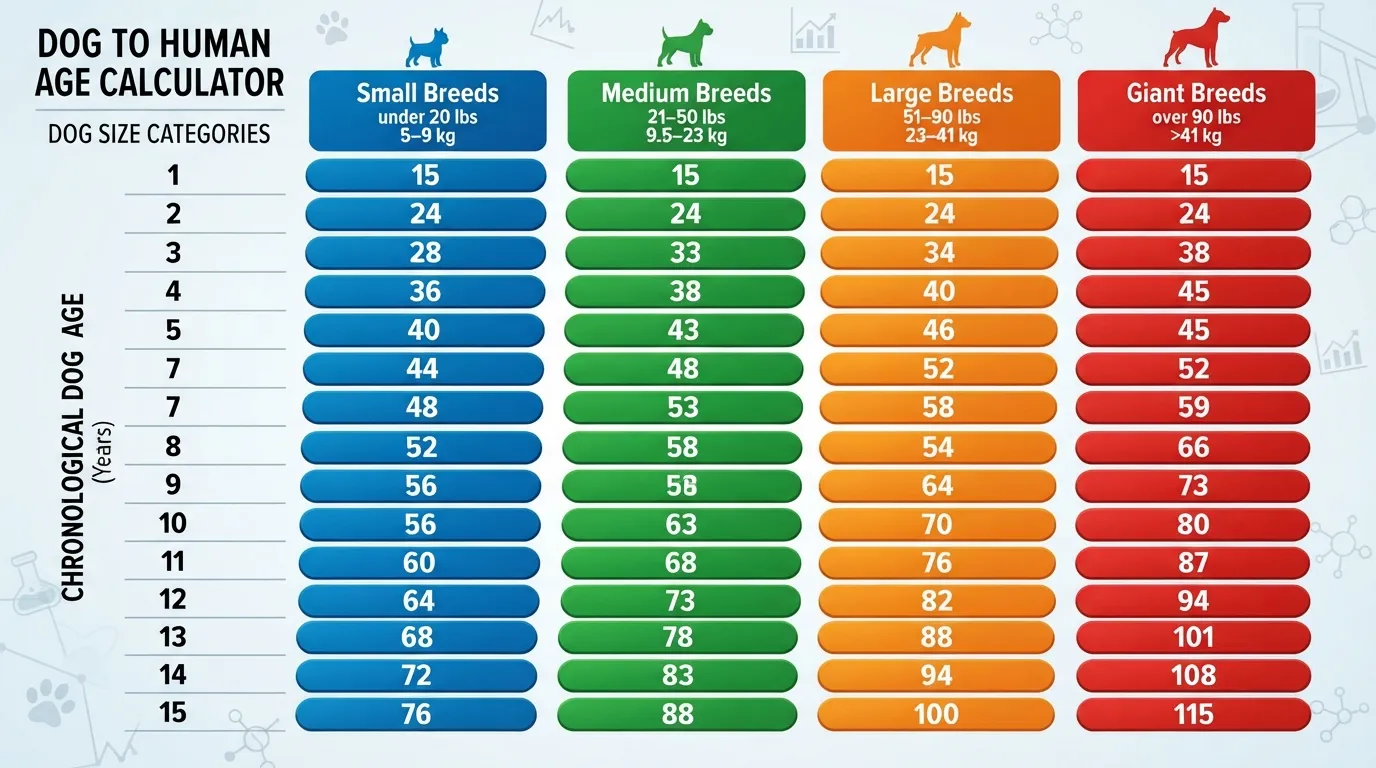
Ready to skip the messy math and find out your dog’s true age? Since the classic “7-year rule” is a myth, calculating the real numbers manually gets complicated fast. Our smart calculator does the heavy lifting for you based on the latest veterinary aging science.
🐾 Dog Age Calculator Tool
How to use it:
Select your dog’s breed size (Small, Medium, Large, or Giant).
Enter their current age in years or months.
Click calculate to get your dog’s precise human age equivalent instantly.
Knowing what is 1 human year in dog years depends heavily on how big your dog gets. By factoring in your pup’s specific weight class, our tool gives you an accurate biological snapshot rather than a wild guess. Try it above to see where your furry friend actually stands on the aging timeline.
Frequently Asked Questions
There isn't a single, flat number that applies to every dog, but the closest general rule of thumb is that the first year of a dog's life equals about 15 human years.
Dogs mature incredibly fast during their first 12 months. While we used to believe that every single year of a dog's life was worth 7 human years, veterinary science has proven that a one-year-old puppy is physically and behaviorally much closer to a human teenager than a 7-year-old child.
After that initial growth spurt in year one, the rate at which dog years pass slows down and depends heavily on your dog's size. During their second year, dogs age about 9 human years.
Once your dog reaches adulthood (around age two), the clock settles into a steadier rhythm. From that point on, a dog ages roughly 4 to 7 dog years for every 1 human year that passes on the calendar. Small breeds age on the lower end of that scale, while giant breeds age much faster.
No, the formula changes dramatically based on your dog's adult weight. The American Veterinary Medical Association (AVMA) breaks this down into four distinct categories: small, medium, large, and giant breeds.
While all dogs age at a similar pace for the first two years of life, their paths split as they mature. A 10-year-old Chihuahua is roughly 56 in human years, whereas a 10-year-old Great Dane is already a whopping 78 in human years. Larger bodies simply undergo more metabolic stress, causing them to age at an accelerated rate compared to smaller pups.
A dog officially reaches "senior citizen" status when they hit the last 25% of their expected lifespan for their specific breed. Because lifespans vary so much by size, this milestone happens at different calendar ages.
Small breeds (under 20 lbs) generally become seniors around age 11 or 12.
Medium breeds (21-50 lbs) typically reach senior status around age 10.
Large breeds (51-90 lbs) enter their senior years around age 8.
Giant breeds (over 90 lbs) are considered seniors by age 5 or 6.
Yes, on average, dogs age faster and have shorter lifespans than cats. While a 10-year-old dog is usually equivalent to a human in their late 50s to late 70s, a 10-year-old cat is only about 56 in human years.
Cats also tend to age more uniformly regardless of their breed, whereas a dog’s aging process is wildly unpredictable due to the massive size differences between breeds. A typical indoor cat frequently lives to 15 or 20 years old, a milestone that only the smallest, healthiest dog breeds usually achieve.
🐾 Other Age Guides

Gulfam Haider Mehdi
Founder & Developer
I built Dogagescalculator.com to give dog owners honest, science-backed answers instead of the outdated "×7" myth. Every figure here is checked against AKC, AVMA, and published veterinary research.
More about the author & this site →📌 Featured Guides
How much food should I feed my Chihuahua
→
golden retriever dog years
→
What Is 14 Dog Years in Human Years
→
What Is 3 Dog Years in Human Years
→
50 in dog years
→
30 human years in dog years
→
Life Expectancy Of a West Highland White Terrier
→
What Is the Lifespan of a Miniature Poodle?
→
how much for a west highland white terrier
→
Blog
→
Comments