
Dog Years to Human Years: The Real Formula
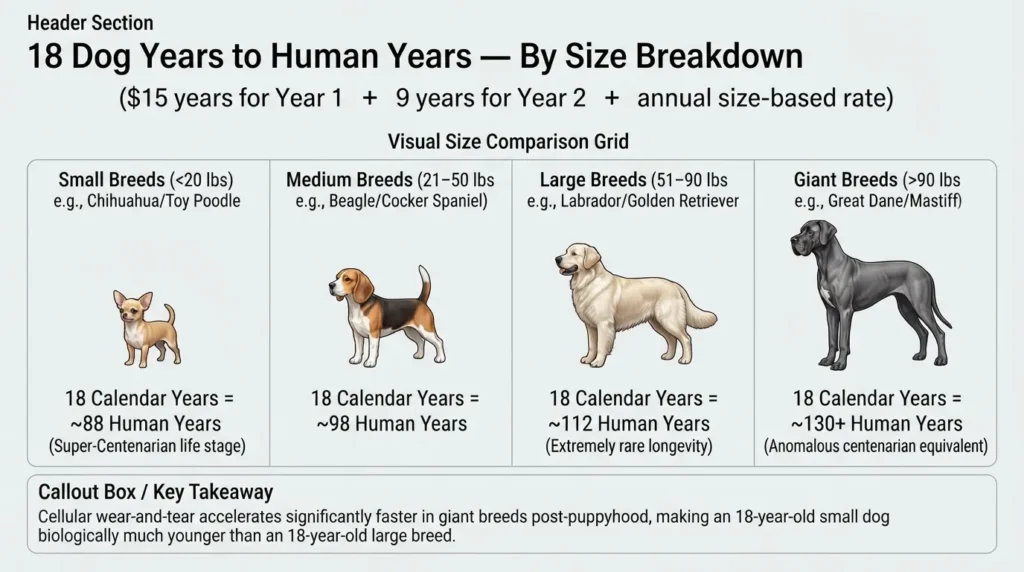
A 1-year-old dog isn’t equivalent to a 7-year-old child; physically and hormonally, a 1-year-old pup has already reached full biological adulthood—closer to a 15-year-old human. The old “multiply by 7” rule was a simple math trick created decades ago, but veterinary science and DNA methylation studies have since proven that dogs age at an exponential rate in their early years, which then slows down as they mature.
To find your dog’s true human age, veterinarians use a variable stage model based on weight, breed size, and biological development:
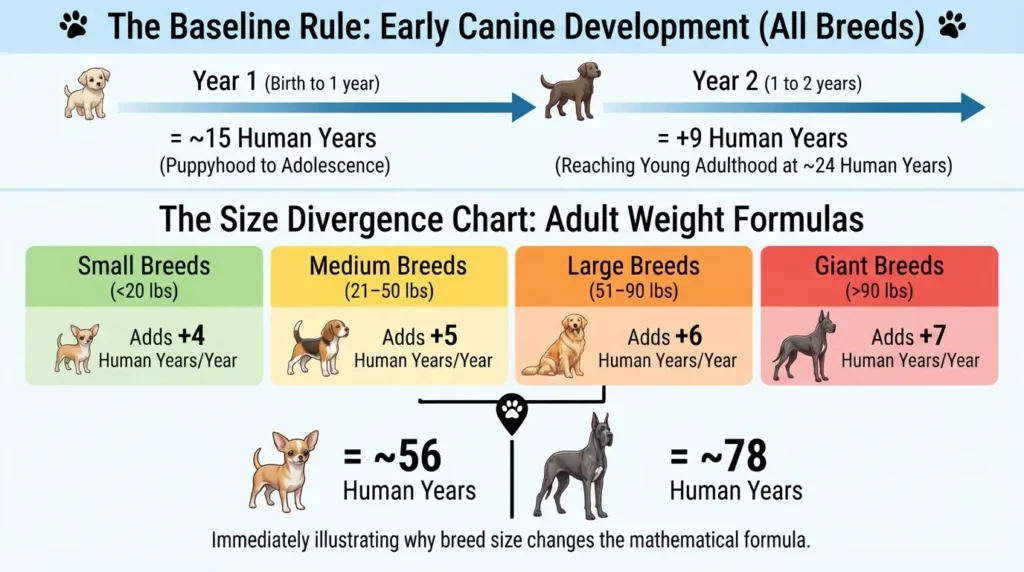
Year 1: Equals approximately 15 human years (rapid physical and skeletal growth).
Year 2: Adds roughly 9 human years (reaching young adulthood around 24 human years).
Year 3+: Adds 4 to 7 human years annually, heavily depending on breed size (small breeds age slower, giant breeds age faster).
The Modern Veterinary Formula: How Dog Aging Actually Works
Recent research from UC San Diego analyzed canine DNA modifications (epigenetic clocks) and established that dogs follow a logarithmic aging curve. Instead of a linear progression, dogs age rapidly in their first two years before settling into a steady pace.
How to Calculate Dog Years to Human Years
To accurately determine your dog’s age in human years, you have to look beyond a single, simplistic equation. Over the past few decades, our understanding of canine biology has evolved from popular playground myths to precise genetic models.
Depending on whether you need a quick rule of thumb for daily care or an exact biological measurement, here are the three main ways people calculate dog age today.
The Old Myth — “1 Dog Year = 7 Human Years”
For nearly a century, the standard rule was simple: multiply your dog’s calendar age by 7.
Where did this rule actually come from? In the 1950s, veterinarians noticed that the average human lifespan was around 70 years, while the average canine lifespan was roughly 10 years. Marketing campaigns and popular media popularized the 7:1 ratio because it was easy to memorize, but biologically, it falls apart almost immediately.
The Flaw in the Math: Under the 7-year rule, a 1-year-old dog would equal a 7-year-old child. In reality, a 1-year-old dog can already reproduce, has a full set of adult teeth, and possesses fully developed physical capabilities—far more comparable to a human teenager than a second-grader.
Why it Fails Seniors: It treats a 10-year-old Chihuahua (still in its late middle age) the same as a 10-year-old Mastiff (already well past its average life expectancy).
The Vet-Approved Formula (10.5:1 First 2 Years, Then 4:1)
To correct the 7-year myth without making math too complicated for pet owners, veterinary associations introduced a stepped ratio model. This approach accounts for the rapid hormonal and skeletal growth spurt dogs experience during early development.
Here is how the standard 10.5/4 formula works in practice:
The First Year: Counts as 10.5 to 15 human years (covering puppyhood through adolescence).
The Second Year: Adds another 9 to 10.5 human years (bringing a 2-year-old dog to roughly 21–24 in human equivalent age).
Every Year After (Age 3+): Adds 4 human years per calendar year for small-to-medium breeds (or 5–7 years for giant breeds).
Practical Example: If you have a 5-year-old Beagle:
Year 1 & 2 = 24 human years
Years 3, 4, & 5 (3 years $\times$ 4) = 12 human years
Total Age: $24 + 12 =$ 36 human years
This staged formula gives veterinarians a far more realistic baseline when scheduling routine preventative diagnostics, like annual blood panels or dental cleanings.
The Scientific Method — Epigenetic Clock Formula (2020 Study)
In 2020, researchers at the University of California, San Diego (UCSD) published a landmark study in the journal Cell Systems that changed how scientists view canine aging.
Led by Dr. Trey Ideker, scientists examined DNA methylation—chemical tags added to DNA molecules over time that act as a biological aging clock. By scanning the epigenomes of over 100 Labrador Retrievers alongside human subjects, they mapped matching milestones between the two species.
The researchers discovered that dogs age at a logarithmic rate: extremely fast at first, and then slowing down significantly as they mature.
| Dog's Calendar Age | Epigenetic Calculation | Real Human Equivalent | Biological Milestone |
|---|---|---|---|
| 8 Weeks | 16 × ln(0.15) + 31 | ~9 Months | Teething and weaning stage |
| 1 Year | 16 × ln(1) + 31 | 31 Years | Young adulthood (DNA methylation peak) |
| 5 Years | 16 × ln(5) + 31 | ~57 Years | Early middle age |
| 10 Years | 16 × ln(10) + 31 | ~68 Years | Senior status |
| 12 Years | 16 × ln(12) + 31 | ~70 Years | Geriatric onset |
Dog Age Chart — By Breed Size & Common Ages
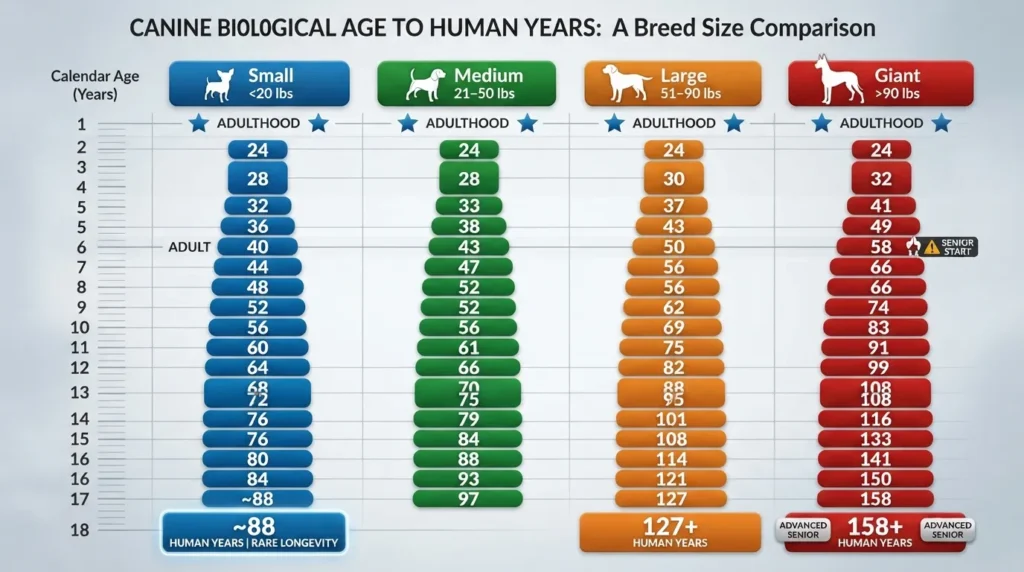
Because a 90-pound Mastiff ages at a completely different physiological rate than a 10-pound Chihuahua, calendar years alone don’t tell the full story. Weight and frame size dictate how cellular wear-and-tear impacts your dog’s vital organs and joint health over time.
Use the reference tables below to match your dog’s actual weight category with their equivalent human age stage.
Small / Medium / Large / Giant Breed Table
The following veterinary reference chart maps calendar age to human age across the four primary canine size categories:
| Calendar Age | Small Breed | Medium Breed | Large Breed | Giant Breed | Life Stage |
|---|---|---|---|---|---|
| 1 Year | 15 yrs | 15 yrs | 15 yrs | 12 yrs | Young Adult |
| 2 Years | 24 yrs | 24 yrs | 24 yrs | 22 yrs | Adult |
| 3 Years | 28 yrs | 28 yrs | 28 yrs | 29 yrs | Adult |
| 4 Years | 32 yrs | 32 yrs | 32 yrs | 36 yrs | Adult |
| 5 Years | 36 yrs | 36 yrs | 36 yrs | 43 yrs | Mature Adult |
| 6 Years | 40 yrs | 42 yrs | 45 yrs | 50 yrs | Mature / Senior (Giant) |
| 7 Years | 44 yrs | 47 yrs | 50 yrs | 57 yrs | Senior Baseline |
| 8 Years | 48 yrs | 51 yrs | 55 yrs | 64 yrs | Senior |
| 9 Years | 52 yrs | 56 yrs | 61 yrs | 71 yrs | Senior |
| 10 Years | 56 yrs | 60 yrs | 66 yrs | 78 yrs | Geriatric (Large/Giant) |
| 12 Years | 64 yrs | 69 yrs | 77 yrs | 93 yrs | Geriatric |
| 15 Years | 76 yrs | 83 yrs | 93 yrs | 115 yrs | Geriatric |
When Is a Dog Considered Senior?
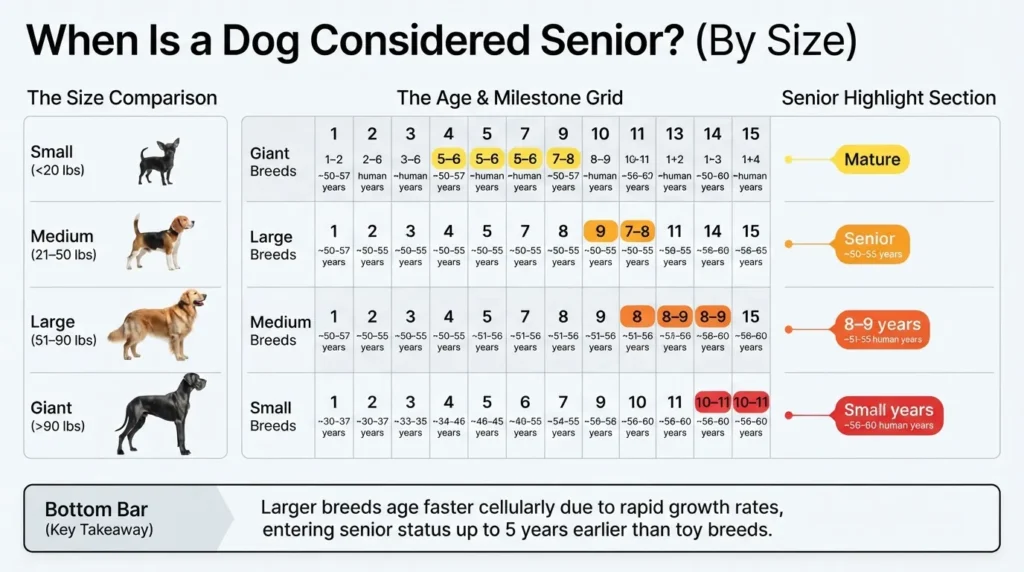
A dog reaches their “senior” status when they enter the final 25% to 30% of their estimated lifespan. Because life expectancy varies so drastically by breed size, there is no single calendar age where every dog officially becomes a senior citizen.
While a small Terrier at age 7 is still in their prime active years, a Great Dane of the exact same age is already well into their senior stage.
Puppy $\rightarrow$ Adult $\rightarrow$ Senior Timeline
Veterinarians divide a dog’s life into three primary physical developmental stages. Because smaller dogs mature and age slower cellularly, their life-stage thresholds occur much later than giant breeds:
| Breed Size | Puppy / Adolescent Phase | Prime Adult Phase | Senior Stage Onset | Geriatric Stage |
|---|---|---|---|---|
| Small (<20 lbs) | 0 – 12 months | 1 – 9 years | 10 – 11 years | 14+ years |
| Medium (21–50 lbs) | 0 – 12 months | 1 – 8 years | 8 – 9 years | 12+ years |
| Large (51–90 lbs) | 0 – 15 months | 1.5 – 6 years | 7 – 8 years | 10+ years |
| Giant (>90 lbs) | 0 – 24 months | 2 – 5 years | 5 – 6 years | 8+ years |
Watch: Dog Years Explained in Short Videos
Learn how dog age conversion actually works through these quick, expert video breakdowns:
The Early Growth Curve
Explains how a 1-year-old pup reaches the equivalent of 15 human years and slows down after age two.
Breed Size & Aging Rates
Museum of Science breaks down how small vs. giant breeds diverge significantly after calendar age 2.
Quick Conversion Chart
A fast, practical look at modern calculation standards over the outdated 7-year myth.
Conclusion & Final Thoughts
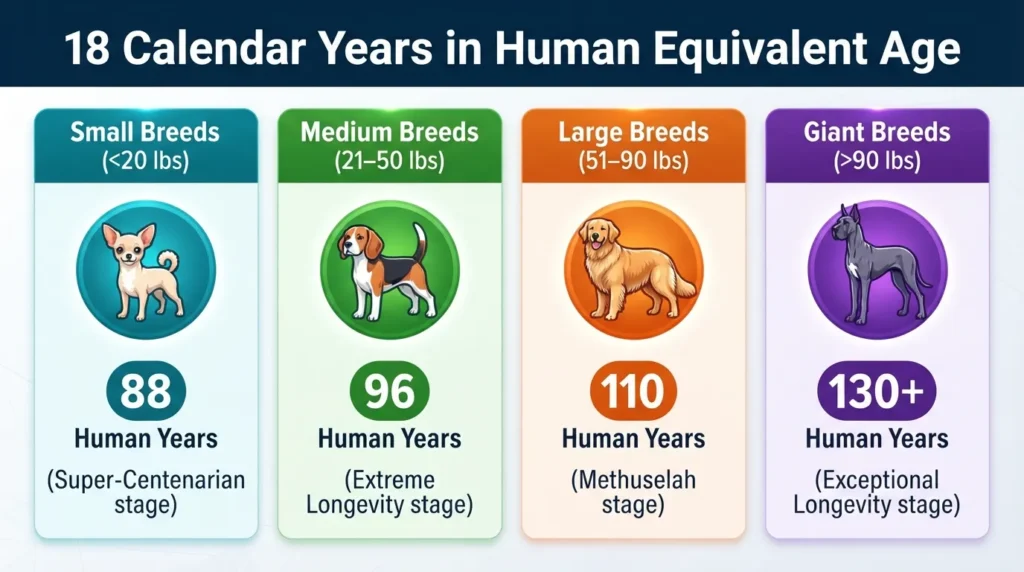
Determining your dog’s true age isn’t about applying an arbitrary math trick—it’s about understanding their unique biological development. While the old “multiply by 7” rule was convenient, modern veterinary science proves that dogs age rapidly in their first two years before settling into a steadier, breed-dependent pace:
Year 1: Equals approximately 15 human years (rapid physical growth).
Year 2: Adds roughly 9 human years (reaching young adulthood at ~24).
Year 3+: Adds 4 to 7 human years annually, depending on whether your dog is a toy, medium, large, or giant breed.
Knowing where your dog actually falls on this biological timeline allows you to provide proactive healthcare—from adjusting their nutritional profile and joint support supplements to scheduling twice-yearly senior wellness checkups at the right life stage.
People Also Ask
How is 1 year 7 years in dog years?
The “1 year equals 7 years” rule was a simple math trick created in the mid-20th century, based on the average human lifespan (around 70 years) compared to the average canine lifespan (around 10 years). While easy to remember, it is biologically inaccurate. Dogs age much faster during their first two years of life—reaching full physical maturity by age 1—and then their aging rate slows down as they mature.
Are dog years 7 or 5?
Neither number applies universally to a dog’s entire life. On average, a dog’s first year equals roughly 15 human years, their second year adds about 9 human years, and every year after that adds roughly 4 to 7 human years depending on size. Small dogs age at a rate closer to 4 human years per calendar year, while giant breeds age closer to 7 human years annually.
How old is a 20-year-old dog?
A 20-year-old dog is equivalent to 96 to 110+ human years, depending on their breed size. Reaching calendar age 20 in the canine world is exceptionally rare—the biological equivalent of a human living well past 100. It is almost exclusively achieved by small and toy breeds like Chihuahuas, Toy Poodles, or Dachshunds.
What age is 12 in dog years?
A 12-year-old dog translates to roughly 64 to 93 human years:
Small Breeds (<20 lbs): ~64 human years
Medium Breeds (21–50 lbs): ~69 human years
Large Breeds (51–90 lbs): ~77 human years
Giant Breeds (>90 lbs): ~93 human years
Is 14 very old for a dog?
Yes, 14 is considered advanced age (geriatric) for almost all dogs. For large and giant breeds, reaching 14 is exceptionally rare. For small and medium dogs, age 14 is equivalent to an 80-to-88-year-old human, requiring gentle routine adjustments, joint support, and frequent wellness checkups.
What is “I love you” in dog language?
Dogs express deep affection through specific behavioral cues rather than vocalizations:
Soft, steady eye contact: Triggers the release of oxytocin (the “bonding hormone”) in both human and dog.
Leaning against you: Showing total physical trust and seeking connection.
Tail wags with a loose body: A relaxed, full-body wag signals comfort and happiness.
Bringing you their favorite toy: A sign of trust and high social regard.
Is 13 very old for a dog?
Yes. A 13-year-old dog corresponds to roughly 68 human years for a small breed, 74 years for a medium breed, and 82 to 100+ years for large and giant breeds. At 13, most dogs are well into their senior or geriatric years and benefit greatly from orthopedic beds, easy room navigation, and regular health screenings.
Do dogs cry at the end of life?
Dogs do not shed emotional tears when nearing the end of their life (watery eyes in dogs are typically caused by blocked tear ducts, eye irritation, or allergies). However, dogs do express emotional distress and physical discomfort near the end of life through vocalizations like soft whining, sighing, changes in breathing patterns, or seeking extra closeness with their owners.
🐾 Other Age Guides

I built Dogagescalculator.com to give dog owners honest, science-backed answers instead of the outdated "×7" myth. Every figure here is checked against AKC, AVMA, and published veterinary research.
More about the author & this site →
Comments