
What Is 9 Dog Years in Human Years? Vet-Reviewed Answer + Chart
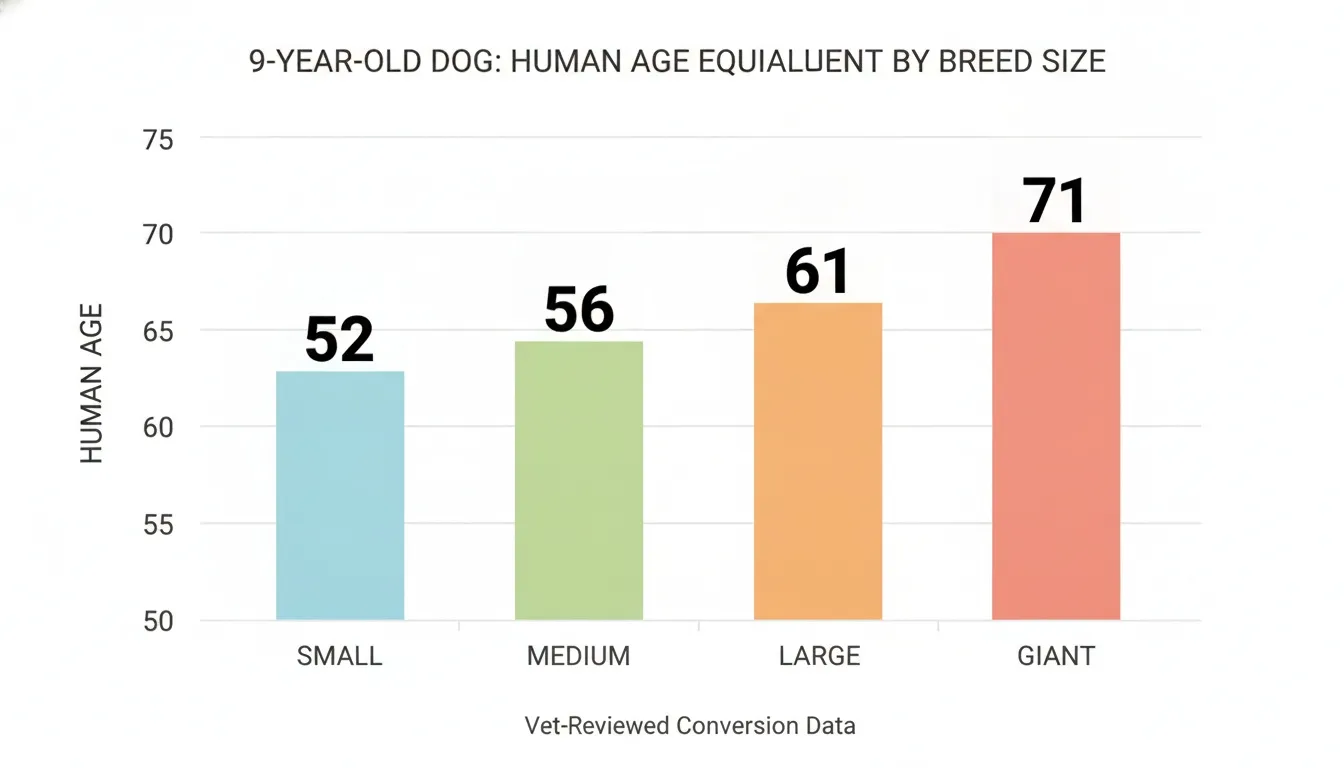
A 9-year-old dog is approximately 52 to 71 human years old, depending on their size and breed. The old “multiply by seven” rule does not accurately reflect how dogs age because dogs mature at different rates throughout their lives, and aging patterns vary by size and breed. Veterinary life-stage guidelines emphasize considering a dog’s age, size, breed, and overall health rather than relying on a single human-age conversion.
9 Dog Years to Human Years — By Size Chart
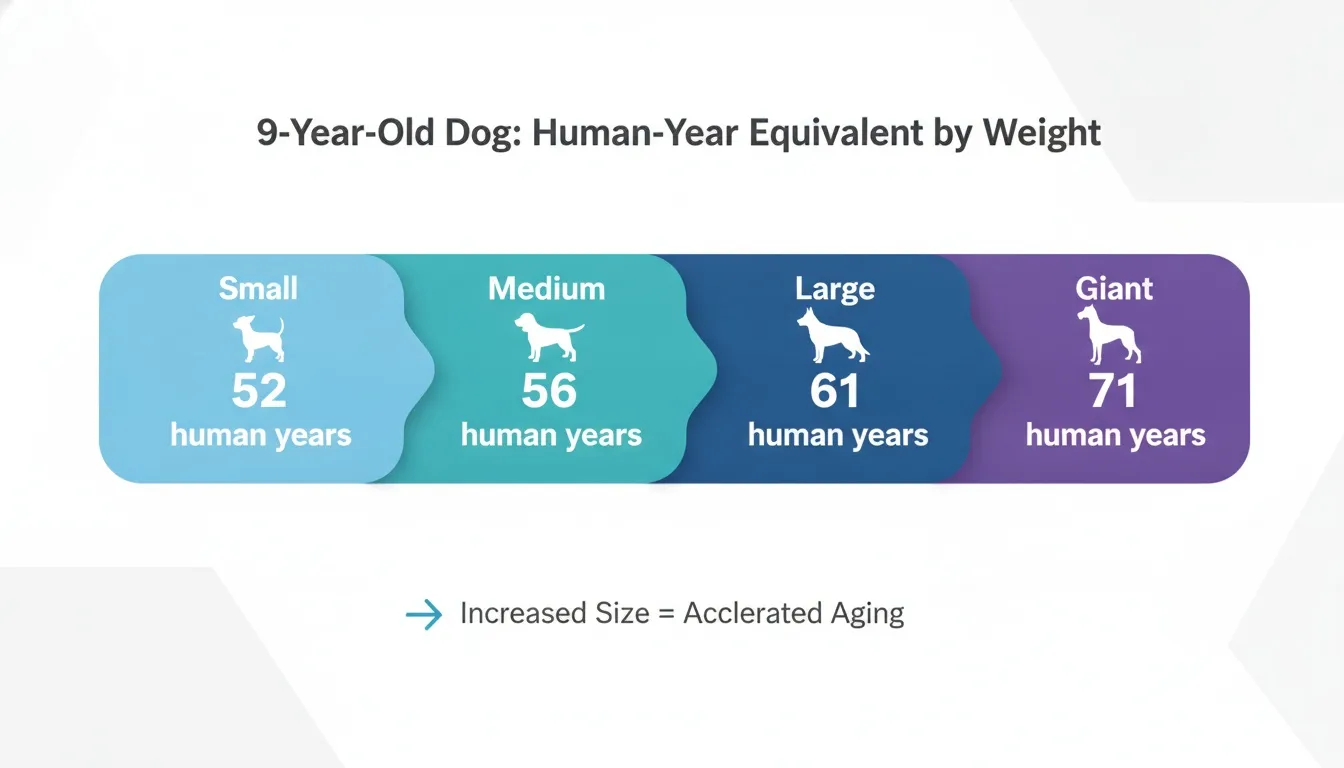
Dog Age Conversion Table 9 Years
| Size Category | Weight Range | Human Years Equivalent |
| Small | ≤20 lbs | 52 |
| Medium | 21–50 lbs | 56 |
| Large | 51–90 lbs | 61 |
| Giant | 90+ lbs | 71 |
Source: AAHA/AVMA Canine Life Stage Guidelines
Aging-pattern math: Years 1–2 add up fast (15 + 9 = 24); after that it’s roughly +4 to +7 per year depending on size.
Breed/mixed-breed note: Breed mostly matters through size — if you’re unsure of your dog’s exact breed (common with rescues), go by weight instead.
Human-relatability line: That puts a 9-year-old dog roughly in the same life stage as a 55–70-year-old person.
Try It With Your Own Dog
Get an exact, breed-specific age calculation here → calculator
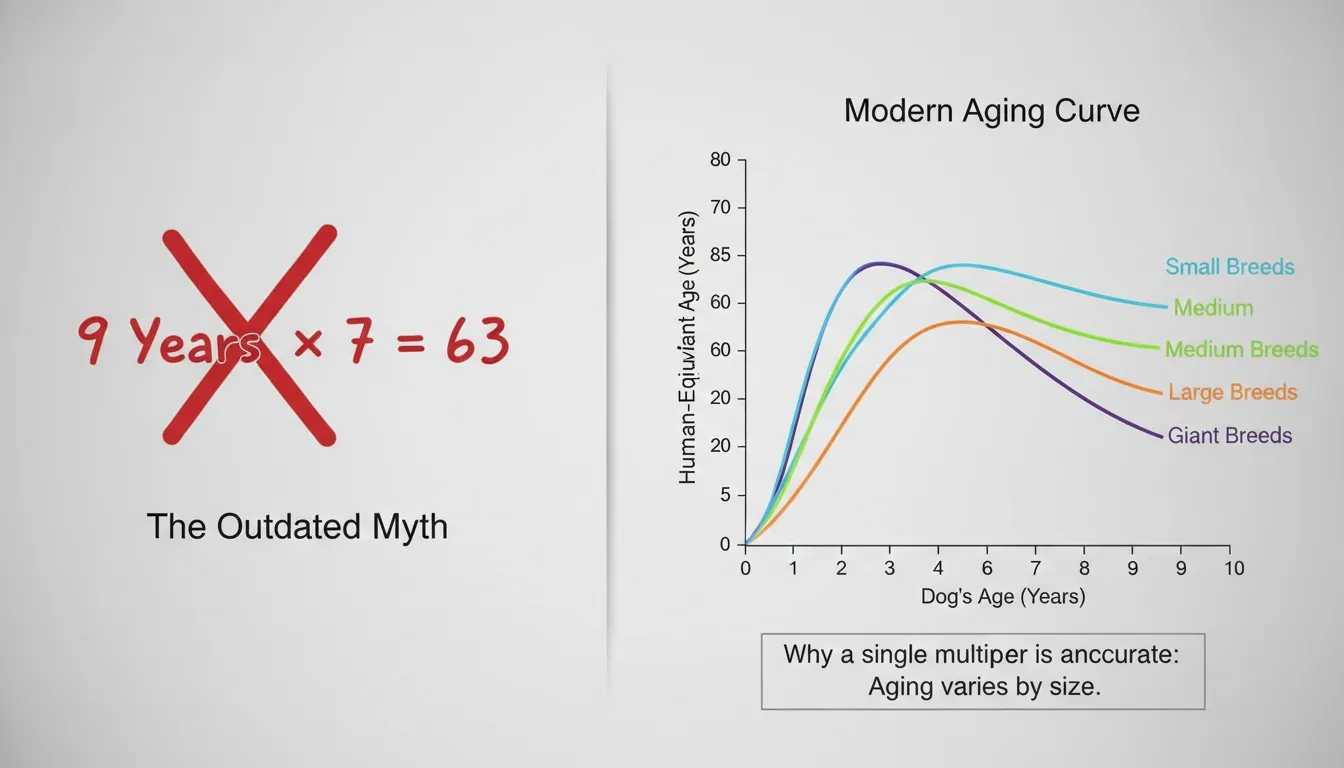
Why Isn't It Just "9 × 7 = 63"? The 7-Year Myth, Debunked
The “multiply by seven” rule likely originated from a simple, flawed calculation: dividing the average human lifespan of 70 years by the average dog lifespan of 10 years. While this formula became a fixture in pop culture decades ago, experts have known since the 1950s that it is an inaccurate oversimplification.
The reality is that dogs don’t age at a steady, linear rate. A puppy matures rapidly during their first two years, but the aging process then slows down and varies significantly depending on the dog’s breed and physical size.
How Is This Calculated? The Science Behind It
Veterinary experts use different models to understand how dogs age. While size-based charts offer a practical guide for your daily care, newer genetic research provides a different, more biological perspective.
AVMA/AAHA Size-Based Method
This approach estimates age by grouping dogs into size categories, recognizing that smaller dogs typically live longer than larger breeds. It assigns different human-age values to each year of a dog’s life based on their size, replacing the inaccurate “multiply by seven” rule with a more realistic life-stage model.
UC San Diego Epigenetic Formula 2020 Study
Researchers created this model by studying DNA changes in Labrador Retrievers using the formula: Human Age=16×ln(Dog Age)+31. Applying this formula to a 9-year-old dog results in approximately 66.2 human years. Since this study focused specifically on 104 Labradors, it may not apply perfectly to every breed, which explains why this number often differs from size-based estimates.
Both methods are scientifically valid, but the AAHA guidelines remain more practical for daily use, whereas the UCSD formula is primarily used for specialized research.
Is a 9-Year-Old Dog a Senior?
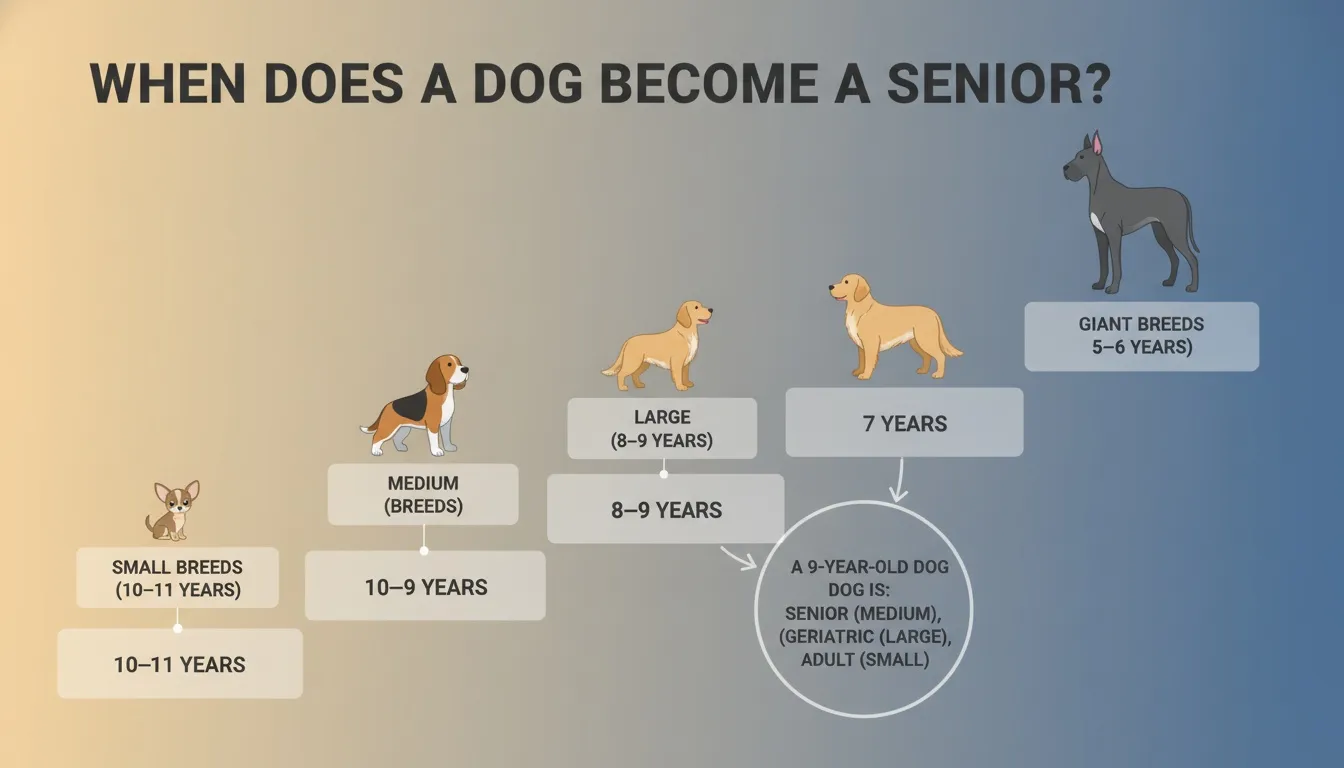
Whether a 9-year-old dog is considered a senior depends heavily on their size and breed, as larger dogs age faster than smaller ones.
Small breeds: Typically reach their senior years around 10–11; a 9-year-old is usually still considered an adult.
Medium breeds: Generally enter their senior years at 8–9; a 9-year-old is at or just past this threshold.
Large breeds: Often considered seniors around age 7; a 9-year-old is already firmly in the senior category.
Giant breeds: Reach senior status by 5–6; a 9-year-old is well into their senior and often geriatric years.
Signs of Aging Also Useful If You Don’t Know Your Dog’s Exact Age
If you adopted a rescue dog and are unsure of their exact birth date, you can monitor these physical changes to estimate their life stage:
Graying fur: Often begins around the muzzle and face.
Dental changes: Noticeable wear on the teeth and accumulation of tartar.
Reduced mobility: A shift toward slower movement or increased joint stiffness.
Eye clarity: Changes in vision or cloudiness in the eyes.
As your dog enters this stage, it’s wise to transition to senior-specific nutrition and increase the frequency of your wellness exams to monitor for common age-related health shifts.
Frequently Asked Questions
Cats and dogs age at different rates, and a 9-year-old cat is roughly equivalent to a 52-year-old human, which is slightly younger than the average for a 9-year-old dog. .
The size-based charts are designed to provide estimates for whole years to keep things simple. If your dog is in between years, their human-equivalent age will fall somewhere between the two nearest values on the chart.
Yes, most veterinarians recommend switching to a senior-specific formula around this age to support joint health, maintain a healthy weight, and provide easier-to-digest proteins. Speak with your vet about a transition plan that suits your dog’s specific health history.
Absolutely, but you may need to adjust the intensity to match their mobility. Short, frequent walks are usually better than one long, strenuous session, as this keeps joints limber without causing unnecessary pain or exhaustion.
🐾 Other Age Guides

Gulfam Haider Mehdi
Founder & Developer
I built Dogagescalculator.com to give dog owners honest, science-backed answers instead of the outdated "×7" myth. Every figure here is checked against AKC, AVMA, and published veterinary research.
More about the author & this site →📌 Featured Guides
Australian Cattle Dog Blue Heeler Labrador Retriever mix
→
What Is the Lifespan of a Great Dane
→
How much to feed a Great Pyrenees
→
how old do you have to be a dog walker
→
27 years in dog years
→
22 years in dog years
→
mutt dog breed
→
how long do red bone coon hounds live
→
what is 20 dog years in human years
→
how many types of mastiff dogs are there
→
Comments