How Long Do Corgis Live in Human Years?
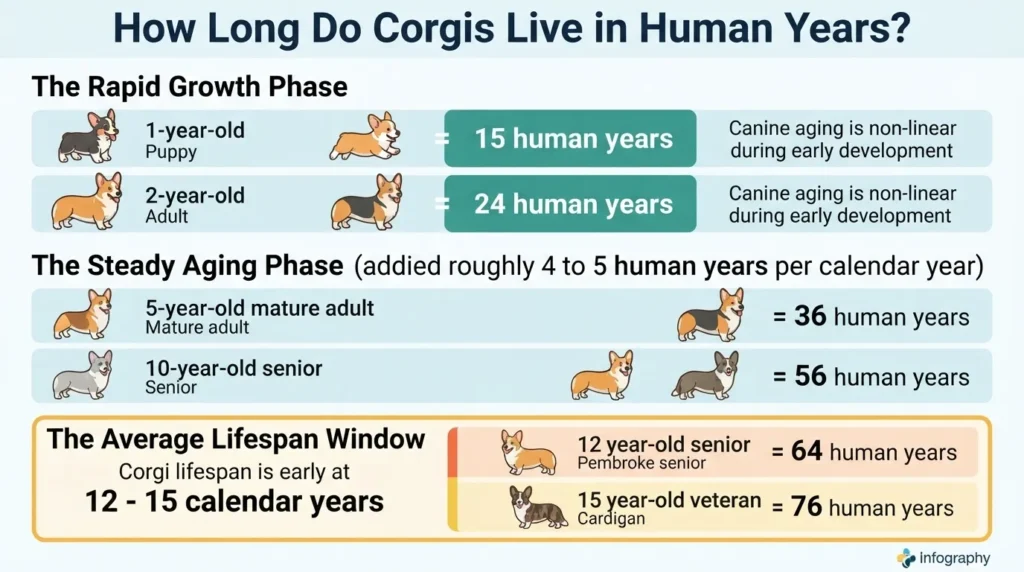
How long do Corgis live in human years? Pembroke and Cardigan Welsh Corgis typically live around 12 to 15 years, which translates to approximately 64 to 76 human years, depending on their age and individual health. If you’re wondering how long Corgis live or what their lifespan means in human-age terms, the answer is more complicated than the old “multiply by seven” rule.
Corgis mature quickly during their first two years, reaching the equivalent of roughly 24 human years by age 2. After that, their aging rate becomes more gradual, with factors such as breed, size, genetics, weight, and overall health influencing their biological age. The typical Pembroke Corgi lifespan is about 12–15 years, although some well-cared-for Corgis live beyond this range.
Below, you’ll find a Corgi age chart showing how different Corgi ages compare with human years, along with life-stage information and practical tips that can help your Corgi enjoy a longer, healthier life.
Corgi Human Years Chart (Quick Breakdown)

Corgi Life Stage
Actual Dog Age
Equivalent Human Years
Puppy / Adolescent
1 Year
15 Years
Young Adult
2 Years
24 Years
Mature Adult
6 Years
40 Years
Senior (Avg. Lifespan)
12–15 Years
64–76 Years
Yeh short metrics dikhate hain ki Corgis apne shuruati do saalon mein bohot tezi se mature hote hain, jahan wo lagbhag 24 human years ki development mukammal kar lete hain. Iske baad, unki aging process dheemi ho jati hai aur wo har saal takreeban 4 se 5 human years ke barabar aage badhte hain.
Agar aapko 1 se le kar 16 saal tak ka poora year-by-year breakdown dekhna hai, toh aap hamara complete [Corgi Dog Age Calculator & Full Chart] check kar sakte hain.
Why You Shouldn't Multiply Corgi Years by 7
Origin of the “x7” Myth
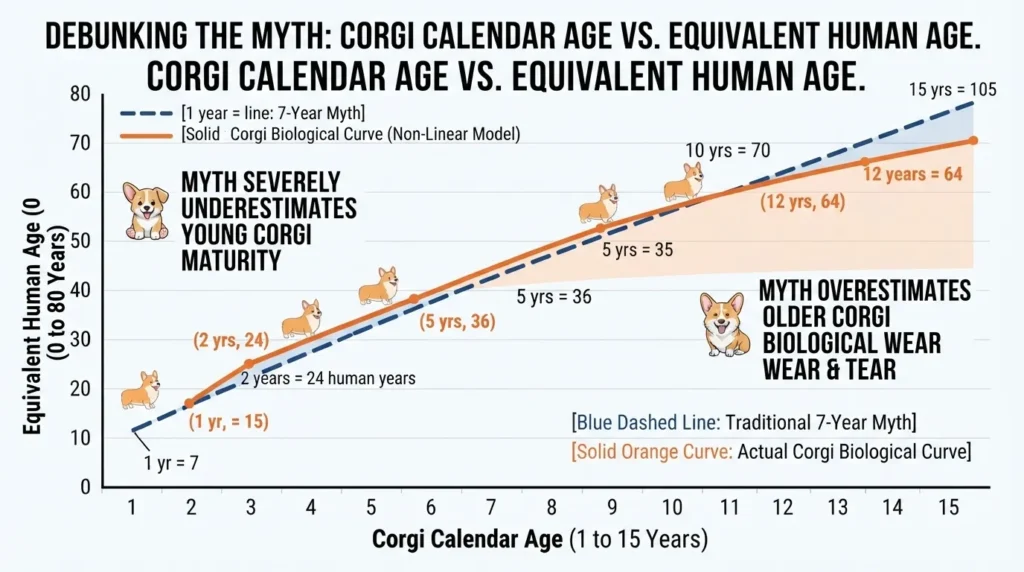
The classic rule of thumb that one calendar year equals seven dog years dates back to the mid-20th century. It originated as a simple, oversimplified marketing tactic rather than a veterinary breakthrough. Veterinarians noticed that the average human lifespan was roughly 70 years, while the average domestic dog lived to be about 10.
By dividing 70 by 10, the “multiply by seven” rule was born. It served as a quick way to encourage pet owners to bring their dogs in for annual checkups. While it worked well for marketing, it completely ignores the actual biological timeline of how a dog develops and ages.
What Science Actually Says
Modern veterinary research has completely debunked this linear approach. According to canine life stage guidelines from the American Animal Hospital Association (AAHA), dogs experience highly dynamic biological shifts that change as they grow.
Puppy years age at an accelerated rate: During the first 12 months, a puppy undergoes massive hormonal, skeletal, and neurological growth. A one-year-old Corgi has already moved past childhood and reached an age equivalent to a 15-year-old human teenager.
The first two years equal a disproportionate jump: By the time a Corgi reaches their second birthday, they are fully mature young adults. This milestone represents roughly 24 human years, meaning your dog packs nearly a quarter-century of human development into just 24 months.
Size and breed heavily influence aging speed: Smaller and medium-sized dogs like Corgis follow a completely different biological clock than giant breeds like Great Danes. While large dogs mature slowly at first but age rapidly later in life, a Corgi’s aging curve levels out after age two, slowing down to a predictable crawl of roughly four to five human years per calendar year.
Corgi Life Stages in Human Years

Puppy (0–1 yr)
During their first year, Corgis experience an incredible growth spurt that compresses over a decade of human childhood into 12 months. A two-month-old Corgi puppy is similar to a human toddler, but by their first birthday, they have rapidly transitioned into their human teenage equivalent of 15 years old. Their growth plates finish fusing around this time, marking the end of raw physical growth and the beginning of heavy adolescence.
Young Adult (1–3 yrs)
From age one to three, Corgis transition from hormonal teenagers to fully mature adults. A two-year-old Corgi has reached the physical and mental development of a 24-year-old human, filling out across the chest and shedding their lanky puppy proportions. By the time they turn three, they are roughly 28 human years old—meaning they still possess plenty of that classic, high-energy herding drive, but with a much more stable, focused temperament.
Adult (3–7 yrs)
This stage represents the prime years of your Corgi’s life, spanning from roughly 28 to 45 human years old. Physiologically, their metabolic rate stabilizes, meaning you have to monitor their caloric intake closely to protect their long backs from excess weight. They are confident, fully settled into their routines, and physically capable of handling long walks and active play sessions without slowing down.
Senior (7+ yrs)
According to AAHA canine life stage guidelines, a Corgi officially crosses the senior threshold at age seven, which translates to 45 human years. You will likely notice a scattering of silver fur around their iconic large ears and muzzle first. As they progress deeper into their senior years, the biological wear on their short, stout legs often manifests as morning joint stiffness or a slower approach to staircases. Catching these early signs of changing mobility and subtle vision shifts allows you to adjust their environment, keeping them comfortable as they navigate their 60s and 70s in human years.
Pembroke vs Cardigan — Human Years Comparison
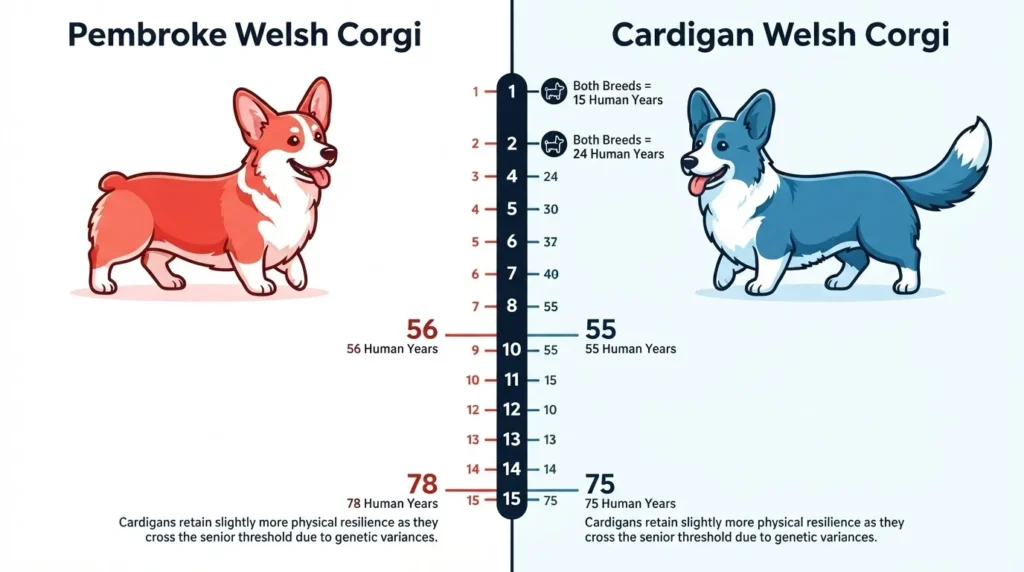
While Pembroke and Cardigan Welsh Corgis share a royal lineage and a low-slung silhouette, they are distinct breeds with differing biological clocks. Pembrokes—famous for their docked tails and pointed, fox-like ears—typically carry a slightly more compact frame. Cardigans sport long, heavy tails, rounded ears, and a denser bone structure.
These subtle physical variations correlate with slightly different lifespans. The average Pembroke lives 12 to 13 years, whereas the sturdier Cardigan frequently enjoys a longer span of 12 to 15 years. Because the Cardigan breed tends to sustain its vitality a bit deeper into double digits, their biological aging paths drift slightly apart once they cross the senior threshold.
At 2 Years: Both breeds stand equal at 24 human years, having fully completed their adolescent growth spurt.
At 10 Years: A Pembroke tracks at 56 human years, while a Cardigan’s baseline matches closer to 55 human years.
At 15 Years: A rare, super-senior Pembroke reaches an advanced 78 human years, whereas a resilient Cardigan tracks closer to 75 human years.
This variance stems from distinct genetic pools and inherited health risks. According to breed health surveys, Pembrokes can experience a slightly steeper metabolic decline after age ten, occasionally accelerated by weight management struggles and joint stress. Cardigans benefit from a slightly more diverse genetic foundation, allowing them to process deep senior aging changes with a touch more physical resilience.
What About Mixed-Breed Corgis?

When a Corgi is crossed with another breed, calculating their human age equivalent requires shifting focus from pure breed standards to individual physical traits. Mixed-breed Corgis inherit a mosaic of genetics that directly affects their metabolic rate, skeletal structure, and ultimate life expectancy.
Because genetics can blend unpredictably, you cannot rely solely on the standard Corgi aging curve. A crossbreed’s biological clock is heavily dictated by the structural build and adult size they inherit from both parents.
Calculation Changes for Corgi Mixes (Borgi, Dorgi, Corgi-Husky)
To calculate the true age of a Corgi mix, the weight-based method becomes much more reliable than a breed-specific chart. According to standard AAHA canine life stage guidelines, dogs are categorized by adult weight because mass heavily influences cellular aging and cardiac workload.
Dorgis (Corgi x Dachshund): Typically weighing between 15 to 28 pounds, these mixes stay firmly within the small dog category. Because both parent breeds share similar low-slung, long-backed builds, their aging pace mirrors the traditional Corgi curve closely, often enjoying a long lifespan of 12 to 15 years.
Borgis (Corgi x Border Collie): These active herding mixes usually mature into medium-sized dogs weighing 30 to 40 pounds. This extra mass puts them into a slightly faster aging bracket during their senior years, meaning a 10-year-old Borgi will physically feel closer to a 60-year-old human, rather than a purebred Corgi’s 56 years.
Corgi-Huskis / Horgis (Corgi x Siberian Husky): This cross creates a massive structural variance, with adult weights ranging anywhere from 20 to 50+ pounds. If your Horgi inherits the heavier, deep-chested Husky frame, their biological clock will accelerate faster after age six compared to a smaller mix.
If you own a mixed-breed Corgi, track their final adult weight once they reach two years old. If they stay under 30 pounds, use the standard small-dog calculations; if they cross into the 30 to 50-pound territory, switch to medium-breed aging charts to ensure you are accurately monitoring their senior life stages.
What Affects a Corgi's Lifespan (and How to Help Them Live Longer)
Breed-Specific Health Risks
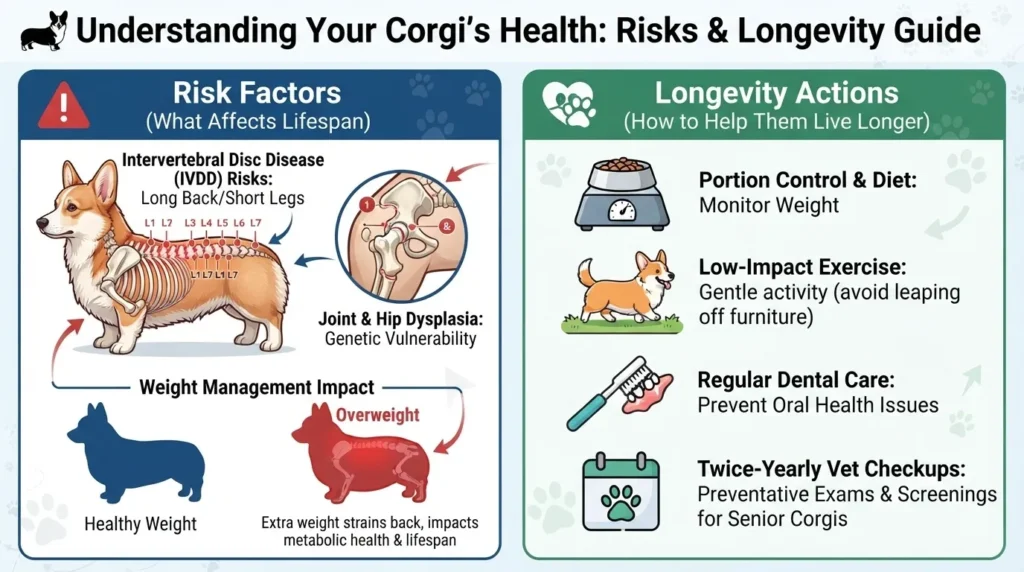
Corgis carry specific genetic vulnerabilities due to their unique skeletal structure. Their long backs and short legs make both Pembrokes and Cardigans highly prone to Intervertebral Disc Disease (IVDD). According to the VCA Animal Hospitals, IVDD occurs when the cushioning discs between the vertebrae herniate or rupture, which can lead to severe pain, nerve damage, or even paralysis.
Beyond spinal issues, Corgis face risks from Hip Dysplasia, a genetic malformation of the hip joint, and Canine Degenerative Myelopathy (DM), a progressive neurological disease that affects the spinal cord in older dogs. Hypothyroidism is also common in the breed, causing metabolic slowdown and unexplained weight gain. Early screening and keeping your dog from jumping off high furniture are critical steps to protect their joints.
Weight Management
Carrying even two extra pounds can significantly cut a Corgi’s life expectancy short. Because of their elongated spines, excess weight puts massive mechanical stress on their vertebrae and accelerates the onset of arthritis. A healthy Corgi should always have a visible waist when viewed from above and a distinct tuck in the abdomen.
Managing their weight requires strict portion control and a refusal to give in to their notorious begging habits. If your senior Corgi starts gaining weight, it is vital to check their thyroid function rather than simply cutting their food, as metabolic issues often mimic overfeeding.
Diet, Exercise & Mental Stimulation
A senior Corgi thrives on a high-quality, lean protein diet rich in omega-3 fatty acids, glucosamine, and chondroitin to support joint health. Daily physical exercise keeps their core muscles strong, which directly protects their spine. Aim for 45 to 60 minutes of low-impact walking rather than high-velocity fetching games that force sudden twisting or hard landings.
Mental workout is just as crucial for this herding breed’s longevity. Corgis are highly intelligent working dogs; without mental puzzles, snuffle mats, or basic obedience training, they easily develop stress and anxiety. Chronic stress elevates cortisol levels, which can negatively impact their immune system over time.
Preventive Vet Care
Routine veterinary visits are the frontline defense against the hidden signs of canine aging. According to the American Animal Hospital Association (AAHA) canine life stage guidelines, senior dogs benefit greatly from twice-yearly wellness exams rather than a single annual checkup.
These biannual visits should include comprehensive senior blood panels and urinalysis to detect early-stage kidney disease, liver dysfunction, or diabetes before physical symptoms surface. Catching these conditions early allows for dietary adjustments that can add years to your dog’s life.
Responsible Breeding/Adoption Source
A Corgi’s lifespan potential is largely set before they ever arrive at your home. Responsible breeders perform rigorous genetic screening, specifically testing parent dogs for the mutated gene responsible for Degenerative Myelopathy (DM) and securing clearance from the Orthopedic Foundation for Animals (OFA) for hips and eyes.
If you are adopting, obtaining comprehensive shelter medical histories helps you understand what health hurdles your dog might face. Choosing a dog from a source that prioritizes health over cosmetic exaggeration ensures you start with a pup built for a long, healthy life.
Frequently Asked Questions
Yes, reaching 15 years old is an impressive milestone for a Corgi. At this point, a 15-year-old dog in human years is roughly 76 years old. While it is on the upper end of how long do corgis live in human years, a Corgi can maintain a wonderful quality of life at this age through proactive senior veterinary checkups and targeted comfort adjustments at home.
According to the American Animal Hospital Association (AAHA) life stage guidelines, a dog enters the senior phase when they hit the last 25% of their breed's estimated lifespan. For a Corgi, this means they officially become a senior around 8 to 9 years old, which is roughly equivalent to 48 to 52 human years.
While the average lifespan peaks around 15, some exceptional Corgis have pushed deep into their late teens. The oldest recorded Pembroke Welsh Corgis have reached over 17 to 20 calendar years, which translates to an incredible 84 to 96+ human years. These extreme ages are rare and typically require excellent genetics combined with meticulous lifelong care.
Corgis enjoy a longer average lifespan than giant or large dog breeds, but they track closely with other medium-sized dogs. According to broad canine demographic data, their 12 to 15-year life expectancy places them well ahead of a Great Dane or Mastiff, though slightly behind some smaller, long-lived toy breeds like Chihuahuas.
A 10-year-old Corgi has reached roughly 56 human years old. When considering how long do corgis live in human years, hitting age ten officially marks their transition into the senior life stage. While they might slow down slightly, many Corgis remain highly active and engaged at this age with proper joint care.
A 5-year-old Corgi is approximately 36 human years old. This calculation accounts for the rapid development that occurs during their first two years of life, followed by a steady aging rate of about four human years for every calendar year thereafter. At this stage, your Corgi is in the prime of their mature adult years.
🐾 Other Age Guides

Gulfam Haider Mehdi
Founder & Developer
I built Dogagescalculator.com to give dog owners honest, science-backed answers instead of the outdated "×7" myth. Every figure here is checked against AKC, AVMA, and published veterinary research.
More about the author & this site →📌 Featured Guides
how long does a lhasa apso dog live
→
Dog Age in Months to Human Years
→
how much to feed a french bulldog puppy
→
what age does a dog have a period
→
golden retriever puppy feeding guide
→
what is the life span of a pit bull
→
puppy age calculator weeks to months
→
how much does a german shorthaired pointer weigh
→
difference between a springer spaniel and a cocker spaniel
→
oldest french bulldog
→
Comments