
What Is 15 Human Years in Dog Years?
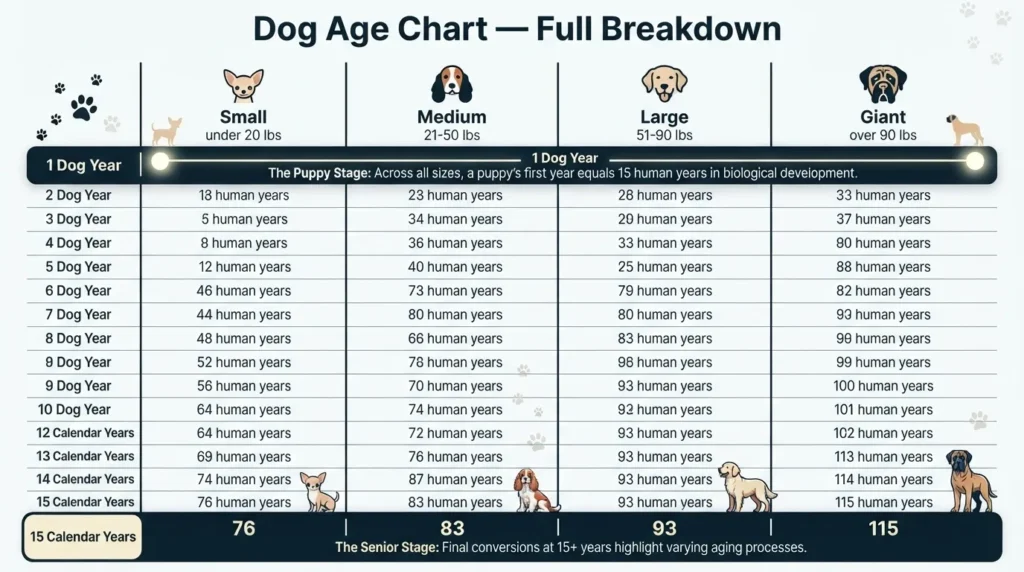
What is 15 human years in dog years? If you’re trying to understand how 15 human years compares to dog age, the answer depends on the stage of a dog’s life. Dogs do not age at a fixed 7-to-1 ratio, because they mature extremely quickly during their first year and then age at different rates depending on breed and size.
In the early stages of life, 15 human years is roughly comparable to a 1-year-old dog. However, if you are asking about a 15-year-old dog in human years, that is a completely different calculation. A 15-year-old dog can be roughly 76 to 115 human years old, depending on size.
Interestingly, this advanced age also connects to one of the most searched questions about canine longevity: the oldest dog in the world. While most dogs never reach 15 years, exceptional dogs have lived far beyond the typical canine lifespan.
Oldest Dog in the World: How Long Can a Dog Live?
The oldest dog in the world is a remarkable example of canine longevity. Most dogs live around 10–13 years, but some small breeds and exceptionally long-lived individuals can reach their late teens or even their 20s.
A dog reaching 15 years old has already entered an advanced senior stage. At this age, regular veterinary care, appropriate nutrition, weight management, dental care, and monitoring for age-related conditions become increasingly important.
Quick distinction: 15 human years in dog years and 15 dog years in human years are reverse conversions. Make sure you are using the correct calculation for the age you want to convert.
Quick Answer — 15 Human Years ≈ 1 Dog Year
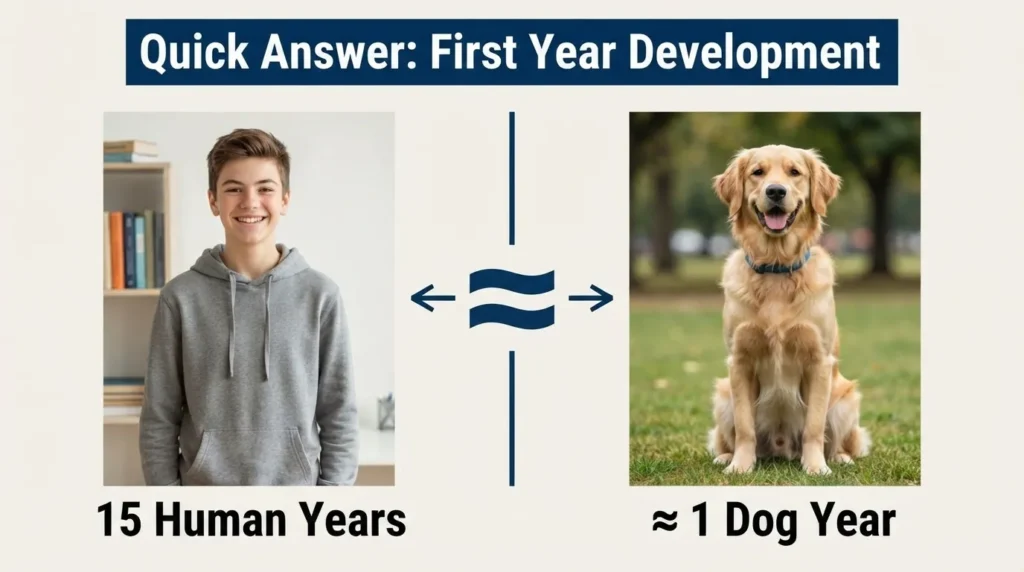
If you are looking at developmental milestones, 15 human years is roughly equivalent to 1 dog year. According to the American Veterinary Medical Association (AVMA) life stage guidelines, a dog’s very first calendar year involves a massive growth spurt, compressing the emotional, physical, and sexual maturity of a human teenager into a single 12-month period.
This means a vibrant 1-year-old dog has already lived the equivalent of a 15-year-old human.
Unlike later stages in life where weight dictates everything, this initial developmental leap holds true across small, medium, and large breeds alike. Whether you have a tiny Chihuahua or a massive Golden Retriever puppy, their first year on earth brings them right to the doorstep of human high school age.
Keep in mind: Canine aging isn’t a straight-line multiplier. While year one equals 15 human years, year two adds about 9 human years, and every subsequent year slows down to an average increase of just 4 to 8
years
Which Direction Did You Mean?
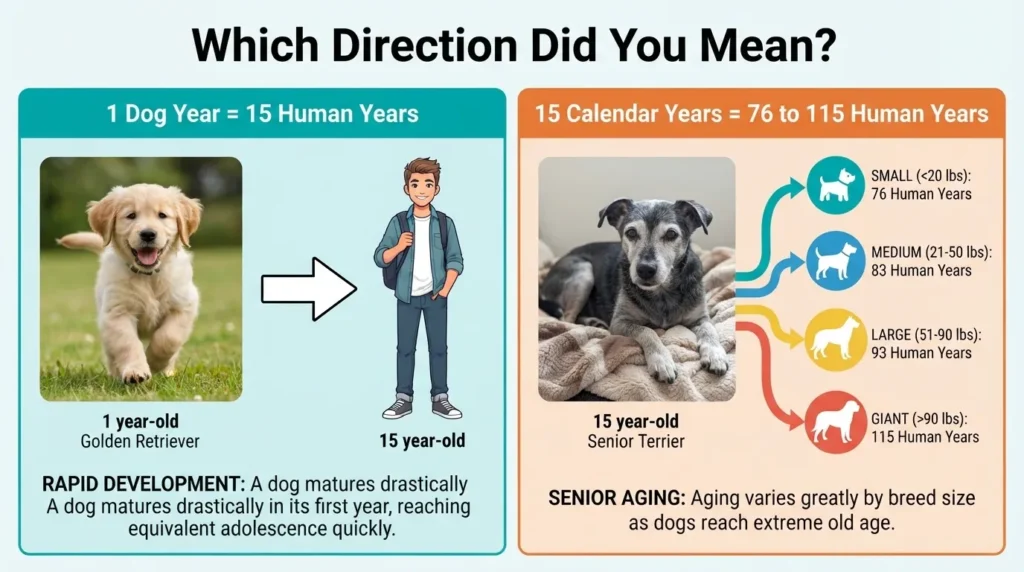
When people look up age conversions, they often get turned around by the phrasing. Depending on whether you are looking at a brand-new puppy or a deeply loved senior pet, you might be asking one of two entirely different questions. Let’s clear up the confusion right now so you get the exact math you need.
“15 Human Years Converted to Dog Years”
If you are thinking about time from our perspective—meaning 15 full calendar years have passed on earth—and you want to know how that impacts a dog, this refers to a senior dog who has celebrated 15 birthdays.
On the flip side, this phrase can also mean looking at a young dog whose biological development matches a 15-year-old human teenager. In canine development, a dog reaches this teenage milestone right around their very first birthday. If you are looking for this quick reference, you can jump straight back to our overview to see how these milestones align.
“My Dog Is 15 Years Old — What’s That in Human Years?”
If your faithful companion has been alive for 15 actual years, they have surpassed the average canine lifespan. At this stage, their true biological age depends heavily on their weight and breed size.
According to the American Veterinary Medical Association (AVMA) canine life-stage formulas, here is how a 15-year-old dog breaks down in human years:
Small Breeds (under 20 lbs): Approximately 76 human years. Smaller dogs, like Chihuahuas or Toy Poodles, age the slowest and often enjoy the longest lifespans.
Medium Breeds (21–50 lbs): Approximately 83 human years. Dogs in this weight class, such as Cocker Spaniels, are firmly in their senior years.
Large Breeds (51–90 lbs): Approximately 93 human years. For a Lab or a Golden Retriever, reaching 15 is an incredible milestone, making them the equivalent of a nonagenarian human.
Giant Breeds (over 90 lbs): Approximately 114 human years. Breeds like Great Danes or Mastiffs age rapidly, and reaching 15 puts them well into extreme old age.
To get a precise calculation tailored to your dog’s specific weight class, head over to our comprehensive Dog Age Calculator for an instant breakdown.
Why Does a Dog's First Year Equal 15 Human Years?
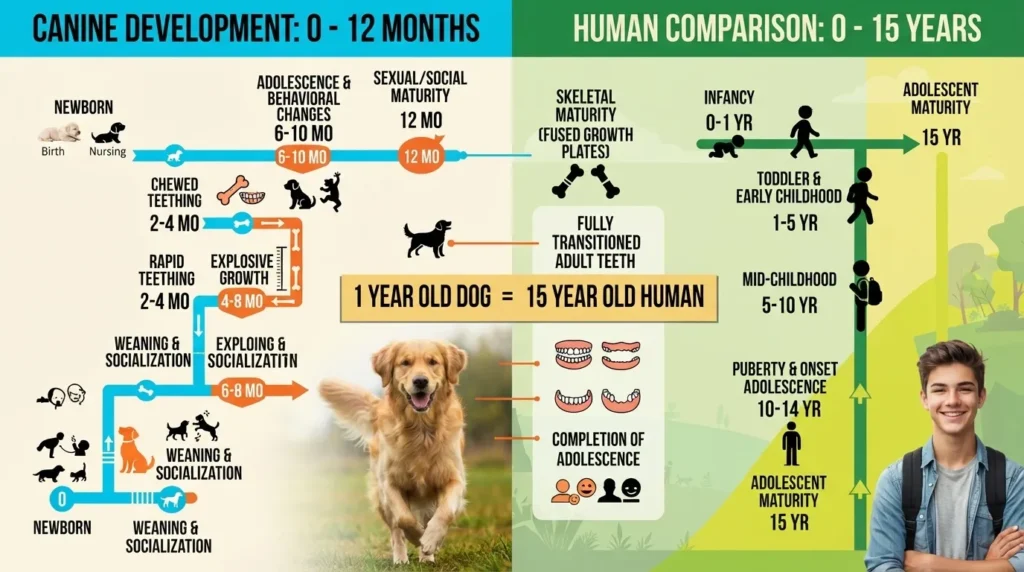
A common point of confusion for pet parents is why the initial jump in a dog’s age is so dramatic. It turns out that canine development does not mirror human development on a steady, linear timeline. During their first 12 months, puppies experience a massive biological milestone, reaching full sexual maturity and completing the vast majority of their skeletal growth.
To put that into perspective, a one-year-old dog has already developed the physical capabilities and hormonal changes comparable to a 15-year-old human teenager. They have effectively packed an entire childhood and early adolescence into a single calendar year.
The Modern Veterinary Aging Breakdown
Because of this rapid early growth, the American Veterinary Medical Association (AVMA) long ago abandoned the idea that dogs age at a constant rate. According to AVMA guidelines, a dog’s first year equals 15 human years. Their second year adds roughly 9 more years to the total, meaning a 2-year-old dog is roughly equivalent to a 24-year-old human.
From age three onward, the calculation stabilizes, and dogs add roughly 4 to 7 human years annually, depending heavily on their weight and breed size.
Debunking the “1 Dog Year = 7 Human Years” Myth
Almost everyone grew up hearing that one dog year equals seven human years. While this old rule of thumb was a simple way to remind people that pets age faster than we do, it is completely outdated and scientifically inaccurate.
If the 7-year rule were true, a 1-year-old puppy would only be a first-grader, yet they are fully capable of reproducing and operating with adult canine reflexes. The myth fails because it assumes non-linear biological processes can be tracked with a flat, rigid multiplier. Modern veterinary science shows us that dogs compress a lot of living into their early years before their aging curve tapens off into a steady, predictable rhythm.
Does Dog Size Change This Answer?
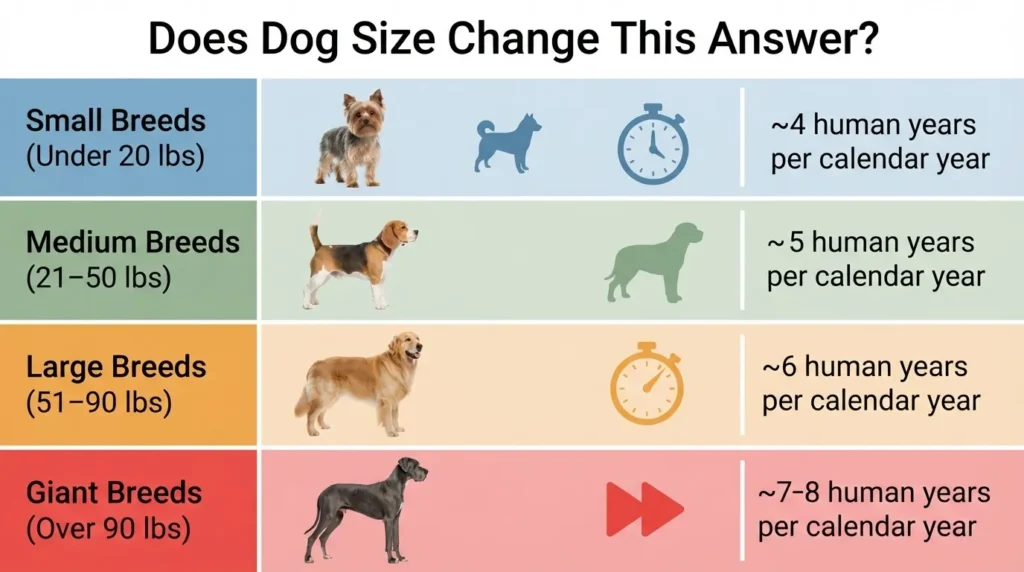
A dog’s physical size changes everything when calculating biological age. While all puppies sprint through infancy at roughly the same pace, their aging speeds diverge dramatically once they hit maturity.
Small Breeds (under 20 lbs): These dogs age the slowest after maturity, adding roughly 4 human years per calendar year. At 17 dog years, they are equivalent to about 84 human years.
Medium Breeds (21–50 lbs): A steady middle ground where dogs age by about 5 human years annually. A 17-year-old medium dog matches a 92-year-old human.
Large Breeds (51–90 lbs): Their biological clock moves faster, burning through roughly 6 human years each calendar year, reaching 104 human years by age 17.
Giant Breeds (over 90 lbs): The fastest aging category, where metabolic demands place heavy strain on the body. Reaching 17 calendar years is incredibly rare for giant breeds, putting them at an estimated 130 human years.
Calculate Your Dog's Exact Age
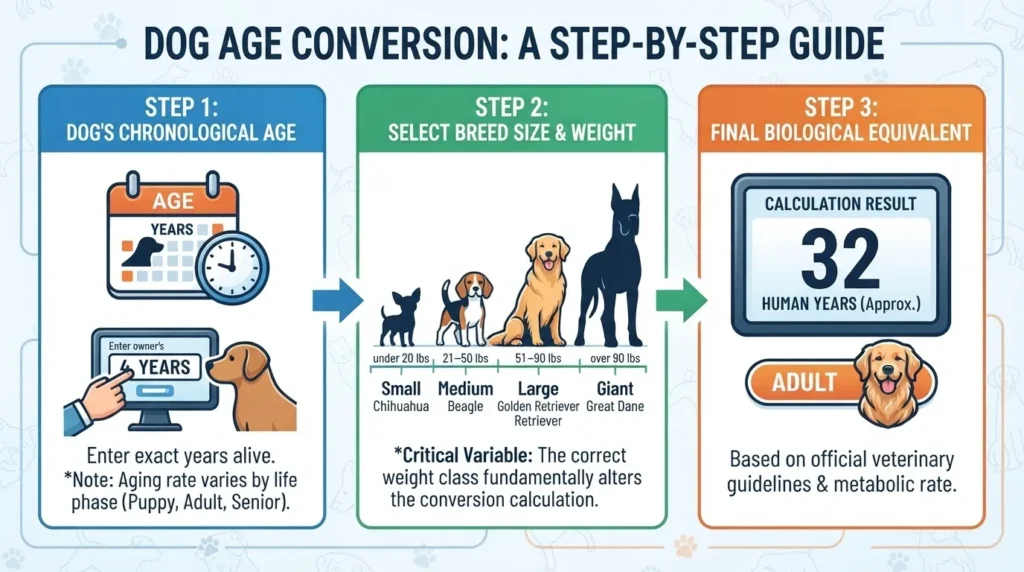
Determining the true biological milestone for your pet doesn’t have to be a guessing game. By moving past generalized estimates, you can pinpoint the exact stage your companion has actually reached based on verified veterinary aging science.
Step 1: Enter your dog’s age — Input your dog’s current calendar years, whether you want to see the impact of 15 human years on a puppy or calculate the age of an older dog.
Step 2: Select breed/size — Choose the weight category that fits your dog best. Physical size is the single most critical variable in determining how rapidly a dog’s biological clock ticks after their first two years of life.
Step 3: Get an instant, accurate human-year equivalent — The system processes your inputs against updated AVMA aging parameters to reveal your dog’s true developmental and life stage status immediately.
Frequently Asked Questions
Absolutely. According to AAHA canine life stage guidelines, a dog that has reached 15 calendar years is firmly in their geriatric phase. At this stage, they require senior-targeted nutrition, modified exercise routines, comfortable bedding for joint support, and biannual veterinary checkups to monitor organ function and mobility.
The American Veterinary Medical Association (AVMA) established this benchmark because dogs do not age at a constant, linear rate. A puppy packs an immense amount of growth, skeletal development, and sexual maturity intOnce a dog passes their initial rapid growth phase (the first two years), their size dictates how they age. If you are tracking a dog's life journey up to 15 calendar years, small breeds add about 4 human years per calendar year, medium breeds add 5, large breeds add 6, and giant breeds add 7 to 8 years annually.o their first 12 months, which slows down dramatically once they reach their second year of life.
The American Veterinary Medical Association (AVMA) established this benchmark because dogs do not age at a constant, linear rate. A puppy packs an immense amount of growth, skeletal development, and sexual maturity into their first 12 months, which slows down dramatically once they reach their second year of life.
If you are asking the question in reverse—meaning your dog has been alive for 15 calendar years—their age in dog years is roughly 76 to 115 human years. The exact number depends entirely on their size. Small dogs will be on the lower end of that range (around 76), while large and giant breeds will be much older biologically (93 to 115+).
Yes, in terms of biological development, the first calendar year of a dog’s life is roughly equal to 15 human years. Dogs mature incredibly fast during infancy and adolescence. By their first birthday, a puppy has undergone the same physical and social development as a 15-year-old human teenager.
🐾 Other Age Guides

I built Dogagescalculator.com to give dog owners honest, science-backed answers instead of the outdated "×7" myth. Every figure here is checked against AKC, AVMA, and published veterinary research.
More about the author & this site →
Comments