Yorkie Mix Breeds: 15+ Adorable Crossbreeds, Sizes, Prices & Lifespans
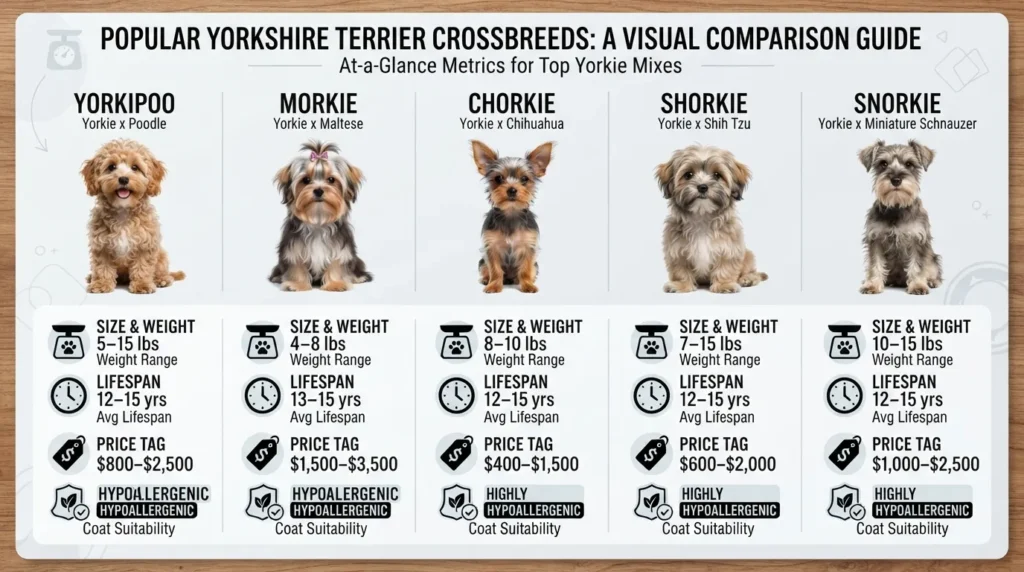
Few small dogs pack as much personality into a tiny frame as the Yorkshire Terrier. They’re feisty, fiercely loyal, and surprisingly brave for a dog that usually tops out around seven pounds. But when you blend those iconic Yorkie traits—the silky coat, high intelligence, and big-dog attitude—with another popular breed, you get a Yorkie mix (or “Yorkie hybrid”) that brings a whole new set of qualities to the table.
Whether you’re looking for a low-shedding companion like a Yorkipoo, a sturdy family-friendly mix like a Chorkie, or an energetic little adventurer like a Snorkie, crossbreeding Yorkies has created some of the most sought-after companion dogs in the world.
That said, designer dogs aren’t a one-size-fits-all package. A Yorkie mix’s size, temperament, coat type, and health traits depend heavily on which parent breed genetics lean toward.
In this comprehensive guide, we break down 15+ of the most popular Yorkie mixes, covering real-world physical traits, temperaments, average lifespans, price expectations, and exact care needs so you can find the right match for your home.
What Is a Yorkie Mix?
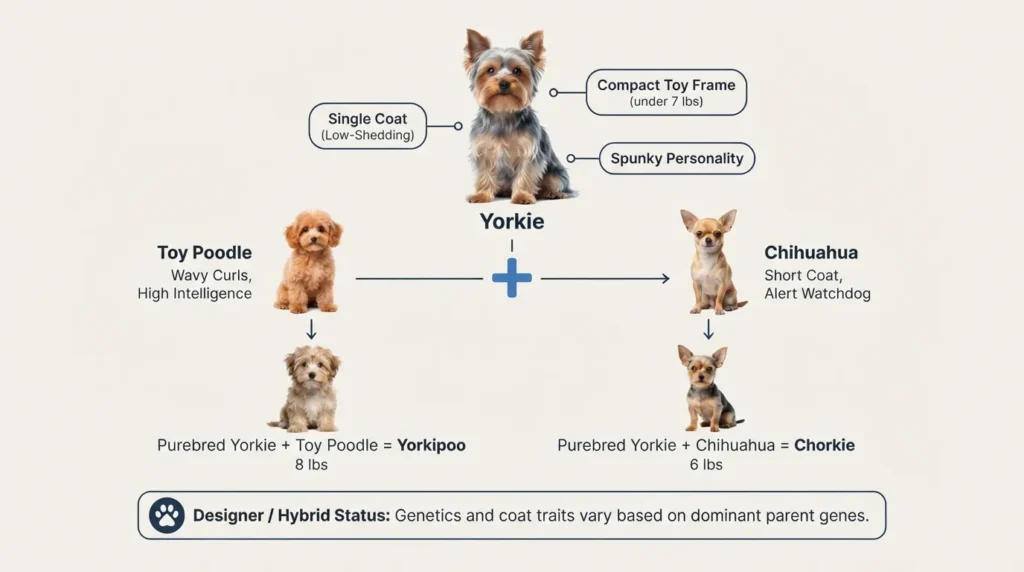
A Yorkie mix (or Yorkshire Terrier hybrid) is a crossbred dog produced by mating a purebred Yorkshire Terrier with another purebred or mixed-breed dog. These designer crossbreeds combine the Yorkie’s compact frame, intelligence, and low-shedding coat with the physical traits, temperament, and health characteristics of the second parent breed.
Yorkies have long been a top choice for crossbreeding due to three standout qualities: their manageable toy size, their hypoallergenic human-like hair that barely sheds, and their confident, affectionate personalities. Crossing a Yorkie with breeds like Poodles, Chihuahuas, or Maltese allows breeders to retain those popular small-dog perks while balancing out specific traits, like reducing prey drive or creating a sturdier build.
It is worth keeping in mind that Yorkie mixes are classified as designer or hybrid dogs. The American Kennel Club (AKC) does not recognize crossbreeds as official individual breeds, meaning they do not have rigid breed standards or pedigree registration. As a result, puppies in the same Yorkie mix litter can vary noticeably in size, coat texture, and temperament depending on which parent’s genetics dominate.
Yorkie Mix Generations Explained
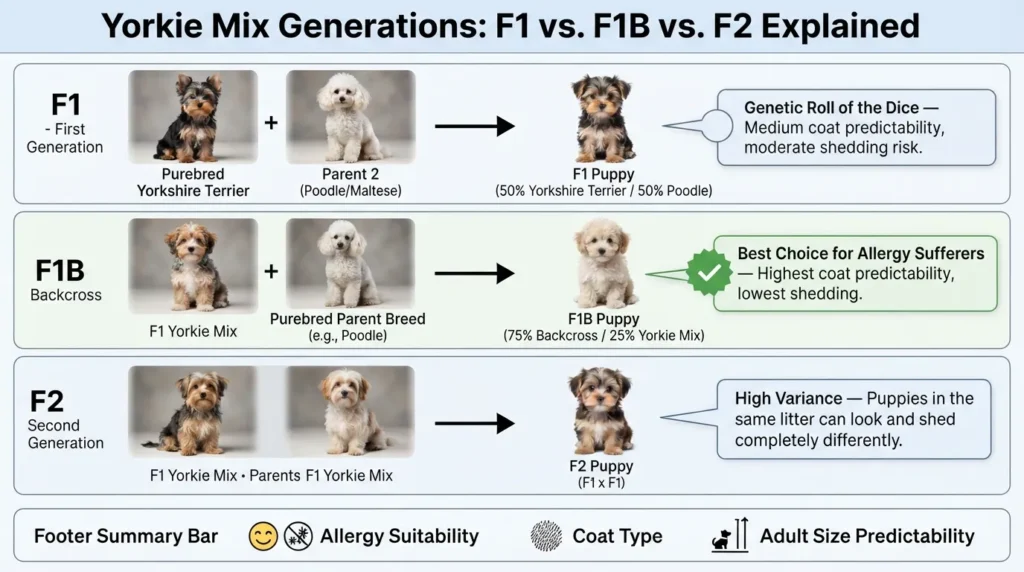
When researching Yorkie mix breeds, you will frequently see labels like F1, F1B, or F2 next to a puppy’s name. These codes simply describe a dog’s family tree—specifically, how many generations removed they are from the original purebred parents.
Understanding generations is essential because a puppy’s genetic makeup directly impacts how predictable their adult size, coat type, shedding levels, and temperament will be.
F1 (First Generation): An F1 mix is a 50/50 cross between a purebred Yorkshire Terrier and another purebred breed (for example, a purebred Yorkie crossed with a purebred Miniature Poodle to make an F1 Yorkipoo). F1 puppies inherit an equal split of genetics, but their outward appearance remains a roll of the dice. One puppy in a litter might inherit the silky straight Yorkie coat, while a littermate gets soft, wavy curls.
F1B (First Generation Backcross): An F1B mix is produced by crossing an F1 Yorkie mix back with a purebred parent breed—most often a Poodle or a Yorkie. For allergy sufferers, an F1B Yorkipoo (75% Poodle, 25% Yorkie) offers much higher predictability for a single-layer, virtually non-shedding coat compared to an F1 cross.
F2 (Second Generation): An F2 mix occurs when two F1 Yorkie mixes are bred together (e.g., an F1 Morkie bred with another F1 Morkie). F2 litters are notoriously unpredictable. Genetics recombine in varied ways, meaning puppies in the same litter can look vastly different from one another in size, muzzle shape, and hair texture.
Why Generations Matter for Allergy Sufferers: While purebred Yorkies have a single coat of hair rather than fur, crossing them with double-coated breeds (like a Beagle or Pomeranian) introduces shedding genes. An F1B backcross to a low-shedding breed offers the most reliable choice if you need a truly low-dander, non-shedding companion.
Yorkie Mix Comparison Chart
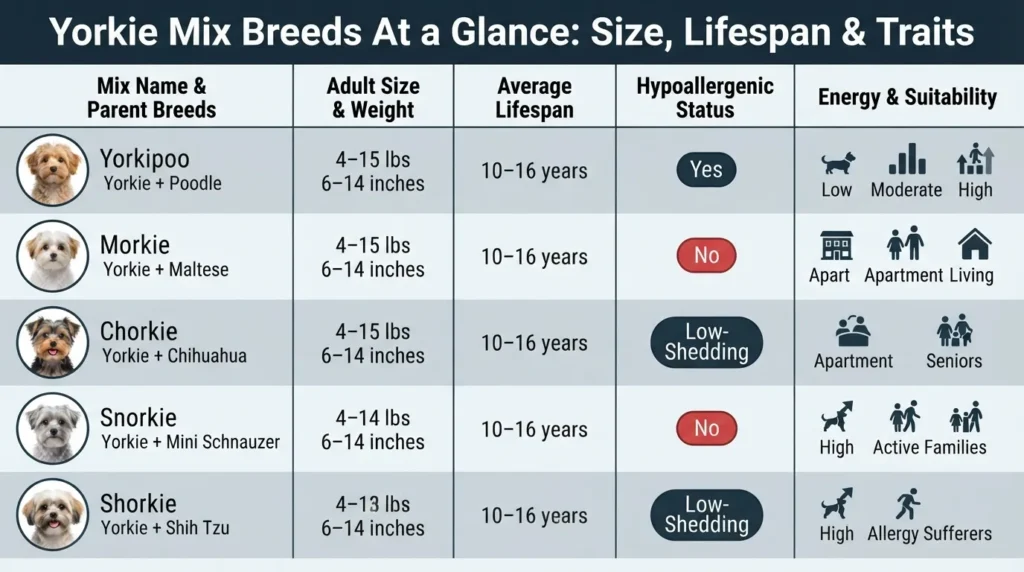
Below is a quick overview comparing the most popular Yorkie mixes. While individual puppies can vary based on generation and which parent’s genetics they inherit, this breakdown provides a realistic snapshot of what to expect for adult size, lifespan, allergy suitability, and energy levels.
| Mix Name | Parent Breed | Avg. Weight | Avg. Height | Lifespan | Hypoallergenic? | Energy Level | Good For |
|---|---|---|---|---|---|---|---|
| Yorkipoo | Toy/Mini Poodle | 4–15 lbs | 7–12 in | 10–15 yrs | Yes | Moderate–High | Allergy sufferers & apartment living |
| Morkie | Maltese | 4–8 lbs | 6–10 in | 12–15 yrs | Yes | Moderate | Seniors, lap dog lovers & singles |
| Chorkie | Chihuahua | 8–10 lbs | 6–9 in | 13–15 yrs | Moderate (Varies) | Moderate–High | Active individuals & compact homes |
| Snorkie | Miniature Schnauzer | 5–12 lbs | 7–14 in | 12–15 yrs | Yes | High | Watchdog instinct & active families |
| Shorkie | Shih Tzu | 5–11 lbs | 6–11 in | 11–16 yrs | Yes | Low–Moderate | Low-activity households & lap lovers |
| Porkie | Pomeranian | 3–7 lbs | 6–12 in | 12–16 yrs | No | Moderate–High | Devoted companions & small spaces |
| Dorkie | Dachshund | 5–12 lbs | 5–10 in | 13–16 yrs | Moderate (Varies) | Moderate | Relaxed homes & gentle walks |
| Borkie | Beagle | 7–12 lbs | 8–12 in | 10–13 yrs | No | High | Families with older kids & active routines |
| Fourche Terrier | West Highland White Terrier | 12–15 lbs | 8–10 in | 12–15 yrs | Yes | High | Terrier enthusiasts & sturdy playmates |
| Torkie | Toy Fox Terrier | 6–9 lbs | 8–10 in | 12–15 yrs | Low-Shedding | Very High | Agility, trick training & busy homes |
| Corkie | Cocker Spaniel | 8–12 lbs | 8–12 in | 11–15 yrs | Moderate (Varies) | Moderate | Affectionate family companion |
| Jorkie | Jack Russell Terrier | 6–8 lbs | 9–13 in | 13–16 yrs | Low-Shedding | High–Extreme | Experienced owners & outdoorsy lifestyles |
| Havashire | Havanese | 6–12 lbs | 7–11 in | 12–15 yrs | Yes | Moderate | Gentle play, seniors & multi-pet homes |
| Boston Yorkie | Boston Terrier | 10–14 lbs | 9–15 in | 11–15 yrs | Low-Shedding | Moderate | Playful companions & urban apartments |
14 Popular Yorkie Mix Breeds
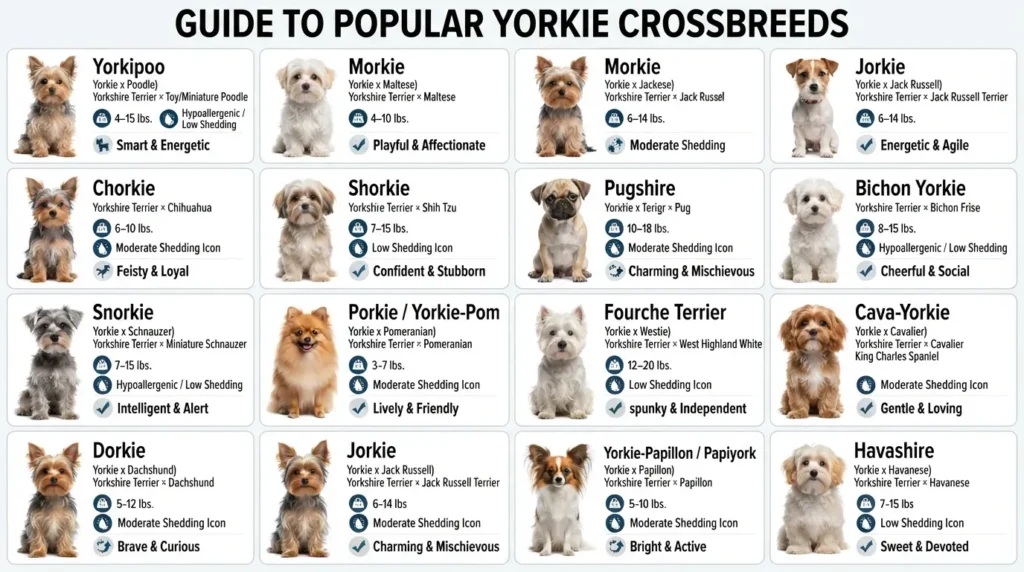
Here is a detailed breakdown of 14 popular Yorkie crossbreeds, detailing their physical traits, personality habits, and ideal homes.
Shorkie (Yorkie + Shih Tzu)
Parent Breeds & Origin: Crossing a Yorkshire Terrier with a Shih Tzu produced the Shorkie, a hybrid developed in the United States during the early 2000s aimed at creating a sweet-natured companion dog.
Size, Weight, Height: 5–11 lbs | 6–11 inches tall
Coat & Shedding: Long, silky double coat or straight single coat; low-shedding but high-maintenance for daily brushing.
Temperament: Extremely affectionate, fiercely loyal, and somewhat vocal. They form intense bonds with their owners and love nothing more than sprawling on your lap, though they can be prone to separation anxiety if left alone for long stretches.
Best For: Seniors, singles, and low-activity households where someone is home most of the day.
Lifespan: 11–16 years
Average Price Range: $500 – $1,500
Chorkie (Yorkie + Chihuahua)
Parent Breeds & Origin: The Chorkie combines the Yorkshire Terrier and the Chihuahua, originating as a popular companion cross in North America during the 1990s.
Size, Weight, Height: 4–10 lbs | 6–9 inches tall
Coat & Shedding: Short to medium coat ranging from soft and silky to slightly wiry; light to moderate shedding depending on whether the Chihuahua parent was short- or long-haired.
Temperament: Big personality packed into a tiny body. Chorkies are spunky, confident, and energetic watchdogs who will readily alert you to every visitor, mail carrier, or strange noise outside your door.
Best For: Apartment dwellers, active individuals, and homes with older, gentle children who know how to handle very small dogs safely.
Lifespan: 13–15 years
Average Price Range: $400 – $1,200
Morkie (Yorkie + Maltese)
Parent Breeds & Origin: A hybrid between the Yorkshire Terrier and the Maltese, bred primarily in the US as a gentle, low-allergen lap dog.
Size, Weight, Height: 4–8 lbs | 6–10 inches tall
Coat & Shedding: Fine, long, soft hair with no undercoat; virtually non-shedding and highly hypoallergenic, though susceptible to matting around the ears and legs.
Temperament: Playful, sweet, and eager to please. Morkies inherit the Maltese’s gentle affection balanced by the Yorkie’s curious nature, making them enthusiastic playful companions inside the house.
Best For: Allergy sufferers, apartment living, and first-time dog owners seeking a loving lap dog.
Lifespan: 12–15 years
Average Price Range: $800 – $2,000
Yorkiepoo (Yorkie + Poodle)
Parent Breeds & Origin: Created by crossing a Yorkshire Terrier with a Toy or Miniature Poodle, the Yorkiepoo emerged during the doodle boom of the late 1990s.
Size, Weight, Height: 4–15 lbs | 7–12 inches tall
Coat & Shedding: Soft, wavy-to-curly single coat; exceptionally low-shedding and one of the best Yorkie mix breeds for people with mild dog allergies.
Temperament: Clever, quick-witted, and energetic. Thanks to their Poodle heritage, Yorkiepoos excel at learning tricks and basic obedience commands, though they can display a stubborn streak if training gets repetitive.
Best For: First-time owners, allergy sufferers, and active families who enjoy daily walks and interactive play.
Lifespan: 10–15 years
Average Price Range: $600 – $1,800
Porkie / Yorkie-Pom (Yorkie + Pomeranian)
Parent Breeds & Origin: A cross between a Yorkshire Terrier and a Pomeranian, often referred to as a Porkie or Yoranian.
Size, Weight, Height: 3–7 lbs | 6–12 inches tall
Coat & Shedding: Fluffy, dense double coat or soft medium coat; sheds moderately and requires regular brushing to keep the fur from tangling.
Temperament: Vibrant, curious, and endlessly entertaining. Porkies carry a bold demeanor and will happily follow you around the house to supervise every task you perform.
Best For: Small space living, devoted single owners, and households without very young, rough-housing children.
Lifespan: 12–16 years
Average Price Range: $500 – $1,500
Snorkie (Yorkie + Schnauzer)
Parent Breeds & Origin: A blend of the Yorkshire Terrier and the Miniature Schnauzer, creating a sturdy working-terrier hybrid.
Size, Weight, Height: 5–12 lbs | 7–14 inches tall
Coat & Shedding: Wiry or silky medium coat; low-shedding but needs regular clipping or hand-stripping to maintain its clean look.
Temperament: Confident, alert, and spirited. Snorkies retain strong watchdog instincts and aren’t afraid to bark when strangers approach, but they are exceptionally affectionate with their core family group.
Best For: Active families, suburban homes, and owners wanting a compact dog with a slightly sturdier build.
Lifespan: 12–15 years
Average Price Range: $500 – $1,400
Dorkie (Yorkie + Dachshund)
Parent Breeds & Origin: The Dorkie is a cross between a Yorkshire Terrier and a Dachshund (Standard or Miniature), known for its long body and short legs.
Size, Weight, Height: 5–12 lbs | 5–10 inches tall
Coat & Shedding: Medium-length coat that ranges from silky to slightly wiry; low-to-moderate shedding depending on coat type.
Temperament: Laid-back, gentle, and sweet, though occasionally stubborn when sniffing out scent trails during outdoor walks.
Best For: Relaxed households, seniors, and homes without a lot of stairs (protecting their long spine is important).
Lifespan: 13–16 years
Average Price Range: $400 – $1,200
Jorkie / Yorkie Russell (Yorkie + Jack Russell Terrier)
Parent Breeds & Origin: Crossing a Yorkshire Terrier with a Jack Russell Terrier yields this high-energy, working-terrier cross.
Size, Weight, Height: 6–12 lbs | 8–13 inches tall
Coat & Shedding: Short-to-medium coarse coat; low-to-moderate shedding with simple weekly brushing needs.
Temperament: High energy, fearless, and sharp-minded. Jorkies need plenty of physical exercise and mental stimulation to prevent destructive chewing or digging.
Best For: Experienced owners, athletic individuals, and homes with a yard or outdoorsy daily routine.
Lifespan: 13–16 years
Average Price Range: $300 – $900
Pugshire (Yorkie + Pug)
Parent Breeds & Origin: A hybrid combining the Yorkshire Terrier and the Pug, resulting in a uniquely expressive face and stocky body.
Size, Weight, Height: 7–12 lbs | 8–12 inches tall
Coat & Shedding: Short, fine hair or medium silky coat; moderate shedding that increases seasonally.
Temperament: Loving, goofy, and social. Pugshires inherit the Pug’s clownish charm and love being the center of attention in any room.
Best For: Families with kids, apartment living, and owners looking for an affectionate, moderate-energy pet.
Lifespan: 12–15 years
Average Price Range: $500 – $1,200
Bichon Yorkie (Yorkie + Bichon Frise)
Parent Breeds & Origin: Bred from a Yorkshire Terrier and a Bichon Frise, designed as a cheerful, hypoallergenic companion dog.
Size, Weight, Height: 6–12 lbs | 7–11 inches tall
Coat & Shedding: Soft, fluffy, slightly curly hair; very low-shedding and hypoallergenic, requiring regular professional grooming.
Temperament: Happy-go-lucky, sociable, and polite. They tend to get along well with visitors, children, and other household pets.
Best For: Families, first-time owners, and households seeking a gentle, low-dander pet.
Lifespan: 12–15 years
Average Price Range: $600 – $1,500
Fourche Terrier (Yorkie + Westie)
Parent Breeds & Origin: A double-terrier mix originating from a Yorkshire Terrier crossed with a West Highland White Terrier.
Size, Weight, Height: 10–15 lbs | 8–10 inches tall
Coat & Shedding: Medium-length, coarse coat; low-shedding but needs routine brushing to keep mats at bay.
Temperament: Independent, courageous, and lively. They carry traditional terrier instincts, including an eager prey drive for small critters.
Best For: Terrier lovers, active households, and homes without small pocket pets like hamsters or mice.
Lifespan: 12–15 years
Average Price Range: $400 – $1,000
Cava-Yorkie (Yorkie + Cavalier King Charles Spaniel)
Parent Breeds & Origin: Combining a Yorkshire Terrier and a Cavalier King Charles Spaniel produces this soft-featured hybrid.
Size, Weight, Height: 7–14 lbs | 8–12 inches tall
Coat & Shedding: Medium, wavy, silky coat; low-to-moderate shedding with regular grooming needs around the ears and legs.
Temperament: Affectionate, quiet, and devoted. The Cavalier influence tones down the classic Yorkie feistiness into a calmer, sweeter disposition.
Best For: First-time dog owners, seniors, and calm family environments.
Lifespan: 11–14 years
Average Price Range: $700 – $1,800
Yorkie-Papillon (Yorkie + Papillon)
Parent Breeds & Origin: A cross between a Yorkshire Terrier and a Papillon, often known as a “Papiyork.”
Size, Weight, Height: 4–9 lbs | 7–10 inches tall
Coat & Shedding: Silky, fine, single-layer coat with signature butterfly-like ear fringe; low-shedding and easy to brush out.
Temperament: Alert, agile, and remarkably smart. They excel at learning fun tricks and love interactive puzzle toys.
Best For: Active singles, trick-training enthusiasts, and apartment owners.
Lifespan: 13–16 years
Average Price Range: $500 – $1,300
Yorkie-Havanese (Havashire)
Parent Breeds & Origin: Bred by crossing a Yorkshire Terrier with a Havanese, creating a sturdy toy companion.
Size, Weight, Height: 6–12 lbs | 7–11 inches tall
Coat & Shedding: Long, soft, wavy coat; hypoallergenic and low-shedding, though requiring regular combing.
Temperament: Gentle, loving, and trainable. They adapt easily to their family’s routine, whether that means a lazy day on the couch or a walk through the park.
Best For: Multi-pet homes, seniors, and families with children.
Lifespan: 12–15 years
Average Price Range: $600 – $1,600
How Big Do Yorkie Mixes Get? Size & Weight Breakdown
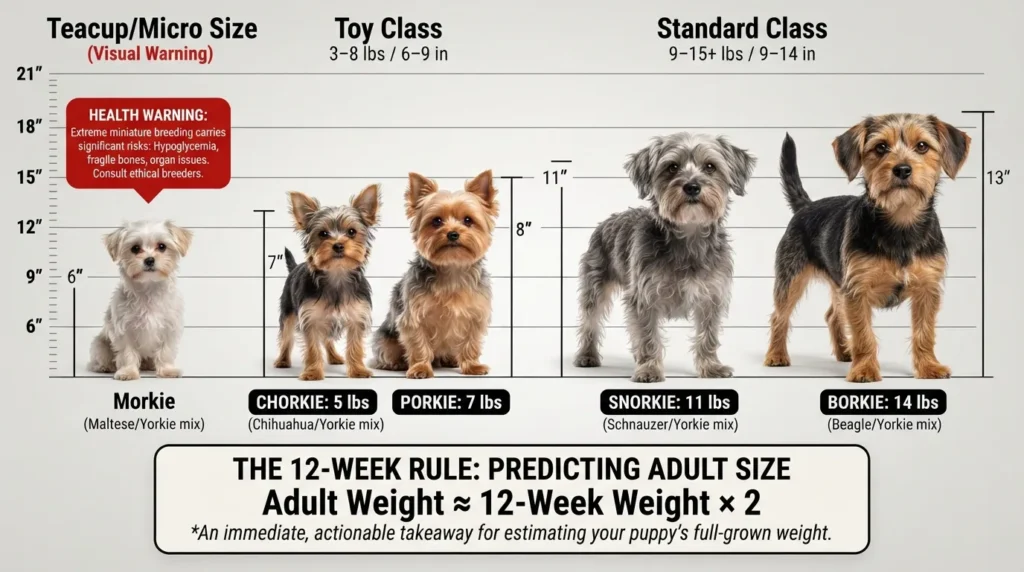
Most Yorkie mixes fall into the toy dog category, typically weighing between 4 and 15 pounds and standing 6 to 12 inches tall at the shoulder. Because a hybrid puppy inherits genes from two different parent breeds, predicting exact adult size isn’t as straightforward as it is with purebreds.
To estimate how large a Yorkie mix will grow, look closely at the non-Yorkie parent. A mix with a tiny parent breed, like a Chihuahua or Pomeranian, will usually stay under 8 pounds. Conversely, a cross with a larger breed—such as a Standard Dachshund, Beagle, or Miniature Schnauzer—can easily reach 12 to 18 pounds. As a general rule, a puppy’s weight at 12 weeks of age is roughly double what their final adult weight will be.
Teacup Yorkie Mixes — Myth vs Reality
You will often see breeders advertising “Teacup Yorkie Mixes” for thousands of dollars, promising a dog that never exceeds 2 to 3 pounds. However, “teacup” is strictly a marketing term created by unethical breeders—it is not an official size classification recognized by veterinary organizations or kennel clubs.
Breeding for extreme micro-sizes comes with severe health trade-offs. These tiny puppies are usually created by breeding the weakest, smallest “runts” of a litter together over generations, leading to fragile genetic profiles.
Common health risks associated with teacup-sized mixes include:
Hypoglycemia: Dangerous drops in blood sugar that can cause seizures or comas if the dog misses a single meal.
Fragile Bones: Bones so thin that jumping off a couch or being stepped on can cause severe fractures.
Collapsed Trachea: Unstable cartilage rings in the windpipe, causing chronic coughing and breathing difficulty.
Severe Dental Issues: Overcrowded baby and adult teeth packed into a tiny jawbone, leading to rapid decay and tooth loss.
If you are considering a very small mix, target a healthy toy-sized dog in the 5- to 8-pound range rather than searching for an artificially miniaturized teacup puppy.
Standard vs Toy Size Comparison
To help you visualize how different Yorkie crossbreeds develop, here is a breakdown comparing toy-sized mixes against standard-sized mixes
| Size Category | Typical Weight Range | Typical Height Range | Common Mix Examples |
|---|---|---|---|
| Toy Yorkie Mixes | 3 – 8 lbs | 6 – 9 inches | Morkie, Porkie (Yorkie-Pom), Chorkie, Yorkie-Papillon |
| Standard Yorkie Mixes | 9 – 15+ lbs | 9 – 14 inches | Snorkie, Dorkie, Fourche Terrier, Borkie (Yorkie-Beagle) |
Keep in mind that first-generation (F1) mixes carry more size variance. If you want a guaranteed compact dog, look for an F1B backcross to a toy breed or adopt an adult dog whose growth plates have closed and whose size is fully established.
What Do Yorkie Mixes Look Like? Coat Colors & Appearance Guide
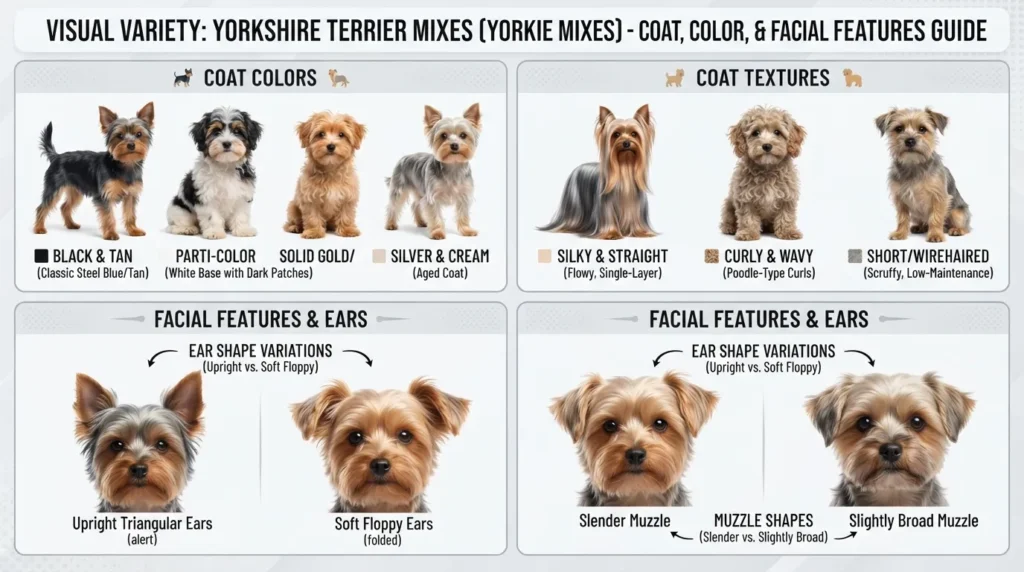
Because a Yorkie mix inherits traits from two distinct gene pools, their physical appearance can vary dramatically—even between littermates born to the same parents. Purebred Yorkshire Terriers are famous for their dark steel blue and rich tan coloring, but mixing them with other breeds creates an incredible spectrum of coat colors, fur textures, and facial structure.
Common Coat Colors
While purebred Yorkies follow a strict color standard, crossbreeding opens the door to virtually every coat pattern in the canine world. A Yorkie mix puppy might display one of several common color combinations:
Black & Tan / Dark Steel Blue & Tan: The classic Yorkie color scheme, where dark fur covers the back and torso while rich tan or gold accents the muzzle, chest, and legs.
Solid Gold or Brown: Often seen in mixes with breeds like the Maltese or Toy Poodle, where the dark black pigment is suppressed, leaving a warm apricot, tan, or deep chocolate shade.
Parti-Color (Tri-Color): A white base coat splashed with distinct patches of black, tan, or brown. This pattern is especially common in Morkies, Yorkipoos, and Chorkies.
Silver & Cream: As Yorkie mixes age, their dark puppy hair often clears into a striking silver, pewter, or pale cream color by the time they reach adulthood.
Coat Types: Silky/Straight vs Curly/Wavy
The texture of a Yorkie mix’s coat depends heavily on the second parent breed’s hair characteristics and the generation of the cross (such as F1 versus F1B).
Silky and Straight: Purebred Yorkies have fine, human-like hair rather than dense fur. Mixes with breeds like the Maltese (Morkie) or Shih Tzu (Shorkie) usually inherit a straight, silky single coat that flows down the body. This coat type sheds very little but matts easily without daily combing.
Curly or Wavy: Mixes with Poodles (Yorkipoo) or Bichon Frises often develop soft, plush curls or loose waves. These coats are highly popular for allergy sufferers because shed hair gets trapped in the curls rather than falling on your furniture.
Short or Wirehaired: Crosses with Chihuahuas (Chorkie) or Dachshunds (Dorkie) can yield short, low-maintenance fur or a scruffy, wirehaired terrier texture that requires minimal grooming.
Ear Shape & Face Variety
Facial structure is one of the most unpredictable—and charming—aspects of a Yorkie mix. A purebred Yorkie features small, erect V-shaped ears and a refined muzzle. However, hybrid puppies can inherit a wide range of facial features depending on their genetics:
Ear Variations: A Yorkie mix may have sharp, upright triangular ears (common in Chorkies and Porkies), soft button ears that fold forward, or long, floppy ears handed down from Spaniel, Poodle, or Dachshund parents.
Muzzle Shape: Muzzles range from the sharp, slender snout of a Chihuahua or Toy Fox Terrier cross to the broader, slightly flatter face seen in a Pugshire or Shorkie.
Expressive Eyes: Most Yorkie mixes inherit dark, round, highly expressive eyes, giving them a perpetually curious and youthful expression throughout their lives.
How Long Do Yorkie Mixes Live? Lifespan & Aging Explained
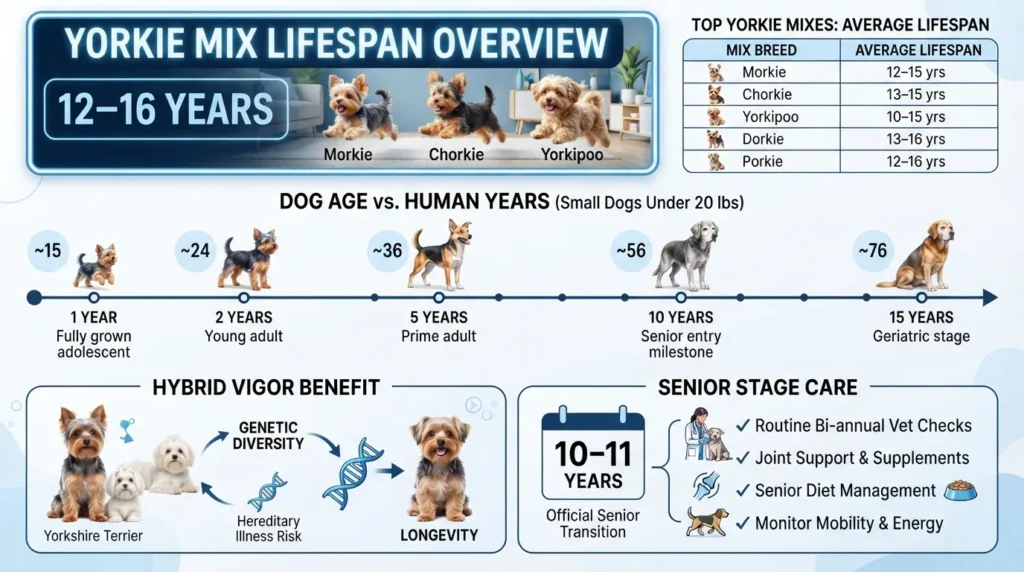
Yorkie mixes are among the longest-lived dogs in the canine world, boasting an impressive average lifespan of 12 to 16 years. Because both Yorkshire Terriers and most small parent breeds (like Poodles, Chihuahuas, and Maltese) naturally enjoy long lifespans, their hybrid offspring inherit that same longevity.
A major reason many Yorkie mixes reach their mid-teens in good health is a genetic concept known as hybrid vigor (or heterosis). Purebred dogs are often bred within limited gene pools, which can accidentally stack up hereditary health problems over time. When you cross two distinct purebred lines, the resulting Yorkie mix inherits a broader, more diverse pool of genes. This biological diversity reduces the likelihood of inheriting specific recessive genetic diseases, often leading to a hardier, healthier dog with a robust immune system.
When Does a Yorkie Mix Become a “Senior” Dog?
Because small-breed dogs age much slower than large breeds, a Yorkie mix enters their golden years later than a retriever or a mastiff would. While a large dog might be considered a senior by age 7, a Yorkie mix generally isn’t considered a senior until they reach 10 to 11 years old.
During this senior stage, you may notice subtle changes like a slight graying around their muzzle, clouding in their eyes, lower energy during outdoor walks, or a stiffer gait when jumping off furniture. Routine bi-annual vet checkups, dental cleanings, and joint support supplements become especially valuable once your mix hits double digits to keep them feeling spry.
Yorkie Mix Age in Human Years
It is a common myth that every dog year equals seven human years. Small dogs actually mature faster during their first two years of life, but their aging process slows down considerably compared to bigger dogs after that point.
To easily track your dog’s exact physical growth and biological stage, you can use our interactive Dog Age Calculator to convert their age instantly based on their specific weight and breed mix.
Here is a quick reference showing how a Yorkie mix’s age roughly converts into human years:
1 Year Old: ~15 human years (Fully grown adolescent)
2 Years Old: ~24 human years (Young adult)
5 Years Old: ~36 human years (Prime adult in their peak health)
10 Years Old: ~56 human years (Entering senior dog status)
15 Years Old: ~76 human years (Geriatric, loving companion)
Common Health Issues in Yorkie Mixes
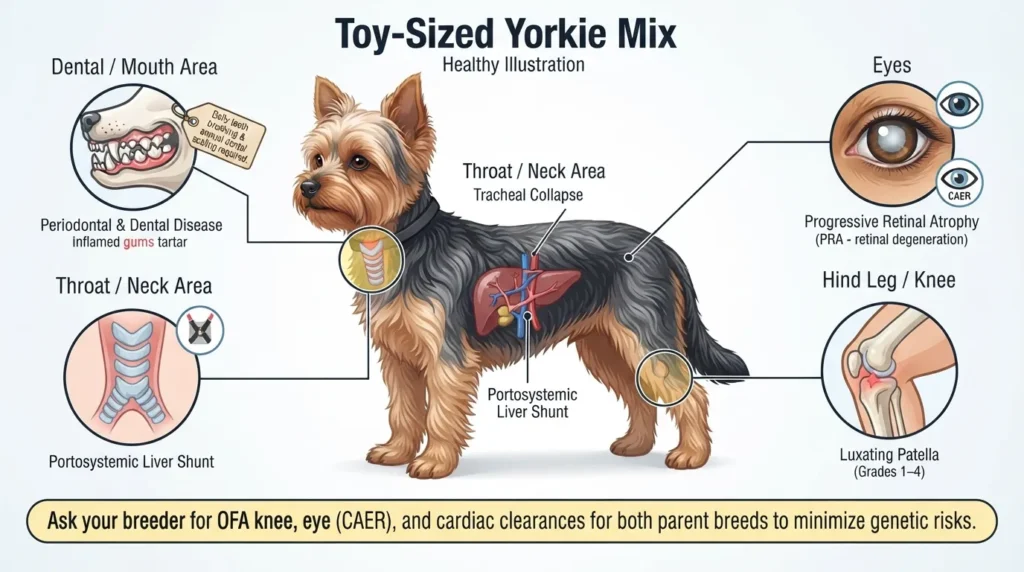
While hybrid vigor often gives crossbred dogs a genetic edge over purebreds, Yorkie mixes are not completely immune to illness. They can still inherit specific health conditions that commonly affect Yorkshire Terriers and other small toy breeds. Being aware of these potential health risks allows you to catch early signs and take preventive action with your veterinarian.
Here are the primary health issues to watch for in a Yorkie mix:
Periodontal & Dental Disease: Small jaws mean tightly packed teeth, creating ideal hiding spots for plaque and tartar. Without regular dental care, Yorkie mixes can suffer from early tooth decay, gum disease, and painful tooth loss.
Luxating Patella: A frequent issue in toy breeds where the kneecap (patella) slips out of its normal groove. You might notice your dog skipping or holding up a hind leg for a few steps before the knee pops back into place.
Portosystemic Liver Shunt: A congenital vascular condition where an abnormal blood vessel bypasses the liver instead of passing through it for filtration. This prevents toxins from being processed properly, leading to poor growth, lethargy, or neurological symptoms.
Tracheal Collapse: The cartilage rings lining the windpipe can weaken over time, causing the trachea to flatten. This results in a dry, harsh “goose-honk” cough, especially when the dog is overly excited or wearing a traditional neck collar.
Eye Conditions: Conditions like cataracts, progressive retinal atrophy (PRA), and dry eye (KCS) can affect Yorkie crossbreeds as they mature, sometimes leading to vision loss if left untreated.
Ask Your Breeder for These Health Clearances: Responsible breeders screen their breeding stock to avoid passing down genetic conditions. Before buying a Yorkie mix puppy, ask to see written health clearances for both parents, specifically including OFA or PennHIP knee evaluations, an OFA eye exam (CAER), and verification of clear cardiac health.
Common Myths About Yorkie Mixes Debunked
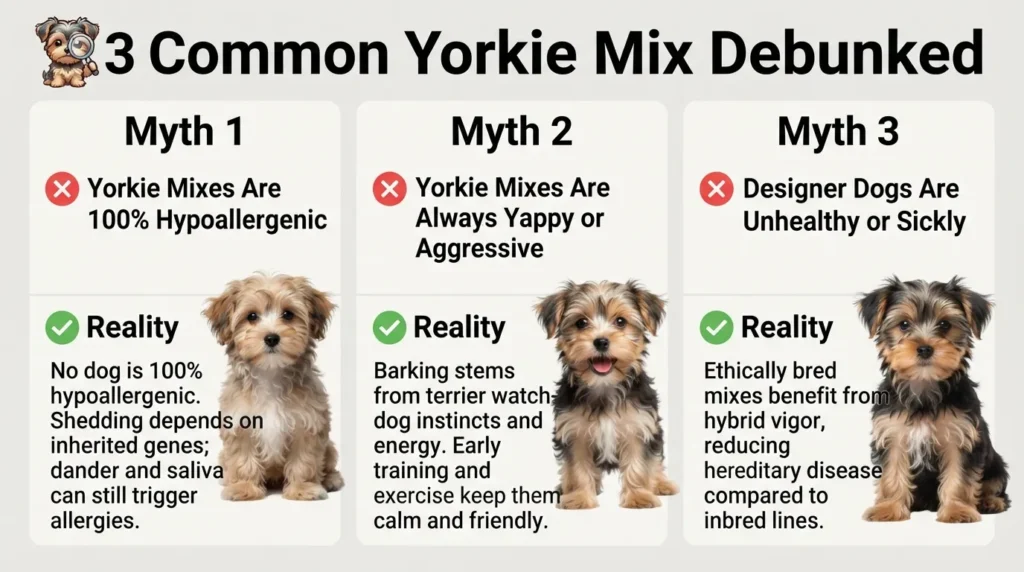
With the rising popularity of designer crossbreeds, plenty of misconceptions circulate online about what to expect when bringing a Yorkie mix home. Sorting fact from fiction helps ensure you choose the right companion for your lifestyle.
“Yorkie Mixes Are Hypoallergenic”
No dog is 100% hypoallergenic. While purebred Yorkies have human-like hair that lacks a dense undercoat and sheds very little, crossing them with a double-coated or higher-shedding parent breed (like a Pomeranian, Beagle, or Dachshund) introduces shedding genes into the litter.
Even in low-shedding crosses like a Yorkipoo or Morkie, allergies are triggered by proteins found in dander, saliva, and urine—not just fur. While an F1B backcross to a low-dander breed is often easier on sensitive immune systems, allergy sufferers should always spend hands-on time with an adult dog or puppy before committing.
“Yorkie Mixes Are Always Yappy/Aggressive”
It is easy to misinterpret terrier feistiness as aggression, but small-dog vocalizations usually stem from alertness, boredom, or poor socialization rather than innate hostility. Terriers were historically bred to be swift, brave rodent hunters, which translates into a keen watchdog instinct.
When a Yorkie mix barks, they are usually alerting you to a strange sound or expressing high energy. Early socialization, positive reinforcement training, and adequate daily mental exercise go a long way in preventing constant barking or fearful defensive behaviors.
“Designer Dogs Are Automatically Unhealthy”
There is a persistent myth that all deliberate crossbreeds suffer from unpredictable health problems compared to purebred dogs. On the flip side, some believe that hybrid vigor makes designer dogs immune to illness. The reality lies right in the middle.
A Yorkie mix bred from health-tested parents carries a lower risk of inheriting breed-specific recessive disorders than an inbred purebred line. However, buying a puppy from an unvetted backyard breeder or puppy mill—where parents aren’t screened for joint, heart, or eye conditions—can lead to health issues regardless of whether the dog is purebred or a mix. Health depends on ethical breeding practices, proper care, and routine veterinary attention.
Yorkie Mix Temperament & Personality
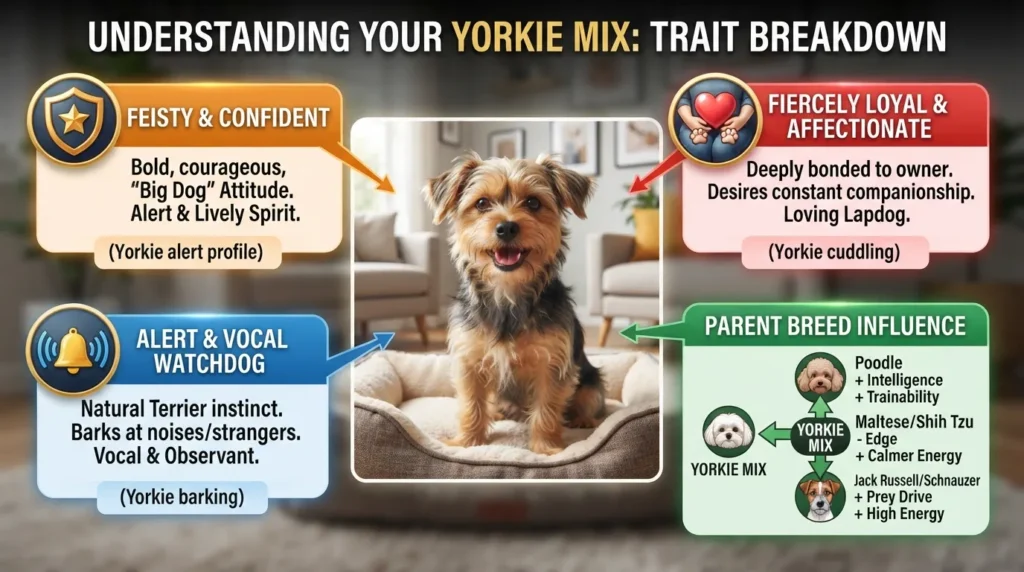
While a Yorkie mix’s appearance can be a delightful surprise, their temperament is where their personality truly shines. To understand what makes a Yorkie mix tick, you have to look at the working roots of the Yorkshire Terrier and how those traits blend with other dog breeds.
Traits Inherited from the Yorkie Side
Don’t let their dainty size fool you—purebred Yorkies were originally bred in 19th-century England to hunt rats and vermin in textile mills and coal mines. That working background leaves a distinct genetic imprint on almost every Yorkie mix:
Spunky and Confident: Yorkies possess classic “big dog in a small body” energy. They are spirited, curious, and rarely intimidated by their surroundings.
Fiercely Loyal: A Yorkie mix typically forms a deep, unwavering bond with their humans. They love being right in the middle of family life, following you from room to room, and claiming your lap the moment you sit down.
Vocal Watchdogs: Terriers are naturally alert and quick to react. Your Yorkie mix will likely view it as their personal duty to announce the arrival of delivery drivers, unfamiliar noises, or guests at the front door.
How Temperament Varies by Mix
The second parent breed acts as a balancing knob on the Yorkie’s natural feistiness. Depending on the genetic blend, your mix’s personality can shift in very different directions:
Softer and Calmer: Mating a Yorkie with a gentle, easygoing breed—like a Maltese (Morkie), Cavalier King Charles Spaniel (Cava-Yorkie), or Shih Tzu (Shorkie)—tends to tone down the sharp terrier edge, producing a sweeter, quieter lap dog.
Highly Intelligent and Trainable: Adding Poodle genetics (Yorkipoo) or Papillon genetics (Papiyork) brings a boost of problem-solving brainpower, making the dog highly receptive to learning tricks and basic obedience commands.
High-Drive and Spirited: Crossing a Yorkie with another high-energy breed—such as a Jack Russell (Jorkie) or Miniature Schnauzer (Snorkie)—amplifies those terrier instincts, resulting in an athletic, highly driven pup that needs plenty of daily physical exercise and mental stimulation.
Good with Kids & Other Pets — An Honest Breakdown
Yorkie mixes can make wonderful family companions, but they aren’t automatically the right fit for every household.
With Children: Yorkie mixes generally thrive around older kids who know how to handle small pets gently. The main concern with younger kids or toddlers isn’t aggression—it’s safety. A fragile 5-pound dog can easily be injured if stepped on, dropped, or squeezed too tightly. Additionally, if a tiny dog feels cornered or hurt by rough play, they may nipping out of self-defense.
With Other Dogs: Most Yorkie mixes get along well with other canine housemates, particularly dogs of similar size. However, their bold terrier confidence means they don’t always realize how small they are, so supervision is important around very large, energetic dogs.
With Cats & Small Animals: Because the Yorkie parent was bred to chase rodents, many Yorkie mixes retain a natural prey drive. They can certainly live peacefully with cats—especially if raised with them from a young age—but they may instinctually chase small pocket pets like hamsters, guinea pigs, or rabbits.
Yorkie Mix vs. Purebred Yorkshire Terrier — Which Should You Choose?
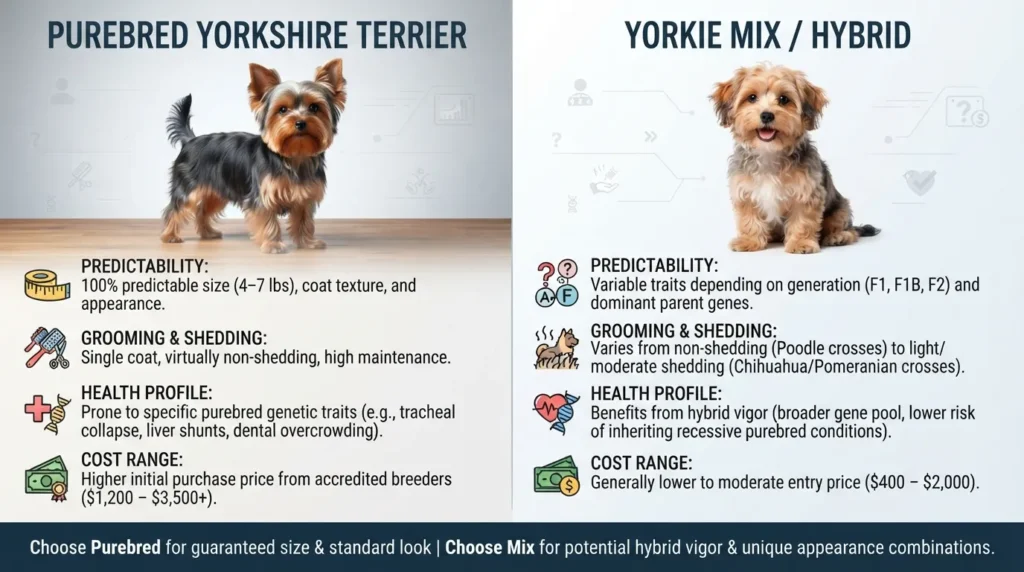
Deciding between a Yorkie mix and a purebred Yorkshire Terrier comes down to what you value most in a companion: genetic predictability or hybrid traits. While both options share the same iconic terrier roots, there are key differences in health, appearance, and overall cost that can guide your choice.
Health & Hybrid Vigor Differences
Purebred Yorkies are bred within a strict, closed gene pool to maintain exact standards. While this preserves specific physical traits, it can also concentrate hereditary health risks like portosystemic liver shunts, severe dental crowding, and tracheal collapse.
A Yorkie mix benefits from hybrid vigor—the genetic advantage gained by combining two distinct gene pools. By widening the genetic lineup, a hybrid cross is generally less likely to inherit the specific recessive health conditions associated with either parent breed, often resulting in a hardier overall immune system.
Predictability of Temperament & Appearance
If absolute predictability is your top priority, the purebred Yorkshire Terrier takes the lead. With a purebred puppy, you know precisely what you are getting: a dog that will grow to roughly 4 to 7 pounds, carry a straight steel-blue and tan single coat, and possess a classic high-energy terrier personality.
With a Yorkie mix, genetics are more of a wildcard. Even within a single F1 litter, one puppy might inherit a soft, curly, non-shedding coat from a Poodle parent, while a littermate gets a short, shedding coat and a broader frame from a Chihuahua or Dachshund heritage.
Cost Differences
Upfront Purchase Price: Purebred AKC-registered Yorkie puppies from reputable show or pet breeders typically cost between $1,500 and $3,500+. Yorkie mixes generally range from $400 to $1,800, though high-demand “doodle” crosses like Yorkipoos can sometimes approach purebred pricing.
Adoption Opportunities: Yorkie mixes are far more common in rescues and local animal shelters, making adoption an accessible, budget-friendly option (usually $150 to $400 including vaccinations and spay/neuter services).
Grooming Expenses: Both require routine maintenance, but a low-shedding Yorkie mix with a dense, curly, or wavy coat may require professional grooming every 4 to 6 weeks, similar to a purebred.
Quick Verdict Box by Owner Priority
Choose a Purebred Yorkie If: You want guaranteed predictability in adult size, coat type, and shedding levels, or if you plan to participate in AKC events and official dog sports.
Choose a Yorkie Mix If: You want potential hybrid health benefits, prefer a wider variety of coat colors and physical builds, or want a slightly sturdier companion for active family life.
How Much Does a Yorkie Mix Cost?

Bringing a Yorkie mix into your life involves two distinct financial steps: the initial purchase or adoption fee and the routine monthly expenses required to keep a small dog healthy and well-groomed over a 12 to 16-year lifespan.
While small dogs generally cost less to feed than large breeds, their specific grooming and dental care needs mean their long-term budget shouldn’t be overlooked.
Puppy Price Ranges by Mix Type
The upfront cost of a Yorkie mix puppy varies significantly based on regional demand, breeder reputation, generation (such as F1 versus F1B), and whether the parents underwent proper genetic health testing.
High-Demand Designer Crosses ($800 – $2,000+): Popular “doodle” mixes like the Yorkipoo, alongside sought-after lap companions like the Morkie or Shorkie, often sit at the higher end of the price spectrum due to strong market popularity.
Moderate-Demand Crosses ($400 – $1,200): Mixes like the Chorkie, Dorkie, Porkie, or Snorkie generally carry more modest price tags from independent breeders.
Rescue & Adoption ($150 – $400): Adopting a Yorkie mix through a local shelter or breed-specific rescue is the most budget-friendly path. This fee typically covers initial vaccinations, microchipping, a complete vet check, and spaying or neutering.
Ongoing Costs — Food, Grooming, Vet Care, Insurance
Beyond the initial adoption or puppy purchase, here is a realistic breakdown of what you can expect to spend annually on a Yorkie mix:
Food & Treats ($20 – $40 / month): Because Yorkie mixes only eat a fraction of a cup of high-quality small-breed kibble a day, food expenses remain very manageable throughout their life.
Professional Grooming ($50 – $90 / visit): Most silky, wavy, or curly-coated Yorkie mixes require professional grooming every 6 to 8 weeks. Over a year, routine haircuts, bath packages, and nail trims add up to $350 – $600+.
Veterinary Care & Preventive Medicine ($300 – $600 / year): Covers annual wellness checkups, core vaccine boosters, and year-round flea, tick, and heartworm preventatives. Budgeting for periodic dental cleanings is also essential given their vulnerability to tartar buildup.
Pet Insurance ($25 – $50 / month): Pet insurance for small hybrid breeds is generally affordable and helps cover unexpected emergencies, accidental bone fractures, or chronic conditions like luxating patellas.
Which Yorkie Mix Is Right for You? Lifestyle Match Guide
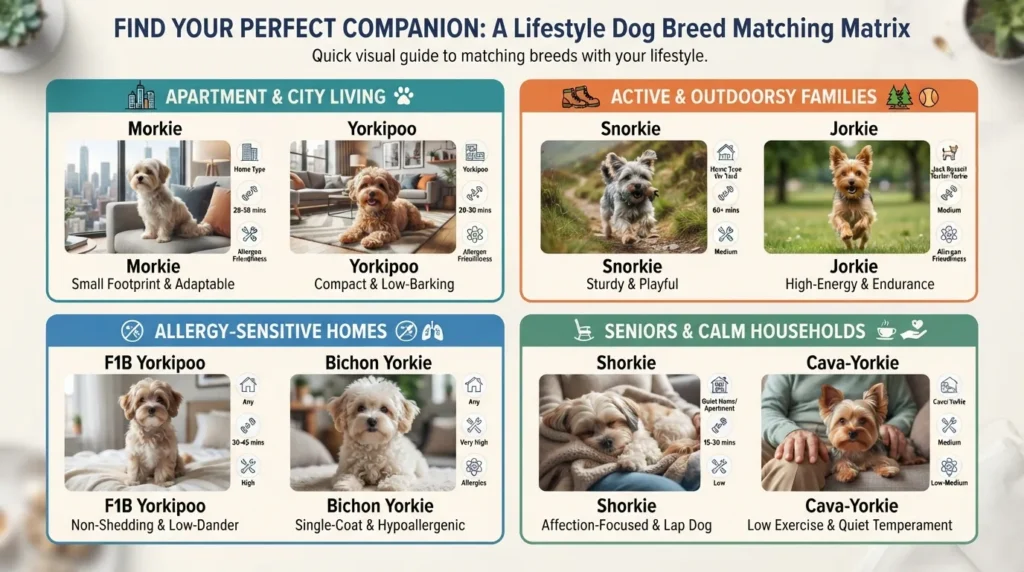
Every Yorkie crossbreed carries a unique mix of energy, personality, and physical care requirements. Choosing the right companion comes down to matching a dog’s traits with your daily routine, living environment, and household needs.
Best for Apartments: Chorkie & Porkie
If space is limited, the compact size of a Chorkie (Yorkie + Chihuahua) or a Porkie (Yorkie + Pomeranian) makes them ideal indoor companions. They burn off much of their energy through short indoor games and short neighborhood strolls. Their tiny frame means they navigate smaller floor plans effortlessly, provided you work on early bark-control training to keep apartment neighbors happy.
Best for Allergy Sufferers: Yorkipoo & Morkie
For households dealing with dander sensitivities, the Yorkipoo (Yorkie + Poodle) and the Morkie (Yorkie + Maltese) are top choices. Both parent breeds carry single-layer, low-shedding coats rather than fur undercoats. An F1B Yorkipoo backcrossed to a Poodle offers the highest level of coat predictability for a low-dander household.
Best for Seniors / Low-Exercise Homes: Shorkie & Cava-Yorkie
Seniors or owners seeking a relaxed companion will love the gentle, lap-focused nature of the Shorkie (Yorkie + Shih Tzu) or Cava-Yorkie (Yorkie + Cavalier King Charles Spaniel). These mixes inherit a calmer demeanor from their non-terrier parents, making them content with short daily walks and plenty of cuddle time on the sofa.
Best for Families with Kids: Snorkie & Fourche Terrier
Families with active children benefit from a dog with a slightly sturdier build. The Snorkie (Yorkie + Miniature Schnauzer) and Fourche Terrier (Yorkie + Westie) boast durable, muscular frames that handle playtime far better than fragile toy mixes. They carry plenty of playful energy and love participating in family outdoor activities.
Best for First-Time Dog Owners: Bichon Yorkie & Yorkie-Havanese
If you are new to dog ownership, the Bichon Yorkie or Havashire (Yorkie + Havanese) provides a sweet, forgiving temperament. These mixes inherit eager-to-please, sociable personalities that make obedience training smooth and straightforward, avoiding the stubborn streaks found in higher-drive terrier crosses.
| Question | Answer |
|---|---|
| What is the smallest Yorkie mix? | The Chorkie (Yorkie + Chihuahua) and the Porkie (Yorkie + Pomeranian) are generally the smallest Yorkie mixes, with many adult dogs weighing between 3 and 7 pounds depending on the size of the parent breeds. |
| What is the biggest Yorkie mix? | The Borkie (Yorkie + Beagle) and the Fourche Terrier (Yorkie + West Highland White Terrier) tend to be the largest, often weighing between 12 and 18 pounds as adults. |
| Are Yorkie mixes good apartment dogs? | Yes, Yorkie mixes make exceptional apartment pets due to their compact size and modest indoor exercise requirements. However, early training is important to keep their watchdog alert-barking under control in shared buildings. |
| Do Yorkie mixes bark a lot? | They can be vocal. Because Yorkshire Terriers possess keen terrier watchdog instincts, many Yorkie mixes bark to alert you of doorbells, strangers, or unexpected noises. Consistent training and mental enrichment help curb unnecessary barking. |
| Are Yorkie mixes good with kids? | They do great with older, gentle children who understand how to interact with small dogs safely. Due to their delicate frames, toy-sized Yorkie mixes can easily be hurt by toddlers or rough play, so supervision is always recommended. |
| How much exercise does a Yorkie mix need? | Most Yorkie mixes need around 30 to 45 minutes of daily exercise. A combination of a brisk daily neighborhood walk and short indoor play sessions with toys is usually enough to burn off their energy. |
| What is the friendliest Yorkie mix? | The Morkie (Yorkie + Maltese) and the Bichon Yorkie (Yorkie + Bichon Frise) are widely considered the most social and friendly Yorkie mixes, inheriting gentle, cheerful temperaments from their non-terrier parents. |
| Do Yorkie mixes shed? | It depends on the second parent breed. Mixes with Poodles, Maltese, or Shih Tzus shed very little and are considered low-dander, while crosses with double-coated breeds like Beagles or Pomeranians will shed moderately. |
| What's the most popular Yorkie mix? | The Yorkipoo (Yorkie + Poodle) and the Morkie (Yorkie + Maltese) hold the top spots as the most popular Yorkie crossbreeds globally thanks to their low-shedding coats and affectionate personalities. |
| How long do Yorkie mixes live? | On average, a healthy Yorkie mix lives between 12 and 16 years, with many reaching their late teens when provided with good nutrition, routine dental care, and regular veterinary checkups. |
| Are teacup Yorkie mixes healthy? | Generally, no. Unethically breeding dogs down to "teacup" size (under 4 pounds) increases their risk for severe health problems like hypoglycemia, fragile bones, dental overcrowding, and tracheal collapse. |
| How much does a Yorkie mix puppy cost? | A Yorkie mix puppy typically costs between $400 and $2,000. Prices vary based on breeder reputation, location, demand, generation (such as F1 vs F1B), and specific parent breed health clearances. |
| Can Yorkie mixes be left alone? | Yorkie mixes are highly social companion dogs and can develop separation anxiety if left alone for extended periods. Most do best when not left alone for more than 4 to 6 hours at a time. |
| What do Yorkie mixes usually look like? | Appearance varies widely even within a single litter. Most Yorkie mixes retain a compact frame, expressive eyes, and a coat that ranges from silky and straight to soft and curly in shades of black, tan, gold, or silver. |
| At what age is a Yorkie mix considered senior? | Because small dogs mature and age slower than large breeds, a Yorkie mix is generally not considered a senior until they reach 10 to 11 years of age. |
| Is a male or female Yorkie mix better? | Both make wonderful pets. Males are often described as slightly more affectionate and eager to please, while females can be more independent. Individual temperament and proper spaying/neutering matter far more than sex. |
| What is an F1B Yorkie mix? | An F1B Yorkie mix is produced by crossing a first-generation (F1) Yorkie mix back with a purebred parent breed—most commonly a Poodle or Yorkie. This backcross creates a more predictable, low-shedding coat. |
| Do Yorkie mixes get along with cats? | Yes, many Yorkie mixes live comfortably alongside cats, especially when raised together from puppyhood. Because terriers carry a natural prey drive, slow and controlled introductions are key when introducing them to new feline housemates. |
🐾 Other Age Guides

I built Dogagescalculator.com to give dog owners honest, science-backed answers instead of the outdated "×7" myth. Every figure here is checked against AKC, AVMA, and published veterinary research.
More about the author & this site →
Comments