
40 Dog Years to Human Years – What Does It Really Mean?
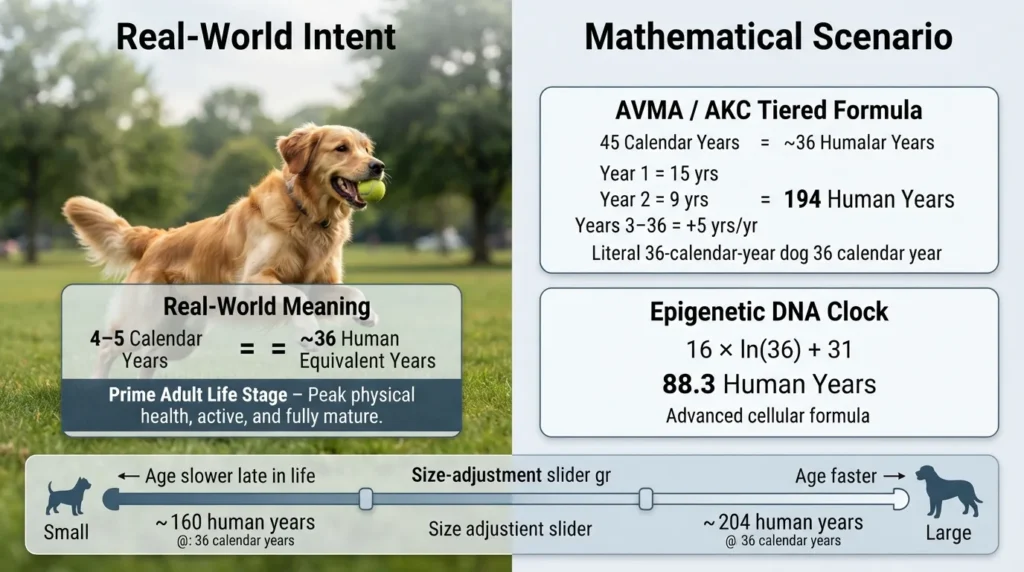
A dog with 36 “dog years” is roughly 4 to 5 calendar years old, depending on their breed and size. While the outdated “multiply by 7” rule created widespread confusion by calculating age linearly, modern veterinary science tells a very different story. According to official American Veterinary Medical Association (AVMA) aging guidelines, dogs age fastest during their first two years before their developmental curve stabilizes—meaning 36 dog years reflects a vibrant adult dog in their prime, not a senior.
Quick Answer At a Glance
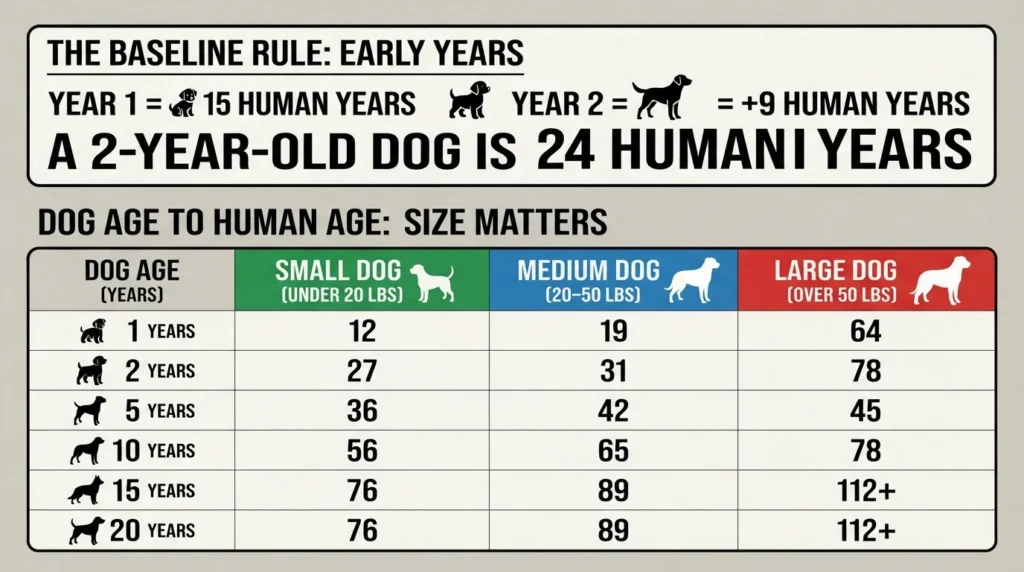
If your dog is celebrating their 17th birthday, congratulations—they’ve reached an extraordinary milestone. But translating those 17 dog years into human years depends entirely on which math model you use, as well as your dog’s physical size.
Old method (7x rule): 119 human years. This traditional “multiply by 7” shortcut simply treats every canine year equally, making a 17-year-old dog the equivalent of a 119-year-old person.
New AVMA-based method: 84 to 100+ human years. According to modern canine life stage guidelines from the American Veterinary Medical Association (AVMA) and the American Animal Hospital Association (AAHA), dogs age rapidly during their first two years, after which the aging curve slows down and splits significantly based on body mass.
Size-Based Breakdown for a 17-Year-Old Dog
Because small breeds age much slower late in life than giant breeds, 17 dog years in human years translates differently across body sizes:
Small Dogs (under 20 lbs): ~84 human years
Medium Dogs (21–50 lbs): ~88–93 human years
Large Dogs (51–90 lbs): ~98–105 human years
Giant Dogs (90+ lbs): ~115+ human years (reaching 17 is exceptionally rare for giant breeds)
How Is Dog Age Calculated in Human Years?
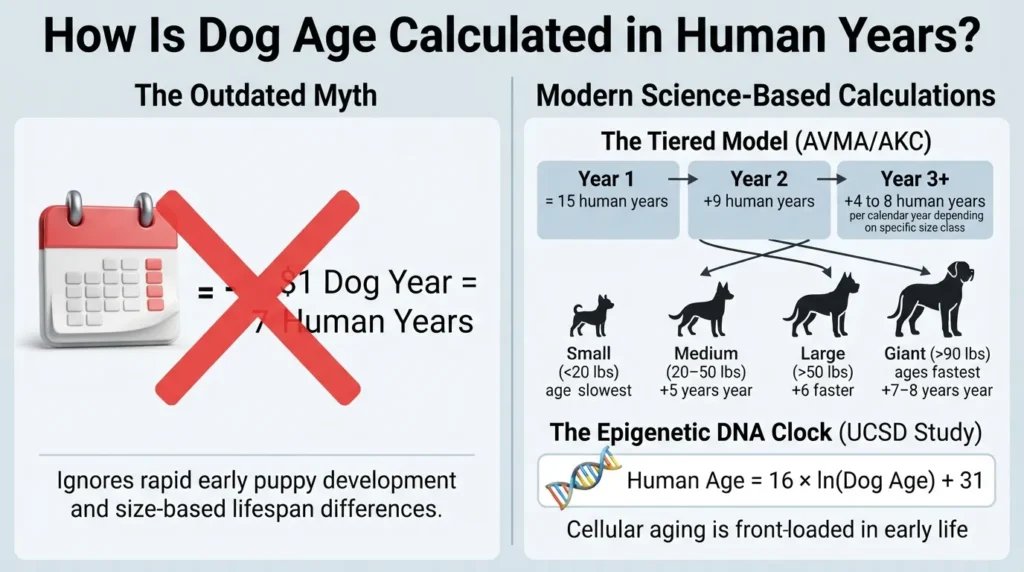
Calculating your dog’s age isn’t as simple as pulling a single number out of a hat. Over the years, veterinary medicine has shifted from quick rule-of-thumb estimates to precise biological formulas that reflect how dogs actually grow, mature, and age at a cellular level.
The Old “1 Dog Year = 7 Human Years” Myth
For decades, the standard belief was simple: multiply your dog’s age by 7 to get their human equivalent.
This rule originated around the mid-20th century, largely based on a simple statistical ratio comparing average human life expectancy (around 70 years at the time) to an average dog’s life expectancy (around 10 years). While easy to remember, it ignores two major biological realities:
Front-loaded maturation: Dogs reach reproductive maturity within their first 12 to 18 months—a pace far faster than a 7-year-old human child.
Size variation: A 70-pound Golden Retriever and a 7-pound Chihuahua age at drastically different rates, which a flat multiplier fails to capture.
The New AVMA/AKC Formula
To provide a more realistic estimate, organizations like the American Veterinary Medical Association (AVMA) and the American Kennel Club (AKC) adopted a tiered guideline. This formula accounts for the rapid development during a puppy’s early years before settling into a steady rate.
Under this standard benchmark, age is calculated as follows:
Year 1: Equals roughly 15 human years (covering rapid skeletal and biological development).
Year 2: Adds another 9 human years, bringing a 2-year-old dog to roughly 24 human years.
Year 3 and beyond: Adds approximately 5 human years for every calendar year, depending on breed size and weight class.
Epigenetic Clock Formula (2019 Study)
In 2019, researchers at the University of California, San Diego (Wang et al., published in Cell Systems) introduced a groundbreaking method based on epigenetics—specifically, chemical changes to DNA known as DNA methylation.
By analyzing how molecular markers change over time in Labrador Retrievers compared to humans, the team developed a logarithmic formula for cellular aging:
Human Age = 16 × ln(Dog Age) + 31
(where ln represents the natural logarithm of the dog’s chronological age)
This research reveals that dogs age rapidly on a cellular level during their puppyhood and young adulthood, after which their biological aging curve flattens significantly. While a 1-year-old dog translates to roughly 31 human years under this genetic model, aging slows down noticeably in the senior years.
36 Dog Years to Human Years – Full Calculation Breakdown
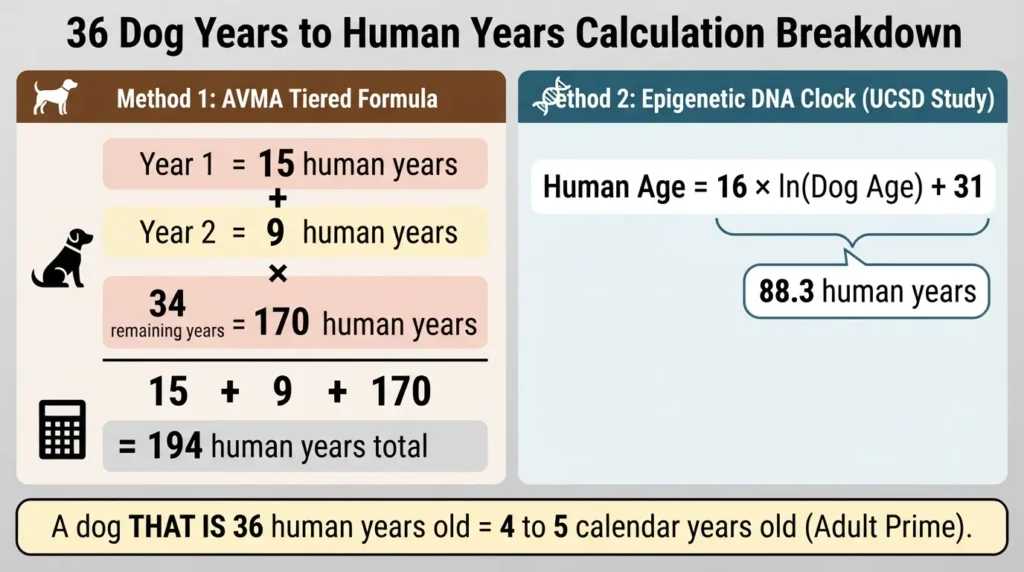
Calculating the human equivalent for a 36-year-old dog relies on established veterinary age models, specifically the American Veterinary Medical Association (AVMA) tiered methodology and the DNA methylation formula from the 2019 Cell Systems genetic study.
Because a 36-calendar-year lifespan in dogs is an extraordinary mathematical scenario, running these standard equations illustrates how canine biological aging compares to human longevity.
Here is the exact step-by-step breakdown using both standard methods:
Method 1: AVMA/AKC Standard Tiered Model
Year 1: First year of life equals 15 human years (rapid physical development).
Year 2: Second year adds 9 human years (reaching initial maturity at 24 human years).
Years 3 through 36 (34 remaining years): Multiply the remaining 34 years by 5 human years per year (34 × 5 = 170).
Final Calculation: 24 + 170 = 194 human years.
Method 2: Epigenetic Clock Model (Wang et al., 2019)
Using the logarithmic methylation formula: Human Age = 16 × ln(Dog Age) + 31
Calculate the natural logarithm of 36: ln(36) ≈ 3.5835
Multiply by 16: 16 × 3.5835 ≈ 57.336
Add 31: 57.336 + 31 = 88.33 human years
Depending on the calculation method used, a 36-year-old dog converts to between 88 and 194 human years, with the 194 human years mark reflecting the standard veterinary baseline.
Note: Biological age varies significantly based on breed and size class. Small breeds (under 20 lbs) age noticeably slower in their senior years compared to large or giant breeds, which means a small dog’s true biological wear and tear at extreme ages is typically lower than standard linear multipliers suggest.
Want to figure out your own pet’s exact biological age? Use our free dog age calculator on this page to get an instant, size-adjusted estimate tailored specifically to your dog’s breed and weight.
Dog Age to Human Age Chart
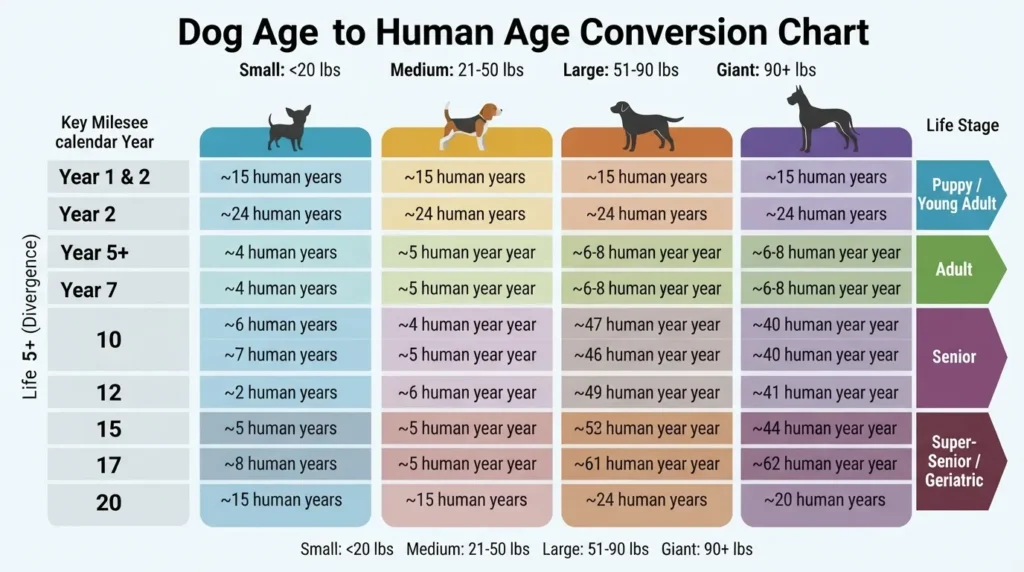
Understanding your dog’s age requires looking past generic formulas. Canine aging rates diverge sharply based on breed size—while all dogs mature rapidly during early life, small breeds age significantly slower in their senior years compared to large or giant breeds.
Chart by Age (1–20 years)
According to canine life stage guidelines from the American Animal Hospital Association (AAHA), dogs follow a shared trajectory for their first two years before size-specific aging takes over.
Below is a quick reference snapshot of key milestones across different size categories:
| Key Life Stage | Dog Age | Small Breed (under 20 lbs) | Medium Breed (20–50 lbs) | Large Breed (over 50 lbs) |
|---|---|---|---|---|
| Young Adult | 2 Years | 24 human years | 24 human years | 24 human years |
| Adult | 5 Years | 36 human years | 36 human years | 36 human years |
| Senior Entry | 7 Years | 44 human years | 47 human years | 50 human years |
| Senior | 12 Years | 64 human years | 69 human years | 77 human years |
| Super Senior | 17 Years | 84 human years | 92 human years | 104 human years |
| Centenarian Equivalent | 20 Years | 96 human years | 105 human years | 120 human years |
Chart Beyond 20 Years (Including 36-Year Scenario)
Reaching 20 calendar years is an extraordinarily rare milestone in canine health. Beyond 20 years, standard veterinary matrices rely on mathematical extrapolation based on AVMA baseline formulas rather than common clinical observations.
| Extreme Milestone | Dog Age | Small Breed (under 20 lbs) | Medium Breed (20–50 lbs) | Large Breed (over 50 lbs) |
|---|---|---|---|---|
| Venerable Senior | 22 Years | 104 human years | 114 human years | 131 human years |
| Quarter-Century | 25 Years | 116 human years | 128 human years | 147 human years |
| Extreme Longevity | 30 Years | 136 human years | 151 human years | 173 human years |
| Record Scenario | 36 Years | 160 human years | 178 human years | 204 human years |
(Note: Mathematical extrapolations past 20 years show biological wear-and-tear projections; in real-world veterinary care, giant breeds very rarely survive past 12 to 14 years.)
Does Dog Size Affect Human Year Conversion?
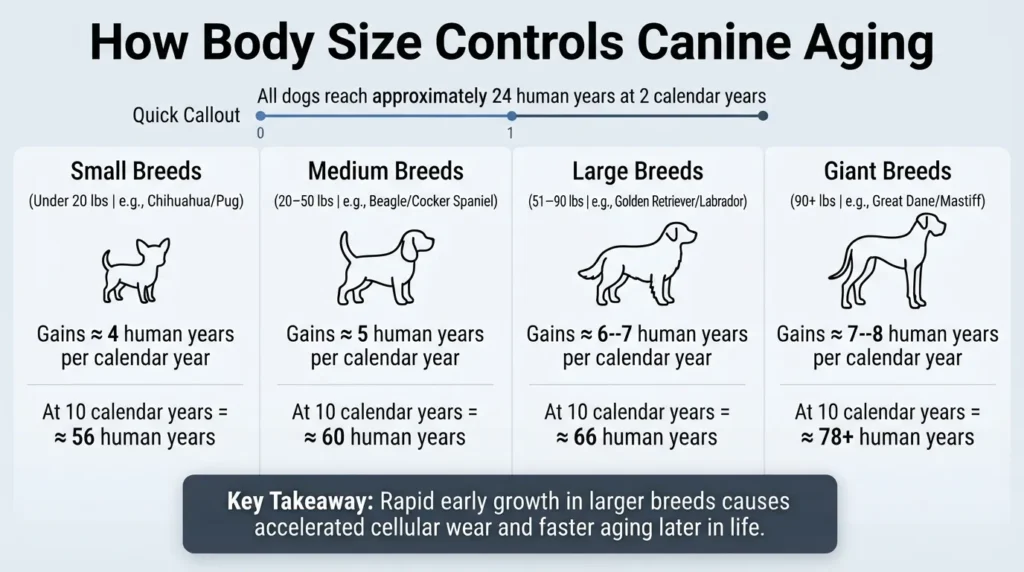
Yes, size is single-handedly the most influential factor in how your dog ages. While a 1-year-old Chihuahua and a 1-year-old Great Dane reach biological maturity at roughly the same pace, their aging trajectories split dramatically once adult growth stabilizes.
In the canine world, the typical mammalian pattern is flipped on its head: smaller animals live significantly longer than larger ones.
Small Breeds Age Slower | Large Breeds Age Faster
During early puppyhood, all dogs experience a rapid growth spurt equivalent to about 15 human years. After year two—where both reach roughly 24 human years—the aging clock ticks at vastly different speeds depending on body weight:
Small Breeds (under 20 lbs): Age by roughly 4 human years for every calendar year after age two.
Medium Breeds (20–50 lbs): Age by roughly 5 human years per calendar year.
Large & Giant Breeds (over 50 lbs): Age by 6 to 8 human years per calendar year, entering their senior stage much earlier.
Because of this physiological gap, a 17-year-old small dog sits at around 84 human years, whereas a 17-year-old large dog would theoretically reach an astonishing 104+ human years.
Popular Breed Examples
To see how size affects aging in everyday life, consider these common breeds at age 10:
Pug (Small, ~15 lbs): At 10 calendar years, a Pug is roughly 56 in human years. They are considered a comfortable senior, often still active with routine health maintenance.
Labrador Retriever (Medium/Large, ~65 lbs): At 10 calendar years, a Lab reaches approximately 66 in human years, requiring closer monitoring for joint stiffness and metabolic shifts.
German Shepherd (Large, ~85 lbs): At 10 calendar years, a German Shepherd is biological equivalent to a 70-year-old human, facing significant age-related wear on their frame.
Body Mass & Lifespan Science
Why do larger dogs age faster? Evolutionary biologists and veterinary researchers point to rapid growth rates and accelerated metabolic demand.
Studies published by the American Physiological Society highlight that large breeds grow at an extraordinary pace during early life—sometimes multiplying their birth weight by 100 times in under a year. This explosive growth produces higher concentrations of free radicals, causing faster cellular damage and accelerated biological aging.
Veterinary researchers also note that larger dogs suffer from age-related developmental conditions (like osteoarthritis and cardiac strain) much earlier in life, effectively shortening their average lifespan compared to toy and miniature breeds.
Is a 36-Year-Old Dog Even Possible?Real-World Context
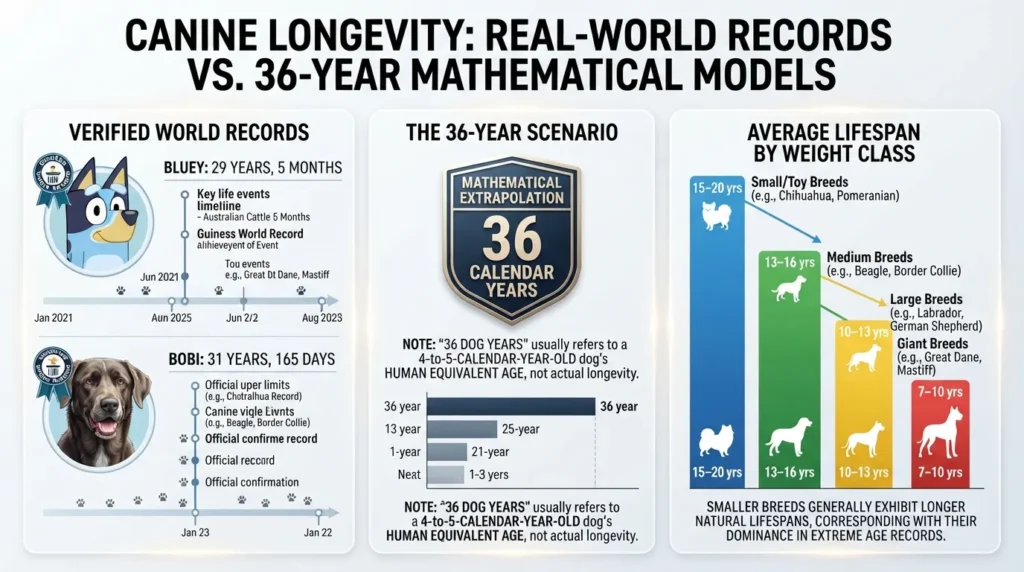
While running the math for a 36-year-old dog gives us an astonishing equivalent of 88 to 204 human years, encountering a canine in their mid-thirties is practically unprecedented in veterinary history.
Understanding what a 36-year lifespan means in the real world requires separating canine biology from extreme outliers and search trends.
The Oldest Verified Dog on Record
The longest-lived dog verified by official longevity databases was Bobi, a Rafeiro do Alentejo from Portugal who reached 31 years and 165 days before his passing in late 2023. Prior to Bobi, the long-standing record belonged to Bluey, an Australian Cattle Dog who lived to be 29 years and 5 months (1910–1939).
While these extraordinary cases prove that dogs can occasionally live well into their late twenties or early thirties under exceptional circumstances, even the oldest recorded dogs fall short of the 36-calendar-year mark.
Realistic Max Lifespan by Breed Size
In everyday veterinary practice, a dog’s maximum potential lifespan depends almost entirely on their body weight class:
Toy and Small Breeds (e.g., Chihuahuas, Toy Poodles): 15–20 years (rare outliers reach 22–24).
Medium Breeds (e.g., Australian Cattle Dogs, Beagles): 13–16 years.
Large Breeds (e.g., Golden Retrievers, German Shepherds): 10–13 years.
Giant Breeds (e.g., Great Danes, Mastiffs): 7–10 years.
Smaller bodies experience far less cardiovascular load and cell wear over time, which is why almost every dog reaching 20+ years belongs to a small or toy breed category.
Literal Lifespan vs. Calculated Intent: What “36” Really Means
When dog owners search for “36 dog years in human years,” they are almost never talking about a dog that has lived through 36 actual calendar years on Earth.
Instead, this search typically stems from one of two scenarios:
Working backward from human age: The owner’s dog is roughly 4 to 5 calendar years old—which translates to around 36 human years on standard AVMA age charts—and they are looking to confirm that milestone.
Using the old “multiply by 7” rule: The owner has a 5-year-old dog (5×7=35) and wants to see what that biological age looks like in human terms.
If your dog is actually 4 or 5 calendar years old, they are currently sitting comfortably in the prime of their adult life—equivalent to a human in their mid-thirties—with many healthy, energetic years ahead.
What Life Stage Does This Represent?
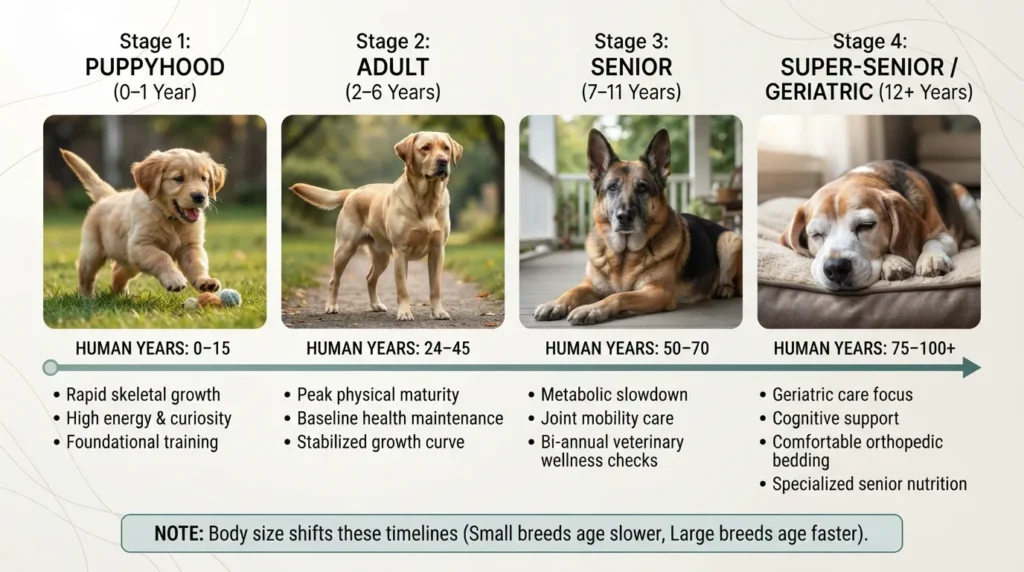
At 17 dog years in human years—which translates to anywhere between 84 and 104 human years—your dog has firmly entered the super-senior stage of life.
According to American Animal Hospital Association (AAHA) canine life stage guidelines, dogs cross into the senior phase around age 7 to 10 depending on size, but reaching 17 moves a dog well past standard senior status into true geriatric longevity.
Puppyhood (0–1 year): Rapid biological growth, equivalent to human childhood and early adolescence.
Adult (2–6 years): Physical maturity and peak health, roughly spanning ages 24 to 45 in human terms.
Senior (7–11 years): Early cellular aging begins; dogs require closer metabolic and joint monitoring.
Super-Senior / Geriatric (12+ years): Advanced age where nearly every organ system shows age-related changes, requiring specialized supportive care.
In human terms, a 17-year-old dog in human years is living in their late 80s, 90s, or even past 100.
Think of this as the great-grandparent stage of a dog’s life. At this age, your companion moves a bit slower, sleeps much deeper, and relies on familiar routines. They have earned extra patience, softer bedding, and gentle daily support for their senior years.
Factors That Affect Aging & How to Support a Senior Dog
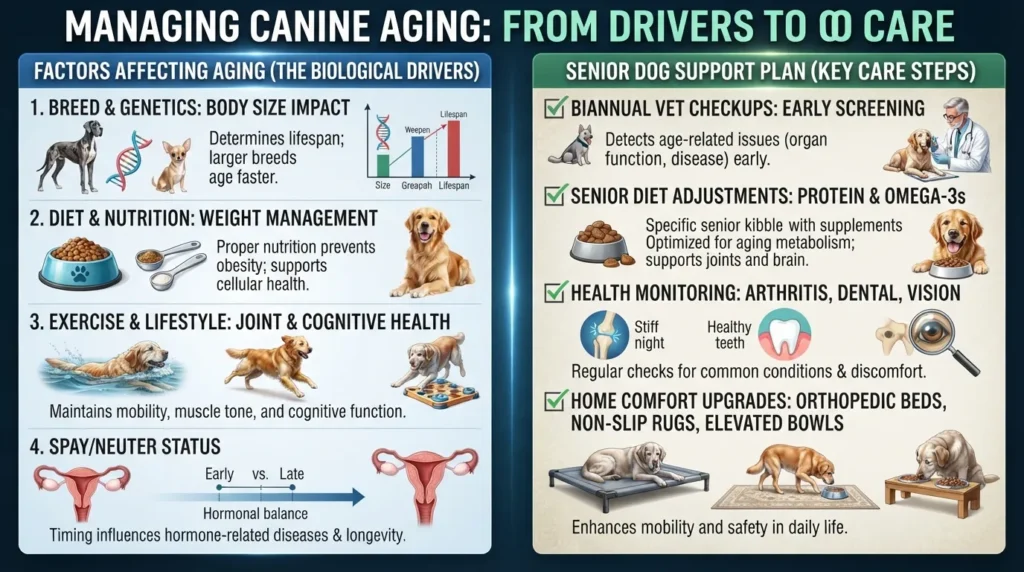
Chronological age only tells half the story. While a 17-year-old dog in human years has reached a venerable milestone, two dogs of the exact same age can have vastly different biological vitality based on their lifetime genetics, environment, and ongoing care.
Key Aging Factors
How quickly a dog’s biological clock ticks comes down to a blend of baseline genetics and daily lifestyle habits:
Breed & Genetics: Body size is the single strongest predictor of canine lifespan. Large and giant breeds experience higher metabolic rates and cellular strain during growth, causing their organs to age faster than small or toy breeds.
Diet & Nutrition: Maintaining a lean body mass directly correlates with extended longevity. Research shows that chronic obesity accelerates inflammatory processes, shortening a dog’s life expectancy by up to two years.
Exercise & Lifestyle: Consistent, low-impact activity keeps joints lubricated, maintains muscle mass, and stimulates brain activity, slowing down cognitive decline in senior years.
Neuter/Spay Status: Studies published in veterinary epidemiological research show that spayed and neutered dogs generally live longer, largely due to a significantly lower risk of reproductive tract cancers and severe uterine infections like pyometra.
Senior Dog Care Tips
Caring for a dog in their golden years requires shifting from preventive routine maintenance to active comfort management and close observation.
Increase Vet Checkup Frequency: Transition from annual checkups to biannual (every 6 months) senior wellness exams. Senior blood panels and urinalysis can catch early-stage kidney disease or thyroid shifts months before physical symptoms appear.
Make Senior Diet Adjustments: Switch to highly digestible protein sources to combat muscle wasting (sarcopenia). Senior formulas with added omega-3 fatty acids (EPA/DHA) help manage systemic joint inflammation.
Monitor Common Health Issues: Keep a daily eye out for subtle changes.
Arthritis: Stiff movement when waking up or hesitancy on stairs.
Dental Disease: Red gums or bad breath, which can send bacteria into the bloodstream and strain the heart and kidneys.
Vision & Hearing Loss: Cloudiness in the lenses (nuclear sclerosis) or startling easily when approached from behind.
Optimize Mobility & Comfort: Place orthopedic memory foam beds in draft-free areas. Lay down non-slip rugs over hardwood or tile floors to prevent painful slips, and consider elevated food bowls to take pressure off an aging neck and spine.
Frequently Asked Questions
How old is a 36 year old dog?
A 36-calendar-year-old dog converts to roughly 160 to 204 human years depending on breed size, or around 88 human years using the epigenetic DNA clock model. While no verified dog has reached 36 years, this extreme timeline represents a biological marvel well past double a standard canine lifespan.
How old is 200 years in dog years?
In veterinary aging conversions, 200 human years translates to a dog that is approximately 35 to 37 calendar years old. Reaching this milestone means a dog has lived more than triple the average canine lifespan of 10 to 13 years.
How old is 90 years old in dog years?
A human age of 90 years equals roughly a 17-year-old small dog or a 14 to 15-year-old large dog. According to American Animal Hospital Association (AAHA) guidelines, reaching 90 human equivalent years places any dog firmly in the senior or "super senior" longevity tier.
Is 7 dog years 1 human year?
No, the traditional "1 dog year equals 7 human years" rule is an outdated myth. Modern veterinary medicine uses tiered formulas because dogs mature rapidly in their first two years (reaching roughly 24 human years) and then age at a rate of 4 to 5 human years per calendar year depending on size.
Is 14 very old for a dog?
Yes, 14 calendar years is considered geriatric for almost all canine breeds, translating to roughly 72 to 88 human years. While small breeds like Chihuahuas often reach 14 with good mobility, it represents exceptional longevity for medium and large breeds.
🐾 Other Age Guides

I built Dogagescalculator.com to give dog owners honest, science-backed answers instead of the outdated "×7" myth. Every figure here is checked against AKC, AVMA, and published veterinary research.
More about the author & this site →
Comments