
50 in Dog Years — What's the Actual Age? Chart
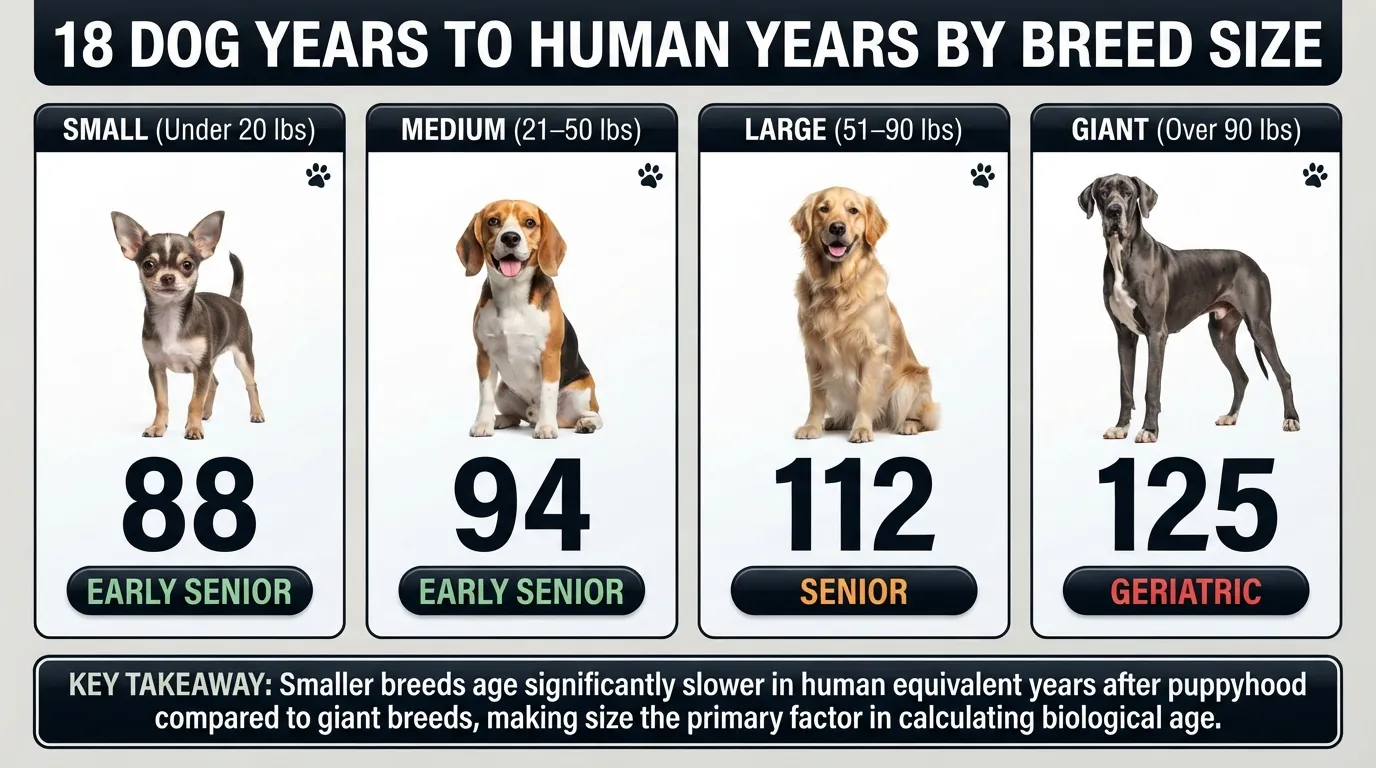
If your dog just hit 50 in dog years, they’ve officially crossed into their middle-aged or senior season. But how old are they in human calendar years?
The short answer: A dog that is 50 in dog years is roughly 7 to 8 human years old.
However, the exact calendar age depends heavily on your dog’s size and breed. A 7-year-old French Bulldog reaches 50 dog years much earlier than a 7-year-old Chihuahua, while a Great Dane reaches that landmark around age 5 or 6.
The 7:1 Myth vs. Modern Veterinary Math
For decades, the standard rule was simple: multiply your dog’s calendar age by 7. Under that formula, a 7-year-old dog would be 49—essentially 50 dog years.
While the old math gets surprisingly close for a 7-year-old medium dog, it completely fails to explain how puppies mature or why large dogs age faster.
According to guidelines from the American Animal Hospital Association (AAHA) and American Veterinary Medical Association (AVMA), canine aging happens in distinct stages:
Year 1: A dog matures rapidly, equal to roughly 15 human years.
Year 2: Growth slows slightly, adding about 9 human years (bringing them to 24).
Year 3+: Each calendar year adds between 4 to 7 dog years, depending on body weight.
Real Calendar Age Breakdown for 50 Dog Years
Here is what reaching 50 years in dog years looks like across different breed sizes:
| Dog Size Class | Weight Range | Human Calendar Age when Dog Reaches ~50 | Human Life Stage Equivalent |
|---|---|---|---|
| Small | Under 20 lbs | 8.5 – 9 years | Early 50s (Active middle age) |
| Medium | 21 – 50 lbs | 7.5 – 8 years | Mid-50s (Mature adult) |
| Large | 51 – 90 lbs | 6.5 – 7 years | Late 50s (Entering senior years) |
| Giant | 90+ lbs | 5.5 – 6 years | Around 60 (Senior status) |
What 50 Dog Years Means for Your Dog’s Health
Hitting 50 dog years is the canine equivalent of a human turning 50. It’s not “old age,” but it is the point where proactive care becomes essential.
Here is what you should focus on at this milestone:
Bi-Annual Vet Visits: Shift from annual exams to wellness checks every 6 months to catch early signs of kidney issues, heart murmur, or thyroid shifts.
Joint Care: You might notice your Golden Retriever taking an extra second to jump into the car or get up off the hardwood floor. Introducing joint supplements (like Glucosamine and Omega-3 fatty acids) helps maintain mobility.
Dental Health: By age 7, over 80% of dogs show signs of periodontal disease. A professional dental cleaning can add years to their life.
Weight & Nutrition: Metabolism slows down. Adjusting calorie intake prevents weight gain that puts excess stress on aging joints.
Quick Answer
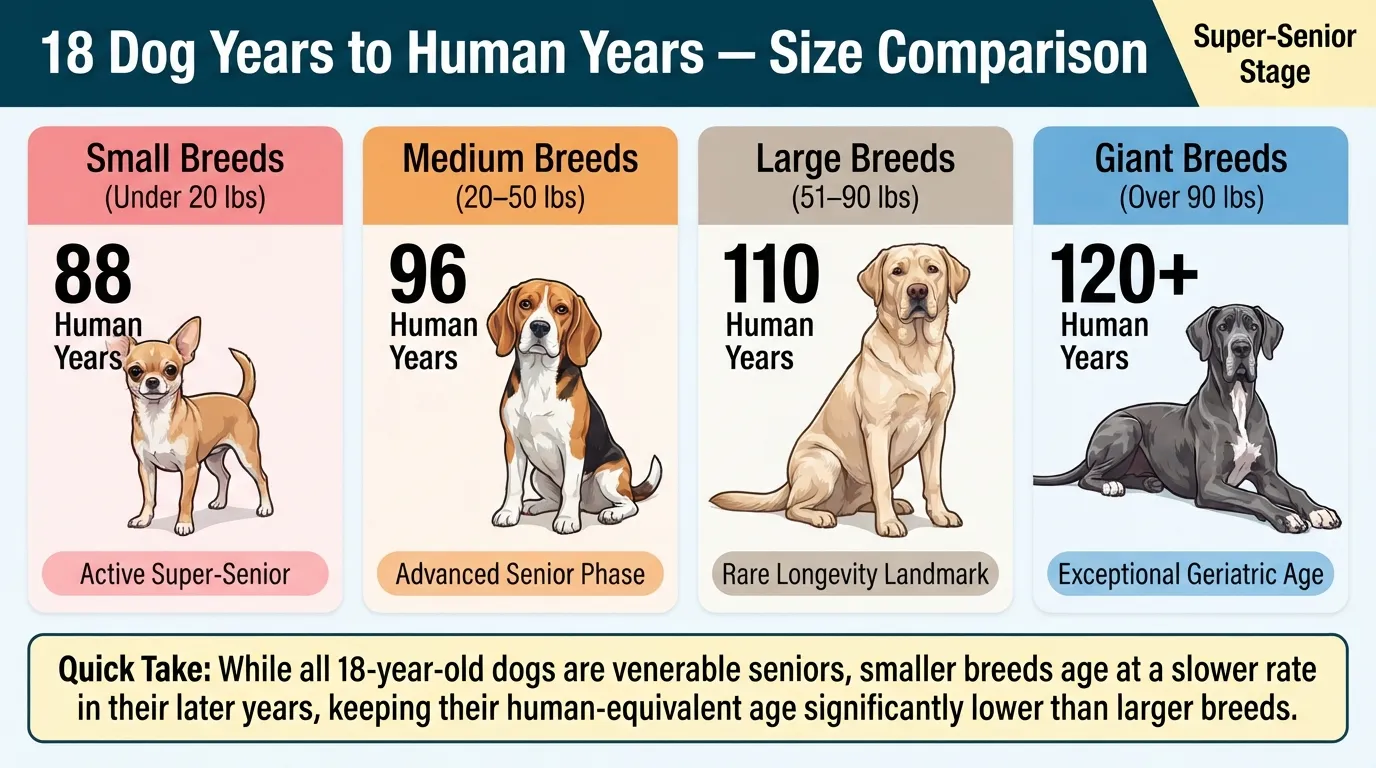
50 dog years ≈ 6–7 actual years, depending on breed size
When someone says a dog is 50 in dog years, it means their pet has reached the human equivalent of midlife. In actual calendar years, a dog at 50 dog years is typically between 6 and 7 years old. Because larger breeds age faster than smaller ones, a 90-pound Great Dane reaches this milestone around age 5, a Golden Retriever hits it right around 7, and a Chihuahua does not reach 50 in dog years until roughly age 8.
The Old 7:1 Rule — Where "50 in Dog Years" Comes From
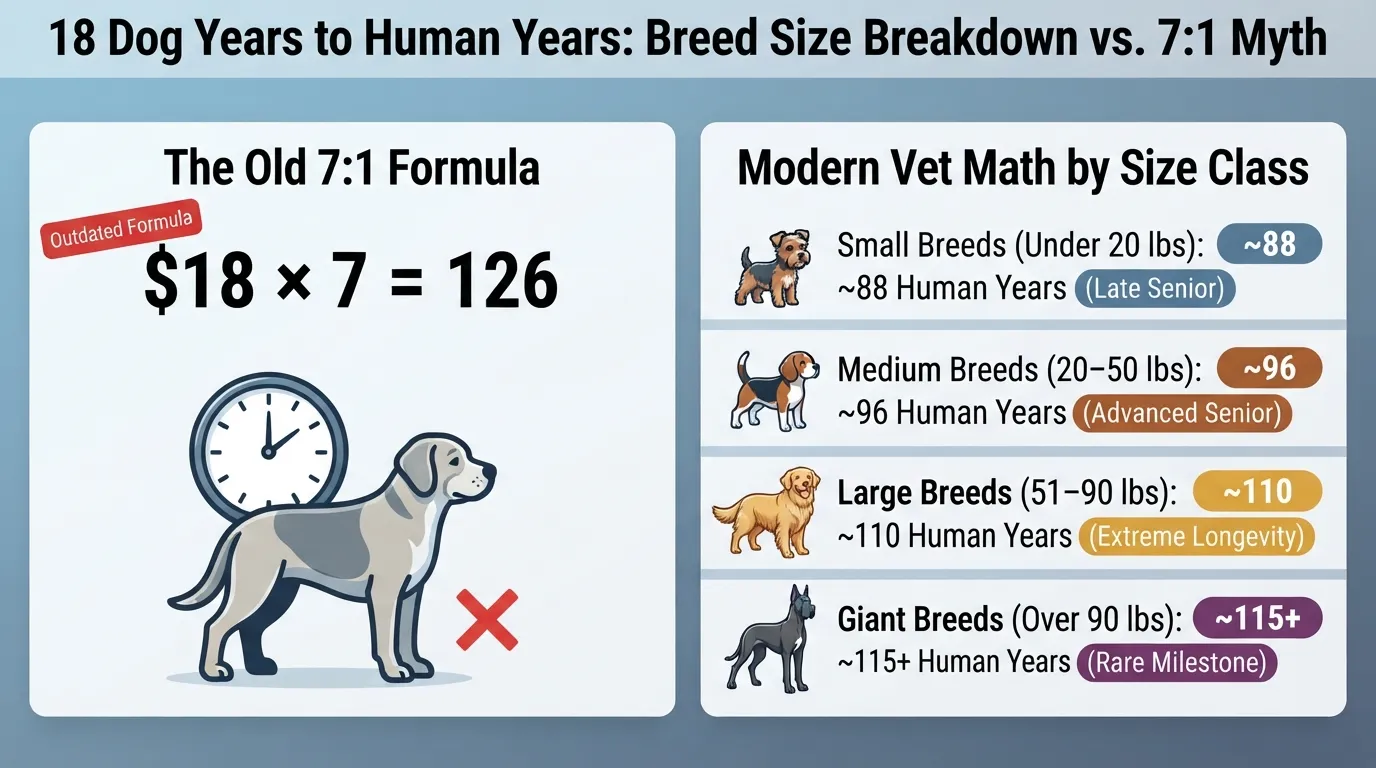
If you grew up using the traditional formula that one human year equals seven dog years, finding the calendar age for 50 in dog years comes down to basic division:
50 ÷ 7 ≈ 7.14 calendar years
That equals roughly 7 years and 1.7 months old.
Note: Veterinary consensus has retired this simplistic ratio because dogs age at dramatically different speeds based on their size and life stage.
50 in Dog Years by Breed Size Full Chart
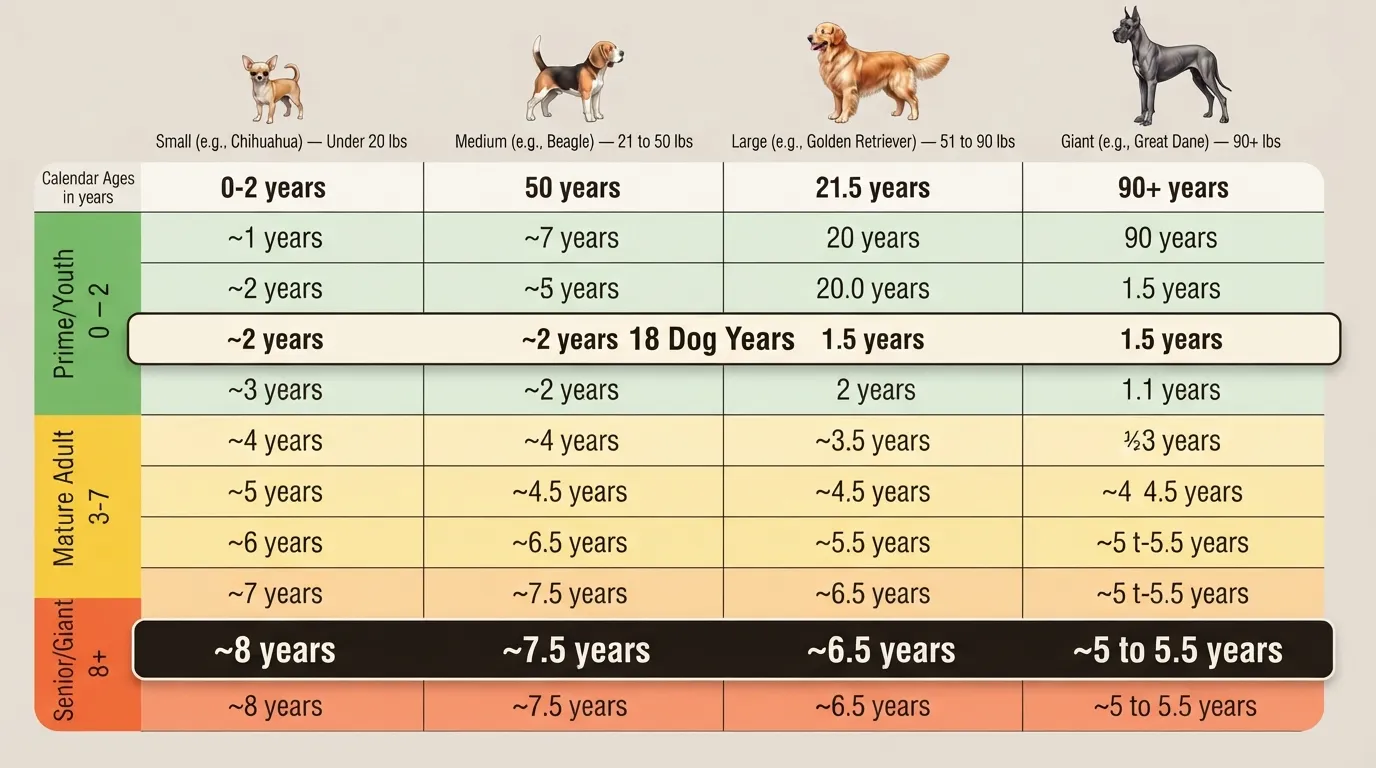
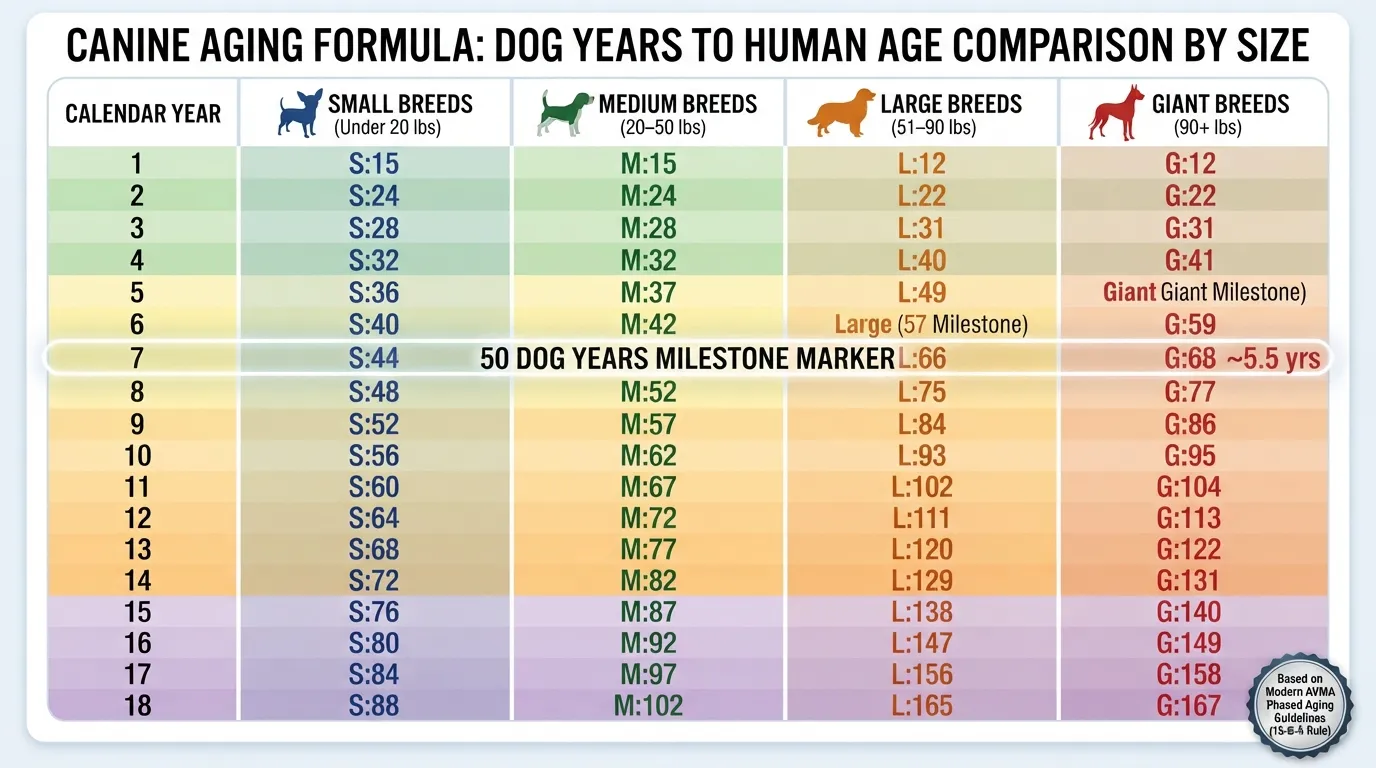
Because smaller dogs generally outlive larger breeds, a single calendar age doesn’t apply to every dog. The comparison chart below illustrates how aging rates diverge across size categories from year 1 to year 20, highlighting where 50 in dog years falls for each group according to modern AAHA and AKC growth curves.
| Calendar Age (Years) | Small Breeds (Under 20 lbs) | Medium Breeds (20–50 lbs) | Large Breeds (51–90 lbs) | Giant Breeds (Over 90 lbs) |
|---|---|---|---|---|
| 1 | 15 | 15 | 15 | 15 |
| 2 | 24 | 24 | 24 | 22 |
| 3 | 28 | 28 | 28 | 31 |
| 4 | 32 | 32 | 32 | 38 |
| 5 | 36 | 36 | 36 | 49 (Senior) |
| 6 | 40 | 42 | 45 (~50 milestone) | 56 |
| 7 | 44 (~50 milestone) | 47 (~50 milestone) | 50 | 64 |
| 8 | 48 | 51 | 55 | 71 |
| 9 | 52 | 56 | 61 | 78 |
| 10 | 56 | 60 | 66 | 85 |
| 11 | 60 | 65 | 72 | 92 |
| 12 | 64 | 69 | 77 | 99 |
| 13 | 68 | 74 | 82 | 106 |
| 14 | 72 | 78 | 88 | 113 |
| 15 | 76 | 83 | 93 | 120 |
| 16 | 80 | 87 | 99 | — |
| 17 | 84 | 92 | 104 | — |
| 18 | 88 | 96 | 110 | — |
| 19 | 92 | 101 | 115 | — |
| 20 | 96 | 105 | 120 | — |
| Calendar Age | Human Age Equivalent |
|---|---|
| 1 Year | 15 |
| 2 Years | 24 |
| 3 Years | 28 |
| 4 Years | 32 |
| 5 Years | 36 |
| 6 Years | 40 |
| 7 Years | 44 (~50 milestone) |
| 8 Years | 48 |
| 9 Years | 52 |
| 10 Years | 56 |
| 11 Years | 60 |
| 12 Years | 64 |
| 13 Years | 68 |
| 14 Years | 72 |
| 15 Years | 76 |
| 16 Years | 80 |
| 17 Years | 84 |
| 18 Years | 88 |
| 19 Years | 92 |
| 20 Years | 96 |
| Calendar Age | Human Age Equivalent |
|---|---|
| 1 Year | 15 |
| 2 Years | 24 |
| 3 Years | 28 |
| 4 Years | 32 |
| 5 Years | 36 |
| 6 Years | 42 |
| 7 Years | 47 (~50 milestone) |
| 8 Years | 51 |
| 9 Years | 56 |
| 10 Years | 60 |
| 11 Years | 65 |
| 12 Years | 69 |
| 13 Years | 74 |
| 14 Years | 78 |
| 15 Years | 83 |
| 16 Years | 87 |
| 17 Years | 92 |
| 18 Years | 96 |
| 19 Years | 101 |
| 20 Years | 105 |
| Calendar Age | Human Age Equivalent |
|---|---|
| 1 Year | 15 |
| 2 Years | 24 |
| 3 Years | 28 |
| 4 Years | 32 |
| 5 Years | 36 |
| 6 Years | 45 (~50 milestone) |
| 7 Years | 50 |
| 8 Years | 55 |
| 9 Years | 61 |
| 10 Years | 66 |
| 11 Years | 72 |
| 12 Years | 77 |
| 13 Years | 82 |
| 14 Years | 88 |
| 15 Years | 93 |
| 16 Years | 99 |
| 17 Years | 104 |
| 18 Years | 110 |
| 19 Years | 115 |
| 20 Years | 120 |
| Calendar Age | Human Age Equivalent |
|---|---|
| 1 Year | 15 |
| 2 Years | 22 |
| 3 Years | 31 |
| 4 Years | 38 |
| 5 Years | 49 (Senior) |
| 6 Years | 56 |
| 7 Years | 64 |
| 8 Years | 71 |
| 9 Years | 78 |
| 10 Years | 85 |
| 11 Years | 92 |
| 12 Years | 99 |
| 13 Years | 106 |
| 14 Years | 113 |
| 15 Years | 120 |
Small Breed ~7–8 yrs
Small dogs—like Chihuahuas, Dachshunds, and Shih Tzus—mature rapidly during their first two years, then slow down to about 4 human years for every calendar year. A small dog reaches 50 dog years right around their 7.5 to 8th birthday. At this point, they are just entering their prime mature adult phase rather than showing physical signs of advanced age.
Medium Breed ~7 yrs
For mid-sized dogs like Beagles, Cocker Spaniels, and Australian Shepherds, the aging pace sits right in the middle of the spectrum. A 7-year-old medium dog sits at approximately 47 to 51 in human equivalent. This makes 7 calendar years the exact baseline where a medium dog experiences the “50 in dog years” transition.
Large Breed ~6 yrs
Larger dogs—including Golden Retrievers, Labradors, and German Shepherds—put more physical stress on their cardiovascular and skeletal systems as they age. Consequently, a large dog hits 50 years in dog years around 6 to 6.5 calendar years old. By age 6, veterinarians consider large breeds to be entering their senior phase, making early joint care and diet adjustments essential.
Giant Breed ~5–6 yrs
Giant breeds like Great Danes, Mastiffs, and Saint Bernards age the fastest after their initial puppy growth spurts. A giant breed reaches the 50-year equivalent between 5 and 5.5 calendar years old. By age 6, a giant dog is already sitting closer to 56 in human terms, which is why preventive health checks start much earlier for these gentle giants.
50 in Dog Years for Popular Breeds
While weight categories give a reliable general estimate, individual breed traits and life expectancies refine the math further. Here is exactly when five of the most popular breeds reach 50 in dog years and what that milestone looks like for each:
Labrador Retriever ~6.5 Calendar Years: America’s long-time favorite family dog reaches 50 midway through their 6th year. Around this time, Labs often maintain their puppy-like enthusiasm, but their joints start absorbing the toll of years of fetching. Keeping them at a lean body weight becomes critical at this milestone to protect their hips.
German Shepherd ~6 Calendar Years: Due to their large frame and genetic predisposition to hip and elbow dysplasia, German Shepherds cross the 50 dog years mark right as they turn 6. At this stage, subtle changes like taking longer to stretch after resting or slight hesitation before jumping into the car are early indicators that senior joint care should begin.
Golden Retriever ~6 to 6.5 Calendar Years: Goldens hit 50 between 6 and 6.5 calendar years. While their coat might start showing a touch of white around the muzzle, their energy levels often mask underlying metabolic shifts. Bi-annual veterinary blood panels starting at this age help track organ function before symptoms appear.
Chihuahua ~8 Calendar Years: As one of the longest-lived breeds, a Chihuahua doesn’t hit 50 years in dog years until around their 8th birthday. At age 8, a Chihuahua is still in their active adult phase, though dental checks become vital since toy breeds are exceptionally prone to periodontal disease.
French Bulldog ~7 Calendar Years: Frenchies fall into the small breed category by height, but their stocky, heavy-boned build puts slightly more demand on their bodies. They reach 50 right around 7 calendar years old. Because of their brachycephalic (flat-faced) structure, managing airway health and weight at this milestone is essential to keep them comfortable.
How Vets Actually Calculate This Modern Formula
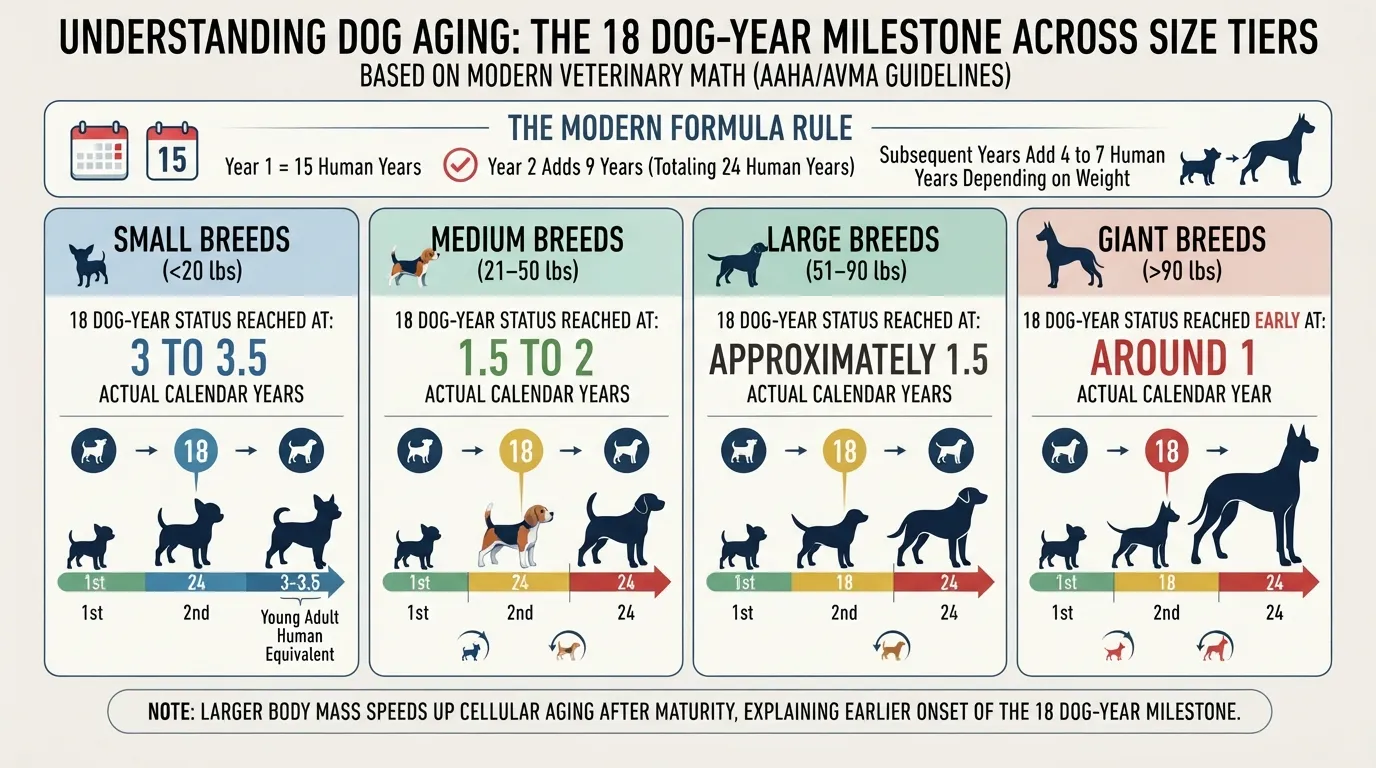
Instead of a flat multiplier, the American Veterinary Medical Association (AVMA) uses a phased approach that reflects a dog’s real biological development:
Year 1: Equals 15 human years (rapid growth from puppyhood to adolescent maturity).
Year 2: Adds 9 human years (bringing the total to 24 human years).
Year 3+: Adds 4 to 5 human years per calendar year, depending on the dog’s size.
Worked Example: Medium Dog e.g., 30 lb Beagle
To find out when a medium-sized dog hits the 50 dog years milestone, apply the AVMA formula step-by-step:
Pehle 2 saal: 15 + 9 = 24 human years
Agle 5 saal (3 se 7 saal ki umar tak): 5 × 5 = 25 human years
7 calendar saal ki kul umar: 24 + 25 = 49 human years
By their 7th birthday, a medium dog is right on the threshold of 50 in dog years—giving you an accurate biological benchmark rather than a rough estimate.
What This Age Means for Your Dog
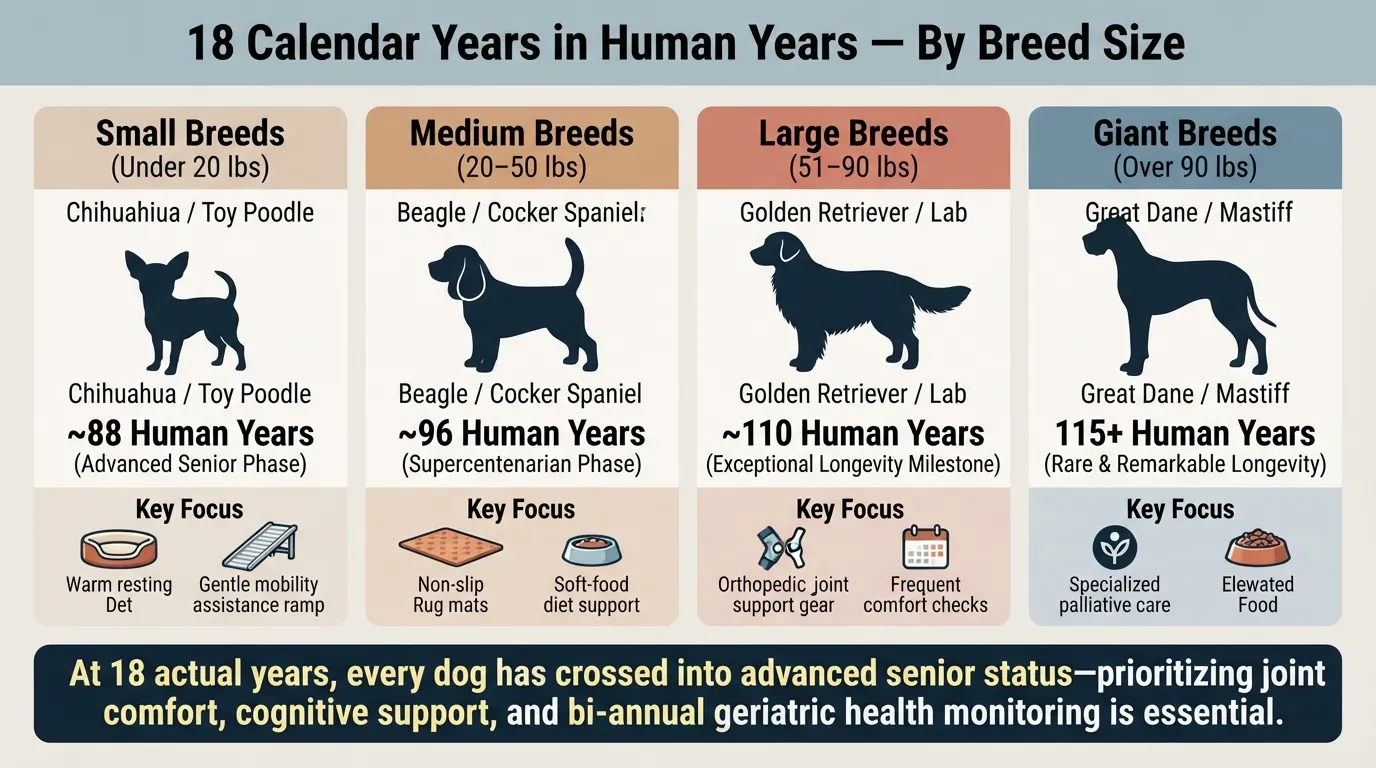
Reaching the 50-year milestone in human equivalent isn’t just a number—it marks a distinct shift in your dog’s daily physical needs, energy levels, and long-term healthcare priorities:
Life Stage Mature Adult to Senior Transition: Depending on their breed size, a dog at 50 in dog years is transitioning from their prime adult phase into early senior hood. Large and giant breeds at this stage are officially seniors, while small to medium dogs are entering their mature “middle-age” years.
Signs to Watch For: Keep an eye out for subtle behavioral and physical changes. Common early indicators include taking a few seconds longer to stand up after sleeping, cloudiness in the eyes (lenticular sclerosis), slight weight changes due to a slowing metabolism, or increased sensitivity to cold weather.
Essential Care Tip: Shift from annual health checkups to bi-annual veterinary exams. Twice-yearly visits allow your vet to run baseline blood panels, check organ function, and catch age-related conditions early when they are easiest to manage.
Common Myths About Dog Years
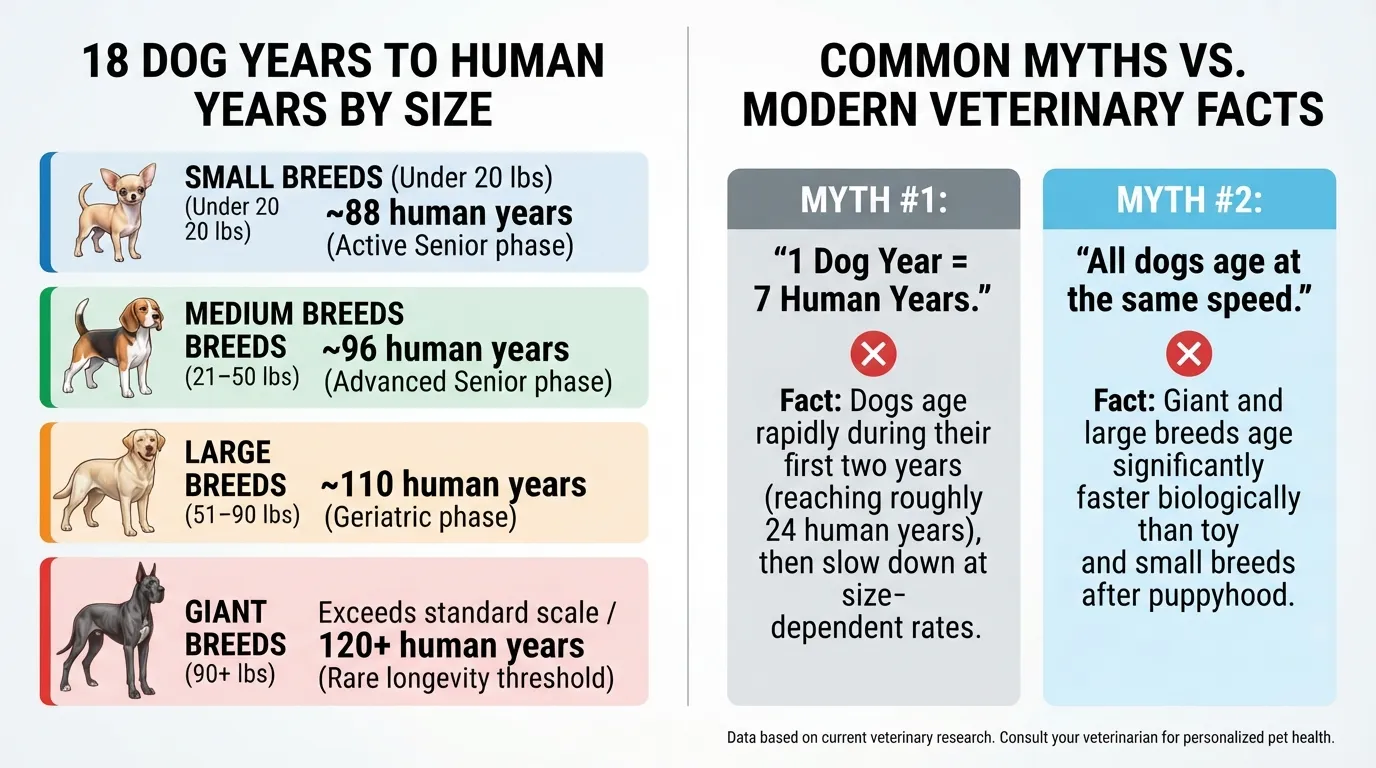
“Is the 7:1 rule completely wrong?” Not completely—it was created as a simple average back when human life expectancy was around 70 years and the average dog lived to about 10. However, as a functional calculation, yes, it is wrong. It completely misses the massive growth spurt of a puppy’s first two years and assumes a 150-pound Mastiff ages at the exact same pace as a 6-pound Chihuahua.
“All dogs age the same rate throughout their lives” — Busted: Dogs do not age in a straight line. During their first calendar year, a dog matures from a helpless newborn into a sexually mature adolescent—an equivalent shift that takes humans roughly 15 years. After age two, their aging trajectory flattens out significantly to a steady 4–5 human years per calendar year.
“Bigger dogs live longer because they are stronger” — Busted: In almost every other mammal species, larger animals outlive smaller ones (like elephants versus mice). Dogs are a rare exception. Large and giant breeds grow at an extremely rapid pace during puppyhood, which accelerates cellular aging and puts greater lifelong strain on their cardiovascular and skeletal systems. As a result, giant breeds hit senior status around 5 calendar years, while small breeds don’t reach that same stage until age 8 or 9.
Other Common Conversions
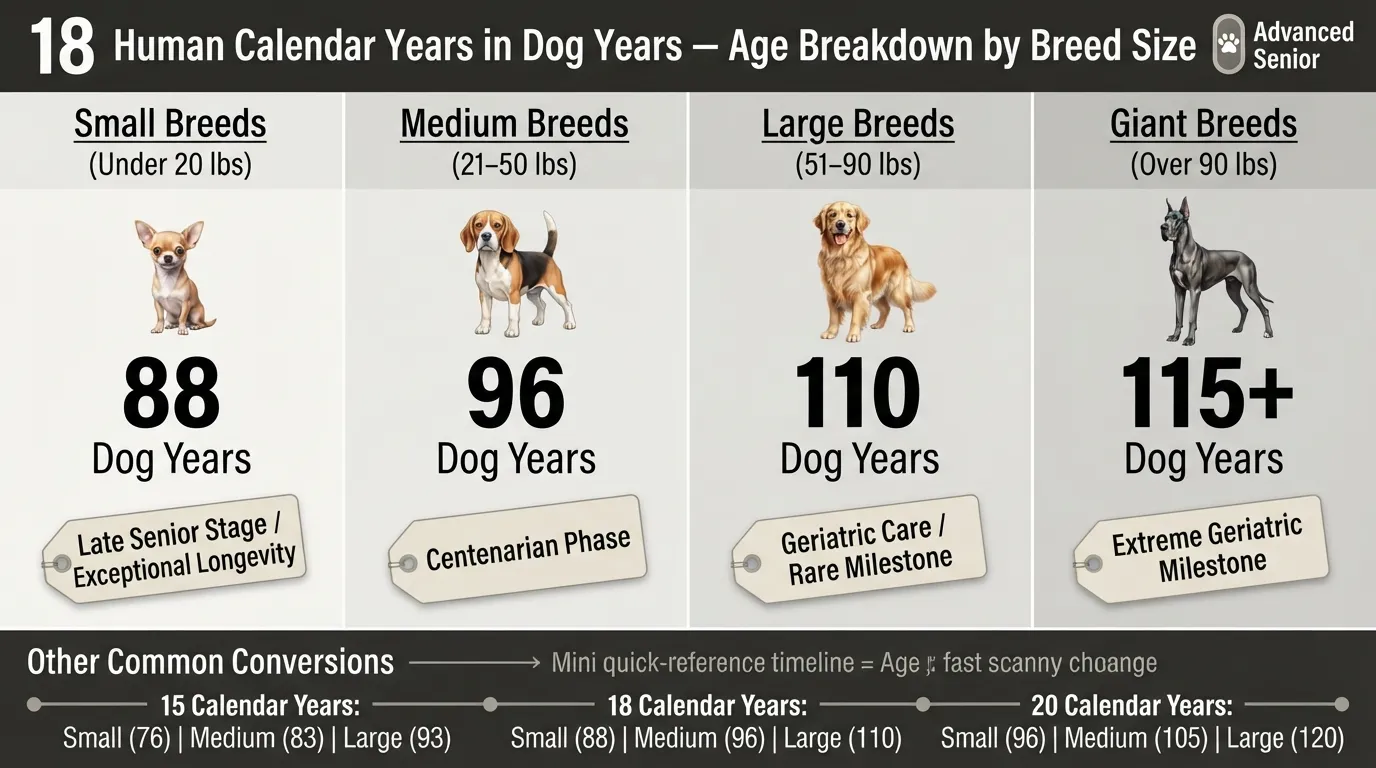
If you are tracking how your dog moves through different life stages, exploring these nearby milestones will give you a complete picture of their biological clock:
30 in Dog Years: Represents the transition from youthful adolescent to prime adult. Small breeds hit 30 in dog years around 3.5 calendar years, while giant breeds reach it by age 2.5.
40 in Dog Years: Marks the peak adult phase before senior care considerations begin. Most medium-sized dogs cross this threshold between 5 and 5.5 calendar years.
60 in Dog Years: Official senior territory across all breed sizes. Small dogs reach this around age 11, whereas large breeds arrive here by their 8th birthday.
70 in Dog Years: Represents advanced senior status. At this milestone, specialized mobility support, cognitive monitoring, and tailored senior nutrition become essential.
Option 1: Clean Blockquote Style Recommended
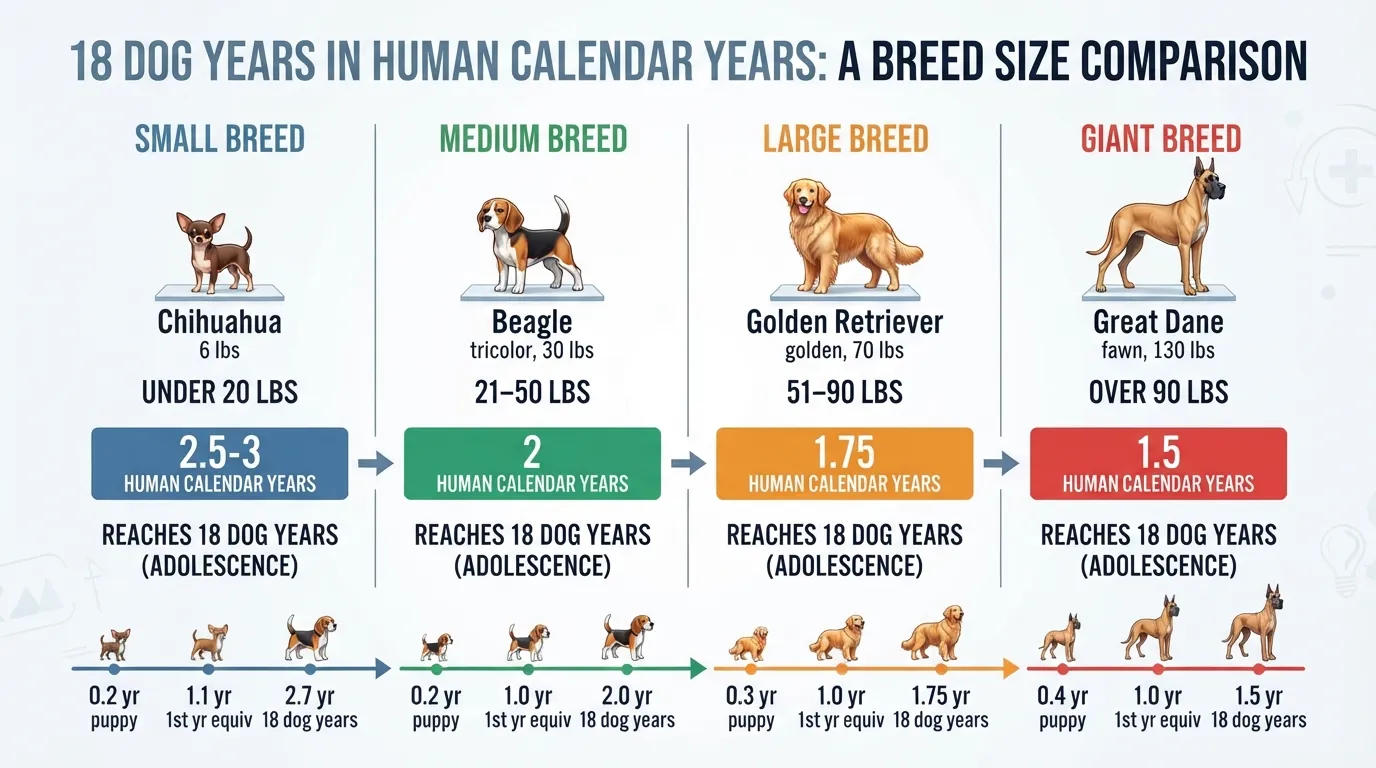
Reverse Math: If a Human Is 50, What’s That in Dog Years?
💡 Quick Flip: A 50-year-old human equates to a dog that is roughly 6 to 7 calendar years old (depending on breed size). Both are navigating that exact same middle-age transition where proactive joint care and routine checkups become essential.
Option 2: Conversational & Catchy Style
What If YOU Are 50? The Reverse Dog-Year Calculation
Bonus Note: Flipping the math around, 50 human years corresponds to a dog around 6.5 calendar years old. If you’re 50 and your dog is 6, you two are officially sharing the same middle-age milestone together!
Option 3: Short & SEO-Focused Style
Reverse Calculation: 50 Human Years in Dog Years
🐾 The Short Answer: A 50-year-old human matches the biological age of a 6 to 7-year-old dog. Depending on their size category, a dog at this age is stepping right out of adult prime and into early senior territory.
Calculate Your Dog's Exact Age
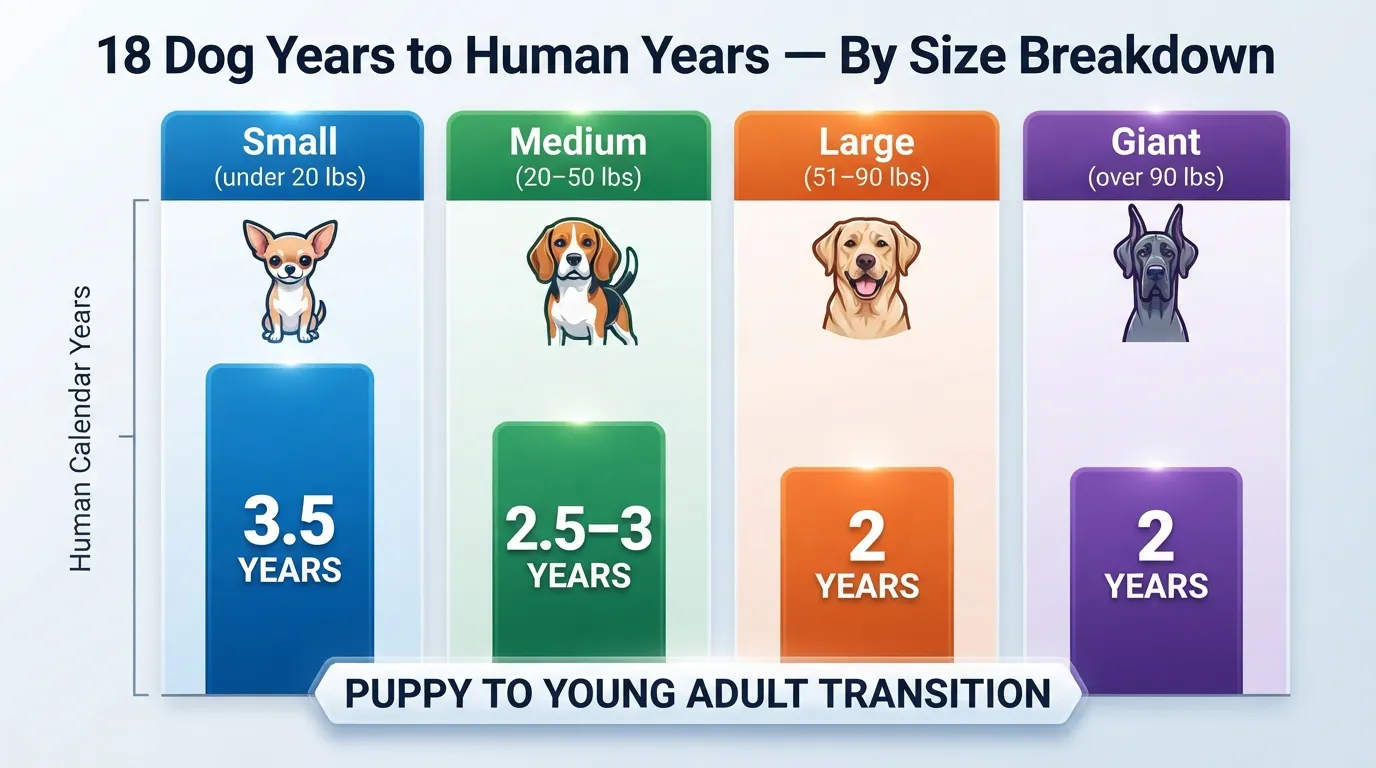
Every dog ages on their own timeline based on their unique breed, weight, and lifestyle. Rather than relying on rough estimates or mental math, plug your dog’s details into our interactive tool to get an instant, vet-approved breakdown of their exact biological age today.
🐕 Find Your Dog’s Real Age in Seconds
Ready to see where your pup stands on the modern growth curve? Use our free Dog Age Calculator to get a precise human-age equivalent customized for your dog’s specific weight and breed category.
Frequently Asked Questions
| Question | Answer |
|---|---|
| What is 50 in dog years exactly? | 50 in dog years corresponds to a human age of around 50. Depending on the dog's size, a dog reaches this equivalent human age when it is physically between 7 and 9 calendar years old. |
| Is a 50-dog-year-old dog senior? | Yes, entering the 50s in human-equivalent years places a dog into the mature/senior phase, requiring more frequent vet check-ups and targeted senior nutrition. |
| Does breed affect this calculation? | Absolutely. Larger breeds age faster than smaller breeds. A giant breed reaches 50 human years much earlier in calendar life than a toy or small breed. |
| Is the 7-year rule accurate? | No, the simple "multiply by 7" rule is outdated because dogs mature much faster in their first two years and age at varying rates depending on size. |
| How is dog age calculated by vets? | Veterinarians assess physical indicators like dental wear, eye clarity, joint mobility, coat graying, and breed size formulas rather than just counting birth years. |
🐾 Other Age Guides

I built Dogagescalculator.com to give dog owners honest, science-backed answers instead of the outdated "×7" myth. Every figure here is checked against AKC, AVMA, and published veterinary research.
More about the author & this site →
Comments