
23 in Dog Years – What Does It Really Mean? Human & Dog Age Explained
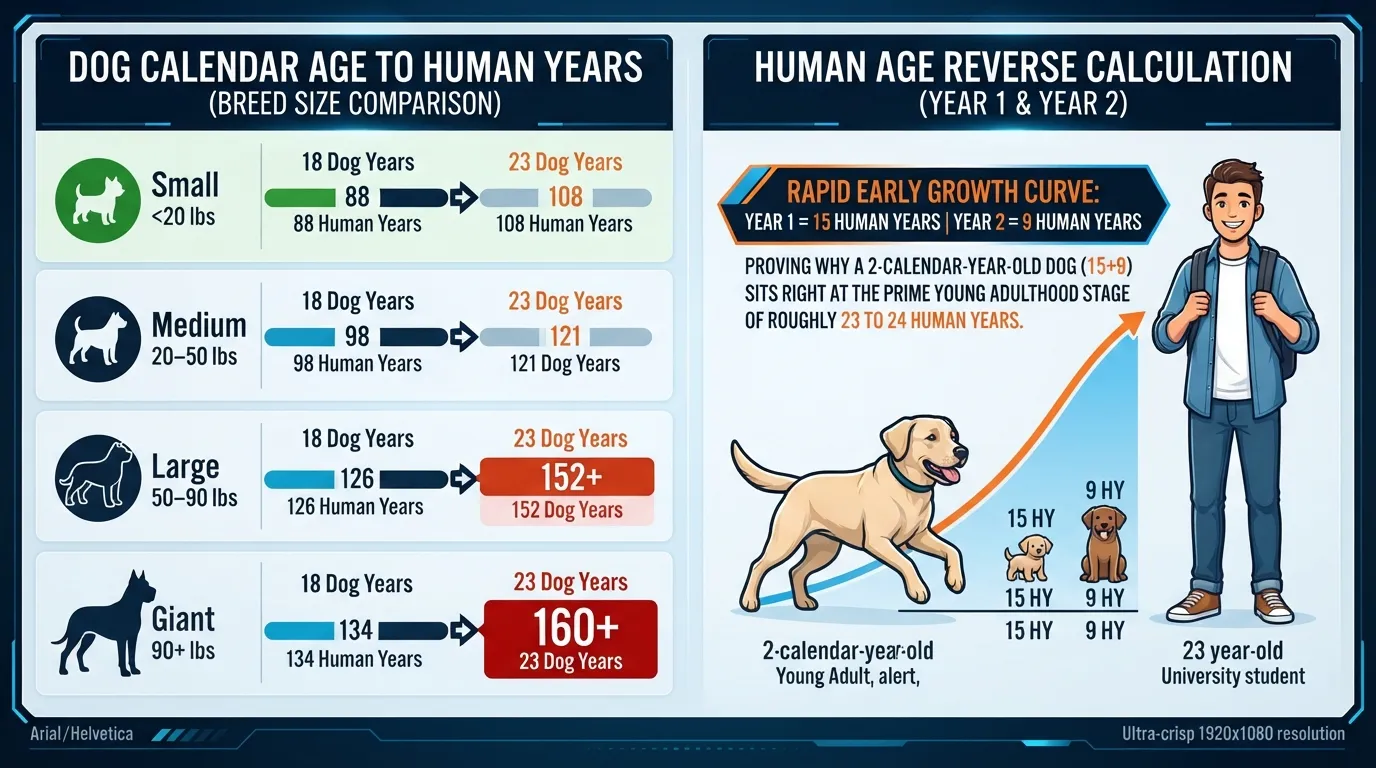
When people talk about 23 in dog years, they usually mean one of two completely different things: either their dog is actually 23 calendar years old (an extraordinary senior canine), or their dog is about 2 years old, which puts them at roughly 23 in human equivalent years.
Here is the quick breakdown:
If your dog is 2 years old: They are roughly 23 to 24 in human years (depending on their breed size).
If your dog is 23 years old: In human terms, they are an incredible 100 to 115+ years old—placing them among the oldest living dogs on the planet.
Want the exact, breed-specific age conversion for your pup right now? Try our quick Dog Age Calculator Tool for instant results.
What Does "23 in Dog Years" Mean? Two Interpretations
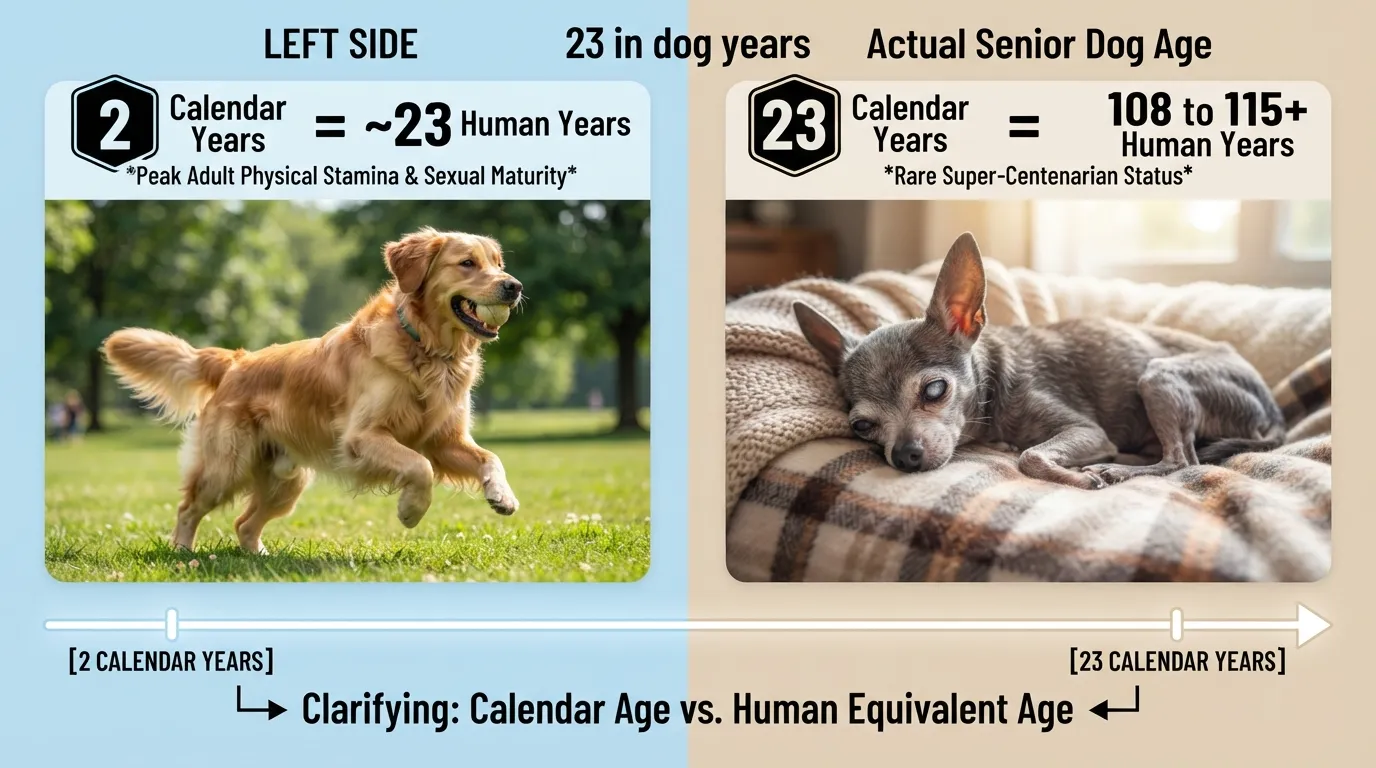
When someone mentions “23 in dog years,” they are usually asking one of two completely different questions. Depending on whether you are looking at a dog’s calendar age or its equivalent human age, here is what that number actually means:
If your dog is 23 actual calendar years old: That’s roughly 108 to 115+ human years, making your dog an extremely rare super-centenarian.
If you want a dog that feels like a 23-year-old human: Your dog is approximately 2 to 2.5 calendar years old, right in the prime of young adulthood.
If Your Dog Is 23 Years Old Dog → Human Age
If your dog has lived 23 actual calendar years, you are living with a biological marvel. Reaching age 23 in actual calendar years places a dog well past the equivalent of a 100-year-old human—typically hovering around 108 to 115+ human years depending on size and breed.
According to guidelines from the American Animal Hospital Association (AAHA), senior status generally begins around age 7 to 10 depending on body mass. Small breeds age significantly slower than large breeds in their senior years, which is why a 23-year-old Toy Poodle or Chihuahua might still be moving around, whereas large breeds almost never reach this threshold.
To put this in perspective, the official Guinness World Record for the oldest dog ever recorded belongs to Bluey, an Australian Cattle Dog who lived to 29 years and 5 months. A 23-year-old dog is getting remarkably close to that realm. At this milestone, every single year is a major victory, requiring specialized senior care, soft-diet management, and frequent joint support.
If You’re 23 Years Old Human → Dog Age
If you are trying to figure out what age a dog is when it matches a 23-year-old human, the answer sits right around 2 to 2.5 actual dog years.
During the first year of life, a puppy develops rapidly—gaining roughly 15 human years in its first 12 months. By the time a dog hits its second birthday, it is roughly equivalent to a 24-year-old human. So, a dog that is just shy of its second birthday or slightly past it (around 22 to 28 months) has the physical energy, mental maturity, and adult stamina of a 23-year-old person.
At this stage, your dog has outgrown the destructive puppy phase, their adult teeth and skeletal frame are fully developed, and they are in peak physical shape for high-energy training and outdoor activities.
Is 23 Years Old Realistic for a Dog? Breeds That Can Live This Long
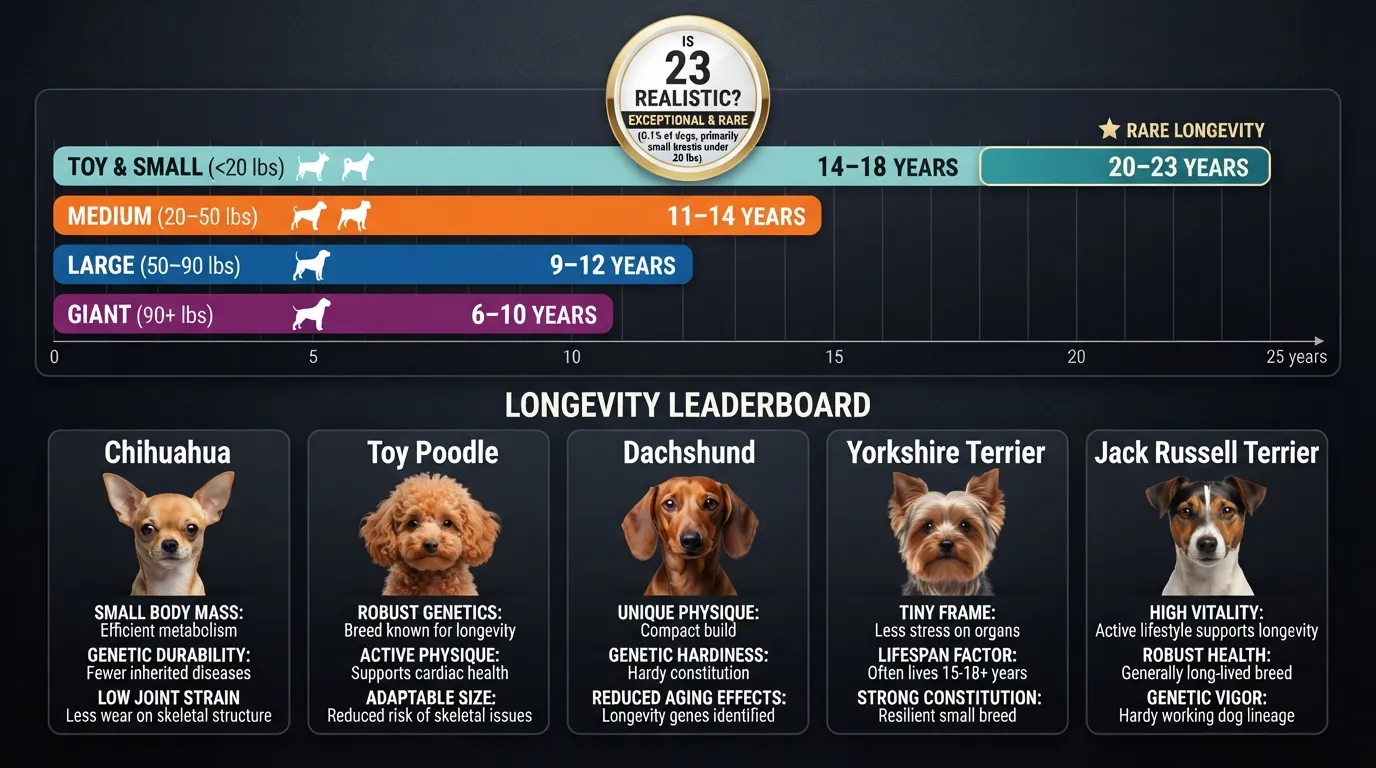
Reaching 23 human years is exceptionally rare for a dog—roughly equivalent to a human living past 110. While the vast majority of dogs pass away well before their late teens, reaching 20 to 23 years isn’t impossible, especially for smaller breeds receiving optimal care.
How long a dog lives comes down heavily to biological scale, genetics, and daily care.
Average Dog Lifespan by Size Category
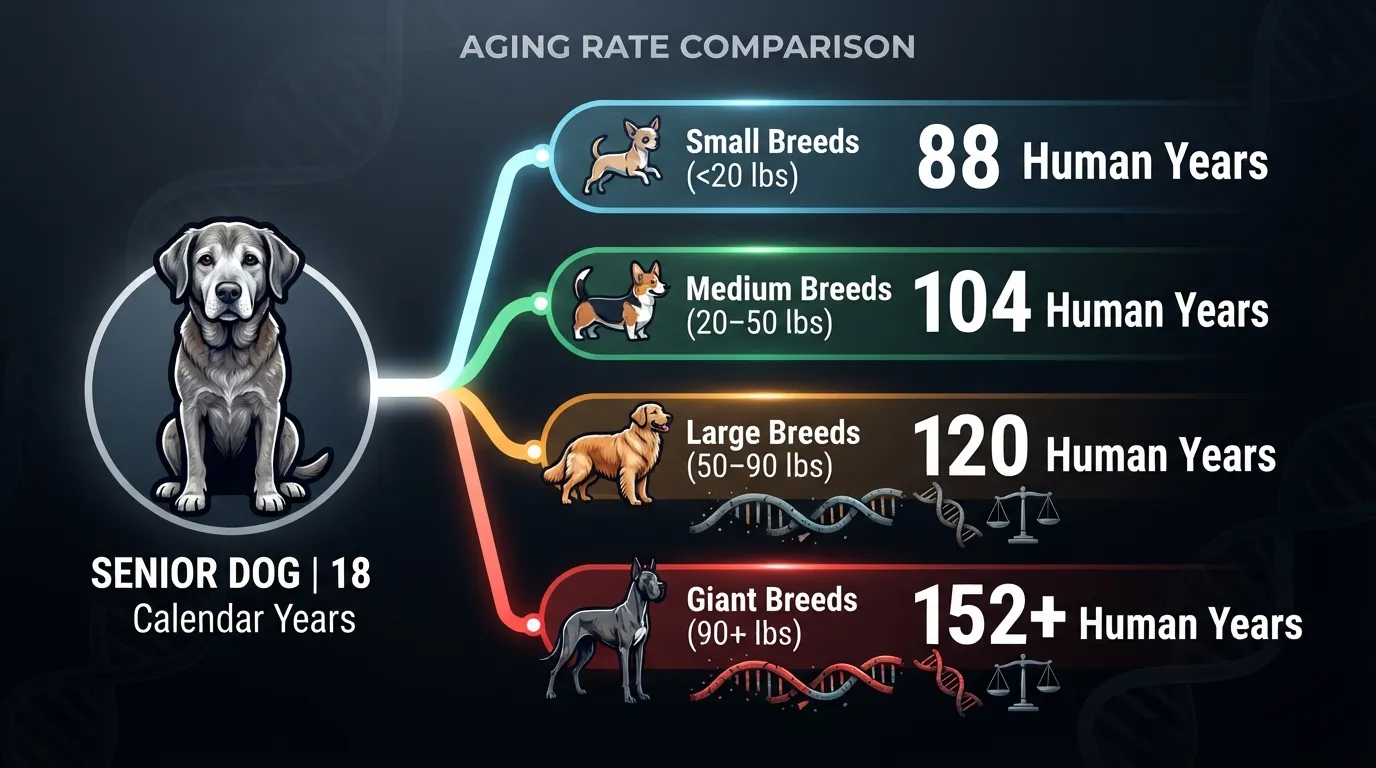
Larger dogs age faster on a cellular level and experience higher biological strain throughout their lives, whereas smaller dogs enjoy a significantly slower biological aging process.
Toy & Small Breeds Under 20 lbs: 14 to 18 years (frequently pushing past 20 with good dental and heart care)
Medium Breeds 20 to 50 lbs : 11 to 14 years
Large Breeds (50 to 90 lbs): 9 to 12 years
Giant Breeds (Over 90 lbs): 6 to 10 years
Breeds Most Likely to Reach Exceptional Ages
If a dog is going to push past the 20-year mark toward 23, history and veterinary records show it almost always belongs to one of these resilient small breeds:
Chihuahua: Known for having one of the longest lifespans in the canine world, frequently living 16 to 20+ years due to their small frame and robust vitality.
Toy Poodle: Highly intelligent and genetically sturdy, Toy Poodles often reach 17 to 20 years when kept at a healthy weight.
Dachshund: Their small body mass helps them stay young longer, though keeping their backs supported is critical to reaching their late teens and early twenties.
Yorkshire Terrier: Tiny builds and low joint impact give Yorkies a real shot at living 17 to 20+ years.
Jack Russell Terrier: Exceptionally energetic and athletic, Jack Russells regularly break average lifespan stats, often living 16 to 20 years.
The World Record: Breaking the Limits
While 23 years sounds extraordinary, official history shows dogs can go even further. For nearly a century, the official Guinness World Record belonged to Bluey, an Australian Cattle Dog who lived to 29 years and 5 months (1910–1939).
In recent years, an Rafeiro do Alentejo named Bobi from Portugal grabbed global headlines when he was reported to have lived to 31 years and 165 days (1992–2023), proving that with the right combination of open-air living, natural diet, and incredible genetics, canine longevity can defy almost all standard expectations.
Why Do Dogs Age Faster Than Humans? The Science Behind It
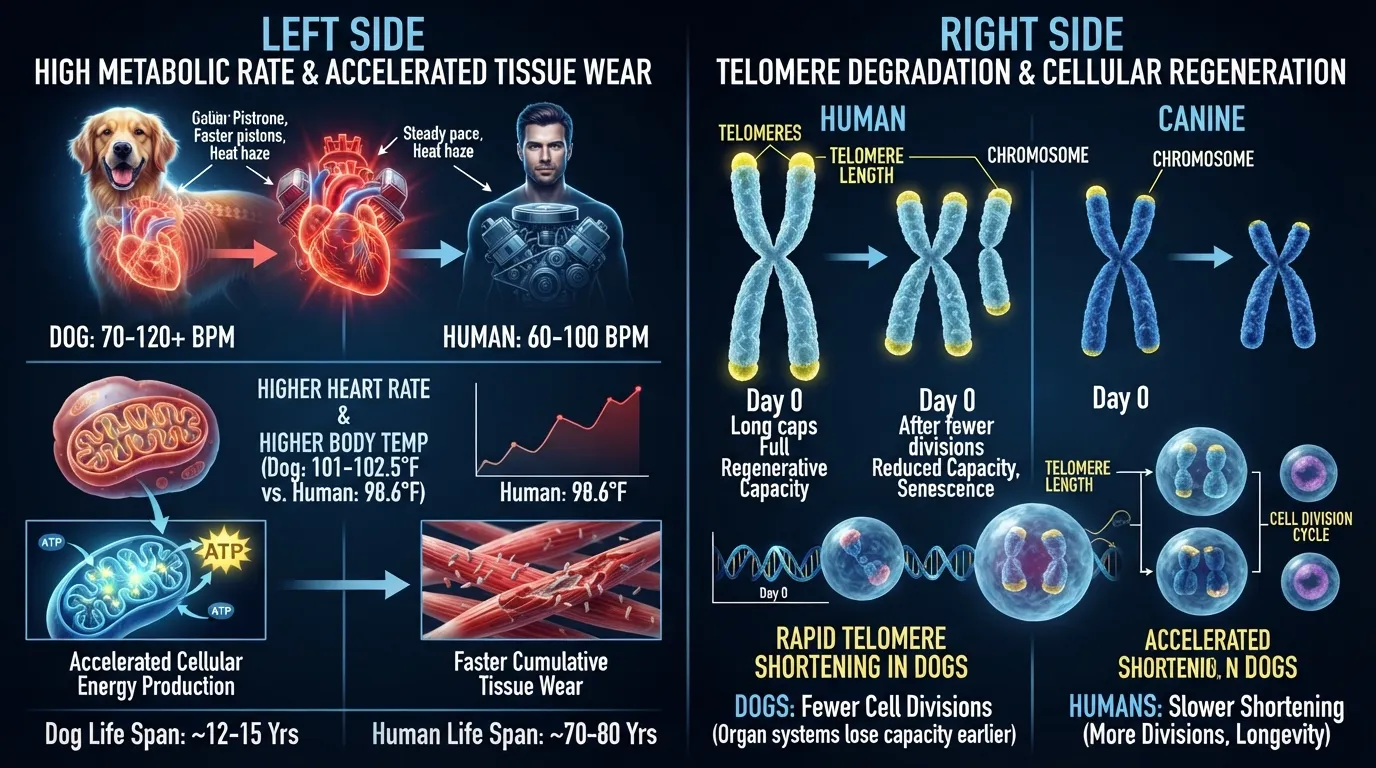
If you’ve ever wondered why your dog reaches middle age in what feels like the blink of an eye, it comes down to basic biology. Dogs don’t just grow up faster—their bodies operate on a completely different timeline than ours.
While a calendar year is 365 days for both of you, a dog’s biological clock runs on fast-forward due to two primary physiological drivers:
A Burn-It-Fast Metabolic Rate: A dog’s body works harder on a baseline level. They have higher heart rates, warmer core temperatures, and process energy much faster than humans. According to veterinary physiologists, this elevated metabolic rate accelerates cellular turnover. Burning energy at this pace creates more oxidative stress over time, meaning their tissues, organs, and joints go through a lifetime of wear and tear in a fraction of the time ours do. Their internal engines simply burn hotter.
Genetics and Rapid Telomere Degradation: Inside every cell, telomeres act as protective caps at the ends of chromosomes—think of them like the plastic tips on shoelaces. Every time a cell divides, those caps get a little shorter until the cell can no longer repair itself. Genetic research published by canine biologists shows that dog telomeres shorten at a significantly faster rate per cell division than human telomeres. Their DNA is fundamentally programmed for a compressed lifespan, limiting how many times their tissues can regenerate before aging sets in.
The Old "Multiply by 7" Myth – Why It's Wrong
If you’re still multiplying your dog’s age by seven to figure out how old they are in human years, you’re getting a completely inaccurate picture. While the math is simple, canine biology doesn’t work in a straight line.
Here is why that old formula fell apart and what science actually tells us today.
Where the myth came from: The “1 dog year = 7 human years” rule started floating around in the 1950s. It wasn’t based on veterinary science, but rather basic math. Back then, researchers noted that the average human lived to about 70, while the average dog lived to about 10. Dividing 70 by 10 gave an easy rule of thumb. It was a handy trick to remind owners to bring their pets in for checkups, but it ignored almost everything about how dogs actually grow and age.
Why vets no longer use it: Modern veterinary medicine treats dog aging as a curve, not a straight line. A puppy develops at an incredible pace during its first two years—a 1-year-old dog has already reached full sexual maturity, which is roughly equivalent to a 15-year-old human, not a 7-year-old child. After age two, aging slows down dramatically, but at wildly different rates depending on body size. Small breeds like Toy Poodles age far slower in their senior years than giant breeds like Mastiffs. Organizations like the American Animal Hospital Association (AAHA) now discard the 7-year rule entirely, relying instead on life-stage guidelines that factor in rapid early growth and breed-specific aging rates.
The Correct Science-Based Formula AVMA/AKC
Forget the old “multiply by 7” myth. It treats a tiny Chihuahua and a massive Mastiff as if they age at the exact same pace, which simply isn’t how dog biology works.
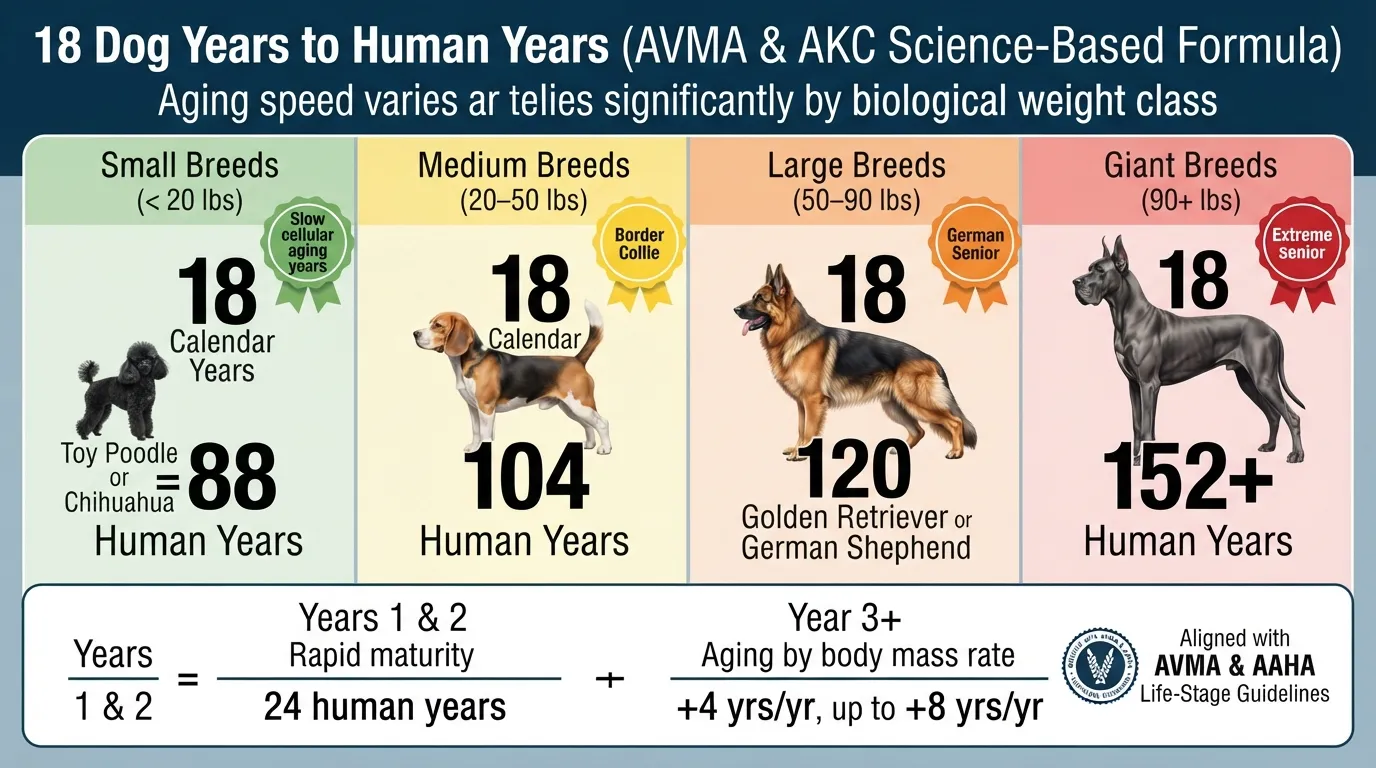
According to guidelines from the American Veterinary Medical Association (AVMA) and the American Animal Hospital Association (AAHA), a dog’s growth isn’t linear. They pack a massive amount of physical development into their first two years, after which their aging slows down and diverges dramatically based on their size.
How Calculation Works – Year 1 & 2 Are Rapid Aging Phases
Think of a puppy’s first year like a human sprinting through childhood, puberty, and early adulthood all at once.
Year 1: A dog matures to roughly the equivalent of a 15-year-old human by their first birthday. They grow bones, gain adult teeth, and reach sexual maturity.
Year 2: The second year adds about 9 human years. By age two, regardless of size, your dog is sitting at around 24 human years.
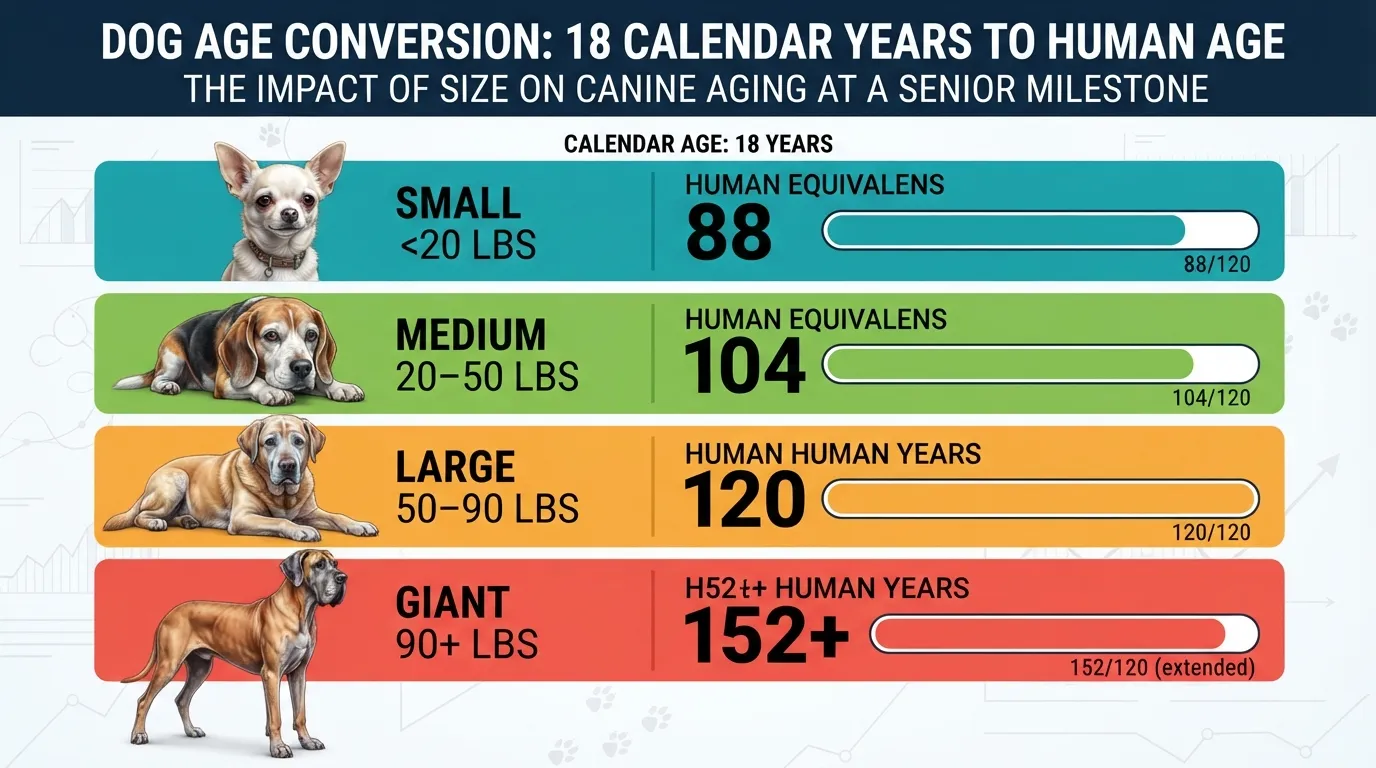
Year 3 and Beyond: This is where breed size takes over. Small dogs age roughly 4 human years per calendar year, medium dogs age about 5, while large and giant breeds age anywhere from 6 to 9 human years annually because their larger bodies experience more cellular wear and tear.
When you look at 23 in dog years, a 23-year-old small dog has lived the equivalent of a 108-year-old human, while a large dog reaching that rare age would theoretically be pushing past 150 human years.
Here is how the science breaks down across all life stages and breed sizes from year 1 all the way to 23+:
Dog Age To Human Years Conversion Chart
| Dog Age (Years) | Small Breeds (< 20 lbs) | Medium Breeds (20 - 50 lbs) | Large Breeds (50 - 90 lbs) | Giant Breeds (90+ lbs) | Life Stage |
|---|---|---|---|---|---|
| 1 | 15 | 15 | 15 | 15 | Puppy / Junior |
| 2 | 24 | 24 | 24 | 24 | Young Adult |
| 3 | 28 | 29 | 30 | 32 | Adult |
| 4 | 32 | 34 | 36 | 40 | Adult |
| 5 | 36 | 39 | 42 | 48 | Adult |
| 6 | 40 | 44 | 48 | 56 | Mature Adult |
| 7 | 44 | 49 | 54 | 64 | Senior Start |
| 8 | 48 | 54 | 60 | 72 | Senior |
| 9 | 52 | 59 | 66 | 80 | Senior |
| 10 | 56 | 64 | 72 | 88 | Geriatric |
| 11 | 60 | 69 | 78 | 96 | Geriatric |
| 12 | 64 | 74 | 84 | 104 | Geriatric |
| 13 | 68 | 79 | 90 | 112 | Geriatric |
| 14 | 72 | 84 | 96 | 120 | Super-Centenarian |
| 15 | 76 | 89 | 102 | 128 | Super-Centenarian |
| 16 | 80 | 94 | 108 | 136 | Super-Centenarian |
| 17 | 84 | 99 | 114 | 144 | Super-Centenarian |
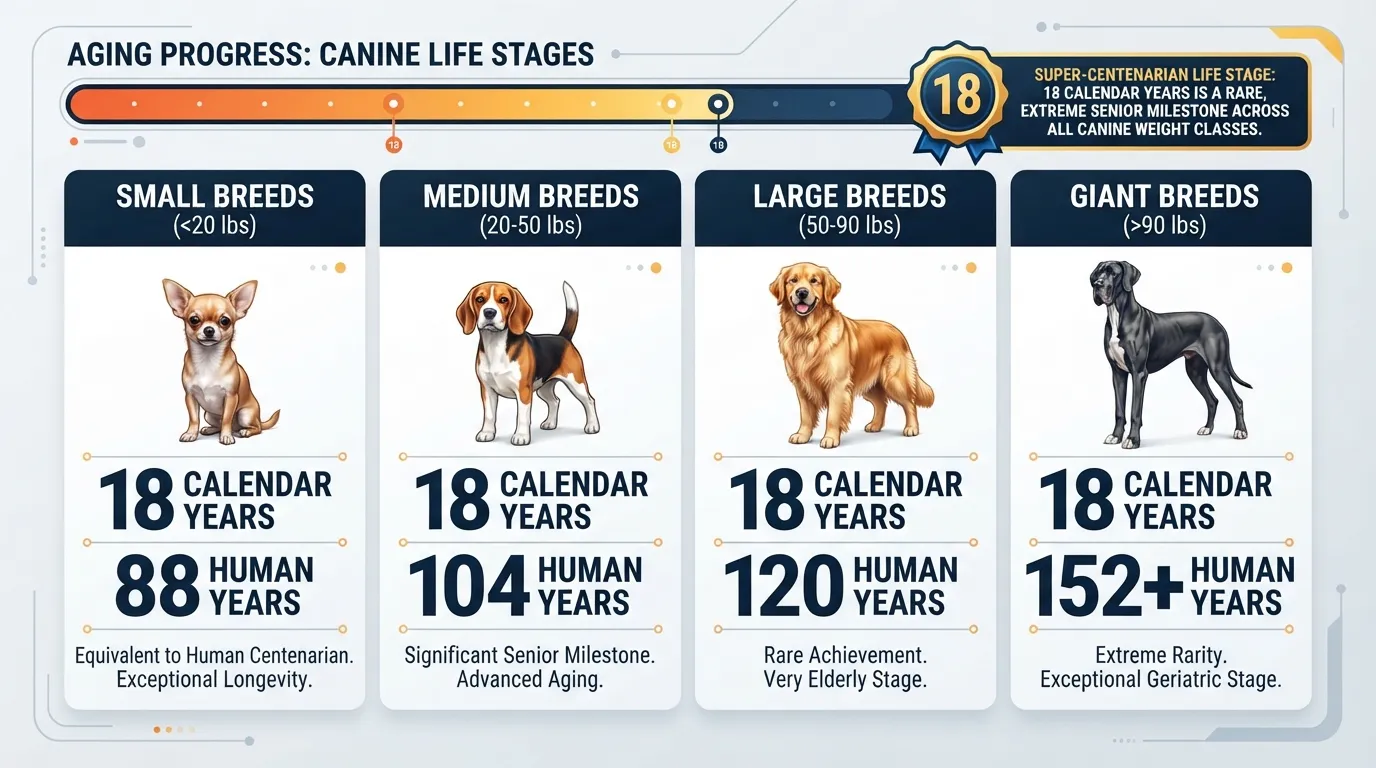
| 18 | 88 | 104 | 120 | 152 | Super-Centenarian |
| 19 | 92 | 109 | 126 | 160 | Super-Centenarian |
| 20 | 96 | 114 | 132 | 168 | Super-Centenarian |
| 21 | 100 | 119 | 138 | 176 | Super-Centenarian |
| 22 | 104 | 124 | 144 | 184 | Super-Centenarian |
| 23+ | 108+ | 129+ | 150+ | - | Super-Centenarian |
| Dog Age | Human Years | Life Stage |
|---|---|---|
| 1 | 15 | Puppy / Junior |
| 2 | 24 | Young Adult |
| 3 | 28 | Adult |
| 4 | 32 | Adult |
| 5 | 36 | Adult |
| 6 | 40 | Mature Adult |
| 7 | 44 | Senior Start |
| 8 | 48 | Senior |
| 9 | 52 | Senior |
| 10 | 56 | Geriatric |
| 11 | 60 | Geriatric |
| 12 | 64 | Geriatric |
| 13 | 68 | Geriatric |
| 14 | 72 | Super-Centenarian |
| 15 | 76 | Super-Centenarian |
| 16 | 80 | Super-Centenarian |
| 17 | 84 | Super-Centenarian |
| 18 | 88 | Super-Centenarian |
| 19 | 92 | Super-Centenarian |
| 20 | 96 | Super-Centenarian |
| 21 | 100 | Super-Centenarian |
| 22 | 104 | Super-Centenarian |
| 23+ | 108+ | Super-Centenarian |
| Dog Age | Human Years | Life Stage |
|---|---|---|
| 1 | 15 | Puppy / Junior |
| 2 | 24 | Young Adult |
| 3 | 29 | Adult |
| 4 | 34 | Adult |
| 5 | 39 | Adult |
| 6 | 44 | Mature Adult |
| 7 | 49 | Senior Start |
| 8 | 54 | Senior |
| 9 | 59 | Senior |
| 10 | 64 | Geriatric |
| 11 | 69 | Geriatric |
| 12 | 74 | Geriatric |
| 13 | 79 | Geriatric |
| 14 | 84 | Super-Centenarian |
| 15 | 89 | Super-Centenarian |
| 16 | 94 | Super-Centenarian |
| 17 | 99 | Super-Centenarian |
| 18 | 104 | Super-Centenarian |
| 19 | 109 | Super-Centenarian |
| 20 | 114 | Super-Centenarian |
| 21 | 119 | Super-Centenarian |
| 22 | 124 | Super-Centenarian |
| 23+ | 129+ | Super-Centenarian |
| Dog Age | Human Years | Life Stage |
|---|---|---|
| 1 | 15 | Puppy / Junior |
| 2 | 24 | Young Adult |
| 3 | 30 | Adult |
| 4 | 36 | Adult |
| 5 | 42 | Adult |
| 6 | 48 | Mature Adult |
| 7 | 54 | Senior Start |
| 8 | 60 | Senior |
| 9 | 66 | Senior |
| 10 | 72 | Geriatric |
| 11 | 78 | Geriatric |
| 12 | 84 | Geriatric |
| 13 | 90 | Geriatric |
| 14 | 96 | Super-Centenarian |
| 15 | 102 | Super-Centenarian |
| 16 | 108 | Super-Centenarian |
| 17 | 114 | Super-Centenarian |
| 18 | 120 | Super-Centenarian |
| 19 | 126 | Super-Centenarian |
| 20 | 132 | Super-Centenarian |
| 21 | 138 | Super-Centenarian |
| 22 | 144 | Super-Centenarian |
| 23+ | 150+ | Super-Centenarian |
| Dog Age | Human Years | Life Stage |
|---|---|---|
| 1 | 15 | Puppy / Junior |
| 2 | 24 | Young Adult |
| 3 | 32 | Adult |
| 4 | 40 | Adult |
| 5 | 48 | Adult |
| 6 | 56 | Mature Adult |
| 7 | 64 | Senior Start |
| 8 | 72 | Senior |
| 9 | 80 | Senior |
| 10 | 88 | Geriatric |
| 11 | 96 | Geriatric |
| 12 | 104 | Geriatric |
| 13 | 112 | Geriatric |
| 14 | 120 | Super-Centenarian |
| 15 | 128 | Super-Centenarian |
| 16 | 136 | Super-Centenarian |
| 17 | 144 | Super-Centenarian |
| 18 | 152 | Super-Centenarian |
| 19 | 160 | Super-Centenarian |
| 20 | 168 | Super-Centenarian |
| 21 | 176 | Super-Centenarian |
| 22 | 184 | Super-Centenarian |
23 Human Years in Dog Years Reverse Calculation
Direct Answer: 23 human years equals roughly 1.8 to 2 calendar years in actual dog age, depending on your dog’s size and breed.
How the Reverse Formula Works: Standard aging charts convert a dog’s real calendar years into equivalent human years where 1 dog year equals roughly 15 human years. To reverse this, subtract 15 for the dog’s first developmental year, leaving 8 human years. Divide those remaining 8 years by 9 the rapid growth value of a dog’s second year, which equals approximately 0.9 years. Adding that back to year 1 gives you roughly 1.9 actual calendar years.
Why Small and Large Dogs Differ Slightly at 23 Human Years
Small Breeds Under 20 lbs: Reach 23 human years at around 21 to 22 months old due to rapid early physical development.
Medium Breeds 20–50 lbs: Hit 23 human years right around the 24-month 2-year mark.
Large/Giant Breeds Over 50 lbs: Reach 23 human years slightly earlier, at around 20 to 22 months, because large breeds mature physically at an accelerated rate during early growth phases according to the American Animal Hospital Association aging guidelines.
Signs of an Extremely Senior Dog 20+ Years & Care Tips
Living with a dog that has reached 20 calendar years—roughly 100 to 105 human years depending on their size—is a rare and beautiful privilege. At this stage, your dog isn’t just old; they are in their ultimate twilight years. Their body slows down significantly, and their daily routine shifts entirely toward comfort, dignity, and gentle maintenance.
Physical & Behavioral Signs of Aging
When a dog reaches 20+, their body and brain undergo noticeable changes. According to the American Animal Hospital Association (AAHA) senior care guidelines, extreme geriatric dogs show a combination of physical decline and cognitive changes that require close daily monitoring:
Severe Vision and Hearing Loss: Advanced cataracts or nuclear sclerosis usually cloud their eyes, leading to poor depth perception. Most 20-year-old dogs are also partially or completely deaf, relying mostly on scent and vibrations to navigate.
Canine Cognitive Dysfunction (CCD): Often called dog dementia, this presents as pacing, staring blankly at walls, getting stuck in corners, or waking up disoriented at night.
Significant Muscle Atrophy and Weight Loss: Even with a good appetite, an ultra-senior dog’s body loses muscle mass (sarcopenia) and struggles to absorb nutrients as efficiently as before.
Deep Sleep and Sleep-Wake Cycle Reversals: They might sleep 18 to 20 hours a day, often sleeping heavily through loud noises, or conversely, staying restless throughout the night.
Incontinence and Poor Bladder Control: Weakened sphincter muscles mean accidents will happen, often while they are resting or sleeping.
Vet & Home Care Tips for Longevity
Caring for a 20-year-old dog isn’t about preventive maintenance anymore—it’s about high-quality palliative and supportive care. Here is how to keep them safe, comfortable, and feeling loved every single day:
Diet & Nutrition: Switch to highly digestible, senior-specific soft food or warm, nutrient-dense fresh toppers. Since appetite often drops as their sense of smell fades, warming up their meal or adding bone broth can stimulate their appetite. Keep meals smaller and more frequent to prevent stomach upset.
Mobility Support: Joint stiffness is guaranteed at this age. Lay down non-slip runner rugs across hardwood or tile floors to prevent painful slips. Invest in an orthopedic memory foam bed with low edges so they don’t struggle to step in and out, and use a rear-support harness (like a Help ‘Em Up harness) to assist them when standing.
Dental Care: Advanced age usually brings sensitive gums or missing teeth. Avoid hard kibble or tough chews that can cause pain or tooth fractures. Gently wipe their teeth and gums with a soft damp cloth or dental wipe, and keep their mouth hydrated with easy access to shallow water bowls.
Regular Vet Checkups: At 20+, visits to the vet should happen every 3 to 4 months—or via mobile/in-home vet consultations to minimize stress. Focus these visits on pain management (such as vet-prescribed joint therapies or gentle pain relief), kidney monitoring, and continuous quality-of-life assessments.
Try Our Free Dog Age Calculator
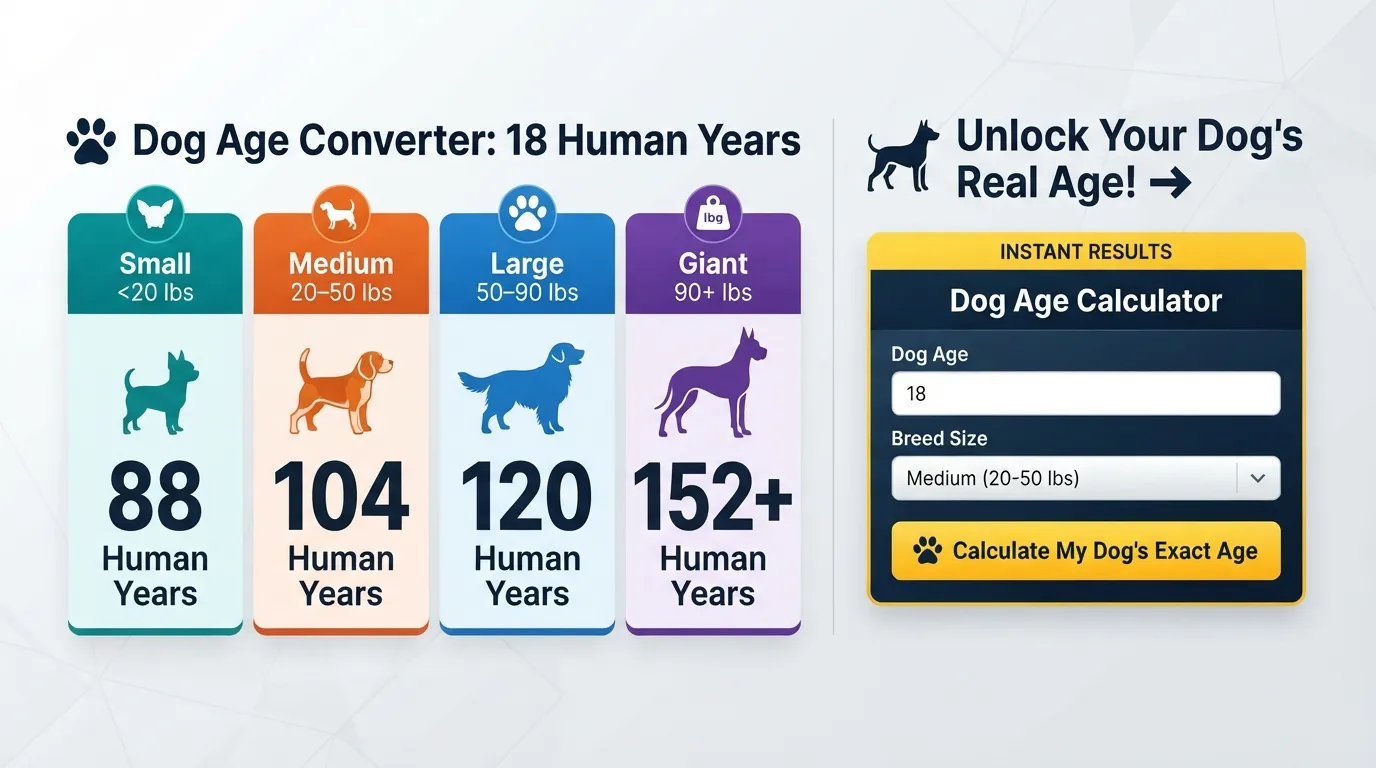
Curious about how old your pup is in human years—without doing the mental math? Standard conversion rules only tell part of the story, especially since small breeds age very differently than larger ones.
Use our free Dog Age Calculator below to get an instant, accurate estimate tailored specifically to your dog’s size and breed. Just plug in their age, and we’ll do the rest!
Why Use Our Calculator Instead of Simple Multiplication?
Breed-Specific Accuracy: Giant breeds like Great Danes reach senior status much earlier than smaller dogs like Chihuahuas or Yorkies.
Non-Linear Aging: Dogs age rapidly during their first two years of life, after which the aging process slows down to a steadier pace.
Veterinary Alignment: Our tool uses updated aging guidelines endorsed by organizations like the American Animal Hospital Association (AAHA) rather than the outdated “multiply by 7” myth.
Frequently Asked Questions
🐾 Other Age Guides

I built Dogagescalculator.com to give dog owners honest, science-backed answers instead of the outdated "×7" myth. Every figure here is checked against AKC, AVMA, and published veterinary research.
More about the author & this site →
Comments