21 in Dog Years: What's That in Human Years?
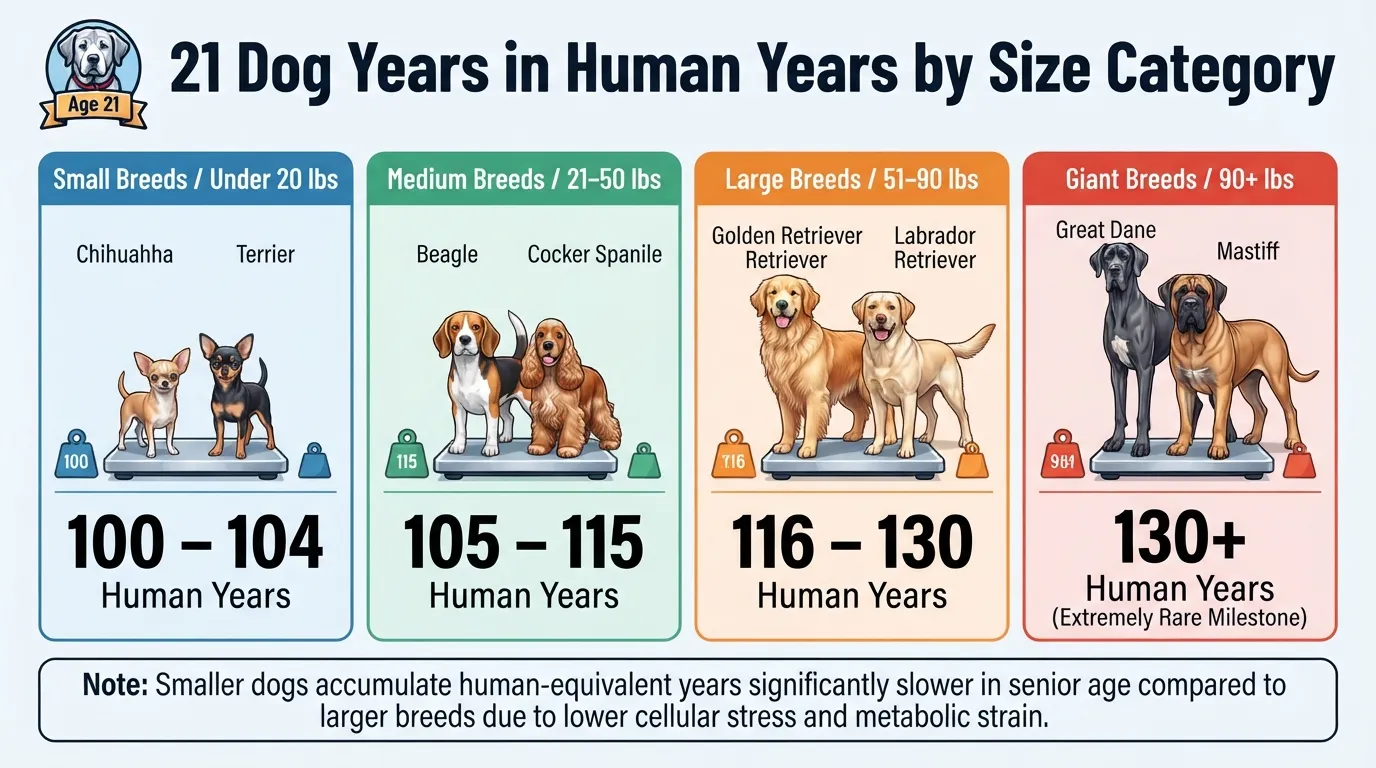
Reaching 21 years old is an extraordinary milestone for a dog. To put it into perspective, less than 0.1% of canines ever celebrate a 21st birthday, placing your companion in a truly elite tier of canine longevity.
In human terms, a 21-year-old dog is roughly equivalent to a person living between 100 and 115 years old, depending heavily on their size, breed, and genetics.
Because canine aging isn’t a simple “multiply by 7” equation—especially once a pet reaches their third decade—calculating an exact age requires looking at how different body sizes age over time. Use our custom calculator below to find the precise human age equivalent for your senior companion based on their specific weight and breed profile.
21 in Dog Years Is Approximately 100 to 110 Human Years
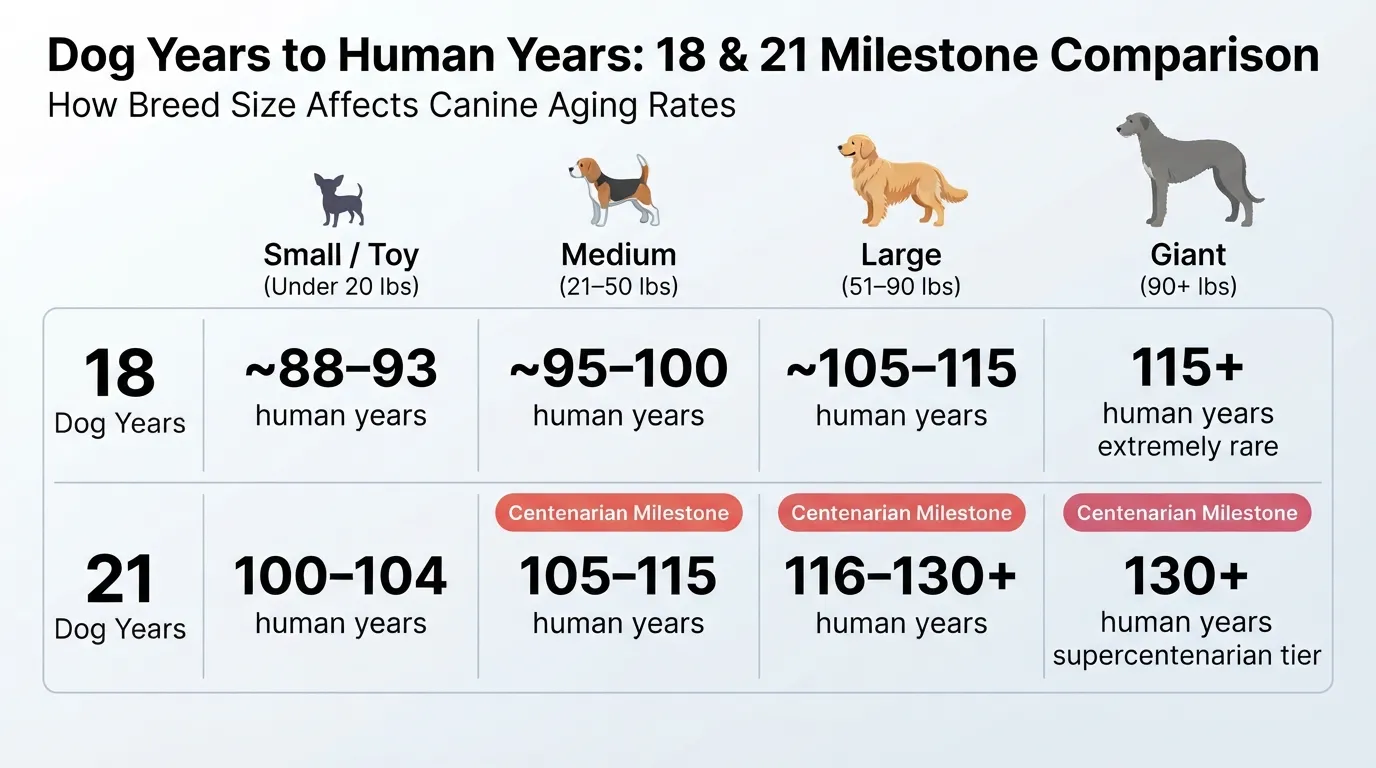
Quick Answer: A 21-year-old dog is roughly 100 to 110 years old in human terms, depending primarily on their breed size. Small dogs aging to 21 hit around 100 to 104 human years, while medium and large dogs—for whom reaching 21 is exceptionally rare—reach the human equivalent of 110+ years.
(Note: The exact human equivalent varies based on your dog’s size and breed. Smaller breeds age more slowly in their senior years compared to larger breeds, which affects the exact math.
How Is a Dog's Age Really Calculated? Old Myth vs. Modern Method
Calculating your dog’s age isn’t as simple as running a basic multiplication table. While the math used to seem straightforward, veterinary science has shifted dramatically away from standard multipliers—especially when evaluating super-senior dogs.
Why “1 Dog Year = 7 Human Years” Doesn’t Work
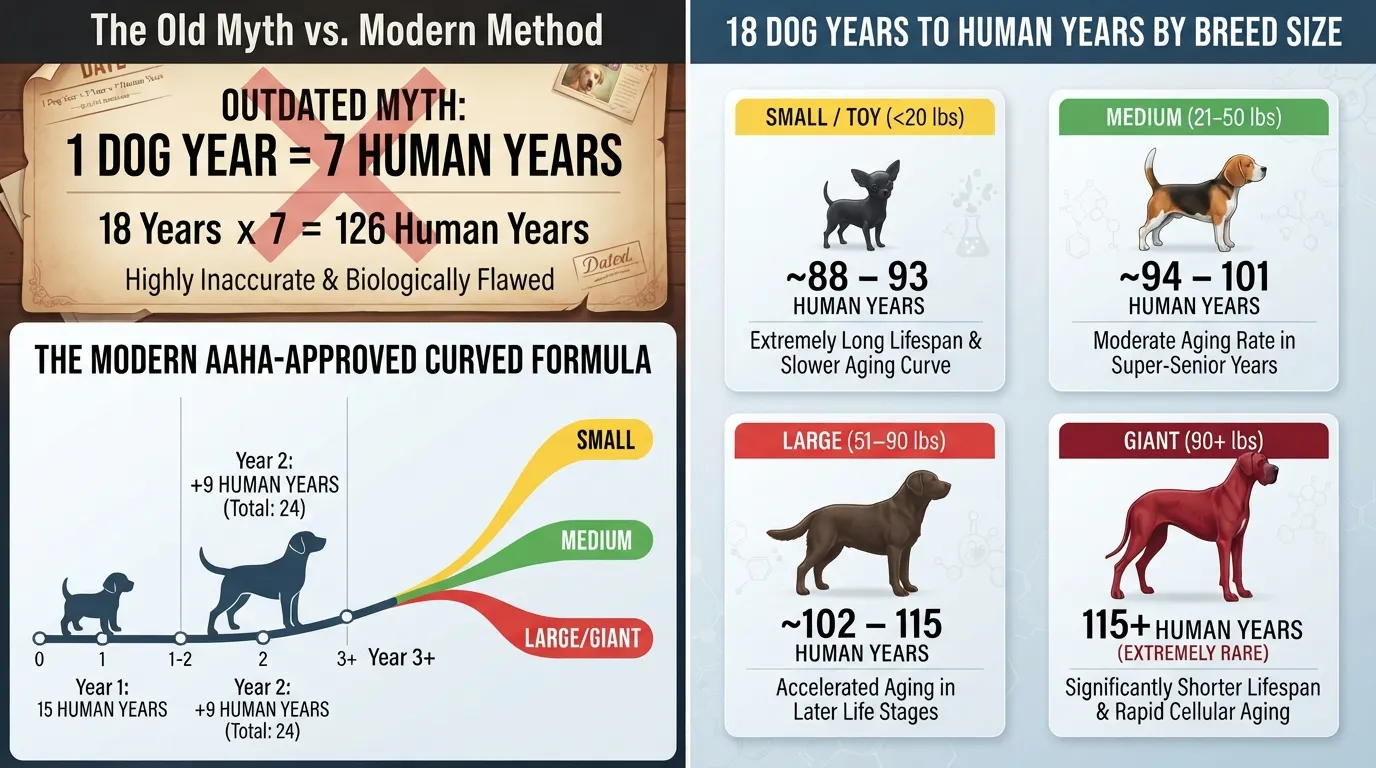
The “1 dog year equals 7 human years” rule has been floating around since the mid-20th century. It likely originated as a simple marketing tactic by early veterinarians to encourage dog owners to bring their pets in for annual checkups, based on the basic logic that humans lived to roughly 70 and dogs lived to about 10.
That neat little formula breaks down completely at the extremes of a dog’s life. Dogs grow at an astonishing rate during their first two years, maturing faster than any human adolescent, and then their biological clock settles into a much slower pace.
If you apply the 7x rule to a 21-year-old dog, you get $21 \times 7 = 147$ human years. While a 21-year-old dog is exceptionally rare, treating their biological age as nearly a century and a half misses the mark scientifically. It oversimplifies canine metabolism and ignores how different breeds age over time.
The Accurate, Size-Based Method
Modern veterinary consensus, supported by aging studies from organizations like the American Animal Hospital Association (AAHA), relies on a curved, size-based calculation model:
Year 1 equals roughly 15 human years: A puppy undergoes massive cellular growth, skeletal development, and sexual maturity all within its first 12 months.
Year 2 brings the dog to approximately 24 human years: The physical growth phase tapers off, and the dog reaches young adult status mentally and structurally.
After Year 2, aging rates diverge based on breed size: From year three onward, small dogs age roughly 4 human years per calendar year, medium dogs age 5, and large or giant breeds can age anywhere from 6 to 8 human years per calendar year.
Because cellular wear and tear happens much faster in large-breed bodies, a small 21-year-old terrier accumulates human-equivalent years far slower than a larger dog would at the same calendar age.
21-Year-Old Dog in Human Years — By Weight
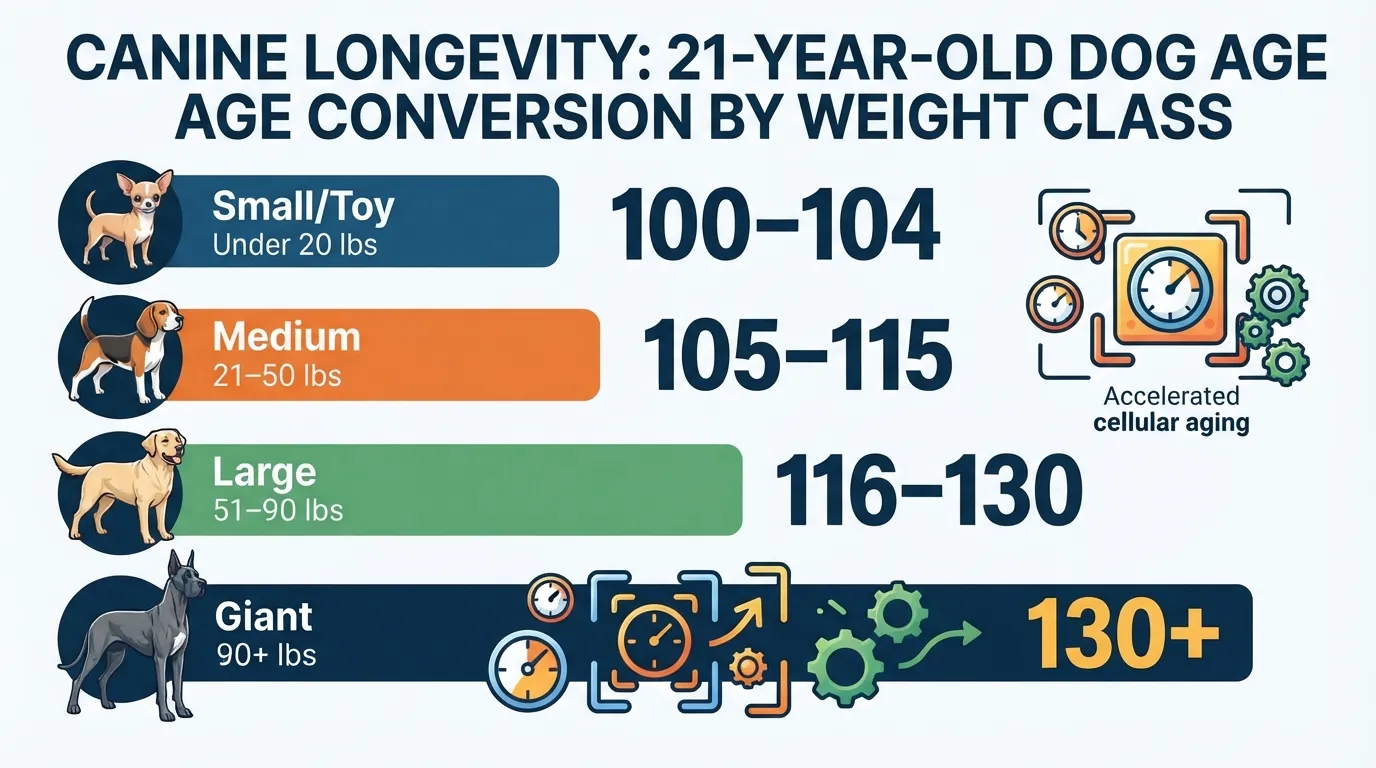
If your dog has reached the ripe old age of 21, they are an absolute legend. Reaching this milestone is extraordinarily rare in the canine world, but a 21-year-old dog isn’t simply “147 in human years.” The old 1:7 rule completely falls apart at extreme ages because small and large dogs age at vastly different biological rates.
According to updated canine aging research—including guidelines from the American Animal Hospital Association (AAHA)—weight is the single biggest factor in how fast a dog ages. Smaller dogs age much slower at a cellular level, while giant breeds age at a accelerated pace.
Here is what 21 chronological dog years actually translates to in human equivalent years, based on your dog’s weight class:
| Dog Weight Class | Size Category | Human Age Equivalent |
|---|---|---|
| Under 20 lbs | Small / Toy | 100 – 104 human years |
| 21 – 50 lbs | Medium | 105 – 115 human years |
| 51 – 90 lbs | Large | 116 – 130+ human years |
| 90+ lbs | Giant | 130+ human years (Extremely rare) |
While a small 15-pound dog reaching 21 is roughly equivalent to a human living past 100, larger breeds hit that century mark much earlier in life. Giant breeds rarely live past 10 to 12 years, making a 21-year-old large or giant dog the canine equivalent of a 130-year-old human.
How to Estimate Age for Mixed-Breed Dogs
If you adopted a rescue or own a mixed breed, pinpointing their exact size category can feel like a guessing game. Here is how to accurately place them in the chart above:
Use their healthy adult weight, not their current weight: Senior dogs frequently lose muscle mass or shed weight due to age-related changes. Base your calculation on what your dog weighed during their prime adult years (around ages 2 to 6) rather than their current scale weight.
Ask your vet for a frame-based size category: If you adopted your dog late in life and don’t know their prime adult weight, ask your veterinarian to estimate their structural frame size. Vets look at bone density, height at the shoulder, and rib cage breadth to determine which weight bracket your mix structurally belongs to, regardless of recent weight loss.
Is 21 Years Old Rare for a Dog?
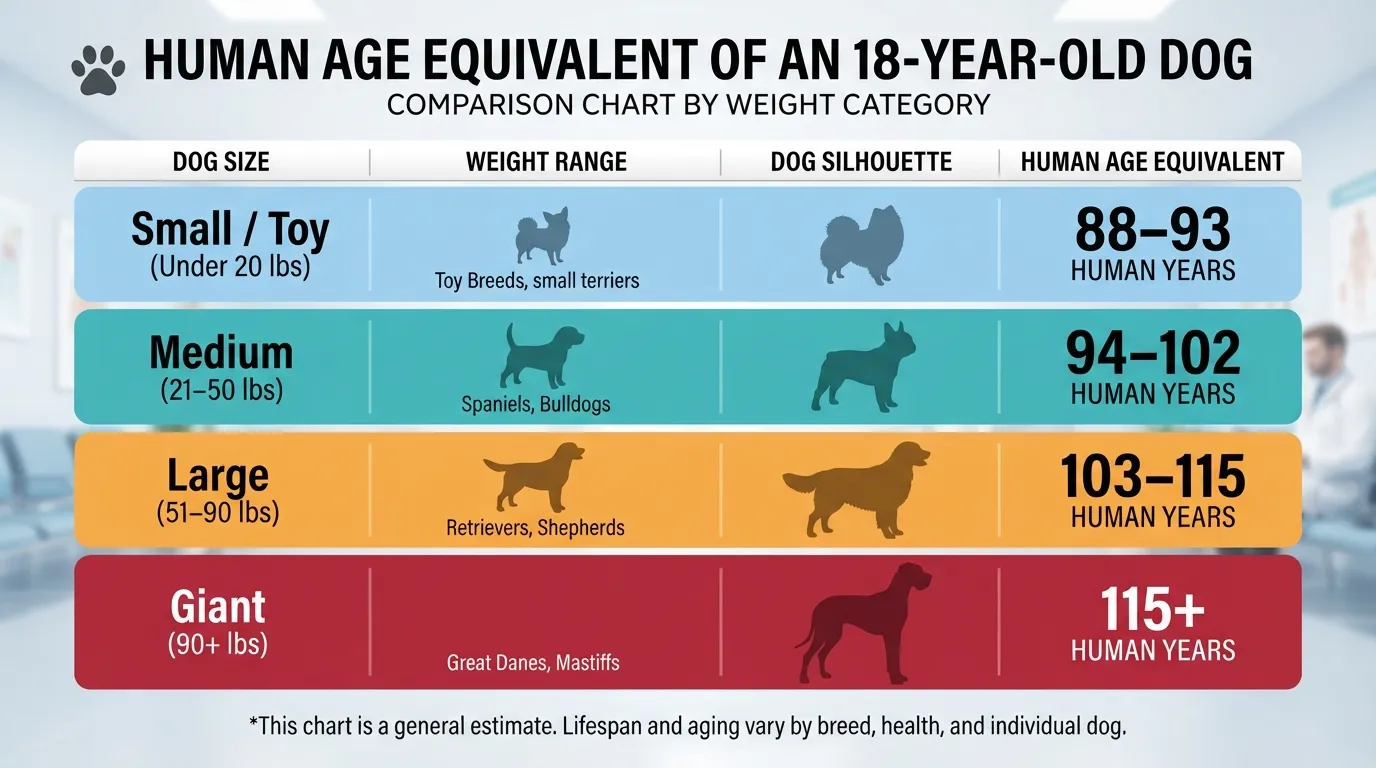
Reaching 21 years old is extraordinarily rare for a dog. To put it into perspective, the average dog lifespan sits between 10 and 13 years across all breeds. Crossing the two-decade mark means a dog has roughly doubled their expected life expectancy, putting them in the upper 0.01% of the global canine population.
In human milestone terms, if turning 21 represents stepping into full young adulthood for us, a 21-year-old dog has already lived through the canine equivalent of a century and then some. They are the supercentenarians of the dog world.
Why do a select few make it this far while most do not? Genetics play the biggest role, particularly when it comes to body size. Smaller dogs consistently outlive larger ones because they age at a much slower cellular pace and put far less physical stress on their cardiovascular and skeletal systems over time.
While giant breeds like Great Danes rarely live past 8 to 10 years, toy and small breeds account for almost every documented case of a dog reaching 20 or beyond. The breeds most likely to reach these rare double-digit milestones include:
Chihuahuas: Known for one of the longest average lifespans (14–16 years), with many individuals stretching into their late teens and early twenties.
Dachshunds: Miniature Dachshunds frequently live 15 to 18 years, supported by strong genetic longevity when back issues are avoided.
Toy Poodles: Highly resilient and prone to fewer congenital health issues than many other purebreds, regularly hitting 15–18+ years.
Shih Tzus: Sturdy small dogs that often maintain good vitality well into their late teens.
Papillons and Maltese: Compact toy breeds that benefit from slow metabolic aging and lower rates of early-onset systemic diseases.
Even among these long-lived breeds, hitting 21 is a remarkable statistical anomaly. For context, the official Guinness World Record for the oldest dog ever verified belongs to Bluey, an Australian Cattle Dog who lived to 29 years and 5 months (1910–1939)—a record that stood untouched for nearly a century. While Bluey was a medium-sized working dog, modern verified cases of dogs living past 20 almost exclusively feature small companion breeds living indoors with consistent veterinary care.
Reaching age 21 isn’t just about luck or genetics, though. It almost always requires a combination of top-tier nutrition, lifelong weight management, proactive dental care, and a good dose of luck in avoiding major illnesses like cancer or kidney failure.
What to Expect at This Age — Health, Signs & Quality of Life
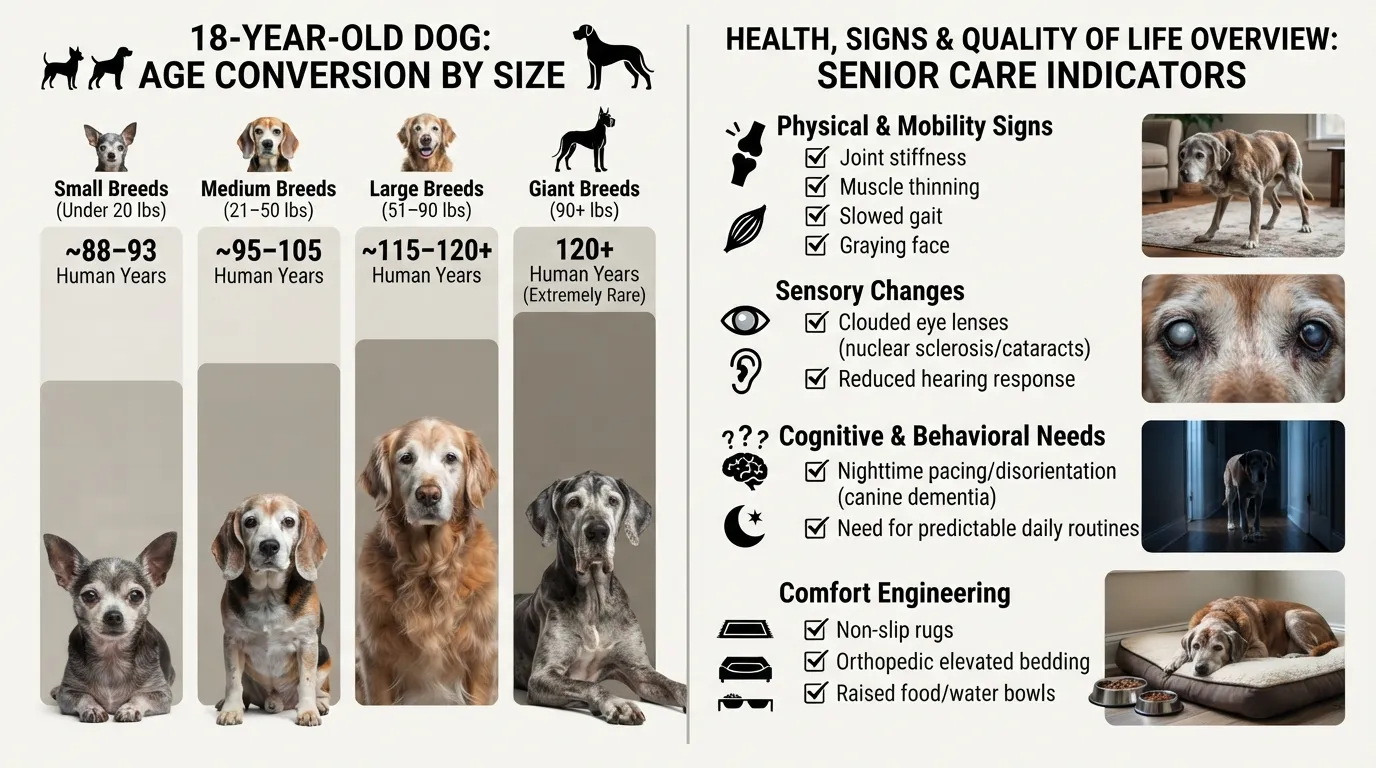
Reaching 21 is an incredible milestone, making your dog the canine equivalent of a centenarian. At this stage, their body systems operate at a very gentle pace, and their needs shift dramatically from active adult dogs—or even standard senior pets. Understanding what is happening physically and mentally helps you protect their comfort and dignity every day.
Common Signs of Aging at This Stage
Graying coat: Muzzling usually spreads across the entire face, around the eyes, and down the chest. The fur often becomes thinner, coarser, or drier due to reduced skin oil production and blood circulation.
Vision and hearing decline: Nuclear sclerosis (a cloudy blue tint in the eyes) or advanced cataracts are extremely common, along with age-related hearing loss. Your dog may startle easily when approached from behind or rely almost entirely on scent to map their environment.
Joint stiffness and reduced mobility: Cartilage wear, advanced arthritis, and muscular atrophy mean getting up takes noticeable effort. You will notice a slower, sometimes unsteady gait, along with difficulty navigating stairs or slippery floors.
Cognitive changes canine dementia : Cognitive Dysfunction Syndrome (CDS) affects a vast majority of dogs who reach two decades. Common signs include pacing at night, staring at walls, getting stuck behind furniture, or temporary confusion about routine exit doors.
Quality-of-Life Care for a 21-Year-Old Dog
Care for a dog at 21 is about hyper-targeted comfort engineering. General senior advice like “exercise daily” no longer applies. Instead, focus on minimizing physical effort and eliminating micro-stressors in their daily environment.
Micro-environments and traction
Unused muscles tire rapidly on smooth surfaces. Place non-slip yoga mats or rubber runner rugs along their exact walking paths—from their bed to the water bowl and the door. If they slip even once, fear of falling can cause them to freeze and stop moving altogether.
Temperature regulation and pressure relief
Centenarian dogs lose subcutaneous fat and muscle bulk, making them susceptible to pressure sores and temperature drops. Use orthopedic memory foam beds elevated a few inches off cold floors, and keep extra blankets handy. A gentle, warmed heating pad (designed specifically for pets with auto-shutoff) can soothe deep joint aches during colder mornings.
Adaptive feeding routines
Arthritic necks make reaching down to floor level painful. Raise food and water bowls to elbow height. Because metabolic efficiency drops, feed smaller, denser, highly digestible meals throughout the day rather than one or two large portions. Warm up wet food slightly to amplify its aroma if their sense of smell has dulled.
When to Talk to Your Vet
At 21, veterinary visits are less about aggressive medical interventions and more about managing daily comfort, pain levels, and dignity. Partner closely with your vet to establish clear, objective metrics for their well-being.
Schedule a consultation immediately if you observe:
Sudden weight loss or a total refusal to eat for more than 24 hours.
Signs of unmanaged pain, such as heavy panting while resting, whimpering when changing positions, or persistent restlessness.
Severe mobility loss where they can no longer stand up to eliminate.
Complete disorientation or distress that does not settle with soothing interaction.
Many veterinarians recommend using a validated Quality of Life scale (such as the HHHHHMM Scale, which measures Hurt, Hunger, Hydration, Hygiene, Happiness, Mobility, and More Good Days Than Bad Days). Tracking these markers weekly gives you and your vet an objective, compassionate framework for making gentle, informed decisions about your dog’s ongoing care.
Frequently Asked Questions
What is 21 in dog years in human years?
A 21-year-old dog is exceptionally rare and would be approximately 100 to 120+ in human years, depending heavily on the dog's breed size (small breeds generally age slower than giant breeds).
Is 21 years old for a dog in human years?
If you mean a human age of 21, that equates to roughly a 1.5 to 2-year-old dog, which is considered a young fully grown adult.
What's the oldest dog ever recorded?
Historically, Bluey (an Australian Cattle Dog) held the record at 29 years and 5 months (1910–1939). Canine longevity records are officially verified by Guinness World Records.
How do I estimate my mixed-breed dog's age category?
Look at estimated adult weight combined with physical markers like tooth wear/tartar, cloudiness in the eyes, and grey hair around the muzzle to place them in Small, Medium, Large, or Giant age curves.
Is the 7-year rule accurate?
No, the simple "1 dog year = 7 human years" rule is an oversimplification. Dogs age much faster during their first two years, and small dogs live significantly longer than large breeds.
🐾 Other Age Guides

I built Dogagescalculator.com to give dog owners honest, science-backed answers instead of the outdated "×7" myth. Every figure here is checked against AKC, AVMA, and published veterinary research.
More about the author & this site →
Comments