
26 in Dog Years — What Does It Really Mean
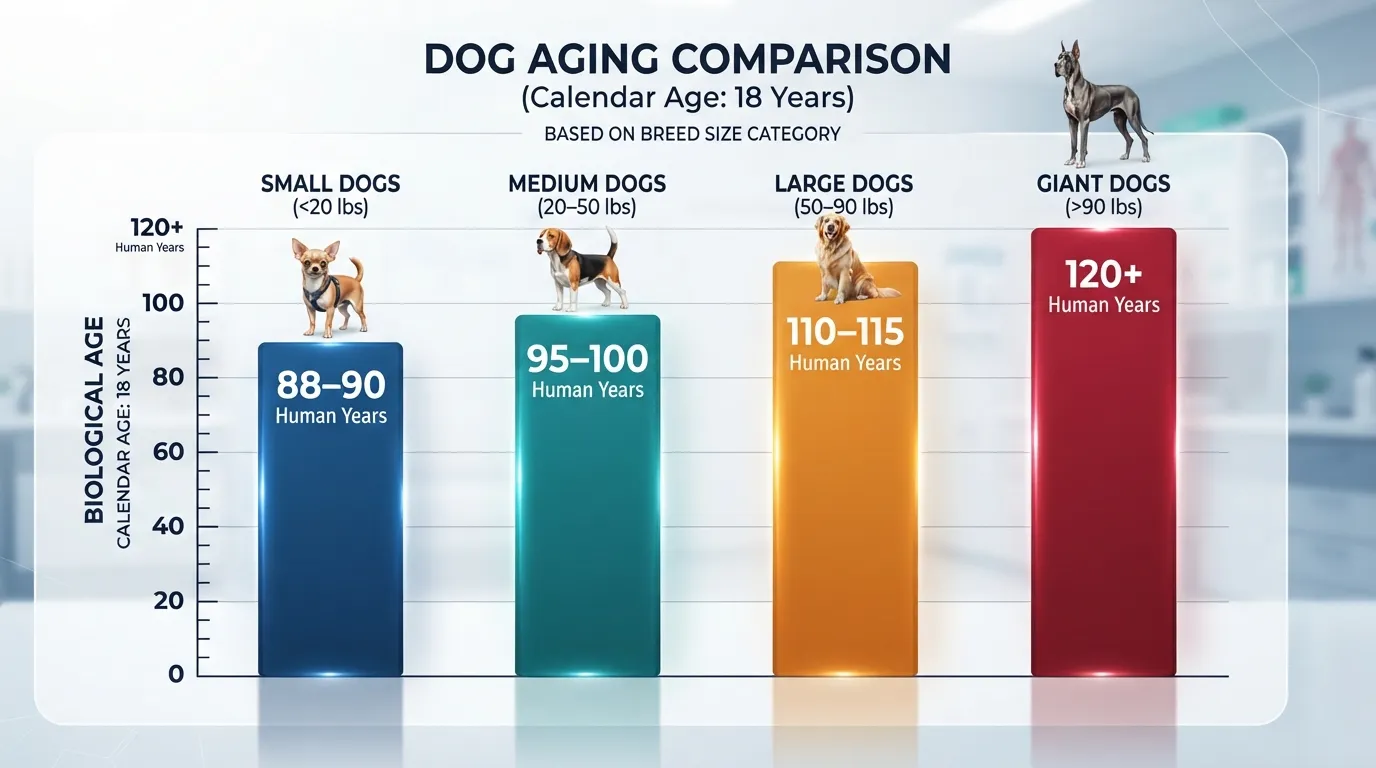
Ever looked at your senior dog lazily stretching in the sun and wondered, “If my dog is 26 in human years, what does that actually mean?” Or maybe your vet mentioned your pup is biologically around 26 years old, leaving you curious about their real stage in life.
Here is the quick answer: A dog that is 26 in human-equivalent years is roughly at the prime of their early adulthood (equivalent to a human in their mid-20s). However, if a dog were chronologically 26 calendar years old, they would be an extraordinarily rare canine superhero—equivalent to a human living well past 120!
Understanding how dog aging actually works isn’t just a fun trivia game. It helps you catch early signs of health shifts, adjust their nutrition on time, and give your companion the exact care they need at every stage.
What Is the Actual Meaning of 26 Dog Years?
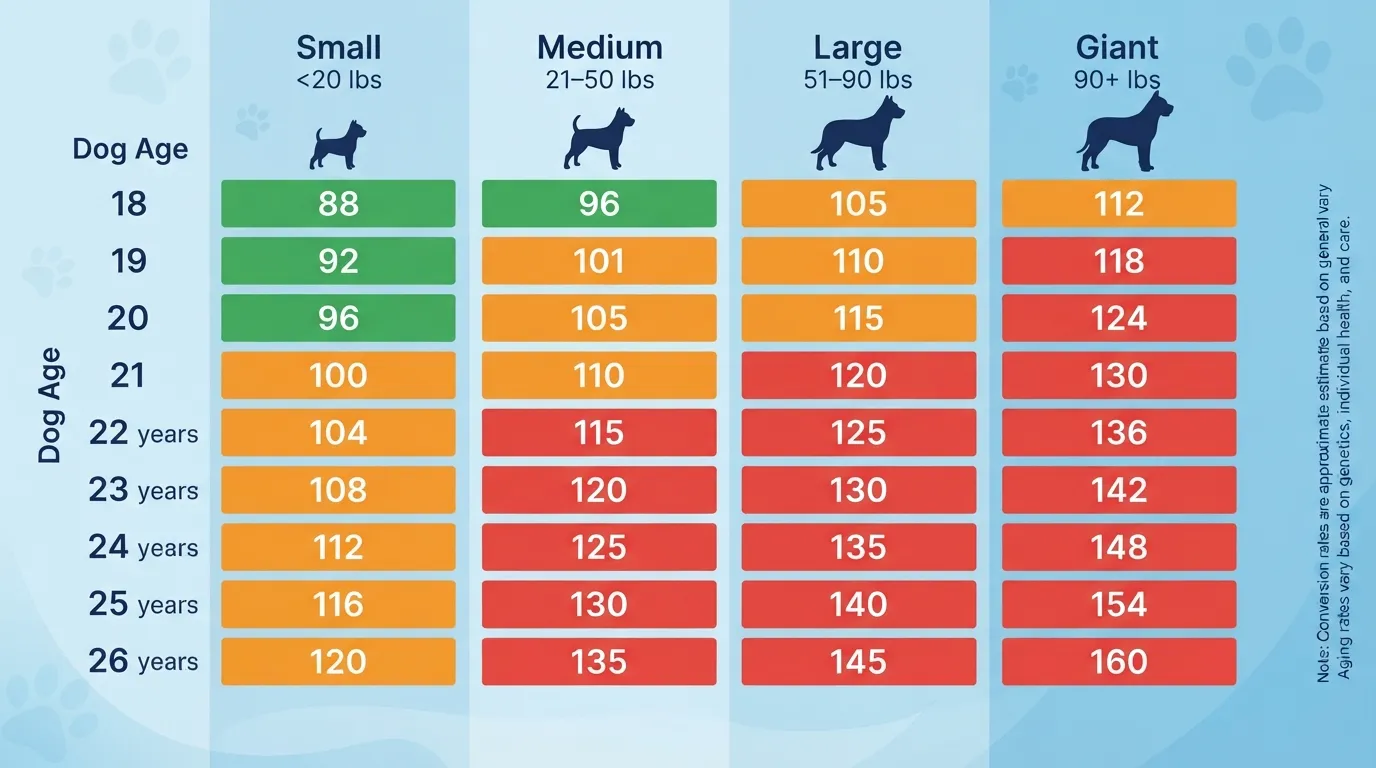
When people ask what “26 in dog years” means, confusion often arises between two completely different scenarios. Some people are converting human age in their minds, while others wonder if a dog can actually live to be 26 years old. For your clarity, let’s understand all three aspects in simple words:
If your own age is 26 and you are wondering how old you would be in the dog world, this means: You are a young adult dog. According to the canine biological timeline:
In the first year, a dog matures rapidly (in humans, around 15 years old). By the second year, it is about 24 human-equivalent years old. After that, every year adds 4 to 5 human years. Bottom Line: If you are looking at human-to-dog conversion, 26 dog years means a dog that is in the prime period of its youth (around 2 to 3 calendar years old). It has full energy, solid muscle growth, and is at the peak of its physical health.
Now let’s look at the second scenario—what if your dog has actually lived for 26 calendar years? This is a completely different story. The average lifespan of dogs is 10 to 15 years. If a dog actually lives up to 26 calendar years, in human-equivalent age, it becomes a 115 to 130-year-old elderly human!
How Rare Is It? Such an occurrence is very rarely seen. Only a handful of dogs in the world manage to cross the age of 20. Biological Condition: At this stage, the dog falls into the ultra-senior category, where it needs special geriatric care, joint support, and daily medical attention.
People often make the mistake of understanding “Dog Years” as a fixed mathematical formula, like converting kilometers into miles. But the reality is that “dog years” is not a single fixed unit. All dogs do not age at the same speed:
First 2 Years: Every dog breed matures very fast. Size Vector: Small dogs (like Pomeranians or Chihuahuas) age calmly and slowly. Large Breeds: Large dogs (like German Shepherds or Great Danes) go through the aging process very rapidly.
Converting 26 Human Years into Dog Years
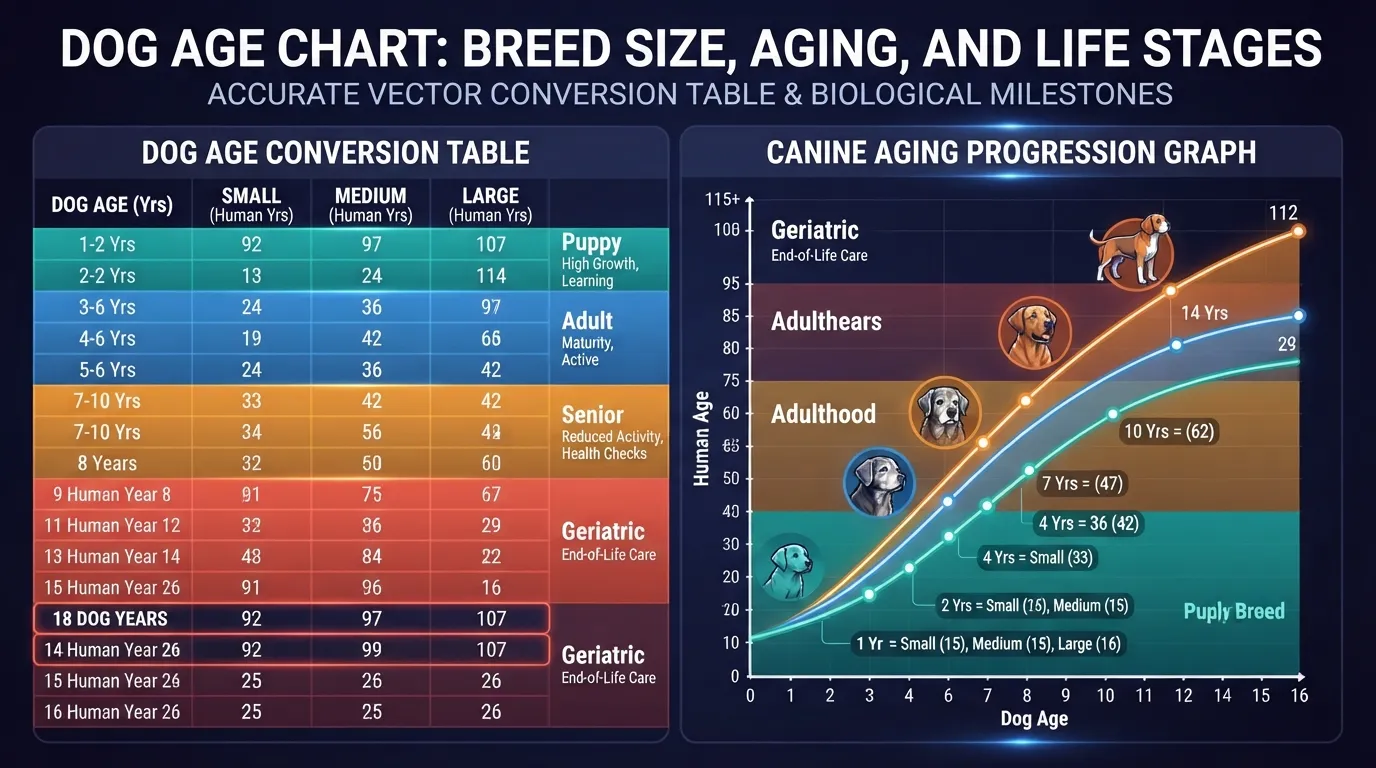
If your own age is 26 human years and you are eager to know what your doggy equivalent would be, or if you want to convert your dog’s actual calendar age on a scientific scale, understanding the calculation is very important. Most pet parents still rely on old mathematical tricks, but modern veterinary science has completely changed this conversion matrix.
Old 7-Year Method (Why Is It Outdated?)
We have all heard this rule since childhood: “1 Dog Year = 7 Human Years”. According to this old 7:1 ratio, if you are 26 years old, in dog years you would be approximately 3.7 years (meaning around 3 years and 8 months) old dog.
Why Has This Formula Been Rejected?
Uneven Aging Curve: Dogs mature much faster compared to humans in their first 1-2 years. A 1-year-old dog is biologically as mature as a 15-year-old teenager—whereas the 7-year rule considers it only a 7-year-old child.
Size Bias Missing: This simple formula treats a small Chihuahua and a large Great Dane on the same scale, while both have a world of difference in their aging patterns. Because of this, veterinary experts now consider this traditional rule completely outdated and inaccurate.
Calculation Using the Correct AVMA Formula (Step-by-Step)
According to the new guidelines of the American Veterinary Medical Association (AVMA) and veterinary research, biological conversion for medium-sized dogs happens in 3 simple steps:
Inverse Calculation: If YOU Are 26 Human Years Old
If we convert your 26 human age into dog age:
First 24 human years are equal to a dog’s first 2 calendar years.
The remaining human years are calculated at a steady rate of about 5 human years per dog year.
Result: If you are 26 human years old, according to biological equivalency, you are a 2.4 calendar years old dog! At this stage, the dog is a fully grown adult and at its peak energy level.
Other Common Ages Comparison Table
From the benchmark table given below, you can easily visualize any human or dog age. (Figures are based on the modern standard AVMA benchmark for medium-sized dogs):
| Dog Age | Human Age Equivalent | Life Stage / Category |
|---|---|---|
| 1 Year | 15 Human Years | Adolescence / Young Teenager |
| 2 Years | 24 Human Years | Young Adult |
| 5 Years | 37 Human Years | Prime Adult |
| 10 Years | 60 Human Years | Senior Dog |
| 15 Years | 85 Human Years | Super Senior (Geriatric) |
| 20 Years | 110 Human Years | Centenarian (Extremely Rare) |
| 25 Years | 125 Human Years | World-Record Longevity |
| 26 Years | 130 Human Years | Mythical / Ultra-Geriatric Legend |
| 30 Years | 150 Human Years | Historic Maximum (e.g., Bobi/Browning records) |
| 40 Years | ~200 Human Years | Theoretical Limit |
| 50 Years | ~250 Human Years | Fantasy / Non-existent |
| 70 Years | ~350 Human Years | Metaphorical Only |
| 100 Years | ~500 Human Years | Fictional |
| 200 Years | ~1000+ Human Years | Pure Fantasy |
If the dog itself is 26 years old
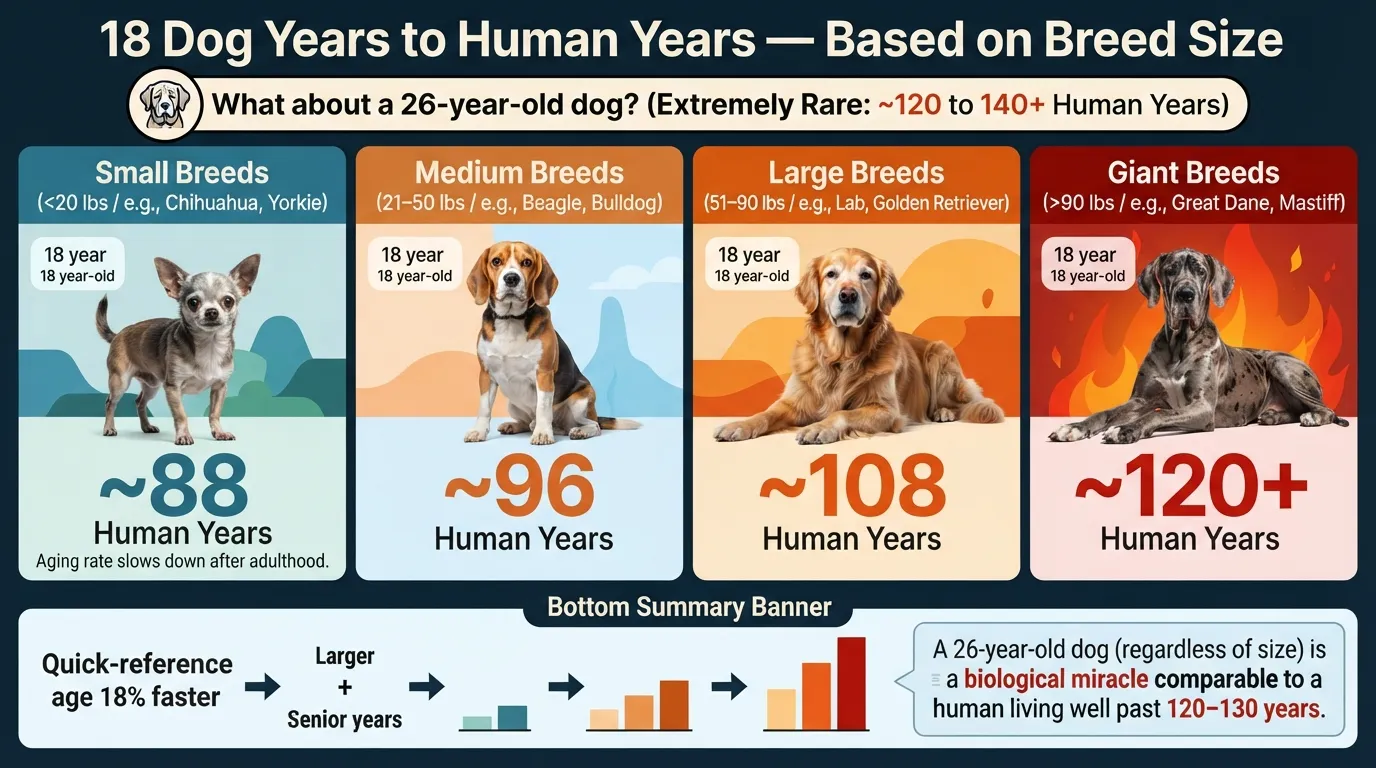
Now let’s look at the scenario which is no less than a miracle—if your dog has actually lived for 26 years according to the calendar (chronological years). When pet owners hear this, they are often surprised because the average lifespan of dogs is between 10 to 15 years. However, completing 26 calendar years is a very rare event in the canine world.
26-Year-Old Dog = How Many Human Years? (Formula Application) If we apply the modern AVMA (American Veterinary Medical Association) biological aging model, calculating the human-equivalent age of a 26-year-old dog is very easy. Let’s look at this breakdown:
First Calendar Year: = 15 Human Years Second Calendar Year: = 9 Human Years (Total: 24 years) The remaining 24 Calendar Years (26 – 2 = 24): Each year is equivalent to an average of 4.5 to 5 human years. 24 × 4.5 = 108 Human Years Total Human Equivalent Age = 15 + 9 + 108 = 132 Human Years
Real Meaning: If your dog has lived for 26 calendar years, on the human scale, it is an elderly human of 130 to 135 years! Dogs reaching this age are in the severe geriatric stage, where they need special joint care, a soft sensory environment, and low-protein tailored nutrition. Is It Close to a World Record? (Rarity + Longevity) The direct answer is: Yes, absolutely! This is 100% world-record tier longevity. Only about 0.0001% of dogs in the world manage to cross the age of 20. Reaching the age of 26 is like a human living past 130+ years without any major illness.
Dog Age Chart By Size
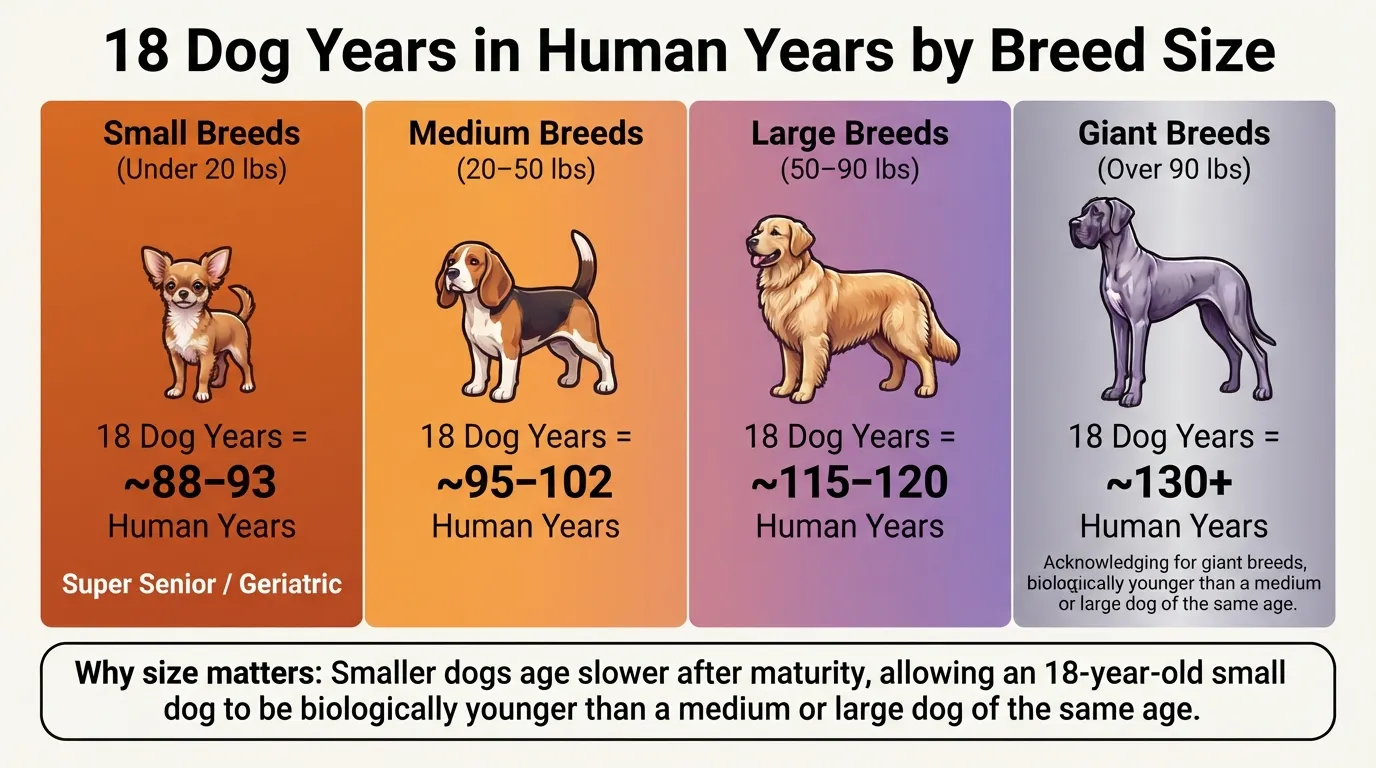
Your dog’s actual biological age (which we talked about in the Calculator) depends heavily on their size and breed. Simply put: Small dogs age slowly, while large dogs age rapidly. Use the charts given below as a reference so you can track the exact life stage:
Small Breeds Table (Upto 9 kg / 20 lbs) This category includes dogs like Chihuahuas, Pomeranians, Toy Poodles, and Dachshunds. These dogs live longer lives and their aging rate (after year 2) is slow.
| Dog Age | Human Age Equivalent |
|---|---|
| 1 Year | 15 Human Years |
| 2 Years | 24 Human Years |
| 5 Years | 36 Human Years |
| 8 Years | 48 Human Years |
| 10 Years | 56 Human Years |
| 13 Years (Senior) | 68 Human Years |
| 15 Years | 76 Human Years |
| 20 Years (Legendary) | 96 Human Years |
Epigenetic & DNA-Based Formula: Science's New Biological Aging Method
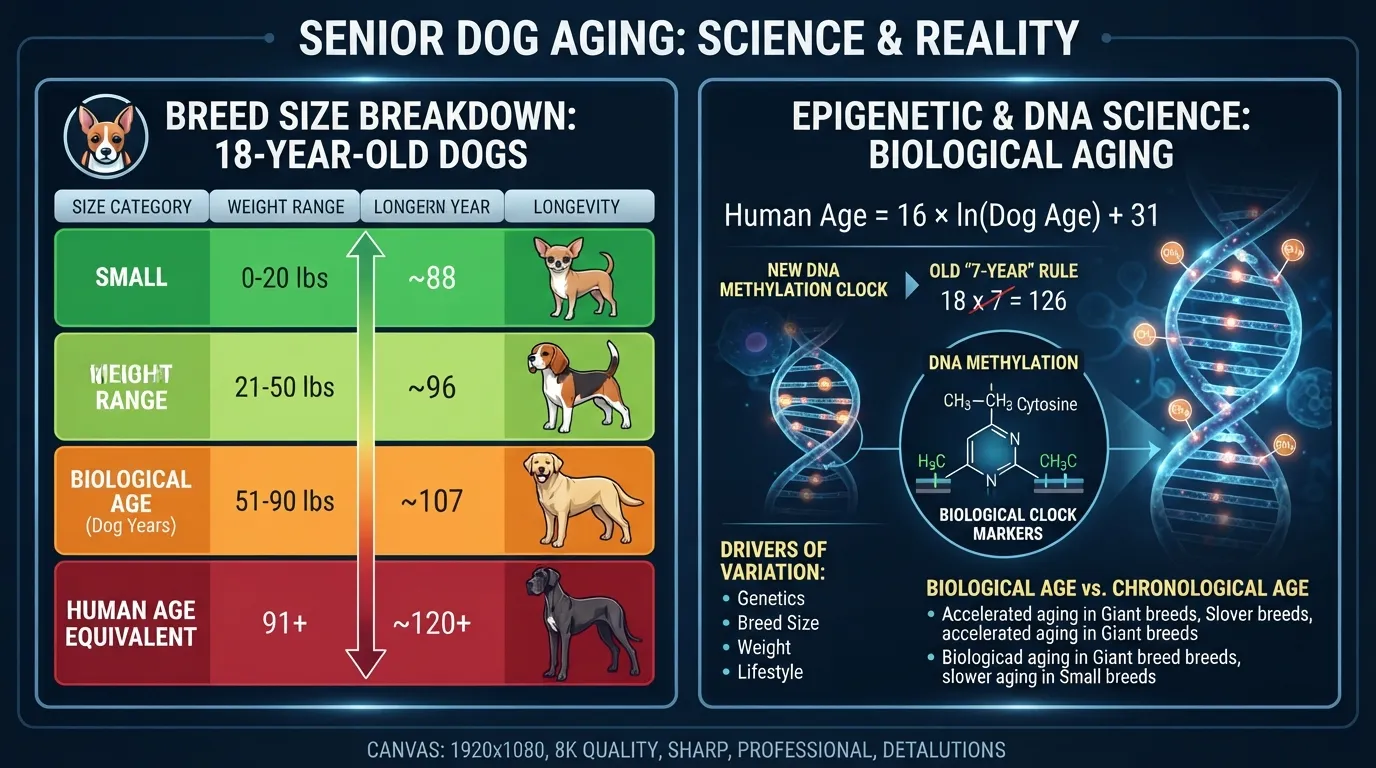
If you think conventional charts are the final way to calculate canine aging, geneticists at the University of California, San Diego (UCSD) have given this entire model a new scientific angle.
A landmark study published in 2019 replaced traditional estimation formulas with direct DNA science. Instead of simple linear multiplication, the scientific community used DNA methylation (Epigenetic Clock)—which maps real biological age by analyzing temporal chemical markers on genomes.
What Is an Epigenetic Clock and How Does This Formula Work?
According to this research, chemical tags (methyl groups) accumulate in a systematic pattern on the DNA of dogs and humans with age. Using this epigenetic tracking, researchers developed a precise logarithmic formula:
Human Equivalent Age = 16 × ln(Dog’s Calendar Age) + 31
(Where ln is the natural logarithm function)
What Do the Results of This New Formula Show?
1-Year-Old Dog: 16 × ln(1) + 31 = 31 Human Years (Conversion from puppyhood to adult is extremely fast in the first year).
2-Year-Old Dog: 16 × ln(2) + 31 ≈ 42 Human Years.
7-Year-Old Dog: 16 × ln(7) + 31 ≈ 62 Human Years.
12-Year-Old Dog: 16 × ln(12) + 31 ≈ 70 Human Years.
This genomic study proved that dogs achieve maturity at a much faster speed compared to humans in the initial phase of life, but their biological aging rate plateaus (slows down) in later life.
You can read this original high-impact research study directly on the Cell Systems Journal (Cell Press), where the team analyzed the DNA methylation profiles of 104 Labrador Retrievers.
Key Science Insight: Why Do Small Dogs Live Longer?
Accelerated Growth Damage: Large and giant breeds go through rapid cell division during puppyhood, keeping their IGF-1 (Insulin-like Growth Factor 1) hormone levels permanently high—this fast growth triggers cellular damage and early-onset age diseases, whereas the slow cellular turnover of small breeds gives them an extended lifespan.
How to Estimate a Dog's Age If the Birth Date Is Unknown
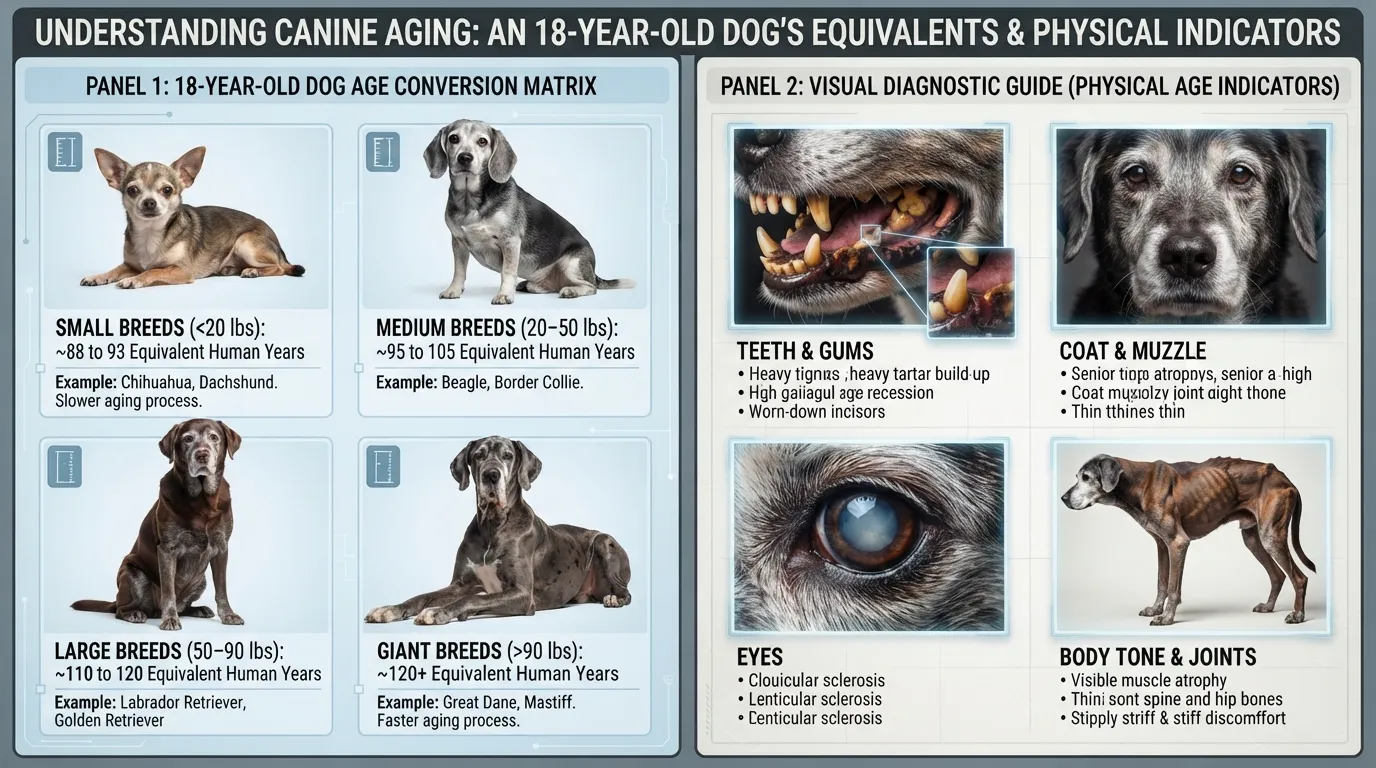
If you have adopted a dog or a rescue pup has come into your life, you might not know their exact birth date. Well, there is no need to worry at all! Vets and animal shelter experts can closely estimate a dog’s biological age even without any legal birth record. When official paperwork is missing, you can guess your dog’s age using the key physical indicators and behavioral markers given below:
How to Check Age Through Physical Signs
Teeth Condition (Dental Examination): Teeth are the most reliable physical sign to tell a dog’s age.
8 Weeks: All baby teeth (deciduous teeth) have erupted.
7 Months: All permanent adult teeth are clean and pearly white.
1 to 2 Years: Mild yellowing (tartar buildup) begins on the back teeth.
3 to 5 Years: Tartar accumulation is clearly visible on the teeth along with visible wear-and-tear.
10+ Years: Worn-down teeth, severe tartar, or missing teeth indicate senior age.
Eyes & Vision Clarity: The eyes of young and adult dogs are completely clear and bright. Around 6 to 8 years of age, a slight bluish-grey cloudiness begins to appear in the lenses of a dog’s eyes, called Lenticular Sclerosis. This is not a cataract, but rather a part of the normal aging process.
Coat & Fur Texture: Much like gray hair in humans, gray or white fur starts appearing on a dog’s muzzle, eyebrows, and face after the age of 7 to 8 years. Additionally, their skin elasticity begins to decrease and the coat starts to feel rough.
Energy Levels & Mobility: Young adult dogs (1-4 years old) are restless, highly energetic, and always ready for physical activity. If your dog rests more often, hesitates to jump, or shows joint stiffness when waking up in the morning, they mostly fall into the 8+ years senior category.
Veterinary Checkup (Professional Assessment): The best and most accurate way is to take your dog to a specialist vet. Vets analyze joint flexibility, internal organ health, dental radiographs, and blood markers to tell you the dog’s estimated age with an accuracy of 1 to 2 years.
For practical insights on dog health evaluation and age estimation procedures, you can check the expert guide by the American Kennel Club (AKC), which covers canine dental physical indicators in detail.
Frequently Asked Questions FAQs
Here are the direct and accurate answers to the common questions pet owners often ask about dog age calculations and longevity:
How old is 26 years in dog years?
This depends on which direction you are converting:
If human age is 26 years: On the dog equivalency scale, you are a 2.4 calendar years old dog (which is their prime adult stage).
If the dog itself is 26 calendar years old: According to the modern AVMA conversion formula, on the human scale, it is an ultra-senior dog of approximately 130 to 135 human years!
How old is a dog in 25 years?
A 25-year-old dog in calendar years is equivalent to about 120 to 125 human years on the human scale. This is considered extreme longevity in the canine world, coming very close to verified world records.
How old is 200 years in dog years?
200 human years would be roughly equivalent to 40 calendar dog years or more based on biological conversion. In reality, this is a purely theoretical and fantasy figure, as no dog in recorded history has ever lived beyond 30 to 31 calendar years.
Is 1 year = 7 years for dogs?
No, this traditional 7-year rule is now considered scientifically wrong and outdated. Dogs mature very rapidly in their first 2 years (the first year equals 15 human years, and the second year adds 9 human years). After that, their aging rate proceeds at about 4 to 5 human years per calendar year, depending on their breed size.
Is 20 years old for a dog?
Yes, 20 calendar years is a very old (super senior) age for any dog. In human age, this is roughly equivalent to 100 to 110 years. Only about 0.0001% of dogs in the world manage to cross the age of 20—this is usually seen only in small-sized breeds like Chihuahuas or Dachshunds.
🐾 Other Age Guides

I built Dogagescalculator.com to give dog owners honest, science-backed answers instead of the outdated "×7" myth. Every figure here is checked against AKC, AVMA, and published veterinary research.
More about the author & this site →
Comments