
What Is 60 in Dog Years? Breed & Size Breakdown
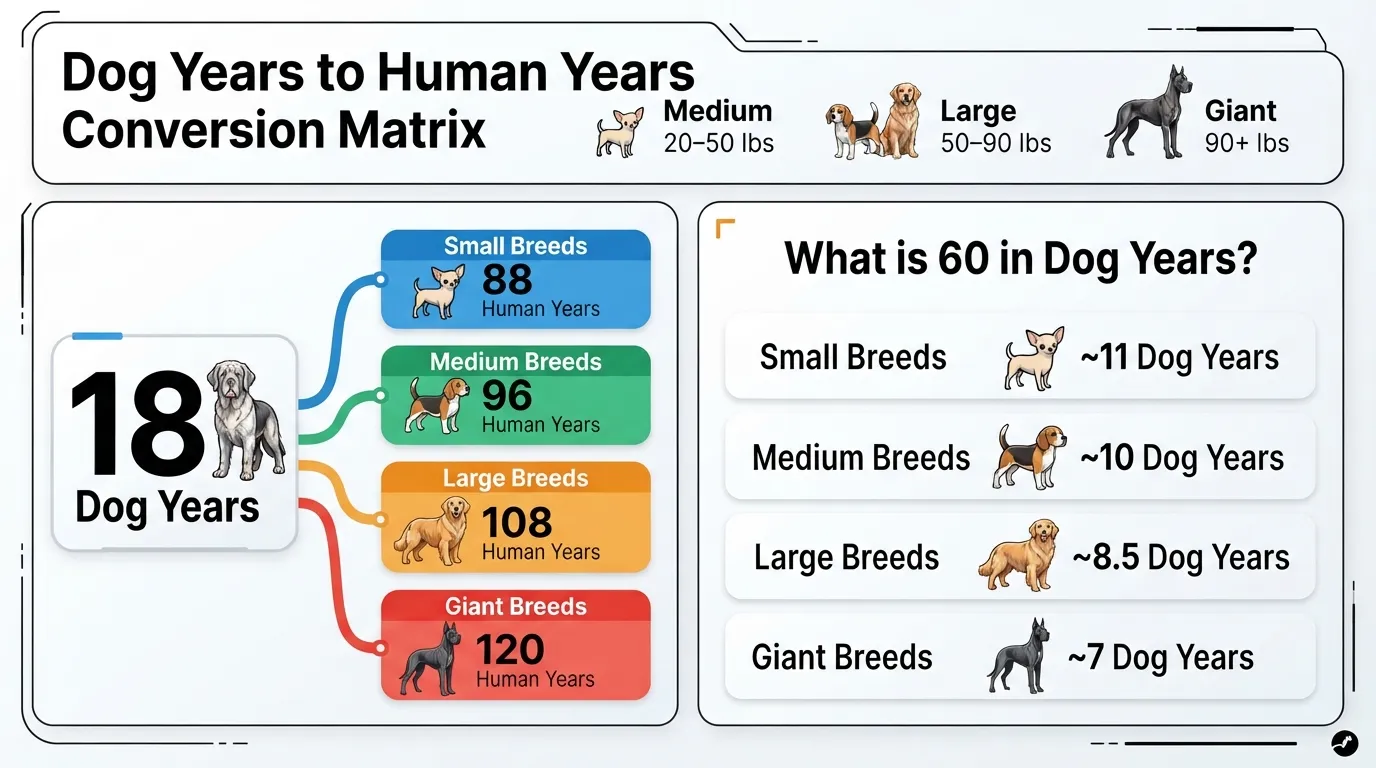
A dog reaches the equivalent of 60 human years between 7.5 and 11 calendar years of age, depending entirely on their weight and breed size.
Because smaller breeds age more slowly after reaching maturity while larger breeds age significantly faster, there is no single “7-to-1 rule” multiplier that works for every dog.
According to guidelines established by the American Animal Hospital Association (AAHA) and the American Veterinary Medical Association (AVMA), here is how a 60-human-year equivalent breaks down by physical size:
| Dog Size Category | Weight Range | Calendar Age Equivalent to 60 Human Years | Senior Stage Status |
|---|---|---|---|
| Small Breeds | Under 20 lbs (9 kg) | 10 to 11 years old | Early Senior |
| Medium Breeds | 20 to 50 lbs (9–23 kg) | 9.5 to 10 years old | Senior |
| Large Breeds | 50 to 90 lbs (23–41 kg) | 8.5 to 9 years old | Senior |
| Giant Breeds | Over 90 lbs (41+ kg) | 7.5 to 8 years old | Geriatric / Advanced Senior |
| Small Breeds | |
|---|---|
| Weight Range | Under 20 lbs (9 kg) |
| 60 Human Years Eq. | 10 to 11 years old |
| Senior Status | Early Senior |
| Medium Breeds | |
|---|---|
| Weight Range | 20 to 50 lbs (9–23 kg) |
| 60 Human Years Eq. | 9.5 to 10 years old |
| Senior Status | Senior |
| Large Breeds | |
|---|---|
| Weight Range | 50 to 90 lbs (23–41 kg) |
| 60 Human Years Eq. | 8.5 to 9 years old |
| Senior Status | Senior |
| Giant Breeds | |
|---|---|
| Weight Range | Over 90 lbs (41+ kg) |
| 60 Human Years Eq. | 7.5 to 8 years old |
| Senior Status | Geriatric / Advanced Senior |
Why Does Size Affect the 60-Year Milestone?
During early puppyhood the first 1–2 years, all dogs develop at a similar rapid rate. However, once physical adulthood is reached, cellular aging varies drastically by size:
Small Dogs e.g., Chihuahua, Shih Tzu, Toy Poodle: Maintain lower metabolic stress relative to organ size over time. A 10.5-year-old small dog sits right at the 60-human-year threshold and often has several vibrant years ahead.
Medium Dogs e.g., Beagle, Border Collie, Bulldog: Age at a steady, baseline rate. They reach 60 human years at approximately age 10.
Large Dogs e.g., Golden Retriever, German Shepherd, Labrador: Suffer greater physiological wear and tear. They cross into the 60 human years bracket at roughly 8.5 to 9 calendar years.
Giant Dogs e.g., Great Dane, Mastiff, Saint Bernard: Experience accelerated biological aging. By the time a giant breed turns 7.5 to 8 years old, their organ systems and joint health reflect that of a 60-year-old human.
Is a Dog “Old” at 60 Human Years?
At 60 human years, a dog is officially in their senior stage. While not yet in late-stage geriatric decline, this transition point marks a critical period where proactive veterinary health checks become essential.
Common biological shifts occurring at this milestone include:
Metabolic Slowdown: Reduced energy expenditure requiring diet adjustments to prevent weight gain.
Joint Stiffness: Subtle onset of osteoarthritis, especially noticeable after sleeping or heavy exercise.
Sensory Changes: Early clouding of the eye lens lenticular sclerosis and gradual hearing loss.
Organ Monitoring Needs: Increased necessity for bi-annual blood panels to check kidney and liver function.
Quick Answer: What Dog Age Equals 60 in Human Years?
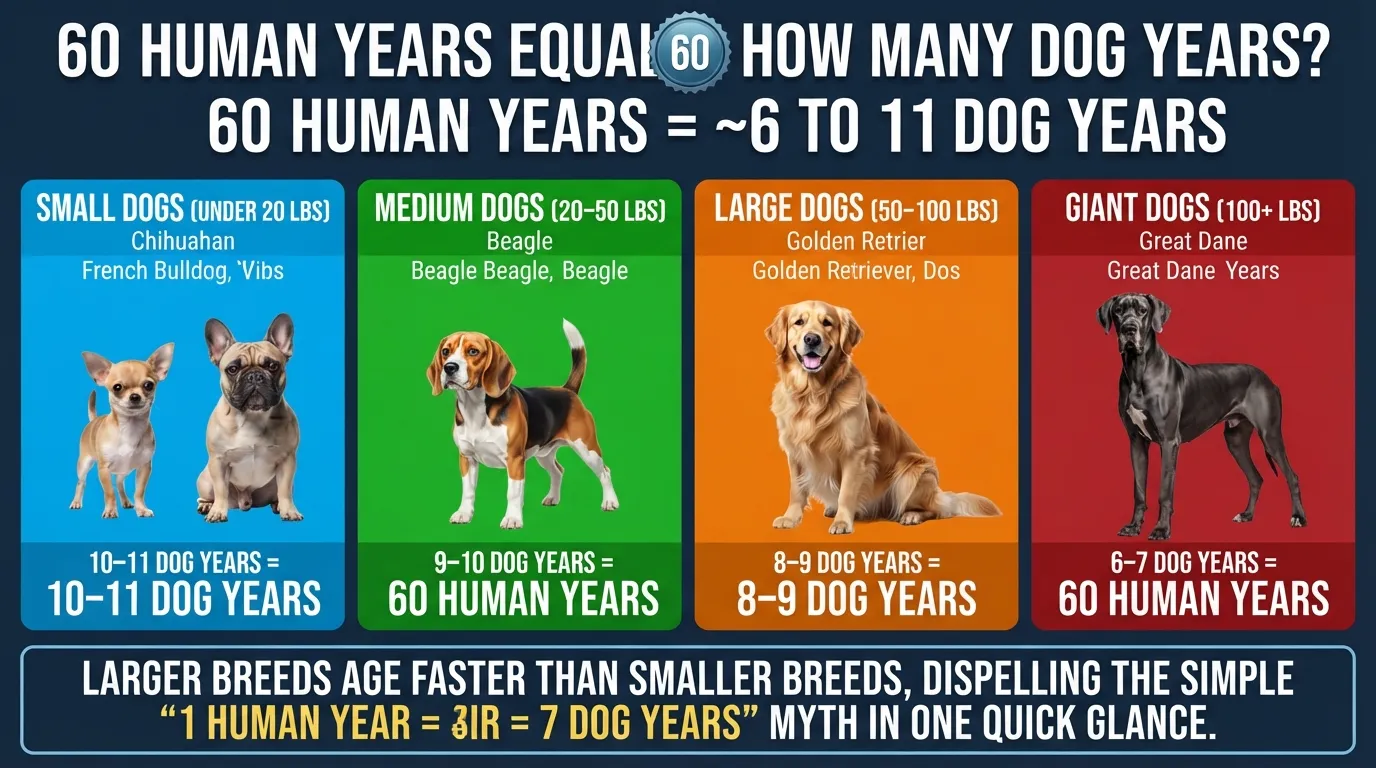
If a dog is 60 in human years, their actual calendar age is between 8 and 11 years old, depending on their weight class and breed size.
Because smaller dogs age slower than larger dogs after reaching adulthood, a giant-breed dog hits the human equivalent of 60 much earlier in life than a small breed.
At a Glance: 60 Human Years by Dog Size
Small Dog <20 lbs: ~11 calendar years old e.g., Chihuahua, Shih Tzu, Yorkshire Terrier
Medium Dog 21–50 lbs: ~10 calendar years old e.g., Beagle, Bulldog, Cocker Spaniel
Large Dog 51–90 lbs: ~9 calendar years old e.g., Golden Retriever, German Shepherd, Boxer
Giant Dog 90+ lbs: ~8 calendar years old e.g., Great Dane, Mastiff, Saint Bernard
Key Takeaway for Pet Parents
Reaching 60 in human equivalent years marks an important milestone: your dog is now officially a senior.
At this stage, their metabolic rate slows, joint cartilage begins to wear, and annual veterinary checkups should ideally transition to semi-annual wellness exams every 6 months. Early screening for mobility changes, kidney function, and dental hygiene can significantly extend both their quality of life and lifespan.
Not sure of your dog’s exact size or cross-breed weight class? Use our interactive calculator above or scroll down to see the complete age conversion chart and breed-specific breakdown.
What Does "60 in Dog Years" Actually Mean?
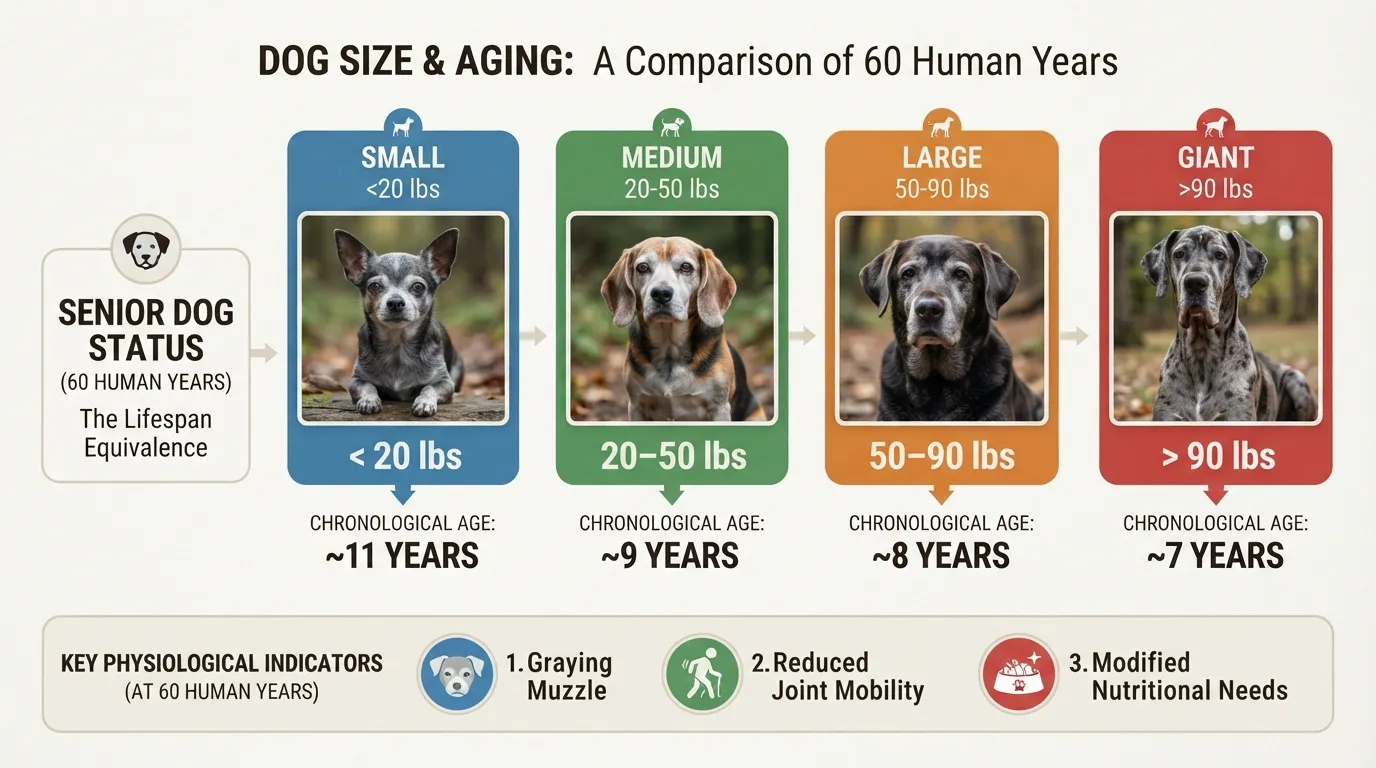
At its core, “60 in dog years” represents a major biological milestone: the transition into official seniority.
In human medicine, 60 marks the entry into late middle age or mature adulthood. In veterinary medicine, reaching a human-equivalent age of 60 means a dog’s body is undergoing predictable physiological shifts—such as reduced metabolic speed, subtle joint stiffness, changes in lens clarity, and altered nutritional requirements.
However, because dogs age at drastically different rates depending on their physical size and breed genetics, a dog does not reach “60” at a single set calendar age.
A Giant Breed e.g., Great Dane: Hits the equivalent of 60 human years by calendar age 7 or 8.
A Large Breed e.g., Golden Retriever: Hits 60 around calendar age 8 or 9.
A Medium Breed e.g., Beagle: Reaches 60 around calendar age 9 or 10.
A Small Breed e.g., Chihuahua: Doesn’t reach 60 until calendar age 10 or 11.
Two Ways People Search This
Search queries around “60 in dog years” generally fall into two distinct interpretations:
“My dog is around 8 to 11 calendar years old—are they 60 in human years?”
This is the most common intent. Pet parents want to know if their senior dog’s current calendar age translates to a 60-year-old human’s stage of life, and what health care adjustments they should make right now.
“If a dog were literally 60 human calendar years old, how old would that be in dog years?”
This is a literal/mathematical intent. While no dog lives to 60 calendar years (the oldest verified dog in history, Bobi, lived to 31), people occasionally mix up “calendar years” and “human-equivalent years” when using online age tools.
If You Meant “Convert My Own Age Into Dog Years” Quick Clarification
If you are a 60-year-old human wondering what your equivalent age would be if you were a dog, or if you’re trying to reverse-calculate human age into dog years:
A 60-year-old human is roughly equivalent to a 9-year-old medium-sized dog.
If you reverse the traditional formula to ask, “How many actual calendar years would a dog need to live to match a 60-year-old human?”, the answer is between 8 and 11 actual years, depending entirely on your dog’s weight and size category.
In short: 60 human-equivalent years = a senior dog between 8 and 11 calendar years old.
Dog Age Chart — What Dog Age Equals 60 Human Years By Size
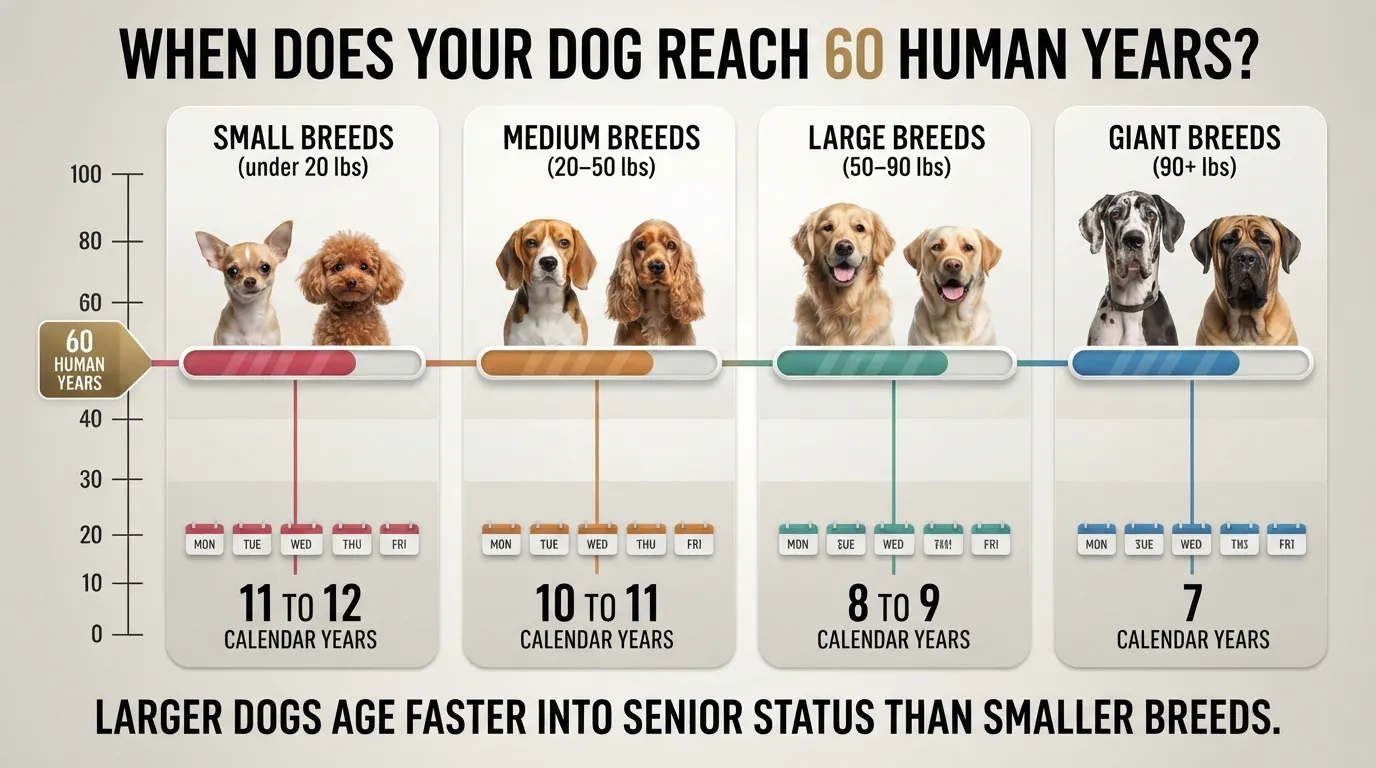
Reaching the equivalent of 60 human years is a significant milestone for a dog. In human medicine, 60 marks the transition into mature middle age and the threshold of senior care. In veterinary medicine, reaching a 60-year human equivalent means your dog has firmly entered their senior or mature stage.
Because dogs age at vastly different rates depending on their physiological size and metabolic demands, a dog doesn’t hit 60 human years at a single static age. According to standards from the American Animal Hospital Association AAHA and veterinary age studies:
Small Breeds ≤ 20 lbs: Reach 60 human years at approximately 11 actual years.
Medium Breeds 21–50 lbs: Reach 60 human years at approximately 10 actual years.
Large Breeds 51–90 lbs: Reach 60 human years between 8.5 and 9 actual years.
Giant Breeds > 90 lbs: Reach 60 human years early, at approximately 7 to 7.5 actual years.
Small Breeds Under 20 lbs
Actual age equivalent to 60 human years: ~11 years old
Toy and small dogs—such as Chihuahuas, Miniature Poodles, Dachshunds, and French Bulldogs—enjoy longer natural lifespans than larger canines. Small breeds experience rapid physiological development during their first two years, but their cellular aging slows down considerably as adults.
Aging Trajectory: At 10 actual years, a small dog is around 56 in human years. By year 11, they cross into 60 human years.
Veterinary Context: While an 11-year-old Chihuahua is chronologically senior, small dogs often remain vibrant and active well into their teens. Early senior monitoring should focus on dental health (periodontal disease is very common in toy breeds), patellar luxation, and early-stage heart murmurs.
Medium Breeds 21 to 50 lbs
Actual age equivalent to 60 human years: ~10 years old
Medium-sized dogs—like Beagles, Border Collies, Cocker Spaniels, and Australian Cattle Dogs—follow the standard baseline age curve most people think of when calculating dog age.
Aging Trajectory: A 9-year-old medium dog is roughly 56 human years old. Upon hitting their 10th birthday, they reach the equivalent of a 60-year-old human.
Veterinary Context: At 10 actual years, medium dogs enter a transitional period. Metabolic rates slowly decline, making weight management a top priority to prevent osteoarthritis stress. Bi-annual veterinary checkups starting at age 10 help catch kidney or thyroid changes early.
Large Breeds 51 to 90 lbs
Actual age equivalent to 60 human years: ~8.5 to 9 years old
Large breeds—such as Golden Retrievers, Labradors, German Shepherds, and Boxers—age faster due to accelerated growth rates during puppyhood and higher overall cellular stress.
Aging Trajectory: By age 8, a large dog is around 55 human years. By the time they turn 9, they have passed 60 human years (averaging roughly 61 to 66 equivalent human years depending on exact weight).
Veterinary Context: At 8.5 to 9 years old, large dogs need proactive senior protocols. Joint supplements (glucosamine, chondroitin, omega-3 fatty acids) become critical, along with screening for hip dysplasia, spinal stiffness, and cardiac health.
Giant Breeds Over 90 lbs
Actual age equivalent to 60 human years: ~7 to 7.5 years old
Giant breeds—including Great Danes, Mastiffs, Saint Bernards, and Irish Wolfhounds—have the shortest relative lifespans. Their bodies work harder on a cellular level, accelerating the aging process early in life.
Aging Trajectory: A giant breed reaches senior status by age 6 (around 49 to 56 human years). By age 7 to 7.5, they are equivalent to a 60- to 64-year-old human.
Veterinary Context: Because 7 calendar years represent 60 human years in giant dogs, health screenings should begin much earlier in life. Monitoring for dilated cardiomyopathy (DCM), arthritis, and bone tumors should be part of their routine care starting around age 5 or 6.
Don’t Know Your Dog’s Size? Average Estimate
If you have a mixed-breed dog and aren’t sure of their full growth profile or precise adult weight bracket, veterinary guidelines suggest using the medium size baseline as a reliable default standard.
General Rule of Thumb: On average across all canine breeds, 10 calendar years equals approximately 60 human years.
Simplified Formula: The American Veterinary Medical Association (AVMA) notes that after a dog’s second year (which equals roughly 24 human years), each additional calendar year adds about 4 to 5 human years for average-sized dogs.
Side-by-Side Comparison: How Dogs Reach 60 Human Years
To see how size alters the timeline to reach a 60-year human equivalent, this side-by-side comparative table displays actual dog age alongside the estimated human age equivalent across all four weight classes:
| Actual Dog Age | Small Breeds (≤20 lbs) | Medium Breeds (21–50 lbs) | Large Breeds (51–90 lbs) | Giant Breeds (>90 lbs) |
|---|---|---|---|---|
| 6 Years | 40 human years | 42 human years | 45 human years | 49 human years |
| 7 Years | 44 human years | 47 human years | 50 human years | 56–60 human years |
| 8 Years | 48 human years | 51 human years | 55 human years | 64 human years |
| 9 Years | 52 human years | 56 human years | 61 human years | 71 human years |
| 10 Years | 56 human years | 60 human years | 66 human years | 78 human years |
| 11 Years | 60 human years | 65 human years | 72 human years | 86 human years |
| 12 Years | 64 human years | 69 human years | 77 human years | 93 human years |
Is 60 in Human Years Considered a Senior Dog?
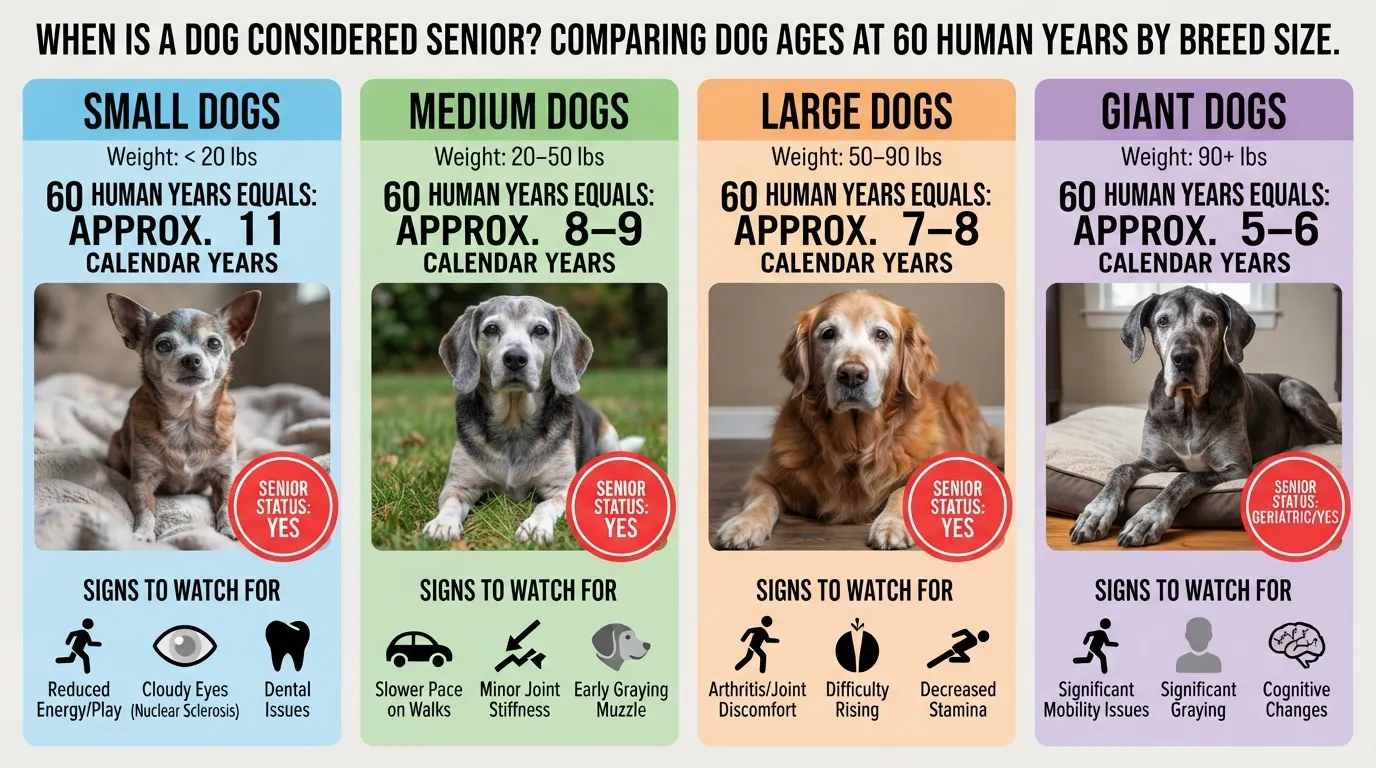
Yes, reaching 60 in human years is universally recognized in veterinary medicine as the official entry point into a dog’s senior life stage.
In human terms, turning 60 marks the transition into mature adulthood and early retirement planning. For dogs, hitting this biological milestone—whether at 6 actual years for a Great Dane or 10 actual years for a Chihuahua—means their metabolism begins to slow down, cellular repair decreases, and immune functions shift. They are not “geriatric” or frail yet, but their care needs require a proactive focus on preventative wellness and mobility support.
Signs Your Dog Is Entering Senior Age
While exact timelines vary by breed size, physical and behavioral indicators often appear when a dog passes the 60-human-year mark. Watch for these early indicators of senior status:
Graying Muzzle and Face: Pigment loss around the snout, chin, and eyebrow area is often the first visible sign of canine aging.
Slower Movement & Stiff Joints: Your dog may hesitate before jumping into the car, take longer to stand up after a nap, or lag slightly behind on long evening walks.
Vision and Hearing Changes: A slight clouding in the eye lenses (nuclear sclerosis) or delayed response to soft vocal commands can signal natural age-related sensory declines.
Weight Shifts & Muscle Loss: Metabolism changes cause some senior dogs to gain weight easily, while others experience age-related muscle mass loss (sarcopenia) along their hind legs and spine.
What a Dog “Acts Like” at This Age
At 60 human years, a dog’s general personality doesn’t vanish—it simply becomes more refined. If you’re looking for a relatable comparison, a dog at 60 acts a lot like a human who has recently turned 60 and settled into early retirement:
Selective Energy Levels: They are still eager for their daily walks and playtime, but they prioritize pacing themselves. The frantic, continuous energy of their youth gives way to purposeful enthusiasm followed by deeper, uninterrupted naps.
Deeper Comfort Preferences: A dog at 60 becomes noticeably more protective of their routine and personal space. They actively seek out warm, cushioned sleeping spots, prefer predictable daily schedules, and may become slightly less tolerant of chaotic environments or overly energetic puppies.
Enhanced Emotional Bond: Senior dogs at this stage tend to become more emotionally tuned in to their owners. They spend less time exploring every corner of the yard independently and more time staying close by your side, preferring gentle companionship over high-intensity play.
How to Find Your Dog's Exact Age Use the Calculator
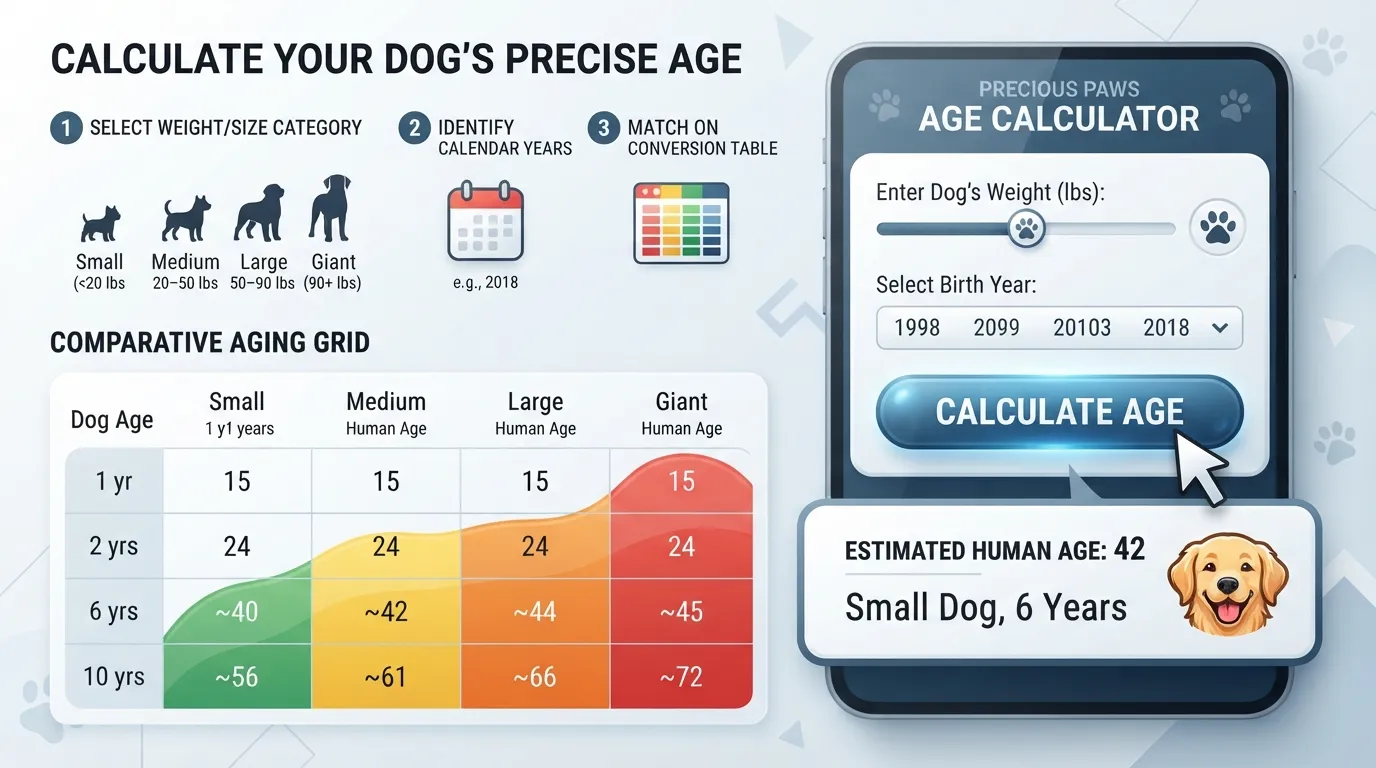
Because biological aging depends heavily on breed size and genetics, universal estimation charts only tell part of the story. Using our interactive tool gives you a precise, customized calculation adjusted specifically for your dog’s size tier and actual age.
Whether your dog is a toy breed hitting senior status at 10 calendar years or a giant breed reaching 60 human years at age 6, our calculator applies updated veterinary formulas to deliver an instant, accurate result.
Step-by-Step: Enter Breed/Size + Age
Calculating your dog’s exact human-equivalent age takes less than 10 seconds:
Select Your Dog’s Size Tier: Choose from Small (under 20 lbs), Medium (20–50 lbs), Large (50–90 lbs), or Giant (over 90 lbs). If you know their exact breed, select it from the dropdown menu for automated size weighting.
Enter Actual Age: Input your dog’s current age in calendar years and months.
Get Your Personal Report: Instant access to their exact human age equivalent, current life stage category, and customized veterinary care recommendations for their specific age bracket.
Nearby Ages Quick Reference 9–12 Years
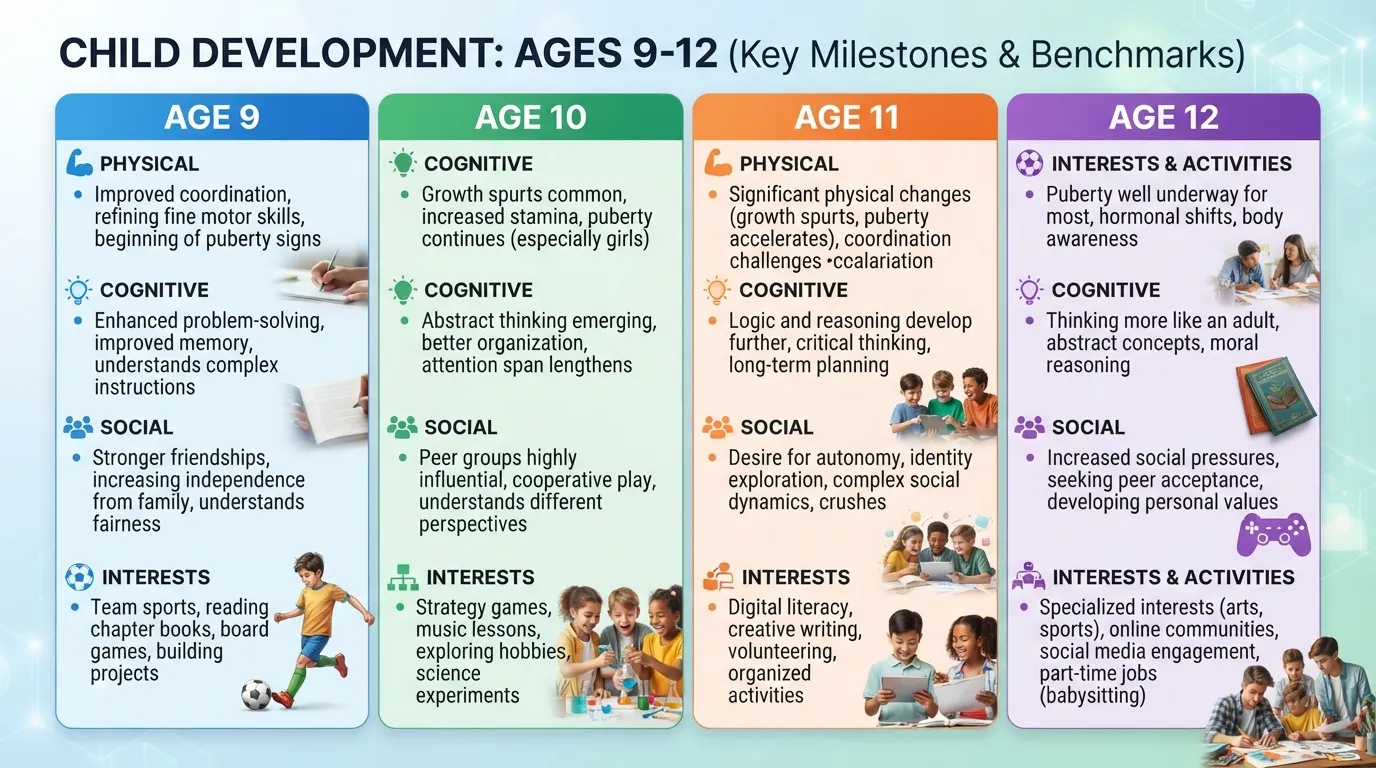
If your dog is approaching or slightly past the 60-human-year threshold, their equivalent age shifts noticeably depending on their weight class. Because biological aging accelerates as dogs mature, even a single calendar year can make a 4-to-7 year difference in human equivalent terms.
Use this quick-reference table to compare how dogs aged 9 through 12 align with human years across all four major size categories:
| Actual Dog Age | Small Breeds (<20 lbs) | Medium Breeds (20–50 lbs) | Large Breeds (50–90 lbs) | Giant Breeds (>90 lbs) |
|---|---|---|---|---|
| 9 Years | 52 Human Years | 56 Human Years | 63 Human Years | 71 Human Years |
| 10 Years | 56 Human Years | 60 Human Years | 68 Human Years | 78 Human Years |
| 11 Years | 60 Human Years | 65 Human Years | 73 Human Years | 85 Human Years |
| 12 Years | 64 Human Years | 69 Human Years | 78 Human Years | 93 Human Years |
| 9 Years | 52 Human Years |
|---|---|
| 10 Years | 56 Human Years |
| 11 Years | 60 Human Years |
| 12 Years | 64 Human Years |
| 9 Years | 56 Human Years |
|---|---|
| 10 Years | 60 Human Years |
| 11 Years | 65 Human Years |
| 12 Years | 69 Human Years |
| 9 Years | 63 Human Years |
|---|---|
| 10 Years | 68 Human Years |
| 11 Years | 73 Human Years |
| 12 Years | 78 Human Years |
| 9 Years | 71 Human Years |
|---|---|
| 10 Years | 78 Human Years |
| 11 Years | 85 Human Years |
| 12 Years | 93 Human Years |
Key Takeaway: Notice how a 10-year-old Medium breed hits the exact 60-human-year mark, whereas a Small breed doesn’t reach 60 until around 11 years old, and a Large breed hits 60 before even turning 9 actual years.
Caring for a Dog at This Life Stage 60+ Human Years
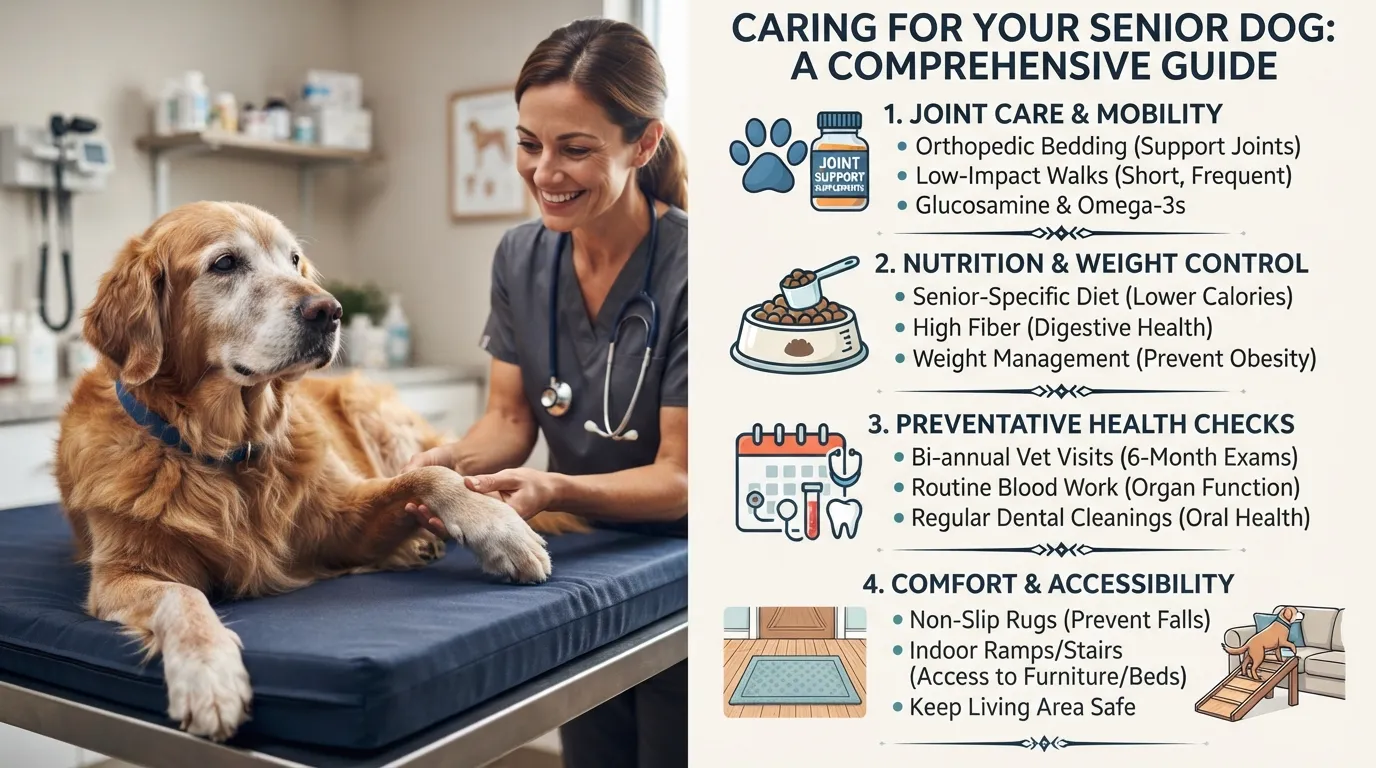
Reaching 60 in human years is a major milestone for your dog. While they still have plenty of life, love, and energy left to share, their physiological needs are shifting. Transitioning your focus toward preventative care, mobility support, and tailored nutrition will help ensure these senior years remain comfortable, active, and happy.
Diet Adjustments
As dogs cross into their senior stage, their metabolism slows down, leading to lower daily energy expenditure. Without diet tweaks, senior dogs can easily gain weight, putting extra strain on aging joints.
Lower Calorie Density, Higher Quality Protein: Switch to a high-quality senior dog food formulated with easily digestible proteins to help maintain lean muscle mass without adding unnecessary calories.
Added Joint & Omega-3 Fatty Acids: Look for recipes enriched with Glucosamine, Chondroitin, and EPA/DHA omega-3 fatty acids to reduce systemic inflammation and support cartilage health.
Increased Fiber for Digestive Health: Older dogs often experience slower intestinal motility. Soluble and insoluble fiber help maintain consistent bowel movements and promote healthy gut flora.
Hydration Boosts: Senior dogs lose some of their natural thirst drive. Adding bone broth or switching partially to wet food helps support kidney function.
Exercise & Mobility Support
At 60 human years, exercise remains essential for cardiac health, mental stimulation, and muscle tone—but the focus shifts from high-intensity play to low-impact consistency.
Shorter, More Frequent Walks: Swap one long, strenuous 60-minute walk for two or three gentle 15-to-20-minute strolls throughout the day.
Low-Impact Activities: Swimming and slow sniffing walks which provide mental enrichment without physical strain are ideal for mature dogs.
Home Mobility Accommodations:
Place non-slip rugs or runners over hardwood or tile floors to prevent slipping.
Provide doggy ramps or stairs to help them access the couch or car without jumping.
Upgrade to an orthopedic memory foam dog bed to relieve pressure points on hips and elbows.
Common Health Issues to Watch For
Catching age-related conditions early dramatically improves a senior dog’s treatment outcomes and quality of life. Keep an eye out for these common senior health concerns:
Osteoarthritis & Joint Stiffening: Hesitation to climb stairs, stiffness after sleeping, or behavioral changes like irritability when touched.
Dental Disease Periodontitis: Red gums, severe bad breath, or difficulty chewing dry kibble. Bacteria from dental infections can travel through the bloodstream, affecting kidney and heart function.
Cognitive Dysfunction Syndrome CDS: Canine dementia can cause disorientation, changes in sleep-wake cycles pacing at night, or forgetting basic house-training rules.
Metabolic & Endocrine Disorders: Increased thirst, frequent urination, or sudden weight shifts can signal conditions like Canine Diabetes, Cushing’s Disease, or Hypothyroidism.
Recommended Vet Checkup Frequency
Once a dog reaches the equivalent of 60 human years, veterinarians recommend shifting from annual checkups to biannual every 6 months wellness visits.
Because dogs age faster than humans, six months for a senior dog equals roughly two to three human years. Biannual exams allow your veterinarian to perform crucial baseline monitoring:
Comprehensive Blood & Urine Screening: Checks kidney function, liver enzymes, blood sugar, and thyroid health.
Blood Pressure Monitoring: Detects early hypertension before it damages internal organs.
Physical Joint & Mobility Assessment: Evaluates range of motion and pinpoints arthritis early so pain management can start before chronic discomfort sets in.
Veterinary Resource: For a complete checklist on monitoring senior health and managing age-related changes, consult the AAHA Senior Dog Care Guidelines.
The Science Behind the Numbers

Why the Old “1 Dog Year = 7 Human Years” Rule Doesn’t Work
For decades, the standard rule of thumb was simple: multiply your dog’s age by 7 to find their equivalent human age. While convenient, this formula is biologically inaccurate.
Dogs do not age at a uniform rate throughout their lives:
Rapid early growth: A 1-year-old dog has already reached physical maturity roughly equivalent to a 15-year-old teenager—not a 7-year-old child.
Slower adult aging: After their first two years, a dog’s physiological aging slows down considerably.
Breed size variations: A 10-year-old Toy Poodle may still be active and healthy, while a 10-year-old Great Dane is deep in late senior care.
Because small dogs routinely outlive giant breeds, a single linear multiplier fails to accurately depict biological aging across different breeds.
The New Veterinary Formula
In 2020, researchers at the University of California, San Diego UCSD developed a groundbreaking formula based on epigenetic clocks. By measuring DNA methylation patterns in humans and Labrador Retrievers, scientists mapped how aging occurs at a cellular level across species.
The Formula:
Human Equivalent Age = 16 × lnDog Age in Years + 31
where ln stands for the natural logarithm
Step-by-Step Worked Calculations
Example 1: How old is a 2-year-old dog in human years?
Find the natural log of 2: ln(2) ≈ 0.693
Multiply by 16: 16 × 0.693 = 11.088
Add 31: 11.088 + 31 = 42.088
Result: A 2-year-old dog has cellular aging roughly equivalent to a 42-year-old human.
Example 2: When does a dog hit “60 in Human Years”?
Set up the equation: 60 = 16 × ln(Dog Age) + 31
Subtract 31 from both sides: 29 = 16 × ln(Dog Age)
Divide by 16: ln(Dog Age) = 1.8125
Calculate e to the power of 1.8125: Dog Age ≈ 6.13 years
Result: Under the UCSD genetic formula, a dog reaches 60 in human years at approximately 6 years and 1.5 months old.
AAHA and AVMA Guidelines: Why Numbers Vary Between Sources
While the UCSD genetic formula offers fascinating insight into cellular aging, practical veterinary medicine relies on clinical guidelines established by the American Animal Hospital Association AAHA and the American Veterinary Medical Association AVMA.
Veterinary guidelines adjust human-age equivalents based on weight and breed size tiers:
Small Breeds under 20 lbs: Age slower after maturity; reach 60 human years around 10 to 11 actual years.
Medium Breeds 20–50 lbs: Reach 60 human years around 8 to 9 actual years.
Large Breeds 50–90 lbs: Reach 60 human years around 7 to 8 actual years.
Giant Breeds over 90 lbs: Age rapidly; reach 60 human years around 6 actual years.
Because the UCSD DNA study was performed exclusively on Labrador Retrievers a large breed, its 6.13-year result matches the senior transition point for large dogs. Veterinary lifespan charts adjust these numbers so dog owners get accurate health milestones for their pet’s specific body size.
Veterinary Reference: For detailed life stages and health milestones based on weight and breed size, consult the official AAHA Canine Life Stage Guidelines.
Frequently Asked Questions
| Question | Answer |
|---|---|
| What dog age is equal to 60 in human years? | Depending on the breed size, a dog reaches around 60 human years between 8 and 11 actual calendar years. Large and giant breeds reach this landmark earlier (around 8–9 years), while smaller breeds reach it around 10–11 years. |
| Is a 10-year-old dog considered 60 in human years? | Yes, for medium-sized dogs, a 10-year-old dog is roughly equivalent to a 60-year-old human. Small dogs may be slightly younger in biological terms (~56 human years), whereas giant breeds may be older (~66+ human years). |
| Does breed size change when a dog hits "60 in dog years"? | Yes, breed size heavily affects aging. Larger dogs age faster biologically than smaller dogs, meaning a Great Dane reaches senior status (60+ human years) much quicker than a Chihuahua. |
| Is 60 (human-years-equivalent) old for a dog? | A dog at 60 human-years-equivalent is officially considered a senior dog. While they are aging, proper nutrition, regular vet checkups, and gentle daily activity keep them active and healthy. |
| What's the most accurate dog age formula? | The logarithmic formula developed by researchers (16 × ln(dog age) + 31) provides the most scientifically accurate estimate based on DNA methylation patterns, adjusting for natural growth curves. |
🐾 Other Age Guides

I built Dogagescalculator.com to give dog owners honest, science-backed answers instead of the outdated "×7" myth. Every figure here is checked against AKC, AVMA, and published veterinary research.
More about the author & this site →
Comments