How Much to Feed a French Bulldog Puppy? Complete Feeding Chart by Age & Weight
Based on nutritional guidelines from AAFCO, WSAVA, and AKC breed standards. This guide provides general nutritional information and is not a substitute for professional veterinary advice.
Quick Answer — At a Glance
A French Bulldog puppy targeting a typical 22 lb (10 kg) adult weight needs 75–85 g (~3/4 cup) of kibble per day at 2 months, increasing gradually to 150–170 g (~1 1/2 cups) by 6–12 months. Feed 4 meals daily at 8–12 weeks, 3 meals daily from 3–6 months, and 2 meals daily from 6 months into adulthood.
French Bulldog Puppy Feeding Chart By Age & Weight
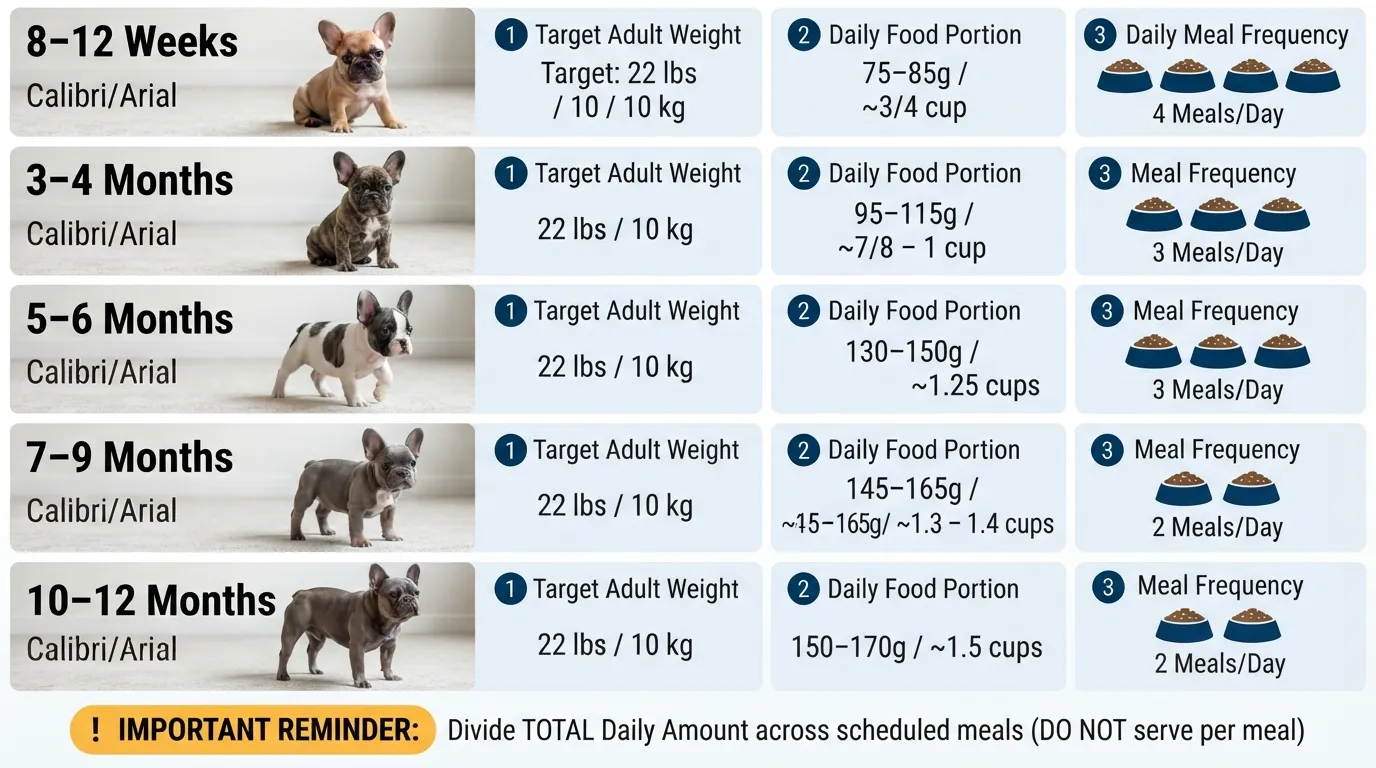
Feeding your Frenchie puppy the right amount requires matching their current growth stage to their estimated adult target weight. Adult males typically land between 20–28 lbs 9–12.7 kg, while females sit slightly lighter at 17–24 lbs 7.7–10.9 kg.
The feeding amounts below assume a standard small-breed puppy kibble ~4 kcal per gram and a middle-of-the-road adult weight target of ~22 lbs (10 kg).
8–12 Weeks
At this delicate stage, your pup is newly weaned, burning calories fast, and developing rapidly. Tiny stomachs require small, frequent portions to prevent sudden drops in blood sugar.
Age: 8–12 Weeks (2 Months)
Adult Weight Target: ~22 lbs (10 kg)
Grams/day: 75 – 85 g
Cups/day: ~3/4 cup
Meals/day: 4 meals
3–4 Months
Growth spurts kick into high gear during month four. Your puppy needs plenty of protein and calcium density to support heavy bone development without overloading their joints.
Age: 3–4 Months
Adult Weight Target: ~22 lbs (10 kg)
Grams/day: 130 – 145 g
Cups/day: ~1 1/4 to 1 1/3 cups
Meals/day: 3 meals
5–6 Months
Your puppy’s overall weight gain starts to smooth out, though frame growth remains active. You can now transition them down to two solid meals per day.
Age: 5–6 Months
Adult Weight Target: ~22 lbs (10 kg)
Grams/day: 150 – 170 g
Cups/day: ~1 1/2 cups
Meals/day: 2 meals
7–9 Months
Your Frenchie reaches near-full height and spends these months filling out muscle tone. Portion sizes peak here and stabilize through late puppyhood.
Age: 7–9 Months
Adult Weight Target: ~22 lbs (10 kg)
Grams/day: 150 – 170 g
Cups/day: ~1 1/2 cups
Meals/day: 2 meals
10–12 Months
Physical growth reaches its plateau. As your puppy nears their first birthday, prepare to transition them from calorie-rich puppy food to an adult formula.
Age: 10–12 Months
Adult Weight Target: ~22 lbs (10 kg)
Grams/day: 150 – 170 g
Cups/day: ~1 1/2 cups (Transitioning)
Meals/day: 2 meals
How to Calculate the Exact Portion for Your Puppy
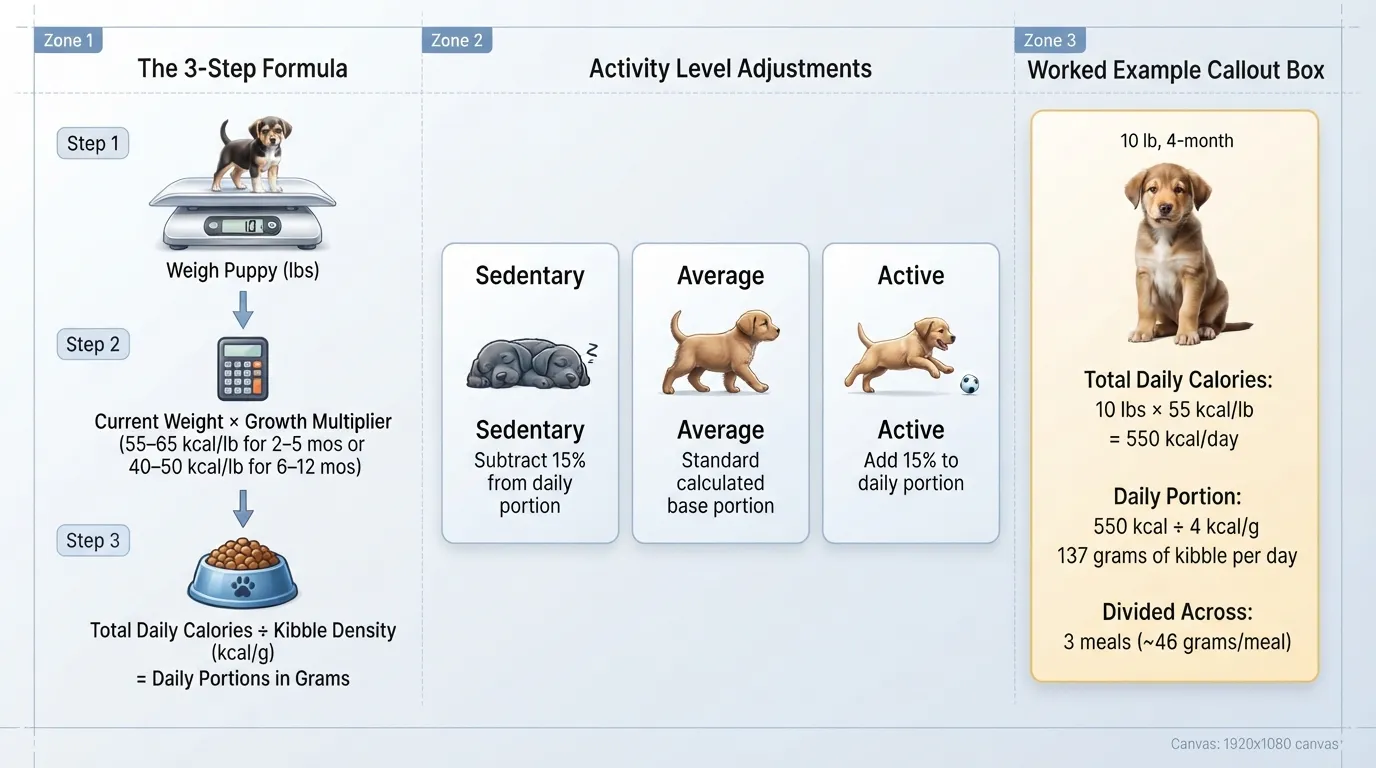
While general feeding charts provide a reliable baseline, calculating your Frenchie’s specific daily calorie target yields the most accurate portion sizes. Small adjustments based on individual metabolism ensure your puppy gains weight at a healthy, steady pace.
Calorie Formula Explained Simplified
Adult French Bulldogs need about 25–30 kcal per pound of body weight each day just for maintenance. Growing puppies require significantly more calories per pound to build bone, muscle, and tissue.
To estimate your puppy’s target daily intake without getting bogged down in complex veterinary math:
Find current weight: Weighed in pounds (lb).
Apply growth multiplier: Multiply current weight by 55–65 kcal for young pups (2–5 months) or 40–50 kcal for older pups (6–12 months).
Convert to grams: Divide total daily calories by the calorie density of your kibble (typically ~4 kcal per gram for small-breed puppy formulas).
Example: A 10 lb, 4-month-old Frenchie needs roughly 550 kcal per day $10 \times 55$. Divided by 4 kcal/g, that equals 137 grams of kibble per day, split into 3 meals of roughly 46 grams each.
Adjust for Activity Level Sedentary / Average / Active
No two Frenchies burn energy at the exact same rate. Use your puppy’s daily routine to fine-tune their calculated portion:
Sedentary (-15%): Pups that prefer indoor snuggles, short walks, and low-key play burn fewer calories. Reduce the base calculated portion by 15% to prevent early obesity.
Average Base Portion: Standard routine of daily play sessions, short neighborhood walks, and normal puppy zoomies. Stick strictly to the base calculation.
Active (+15%): High-energy puppies that spend hours playing outdoors, doing structured training, or running with doggy friends need up to 15% more calories to fuel growth.
Calculate in seconds: Skip the manual math and get an instant, custom portion recommendation tailored to your pup’s exact age and weight using our Puppy Feeding Calculator.
How Many Times a Day Should You Feed a French Bulldog Puppy?
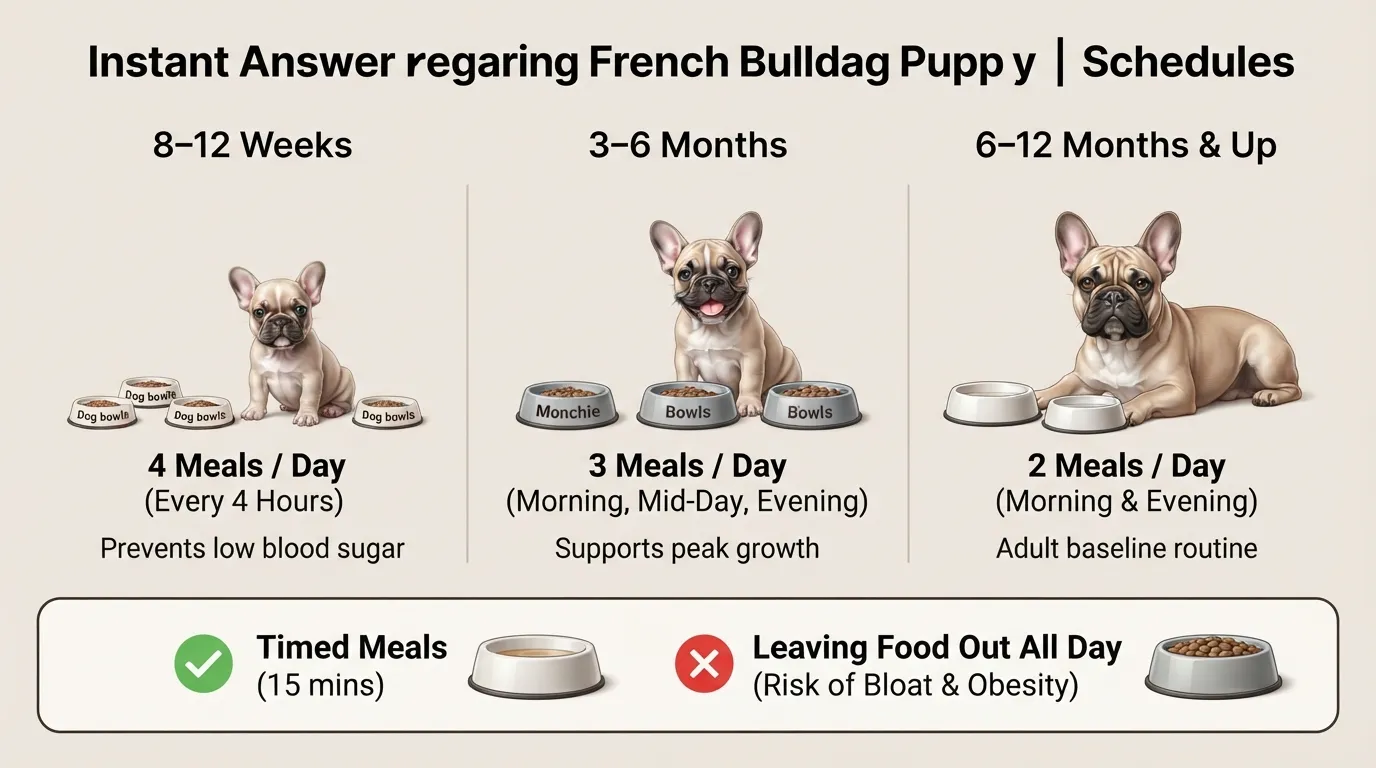
Establishing a consistent feeding routine is just as important as measuring out the right bowl portions. Because French Bulldogs are prone to sensitive stomach issues and flatulence, splitting their daily food into timed feedings prevents rapid eating and keeps digestion smooth.
Feeding Frequency by Age 4 → 3 → 2 Meals
A young Frenchie puppy’s stomach is about the size of a ping-pong ball. They process calories fast, so feeding them their entire daily portion in one or two sitments can overload their digestion and cause painful bloat.
8 to 12 Weeks 4 Meals/Day: Feed at breakfast, lunch, late afternoon, and dinner (e.g., 7:00 AM, 11:30 AM, 3:30 PM, and 7:00 PM). Spacing meals 4 hours apart prevents sudden drops in blood sugar (hypoglycemia).
3 to 6 Months 3 Meals/Day: Shift to a classic morning, mid-day, and evening routine (e.g., 7:00 AM, 1:00 PM, and 6:30 PM). Your puppy’s stomach capacity has expanded enough to hold slightly larger portions.
6 Months & Up 2 Meals/Day: Drop the mid-day meal and divide the daily allowance equally between a morning and evening meal (e.g., 7:30 AM and 6:30 PM). This 2-meal schedule remains standard for the rest of their adult life.
Free-Feeding vs. Scheduled Feeding
Leaving a bowl of kibble out all day for your puppy to graze on—known as free-feeding—is a recipe for disaster with French Bulldogs.
Frenchies are notoriously food-motivated and lack a reliable “full” switch. Free-feeding leads to overeating, rapid weight gain that stresses young joints, and unpredictable potty training schedules. Scheduled feeding leaving the bowl down for 15 minutes per meal gives you complete control over caloric intake and makes housebreaking exponentially easier.
Bringing Your Puppy Home — First Week Feeding Tips
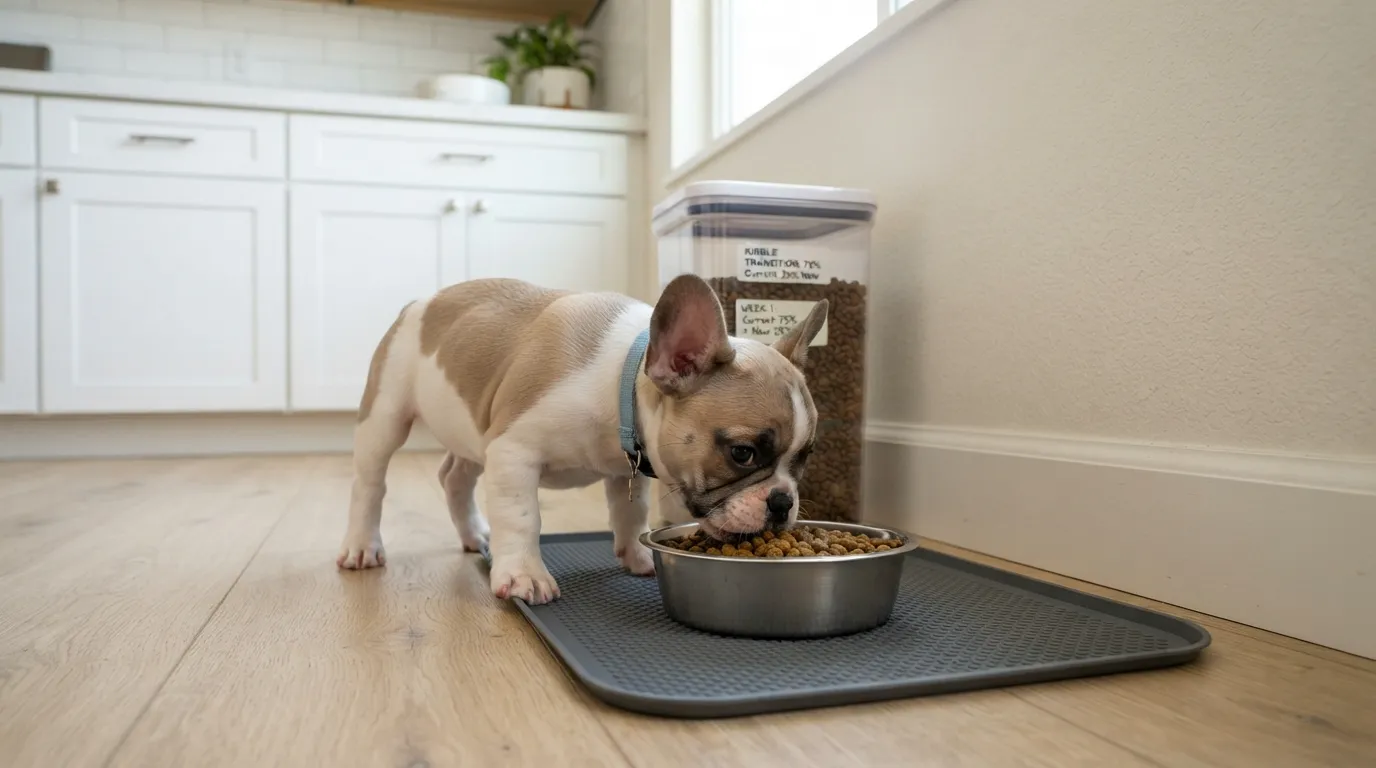
Your puppy’s first week at home is a massive transition period filled with new smells, unfamiliar surroundings, and separation from their mother and littermates. Keeping their feeding routine as predictable as possible during these initial 7 days prevents unnecessary digestive upset and helps your new Frenchie feel secure.
Do not switch food immediately: Ask your breeder or shelter for a 1–2 week supply of the exact food your puppy was eating before coming home. Switching diets on day one combined with transition stress almost guarantees runny stools or a complete refusal to eat.
Transition diets slowly over 7–10 days: If you plan to switch to a different high-quality small-breed puppy kibble, wait until your pup has settled in for a few days. Gradually mix the new food into the old food using a strict ratio: 25% new for 3 days, 50% new for 3 days, 75% new for 3 days, then 100% new food.
Expect stress-related appetite changes: It is completely normal for an 8-week-old Frenchie to pick at their food or turn their nose up during the first 24 to 48 hours. Offer their scheduled portion in a quiet room, leave the bowl down for 15 minutes, and pick it up gently without making a fuss if they don’t finish.
What Should You Feed a French Bulldog Puppy?
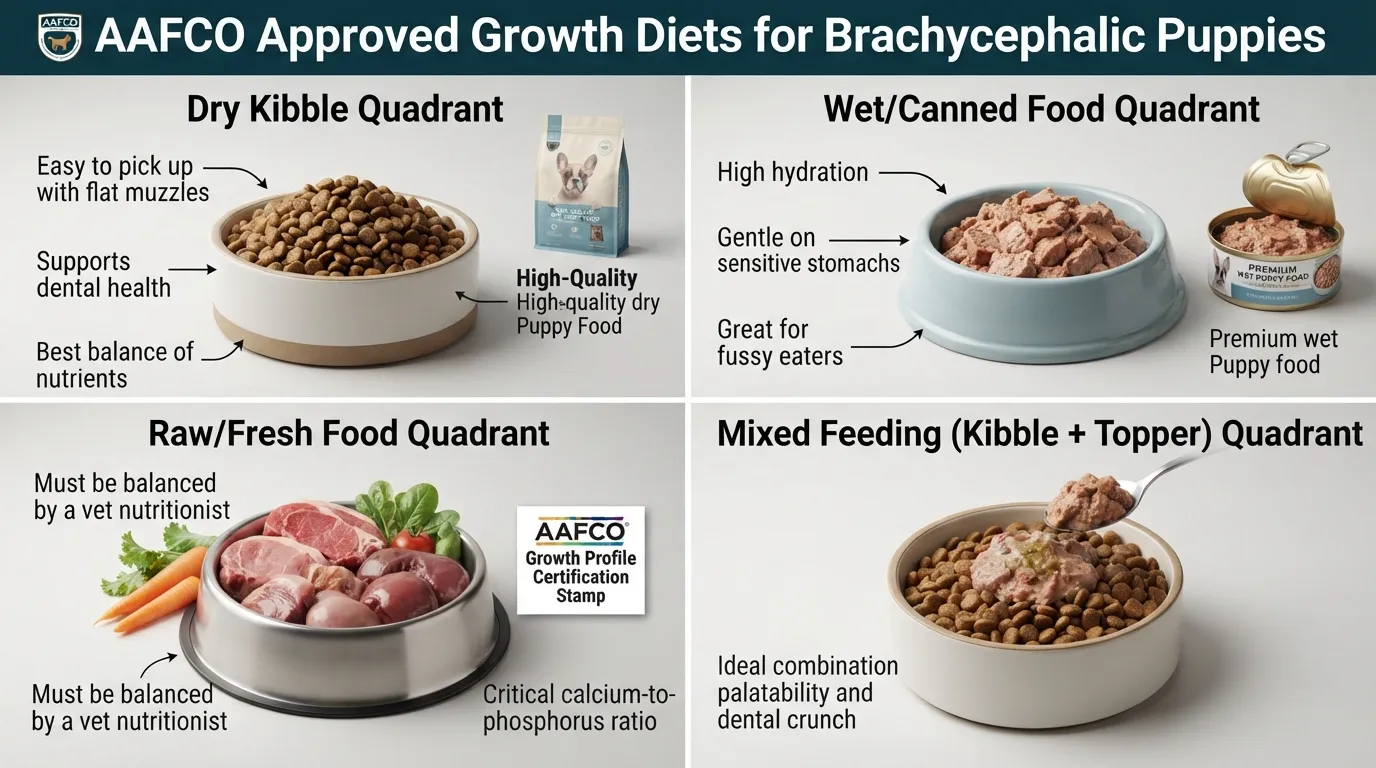
Choosing the right type of food is just as critical as measuring out the correct daily weight. French Bulldogs have unique anatomical features—like flat muzzles and underbites—that affect how they pick up and chew their food, alongside sensitive digestions that react quickly to sudden ingredient changes.
Dry Kibble
High-quality dry kibble designed specifically for small breeds is generally the best all-around option for Frenchie puppies. The tiny, specially shaped pieces allow brachycephalic jaws to easily grab and crunch each bite rather than swallowing pieces whole. Kibble also helps scrape away early plaque buildup on crowded teeth and offers the most cost-effective, shelf-stable nutrition.
Wet/Canned Food
Wet food is packed with natural moisture, which aids digestion and helps keep your puppy hydrated. It is extremely palatable, making it a lifesaver if your 10-week-old pup is a fussy eater or recovering from vaccinations. However, an all-wet diet can lead to softer stools and offers zero dental scraping benefits, so it is often best used as a supplement.
Raw / Fresh / Home-Cooked
Fresh or raw commercial diets have gained massive popularity, but they require extreme caution during puppyhood. Growing Frenchies need a precise ratio of calcium to phosphorus (roughly 1.2:1) to ensure their heavy bones and compact joints develop correctly. Unbalanced home-cooked recipes can lead to irreversible skeletal deformities, so any raw or fresh diet must be formulated by a board-certified veterinary nutritionist.
Mixing Wet + Dry
Combining kibble with a spoonful of wet food or warm water gives you the best of both worlds. The kibble supplies crunch and dental benefits, while the wet topper adds aroma and extra hydration. If you mix the two, remember to account for the calories in both so you don’t accidentally overfeed your puppy.
Always check the AAFCO nutritional adequacy statement: Ensure the bag or can explicitly states that the food is formulated to meet AAFCO Nutrient Profiles for Growth or “All Life Stages.” Avoid adult maintenance formulas entirely until your Frenchie is at least 10–12 months old, as they lack the calorie and protein density needed for healthy puppy development.
How Much Water Does a French Bulldog Puppy Need?
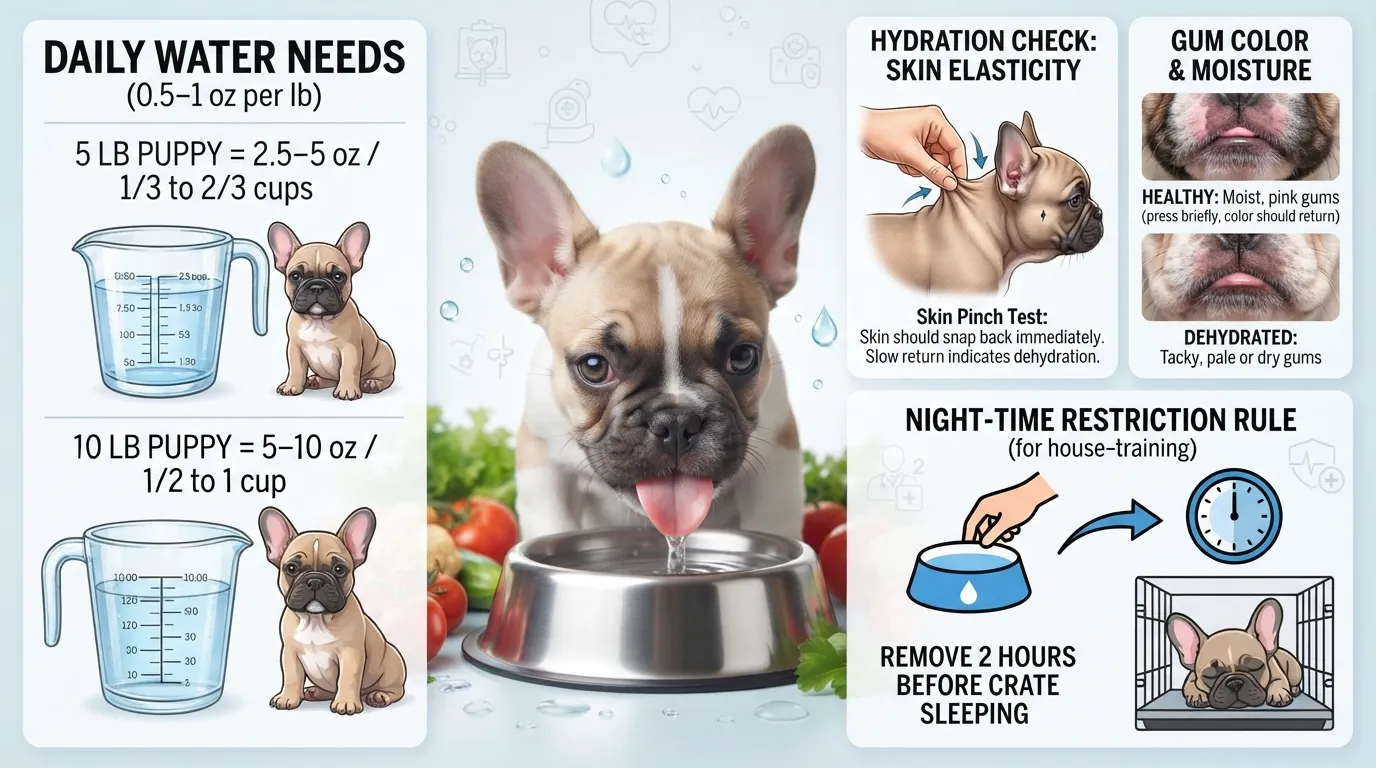
Proper hydration is just as vital as accurate kibble portions, especially for a flat-faced breed that struggles to regulate body temperature through panting. Keeping track of your Frenchie puppy’s fluid intake ensures their kidneys function smoothly and keeps their digestion regular.
Daily water guidance: Aim for roughly 1/2 to 1 ounce of fresh water per pound of body weight each day. For example, a 10 lb, 4-month-old puppy needs around 5 to 10 ounces (about 1/2 to 1 cup) of water daily, though active play or warm weather will naturally increase their thirst.
Signs of healthy hydration vs. dehydration: Check hydration by gently lifting the skin at the back of their neck—it should snap back immediately. A well-hydrated Frenchie has moist, pink gums and bright eyes, whereas pale, sticky gums, sunken eyes, or dark yellow urine signal that your puppy needs more fluids immediately.
The always-available water rule: Keep a clean bowl of fresh water accessible at all times during daytime hours. The only exception is house-training: pick up the water bowl about 2 hours before bedtime (around 8:00 PM) to help prevent overnight potty accidents in their crate.
Why French Bulldog Puppies Need Special Feeding Care Brachycephalic Tips
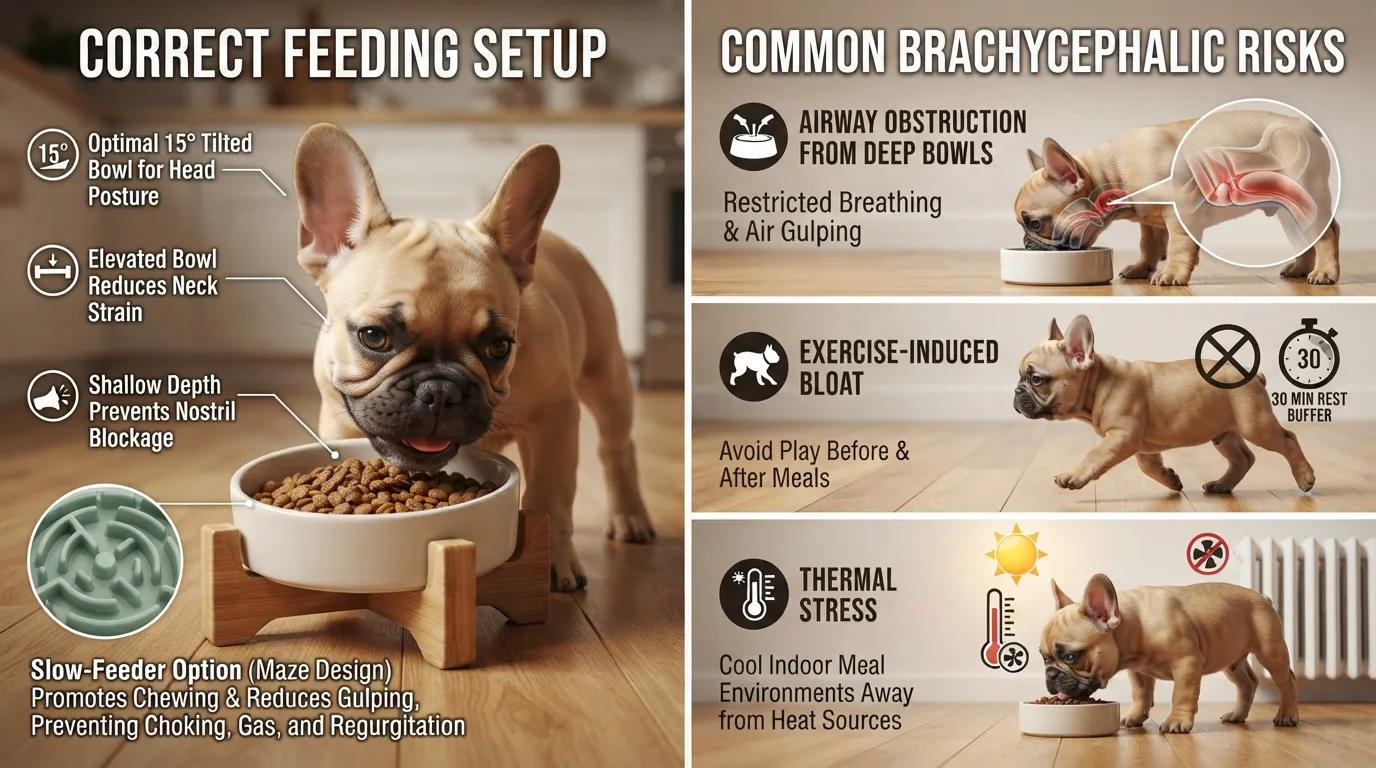
French Bulldogs are flat-faced (brachycephalic) dogs, which means their physical build drastically shapes how they eat. Their compact skulls, shortened nasal passages, and wide, underbit jaws turn routine mealtimes into potential health hazards like choke risks, excessive gas, bloat, or rapid overheating.
Bowl Shape & Slow Feeders
Deep, narrow food bowls are terrible for flat-faced puppies because they force the pup to bury their entire snout, blocking their airway while they try to scoop up kibble. Switch to a wide, shallow dish with a slanted base or an elevated stand so your Frenchie can chew without smothering their nose.
If your 3-month-old pup inhales their food in under 30 seconds, they are gulping massive amounts of air along with each bite. Introduce a maze-style slow-feeder bowl or a silicone lick mat to physically force them to take smaller, deliberate mouthfuls, which drastically reduces painful stomach gas and regurgitation.
Feeding Around Exercise
Never feed your Frenchie puppy immediately before or after intense physical activity. Exercise speeds up breathing and causes the stomach to churn, and feeding a heavily panting pup significantly increases their risk of severe indigestion or gastric torsion (bloat).
Establish a strict 30-minute buffer rule around every meal:
Before meals: Rest your puppy inside for at least 30 minutes after outdoor play before putting their bowl down.
After meals: Keep play low-key for 30–45 minutes post-feeding to let their stomach settle completely.
Heat Sensitivity at Mealtimes
Because brachycephalic dogs cannot cool themselves efficiently through panting, the simple physical act of eating in a warm room can cause their body temperature to spike. A hot, panting puppy will struggle to swallow kibble safely and may choke or vomit.
Always feed your puppy in a cool, air-conditioned space away from direct sunlight. If your 10-week-old pup is panting heavily after playing in the yard during summer, bring them indoors, let them rest near a fan, and wait until their breathing returns to normal before offering their scheduled portion.
How Many Treats Can You Give a French Bulldog Puppy? 10% Rule
Frenchies are notoriously food-motivated, making treats an incredible tool for potty training and teaching basic commands. However, because this compact breed is highly prone to rapid weight gain, unmeasured treats can quickly blow past their daily calorie needs and throw off their growth balance.
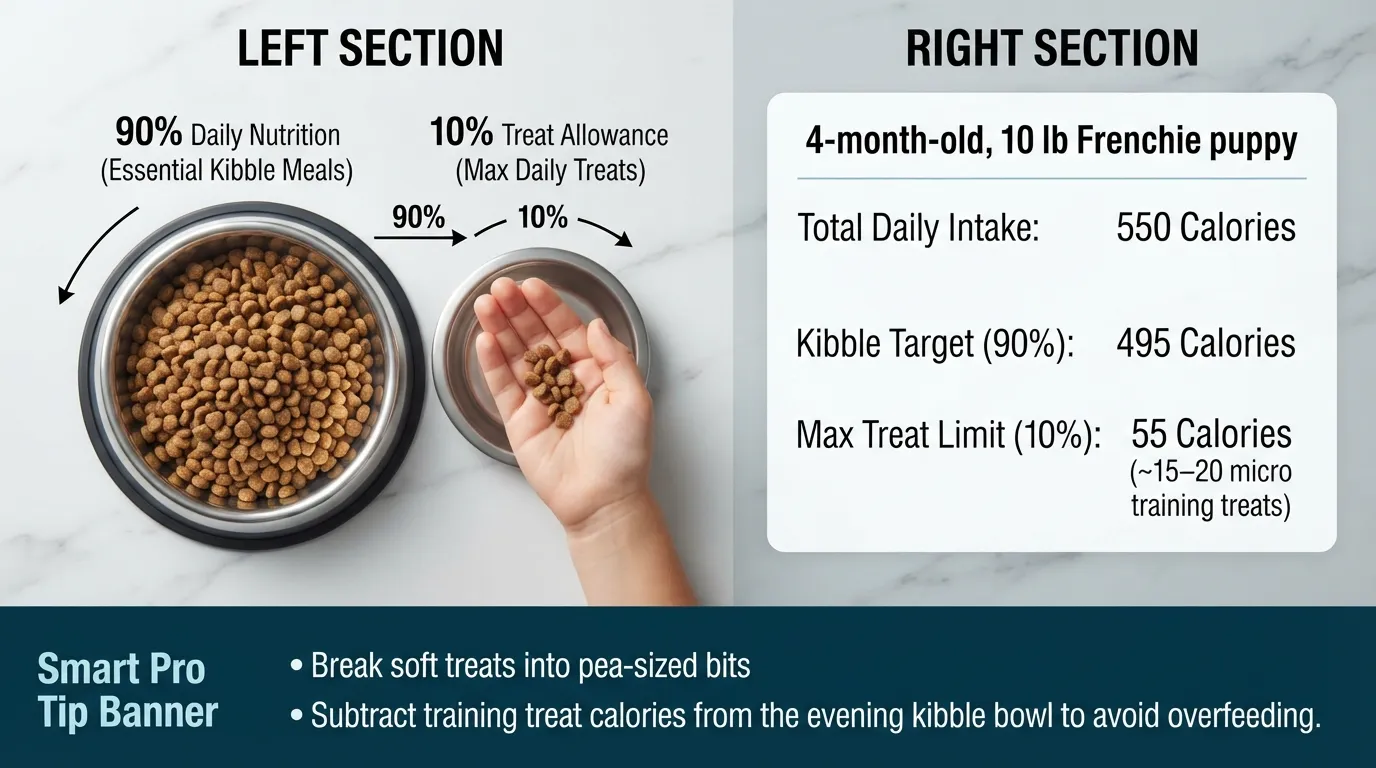
The 10% daily calorie rule: Treats should never account for more than 10% of your puppy’s total daily calories. The remaining 90% must come from their complete and balanced puppy kibble to ensure they receive proper levels of calcium, protein, and essential nutrients.
Daily calorie budget example: If your 4-month-old, 10 lb Frenchie has a daily target of 550 total calories, no more than 55 calories should come from treats. That allows for roughly 15 to 20 tiny commercial training treats (at ~2–3 kcal each) spread throughout the day, while 495 calories come directly from their measured meals.
Smart training treat guidance: Cut soft training treats into fingernail-sized pieces so your puppy gets the high-value reward without the extra calories. You can also measure out 10% of their daily kibble allowance from their morning meal and use those exact kibble pieces as “free” training rewards throughout the day.
Quick Recap — Feeding Mistakes to Avoid
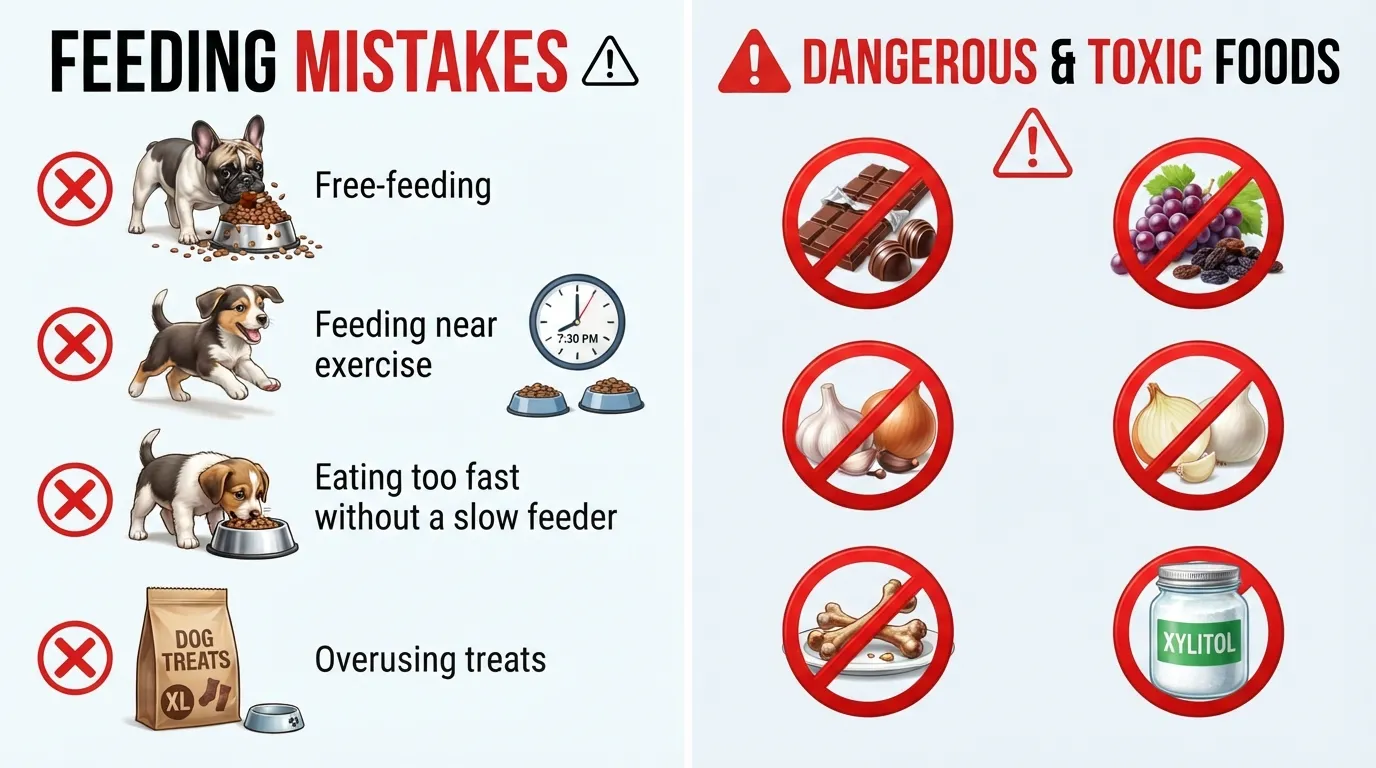
Free-feeding: Leaving a bowl out all day leads to overeating, weight gain, and messy potty schedules.
Gulping too fast: Fast eating causes swallowed air, severe gas, choking, and bloat—always use a slow feeder.
Feeding before or after heavy play: Exercising on a full stomach or while panting heavily risks gastric torsion and vomiting.
Overusing treats: Exceeding the 10% daily calorie limit unbalances your puppy’s nutritional intake.
Switching diets abruptly: Changing kibble brands overnight causes painful diarrhea and severe stomach upset.
Ignoring body condition: Relying strictly on chart numbers instead of checking your puppy’s ribs and waist leads to under- or overfeeding.
Foods to Avoid
Never feed your Frenchie puppy any of the following toxic or unsafe items:
Chocolate, coffee, and caffeine: Contains theobromine, which causes cardiac toxicity and seizures.
Grapes and raisins: Highly toxic, leading to sudden, irreversible kidney failure.
Onions, garlic, and chives: Damages red blood cells and causes severe anemia.
Xylitol (birch sugar): Found in sugar-free peanut butter; triggers rapid, fatal hypoglycemia and liver failure.
Cooked bones: Easily splinter into sharp shards that tear through the throat or intestinal lining.
Avocados, macadamia nuts, and alcohol: Cause severe gastrointestinal distress and central nervous system depression.
Frequently Asked Questions
How much should an 8-week-old French Bulldog puppy eat?
An 8-week-old Frenchie usually needs about 1/2 to 3/4 cup of high-quality puppy food per day, divided evenly across 3 to 4 meals. Adjust portion sizes based on your kibble’s specific calorie density and puppy weight.
How many meals a day for a French Bulldog puppy?
Feed 4 meals daily from 8 to 12 weeks. Transition to 3 meals daily between 3 and 6 months, and down to 2 meals daily after 6 months to maintain stable blood sugar levels.
Is my puppy eating too much or too little?
Feel for your puppy's ribs — you should feel them under a thin layer of fat without seeing them prominently. A visible waistline from above indicates a healthy weight, while soft stool or lethargy can signal overfeeding or underfeeding.
What if my puppy refuses to eat?
Try warm water or low-sodium bone broth to enhance food aroma. Frenchies can be pickier when teething. If refusal lasts more than 24 hours or is accompanied by lethargy, consult your vet immediately.
Wet or dry food — which is better?
A combination works best! Dry kibble promotes dental hygiene, while wet food boosts hydration and palatability. Ensure both are formulated specifically for small-breed growing puppies.
When should I switch to adult food?
Transition your Frenchie to adult dog food around 10 to 12 months of age. Mix the new adult kibble into the puppy food gradually over 7 to 10 days to prevent digestive upset.
🐾 Other Age Guides

I built Dogagescalculator.com to give dog owners honest, science-backed answers instead of the outdated "×7" myth. Every figure here is checked against AKC, AVMA, and published veterinary research.
More about the author & this site →
Comments