How Long Can a Puppy Hold Their Pee? Age-by-Age Guide
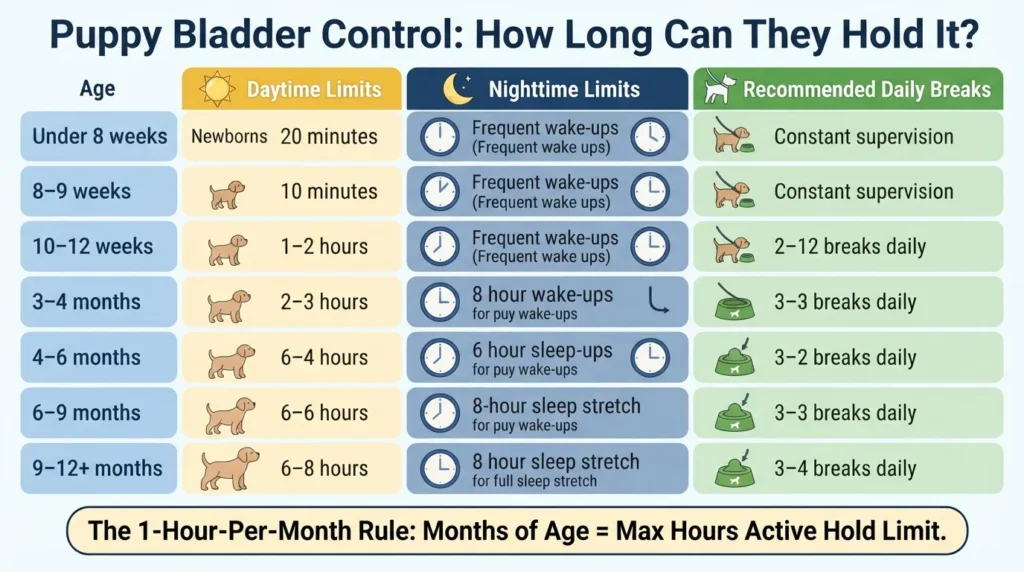
As a general rule, a puppy can hold their pee for one hour per month of age, reaching a maximum of 6–8 hours as adults. However, puppies under 4 months old have small, developing bladders and usually need bathroom breaks every 1 to 2 hours. Treat this formula as a realistic guideline rather than an exact guarantee.
Puppy Bladder Control & Potty Schedule by Age
Young puppies physically cannot hold their urine for long periods. Their nervous systems and urethral sphincters are still developing, and their bladders are tiny. Expecting a two-month-old pup to wait four hours is asking for a biological impossibility.
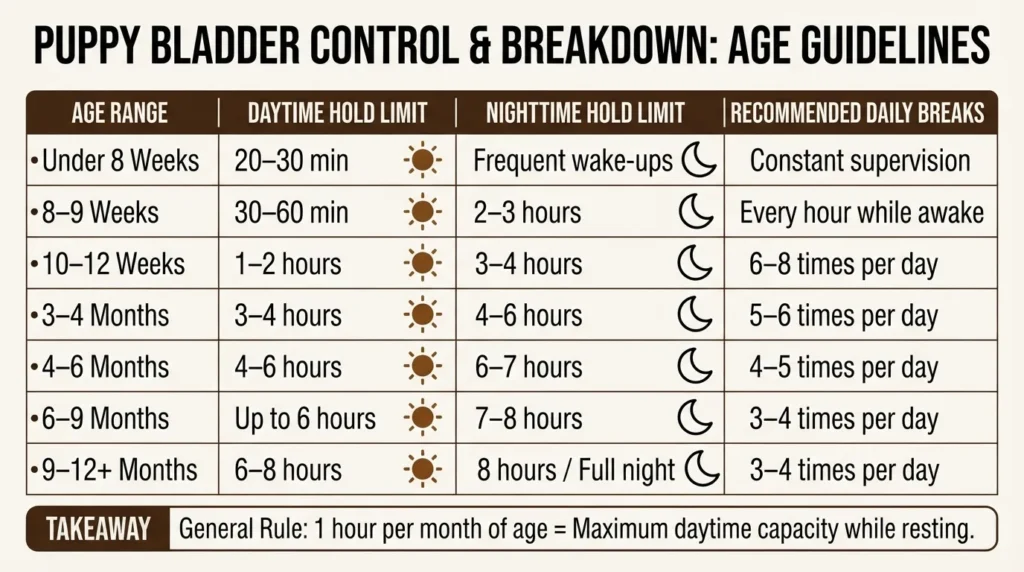
To help you set realistic expectations and prevent frustration for both you and your pup, here is how long a puppy can hold their pee, broken down by age, day vs. night capacity, and daily potty trip requirements:
| Age Range | Daytime Hold Limit | Nighttime Hold Limit | Recommended Potty Breaks |
|---|---|---|---|
| Under 8 weeks | 20–30 minutes | Frequent wake-ups | Almost constant monitoring |
| 8–9 weeks | 30–60 minutes | 2–3 hours (1–2 wake-ups) | Every hour while awake |
| 10–12 weeks | 1–2 hours | 3–4 hours | 6–8 times per day |
| 3–4 months | 3–4 hours | 4–6 hours | 5–6 times per day |
| 4–6 months | 4–6 hours | 6–7 hours | 4–5 times per day |
| 6–9 months | Up to 6 hours | 7–8 hours | 3–4 times per day |
| 9–12 months+ | 6–8 hours | 8 hours (full night) | 3–4 times per day |
Notice how nighttime capacity is significantly longer than daytime limits. When a puppy sleeps, their heart rate slows, metabolic rate drops, and their body produces antidiuretic hormone (ADH), which slows urine production. During active daytime hours—when they are drinking, running, and playing—their bladder fills up much faster.
The “1 hour per month” formula (quick worked example)
Veterinarians commonly recommend a simple rule of thumb: a puppy can hold their bladder for one hour for every month of age, plus one.
For example: 3 months old + 1 = 4 hours maximum daytime hold time.
While this basic formula works well as an absolute ceiling, treat it as the absolute maximum time your puppy can physically hold it while resting—not their baseline schedule for active daytime potty training.
Why real puppies vary from the chart
The guidelines above represent standard averages, but every dog develops at their own rate. Several real-world factors can push your puppy’s capacity above or below these benchmarks:
Breed Size and Anatomy: Toy breeds (like Chihuahuas or Yorkies) have tiny bladders relative to their high metabolisms, meaning they need more frequent breaks than a Large-breed pup (like a Labrador or Golden Retriever) at the exact same age.
Individual Bladder Capacity: Just like humans, some puppies simply naturally develop muscle control and bladder capacity faster than their littermates.
Recent Adoption and Stress: Moving to a new home floods a puppy’s system with cortisol. Stress increases heart rate and muscle tension, which frequently leads to sudden, unpredictable urinary urges.
Weather and Temperature: Hot summer days mean higher water intake and more frequent urination. Conversely, extreme cold, rain, or snow can make a puppy hesitant to empty their bladder completely outside, leading to an accident shortly after coming back indoors.
Overnight — How Long Can a Puppy Hold It at Night?

Puppies can almost always hold their bladder longer overnight than during the day. While an eight-week-old pup might only make it 45 to 60 minutes while awake and active, that same puppy can usually sleep for 2 to 3 hours straight before needing a midnight bathroom break. By 16 weeks old, most puppies can sleep 6 to 8 hours through the night without an accident.
This night-and-day difference comes down to basic physiology. When your puppy settles down to sleep, their metabolic rate drops significantly, their heart rate slows, and their body releases antidiuretic hormone (ADH). This hormone signals the kidneys to concentrate urine and slow down bladder filling. Combine that hormone shift with zero physical activity and no late-night water gulping, and their bladder stays manageable for hours at a time.
Setting Your Puppy Up for a Dry Night
Getting through the night without messy accidents takes a proactive bedtime system. These three adjustments make a massive difference:
Taper off water 2 hours before bed: Lift the water bowl roughly 120 minutes before lights-out. Your pup won’t get dehydrated overnight, but this buffer gives their body enough time to process and eliminate daytime fluid before they settle down.
Establish a strict “last call” routine: Right before you lock up for the night, take your puppy out to their designated potty spot. Keep this trip quiet, low-energy, and boring—no playing or excited praise. Give them 5 to 10 minutes to completely empty their bladder, then head straight to the crate.
Keep the crate close to your bed: Place the crate in your bedroom for the first few weeks. Young puppies naturally whimper or rustle when their bladder feels full. Sleeping nearby lets you catch those subtle early warning signs before a full-blown accident happens, while giving your pup the comfort of your presence.
Age-Specific Quick Answers
9-Week-Old Puppy — How Long Can They Hold It?
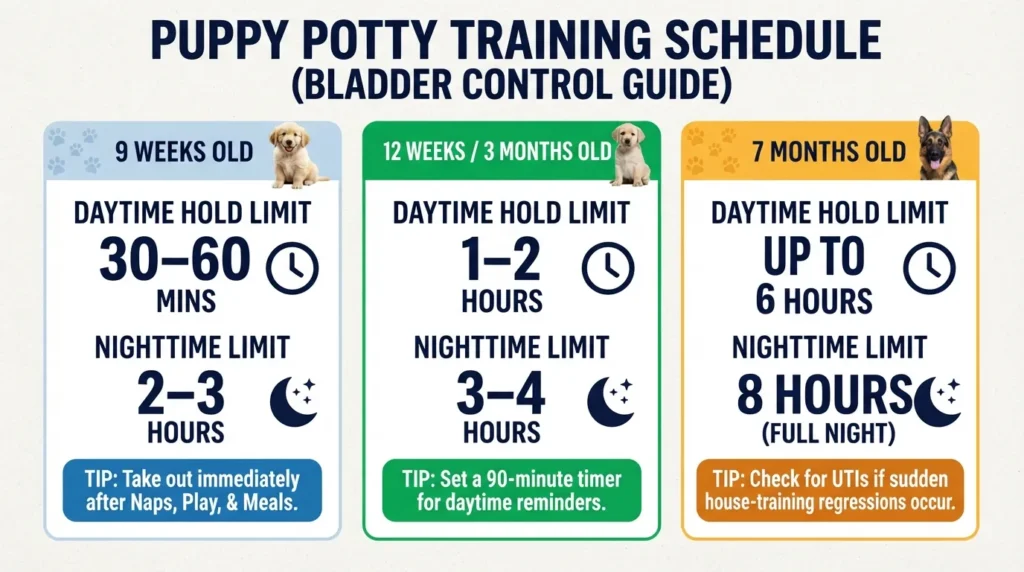
A 9-week-old puppy can reliably hold their pee for about 30 to 60 minutes during active daytime hours, and up to 2 to 3 hours overnight. Their bladder is tiny and their sphincter control is still developing, so expect at least one midnight trip outside.
Practical tip: Take your 9-week-old out immediately after every nap, play session, and meal, as a full stomach puts direct pressure on a small bladder.
12-Week-Old Puppy Bladder Control
By 12 weeks (3 months), most puppies can hold their urine for 1 to 2 hours while awake, and up to 3 to 4 hours when sleeping at night. According to standard veterinary guidelines, this age marks the transition where a pup can begin learning to hold it intentionally rather than just acting on pure reflex.
Practical tip: Set a timer on your phone for every 90 minutes during the day so you can leash them up before they start sniffing in circles or heading for the rug.
7-Month-Old Puppy — How Long Can They Hold It?
At 7 months, a healthy puppy can hold their pee for up to 6 hours during the day and comfortably sleep through an 8-hour night. Because their physical bladder control is nearly fully matured, indoor accidents at this stage are usually down to overexcitement, boredom, or inconsistent routines rather than lack of physical ability.
Practical tip: If your 7-month-old suddenly starts leaking or peeing inside out of nowhere, ask your vet to run a quick urinalysis to rule out a urinary tract infection (UTI) before tweaking your training.
Can You Leave a Puppy Home Alone During Work Hours?
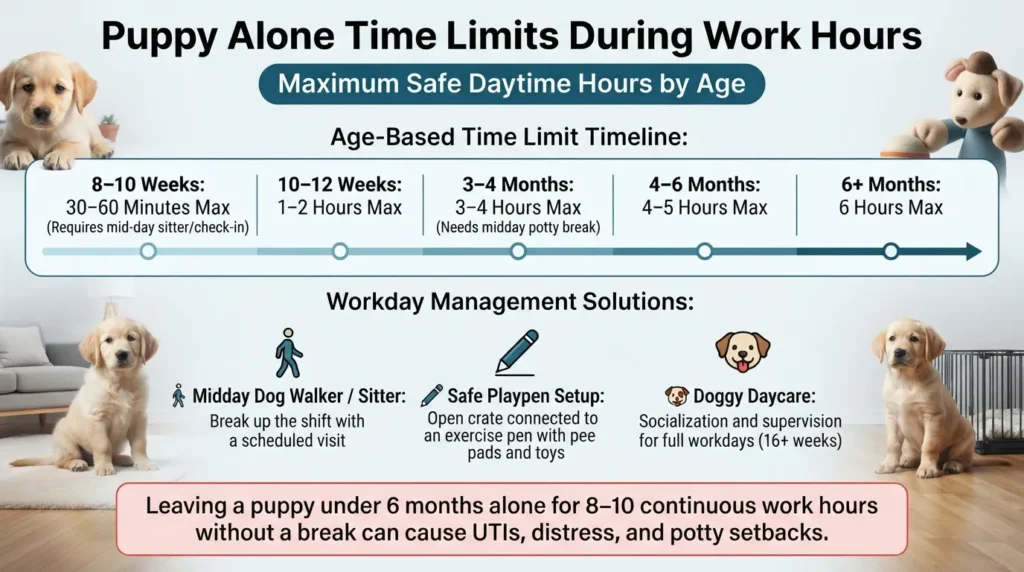
Leaving a puppy home alone for a standard 8-to-10-hour workday simply isn’t feasible without a solid management plan in place. Young pups physically cannot hold their bladders that long, nor do they have the emotional maturity to handle hours of isolation without developing severe distress or destructive habits.
Expectations must match your puppy’s physical stage of development:
8 to 10 weeks old: They can handle 30 to 60 minutes alone at most. Leaving a puppy this young for a full workday is impossible without multiple interventions throughout the day.
10 to 12 weeks old: Bladder capacity increases to 1 to 2 hours. They still need frequent attention and potty breaks.
3 to 4 months old: They can stretch to 3 to 4 hours. This is usually the stage where a midday visit makes a partial workday manageable.
4 to 6 months old: Max capacity hits 4 to 5 hours. They can manage half-days well, but a full 8-hour stretch is still too long.
6 months and older: Bladder capacity reaches 6 hours or more, bringing them much closer to surviving a standard adult schedule, though daily mid-day breaks are still ideal.
If you work outside the home full-time, you need a strategy to bridge the gap between your work schedule and your pup’s bladder size. Here are the most effective options to keep your puppy safe, comfortable, and accident-free:
Hire a midday dog walker or pet sitter: Having someone drop by once or twice during the day breaks up the isolation, provides a potty break, and burns off excess energy.
Set up a puppy-proofed exercise pen (X-pen): Instead of locking a puppy in a small crate all day, attach an exercise pen to an open crate. Line one side with washable or disposable puppy pads and leave safe chew toys on the other. This creates a clear distinction between their sleeping area and their emergency potty spot.
Enroll in doggy daycare: Once your puppy is fully vaccinated (typically around 16 weeks), high-quality doggy daycare provides socialization and constant supervision while you are at work.
Utilize puppy pads responsibly: If family or paid help isn’t an option, dedicated indoor potty pads inside a restricted playpen allow your puppy to relieve themselves without ruining your house training progress.
Signs Your Puppy Needs to Go Out
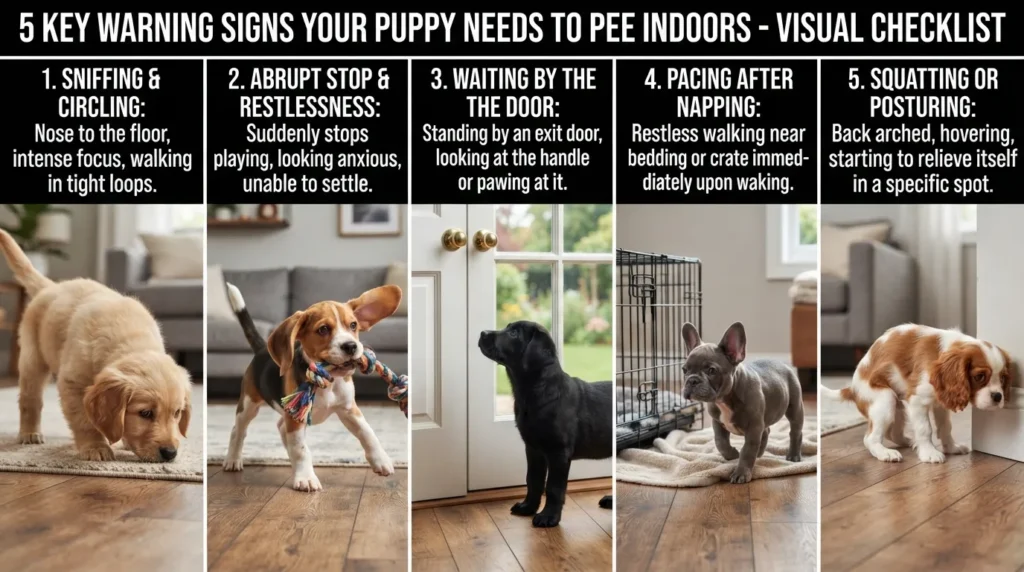
Puppies rarely send formal announcements when they need to pee. Instead, they give subtle behavioral cues right before an accident happens. Learning to spot these warning signals instantly—and acting within seconds—is the secret to successful potty training.
Watch for these five high-priority signs that your puppy needs an immediate trip outside:
Sniffing the Floor and Circling: A puppy actively sniffing the ground while turning in tight circles is looking for a spot to eliminate. The moment you see this nose-to-ground scanning motion, pick them up immediately and head for the door.
Sudden Stillness During Play: If your pup stops mid-chase, abandons a favorite toy, or freezes in place during active play, their bladder just hit capacity. Playing stimulates the body and speeds up urine production, leading to sudden urges.
Restlessness Right After Waking: Waking up from a nap triggers an automatic physiological urge to eliminate. A newly awake puppy pacing, shifting around, or refusing to settle back down needs to go out before they step foot off their bed or out of their crate.
Whining, Barking, or Agitation: Vocalizing combined with an inability to sit still is a vocal plea for help. Young pups often get visibly anxious when they feel a full bladder but aren’t sure where to empty it.
Scratching or Hovering Near the Door: Standing near an exit, staring at the doorknob, or pawing at the entry frame is a fantastic sign that your puppy is connecting “outside” with potty time. Reward this clear communication by opening the door right away.
Backup Option: Puppy Pads
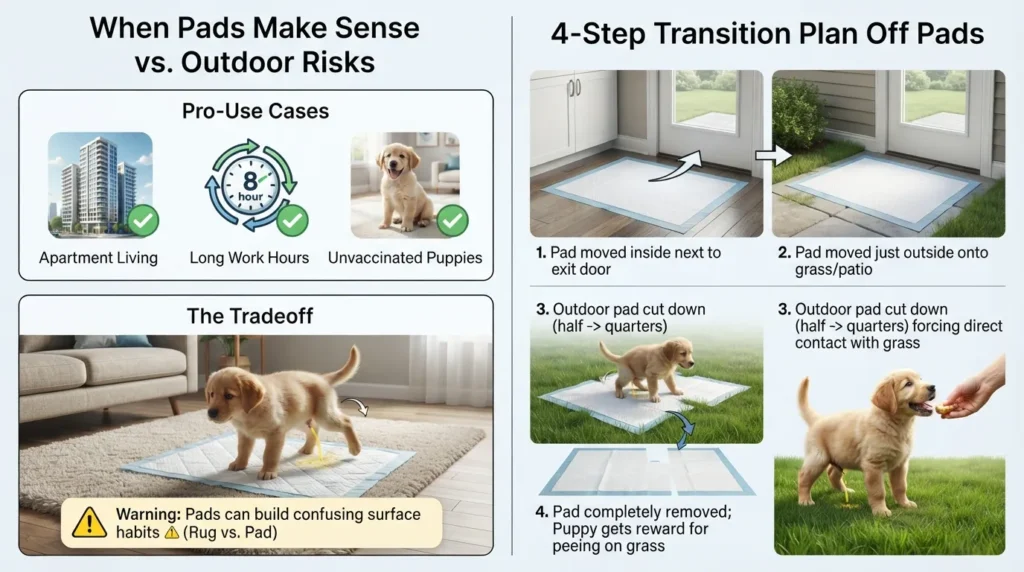
Puppy pads are a tool, not a mandatory step in potty training. While they can save your floors during the early weeks, relying on them too long can actually confuse your puppy about where it’s acceptable to go.
Understanding when pads make sense—and how to move past them—will keep your potty training on track.
When pads make sense vs. when they delay outdoor training
Indoor potty pads are an absolute lifesaver in specific living situations, but they come with a distinct tradeoff for long-term training.
When pads make sense: If you live on the 15th floor of an apartment building, work 8-hour shifts without a dog walker, or have an unvaccinated puppy in a high-risk disease area, indoor pads are a practical necessity. They give your pup a safe, accessible spot to relieve themselves when getting outside in time is physically impossible.
When pads delay outdoor training: If your ultimate goal is a dog that exclusively pees outside, starting with pads teaches your puppy that relieving themselves on soft indoor surfaces is fine. Puppies form strong surface preferences early on. To a young pup, the texture of a quilted puppy pad feels remarkably similar to your living room rug, bathmat, or bedroom carpet.
If you have easy access to a private yard or a safe outdoor space, skipping pads entirely and taking your puppy outside from day one usually leads to much faster potty training results.
How to transition off pads later
If you used pads initially and are ready to move all potty trips outside, you need a gradual plan. Cold-turkey transitions often lead to sudden indoor accidents.
Move the pad toward the exit: Shift the puppy pad a few feet closer to your outdoor door every single day. If your pup gets confused, pause for a day before moving it again.
Place a pad outdoors: Once the pad is right next to the door, move it directly outside onto the grass or patio where you want your dog to go.
Reduce pad size: Cut the outdoor pad in half, then into quarters, forcing your puppy to target grass while still recognizing the familiar scent of the pad material.
Remove the pad completely: Once your puppy consistently uses the tiny pad piece outside, remove it entirely and reward generously with high-value treats whenever they pee directly on the ground.
What Happens If a Puppy Holds Pee Too Long Safety & Health Risks
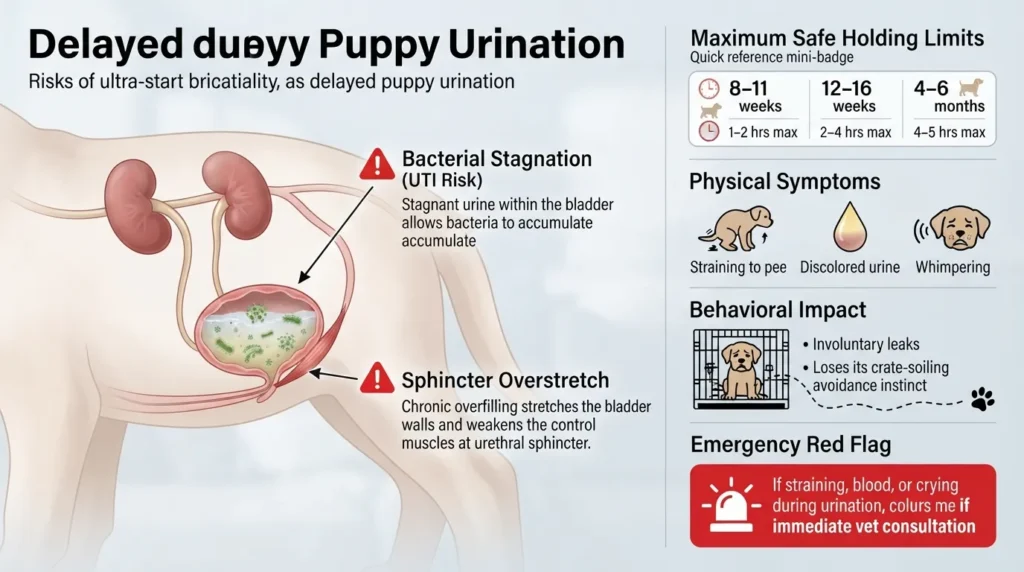
Pushing a young dog past their biological limits might seem harmless if they manage to wait without an accident, but it creates hidden physical stress. While an adult dog can occasionally stretch their hold time during an emergency, a puppy’s urinary system is far too delicate for frequent delays.
To protect your pup’s developing kidneys and bladder, stick strictly to these maximum safe daytime holding limits—even if your puppy seems fine sitting in their crate longer:
8–11 weeks: 1 to 2 hours maximum
12–16 weeks: 2 to 4 hours maximum
4–6 months: 4 to 5 hours maximum
6–12 months: 6 hours maximum (up to 8 hours only once fully mature)
Forcing a puppy to hold their urine regularly causes real medical and behavioral issues. Physical retention allows bacteria to collect and multiply in the bladder, significantly increasing the risk of painful Urinary Tract Infections (UTIs). Over time, chronically stretching the bladder walls weakens the sphincter muscles, leading to involuntary urine leaking and overflow accidents.
Sometimes, frequent accidents or an inability to hold urine aren’t scheduling issues at all, but signs of an underlying medical problem. You should contact your veterinarian immediately if you notice any of these red flags:
Visible straining or taking a long time to produce only a few drops of urine.
Blood or severe discoloration in the urine (pink, red, or dark brown tints).
Vocalizing, crying, or whimpering while attempting to pee.
A sudden regression in a puppy who was previously fully house-trained.
Excessive water intake accompanied by unusually frequent, urgent urination.
What to Do After an Accident
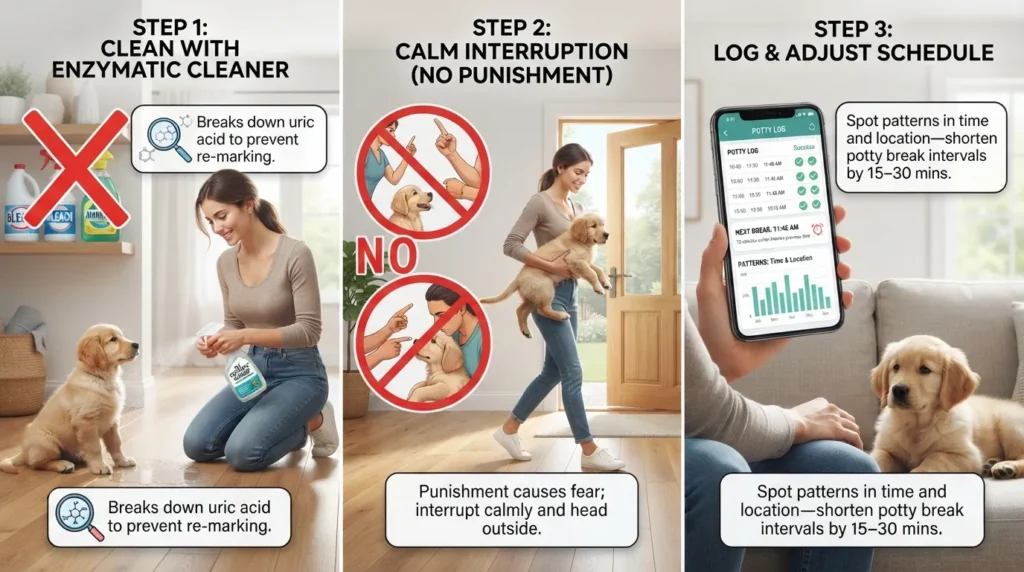
Accidents happen, even with the most attentive owners. When your puppy misses the mark, how you respond in the immediate aftermath dictates how fast your potty training gets back on track.
Clean thoroughly with an enzymatic cleaner (prevents re-marking): Regular household cleaners or bleach might eliminate the scent for your nose, but they leave behind microscopic urine proteins. A dog’s powerful sense of smell will still pick up those breakdown products, marking the spot as an acceptable target for next time. Use a dedicated enzymatic pet cleaner to break down the uric acid completely.
Don’t punish — tighten the schedule instead: Yelling, rubbing your puppy’s nose in the mess, or scolding hours after the event causes fear, not understanding. It simply teaches your puppy to hide away and pee behind the couch next time. If you catch them in the act, calmly interrupt them with a quick word, scoop them up, and bring them straight to their outdoor potty spot. If you find a puddle later, swallow your frustration, clean it up silently, and shorten the time between potty breaks by 15–30 minutes.
Watch for a pattern (same time/place) as a signal to adjust routine: Keep a mental log or a quick note on your phone of where and when accidents occur. If your pup consistently has an accident at 4:30 PM or near the rug in the hallway, their body is giving you a clear signal. Use that data to proactively take them out 10 minutes before their usual accident window, or block access to that specific room until their bladder control matures.
How to Help Your Puppy Build Bladder Control Safely
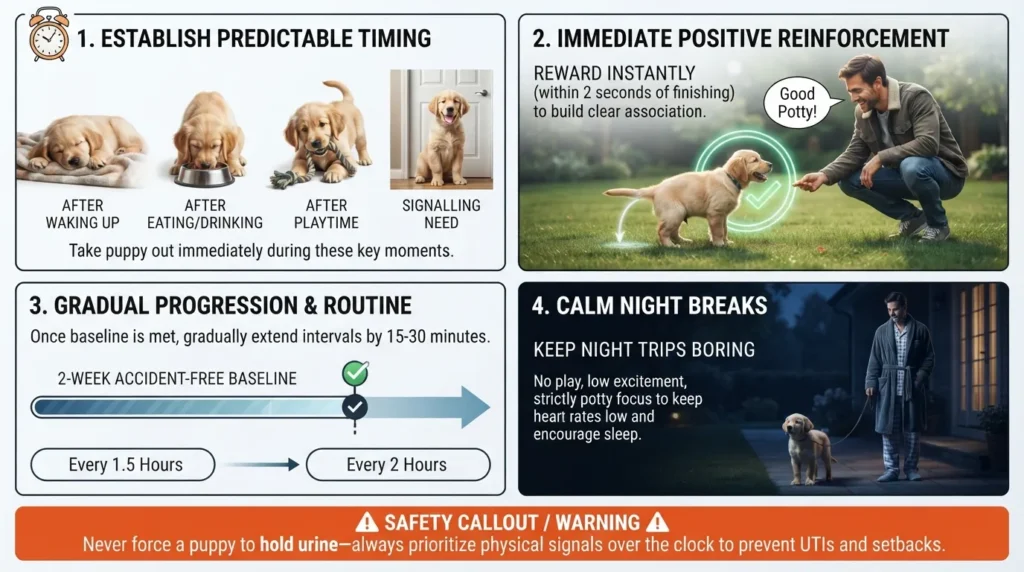
Building bladder strength isn’t about forcing your puppy to wait until they can’t take it anymore. It’s a physiological process that happens naturally as their muscles mature and their nervous system learns to recognize a full bladder. Your job is to create a structured environment where success is easy and accidents are rare.
Here is how you can help your puppy develop reliable bladder control without stress or health risks:
Stick to a strict, predictable schedule. Take your puppy outside the second they wake up, right after every meal, after intense play sessions, and immediately after taking a drink. Puppies thrive on routine, and consistent timing teaches their body when to expect relief.
Use high-value positive reinforcement. The moment your puppy finishes peeing outside, mark the behavior immediately with enthusiastic praise and a small, high-value treat. Reward them outside within two seconds of finishing so they clearly connect the outdoor spot with a positive reward.
Increase intervals gradually. Once your puppy goes two full weeks without a single accident on their current schedule, add 15 to 30 minutes to the time between potty breaks. If accidents start happening again, dial it back to the previous interval for another week before trying again.
Keep night routines calm and boring. When you take your puppy out for a midnight potty break, keep lights dim and avoid talking excited chatter or initiating play. This helps them quickly learn that night trips are strictly business, making it easier for their heart rate and bladder to settle back to sleep.
Never Intentionally Withhold Breaks to “Train” Longer Holding
Trying to “stretch” a puppy’s bladder by forcing them to hold their pee longer than their body is physically ready for does not speed up potty training. In fact, it backfires completely.
When a puppy is forced to hold urine past their physical limit, two major problems occur:
Increased Risk of Urinary Tract Infections (UTIs): Stagnant urine sitting in the bladder becomes a breeding ground for bacteria. According to veterinary guidelines from the AAHA, forcing dogs to hold urine for extended periods significantly raises the risk of painful UTIs and bladder stones.
Behavioral Setbacks: A puppy forced to hold it will eventually have an accident inside. Once they soak their crate or bedding, they lose their natural instinct to keep their sleeping area clean, making crate training and housebreaking twice as difficult to fix later.
If your puppy is whining, pacing, sniffing the floor, or circling near the door, listen to their signals. Always prioritize giving them a break over sticking rigidly to a timer.
Frequently Asked Questions: How Long Can a Puppy Hold Their Pee?
As a general rule, a puppy can hold their pee for about 1 hour for every month of age during the day. For example, an 8-week-old (2 months) puppy can hold it for 2 hours max, a 3-month-old for 3 hours, and a 4-month-old for 4 hours. Once they reach 6 to 9 months, most dogs can manage up to 6–8 hours.
The "1 hour per month" rule is a standard veterinary guidelines formula to estimate daytime bladder capacity. Take your puppy’s age in months to find their max resting hold time (e.g., 3 months old = 3 hours). Treat this number as an absolute maximum limit, not a routine potty schedule while active.
During sleep, a puppy's metabolic rate slows down, their heart rate drops, and their body naturally produces antidiuretic hormone (ADH), which reduces urine production in the kidneys. During daytime active hours, drinking water, running, and playing fill the bladder much faster.
Most puppies can sleep through the night (7 to 8 hours) without a potty break around 16 to 20 weeks (4 to 5 months) of age, provided water intake is managed before bedtime and they are given a full potty break right before sleep.
A puppy should not go more than 1 to 2 hours beyond their age-based physical limit. Holding urine for 8–10+ hours regularly increases the risk of urinary tract infections (UTIs) and bladder inflammation. If a puppy goes 10–12 hours without urinating, consult a veterinarian immediately.
Yes. Dogs naturally avoid soiling their sleeping space (den instinct). In an appropriately sized crate, a puppy will exert much better muscle control to avoid an accident compared to roaming freely in a house where they can easily find an unused corner.
Yes, for puppies under 10–12 weeks old during active awake hours. Playing, eating, and drinking stimulate intestinal and bladder activity. However, if an older puppy (4+ months) suddenly starts peeing every 30 minutes or strains while urinating, check with a vet for potential UTIs.
Yes. Toy and small breeds (like Chihuahuas, Yorkies, or Shih Tzus) have higher metabolic rates and significantly smaller physical bladder capacities relative to large breeds (like Golden Retrievers or Labradors) at the same age, requiring more frequent outdoor trips.
Bladder control develops gradually alongside physical growth and nerve maturation. As the sphincter muscles strengthen and neural connections between the brain and bladder mature, hold time increases incrementally week-by-week until full physical control is achieved around 6–9 months.
Routine spaying or neutering does not permanently lower bladder capacity. However, temporary post-surgical inflammation or pain medication may temporarily alter their routine during recovery. In rare cases, early spaying can cause hormone-responsive incontinence later in adulthood, but it does not interfere with basic puppy house training.
🐾 Other Age Guides

I built Dogagescalculator.com to give dog owners honest, science-backed answers instead of the outdated "×7" myth. Every figure here is checked against AKC, AVMA, and published veterinary research.
More about the author & this site →
Comments