
how big does a shiba inu dog get
How Big Does a Shiba Inu Dog Get? Full Size, Weight & Growth Chart
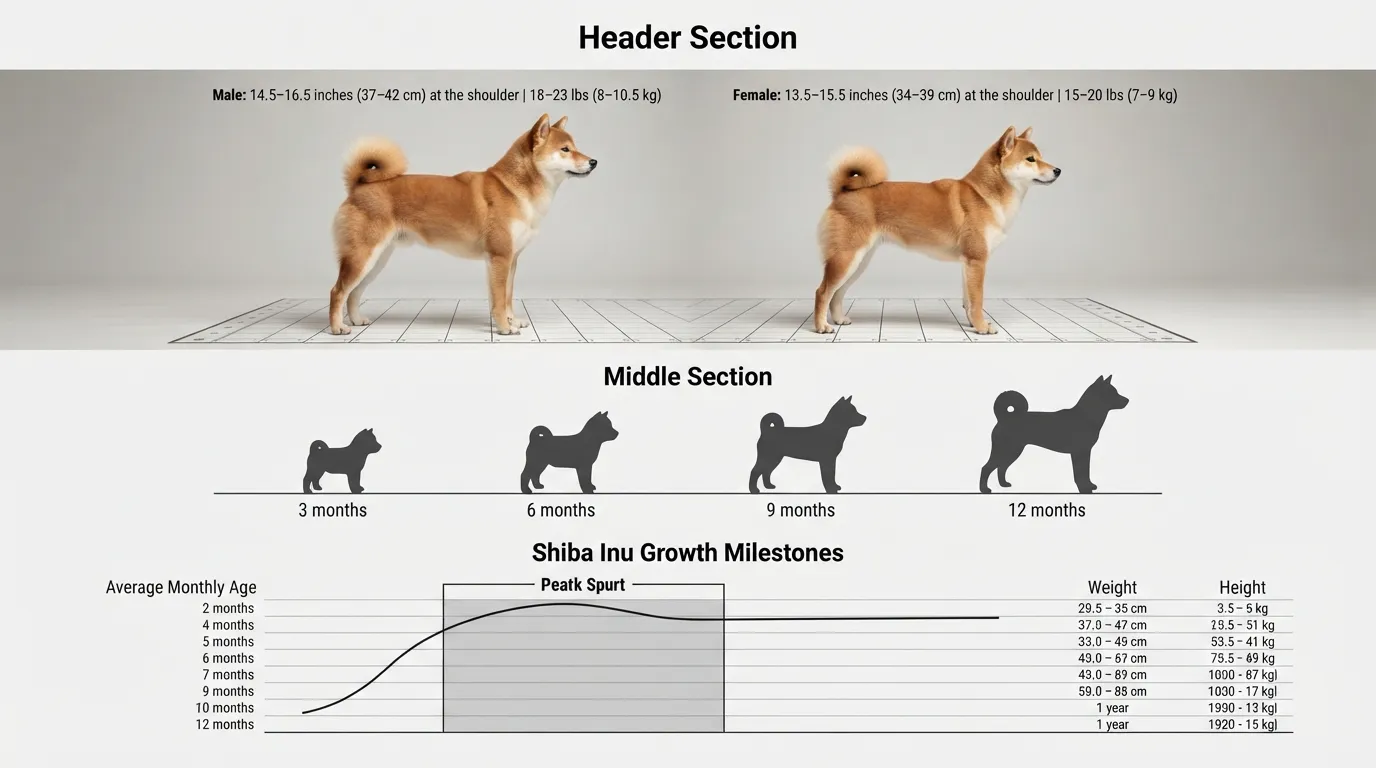
Wondering how big a Shiba Inu gets when fully grown? A full-grown Shiba Inu typically stands about 13.5 to 16.5 inches (34–42 cm) tall and weighs around 17 to 23 pounds (7.7–10.4 kg). Males are generally larger and heavier than females, although individual size can vary based on genetics and other factors.
Most Shiba Inus reach close to their adult height by around 12 months, but they may continue gaining muscle and filling out until approximately 14–18 months. Genetics, sex, nutrition, overall health, and growth pattern can all influence a Shiba Inu’s final adult size.
If you’re wondering how big Shiba Inus get, understanding both height and weight is important. A puppy’s current growth stage can also provide clues about how much more growing it has left, although puppy size predictions cannot determine an exact adult size.
In this guide, you’ll find a detailed Shiba Inu size and weight chart, male vs. female measurements, typical height in centimeters and inches, growth stages, and information about when Shiba Inus stop growing. We’ll also explain what to expect from a Shiba Inu as it reaches full size.
Shiba Inu Full-Grown Size — Male vs Female
Shiba Inu Full-Grown Size — Male vs Female
Male and female Shiba Inus exhibit a distinct difference in frame, substance, and weight. While the height gap seems minor on paper, males carry a noticeably square, muscular silhouette, whereas females maintain a slightly finer-boned, more refined structure.
Male Shiba Inu Height & Weight
An adult male Shiba Inu typically reaches 14.5 to 16.5 inches (37 to 42 cm) at the shoulder. Healthy adult males average 23 pounds (10.4 kg), hitting the upper limit of the breed standard.
They develop a broad chest, a solid neck, and strong bone density that makes them feel surprisingly sturdy when picked up. If a male exceeds 25 pounds without visible fat around the ribcage, he is likely slightly over standard height or exceptionally thick-boned.
Female Shiba Inu Height & Weight
Female Shiba Inus stand 13.5 to 15.5 inches (34 to 39 cm) tall at the wither. Their healthy adult weight hovers around 17 to 18 pounds (7.7 to 8.2 kg).
Females are lighter on their feet and have a slightly longer body proportion relative to their height. Breeders often refer to female Shibas as having a softer expression and cleaner lines, making them noticeably smaller in hand compared to males.
Male vs Female — Quick Comparison Table
| Feature | Male Shiba Inu | Female Shiba Inu |
|---|---|---|
| Standard Height | 14.5–16.5 in (37–42 cm) | 13.5–15.5 in (34–39 cm) |
| Average Weight | ~23 lbs (10.4 kg) | ~17–18 lbs (7.7–8.2 kg) |
| Body Build | Heavy-boned, broad chest | Finer-boned, compact frame |
| Growth Completion | 14–18 months | 12–14 months |
Is a Shiba Inu a Small, Medium, or Large Dog?
The Shiba Inu is officially classified as a small-to-medium breed. It is the smallest of the six native spitz-type dog breeds originating from Japan.
While their plush double coat can give them a larger appearance, their actual skeleton and muscle mass place them firmly between smaller toy breeds and true medium dogs like the Australian Cattle Dog. Their compact size makes them ideal for apartment living, provided their exercise needs are met.
Shiba Inu Growth Chart by Age (Month-by-Month)
Shiba Inu Growth Chart by Age (Month-by-Month)
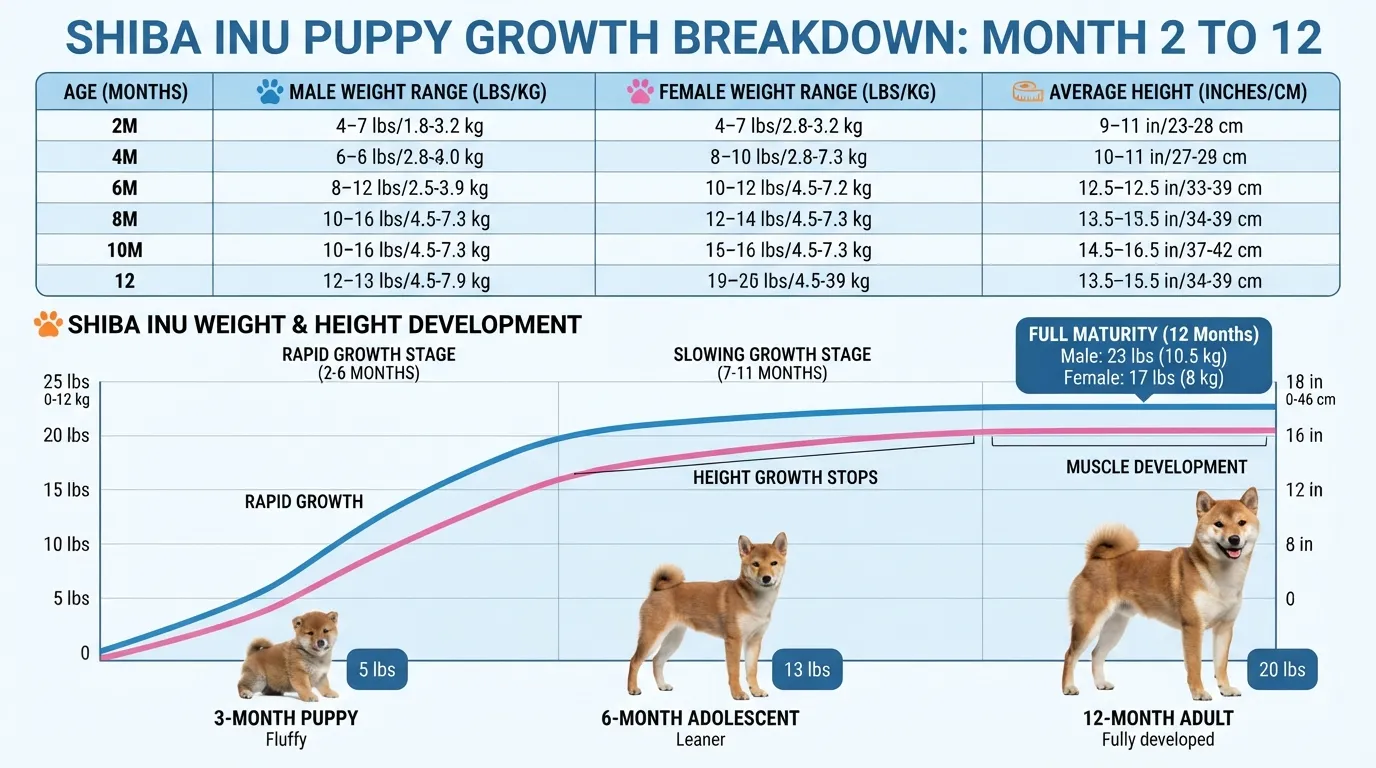
Tracking a Shiba Inu's puppyhood growth requires looking at both height and weight, as these dogs gain altitude quickly before filling out through their chest and shoulders. Expect steady, predictable gains early on that gradually taper as they approach their first birthday.
Growth Chart Table (1–12+ months, imperial + metric)
| Age | Male Weight | Female Weight | Average Height (At Withers) |
|---|---|---|---|
| 1 Month | 2.5–3.5 lbs (1.1–1.6 kg) | 2.0–3.0 lbs (0.9–1.4 kg) | 4–5 in (10–13 cm) |
| 2 Months | 5.5–7.0 lbs (2.5–3.2 kg) | 4.5–6.0 lbs (2.0–2.7 kg) | 6–8 in (15–20 cm) |
| 3 Months | 9.0–11.0 lbs (4.1–5.0 kg) | 7.5–9.5 lbs (3.4–4.3 kg) | 9–11 in (23–28 cm) |
| 4 Months | 12.0–14.5 lbs (5.4–6.6 kg) | 10.0–12.5 lbs (4.5–5.7 kg) | 11–13 in (28–33 cm) |
| 5 Months | 15.0–17.5 lbs (6.8–7.9 kg) | 12.5–15.0 lbs (5.7–6.8 kg) | 12–14 in (30–36 cm) |
| 6 Months | 17.5–20.0 lbs (7.9–9.1 kg) | 14.5–16.5 lbs (6.6–7.5 kg) | 13–15 in (33–38 cm) |
| 9 Months | 20.0–22.0 lbs (9.1–10.0 kg) | 16.0–17.5 lbs (7.3–7.9 kg) | 13.5–16 in (34–41 cm) |
| 12 Months | 22.0–23.5 lbs (10.0–10.7 kg) | 16.5–18.0 lbs (7.5–8.2 kg) | Full Adult Height |
| 18 Months+ | ~23 lbs (10.4 kg) | ~17–18 lbs (7.7–8.2 kg) | Fully Filled Out |
Note: Some U.S. lineage Shibas run slightly larger (up to 30–34 lbs), while native Japanese lines lean closer to the strict kennel standard.
When Do Shiba Inus Grow the Fastest? (3–7 month spurt)
The most rapid growth spurt occurs between 3 and 7 months of age. During this window, puppies gain roughly 1.5 to 2.5 pounds per month and quickly develop their adult leg length.
Because their bones grow so fast in this timeframe, vets recommend avoiding high-impact running or intense stair-climbing to protect developing growth plates. You may notice your puppy looking disproportionately "leggy" or lanky around month 5, which is completely normal before their muscle density catches up.
At What Age Is a Shiba Inu Fully Grown?
A Shiba Inu hits its full adult height around 12 months. However, physical maturation does not stop there; most Shibas need an additional 4 to 6 months to broaden their chest, thicken their neck, and grow their dense adult double coat.
By 18 months of age, your Shiba is fully adult in both bone structure and weight distribution. Ensure you monitor their body condition score after month 12, as their caloric needs drop once frame growth completes.
Is There a "Mini" or "Miniature" Shiba Inu?
No, a “Miniature Shiba Inu” is not a recognized separate breed by the American Kennel Club (AKC), United Kennel Club (UKC), or NIPPO (the Nihon Ken Hozonkai, Japan’s primary preservation society).
Any dog marketed as a “teacup,” “micro,” or “mini” Shiba is either a mixed breed, an out-of-standard purebred, or the result of unethical breeding practices. In Japan, some breeders produce the Mame Shiba (meaning “bean-sized” Shiba), but even in its native country, it remains an unofficial size variation rather than a distinct, standardized breed.
Why Some Shibas Look Smaller
If you see an adult Shiba Inu that looks noticeably smaller than the standard 17 to 23 pounds, the size difference almost always traces back to one of these factors:
Regional Genetic Lines: Japanese bloodlines tend to sit precisely within traditional standards (often slightly finer-boned), whereas American lines frequently trend toward the heavier, stockier end of the spectrum.
Runts of the Litter: A naturally occurring runt may simply inherit smaller growth traits from the gene pool, ending up 2 to 4 pounds below average without any underlying health problems.
Breeder Gimmicks & Selective Breeding: Unscrupulous breeders often pair two undersized, out-of-standard Shibas to force smaller litters. This practice frequently introduces health complications, including severe dental crowding, weak bone density, and patellar luxation.
Mixed Lineage: Many dogs sold as “mini Shibas” online are actually crossbreeds—commonly mixed with Pomeranians, American Eskimo Dogs, or Chihuahuas—to intentionally downsize the frame while keeping the fox-like face.
Shiba Inu Size Compared to Other Breeds & Humans
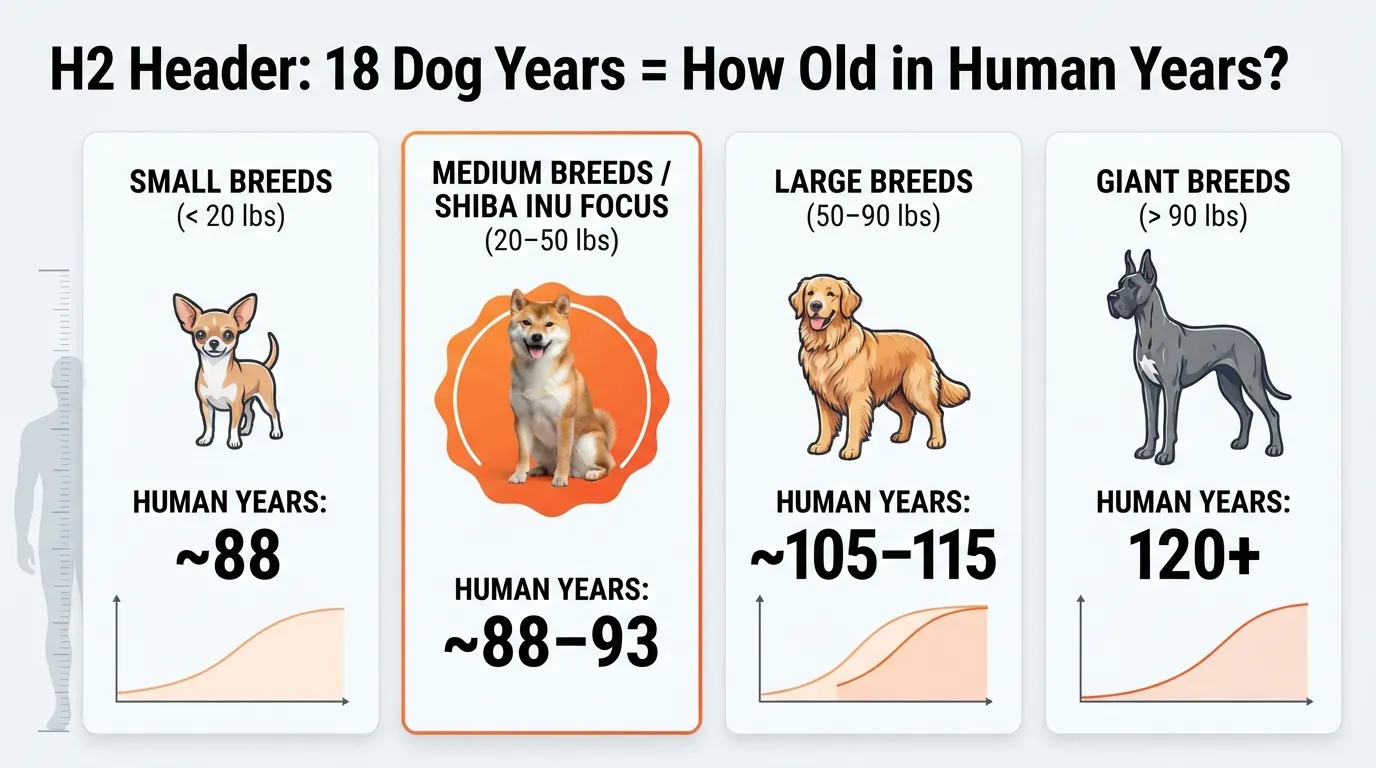
Shiba Inu Size Compared to Other Breeds & Humans
Putting a Shiba Inu's measurements into perspective is easiest when side-by-side with other familiar breeds. Because their thick double coat often tricks the eye into thinking they are heavier than they actually are, understanding their actual skeletal footprint helps clarify where they sit in the dog world.
Shiba Inu vs Akita
While both breeds share the iconic fox-like face, curled tail, and spitz heritage from Japan, their physical scale could not be more different:
- Shiba Inu: Stands 13.5 to 16.5 inches tall and weighs 17 to 23 pounds. It is built as a compact, nimble hunter designed for dense brush.
- Akita: Stands 24 to 28 inches tall and weighs a massive 70 to 130 pounds.
An Akita is roughly four to five times heavier than a Shiba Inu. Seeing them together immediately highlights the difference between a compact small-to-medium companion and a powerful giant breed.
Shiba Inu vs Corgi
Comparing a Shiba Inu to a Pembroke Welsh Corgi offers an interesting contrast in proportions and weight distribution:
| Feature | Shiba Inu | Pembroke Welsh Corgi |
|---|---|---|
| Average Height | 13.5–16.5 inches (Leggy, balanced build) | 10–12 inches (Short-legged, dwarf frame) |
| Average Weight | 17–23 pounds | 25–30 pounds |
| Body Shape | Square, athletic, high ground clearance | Elongated torso, low ground clearance |
Even though a Corgi stands several inches shorter at the shoulder due to its short legs, it actually outweighs a typical Shiba Inu by 5 to 8 pounds due to its heavy bone density and dense, cylindrical body.
Shiba Inu Next to an Average Adult (visual)
When standing next to an average adult human (around 5'6" to 5'10"), a full-grown Shiba Inu:
- Reaches just below mid-calf or around lower-knee height when standing on all four paws.
- Fits comfortably in a lap or across an adult's torso when picked up.
- Takes up minimal floor space in a home, occupying roughly the footprint of an average carry-on suitcase when curled up to sleep.
How to Measure Your Shiba Inu's Size at Home
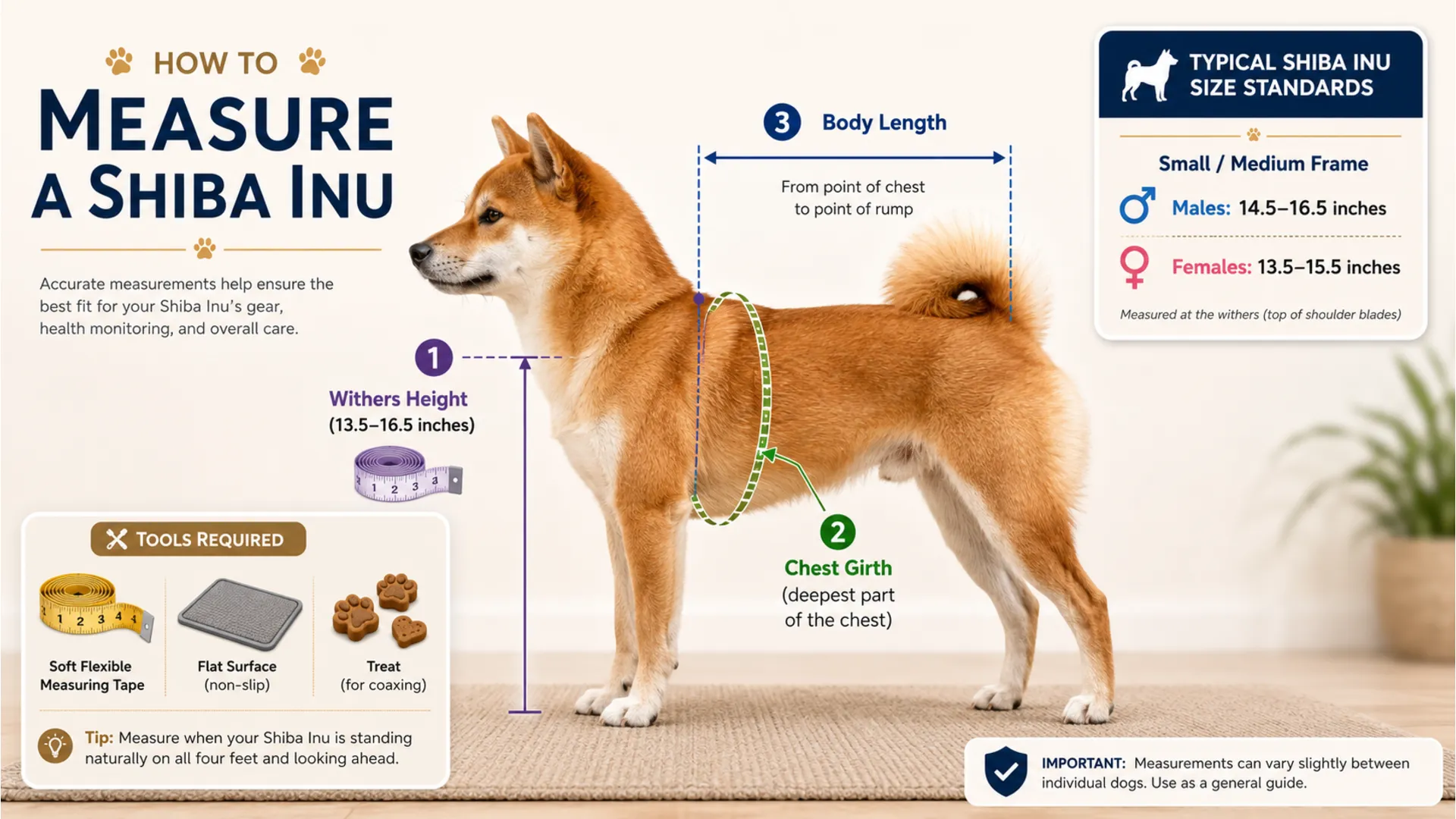
Accurately measuring your Shiba Inu at home takes less than five minutes and ensures you get reliable numbers for growth tracking, harness sizing, or weight management. To get precise results, always take measurements while your dog is standing squarely on a flat, even surface.
Measuring Height (at the Withers)
In dog anatomy, height is always measured from the floor to the highest point of the shoulder blades—known as the withers—rather than the top of the head.
Stand your Shiba squarely on the floor with all four paws positioned directly under their body.
Locate the withers by feeling for the prominent ridge right where the base of the neck meets the top of the shoulders.
Place a firm tape measure or ruler vertically from the floor straight up to that shoulder point, keeping the line perpendicular to the ground.
Press your dog’s double coat down gently so you measure directly to the bone frame rather than the tip of their outer guard hair.
Weighing Your Dog Accurately
Because adult Shibas generally weigh under 25 pounds, getting a precise reading on a standard home bathroom scale is straightforward using the step-and-subtract method.
Step onto your digital bathroom scale by yourself and note your exact weight.
Pick up your Shiba Inu, hold them firmly against your torso, and step back onto the scale together.
Subtract your solo weight from the combined weight—the difference is your dog’s current weight.
What Affects a Shiba Inu's Final Size? (Breed-Specific)
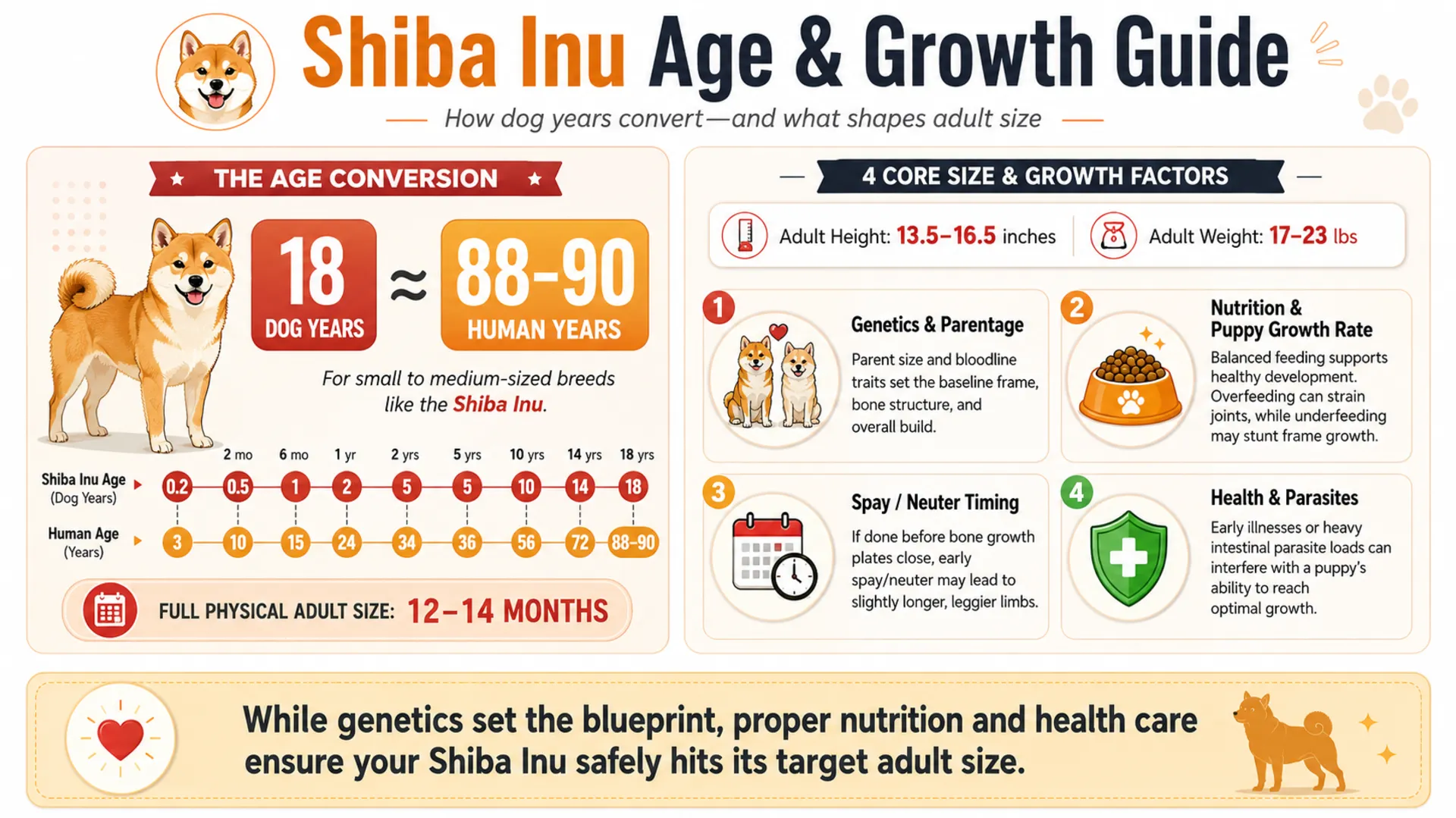
While the standard height and weight ranges offer a reliable baseline, individual Shiba Inus don’t all grow at the exact same pace or hit the exact same dimensions. A dog’s final adult frame is shaped by a combination of inherent genetics and key developmental factors during their first year.
Genetics and Parent Size
Genetics serve as the primary blueprint for your Shiba’s ultimate height and skeletal frame. The physical size of the sire (father) and dam (mother)—along with the broader lineage—is the single strongest indicator of how large a puppy will become.
Lineage origin plays a notable role here:
Japanese Show & Preservation Lines: Typically follow strict kennel standards closely, tending to stay compact, refined, and within the 17-to-23-pound mark.
American Lines: Frequently trend slightly larger and stockier, sometimes naturally leaning toward the upper boundary of the weight chart.
Veterinarians and breeders often advise looking at the adult parents to get a realistic estimate of a puppy’s target adult footprint.
Spay/Neuter Timing (Effect on Growth)
The age at which a Shiba Inu is spayed or neutered directly influences how their long bones develop. Sex hormones (estrogen and testosterone) signal the growth plates at the ends of long bones to close and stop lengthening.
Early Altering (Before 6–9 Months): Removing these hormones early delays growth plate closure, which can cause the leg bones to continue growing longer than they normally would. This often results in a taller, lankier, and slightly lighter-boned frame.
Standard/Delayed Altering (After 12 Months): Waiting until after physical maturity allows the growth plates to close naturally on schedule, preserving the Shiba’s traditional square, compact, and muscular proportions.
Diet & Nutrition During Growth Spurts
Proper nutrition fuels healthy skeletal and muscular development, especially during the critical rapid growth window between 3 and 7 months.
Caloric Surplus & Overfeeding: Excess calories do not cause a puppy’s skeleton to grow larger than its genetic potential; instead, overfeeding causes rapid weight gain. Excess weight puts undue stress on immature joints and developing cartilage, increasing the risk of orthopedic issues like patellar luxation.
Malnutrition or Parasites: Severe underfeeding, an unbalanced diet lacking crucial minerals (like calcium and phosphorus in proper ratios), or heavy intestinal parasite loads can stunt a puppy’s natural growth trajectory.
Is My Shiba Inu the Right Weight? (Body Condition Check)
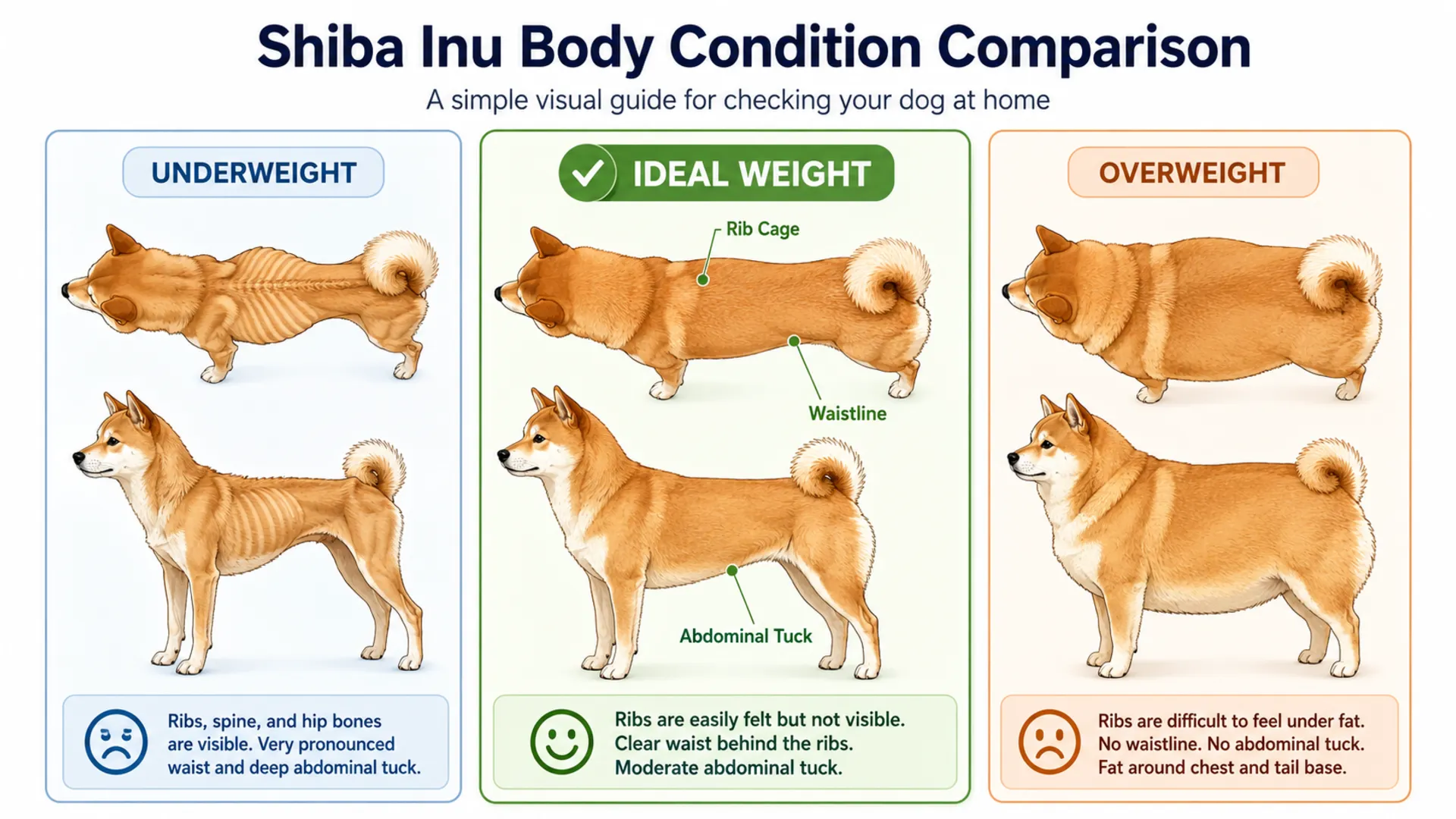
Because a Shiba Inu’s thick, plush double coat can hide significant weight fluctuations, you cannot rely on sight alone to tell if your dog is at a healthy size. The most accurate way to evaluate your Shiba’s frame is by combining a hands-on physical check with a visual assessment from above.
Signs of a Healthy Weight
A Shiba Inu at an ideal weight carries a lean, athletic build under their dense fur. During a body condition check, look for these three key indicators:
Felt Ribs: You should be able to feel their ribs easily with light thumb pressure without pressing through a heavy layer of fat. The ribs shouldn’t be visible, but they should feel like pencil grips under a cloth.
Visible Waistline: Looking down at your Shiba from above, you should see a clear “hourglass” waist curve inward behind the ribs before widening slightly at the hips.
Abdominal Tuck: Looking from the side, their chest should extend lower than their stomach, showing a distinct upward tuck of the abdomen toward the hind legs.
Signs of an Overweight or Underweight Shiba
Catching weight deviations early prevents long-term joint strain and systemic health issues.
Overweight Signs:
Difficulty feeling the ribs under a thick layer of fat.
A flat, broad back when viewed from above, with little to no visible waist contour.
A sagging, straight baseline along the underside without a noticeable abdominal tuck.
Rapid fatigue or reluctance during routine daily walks.
Underweight Signs:
Prominent ribs, spine, or hip bones clearly visible through their double coat.
A severe, exaggerated abdominal tuck that makes the flank appear sunken.
Loss of muscle mass over the shoulders, thighs, and hindquarters.
When to See a Vet
Schedule a consultation with your veterinarian if your Shiba drops below 15 pounds or climbs above 25 pounds without an obvious change in their activity level or diet. Unexplained, rapid weight loss can signal underlying issues such as internal parasites, dental distress, or endocrine conditions.
Similarly, if your adult Shiba remains visibly overweight despite portion control, your vet can run bloodwork to rule out thyroid issues and design a safe, gradual weight loss plan.
Predict Your Shiba Inu's Adult Size
Curious whether your puppy will end up on the lighter 17-pound side or reach a stockier 23-pound adult frame? You don’t have to guess based on standard averages alone.
By plugging your puppy’s current age, gender, and precise weight into our specialized Shiba Inu Size & Growth Calculator, you can instantly project their final adult height and full-grown weight trajectory.
🐾 Try Our Shiba Inu Growth Calculator
Calculate Your Shiba Inu’s Adult Size & Weight →
Our calculator uses breed-standard growth curves adjusted for both native Japanese and American lineage trends to give you an accurate weight projection within seconds.
How the Calculator Works
Our tool tracks your dog’s growth rate against thousands of recorded breed data points across every major puppy milestone:
Age-Adjusted Benchmarks: Compares your puppy’s current weight against standard month-by-month growth trajectories.
Gender Calibration: Accounts for the natural 5-to-6-pound weight gap between adult males and females.
Growth Spurt Detection: Evaluates whether your puppy is currently in their primary growth phase (3–7 months) or entering the filling-out stage (12–18 months).
Frequently Asked Questions
Is a Shiba Inu a medium or large dog?
A Shiba Inu is classified as a small-to-medium dog breed. Standing 13.5 to 16.5 inches tall and weighing between 17 to 23 pounds, it is the smallest of Japan’s six native spitz-type breeds and is far smaller than large or giant breeds like the Akita or Siberian Husky.
Is a Shiba Inu a good family dog?
Yes, a Shiba Inu can be a wonderful family dog for households with older children who understand how to respect a dog’s personal space. Because Shibas are independent, possessive of their belongings, and value clean boundaries, early socialization and firm, consistent training are essential for a smooth family integration.
How big is a full-grown Shiba Inu?
A full-grown Shiba Inu reaches 13.5 to 16.5 inches (34 to 42 cm) at the shoulder and weighs 17 to 23 pounds (7.7 to 10.4 kg) on average. Males trend toward the taller, heavier end of the standard, while females remain slightly smaller and lighter-framed.
Is a Shiba Inu a difficult dog?
Yes, Shibas can be challenging for first-time owners. Known for their cat-like independence, stubborn streak, and high prey drive, they do not naturally aim to please humans the way breeds like Golden Retrievers do. They require confident leadership, strict leash management, and continuous, reward-based training.
What are the disadvantages of a Shiba Inu?
The main drawbacks of owning a Shiba Inu include heavy twice-yearly shedding (“blowing coat”), a tendency to run off if off-leash, stubbornness during training, and potential dog selectivity or resource guarding. They are also known for the dramatic “Shiba scream” when stressed or forced into unpleasant grooming situations.
Can a Shiba Inu be left alone?
Yes, adult Shiba Inus handle independent alone time better than many other breeds. Thanks to their self-reliant, cat-like nature, they are generally not prone to severe separation anxiety, provided they receive adequate physical exercise, mental stimulation, and crate training before being left alone for standard workday hours.
Cavalier King Charles Spaniel and Bichon Frise Mix: The Complete Cavachon Guide
🐾 Other Age Guides

I built Dogagescalculator.com to give dog owners honest, science-backed answers instead of the outdated "×7" myth. Every figure here is checked against AKC, AVMA, and published veterinary research.
More about the author & this site →
Comments