
30 Human Years in Dog Years: Complete Age Conversion Guide
When a dog reaches 30 human years of age, their chronological age sits right around 4 years old.Forget the outdated rule that one human year equals seven dog years. Modern veterinary science shows that dogs mature at an accelerated rate during their first two years of life. By the time a pup hits their fourth birthday, they’ve physically and physiologically caught up to a 30-year-old human. At this stage, your dog is in their prime adult years—fully developed, highly active, and mentally mature.dog age calculator
| Category / Topic | Details & Overview |
|---|---|
| Quick Answer | What is 30 Human Years in Dog Years? |
| The Real Math | The Real Math Behind the 7-Year Myth |
| Breed Size Impact | How Breed Size Changes Everything at Age 30 |
| Milestones | Health and Behavioral Milestones for a 30-Year-Equivalent Dog |
How Dog-to-Human Year Conversion Works
What “Dog Years” Really Means
Basic concept: A “dog year” isn’t a fixed 365-day period; it’s a metric used to compare a canine’s biological, physiological, and mental development to that of a human.
Why simple multiplication doesn’t work: Dogs pack an immense amount of growth, sexual maturation, and aging into their first 12 to 24 months of life, meaning their aging curve is steep at first and flattens out later.
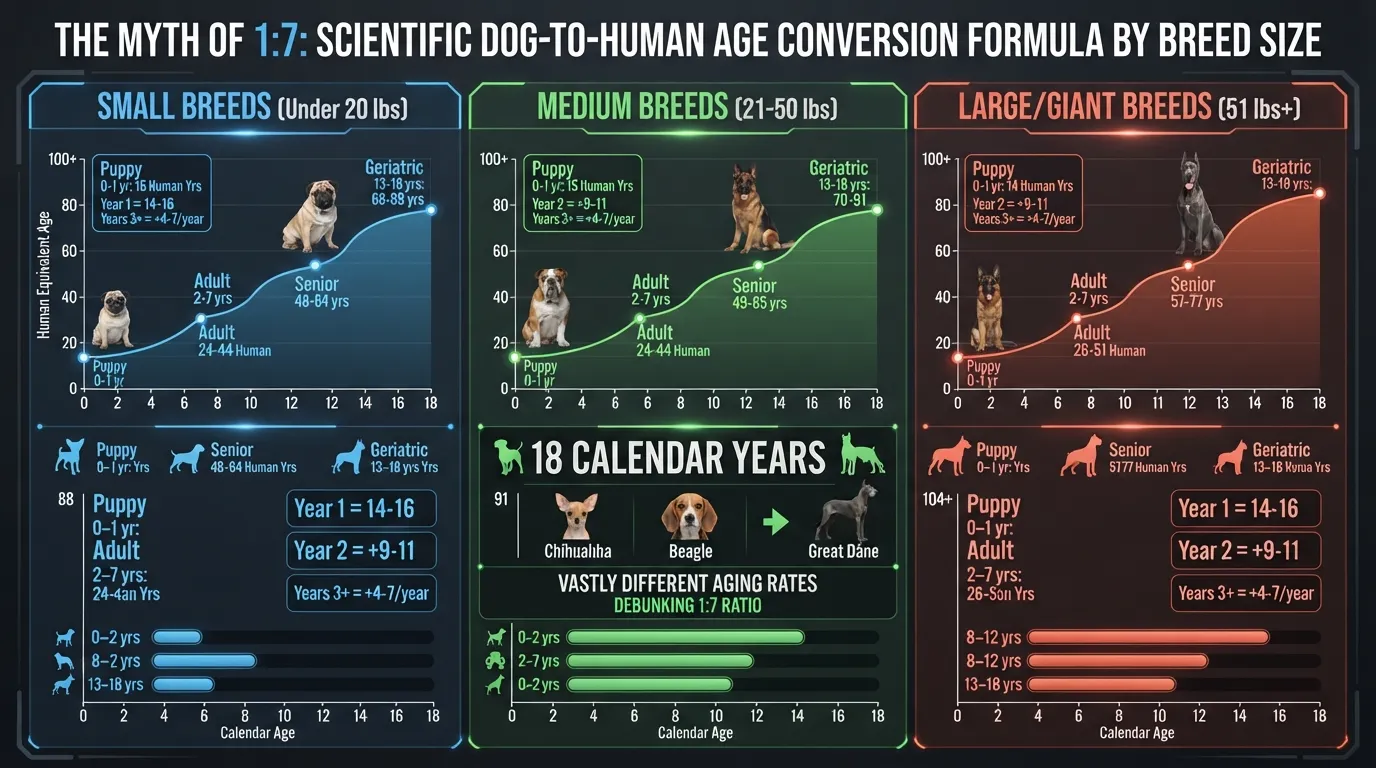
The 7-Year Myth Explained
Origin: The concept gained popularity largely as a convenient rule of thumb popularized in the mid-20th century, offering humans an easy way to think about their pets passing through time.
Why it’s inaccurate: It assumes a linear aging rate across an entire lifespan, completely ignoring the fact that a one-year-old dog is capable of reproducing and is physically far more mature than a seven-year-old human child.
AVMA’s Real Formula
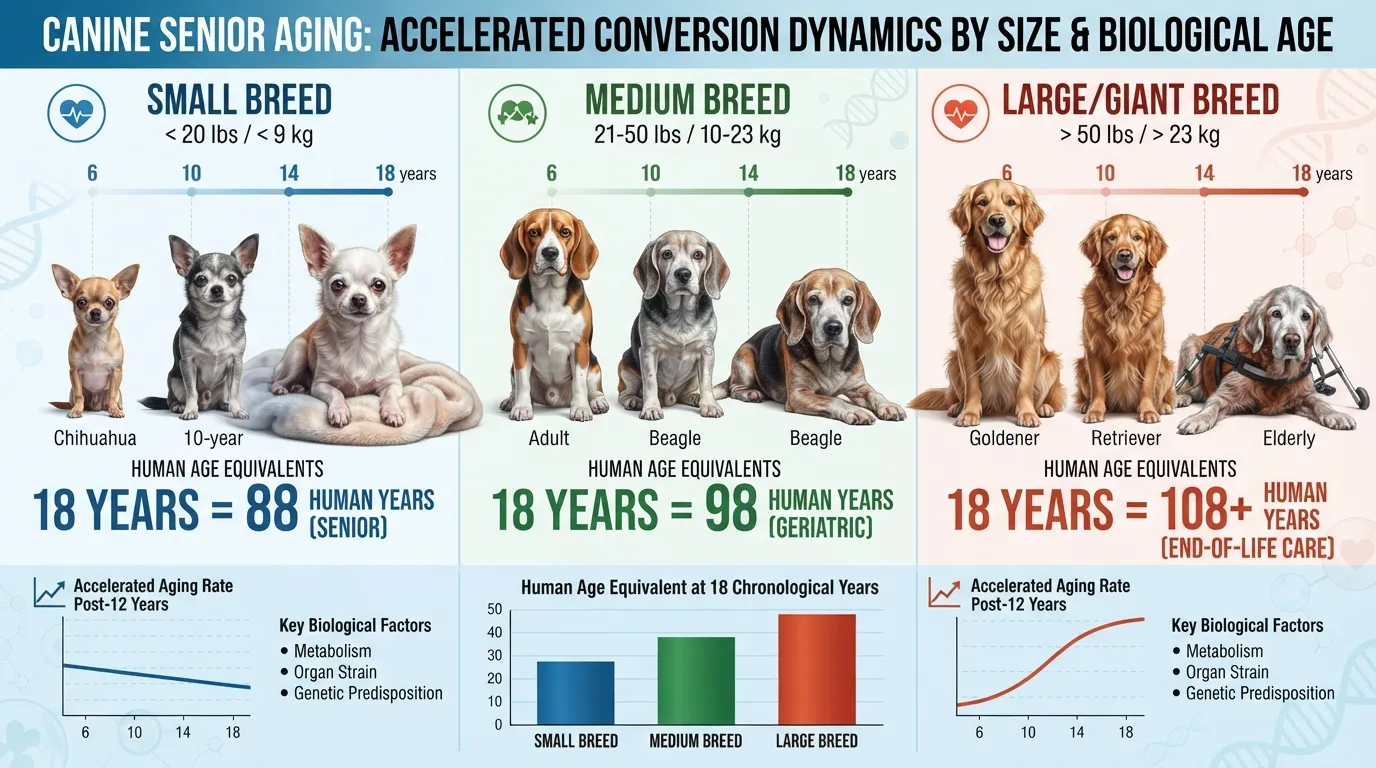
Year 1: The first 12 months of a dog’s life equate to approximately 15 human years due to rapid puppy development.
Year 2: The second year adds another 9 human years, bringing a two-year-old dog to an equivalent of 24 human years.
Each year after: Every subsequent calendar year adds roughly 4 to 5 human years, with the exact increment shifting based on the dog’s adult body size and breed.
Scientific Epigenetic Formula (2019 UCSD Study)
Formula: Researchers at the University of California, San Diego developed an epigenetic clock formula based on DNA methylation patterns, expressed mathematically as human age equals sixteen times the natural logarithm of the dog’s age plus thirty-one.
Limitation: This specific study was conducted using only Labrador Retrievers, meaning the formula tracks one specific breed’s genetic markers and doesn’t automatically account for the wide lifespan variations seen between tiny Chihuahuas and giant Mastiffs.
Dog Longevity — How Old Can Dogs Really Get?
How Old Is a 30-Year-Old Dog? World’s Oldest Dogs on Record
Bobi and Bluey: Historically, dogs like the Australian Cattle Dog named Bluey (who lived to 29 years and 5 months) set the benchmark for extreme canine longevity. While a Rafeiro do Alentejo named Bobi was widely cited as reaching 31 years, Guinness World Records later posthumously rescinded the title after veterinary investigations found insufficient conclusive proof of age.
Why 30-year-old dogs are extremely rare: Canine biology simply isn’t engineered for a three-decade lifespan. Organs, cellular repair mechanisms, and joint structures degrade long before that point, making a 30-year-old dog an extraordinary biological anomaly.
Can a Dog Live 20 Years? Breeds & Factors
Longest-living breeds: Toy and small dog breeds—such as Chihuahuas, Toy Poodles, and Jack Russell Terriers—frequently cross the mid-teens threshold and occasionally reach 18 to 20 years of age.
Key longevity factors: Achieving exceptional lifespan requires a combination of genetics, maintaining an optimal lean body weight, high-quality nutrition, proactive veterinary care, and regular daily exercise to prevent metabolic and joint decline.
Why Results Vary — Accuracy & Breed Differences
Small vs Large Breed Aging
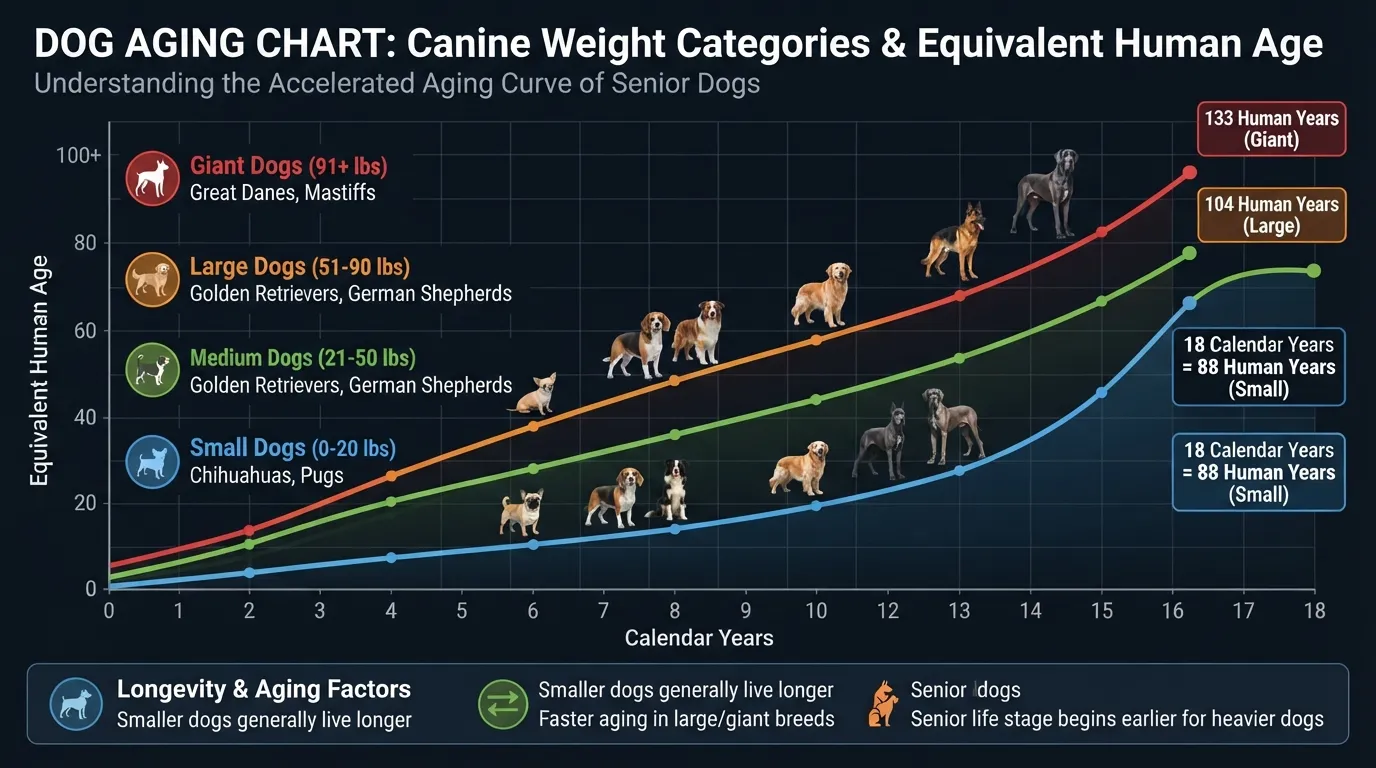
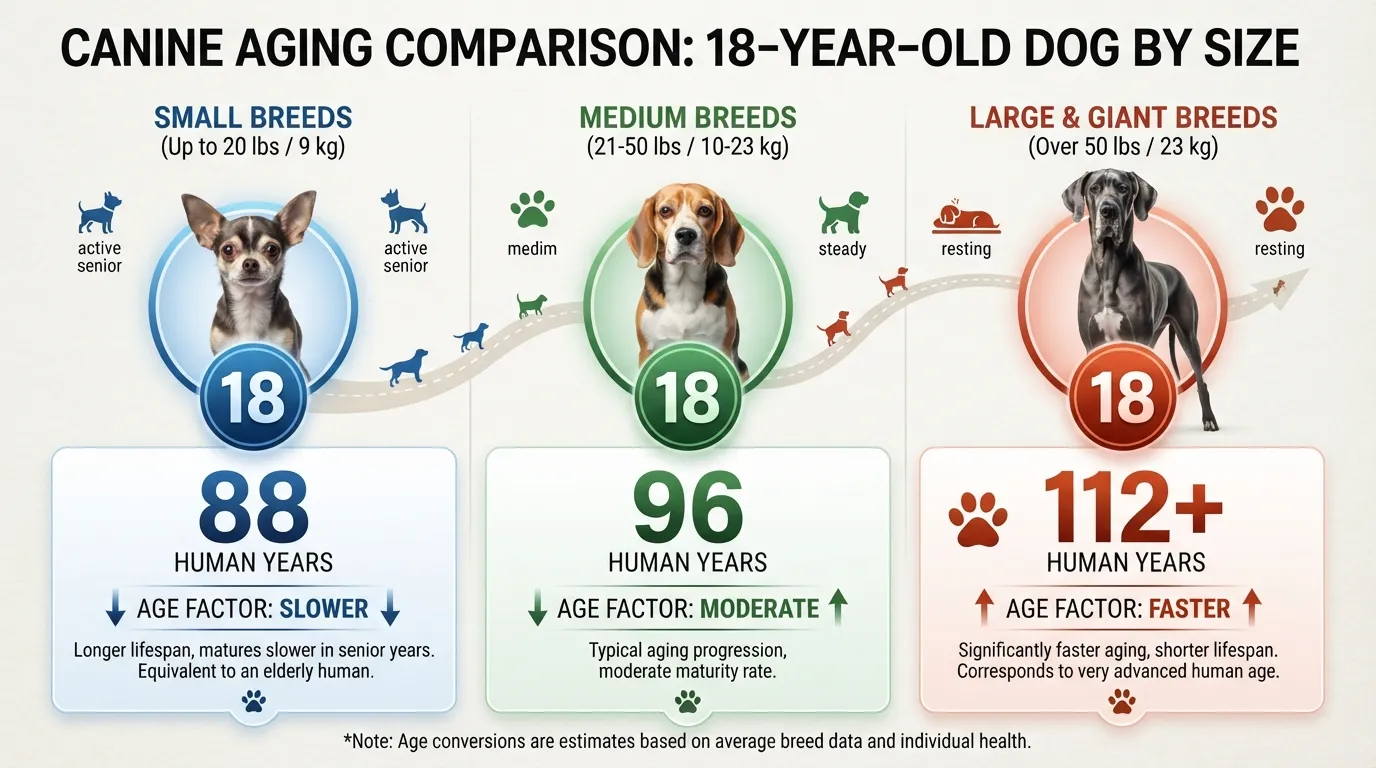
Small breeds age slower long-term: Miniature and toy dogs experience a slower metabolic rate and delayed cellular aging once they pass puppyhood, which allows them to maintain vitality well into their teens.
Large breeds age faster (cellular growth link): Massive canines experience rapid, heavy cellular division and metabolic strain early in life, causing their biological clocks to tick much faster than their smaller counterparts.
Individual Variation Disclaimer
This is an estimate, not exact science: Conversion charts and formulas provide a helpful baseline, but they can’t predict the exact biological age of every individual animal.
Genetics and lifestyle affect real aging: Everyday choices—such as high-quality nutrition, proactive veterinary care, spay/neuter status, and environmental stress—play a massive role in how fast or slow a specific dog actually ages.
What This Means for Your Dog's Care
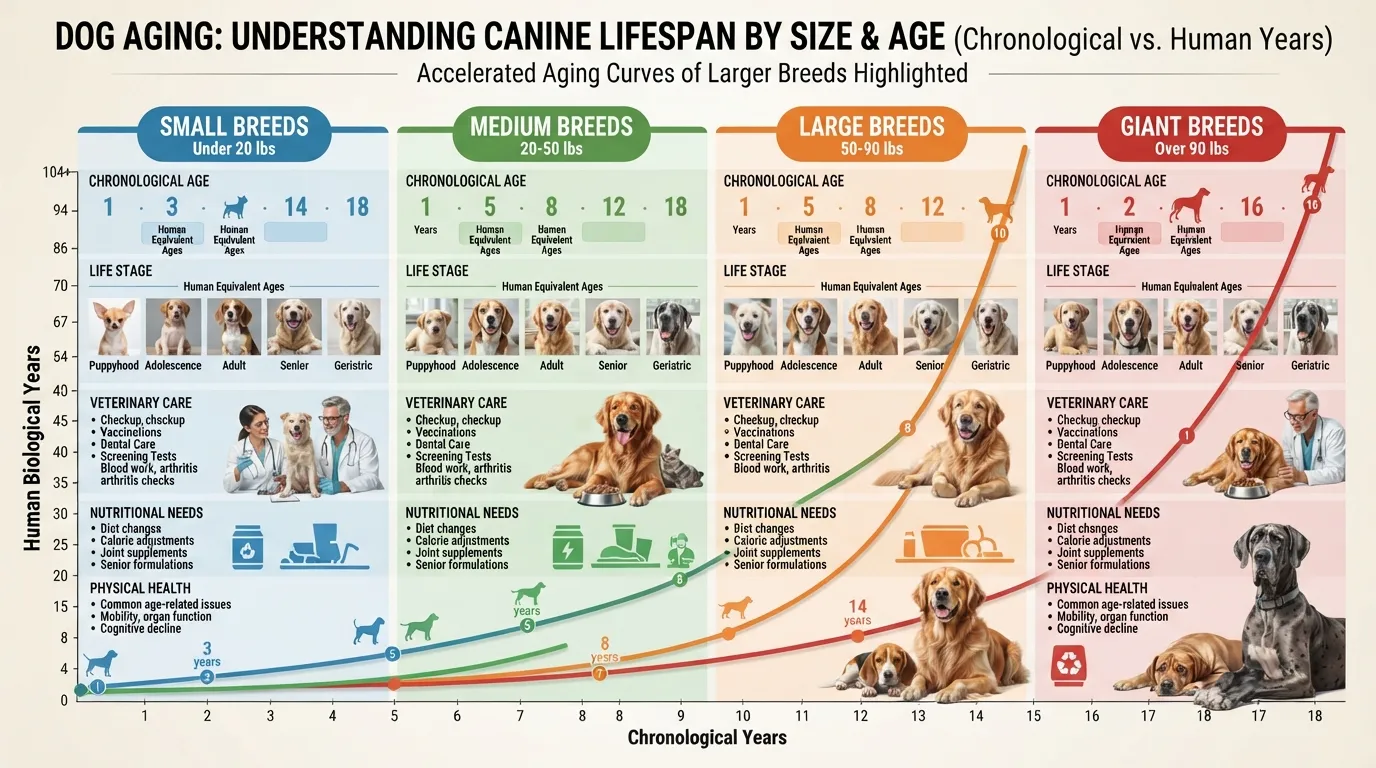
Puppy stage: Focus heavily on measured, growth-supporting nutrition and controlled exercise to protect developing joints from premature wear and tear.
Adult stage: Shift priorities toward precise weight management, joint health support, and regular activity to keep your dog thriving in their prime years.
Senior stage: Increase veterinary screening frequency to catch age-related conditions early, and transition to a specialized diet tailored for a slower metabolism.
Frequently Asked Questions
How old is 30 years in dog years?
In calendar years, 30 human years equals about 4 years old for an average medium-sized dog. At this age, your pet has reached full adulthood, maturity, and their physical prime.
How old is a 30 year old dog?
A dog that reaches 30 chronological calendar years is an unprecedented biological anomaly. In human terms, that would be roughly equivalent to living well past 200 human years, far beyond the natural limits of canine biology.
How old is 200 years in dog years?
Based on standard extrapolation charts, 200 human years translates to a dog age of 13 to 20+ years, depending entirely on the breed’s size. Because no dog has ever lived to be 200 calendar years old, this figure remains a theoretical calculation rather than a biological reality.
How old is 90 years old in dog years?
A human age of 90 translates to a dog age of roughly 11 to 13 years old, depending on whether your pet is a smaller or larger breed. At this stage, most dogs are firmly in their senior or geriatric years.
What is 100 years old in dog years?
Reaching 100 human years is equivalent to a dog age of 11 to 14.5 years. Giant breeds hit this milestone around age 11, while small toy breeds typically reach it closer to 14.5 years.
Can a dog live 20 years?
Yes, but it is rare. Toy and small dog breeds—such as Chihuahuas, Toy Poodles, and Jack Russell Terriers—occasionally reach 18 to 20 years of age with exceptional genetics, proper nutrition, and proactive veterinary care.
Is the 7-year rule accurate?
No, the traditional 1-to-7 ratio is a myth. Dogs age much faster during their first two years of life—reaching the equivalent of a 24-year-old human by age two—and their subsequent aging rate depends heavily on their adult body size and breed.
Do small dogs live longer than large dogs?
Yes. Miniature and toy breeds generally live much longer (often 12 to 16+ years) compared to giant breeds like Great Danes or Mastiffs, which typically have a lifespan of 8 to 10 years due to the heavy physiological strain on their bodies.
🐾 Other Age Guides

I built Dogagescalculator.com to give dog owners honest, science-backed answers instead of the outdated "×7" myth. Every figure here is checked against AKC, AVMA, and published veterinary research.
More about the author & this site →
Comments