
16 Human Years to Dog Years — What Your Dog's Age Really Means
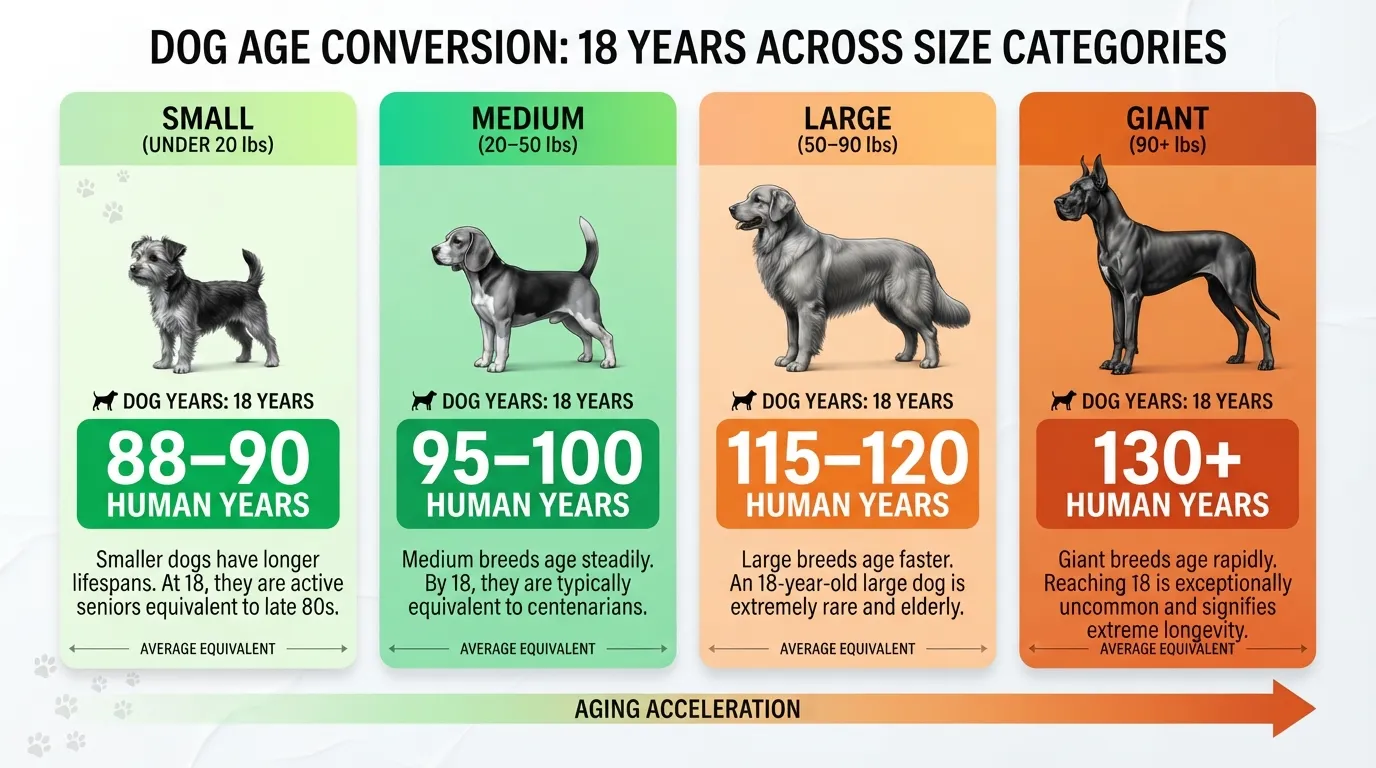
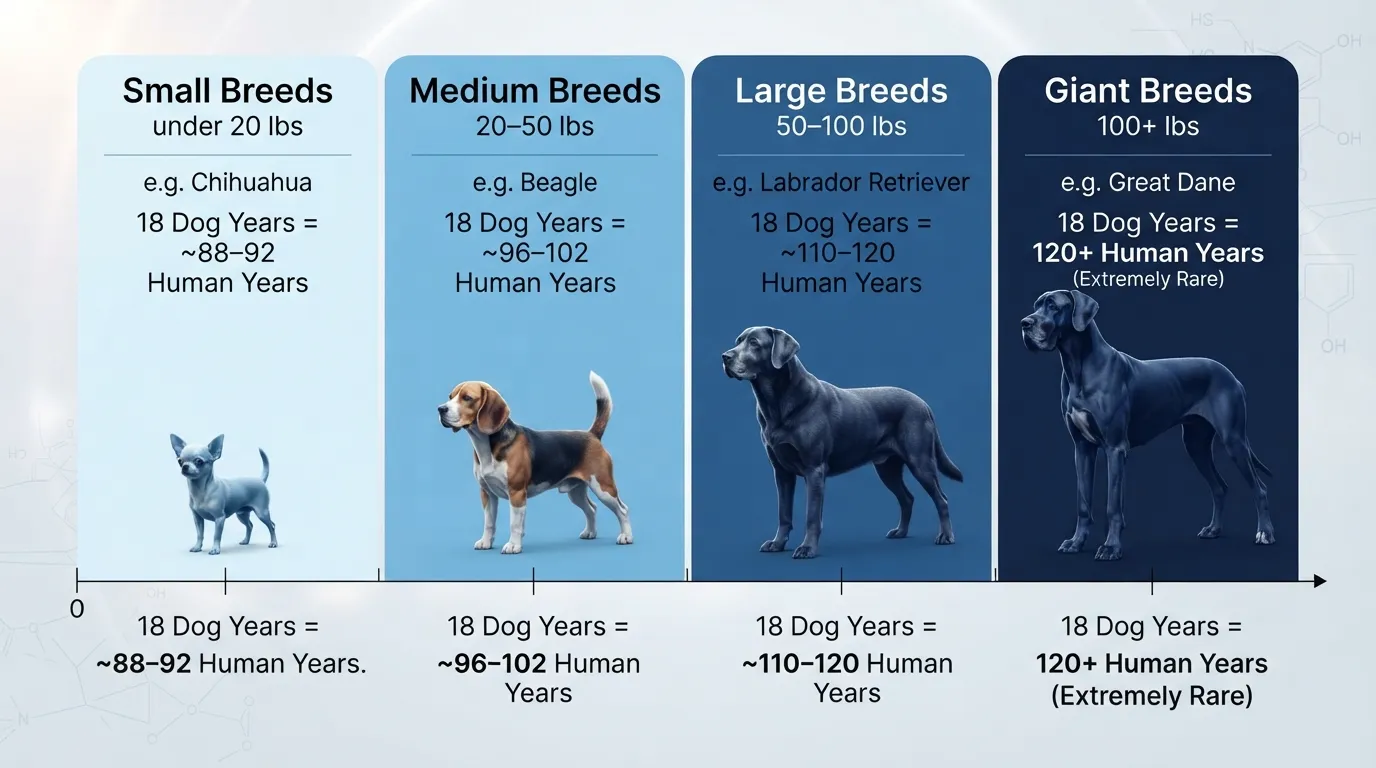
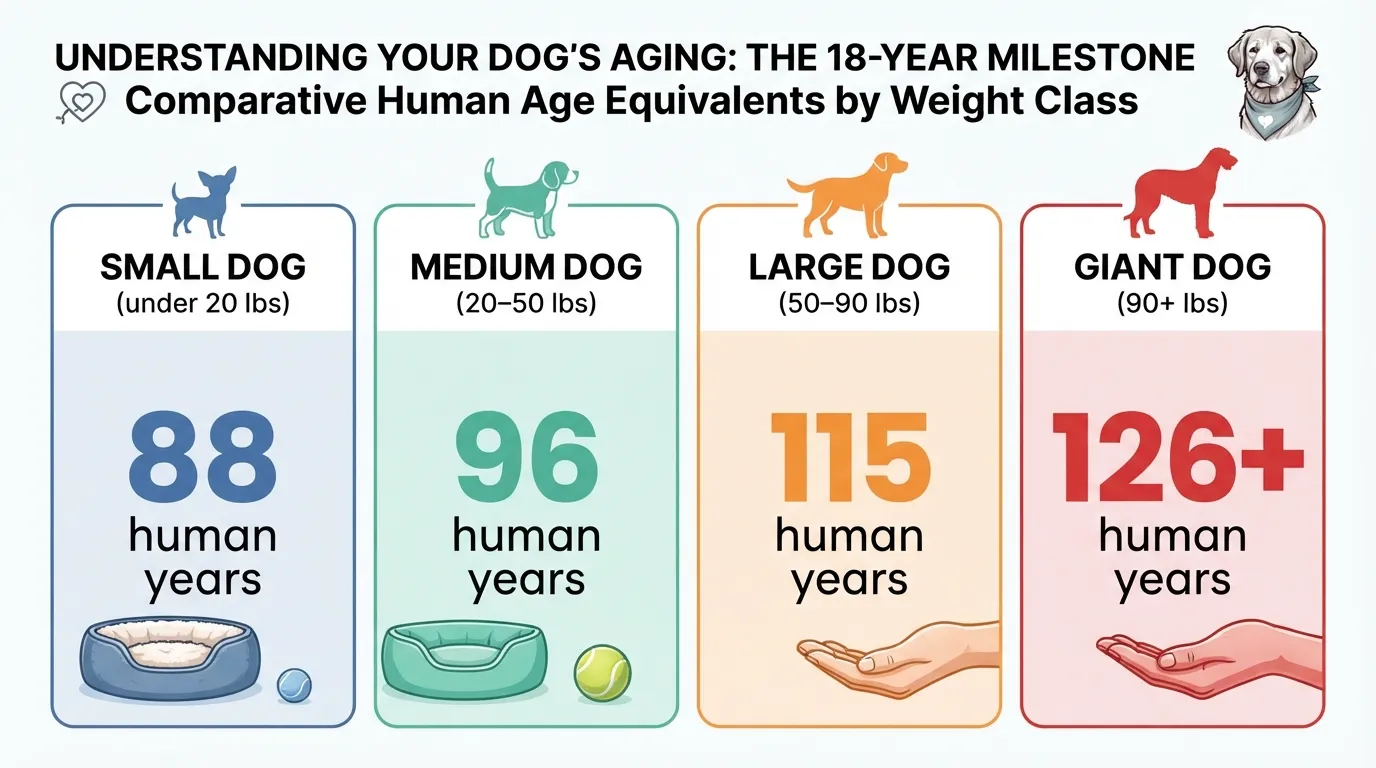
A 16-year-old dog is approximately 80 to 120+ human years old, depending heavily on their size and weight. While a small dog at 16 sits around 80 human years, a large or giant breed has reached the equivalent of 115 to 120+ human years.
Because the old “multiply by 7” rule falls short for senior dogs, use our interactive dog age calculator above to get an exact, size-specific breakdown for your dog instantly.
Quick Clarification — What Does "16 Human Years to Dog Years" Mean?
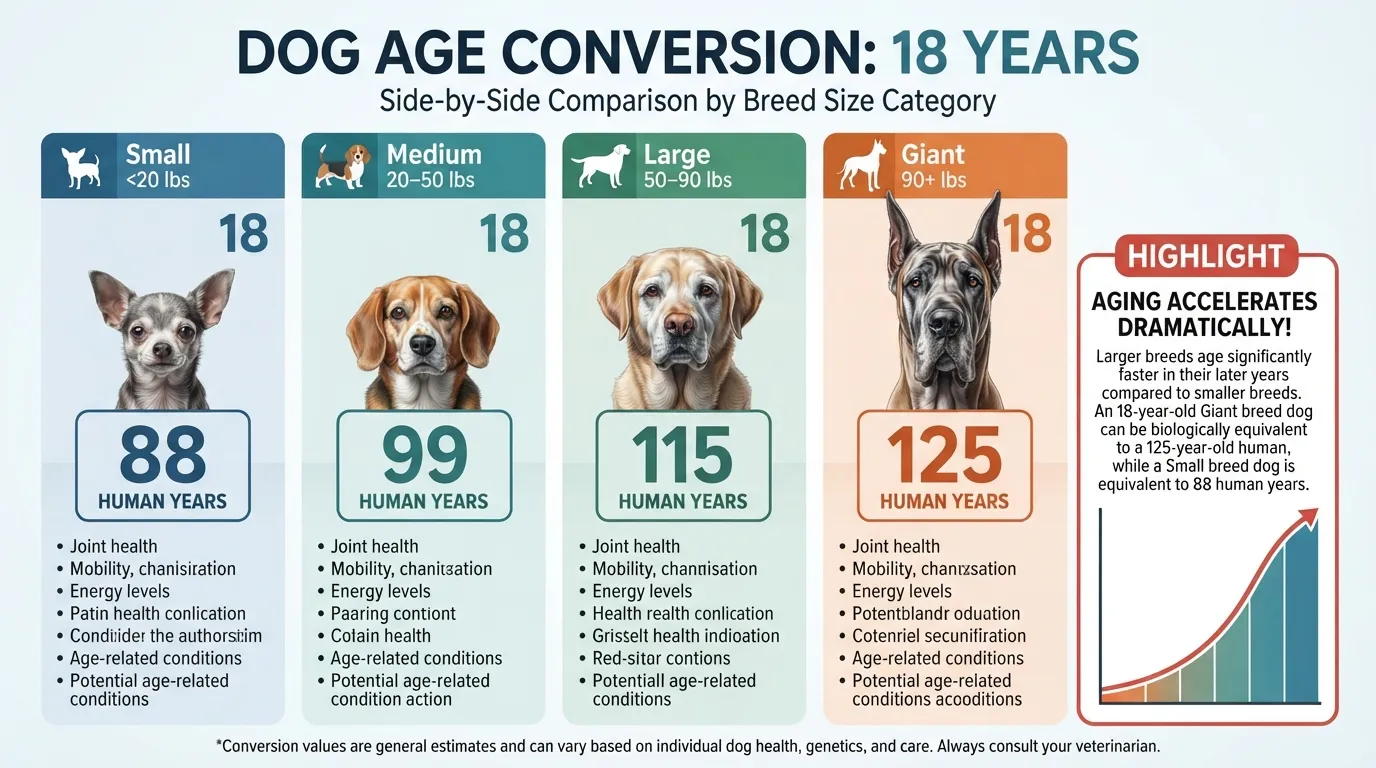
When most dog owners search for “16 human years to dog years,” they mean: “My dog has been alive for 16 calendar years—how old is that in human equivalent age?” If your dog celebrated their 16th birthday, they are a remarkable super-senior operating at the equivalent of a human in their late 70s to well over 100.
If you are thinking in the reverse direction—wondering what a 16-year-old human translates to in dog life stages—that corresponds to a young dog between 12 and 18 months old, right on the threshold of full adulthood. Throughout this guide, we focus on the most common intent: understanding and caring for a dog who has lived 16 real-world years.
16 Dog Years in Human Years — Full Comparison Table By Size
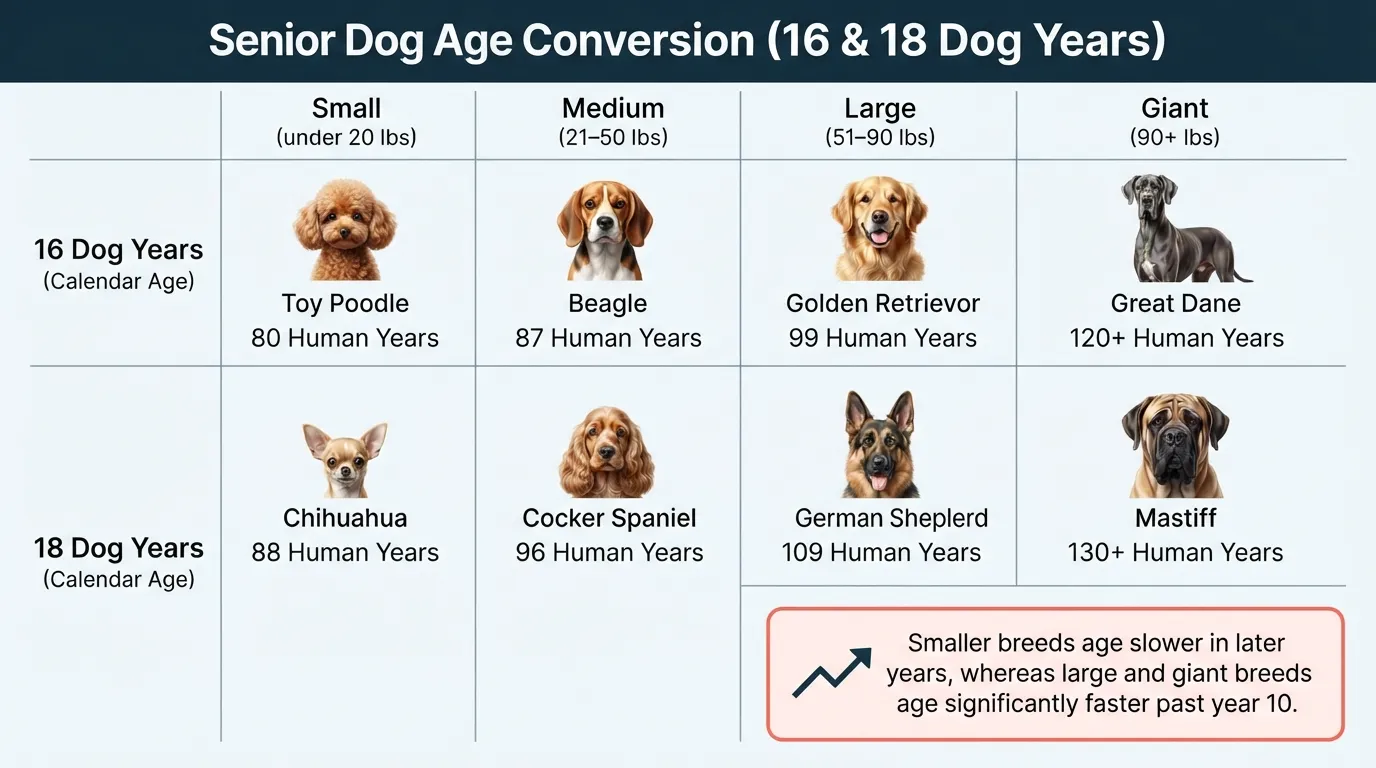
A dog’s physical aging rate is directly tied to their adult weight class. While all puppies grow rapidly during their first two years, larger dogs age significantly faster at a cellular level past middle age. By age 16, size creates a massive gap in human-equivalent age—a small dog is at an advanced senior stage, while a giant breed at 16 has reached extraordinary longevity.
Here is how ages 14 through 18 compare across all four size categories, based on standard American Animal Hospital Association (AAHA) canine life stage guidelines:
| Dog's Actual Age (Calendar Years) | Small Dog (< 10 kg / < 22 lbs) | Medium Dog (10–25 kg / 22–55 lbs) | Large Dog (25–45 kg / 55–100 lbs) | Giant Dog (> 45 kg / > 100 lbs) |
|---|---|---|---|---|
| 14 Years | 72 human years | 78 human years | 88 human years | 101 human years |
| 15 Years | 76 human years | 83 human years | 95 human years | 109 human years |
| 16 Years (Current) | 80 human years | 88 human years | 102 human years | 117 human years |
| 17 Years | 84 human years | 93 human years | 109 human years | 125 human years |
| 18 Years | 88 human years | 98 human years | 116 human years | 133 human years |
Small Dog (under 10 kg)
Small breeds like Chihuahuas, Toy Poodles, and Dachshunds age the slowest after their juvenile growth period. At 16 actual years, a small dog is roughly 80 human years old. Because their metabolic stress over a lifetime is lower than that of larger dogs, small breeds routinely reach 16 with manageable, slow-progressing age changes.
Medium Dog (10–25 kg)
Medium-sized breeds like Cocker Spaniels, Beagles, and Australian Cattle Dogs age at a steady baseline rate. At 16 years, a medium dog equates to approximately 88 human years old. They are deep into their geriatric years and typically require structured mobility and cognitive support.
Large Dog (25–45 kg)
Large breeds such as Golden Retrievers, German Shepherds, and Labradors age considerably faster in senior years due to higher cellular growth rates early in life. A 16-year-old large dog corresponds to roughly 102 human years old. Reaching this age requires exceptional genetics, proactive healthcare, and diligent daily management.
Giant Dog (45 kg+)
Giant breeds like Great Danes, Mastiffs, and Irish Wolfhounds experience accelerated aging throughout adulthood. At 16 years, a giant breed translates to approximately 117 human years old.
Important Note on Giant Breeds: It is exceptionally rare for giant breed dogs to reach 16 calendar years. According to veterinary epidemiological data, the average lifespan for giant breeds ranges from 6 to 10 years. If your giant breed dog has reached 16, they are a true outlier living at the absolute upper biological limit for their size category.
Why "1 Dog Year = 7 Human Years" Doesn't Work at Age 16
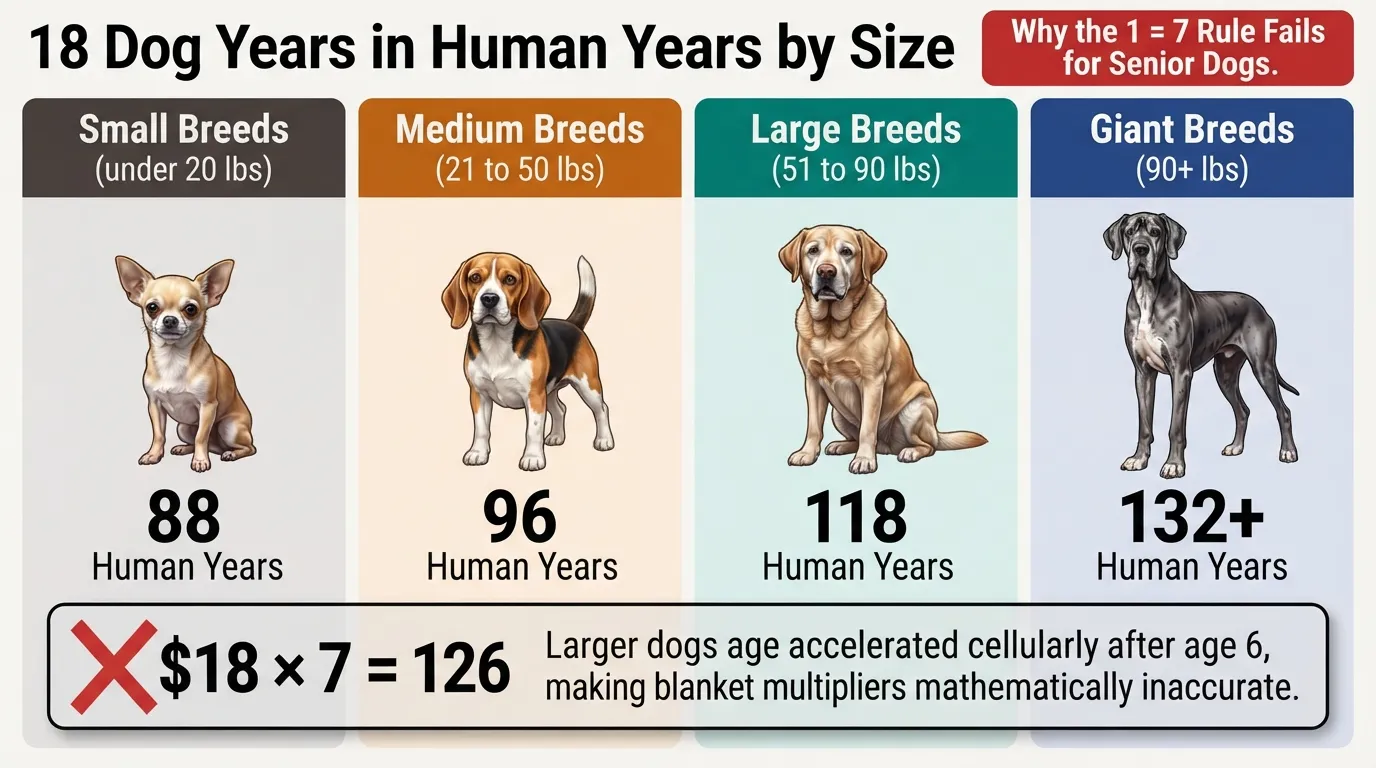
The popular “multiply by 7” rule is a massive oversimplification that fails completely when evaluating a senior dog. If you simply multiplied 16 by 7, you would get 112 human years for every dog regardless of whether they are a 6-pound Yorkie or a 90-pound Golden Retriever. In reality, a 16-year-old Yorkie is closer to 80 in human terms, while that Golden Retriever is well past 100.
Dogs do not age in a straight line. They undergo an intense burst of biological development in their first two years—reaching physical maturity rapidly—and then the rate of aging slows down and diverges drastically based on adult weight. The 7-year myth ignores both this early growth spike and the massive impact of body size on late-stage cellular aging.
The Real Aging Formula (15 + 9 + size-based tier)
Veterinary medical guidelines, including standards outlined by the American Animal Hospital Association (AAHA), rely on a far more accurate staged framework:
Year 1: Counts as 15 human years (covering rapid puppy growth and sexual maturity).
Year 2: Adds 9 human years (reaching young adulthood, total = 24 human years).
Years 3 and beyond: Each additional calendar year adds between 4 to 8+ human years, depending entirely on the dog’s size tier.
Small dogs accumulate roughly 4 human years per calendar year in late life, medium dogs accumulate about 5, large dogs add about 6 to 7, and giant breeds add 8 or more.
Example Calculation (step-by-step for a 16-year-old dog)
Here is how this formula breaks down step-by-step for a 16-year-old small dog (under 10 kg) versus a 16-year-old large dog (25–45 kg):
Step 1: First 2 Years (All Dogs)
Year 1 = 15 human years
Year 2 = 9 human years
Subtotal at age 2 = 24 human years
Step 2: Remaining 14 Years (Ages 3 through 16)
For a Small Dog (~4 years per calendar year):
14 years × 4 = 56 additional human years
Total: 24 + 56 = 80 human years
For a Large Dog (~5.5 years per calendar year):
14 years × 5.5 = 77 additional human years
Total: 24 + 77 = 101 human years
This size-adjusted model reflects true biological strain, giving you an accurate picture of where your 16-year-old dog stands in human terms.
What Life Stage Is a 16-Year-Old Dog In?
At 16 years old, your dog has officially transitioned beyond the standard “senior” tier and entered the super-senior or geriatric stage of life.
According to American Animal Hospital Association (AAHA) guidelines, dogs enter the senior stage when they hit the final 25% of their estimated lifespan. Crossing the 16-year threshold puts any dog well beyond that mark, requiring a distinct clinical approach focused on mobility, cognitive function, and daily quality of life.
Super Senior / Geriatric Classification
While “senior” refers to the aging process starting around 7 to 10 years of age, “geriatric” or “super senior” describes dogs who have lived past their breed’s expected life expectancy.
At this stage, biological reserves naturally decrease. Subtle daily changes become far more meaningful than they were a few years ago. Super seniors typically experience:
Muscle wasting (sarcopenia): Gradual loss of lean muscle mass despite a normal diet.
Sensory decline: Reduced hearing, clouding of the lenses (nuclear sclerosis), and dulled smell.
Slower organ reserve: Kidneys and liver work harder to process medications and balance fluids.
Cognitive shifts: Changes in sleep patterns, awareness, or general routines.
Is 16 Old for a Dog? Lifespan & Breed Reality Check
Yes, 16 is exceptionally advanced for any dog. Considering the overall average canine lifespan ranges between 10 and 13 years, reaching 16 means your dog has outlived the vast majority of their peers.
How remarkable this milestone is depends almost entirely on their size and genetic background.
Breeds that commonly reach 16+: Toy and small breeds dominate this category due to lower metabolic stress throughout their lives. Chihuahuas, Miniature Dachshunds, Toy Poodles, Yorkies, Pomeranians, Shih Tzus, and Maltese frequently cross into their mid-to-late teens with dedicated care.
Breeds that rarely reach 16: Large and giant breeds age at an accelerated rate. Breeds like Great Danes, Mastiffs, Bernese Mountain Dogs, Boxers, and German Shepherds rarely surpass 12 to 14 years. Seeing a giant breed at 16 is a medical rarity.
Average remaining lifespan by size:
Small dogs (<10 kg): 1 to 3+ years remaining with managed chronic conditions.
Medium dogs (10–25 kg): 6 to 18 months remaining.
Large/Giant dogs (>25 kg): Months to 1 year remaining.
Veterinary Care Note: Remaining lifespan figures are statistical averages, not a direct timeline for your dog. Always work closely with your veterinarian to monitor bloodwork, pain management, and comfort levels to evaluate your specific dog’s health trajectory.
Care Guide for a 16-Year-Old Super Senior Dog
Caring for a 16-year-old dog requires shifting from preventive wellness to specialized comfort management. Small adjustments in your home, daily routine, and veterinary care can drastically improve your super-senior’s daily comfort and independence.
Diet & Nutrition
Nutritional requirements change significantly as dogs reach their late teens. A 16-year-old dog’s primary nutritional goals are preserving lean muscle mass, supporting digestion, and maintaining proper hydration.
Protein Levels: Unless your veterinarian has diagnosed end-stage kidney disease requiring protein restriction, super seniors need highly digestible, high-quality protein to combat age-related muscle loss (sarcopenia).
Caloric Balance: Metabolism slows down, but appetite often drops due to dulled smell or taste. Monitor body condition closely—unintended weight loss is far more dangerous at 16 than mild weight gain.
Hydration & Food Texture: Older dogs are prone to mild dehydration. Adding warm water, bone broth, or transitioning to canned/wet food softens kibble for tender teeth and encourages fluid intake.
Targeted Supplements: Joint supplements containing Omega-3 fatty acids (EPA/DHA) support joint comfort and cognitive function, while probiotics aid aging digestive systems.
Exercise & Mobility
At 16, exercise is no longer about burning energy—it is about maintaining joint mobility, circulation, and mental engagement without causing exhaustion or pain.
Short, Frequent Walks: Swap one long 30-minute walk for three or four 5- to 10-minute sniff walks on flat, forgiving surfaces like grass. Sniffing provides gentle mental stimulation without physical strain.
Listen to Pain Signals: Slowing down, hesitation before steps, or panting are clear indicators to stop immediately. Never force a 16-year-old dog to keep walking if they lag behind.
Mobility Aids: Consider using a padded rear-lifting harness (like a Help’EmUp harness) to support their hind end when standing up, navigating steps, or getting into the car.
Vet Visit Frequency
At 16, waiting a full year between vet visits is equivalent to a human going nearly a decade without seeing a doctor. Subtle health shifts can escalate quickly.
Bi-Annual to Quarterly Checkups: Schedule routine veterinary visits every 3 to 6 months. These exams should focus on pain assessment, heart monitoring, and weight trends.
Senior Bloodwork & Urinalysis: Running comprehensive senior blood panels and urinalysis twice a year allows your vet to catch early shifts in kidney function, liver values, or thyroid levels before outward symptoms appear.
Proactive Pain Management: Arthritis is practically universal at age 16. Discuss modern, multi-modal pain management options with your vet—such as targeted joint injections, non-steroidal anti-inflammatory drugs (NSAIDs), or nerve pain medications—to keep your dog comfortable daily.
Home Comfort Adjustments
Your home environment plays a massive role in preventing injuries and reducing anxiety for an aging dog with failing eyesight, hearing, or stability.
Traction on Slick Floors: Wooden and tile floors are major slip hazards for weak hind legs. Place non-slip rug runners, yoga mats, or grip booties along their primary walking paths.
Orthopedic Bedding: Invest in high-density memory foam orthopedic beds that support aching joints and prevent painful pressure sores. Ensure the bed edges are low so your dog does not trip stepping in or out.
Ramps & Accessibility: Provide sturdy ramps to help your dog access raised beds or sofas if they are accustomed to resting near you—preventing dangerous jumps that can strain aging spines and hips.
Nighttime Lighting: Senior dogs often experience reduced night vision or cognitive confusion after dark. Leaving plug-in nightlights near their bed, water bowl, and food area helps them navigate comfortably at night.
Veterinary Care Note: Always consult your veterinarian before starting new dietary supplements, changing prescription diets, or altering your senior dog’s pain management routine.
Common Health Concerns at This Age
At 16, a dog’s body has accumulated years of structural and cellular wear. Catching health shifts early—and distinguishing normal aging from manageable medical conditions—is crucial for keeping your super-senior comfortable.
Joint Pain & Severe Arthritis: Nearly every 16-year-old dog experiences some degree of osteoarthritis. You may notice stiffness after sleeping, difficulty standing up on smooth floors, hesitation at stairs, or a subtle “bunny-hopping” gait in their hind legs.
Advanced Dental Disease: Decades of tartar buildup lead to periodontal disease, cracked teeth, or painful root abscesses. Because old dogs often hide mouth pain, red flags include bad breath, dropping kibble while eating, head-shaking, or favoring one side of the jaw.
Vision & Hearing Loss: Nuclear sclerosis—a normal bluish clouding of the eye lens—is extremely common and affects depth perception without causing total blindness. True cataracts, retinal degeneration, or age-related hearing loss can leave dogs easily startled or hesitant in unfamiliar rooms.
Canine Cognitive Dysfunction (CCD): Often called “dog dementia,” CCD affects a high percentage of 16-year-olds. Watch for the DISH acronym: Disorientation (getting stuck behind furniture), reduced social Interaction, changes in Sleep-wake cycles (pacing at night), and House-soiling in a previously potty-trained dog.
Unintended Weight Changes: Rapid weight loss often signals underlying organ changes (like kidney disease or diabetes) or muscle wasting (sarcopenia). Conversely, sudden weight gain or a swollen abdomen can indicate fluid retention from heart issues or hormone imbalances like Cushing’s disease.
Veterinary Care Note: Many senior health conditions share overlapping symptoms. If you notice sudden behavior shifts, appetite loss, or new mobility issues, schedule an evaluation with your veterinarian to tailor a supportive care plan.
Signs Your Senior Dog Has Good Quality of Life
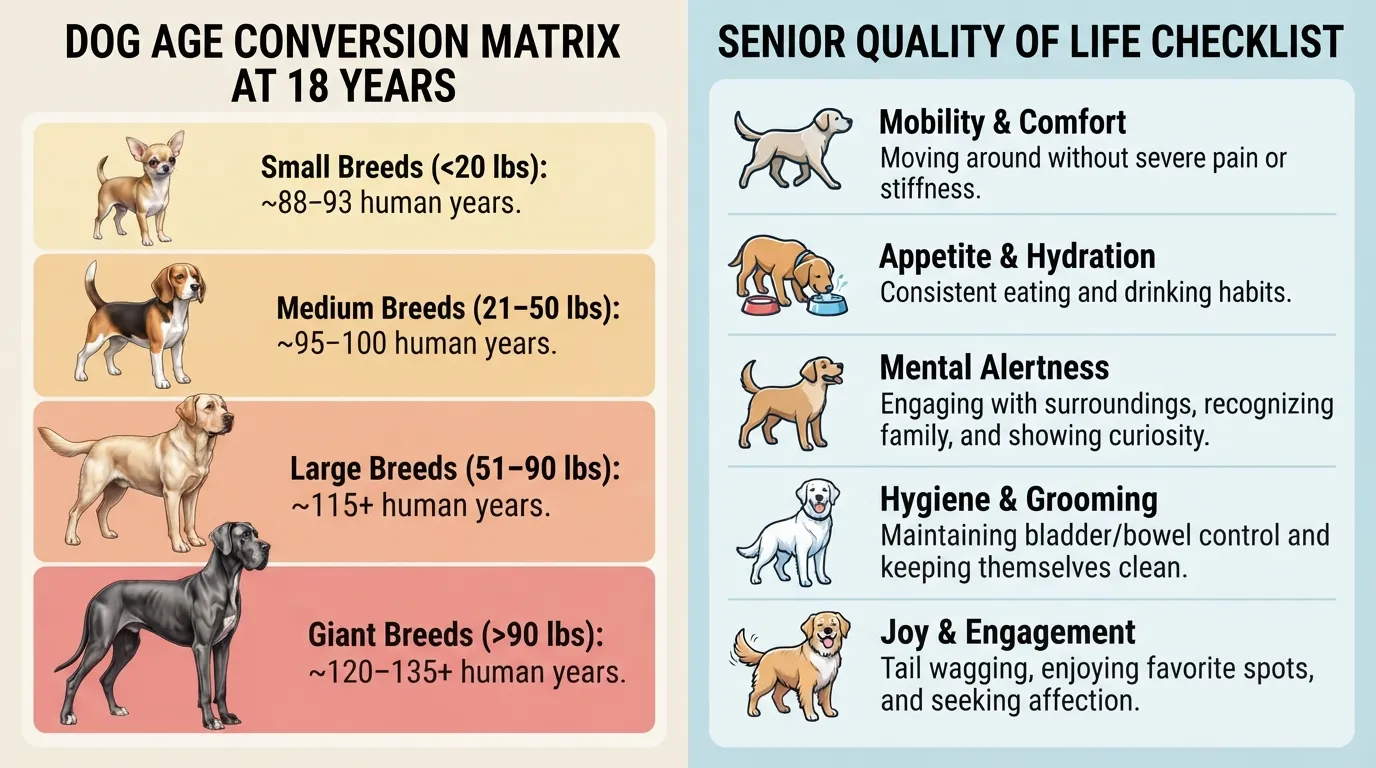
Evaluating a 16-year-old dog’s daily well-being can feel overwhelming when good days and tough days start to blur together. Rather than focusing on a single symptom, veterinary care specialists assess quality of life by looking at patterns across mobility, appetite, hygiene, and social engagement.
Positive Signs
A super-senior dog enjoying a solid quality of life will consistently display subtle markers of comfort, connection, and interest in their world:
Eager Mealtime Response: They show genuine excitement for food or high-value treats, even if they eat at a slower pace.
Active Engagement: They greet family members, wag their tail when spoken to, or follow you into common rooms to rest nearby.
Pain-Controlled Mobility: They move comfortably enough on non-slip surfaces to stand, walk to their water bowl, and eliminate outdoors without severe distress or collapse.
Predictable Sleep Patterns: They sleep soundly through the night and wake up reasonably bright and alert during the day.
Maintaining Basic Hygiene: They can eliminate outdoors or on designated pads without constant distress, keeping themselves relatively clean.
Warning Signs (When to Talk to Your Vet)
When chronic health issues begin to outweigh your dog’s comfortable moments, you will often notice a shift across multiple daily habits. Watch for these red flags:
Persistent Appetite Loss: Refusing regular food or turning down favorite treats for more than 24 to 48 hours.
Unmanaged Pain: Persistent panting while resting, whimpering, trembling, or vocalizing when standing up or being touched.
Severe Nighttime Restlessness: Pacing, crying, or wandering aimlessly for hours after dark due to pain or advanced cognitive confusion.
Complete Social Withdrawal: Hiding in closets, failing to acknowledge family members, or showing persistent apathy toward their surroundings.
Inability to Stand or Move: Requiring total assistance to get up or walking with frequent falls and leg collapse.
Veterinary Care Note: Quality-of-life tools like the HHHHHMM Scale (Hurt, Hunger, Hydration, Hygiene, Happiness, Mobility, More Good Days Than Bad Days) can help you measure trends objectively. If you notice several warning signs, consult your veterinarian to discuss pain protocol adjustments or palliative end-of-life support.
Watch: Dog Age Explained (Video)
If you prefer a visual breakdown of how canine aging is calculated—and why the traditional "multiply by 7" myth fails—these two expert video guides walk through the exact science and formulas used by veterinarians.
1. Step-by-Step Dog Age Calculation Formula
This practical walkthrough demonstrates how to calculate your dog's age using a weight-adjusted method rather than simple multiplication. It illustrates why a 10-year-old small dog (under 25 lbs) is roughly equivalent to a human in their mid-50s, whereas a giant breed of the same calendar age aligns more closely with a human in their 70s or 80s.
2. Veterinary Breakdown: The Science of Canine Aging
Dr. M from Vet Med Corner breaks down the biological realities of senior dog care. Key takeaways from this veterinary discussion include:
- The "Multiply by 7" Myth: Why early development is accelerated compared to human growth, making young dogs age faster in their first two years before slowing down.
- Weight & Lifespan: Long-term research showing that keeping your dog at a lean body condition score can extend lifespan by up to two years and significantly delay the onset of osteoarthritis and chronic disease.
- Senior Preventive Care: How transition frequency to bi-annual veterinary checkups, routine screening, and targeted nutrition directly support quality of life during late senior stages.
Calculate Your Dog's Exact Age
General guidelines give you a rough baseline, but aging isn't one-size-fits-all. A 16-year-old Chihuahua is navigating mid-stage senior life, while a 16-year-old Golden Retriever has reached an extraordinary, rare milestone. Body mass, breed genetics, and individual metabolic rates dictate how fast a dog truly ages.
Want the precise human-year equivalent for your dog's specific breed and body weight?
Simply enter your dog's exact age, weight, and breed type into our tool on the homepage to get an instant, medically aligned age breakdown based on the latest epigenetic and AVMA aging models.
Frequently Asked Questions
How old is 16 years in dog years?
A 16-year-old dog equals approximately 80 to 120+ human years, depending primarily on their size and weight. According to veterinary life-stage standards, a small dog (under 20 lbs) at age 16 is roughly equal to an 80-year-old human, a medium dog is around 87 to 95 human years, and a large or giant breed reaches the equivalent of 105 to 120+ human years.
How old is a 16 year old dog?
In calendar time, a 16-year-old dog has lived for 192 months. Biologically, any 16-year-old dog is in the advanced "geriatric" or "super-senior" life stage. At this milestone, their physiological age reflects late-stage human longevity, requiring specialized senior mobility support, tailored nutrition, and frequent veterinary monitoring.
What about other ages — 20, 70, or 100 years?
- 20 calendar years in a dog: An extraordinary age equal to roughly 96 to 120+ human years (mostly seen in toy or small breeds like Chihuahuas).
- 70 dog years: If your dog calculates to 70 "dog years" (human-equivalent years), they are biologically equal to a 70-year-old human—entering early-to-mid senior status.
- 100 dog years: A dog reaching a 100-human-year equivalent is a super-senior (around 15–16 years for a large dog, or 20+ years for a small dog).
Is it rare for a dog to live to 16?
Yes, reaching 16 calendar years is relatively rare across the overall canine population. While small breeds (under 20 lbs) hit this milestone with moderate frequency, less than 10% of medium dogs and fewer than 1% of giant breeds reach 16 years. Crossing this threshold represents exceptional longevity.
How can I help my dog live longer?
Veterinary research shows that three core factors have the highest impact on canine lifespan:
- Maintain a Lean Weight: The landmark 14-year Purina Lifespan Study demonstrated that keeping dogs at a lean body condition score extended median lifespan by 1.8 years and delayed chronic disease.
- Bi-Annual Senior Vet Checks: Transition from annual to twice-yearly vet visits after age 7 to catch kidney disease, heart issues, or tumors early.
- Daily Low-Impact Exercise & Oral Care: Consistent, gentle movement preserves muscle mass, while routine dental care prevents systemic inflammation caused by advanced periodontal disease.
🐾 Other Age Guides

I built Dogagescalculator.com to give dog owners honest, science-backed answers instead of the outdated "×7" myth. Every figure here is checked against AKC, AVMA, and published veterinary research.
More about the author & this site →
Comments