
What Is 4 Dog Years in Human Years?
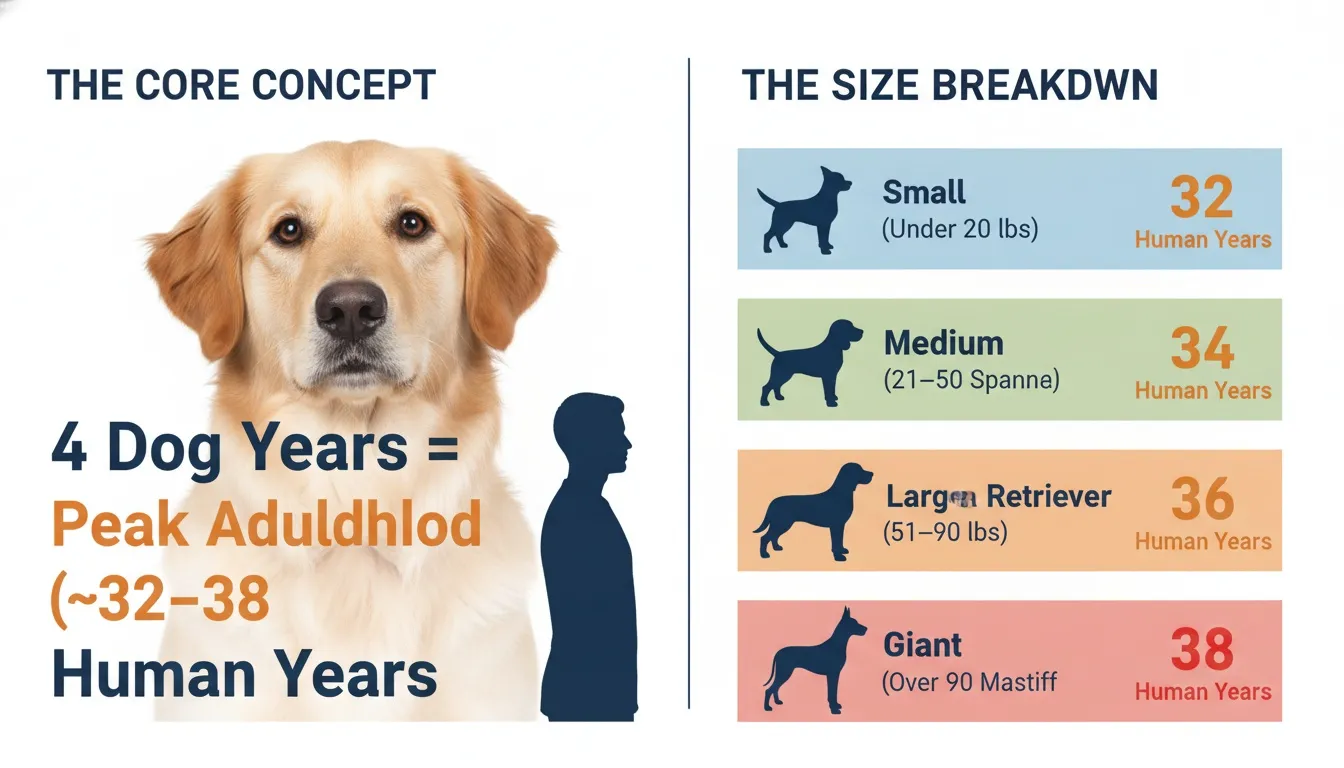
If you are asking yourself, what is 4 dog years in human years, the quick answer is that your 4-year-old pup is roughly 34 human years old. For decades, we were told to just multiply a dog’s age by 7, but modern veterinary science proves that old rule is completely wrong.
The confusion happens because different research methods yield different numbers, leaving owners stuck between 34 and 52 human years. The American Veterinary Medical Association (AVMA) places a 4-year-old dog at 34, while a 2019 UC San Diego study tracking DNA changes suggests they could be closer to 52.
To complicate things further, weight changes how dogs age. A 4-year-old Chihuahua is still a young adult, while a giant Great Dane at the exact same age is already stepping into middle age.
Here is exactly what we will break down for you on this page:
The exact human age equivalent calculated specifically for your dog’s size.
The science behind why you see conflicting numbers like 34 versus 52.
What life stage your dog is actually experiencing at age 4.
Crucial, age-specific health priorities you need to watch right now.
How many vibrant, healthy years your canine companion likely has left.
The best methods to estimate your dog’s age if they are a rescue.
Everything you need to know is on this single page, so you do not have to search anywhere else.
Why Do You See Two Different Numbers?
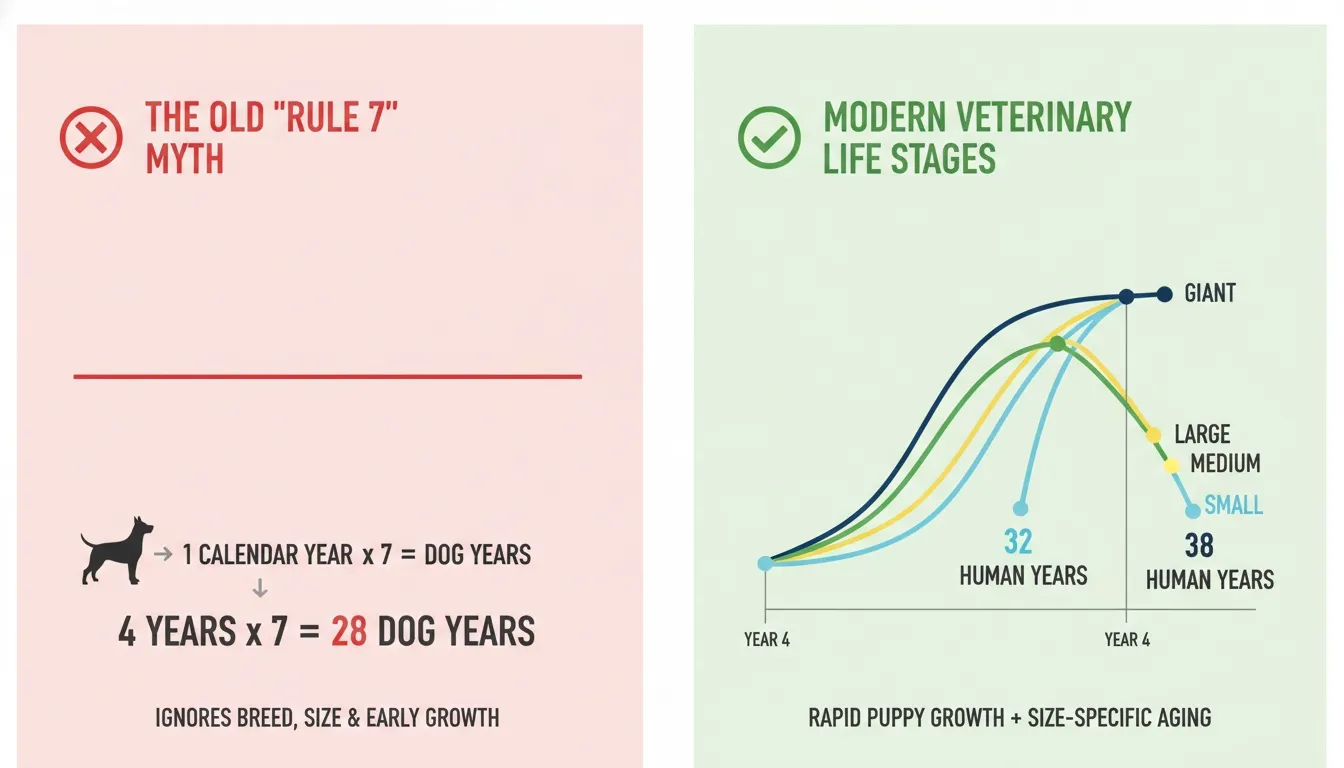
A 4-year-old dog human age ranges anywhere from 32 to 38 years old depending entirely on your dog’s size and weight. While the classic rule of thumb was always to multiply a dog’s age by 7, modern veterinary science proves that dogs age much faster during their first two years of life before settling into a predictable rhythm. For a standard medium-sized pup, hitting 4 dog years means they are officially 34 years old in human terms—firmly settled into the prime of their adulthood.
AVMA Formula — Step by Step
The American Veterinary Medical Association (AVMA) provides a much more accurate framework than the old “rule of 7” myth. Their data shows that the first year of a dog’s life packs in a massive developmental sprint, followed by a steady, predictable aging curve.
Here is exactly how the AVMA formula breaks down your dog’s age step by step:
Year 1 = 15 human years: Your puppy reaches full skeletal growth and adolescence within their first 12 months.
Year 2 = +9 → total 24: The second year adds nine additional years, bringing your pup to full emotional and physical maturity.
Year 3 = +5 → total 29: Once your dog reaches adulthood, the metabolic clock slows down to adding roughly five years per calendar year.
Year 4 = +5 → total 34 human years: By adding another five years, a standard medium-sized dog officially reaches a human age equivalent of 34.
At a Glance — By Size
What most people don’t realize is that larger dogs put more physical strain on their bodies, causing them to age at a accelerated pace compared to smaller breeds. To figure out how old is my dog, you must look at their specific weight class rather than a blanket average.
The chart below shows exactly how your 4 year old dog human age changes based on their breed’s size.
| Dog Size | 4 Dog Years = Human Years |
| Small (under 20 lbs) | ~32 |
| Medium (20–50 lbs) | ~34 |
| Large (50–90 lbs) | ~36 |
| Giant (90+ lbs) | ~38 |
4 Dog Years in Human Years — Full Breakdown by Breed Size
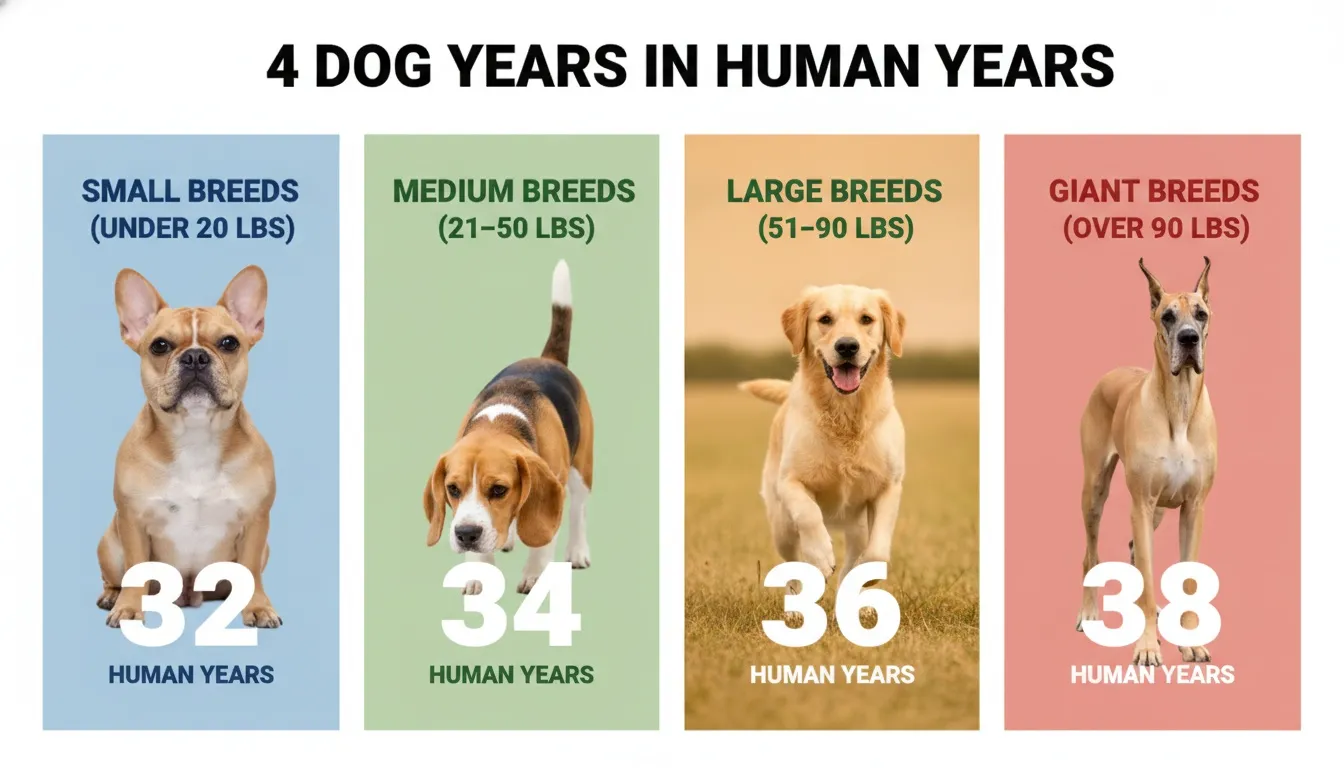
f you’re wondering what 4 dog years in human years looks like for your specific pup, the old “multiply by seven” rule won’t help you here. The American Kennel Club (AKC) explains that dogs age at completely different rates based on how much they weigh.
Small Breeds (Under 20 lbs) — ~32 Human Years
At 4 years old, small dogs like Chihuahuas, Pomeranians, Malteses, and Shih Tzus are in the absolute prime of their lives. Biologically, your small pup is the equivalent of a 32-year-old human young adult.
What most people don’t realize is that while small dogs mature faster in their first year, their aging process slows down significantly after that. You will likely notice their behavior has shifted from chaotic puppy energy to a calm, established, and highly trainable mindset.
Medium Breeds (20–50 lbs) — ~34 Human Years
If you own a medium-sized dog like a Beagle, Border Collie, or Cocker Spaniel, your 4-year-old dog’s human age is roughly 34 human years.
They have reached full adulthood and are experiencing peak physical health and balanced energy. This is widely considered the ideal training age because their brains are fully developed, allowing them to focus without the easy distractions of puppyhood.
Large Breeds (50–90 lbs) — ~36 Human Years
For large dogs such as Labradors, German Shepherds, and Golden Retrievers, 4 years old means they are turning the corner into 36 human years.
Your big pup is technically an adult entering early middle age. Since larger frames carry more stress, this is the exact life stage where you need to actively watch for sudden weight gain and the very early signs of joint issues.
Giant Breeds (90+ lbs) — ~38 Human Years
Giant dogs like Great Danes, Saint Bernards, and Mastiffs age on a much faster timeline, making a 4-year-old giant breed roughly 38 human years old.
They are already transitioning into early middle age and creeping closer to their senior years. At this stage, you should closely monitor your dog for subtle energy drops, joint stiffness during morning walks, and structural heart health.
The following table breaks down exactly how your dog’s weight determines their real developmental age.
| Dog Size Category | Weight Range | Human Age Equivalent at 4 Years Old |
| Small | Under 20 lbs | 32 years old |
| Medium | 20–50 lbs | 34 years old |
| Large | 50–90 lbs | 36 years old |
| Giant | Over 90 lbs | 38 years old |
For a complete look at how these numbers shift as your dog grows older, you can check out the official AKC Dog Age Chart.
Dog Age Conversion Chart — Ages 1 to 7
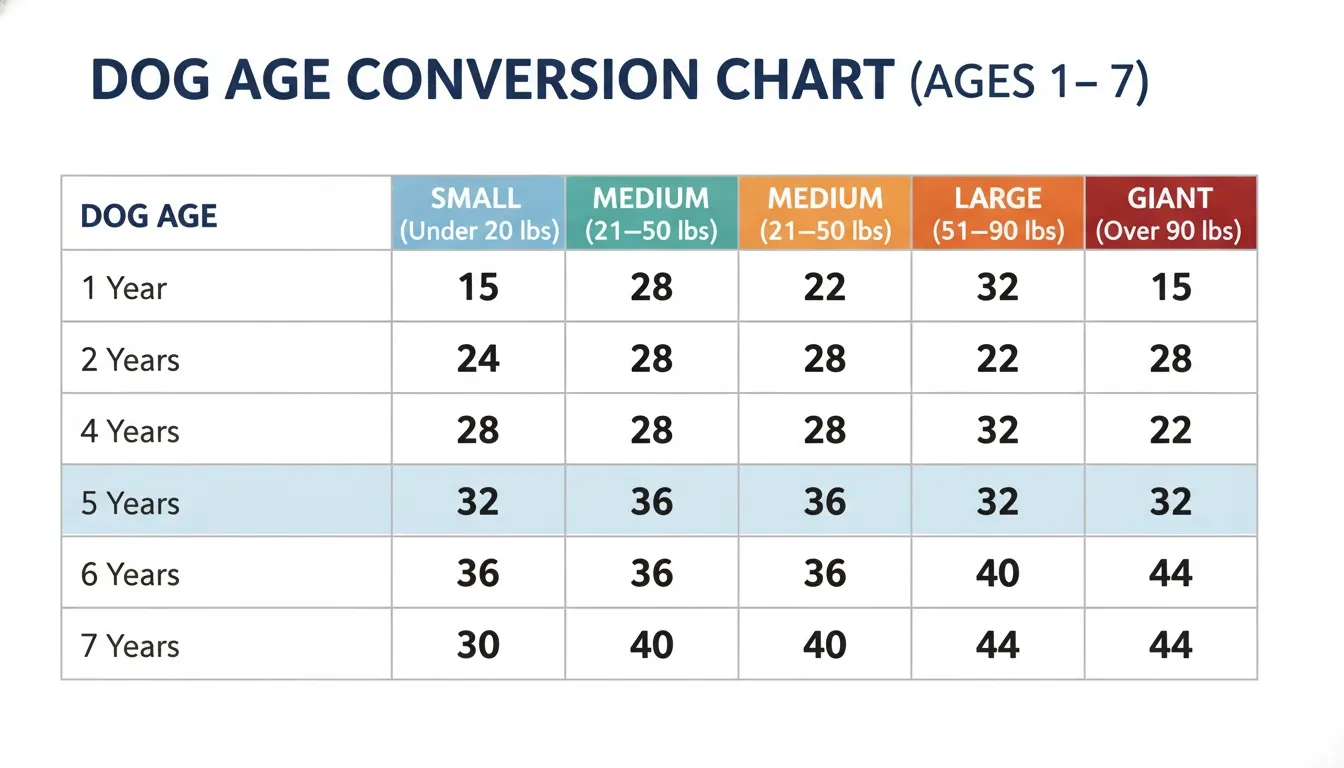
What most people don’t realize is that your dog’s first two years of life represent a massive developmental spike, regardless of their size. According to guidelines from the American Animal Hospital Association (AAHA), a dog’s first year equals about 15 human years, and their second year adds another 9 years to the odometer. Once your pup hits age three, their aging trajectory shifts completely based on their breed size, making a customized dog years calculator essential.
The data below shows exactly how your dog’s size impacts their physiological age during their young adult and middle-age years.
| Dog Age | Small Dogs (Under 20 lbs) | Medium Dogs (21–50 lbs) | Large Dogs (51–90 lbs) | Giant Dogs (Over 90 lbs) |
|---|---|---|---|---|
| 1 year | 15 | 15 | 15 | 15 |
| 2 years | 24 | 24 | 24 | 24 |
| 3 years | 28 | 29 | 29 | 30 |
| 4 years ⬅ | 32 | 34 | 36 | 38 |
| 5 years | 36 | 39 | 42 | 45 |
| 6 years | 40 | 44 | 49 | 52 |
| 7 years | 44 | 49 | 56 | 59 |
For ages 8–15, see our full dog age chart.
Here’s the thing: at 4 years old, your dog has officially transitioned out of adolescence and is navigating their prime adult years. If you look closely at the data, a 4-year-old French Bulldog (small) is roughly 32 in human terms, while a Golden Retriever (large) at the exact same age behaves more like a 36-year-old adult. You can learn more about how veterinarians track these specific milestones by reviewing the AAHA Canine Life Stage Guidelines.
4-Year-Old Dog Health — What Matters Most at This Age
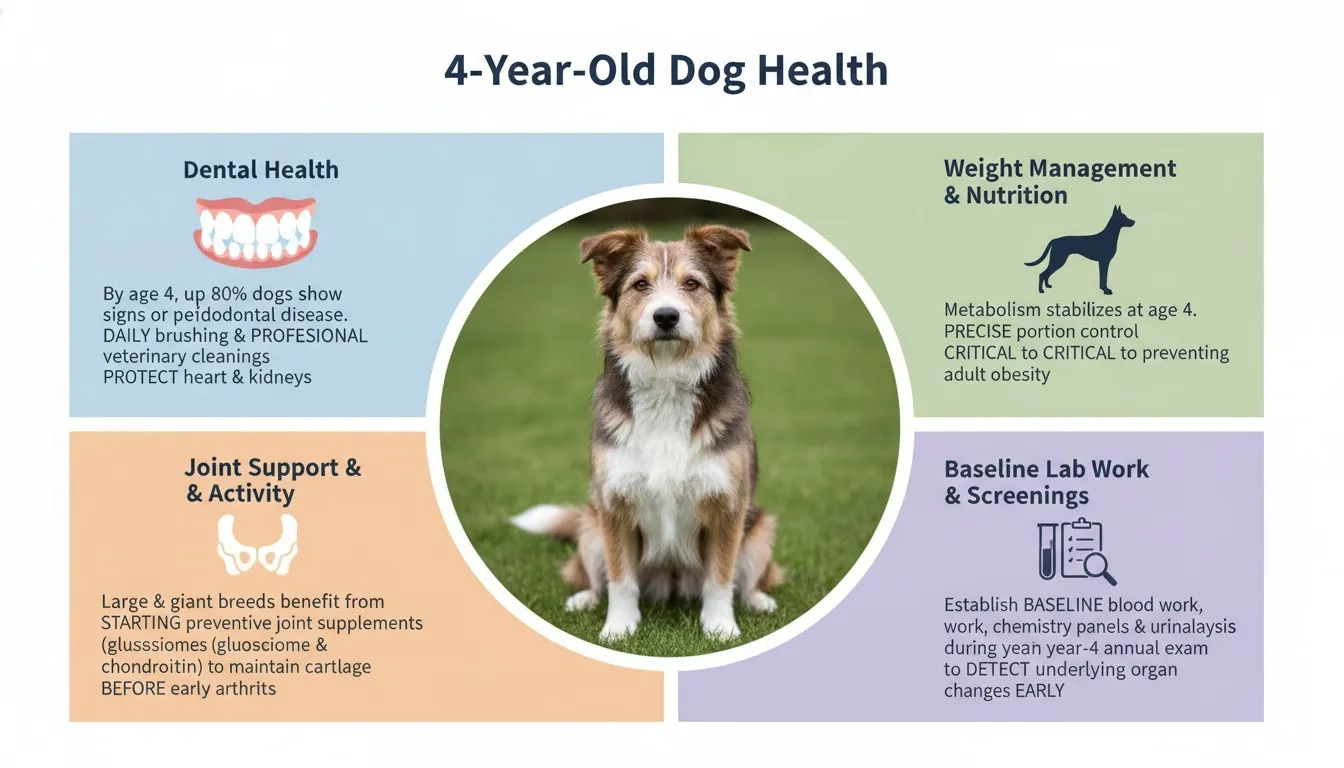
Your dog just turned 4 and you’re wondering if they’re still young or already middle-aged, which is exactly why shifting your vet focus to preventive care matters right now.
Dental Disease — #1 Problem at Age 3–5
What most people don’t realize is that oral bacteria have been quietly building up since your pup was a teething teenager. According to research published by the American Veterinary Medical Association (AVMA), over 80% of dogs show signs of canine periodontal disease by the time they reach age 3. By age 4, this structural damage can directly compromise your dog’s immune system if left untreated.
You can spot active dental issues in your 4-year-old dog by keeping an eye out for these specific red flags:
Chronic bad breath that smells distinctly foul or metallic rather than normal puppy breath.
Heavy yellow tartar or dark brown buildup forming near the upper back molars and gum lines.
Reluctance to chew hard kibble, favoring one side of the mouth, or dropping toys unexpectedly during fetch.
The good news is that you can completely reverse early gum inflammation before it causes permanent bone loss. Schedule an annual professional dental cleaning under anesthesia with your veterinarian to clear below the gumline. To maintain those pearly whites at home, introduce daily brushing using a dog-safe enzymatic toothpaste.
Weight Gain — Metabolism Starts Slowing at Age 4
Here’s the thing: your dog’s metabolic engine is officially beginning its subtle, long-term cooldown period. A comprehensive dog aging study conducted by the University of Göttingen notes that canines experience a noticeable drop in daily energy expenditure as they transition out of young adulthood. If you keep filling the food bowl with the exact same portions they ate as an energetic 2-year-old, the pounds will pile on quickly.
Instead of relying purely on the bathroom scale, veterinarians at the American Animal Hospital Association (AAHA) recommend performing a simple body condition assessment right at home.
The table below breaks down exactly how to evaluate your 4-year-old dog’s current physical shape:
| Physical Test | Ideal Healthy Target | Danger Sign of Excess Weight |
| The Rib Test | You can easily feel the ribs under a thin layer of fat without pressing hard. | You must push firmly through a thick, soft layer of fat to find the rib cage. |
| Waist Visibility | A distinct, visible tuck-in is present right behind the ribs when viewed from above. | The body line is completely straight or bulges outward like a cylinder from overhead. |
Preventing adult obesity comes down to a simple mathematical adjustment in your dog’s daily routine. Slightly reduce their daily kibble scoop or transition them to a lower-calorie adult formula if their daily zoomies have naturally decreased. Swap out high-calorie commercial liver treats for crunchy, low-calorie alternatives like fresh green beans or plain cucumber slices.
Joint Monitoring — Large & Giant Breeds Only
While a 4-year-old Chihuahua is still bouncing around without a care, a heavy 4-year-old German Shepherd or Great Dane is already experiencing the early structural stages of joint wear and tear. Data from the American Kennel Club (AKC) indicates that large and giant breeds carry significantly more structural load, causing their joint cartilage to degrade years ahead of smaller toy breeds. Catching these cellular changes now prevents debilitating osteoarthritis down the road.
Pay close attention to how your large-breed dog moves during normal everyday activities to spot early joint inflammation:
Noticeable stiffness or slowness when rising from their orthopedic bed first thing in the morning.
Sudden hesitation or stalling before climbing up steep stairs or jumping into the back of your car.
Slightly limping or favoring a specific leg after a long afternoon walk at the park.
Taking early action at age 4 can dramatically extend your large dog’s active, pain-free years. Talk to your veterinarian about starting a high-quality joint supplement containing glucosamine and chondroitin right now to protect remaining cartilage matrix. Additionally, consider introducing low-impact exercises like controlled swimming or steady leash walks to keep their supporting leg muscles strong without pounding their joints.
How Many Years Does a 4-Year-Old Dog Have Left?
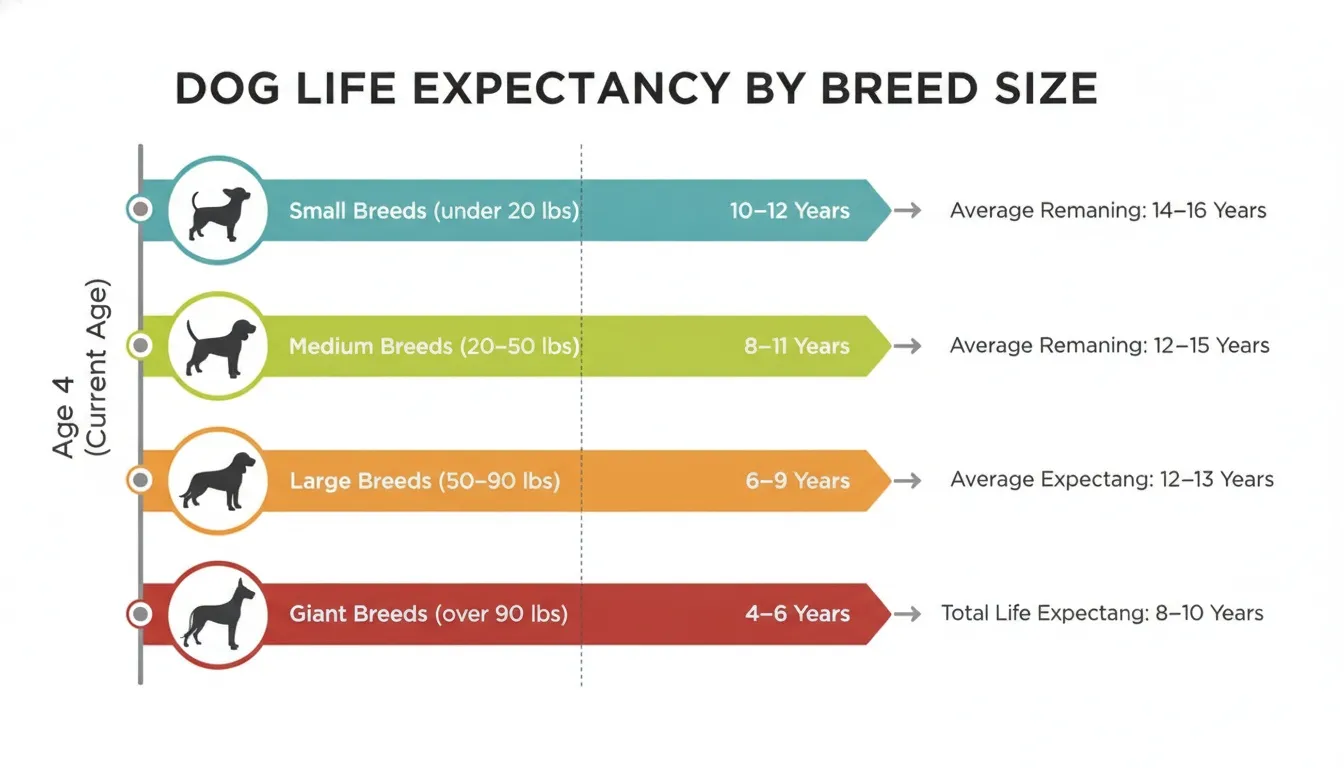
Your dog just turned 4 and you’re wondering if they’re still young or already middle-aged, which naturally brings up the question of how much time you have left together. The good news is that at age 4, your canine companion is sitting right in the sweet spot of their lives, with the vast majority of their years still ahead of them.
What most people don’t realize is that dog aging by breed dictates their remaining timeline much more accurately than a generic mathematical formula. According to a comprehensive longevity study by the University of Göttingen, smaller breeds like Chihuahuas slow down their aging engine after puppyhood, whereas giant breeds like Mastiffs continue to burn through their biological clock at an accelerated rate.
Remaining Life Expectancy at Age 4
The data below outlines exactly how much time you can expect to share with your pup based on their specific weight class.
| Breed Size | Avg Lifespan | Remaining at Age 4 |
| Small (Under 20 lbs) | 14–16 years | ~10–12 more years |
| Medium (21–50 lbs) | 12–14 years | ~8–10 more years |
| Large (51–90 lbs) | 10–12 years | ~6–8 more years |
| Giant (Over 90 lbs) | 7–10 years | ~3–6 more years |
How to Help Your Dog Live Longer — Age 4 Is the Best Time to Start
Here’s the thing: age 4 is the ultimate turning point to protect your pup’s future health before invisible issues settle in. Data collected by the Dog Aging Project highlights that proactive, preventative care at this exact life stage yields the most significant impact on overall life extension.
You can actively push your dog’s life expectancy toward the maximum numbers on our chart by implementing these five daily habits right now:
Annual vet checkup: Make sure your vet performs a thorough dental exam, closely monitors weight changes, and runs baseline bloodwork to catch silent kidney or liver shifts early.
Healthy weight: Keeping your dog lean is the single most effective factor in lifespan extension, as carrying even two extra pounds puts immense stress on a 4-year-old dog’s joints and heart.
Daily exercise: Maintain a consistent, breed-appropriate routine—like a solid 45-minute daily walk for a Labrador Retriever—to support cardiovascular strength without overworking their joints.
Dental hygiene: Brush their teeth at home or schedule a veterinary cleaning, because untreated periodontal disease directly allows bacteria to enter the bloodstream and damage the heart and kidneys.
Mental stimulation: Keep their adult mind sharp and fight off early cognitive decline by introducing daily puzzle toys, nose-work games, or refreshing their basic obedience training sessions.
Not Sure How Old Your Dog Is? Here Is How to Find Out
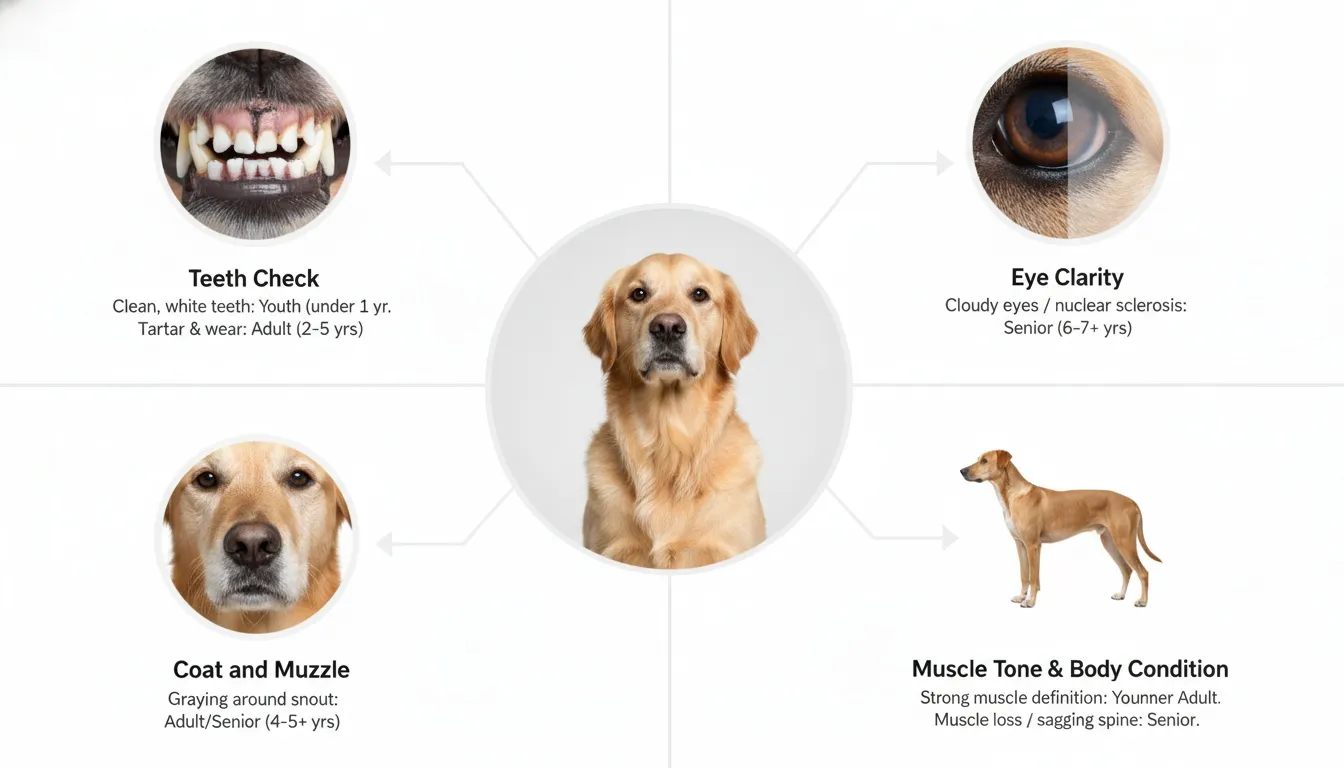
If you just rescued a dog or adopted a stray, pinpointing their exact birthday can feel like a guessing game. The good news is that you don’t need an official birth certificate to figure out what is 4 dog years in human years for your new best friend. Veterinarians use specific physical markers to reverse-engineer a dog’s age, allowing you to estimate where they stand on a dog years calculator.
What Vets Check to Estimate Age
Most people think a dog’s behavior tells you everything about their age, but the reality is that physical milestones provide far more reliable data. When you bring an adopted dog to the clinic, veterinarians examine very specific biological clocks across their bodies to give you an accurate estimate.
Here is what vets look for during an age assessment exam:
Teeth development and wear: Puppies get all of their permanent adult teeth by 7 months of age, while a 4-year-old dog will typically show moderate wear and slight tartar buildup on their back molars.
Eye clarity and lens changes: Clean, crystal-clear lenses point to a younger dog, while a distinct blue-grey cloudiness indicates nuclear sclerosis, which typically doesn’t appear until a dog reaches 6+ years of age.
Muzzle and facial fur: Just like humans turning gray at the temples, dogs usually begin developing distinct silver or grey fur around their muzzle and eyebrows starting around age 5.
Muscle tone and body condition: Young adult dogs boast lean, well-defined muscle tone, whereas older dogs experience a noticeable decrease in muscle mass along their spine and hindquarters.
Energy level and play patterns: A dog’s stamina and recovery time reveal their life stage, as a 4-year-old dog retains plenty of playful endurance but lacks the frantic, unfocused energy of a yearling.
Step-by-Step — What to Do If You Don’t Know Your Dog’s Age
Wondering how to turn these physical clues into a concrete care plan for your adopted pup? Here is exactly how to navigate the process so you can accurately determine your dog age in human years.
Book a vet visit for a professional age estimate: Your veterinarian will conduct a thorough physical exam, evaluating dental wear and joint flexibility to establish a baseline age range.
Confirm your dog’s current life stage: The vet will use these physical findings to categorize your dog as either a puppy, a young adult, a mature adult, or a senior.
Match the estimate to a breed size chart: Once you have a rough calendar age, factor in your dog’s weight class to see how their timeline translates to a 4 year old dog human age.
Align their daily care with our health guide: Use the confirmed life stage to customize their diet, joint support, and screening schedule to ensure you are meeting their precise biological needs.
For a deeper dive into evaluating physical markers at home, you can read through the comprehensive PetMD Dog Age Guide to help narrow down your rescue dog’s history.
Frequently Asked Questions
Finding out your pup’s true biological age helps you provide the best possible care for their specific stage of life.
A 4-year-old dog is generally equivalent to 34 human years, according to standard calculations by the American Veterinary Medical Association (AVMA). However, the exact number depends heavily on your dog's size and weight. Your dog's age will fall into a specific range between 32 and 38 human years, with smaller breeds like Chihuahuas tracking on the younger side and giant breeds tracking older.
No, the idea that a 4-year-old dog equals 28 human years is based on the outdated 7-year rule that veterinarians no longer support. Research by the American Kennel Club (AKC) confirms that dogs age much faster during their first 24 months than humans do. Applying the modern, size-adjusted calculation shows that your 4-year-old dog is actually 34 years old, making them older and more physically mature than the old myth suggests.
A 4-year-old Great Dane is roughly 35 to 38 human years old. Data from the University of Göttingen dog aging research shows that giant breeds experience accelerated physiological aging compared to smaller dogs. Because their bodies undergo more metabolic stress, a 4-year-old giant breed has already exited early adulthood and is rapidly entering middle age.
A 4-year-old dog feels remarkably similar to a human in their early-to-mid 30s. At this phase, they have shed all of their hyperactive puppy behaviors but remain at the absolute peak of their physical and mental abilities. According to the 2019 UC San Diego Epigenetic Clock Study, which analyzed canine DNA methylation, a 4-year-old dog enjoys a stable, fully mature adult mind alongside an active, fully developed body.
🐾 Other Age Guides

Gulfam Haider Mehdi
Founder & Developer
I built Dogagescalculator.com to give dog owners honest, science-backed answers instead of the outdated "×7" myth. Every figure here is checked against AKC, AVMA, and published veterinary research.
More about the author & this site →📌 Featured Guides
What is 14 Human Years in Dog Years
→
full grown cane corso size comparison to human
→
what is the lifespan of a siberian husky
→
how much to feed an 8 week old lab puppy
→
What Is 29 Dog Years in Human Years
→
How much to feed a Great Pyrenees
→
22 years in dog years
→
chihuahua dog years to human years
→
greater swiss mountain dog and bernese mountain dog mix
→
Senior Dog Care
→
Comments