
Puppy Age Calculator – Convert Weeks to Months Instantly
Why Tracking Your Puppy’s Age in Months Matters
In those fast-paced first six months, a puppy’s body and brain change every single week. While breeders and shelters typically count age in weeks for the first two months, veterinarians switch to months because key developmental care depends on monthly age markers.
Here is why getting the exact month count right is critical for your pup’s health:
Precise Feeding Guidelines: Commercial puppy food bags measure daily kibble portions by age in months alongside projected adult weight. Feeding a 3-month-old puppy on a 5-month-old schedule can lead to undernourishment or painful growth spurts.
Vaccination & Deworming Timelines: Core vaccines (like DHPP and Rabies) are administered at strict monthly intervals (typically at 8, 12, and 16 weeks / ~4 months). Missing these windows leaves your pup vulnerable to serious illnesses like Parvovirus.
Preventing Joint Damage: Large breed puppies like Golden Retrievers and Labs develop their growth plates differently than small breeds. Knowing their exact month stage helps you avoid over-exercising them during fragile developmental windows (according to veterinary guidelines from sources like the American Kennel Club).
Socialization Windows: The critical socialization period peaks between 3 and 14 weeks (roughly up to 3.5 months). Knowing where your pup stands on this timeline helps you introduce new environments and experiences safely before fear periods set in.
How to Use This Puppy Age Calculator
Finding your puppy’s exact age shouldn’t feel like a math test. Whether you know their exact birthday or just how many weeks old they were when you brought them home, this tool gives you accurate results in seconds.
Step-by-Step Guide
Enter Your Puppy’s Age or Birthdate: Select whether you know your pup’s exact date of birth or their current age in weeks.
Hit “Calculate”: The tool automatically applies the precise 4.34-weeks-per-month formula (accounting for full calendar months rather than basic rounding).
Get Your Instant Breakdown: You’ll immediately see your puppy’s exact age in months, their remaining weeks, and their current developmental life stage (e.g., Neonate, Socialization Window, or Adolescence).
Why Convert Weeks to Months?
When you bring a puppy home at 8 weeks, counting in weeks feels natural. But as the months roll on, trying to figure out if “18 weeks” means 4 months, 4.5 months, or nearly 5 months gets confusing fast—and that confusion can affect their everyday care.
Veterinarians and animal nutritionists structure almost all pet care protocols around months, not weeks:
Tailored Vet & Vaccination Schedules: Core vaccines (like Parvovirus, Distemper, and Rabies) follow strict monthly boosters—usually at 2, 3, and 4 months of age. Vets also dose heartworm and flea preventatives based on monthly weight and age benchmarks.
Accurate Portion Control: If you check the back of any vet-recommended kibble bag (like Royal Canin or Hill’s Science Diet), feeding charts are split into monthly age brackets. Mistaking a 16-week-old (3.6 months) for a full 4-month-old can lead to overfeeding or stomach upset.
Tracking Growth Plates & Exercise: According to the American Veterinary Medical Association (AVMA), a puppy’s growth plates don’t fully close until anywhere between 12 to 18 months (depending on breed size). Knowing their exact month stage helps you avoid high-impact jumping or long runs during high-risk growth windows.
Puppy Age Chart – Weeks to Months Conversion Table
Because a calendar month averages 4.345 weeks (365 days ÷ 12 months ÷ 7 days), simply dividing your puppy’s age in weeks by 4 will leave you with an inaccurate month count.
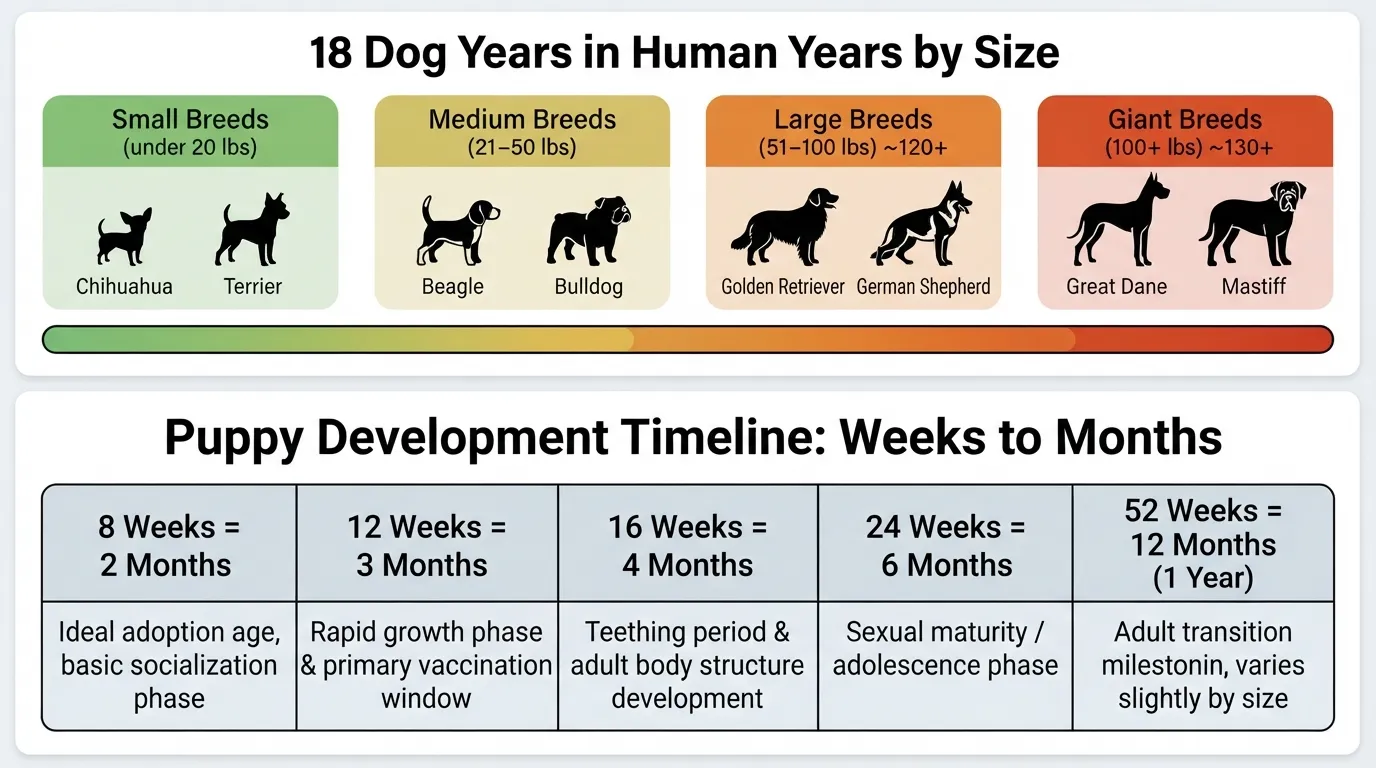
Use this quick-reference chart to instantly map your puppy’s exact age in weeks to their calendar months and key biological life stages.
| Age in Weeks | Equivalent Age in Months | Biological Life Stage | Key Developmental Focus |
|---|---|---|---|
| 0 – 4 Weeks | 0 to ~1 Month | Neonatal / Transitional | Nursing, opening eyes, mother's milk immunity |
| 4 – 8 Weeks | ~1 to 2 Months | Weaning & Socialization | Transition to soft kibble, learning bite inhibition from littermates |
| 8 – 12 Weeks | 2 to 3 Months | Primary Socialization | First home arrival, core vaccine series starts, basic crate training |
| 12 – 16 Weeks | 3 to ~3.7 Months | Juvenile / Fear Impact | Teething begins, fear periods, rabies booster vaccination |
| 16 – 20 Weeks | ~3.7 to 4.5 Months | Rapid Growth | Adult teeth incoming, high curiosity, intensive leash training |
| 20 – 24 Weeks | 4.5 to 5.5 Months | Pre-Adolescence | Growth rate starts slowing (small breeds), testing boundaries |
| 24 – 32 Weeks | 5.5 to 7.5 Months | Adolescence | Sexual maturity/heat cycles (if intact), secondary fear stages |
| 32 – 52 Weeks | 7.5 to 12 Months | Young Adult Transition | Final height reached for medium breeds; adult kibble transition |
| 52+ Weeks | 12+ Months (1 Year) | Full Adult / Maturity | Growth plates close (12-18+ months depending on breed size) |
Puppy Life Stages Explained Week by Week & Month by Month
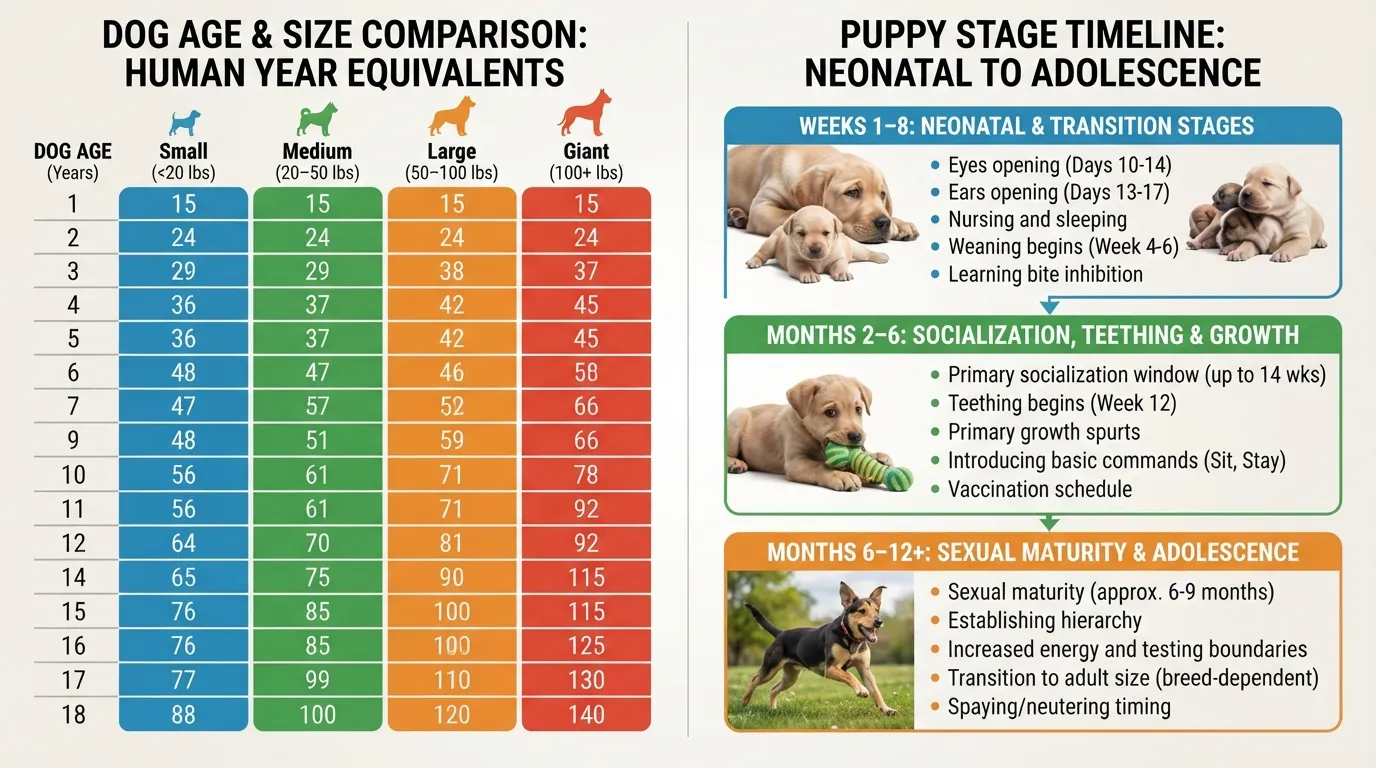
Understanding your puppy’s current development stage is key to providing proper care, nutrition, and training. Here is what to expect physically, behaviorally, and on the scale as your pup grows from a newborn into a full-grown adult.
Newborn Stage (0–2 Weeks)
During their first fortnight, puppies are completely helpless and rely entirely on their mother for survival. They are born blind, deaf, and unable to regulate their own body temperature.
Physical Changes: Eyes and ear canals remain tightly shut. Paws are soft, and puppies navigate purely by smell and touch to find their mother’s milk (colostrum), which provides vital maternal antibodies.
Behavior: Sleeping occupies roughly 90% of their day. Movement is limited to slow crawling and root searching.
Typical Weight Range: 0.25 to 2.5 lbs (110–1,100 g) depending heavily on breed size. Healthy puppies should double their birth weight within the first 7 to 10 days.
Transitional Stage (2–4 Weeks)
This short phase marks a rapid period of sensory awakening as the puppy begins to perceive and interact with the outside world.
Physical Changes: Eyes open (usually between days 10–14), followed shortly by ear canals opening. Milk teeth (deciduous teeth) start erupting through the gums, and body temperature regulation improves.
Behavior: Puppies take their first wobbly steps, begin to wag their tails, and start producing their first barks and whimpers. They also start recognizing their mother and littermates visually.
Typical Weight Range: 0.5 to 5.5 lbs (220–2,500 g). Weight gain remains rapid, with steady weekly increases across all breeds.
Socialization Stage (3–12 Weeks)
Often called the most critical developmental window in a dog’s life, this stage shapes how your puppy views the world and reacts to novel stimuli.
Physical Changes: Full set of 28 sharp baby teeth emerges. High energy levels develop as motor skills, balance, and coordination refine dramatically.
Behavior: Peak curiosity and social learning. Puppies learn bite inhibition (how hard they can bite without hurting) through play with littermates. Between 8 to 11 weeks, puppies often enter their first fear period, where scary experiences can leave lasting impressions.
Typical Weight Range: 1.5 to 25+ lbs (0.7–11+ kg). Small breeds (like Chihuahuas) hover around 1.5–4 lbs, while giant breeds (like Great Danes) can reach 25+ lbs by week 12.
Juvenile Stage (3–6 Months)
This is the “elementary school” phase of puppyhood—marked by rapid physical growth, teething pains, and boundless energy.
Physical Changes: Baby teeth fall out as 42 permanent adult teeth begin pushing through. Body proportions stretch out, often giving puppies a gangly, awkward look as long bones grow.
Behavior: Teething drives an intense urge to chew on anything within reach. Pups begin testing house rules and boundaries as independence grows. Basic house-training and leash habits solidify during this phase.
Typical Weight Range: 5 to 50+ lbs (2.2–23+ kg). By 6 months, most puppies reach roughly 50% to 75% of their ultimate adult weight.
Adolescent Stage (6–18 Months)
Adolescence brings sexual and physical maturity, often accompanied by a temporary return of rebellious behaviors similar to human teenagers.
Physical Changes: Growth plates gradually close (around 10–12 months for small/medium breeds, and up to 18–24 months for giant breeds). Sexual hormones peak if the dog is not spayed or neutered, and the adult coat finishes growing in.
Behavior: Increased alertness, territory marking, and high energy. A second fear period can occur around 6 to 10 months. Consistent, positive reinforcement training is essential to reinforce previously learned boundaries.
Typical Weight Range: 10 to 100+ lbs (4.5–45+ kg). Growth slows down significantly as pups approach their final adult weight and fill out in chest width and muscle tone.
Does Breed Size Affect Puppy Age Stages?
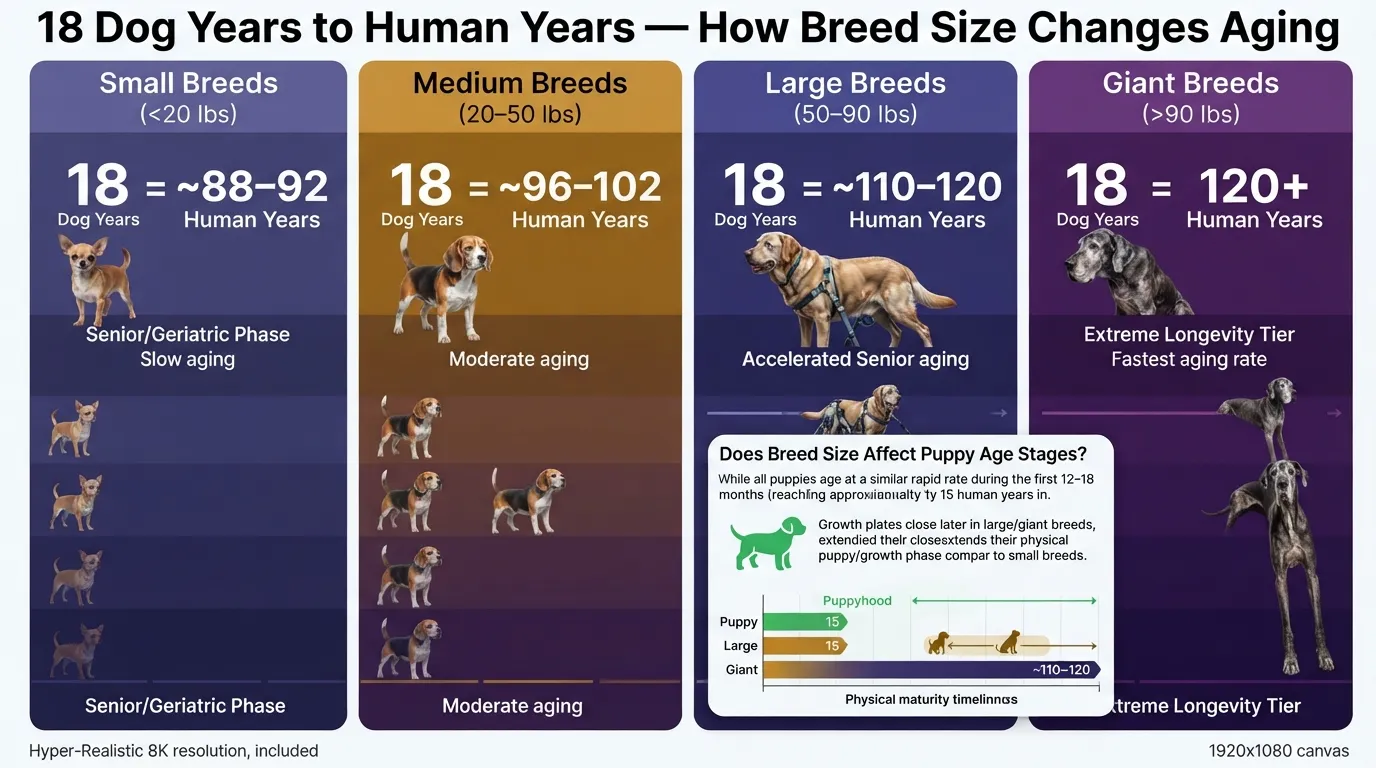
Yes—dramatically so. While every puppy passes through the same core developmental milestones, their speed of maturation depends almost entirely on their projected adult weight.
A Chihuahua puppy might reach full skeletal maturity before its first birthday, whereas a Mastiff or Great Dane is still growing at two years old. Understanding where your pup falls on this scale prevents feeding mistakes and guards against joint injuries during critical developmental windows.
Small Breeds (Maturity Timeline)
Examples: Chihuahua, Shih Tzu, French Bulldog, Pomeranian (< 20 lbs)
Growth Spurt Peak: 2 to 6 months
Skeletal Maturity: 8 to 12 months
Behavioral Maturity: 10 to 12 months
Toy and small-breed puppies sprint through their growth phases. Because they only need to gain a few pounds to reach adult size, their growth plates close early—often by 9 to 10 months of age. They can typically transition from high-calorie puppy food to adult maintenance kibble right around their first birthday.
Medium Breeds (Maturity Timeline)
Examples: Beagle, Cocker Spaniel, Border Collie (20 – 50 lbs)
Growth Spurt Peak: 3 to 7 months
Skeletal Maturity: 12 to 14 months
Behavioral Maturity: 12 to 18 months
Medium breeds follow the “textbook” timeline most standard growth charts use. They experience a steady, predictable growth curve during their first six months, then gradually fill out in chest width and muscle tone over their second year.
Large Breeds (Maturity Timeline)
Examples: Golden Retriever, German Shepherd, Labrador (50 – 90 lbs)
Growth Spurt Peak: 4 to 9 months
Skeletal Maturity: 15 to 18 months
Behavioral Maturity: 18 to 24 months
Large-breed puppies grow rapidly in height before their bone density catches up, giving them that classic “clumsy big-pawed” look. Because their skeletal growth plates remain open much longer, controlled exercise is crucial to prevent conditions like hip dysplasia. Vets recommend keeping large pups on specialized large-breed puppy formulas (which have balanced calcium-to-phosphorus ratios) until at least 15 months.
Giant Breeds (Maturity Timeline)
Examples: Great Dane, Saint Bernard, English Mastiff (90+ lbs)
Growth Spurt Peak: 4 to 12 months
Skeletal Maturity: 18 to 24+ months
Behavioral Maturity: 24 to 36 months
Giant breeds are the true marathon runners of canine growth. A Great Dane puppy can gain up to 3 to 5 pounds a week during peak growth spurts. Their growth plates don’t fully close until around 2 years of age, and they may continue adding muscle mass until they turn 3. Careful caloric management is essential here—growing too fast puts immense stress on developing joints.
How to Calculate a Puppy's Age Without Knowing Birth Date
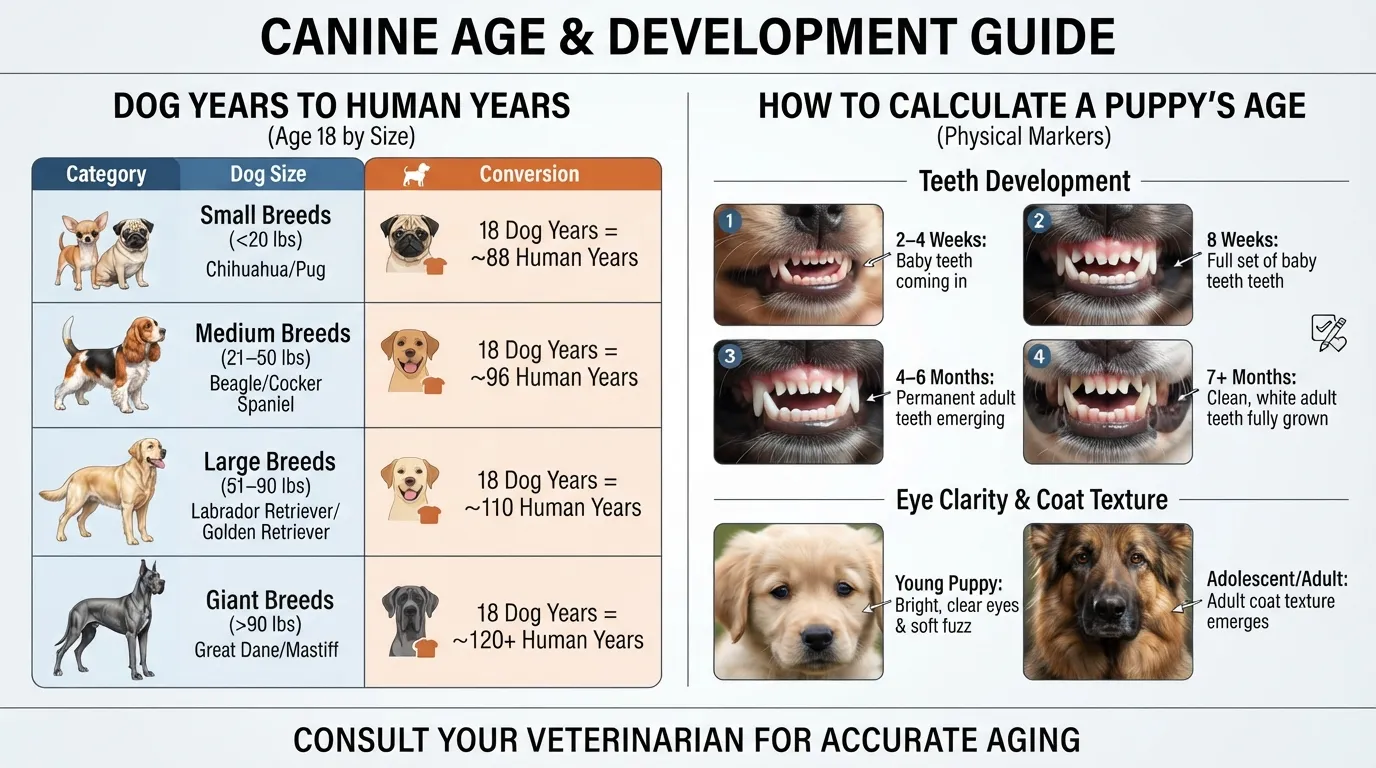
If you adopted a rescue pup or found a stray, you likely don’t have an exact birth certificate. Don’t worry—veterinarians estimate a puppy’s age using a combination of physical dental markers, body structure, and behavioural cues.
By cross-referencing these three biological indicators, you can pin down your pup’s age within a very tight 1 to 2-week window.
Teeth Growth Method
Teeth are by far the most reliable “birth clock” in young dogs. Dental eruption follows a remarkably strict biological calendar across almost all breeds:
Under 3 Weeks: No teeth visible in the gums.
3 to 4 Weeks: Sharp needle-like baby incisors and long canine teeth start poking through the gums.
6 to 8 Weeks: All 28 sharp baby (deciduous) teeth have fully erupted. If your pup has a full mouth of tiny, razor-sharp teeth, they are likely between 7 and 10 weeks old.
12 to 16 Weeks (3 to 4 Months): Baby incisors start falling out, replaced by larger, duller adult front teeth.
16 to 24 Weeks (4 to 6 Months): Adult canine teeth and molars erupt. If you see double teeth (an adult canine pushing out alongside a baby canine), your pup is right in the 4.5 to 5.5-month teething sweet spot.
6 Months & Older: All 42 permanent adult teeth are fully present, clean, and bright white without tartar buildup.
Size & Weight Method
While less precise than checking teeth—since a 4-month-old Chihuahua weighs far less than a 4-month-old Labrador—weight trajectories offer useful secondary clues when combined with estimated breed type:
Paw-to-Body Ratio: Puppies with oversized, thick paws relative to their legs are typically in a rapid growth phase between 3 and 6 months old.
Proportion Test: If their torso looks disproportionately long or leggy (“gangly adolescence”), they are likely between 5 and 9 months old.
The 16-Week Weight Formula: For medium to large breeds, a puppy’s weight at 16 weeks (4 months) is roughly 50% of their ultimate adult weight. If you weigh them regularly over two weeks and track the daily gain, a vet can back-calculate their approximate age curve.
Behavior-Based Estimation
A puppy’s cognitive milestones shift rapidly over their first six months, revealing clear age markers:
3 to 6 Weeks: Wobbly walking, learning to play with littermates, beginning to lap liquid food.
8 to 12 Weeks: Extremely curious, easily startled (first fear window), short attention span, frequent nap-and-play cycles every 30–45 minutes.
3 to 6 Months: Constant chewing due to teething discomfort, testing boundaries, high energy, and displaying fearlessness alongside high trainability.
6 to 12 Months (Adolescence): Marking territory, displaying selective hearing, testing house rules, and showing increased interest in other dogs (sexual maturity signs begin if unneutered/unspayed).
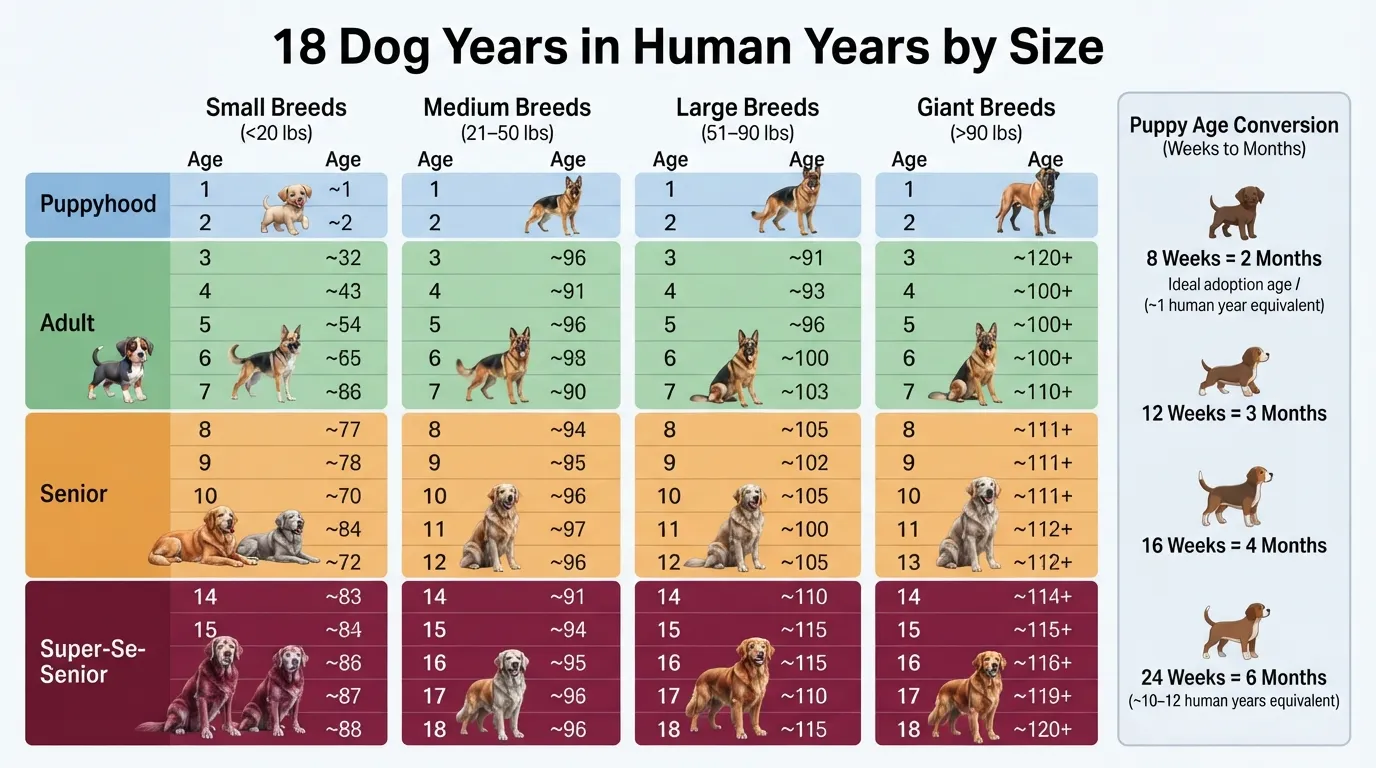
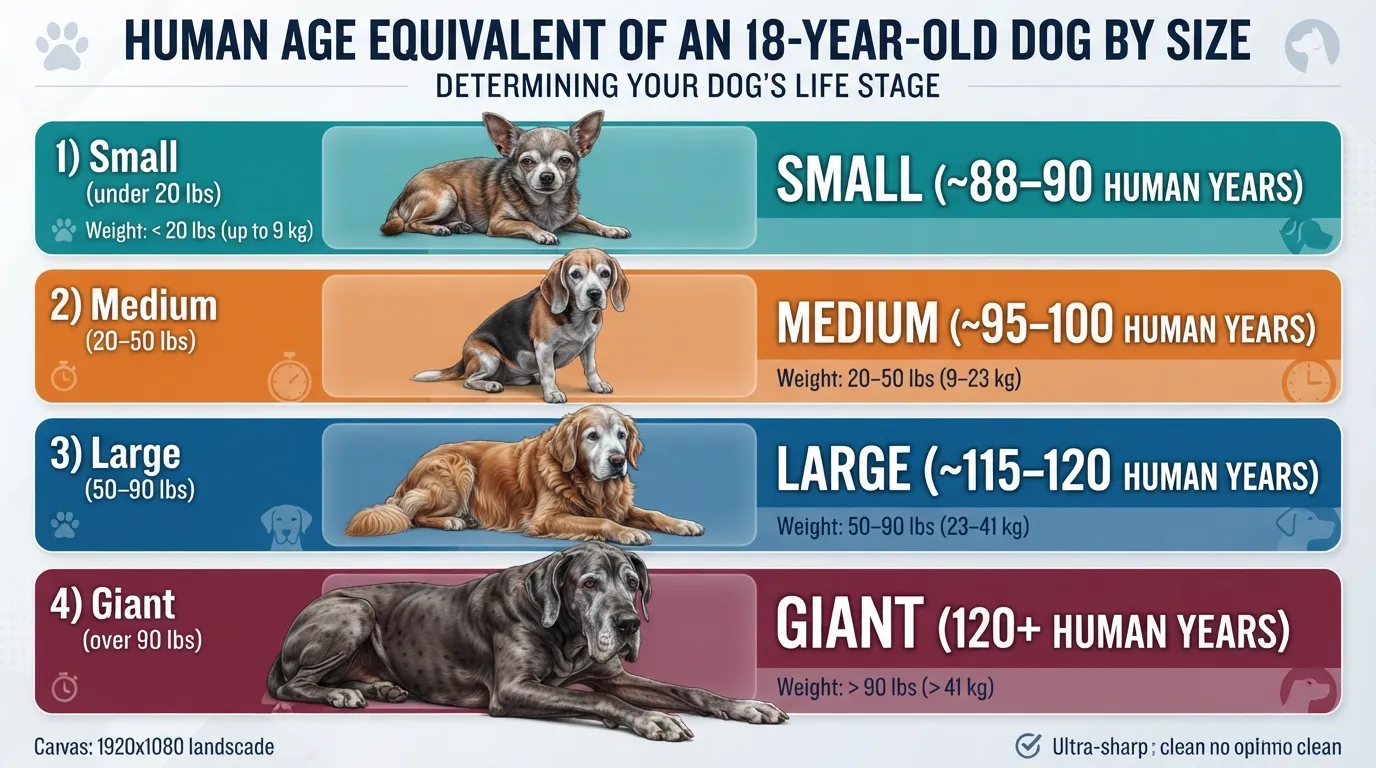
Puppy Age vs Human Age Comparison Chart
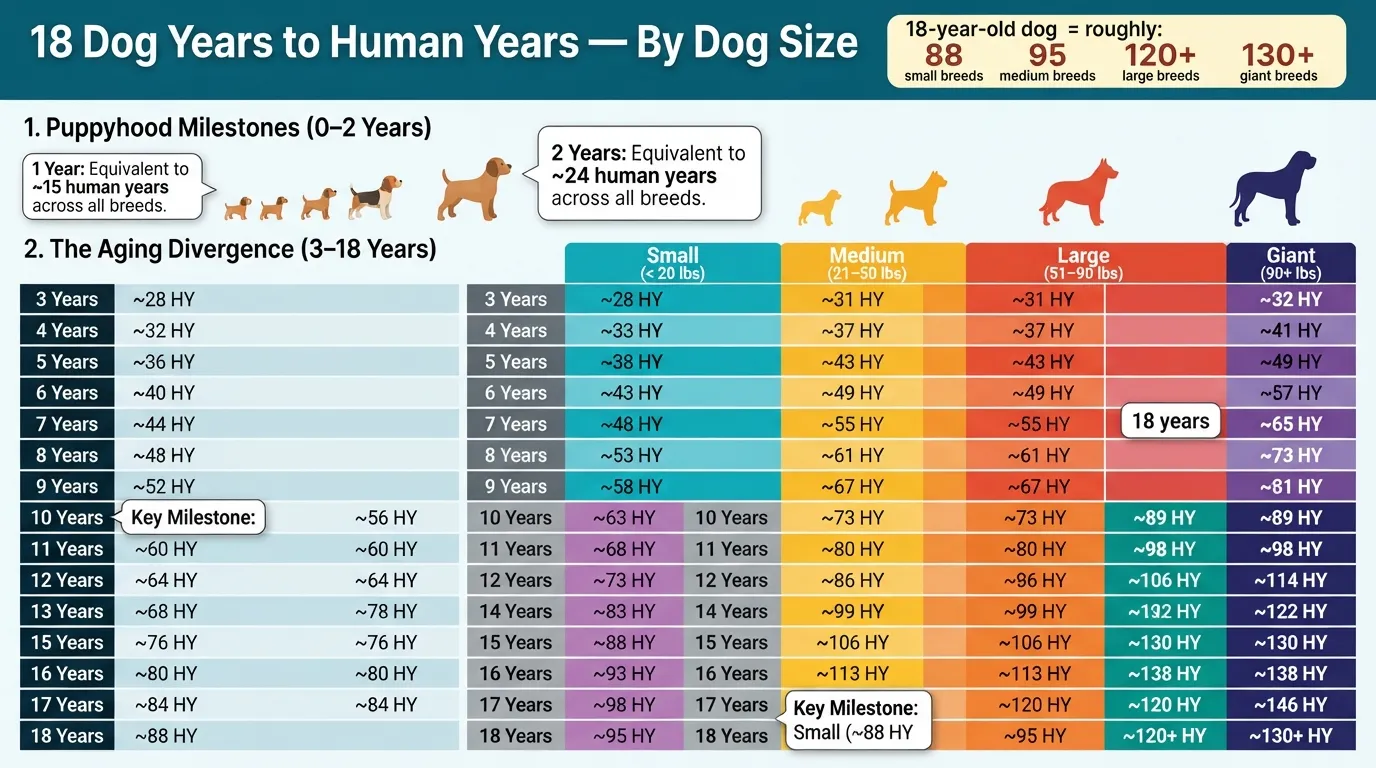
Forget the old “multiply by 7” rule—it is biologically inaccurate! Dogs mature exponentially faster in their first year of life than humans do. A 1-year-old dog isn’t equivalent to a 7-year-old child; physically and cellularly, they are closer to a young adult.
Dog Years to Human Years Formula (Research-Based)
According to a landmark 2020 study by researchers at UC San Diego and UC Davis School of Veterinary Medicine (published in Cell Systems), canine aging is measured using an epigenetic clock based on DNA methylation patterns.
Scientists developed a logarithmic formula that maps biological aging across species:
(Where $\ln$ represents the natural logarithm)
Because puppies age at lightning speed during infancy, their human equivalent jumps rapidly in the first few months. The table below outlines how a puppy’s development aligns with human physiological milestones.
| Puppy Age | Estimated Human Age Equivalent | Biological Milestone Alignment |
|---|---|---|
| 8 Weeks (2 Months) | ~9 Months | Human infancy (crawling, milk diet transition) |
| 12 Weeks (3 Months) | ~1 to 2 Years | Early toddler stage (first independent steps, intense curiosity) |
| 16 Weeks (4 Months) | ~3 to 4 Years | Early childhood (primary teeth loss, high activity levels) |
| 6 Months | ~10 to 12 Years | Pre-puberty / Pre-adolescence (testing independence) |
| 9 Months | ~15 to 17 Years | Mid-adolescence (sexual maturity begins, testing boundaries) |
| 12 Months (1 Year) | ~31 Years | Early adulthood (skeletal development nears completion) |
| 2 Years | ~42 Years | Full adult biological maturity |
Why Knowing Your Puppy's Exact Age Matters
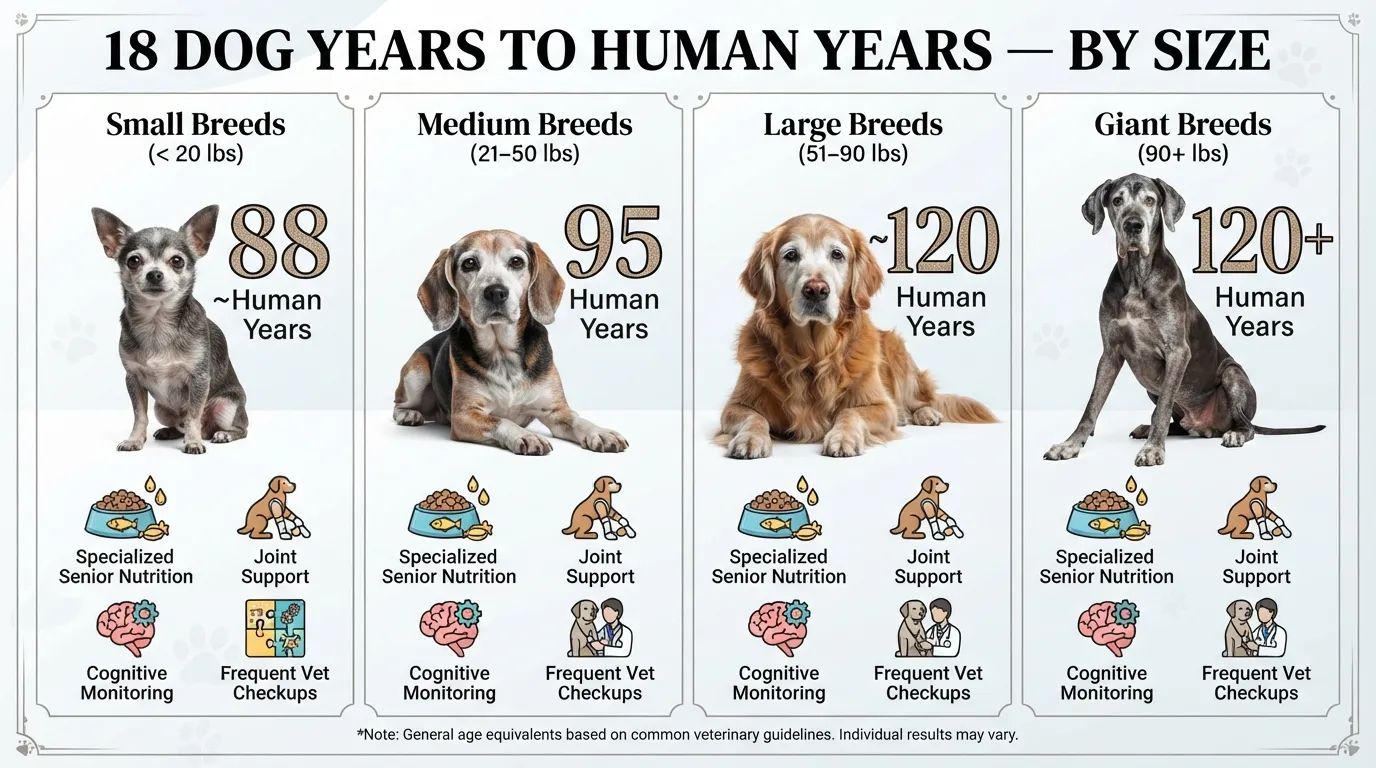
In puppy care, timing is everything. A difference of just two or three weeks can change what food your pup should eat, which vaccines they can safely receive, and how much exercise their joints can handle.
Knowing your puppy’s exact age in months and weeks allows you to align with veterinary care protocols and set them up for a long, healthy life.
Age-Specific Vaccination Schedules: Core puppy vaccines (DHPP/DA2PP and Rabies) rely on maternal antibodies fading, which typically happens between 6 and 16 weeks of age. Administering shots too early can render them ineffective, while waiting too late leaves your puppy exposed to deadly viruses like Parvovirus. Vets schedule boosters at precise 3 to 4-week intervals (usually at 8, 12, and 16 weeks).
Tailored Feeding & Nutritional Requirements: A 2-month-old puppy requires up to four meals a day with higher caloric density to support rapid bone growth, whereas a 6-month-old needs only two to three meals to prevent rapid weight gain. Additionally, large-breed puppies require precise calcium-to-phosphorus ratios to prevent developmental orthopedic diseases.
The Prime Socialization Window (8–16 Weeks): Animal behaviorists at the American College of Veterinary Behaviorists (ACVB) identify 8 to 16 weeks as the critical window for socio-behavioral development. During this brief timeframe, your pup’s brain is uniquely receptive to forming positive associations with new dogs, people, sounds, and environments—before fear-based instincts fully solidify.
Optimal Spay/Neuter Timing: Gone are the days of a one-size-fits-all 6-month rule. According to multi-year studies from the UC Davis School of Veterinary Medicine, neutering or spaying too early (especially in large and giant breeds like Golden Retrievers or German Shepherds) can double the risk of joint disorders and certain cancers. Knowing their exact age helps your vet determine the safest month for surgery based on breed size and growth plate closure.
Frequently Asked Questions
How to calculate a puppy’s age?
You can calculate your puppy’s age by subtracting their birth date from the current date to get the total days, then dividing by 7 for age in weeks or dividing by 30.44 for age in calendar months. If the exact birthday is unknown, a veterinarian estimates age by examining teeth eruption—milk teeth appear at 3–6 weeks, adult incisors replace them around 3–4 months, and full adult teeth emerge by 6 months.
How old is a dog in 1 month?
A 1-month-old puppy (4 weeks) is roughly equivalent to a 5-to-9-month-old human infant. At this stage, they are transitioning from nursing to soft puppy food, their eyes and ear canals are fully open, and they are taking their first steps around the whelping box.
How many weeks old is a 5-month-old puppy?
A 5-month-old puppy is approximately 21.7 weeks old (typically between 21 and 22 weeks). Because average calendar months contain 4.345 weeks rather than a flat 4 weeks, simply multiplying 5 months by 4 weeks (20 weeks) underestimates their actual age by nearly half a month.
How old is my puppy — birth date calculator?
To use our instant birth date calculator, select your pup’s birth date on the calendar input above and click Calculate. The tool automatically measures the exact time elapsed up to today’s date, outputting their precise age broken down into total days, weeks, months, and their current biological life stage.
Is age 2 still a puppy?
For small and medium breeds, no—they reach full physical and emotional maturity between 12 and 18 months. However, for large and giant breeds (like Golden Retrievers, Boxers, or Great Danes), age 2 is still considered late adolescence. Their skeletal growth plates and mental maturity often take anywhere from 24 to 36 months to fully settle.
What is “I love you” in dog language?
In canine body language, a soft, slow blink coupled with direct eye contact is the ultimate sign of affection and trust—often referred to by behaviorists as a “dog kiss.” Dogs also say “I love you” by leaning their full body weight against your legs, resting their chin on you, raising their left eyebrow when they see you, or giving you a relaxed, tail-wagging greeting when you walk through the door.
🐾 Other Age Guides

I built Dogagescalculator.com to give dog owners honest, science-backed answers instead of the outdated "×7" myth. Every figure here is checked against AKC, AVMA, and published veterinary research.
More about the author & this site →
Comments