What Is 8 Human Years in Dog Years? Instant Answer + Chart
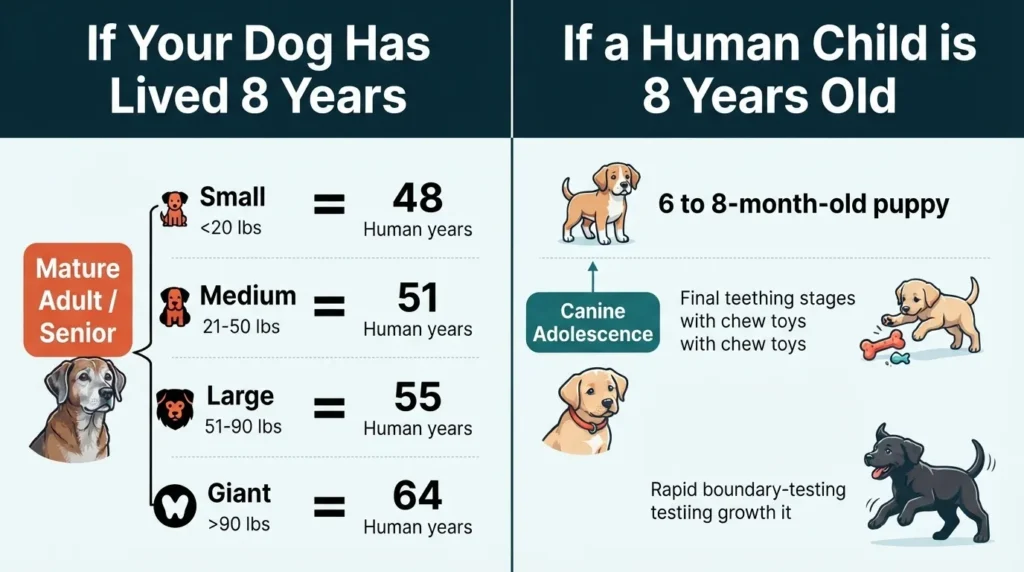
If your dog has been by your side for 8 calendar years, they are roughly 48 to 64 human years old, depending entirely on their breed size. Because people often search for this conversion from two completely different angles, let’s clear up both right away: if you are asking how old an 8-year-old dog is in human terms, they have officially entered their senior years; if you are wondering what an 8-year-old human child’s age looks like in a canine lifespan, it is equivalent to a fast-growing 6 to 8-month-old puppy.
⏱️ Quick Answer Box
8 Calendar (Human) Years lived by a dog = 48 to 64 years old in human physiological age (576 to 768 months).
An 8-year-old Human Child = Roughly a 6 to 8-month-old puppy in terms of developmental milestones.
Age Conversion Metrics
Dog's Age to Human Years
Calendar Time Elapsed
8 Years Lived
Equivalent Developmental Age
48 – 64 Years Old
(Based on size)
Life Stage
Mature Adult / Senior
Human Age to Dog Years
Calendar Time Elapsed
8 Years Lived
Equivalent Developmental Age
6 – 8 Months Old
(Puppy age)
Life Stage
Adolescence
Why 8 Human Years Doesn't Equal a Full Dog Year
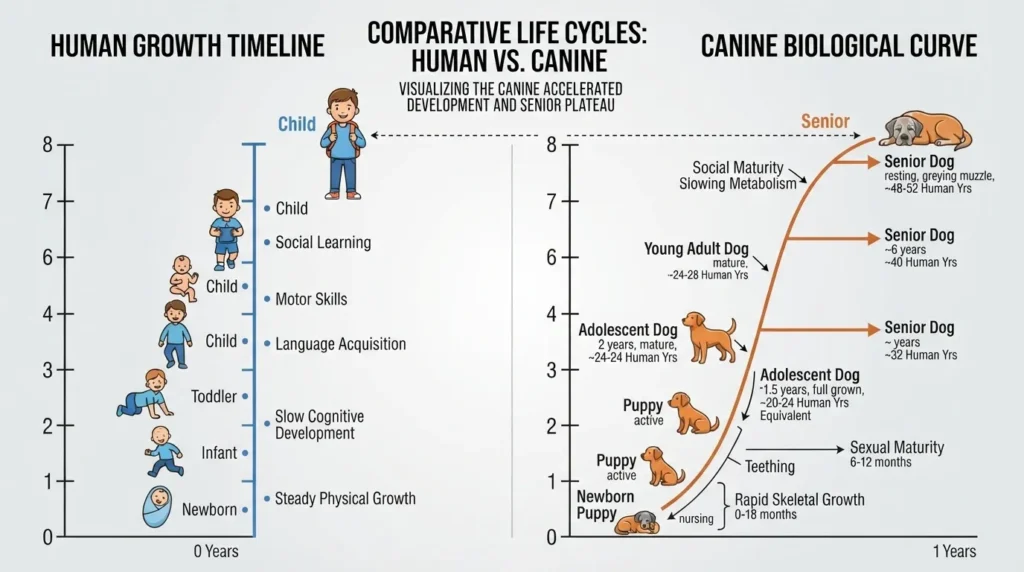
The old idea that dogs age at a fixed rate every calendar year misses a fundamental biological reality: canine development doesn’t move in a straight line. During their first single year of life, a puppy undergoes a massive hormonal and physical growth spurt, effectively shifting from infancy to mid-adolescence in a matter of months. If a human child aged at that exact same pace, an eight-year-old kid would already be driving a car and graduating from college.
Once a dog hits physical maturity around age two, this aggressive biological clock finally slows down. From that point forward, their body cells age much more predictably, but the rate still varies dramatically depending on whether the dog is a tiny Chihuahua or a massive Great Dane. Because a dog’s early development is compressed into such a brief window, treating eight human calendar years as just one standard “dog year” simply doesn’t align with natural canine biology.
How This Is Calculated
The 7:1 Myth
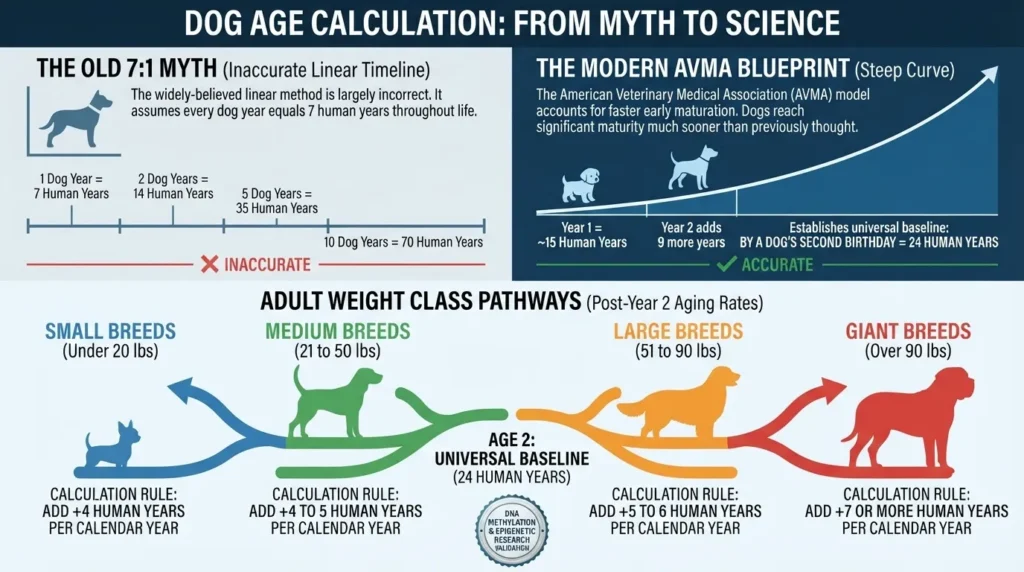
For decades, the standard shorthand was simple: just multiply your dog’s age by seven to find their equivalent human age. While this basic 7:1 rule is incredibly easy to calculate, it is a highly inaccurate myth that completely misrepresents a dog’s true life cycle. It treats a highly resilient one-year-old puppy as a fragile seven-year-old child, and completely ignores the massive impact that adult body mass has on a senior dog’s aging process.
AVMA Vet-Approved Method
To get a genuinely precise look at canine aging, veterinarians rely on the multi-tiered guidelines established by the American Veterinary Medical Association (AVMA). This official methodology abandons fixed multipliers entirely, recognizing that a dog’s first year counts for roughly 15 human years of physiological development, while their second year adds another 9 human years. By the time any dog reaches its second birthday, it is universally considered to be roughly 24 human years old.
After this initial two-year baseline, the AVMA calculation branches out into highly specific pathways based on adult breed size and weight class:
Small Breeds (Under 20 lbs): These compact dogs age the slowest in their adult years, adding roughly 4 human years for every calendar year lived. At 8 calendar years, a small dog is a mature but spry 48 human years old.
Medium Breeds (21 to 50 lbs): Medium dogs age at a slightly faster clip, averaging about 4 to 5 human years per calendar year. By age 8, they land safely at approximately 51 human years old.
Large Breeds (51 to 90 lbs): Larger dogs experience more physical wear and tear, accumulating roughly 5 to 6 human years annually. An 8-year-old large dog is well into their senior phase at 55 human years old.
Giant Breeds (Over 90 lbs): Giant dogs age at an accelerated rate of 7 or more human years each year. By calendar year 8, a giant breed has already reached an advanced geriatric equivalent of 64 human years old.
8 Human Years in Dog Years by Breed Size
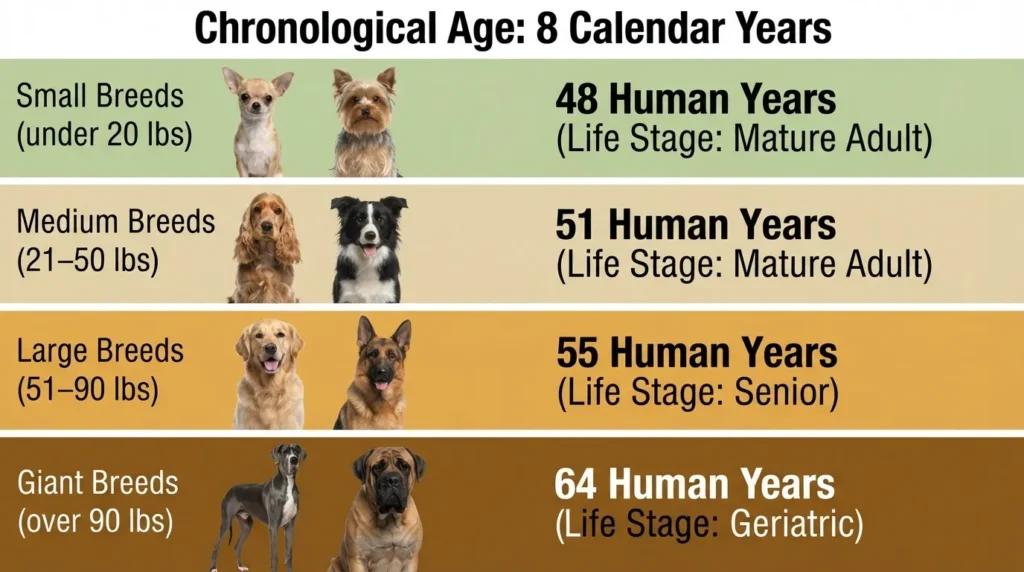
While a standard baseline gives us a starting point, body mass is the real engine behind how a dog ages. A small dog at 8 human years is often still in their prime, playing fetch with the energy of a young adult. Meanwhile, a giant breed dog at that exact same milestone is already considered an elder state-dog, showing gray on their muzzle and moving a bit more deliberately during morning walks.
According to the AAHA canine life stage guidelines, this divergence happens because larger bodies physically work harder to grow and maintain themselves, accelerating cellular wear. To see exactly where your companion falls on this spectrum, check the weight-specific breakdown below.
Breed Size & Age Breakdown (At 8 Years)
Small Breeds
Adult Weight Range
Under 20 lbs (9 kg)
Equivalent Human Age
48 Human Years
Official Life Stage
Mature Adult
Medium Breeds
Adult Weight Range
21 to 50 lbs (10–23 kg)
Equivalent Human Age
51 Human Years
Official Life Stage
Mature Adult
Large Breeds
Adult Weight Range
51 to 90 lbs (24–41 kg)
Equivalent Human Age
55 Human Years
Official Life Stage
Senior
Giant Breeds
Adult Weight Range
Over 90 lbs (41+ kg)
Equivalent Human Age
64 Human Years
Official Life Stage
Geriatric
What Life Stage Does This Represent in a Dog?
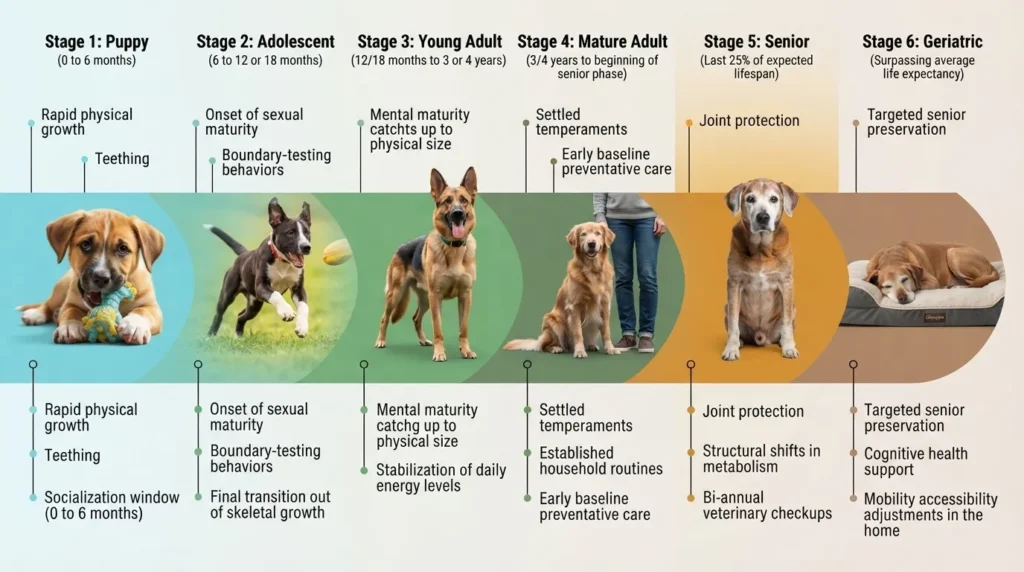
Reaching 8 human years means your dog has officially transitioned out of mature adulthood and crossed the threshold into their senior years. You might notice they still chase a tennis ball with enthusiasm, but they sleep a little harder afterward or take an extra moment to stretch when getting off the couch. It is a subtle shift—much like a human noticing they need reading glasses or realizing a weekend of yard work leaves them stiffer than it used to.
At this point, your dog has completed roughly 60% to 75% of their expected natural lifespan, depending heavily on their size and breed genetics.
Because their metabolism and physical resilience are shifting, this is the ideal time to focus on proactive care, such as switching to a senior-specific diet and adding joint supplements like glucosamine to protect their mobility.
Human Years to Dog Years — Full Chart + Visual (1–18 Years)
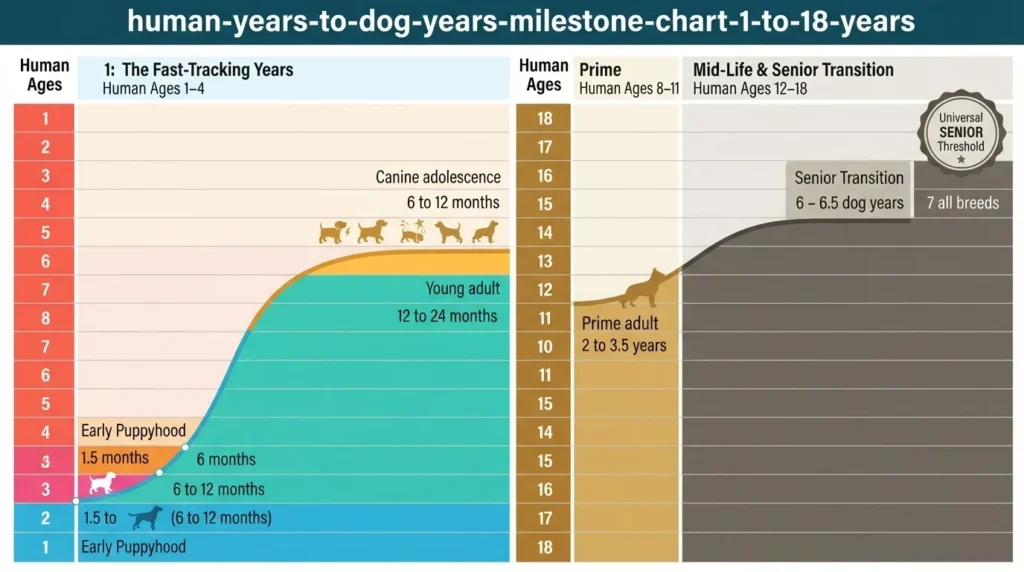
To see exactly how a human child or adult’s age translates into canine development, you cannot rely on simple math. A human child grows gradually over nearly two decades, whereas a dog packs their entire infancy, childhood, and teenage rebellion into their first 12 to 18 months.
Instead of tracking aging line by line, think of it in major developmental milestones. During the first two human years, your dog shoots through puppyhood and adolescence, reaching a young adult baseline. By the time a human child turns eight, a dog has reached maturity, which is the stable equivalent of an adult in their mid-twenties.
As time moves forward, these paths diverge based on breed size. When tracking milestones up to adulthood—like knowing what is 17 dog years in human years—a 17-year-old human adolescent actually correlates to a mature 6.5-year-old canine companion. Once a human reaches 18 years, almost every dog breed has officially crossed the threshold into their rewarding senior life stage.
Frequently Asked Questions
If you are converting a human child's age into a dog's lifespan, an 8-year-old child matches the developmental milestones of a 6 to 8-month-old puppy who is going through adolescence.
Large dogs experience much faster cell turn-over and physical strain as they grow. Genetic aging studies show that while all puppies grow fast, large breeds continue to age at an accelerated rate throughout their adult lives compared to smaller dogs.
Yes, according to the American Animal Hospital Association (AAHA) guidelines, most dogs enter their senior years around age 7 to 8. Large and giant breeds hit this milestone even earlier, often showing senior signs by age 6.
If a dog has lived for 8 calendar years, they are roughly 48 to 64 human years old. The exact age depends heavily on their size, as smaller dogs age much slower than large or giant breeds.
🐾 Other Age Guides
What Is 18 Dog Years in Human Years
Read More →
What Is 7 Human Years in Dog Years
Read More →
What is 20 dog years in human years
Read More →
What Is 5 Human Years in Dog Years?
Read More →