
What Is 7 Dog Years in Human Years? Answer by Size & Breed
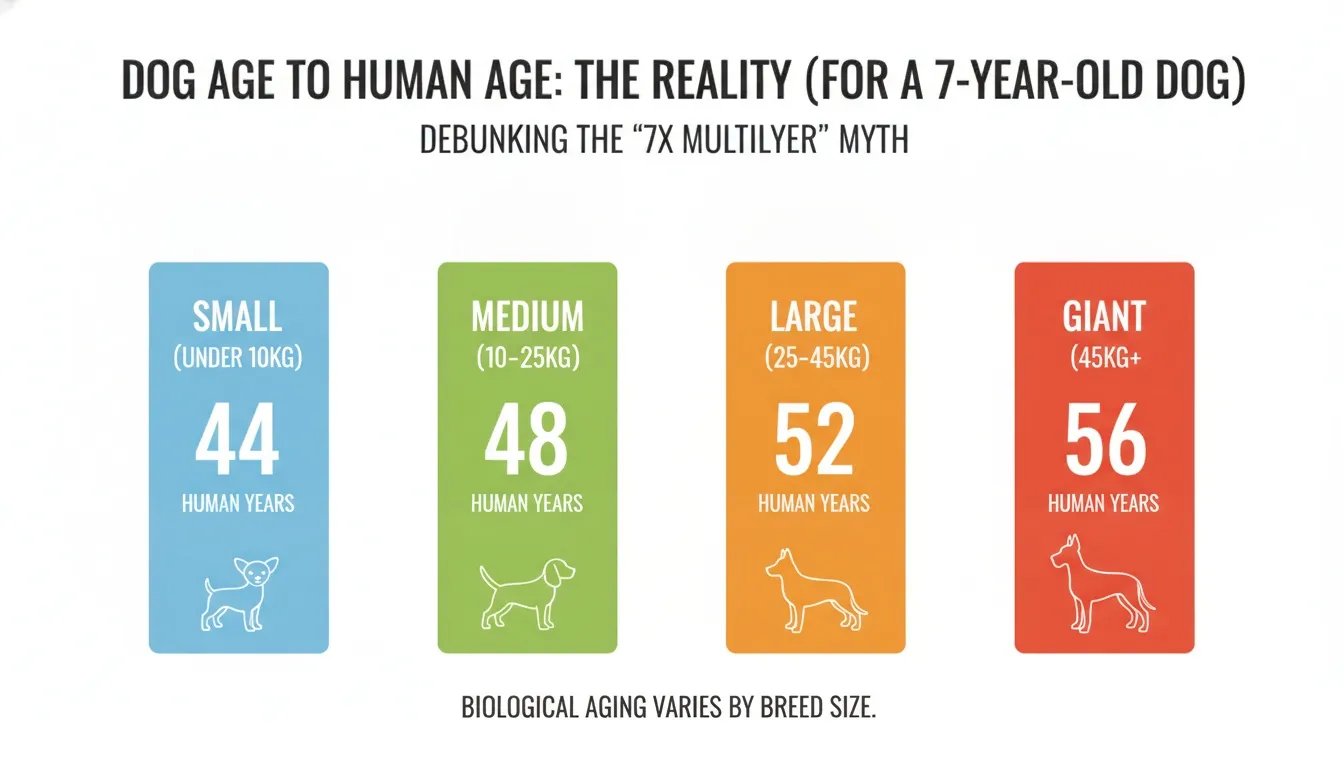
A 7-year-old dog is approximately 44 to 56 human years old, depending on size and breed. Small dogs generally age more slowly and may still be in middle adulthood at seven, while large and giant breeds tend to age faster and may already be entering their senior years. This is why the old “multiply by seven” rule does not give an accurate human-equivalent age for every dog.
Your dog’s size is one of the most important factors when estimating their age. Use the size-based chart below to see where a 7-year-old dog typically falls on the human aging scale.
Quick Answer — 7 Dog Years in Human Years by Size
| Dog Size | Weight | Human Years at 7 | Life Stage |
|---|---|---|---|
| Small Dog | Under 10kg | ~44 human years | Mature Adult |
| Medium Dog | 10–25kg | ~47 human years | Pre-Senior |
| Large Dog | 25–45kg | ~50 human years | Early Senior |
| Giant Dog | 45kg+ | ~56 human years | Senior |
Research from the UC San Diego 2020 DNA study proves that the old “1 dog year equals 7 human years” rule is a myth. Large and giant breeds simply pack more aging into those seven calendar years than small breeds do. Think of it like comparing a small car engine that runs efficiently for decades to a high-performance engine that works harder and matures faster.
Your dog’s specific genetic blueprint and breed play the biggest roles in how these numbers translate to their actual health. While this chart gives you a clear baseline, your vet provides the most accurate assessment based on your dog’s physical condition. Always confirm with your vet before making diet or medication changes for your dog.
→ Use our free Dog Age Calculator for breed-specific exact result — dogagescalculator.com
Why Does Size Affect How Fast Dogs Age?
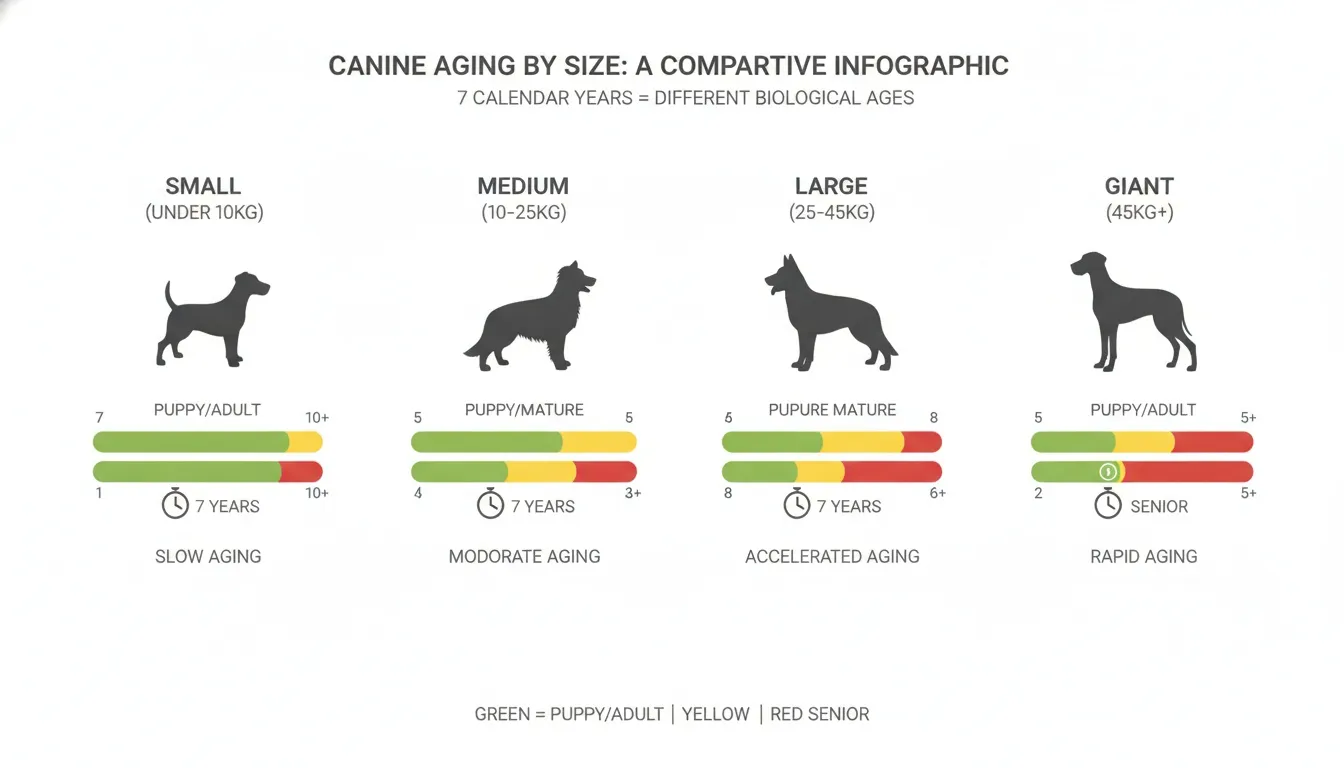
Small vs Large Dogs — Why Aging Rate Differs
Small breeds generally experience less wear on their joints and organs, leading to a slower biological aging process. In contrast, large and giant breeds carry significantly more body mass, which creates extra strain on their hearts and skeletons. This added physical load causes their bodies to reach senior milestones much earlier than their smaller counterparts.
The UC San Diego 2020 DNA study revealed that dogs age logarithmically rather than linearly. While a puppy’s first year equals about 15 human years and the second brings them to roughly 24, the rate then slows down based on breed size. This finding confirms the old “7x rule” was never scientifically valid. Think of it like comparing a small, steady-running sedan to a massive truck; the larger machine works harder and reaches the end of its cycle sooner.
Check the UC San Diego 2020 aging study for a deeper look at the science. Talk to your vet about your dog’s specific growth curve to understand their current needs.
Does Weight Affect How Fast My Dog Ages?
Overweight dogs age measurably faster than those kept at a lean, healthy weight. Obesity is the most significant controllable aging factor after your dog’s natural breed size. Carrying extra pounds puts unnecessary stress on your dog’s joints and vital organs, often shortening their quality of life.
Maintaining an ideal weight can actually add one to two healthy years to your dog’s lifespan. If your 7-year-old dog currently carries extra weight, now is the perfect time to make positive changes. Your vet can provide specific body condition score targets to help your dog stay active and comfortable.
Refer to the AVMA senior pet care guidelines to learn how to keep your dog at their best. Always confirm with your vet before starting a new weight management plan or diet change.
7 Dog Years by Popular Breed — Real Examples
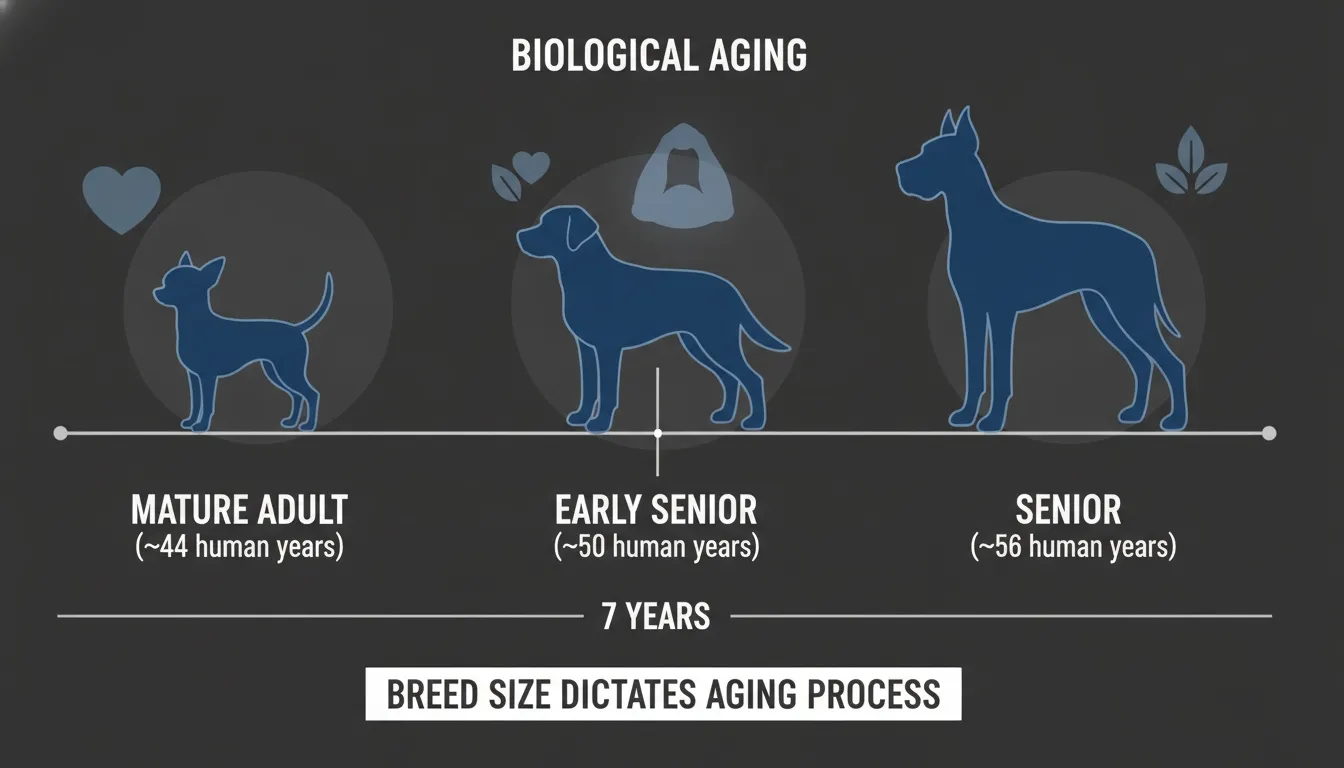
The traditional rule that “one human year equals seven dog years” is a helpful simplification, but it doesn’t account for the reality of canine biology. In truth, dogs age at different rates depending on their size and breed. Smaller dogs typically live longer and reach senior status later in life, while larger breeds mature more rapidly and have shorter life spans.
The following table illustrates how a dog that is 7 years old corresponds to different human ages and life stages based on their size category.
| Breed | Size | Human Age at 7 | Life Stage |
|---|---|---|---|
| Chihuahua | Small | ~44 years | Mature Adult |
| Pomeranian | Small | ~44 years | Mature Adult |
| Shih Tzu | Small | ~44 years | Mature Adult |
| Beagle | Medium | ~47 years | Pre-Senior |
| Border Collie | Medium | ~47 years | Pre-Senior |
| Cocker Spaniel | Medium | ~47 years | Pre-Senior |
| Labrador Retriever | Large | ~50 years | Early Senior |
| German Shepherd | Large | ~50 years | Early Senior |
| Golden Retriever | Large | ~50 years | Early Senior |
| Great Dane | Giant | ~56 years | Senior |
| St. Bernard | Giant | ~56 years | Senior |
| Mastiff | Giant | ~56 years | Senior |
Understanding the Differences
Size Matters: The metabolic rate and health trajectories of giant breeds like the Mastiff differ significantly from toy breeds like the Chihuahua. Larger dogs age faster, often entering their senior years by age 6 or 7.
Individual Variation: These figures are estimates. Genetics, nutrition, exercise, and preventative veterinary care play major roles in how gracefully a dog ages.
Life Stage Shifts: As dogs move into these “equivalent” human ages, their needs change. A 7-year-old Great Dane may require more joint support and mobility modifications compared to a 7-year-old Chihuahua, who might still be quite spry.
Is a 7-Year-Old Dog Considered a Senior?
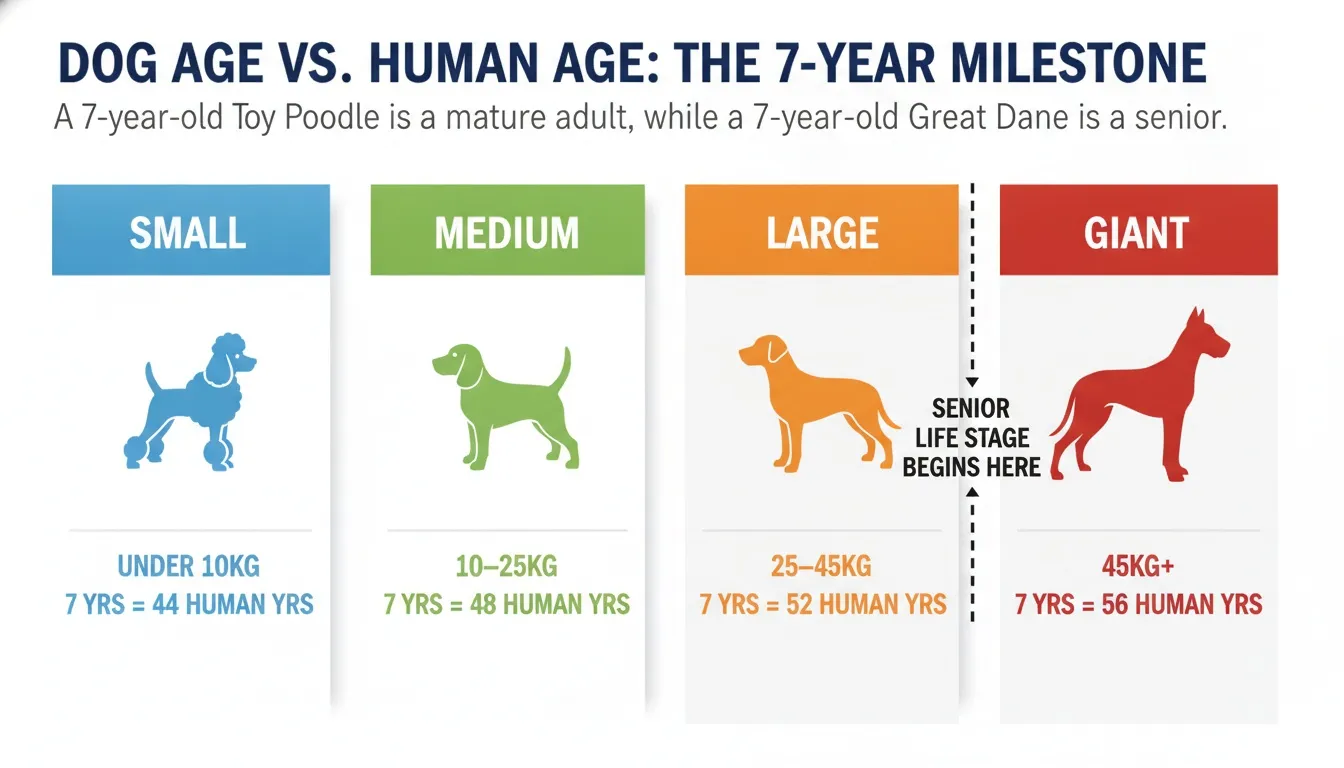
Whether a 7-year-old dog is considered a senior depends entirely on their size. Large and giant breeds are generally considered senior by age 7, as their faster aging process leads to an earlier transition into their twilight years. Conversely, small and medium-sized dogs typically do not reach senior status until they are between 8 and 10 years of age.
Life Stage at 7 by Size — Quick Reference
Small dogs at 7: Mature Adult (not senior yet)
Medium dogs at 7: Pre-Senior (approaching senior)
Large dogs at 7: Early Senior ✓
Giant dogs at 7: Senior ✓
How Many Years Does My 7-Year-Old Dog Have Left?
Estimating a dog’s remaining lifespan depends heavily on their breed and individual health profile:
Small dogs at 7: Approximately 6–8 years remaining.
Medium dogs at 7: Approximately 4–6 years remaining.
Large dogs at 7: Approximately 2–4 years remaining.
Giant dogs at 7: Approximately 1–2 years remaining.
Note: These figures are based on breed averages. With optimal nutrition, consistent veterinary care, and the maintenance of a healthy weight, many dogs often exceed these estimates. You can find more detailed information on specific breed lifespans in the AKC — Dog breed lifespan guide.
Physical Signs Your Dog Is Aging at 7
At age 7, you may begin to notice the subtle (or sometimes more pronounced) shifts associated with the aging process:
Coat changes: The emergence of grey or white fur, particularly around the muzzle and face.
Joint stiffness: Notable stiffness or difficulty rising after sleep or long periods of rest.
Reduced stamina: A slower pace during walks and tires more quickly than they did in their younger years.
Sleep patterns: Sleeping for longer durations throughout the day.
Activity levels: Decreased enthusiasm for high-intensity play or long-distance running.
Important: While these are common signs of aging, if you notice these changes appearing suddenly or if they seem severe, please consult your veterinarian. These symptoms can sometimes indicate an underlying health issue rather than just natural aging.
What to Do When Your Dog Turns 7 — Vet-Approved Care
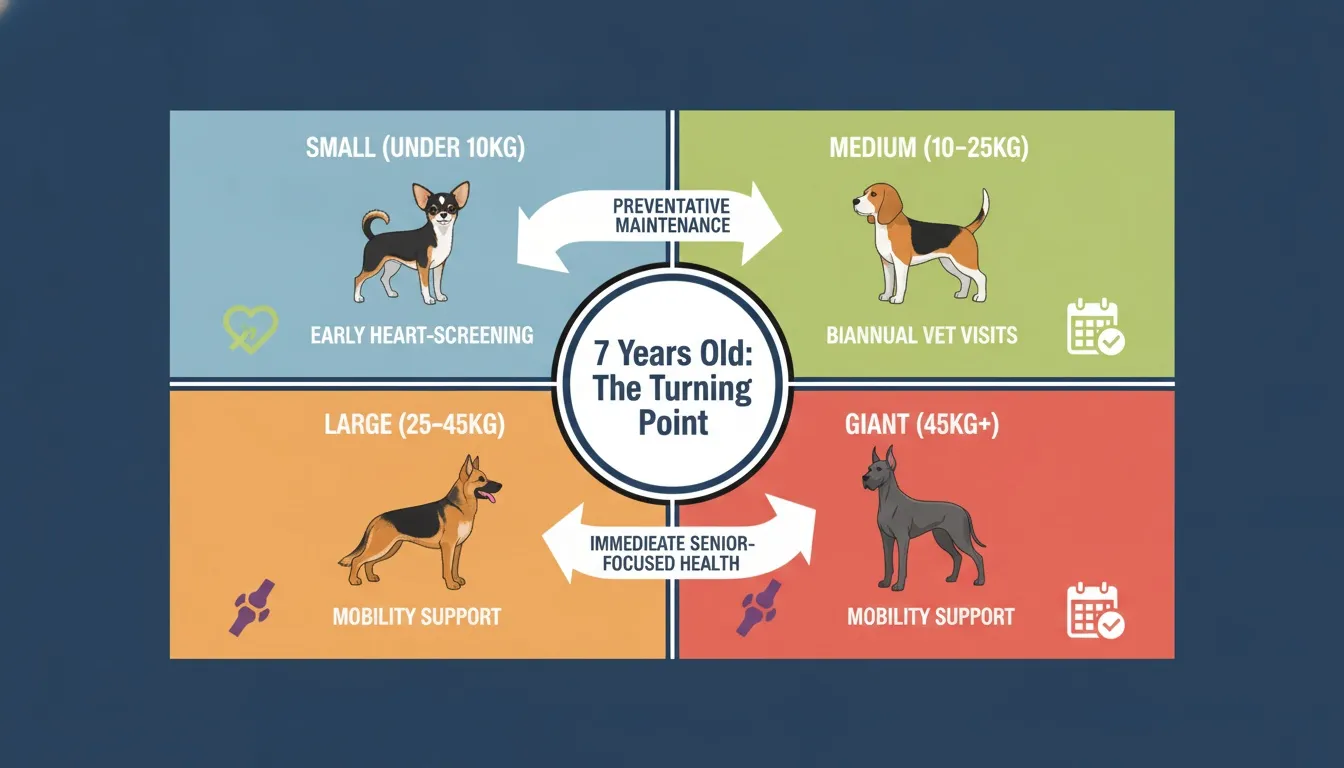
Reaching the age of 7 is a major milestone for your dog. It marks the transition into a new life stage where proactive, preventative care becomes the foundation for longevity and quality of life.
Diet and Exercise Changes at Age 7
As your dog’s metabolism and activity levels naturally shift, adjusting their lifestyle can help prevent age-related health complications.
Tailored Nutrition: Large breeds should transition to a senior-specific formula at age 7. For small and medium breeds, you can typically wait until age 8–10 to make this switch.
Weight Management: Portion control is critical. A dog’s risk of obesity increases significantly after 7, which can put unnecessary stress on their joints and organs.
Low-Impact Exercise: Replace high-impact activities—like heavy jumping or intense rough-housing—with moderate daily walks of 30–45 minutes.
Joint-Friendly Activity: Swimming is an excellent, low-impact exercise that allows your dog to stay active without putting pressure on aging joints.
Cognitive Enrichment: Mental stimulation games (like scent work or puzzle feeders) are essential for maintaining your dog’s cognitive health and keeping them sharp.
Vet Visit Schedule at Age 7
Consistent veterinary oversight is your most powerful tool for catching age-related issues early.
Frequency: Schedule annual checkups for small and medium dogs. For large and giant breeds, increase the frequency to every 6 months to monitor their faster aging process.
Essential Screenings: During these visits, ensure your vet performs a full blood panel, dental assessment, thyroid test, blood pressure measurement, and, if necessary, joint X-rays.
Preventative Logic: Think of this stage like a 50-year-old human’s annual health screening—the objective is to identify and manage potential issues before they become symptomatic.
Supplements: Discuss targeted support with your veterinarian. Based on your dog’s individual condition, they may recommend adding glucosamine for joint health or Omega-3 fatty acids for inflammation and coat support.
The 7x Rule — Why It Is Wrong and What Is More Accurate
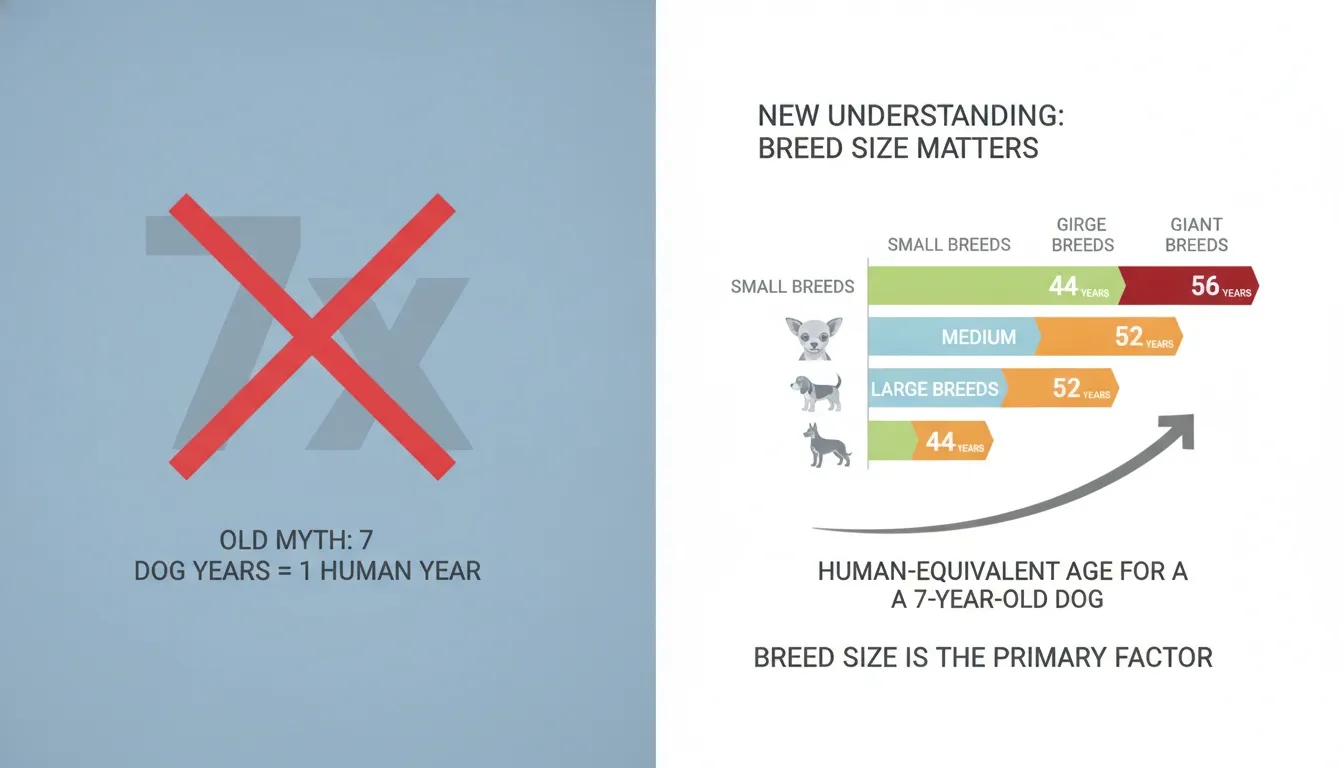
For decades, the “one human year equals seven dog years” rule has been the go-to metric for pet owners. While it provided a simple baseline, it is not scientifically accurate and fails to account for the complex ways dogs mature.
Origin: This rule emerged as a rough estimation in the 1950s, based on a simple division—a 70-year human lifespan divided by a 10-year average dog lifespan. It was never intended to be a scientifically validated formula.
Problem 1: Ignoring Rapid Early Maturity: The rule fails to account for the accelerated development of puppies. A 1-year-old dog is physically and neurologically comparable to a human adolescent of about 15 years, not 7.
Problem 2: One Size Does Not Fit All: The rule treats all breeds as equal, ignoring the massive biological gap between a Chihuahua and a Great Dane. Giant breeds age significantly faster than smaller ones, making a universal multiplier misleading.
A More Accurate Approach
Modern veterinary science favors a tiered approach that accounts for the rapid maturity of early life and the variances between breed sizes:
The AKC Tiered Model:
Year 1: Approximately 15 human years.
Year 2: Adds roughly 9 human years.
Subsequent Years: Each year thereafter adds approximately 4–5 human years, adjusted according to the dog’s specific size category.
Ongoing Research: The Dog Aging Project
To move beyond estimates, the Dog Aging Project at the University of Washington is currently studying over 50,000 dogs of various breeds and backgrounds. This massive undertaking aims to decode the biology of canine aging, identify key environmental and genetic factors, and discover new ways to extend the healthy, active years of our canine companions.
By moving away from the outdated 7x rule, you can better understand your dog’s actual life stage and ensure they receive the appropriate care for their specific developmental needs.
Frequently Asked Questions
A 7-year-old dog is between 44 and 56 human years old, depending on their breed size. Small dogs are equivalent to ~44 human years, medium breeds to ~47, large breeds to ~50, and giant breeds reach the equivalent of ~56 human years at age 7.
For small and medium breeds, 7 is not considered old; it is generally viewed as middle age. For large breeds, 7 marks the early senior stage. For giant breeds, such as Great Danes or Mastiffs, age 7 is fully senior, often indicating a shorter lifespan remaining.
Yes. Large and giant dogs carry significantly more body mass, which places greater, sustained strain on their vital organs and skeletal structure. This accelerated physical demand causes them to age faster and experience shorter average lifespans compared to small and toy breeds.
For large and giant breeds, it is recommended to switch to a senior formula food at age 7 to support their changing nutritional needs. For small and medium breeds, you can generally wait to consider this transition until they are between 8 and 10 years old. Always consult your veterinarian before making significant changes to your dog's diet to ensure it aligns with their specific health requirements.
🐾 Other Age Guides

Gulfam Haider Mehdi
Founder & Developer
I built Dogagescalculator.com to give dog owners honest, science-backed answers instead of the outdated "×7" myth. Every figure here is checked against AKC, AVMA, and published veterinary research.
More about the author & this site →📌 Featured Guides
how much does a german shorthaired pointer weigh
→
What Is 8 Dog Years in Human Years
→
what is 20 dog years in human years
→
what is the lifespan of a yorkie dog
→
9 human years to dog years
→
What Is 5 Dog Years in Human Years
→
golden retriever puppy feeding guide
→
oldest historical picture of the breed shar pei
→
how long does a lhasa apso dog live
→
What Is 13 Dog Years in Human Years
→
Comments