
Dog Years by Breed: Age
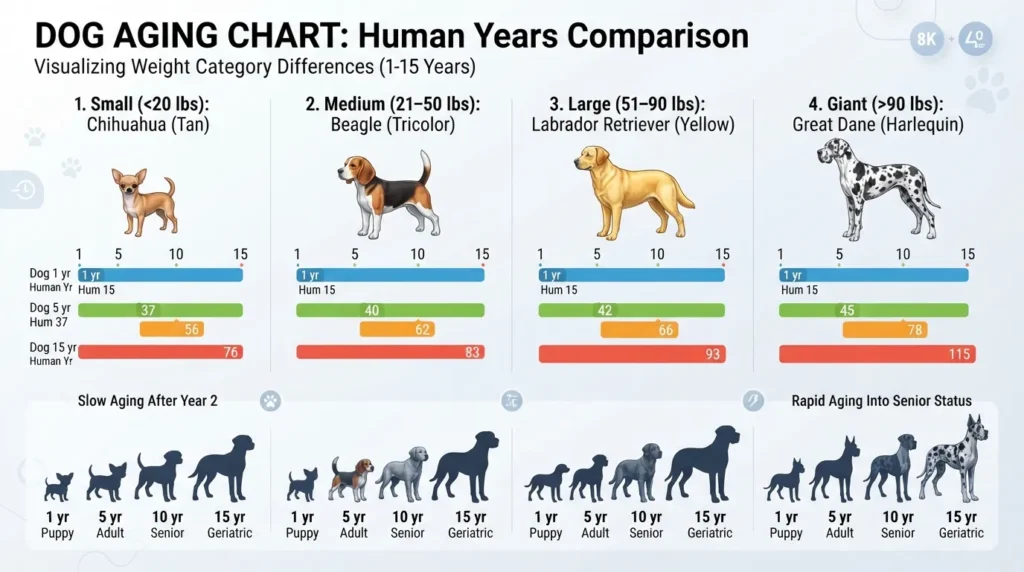
If you’ve ever wondered how old your dog actually is in human terms, the classic “multiply by 7” rule isn’t accurate.
A 17-year-old dog isn’t simply 119 in human years. Depending on their size and breed, a 17-year-old dog is roughly equivalent to a human between 84 and 120+ years old. Small dogs age slower over time, while giant breeds age much faster.
Why the 7-Year Myth Is Wrong
Dogs mature rapidly during their first two years. By age one, a pup reaches human teenage development (~15 human years). By age two, they are roughly equivalent to a 24-year-old adult.
After two years, aging slows down and varies significantly by breed size:
Year 1 = ~15 human years
Year 2 = +9 human years
Year 3+ = +4 to +8 human years (depending on size)
Quick Dog Age Breakdown by Breed Size
According to American Veterinary Medical Association (AVMA) guidelines:
Small Breeds (Under 20 lbs)
Age 1 = 15 human years
Age 5 = 36 human years
Age 10 = 56 human years
Age 15 = 76 human years
Age 17 = 84 human years
Medium Breeds (21 to 50 lbs)
Age 1 = 15 human years
Age 5 = 36 human years
Age 10 = 60 human years
Age 15 = 83 human years
Age 17 = 92 human years
Large Breeds (51 to 90 lbs)
Age 1 = 15 human years
Age 5 = 38 human years
Age 10 = 66 human years
Age 15 = 93 human years
Age 17 = 104 human years
Giant Breeds (Over 90 lbs)
Age 1 = 12 human years
Age 5 = 44 human years
Age 10 = 79 human years
Age 15 = 114 human years
Age 17 = 128 human years
The Scientific DNA Formula (UC San Diego Study)
Researchers at UC San Diego developed an epigenetic formula based on DNA methylation in dogs:
Human Age = 16 x ln(Dog Age) + 31
1 Dog Year = 31 Human Years
5 Dog Years = 57 Human Years
10 Dog Years = 68 Human Years
15 Dog Years = 74 Human Years
When Is Your Dog a Senior?
Small Breeds: Senior at 10–11 years
Medium Breeds: Senior at 8–9 years
Large Breeds: Senior at 6–7 years
Giant Breeds: Senior at 5 years
Key Senior Signs to Watch For:
Stiffness or slowing down on walks
Cloudy appearance in eyes (nuclear sclerosis)
Changes in weight, sleep, or dental health
Transitioning senior dogs to bi-annual (every 6 months) vet checkups helps catch health changes early and maintains their quality of life.
Dog Years by Breed at a Glance
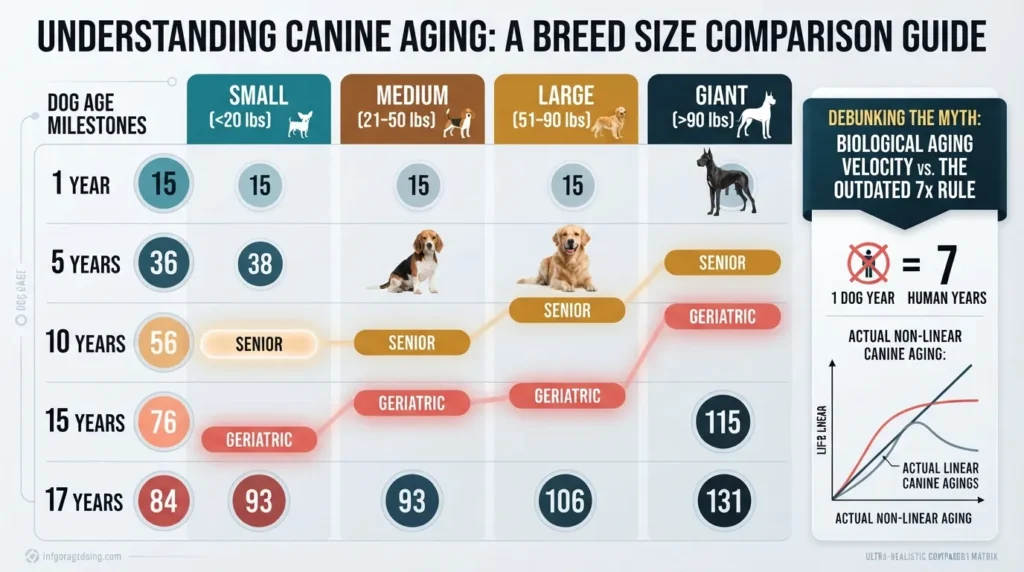
If you are asking what 17 dog years in human years actually means for your dog, the direct answer depends entirely on your dog’s adult weight.
According to veterinary guidelines from the American Animal Hospital Association (AAHA), a 17-year-old dog translates to anywhere between 84 and 128 human years. Small dogs reach the lower end of that range because they age much slower after adulthood, while giant breeds hit senior and geriatric milestones far earlier.
| Dog Weight Category | Mature Adult Weight | 17 Dog Years in Human Years | Life Stage Category |
|---|---|---|---|
| Small Breeds | Under 20 lbs (e.g., Chihuahua, Yorkie) | 84 human years | Geriatric / Super-Senior |
| Medium Breeds | 21 to 50 lbs (e.g., Beagle, Cocker Spaniel) | 92 human years | Geriatric / Super-Senior |
| Large Breeds | 51 to 90 lbs (e.g., Golden Retriever, Lab) | 104 human years | Exceptional Longevity |
| Giant Breeds | Over 90 lbs (e.g., Great Dane, Mastiff) | 128 human years | Extremely Rare Longevity |
Old 7x Rule vs Real Breed-Based Rule
The Old 7x Rule: Assumes 17×7=119 human years for every dog, regardless of breed, shape, or weight.
The Real Breed-Based Rule: Calculates rapid initial growth during years 1–2, then applies a size-adjusted aging velocity (4 years per calendar year for small dogs versus 7–8 years per calendar year for giant dogs).
Why the 7x Rule Fails Biological Science
While the 1-to-7 ratio is easy to remember, it ignores basic mammalian biology and clinical research:
Growth Rate & Cellular Stress: Giant breeds grow from tiny puppies into 100+ pound adults in under 18 months. This massive cellular division accelerates metabolic aging, whereas smaller breeds grow gradually and experience far less early tissue stress.
Metabolic Rate Discrepancy: Smaller dogs maintain higher heart rates and resting metabolic rates, yet their cells degrade at a significantly slower rate over time compared to large dogs.
Cancer & Disease Vulnerability: Research published by the American Veterinary Medical Association (AVMA) notes that large and giant dogs face an exponentially higher risk of early-onset age-related conditions, such as osteosarcoma and heart failure, effectively shortening their biological lifespan compared to small breeds.
Dog Years by Breed — Full Comparison Chart
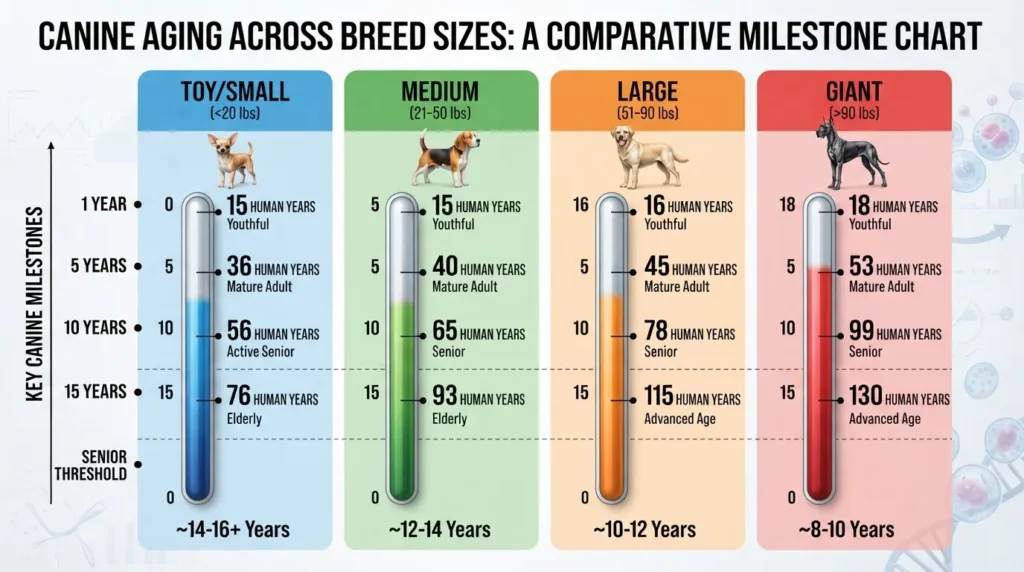
If you want to know exactly how your dog’s breed influences their biological aging, a general weight chart is only half the story. Specific breeds carry distinct genetic traits, metabolic rates, and health predispositions that change how quickly their cellular clock ticks.
Below is a detailed breakdown showing how 45 popular breeds convert to human age across key life stages, based on life stage benchmarks established by the American Animal Hospital Association (AAHA).
Full Breed Table (40–50 Breeds)
| Breed | Size Category | Average Lifespan | Age 5 (Human Yrs) | Age 10 (Human Yrs) | Senior Age Threshold |
|---|---|---|---|---|---|
| Chihuahua | Toy (<10 lbs) | 15–20 yrs | 36 | 56 | 11 yrs |
| Yorkshire Terrier | Toy (<10 lbs) | 13–16 yrs | 36 | 56 | 11 yrs |
| Pomeranian | Toy (<10 lbs) | 12–16 yrs | 36 | 56 | 11 yrs |
| Maltese | Toy (<10 lbs) | 12–15 yrs | 36 | 56 | 11 yrs |
| Toy Poodle | Toy (<10 lbs) | 14–18 yrs | 36 | 56 | 11 yrs |
| Shih Tzu | Small (10–20 lbs) | 10–16 yrs | 36 | 56 | 10 yrs |
| Dachshund | Small (10–20 lbs) | 12–16 yrs | 36 | 56 | 10 yrs |
| Boston Terrier | Small (10–20 lbs) | 11–13 yrs | 36 | 58 | 10 yrs |
| Pug | Small (10–20 lbs) | 13–15 yrs | 36 | 58 | 10 yrs |
| French Bulldog | Small (10–28 lbs) | 10–12 yrs | 37 | 60 | 9 yrs |
| Cavalier King Charles | Small (10–18 lbs) | 9–14 yrs | 36 | 58 | 9 yrs |
| Miniature Schnauzer | Small (11–20 lbs) | 12–15 yrs | 36 | 56 | 10 yrs |
| Beagle | Medium (20–30 lbs) | 10–15 yrs | 36 | 60 | 8 yrs |
| Cocker Spaniel | Medium (20–30 lbs) | 10–14 yrs | 36 | 60 | 8 yrs |
| Border Collie | Medium (30–45 lbs) | 12–15 yrs | 36 | 60 | 8 yrs |
| Bull Terrier | Medium (35–50 lbs) | 10–14 yrs | 37 | 62 | 8 yrs |
| Basset Hound | Medium (40–60 lbs) | 10–12 yrs | 37 | 63 | 7 yrs |
| Australian Shepherd | Medium (40–60 lbs) | 12–15 yrs | 36 | 60 | 8 yrs |
| English Springer Spaniel | Medium (40–50 lbs) | 12–14 yrs | 36 | 60 | 8 yrs |
| Standard Poodle | Medium (45–70 lbs) | 12–15 yrs | 37 | 62 | 8 yrs |
| Siberian Husky | Large (35–60 lbs) | 12–14 yrs | 37 | 62 | 8 yrs |
| Golden Retriever | Large (55–75 lbs) | 10–12 yrs | 38 | 66 | 7 yrs |
| Labrador Retriever | Large (55–80 lbs) | 10–12 yrs | 38 | 66 | 7 yrs |
| German Shepherd | Large (50–90 lbs) | 7–10 yrs | 38 | 66 | 7 yrs |
| Boxer | Large (50–80 lbs) | 10–12 yrs | 38 | 66 | 7 yrs |
| Australian Cattle Dog | Medium (35–50 lbs) | 12–16 yrs | 36 | 60 | 9 yrs |
| Doberman Pinscher | Large (60–100 lbs) | 10–12 yrs | 39 | 68 | 7 yrs |
| Rottweiler | Large (80–135 lbs) | 8–10 yrs | 40 | 70 | 6 yrs |
| Rhodesian Ridgeback | Large (70–85 lbs) | 10–12 yrs | 39 | 68 | 7 yrs |
| Chesapeake Bay Retriever | Large (55–80 lbs) | 10–13 yrs | 38 | 66 | 7 yrs |
| Bernese Mountain Dog | Giant (80–115 lbs) | 7–10 yrs | 42 | 75 | 6 yrs |
| Great Dane | Giant (110–175 lbs) | 7–10 yrs | 44 | 79 | 5 yrs |
| Mastiff | Giant (120–230 lbs) | 6–10 yrs | 44 | 79 | 5 yrs |
| Saint Bernard | Giant (120–180 lbs) | 8–10 yrs | 44 | 79 | 5 yrs |
| Irish Wolfhound | Giant (105–120 lbs) | 6–8 yrs | 45 | 82 | 5 yrs |
| Newfoundland | Giant (100–150 lbs) | 9–10 yrs | 44 | 79 | 5 yrs |
| Great Pyrenees | Giant (85–160 lbs) | 10–12 yrs | 42 | 75 | 6 yrs |
| Cane Corso | Giant (90–120 lbs) | 9–12 yrs | 42 | 75 | 6 yrs |
| Akita | Large (70–130 lbs) | 10–14 yrs | 40 | 70 | 6 yrs |
| Bloodhound | Large (80–110 lbs) | 10–12 yrs | 40 | 72 | 6 yrs |
| Whippet | Medium (25–40 lbs) | 12–15 yrs | 36 | 58 | 9 yrs |
| Vizsla | Medium (45–65 lbs) | 12–14 yrs | 37 | 62 | 8 yrs |
| Weimaraner | Large (55–90 lbs) | 10–13 yrs | 38 | 66 | 7 yrs |
| Shetland Sheepdog | Small (15–25 lbs) | 12–14 yrs | 36 | 56 | 10 yrs |
| Pembroke Welsh Corgi | Small (28–30 lbs) | 12–15 yrs | 36 | - | - |
Aging Extremes: Fastest vs. Slowest
Slowest Aging: Small toy breeds like Chihuahuas and Toy Poodles age at roughly 4 human years per calendar year after age two, often living well past 15 to 17 dog years (84 to 88+ human years).
Fastest Aging: Giant breeds like the Great Dane and Irish Wolfhound age at roughly 7 to 8 human years per calendar year after age two. They cross the senior threshold by age 5 and reach an equivalent human age of 79 by calendar age 10.
Got a mixed or unknown breed? Use your dog’s healthy, mature adult weight to estimate their category. If your rescue dog is 35 lbs, follow the medium breed trajectory (roughly 60 human years at age 10) regardless of what their physical genetic makeup looks like.
How to Calculate Your Dog's Age by Breed
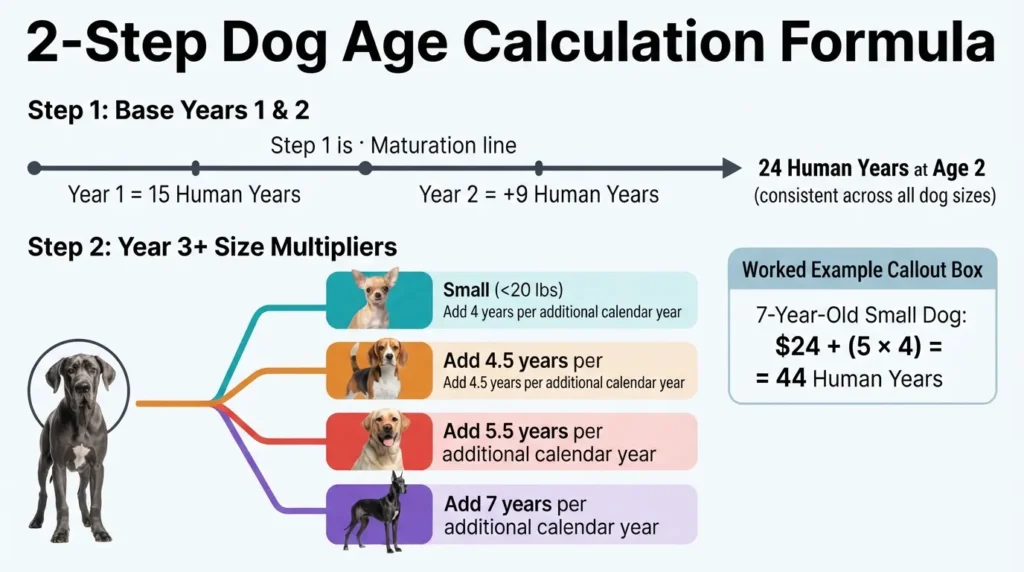
The Simple Formula (Year 1 & 2 + Size Multiplier)
Years 1 & 2: Count the first year of your dog’s life as 15 human years to account for rapid growth, and add 9 human years for their second year. By age two, regardless of breed, every dog sits at roughly 24 in human equivalent.
Year 3+ Size Multipliers: Starting at year three, aging rate branches off by weight class: multiply each additional year by 4 for small breeds (<20 lbs), 4.5 for medium breeds (21–50 lbs), 5.5 for large breeds (51–90 lbs), and 7 for giant breeds (>90 lbs).
Worked Example: A 17-year-old small dog reaches 24 human years in their first two years, plus 15 additional years multiplied by 4 (60 years), resulting in 84 human years. A 17-year-old large dog accumulates those same 24 base years, plus 15 additional years multiplied by 5.5 (82.5 years), putting them at roughly 106 human years.
The Scientific Formula (UC San Diego Study)
16 × ln(Dog Age) + 31: Published in Cell Systems, researchers led by Wang et al. developed this epigenetic formula by tracking DNA methylation patterns in dogs. Multiplying the natural logarithm ($\ln$) of your dog’s calendar age by 16 and adding 31 offers a precise molecular snapshot of aging, though it tends to align most closely with medium-to-large breeds like Labradors.
When Does Each Breed Become a Senior?

A dog doesn’t become a senior overnight, nor do all dogs reach their golden years at the same calendar age. Veterinary guidelines from the American Animal Hospital Association (AAHA) define a dog as “senior” when they hit the final 25% of their estimated breed lifespan. Because smaller dogs outlive larger ones by a wide margin, their entry points into old age look completely different on paper.
Here is the general breakdown by weight class:
Small Breeds (under 20 lbs): Senior at 10 to 11 years old (geriatric at 14+ years)
Medium Breeds (21 to 50 lbs): Senior at 8 to 9 years old (geriatric at 12+ years)
Large Breeds (51 to 90 lbs): Senior at 7 years old (geriatric at 10+ years)
Giant Breeds (over 90 lbs): Senior at 5 to 6 years old (geriatric at 8+ years)
Senior Age Thresholds for Popular Breeds
If you want to pinpoint when your specific pup officially reaches senior status, here is when some of the most popular breeds make that transition:
Chihuahua & Toy Poodle: Senior at 11 to 12 years (These tiny companions frequently live past 15, keeping their youthful sprint well into their first decade.)
French Bulldog & Boston Terrier: Senior at 8 years (Their compact size helps with longevity, though respiratory and spinal health require extra attention earlier on.)
Beagle & Cocker Spaniel: Senior at 8 to 9 years (As mid-sized dogs, they enjoy a steady aging pace, often showing subtle greezing around the muzzle first.)
Golden Retriever & Labrador Retriever: Senior at 7 years (By age seven, these family favorites benefit from joint supplements and lower-impact daily exercise.)
German Shepherd & Boxer: Senior at 6 to 7 years (Larger frame sizes mean their joints and hips show metabolic wear earlier than smaller working dogs.)
Rottweiler & Great Dane: Senior at 5 years (Giant breeds experience accelerated early growth, putting them in the senior category right around their fifth birthday.)
Mixed Breeds: Base their senior milestone on their full-grown adult weight—match your rescue dog’s weight to the four size tiers above to get an accurate estimate.
Try Our Free Dog Age Calculator by Breed
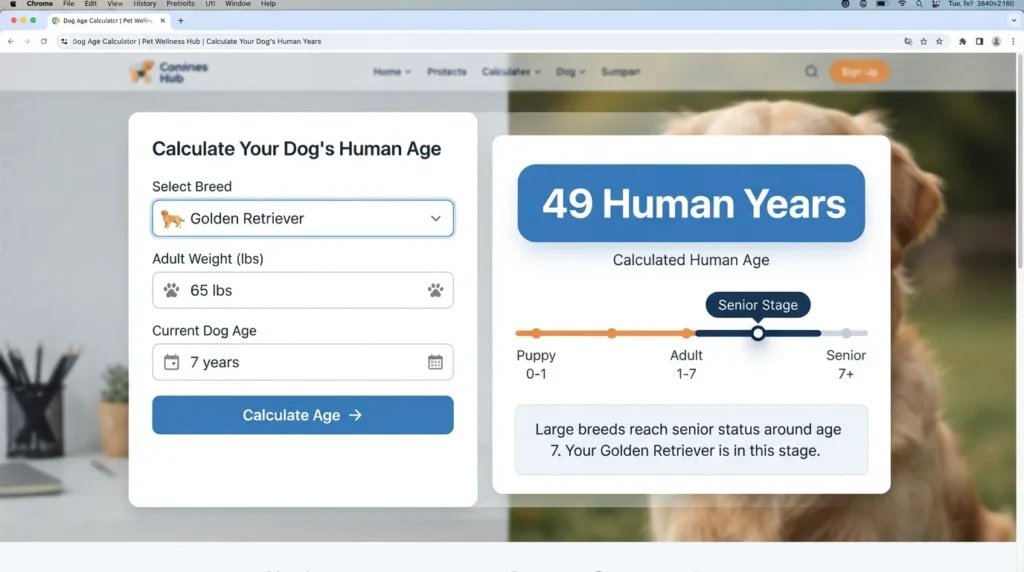
Every breed ages on its own distinct timeline. Use our main interactive calculator to get an instant, medically accurate conversion tailored to your dog’s exact size and weight class.
Want an offline reference for your next vet visit? You can save our complete breed-wise conversion chart directly to your device.
Download the Free Printable Dog Age Chart (PDF)
Aapko bas kya karna hai:
Is ek akely link mein # ko hata kar apni PDF file ka URL ya apne main calculator page ka link daal dein. Baaki saare extra internal links hata diye gaye hain taaki aapka page neat rahe!
Frequently Asked Questions: Dog Years by Breed
Calculating dog years by breed varies because larger breeds grow at an accelerated rate, causing their cells to age faster. While a 7-year-old small breed like a Chihuahua equals roughly 44 human years, a 7-year-old giant breed like a Great Dane is closer to 58 human years.
When comparing dog years by breed, medium-to-large breeds like Labradors reach senior status around age 7 (roughly 50 human years). Small breeds like Chihuahuas mature slower during adulthood and don't hit senior stage until around age 10 or 11 (roughly 56 human years).
To determine dog years for a mixed breed, use their expected mature adult weight class (Small, Medium, Large, or Giant). Since mixed breeds follow the same biological aging patterns as purebreds of similar size, adult weight gives the most accurate age conversion.
Toy and small breeds (such as Poodles, Chihuahuas, and Dachshunds) age the slowest, often living 14 to 18 years. Giant breeds (such as Mastiffs, Great Danes, and Bernese Mountain Dogs) age the fastest, reaching senior status as early as 5 to 6 years old.
Senior age threshold depends heavily on breed size: Small breeds become seniors at 10–11 years, medium breeds at 8–9 years, large breeds at 6–7 years, and giant breeds are considered seniors by age 5.
All dog breeds experience rapid growth during their first year. Regardless of breed, a 6-month-old puppy is roughly equivalent to a 10-year-old child, and by 1 year, most breeds equal approximately 15 human years.
🐾 Other Age Guides

I built Dogagescalculator.com to give dog owners honest, science-backed answers instead of the outdated "×7" myth. Every figure here is checked against AKC, AVMA, and published veterinary research.
More about the author & this site →
Comments